Technical sciences
105
DYNAMIC INDEXES OF DOUBLE-WAY FEED MACHINE AT
DIFFERENT FREQUENCY SUPPLY
Aristov A.V.
Tomsk Polytechnic University
The features of a double-way feed machine performance in the operation of periodic reverse at different frequency supply are considered. A comparative valuation of the system’s transient indexes and an electric ma-chine parameters and the load for asynchronous and synchronous operating regimes has been carried out.
The double-way feed machine (DFM) oriented oscillating electric drives’ synthesis, the choice of a rational control structure and its options providing maximal operating speed and the pre-set coordinate accuracy are not possible without the estimation of tran-sient processes taking place within the sys-tem. Even in the mode of sustained oscilla-tions the actuating motor performs a peculiar periodic reverse operation which is equiva-lent of a quasi-stationary process. At the start, perturbation actions control, stop and reclose there appear additional transients in the electrical machine, which, together with periodic steady-state values, form complex magneto-electric and electromechanical couplings.
One of the most efficient instruments to investigate the transients in electrical ma-chines at the periodic motion is the use of numerical differentiation, the availabilities of interesting to us results expanding essentially
when considering both linear and nonlinear mathematical models of actuating motors. The numerical methods of computation allow attaining the minimum of hypothesis and get-ting the maximal adequacy to real processes taking place in electromechanical energy converters [1].
For the DFM oscillatory operation conditions the numerical differentiation is reasonable to be carried out according to dif-ferential system of equations recorded for flux linkage within the intrinsic frame of ref-erence supplemented with algebraic equa-tions for line currents, and the calculation da-ta are to be considered in terms of the corres-ponding graphic charts determining the de-pendence of the electrical machine features, loading and feed elements effect on the oscil-lating system’s dynamic characteristics.
At different frequency supply the regu-lating functions for the stator and rotor motor windings can be written as
(
)
(
ω)
, sin α ) ( ); α ω sin( α ) ( ; ω sin α ) ( ); α ω sin( α ) ( 2 4 1 3 2 2 1 1 b b b a + × = + × = + × = + × = t U t U t U t U t U t U t U t U m qr m dr m s m s ъwhere αi – are the coefficients of sig-nals; α, β, ω1, ω2 – starting phases and
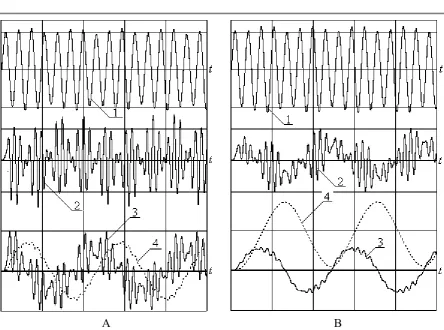
vol-tage frequencies across the motor windings;i = 1, 2, 3, 4. If only the inertial load compo-nent is considered, then at different frequen-cy feed the transient current characteristics I = f(t) (1) of the moments Мэм = f(t) (2),
speeds ω =f(t) (3), and also the motors’ mov-ing elements’ joint coordinate χ = f(t) (4) at starting into the DFM mode (α1 = α2 = 1; α3 =
α4 ≠ 0) or into the mode of an asynchronous
motor (AM) (α1 = α2 = 1; α3 = α4 = 0) will
have a quality format represented in the pic-ture 1.
A B
Figure 1. Time dependences of currents, torques, speed and coordinate in the DFM a) and AM; b) modes.
The fact that the motor moving ele-ment’s steady-state coordinate value has a geometric displacement of the oscillation neutral point at the electrical machine operat-ing in the mode of asynchronous motor (α3 =
α4 = 0), while the displacement in the DFM
mode is lacking, comes under notice. This fact is explained by the positional component presence in the oscillation electromagnetic DFM torque caused by the flux linkage resul-tant vector modulation on the move of the motor moving element [2].
It is evident that at research investiga-tions the emphasis is made on the predeter-mined dynamic behavior oscillating system synthesis taking into account the parameters of the electrical machine used. As varied pa-rameters it is recommended to choose rela-tive values of the armature stator (Rs) and ro-tor (Rr) resistances, leakage inductance of stator L s and rotor L r coils and mutual
in-As it is seen from the investigation the surge current Is value behavior graphs are
characterized by linear or almost linear de-pendences (nonlinearity doesn’t exceed 10%) at stator and rotor leakage inductances change within the limits of 25%. At that the values of impact torques Мs can low for the
AM mode by 30%, and for the DFM one – by 40%. Comparing the stator and rotor coils leakage inductance parameters effects on the electromechanical transients’ characteristics, the identity of the last ones should be noticed once more, but still pointed at a greater effi-ciency of the Lσr influence from the position
of the Is andMtvalues widest variation range achieving.
Technical sciences
107
flux increase affects the electromagnetic field empowerment on the secondary motor ele-ment, and it leads to the surge currents value decrease.
Another important index of electrome-chanical energy converters operating in spe-cial modes is the response time τr. At
differ-ent frequency supply of the actuating motor it is hardly ever changes and the dependences τr = f(Lσs); τn = f(Lσr) bear almost linear
cha-racter throughout the whole parameters varia-tion range.
The armature stator and rotor resis-tances prove themselves quite opposite. Thus, with theRsdecrease the electromagnet-ic processes decay time increase is observed, that, in its turn, influences greatly on the pe-riod of electromechanical transients. This
af-firmation is related, in the first instance, to the DFM, for which a more obvious induc-tive reactance effect predominance is indica-tive at the Rsdecrease.
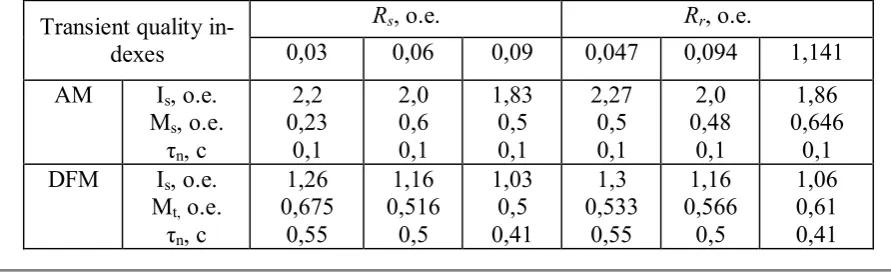
As an illustration of the point, the tran-sient quality indexes’ quantitative assessment for the boundary and nominal values of the varied parameters is represented in Table 1.
The research testified that at compara-bleМt values of the asynchronous motor and double-way feed machine, the last has a double excess of the steady-state torque am-plitude value. The given affirmation is true for all the cases considered earlier and is typ-ical when comparing the machines with a squirrel-cage induction and phase-wound ro-tor moro-tor.
Table 1. The transient quality indexes’ quantitative assessment for the boundary and nominal values of the varied parameters is represented
Transient quality in-dexes
Rs, о.е. Rr, о.е.
0,03 0,06 0,09 0,047 0,094 1,141 AM Is, о.е.
Ms, о.е.
τn, с
2,2 0,23
0,1
2,0 0,6 0,1
1,83 0,5 0,1
2,27 0,5 0,1
2,0 0,48
0,1
1,86 0,646
0,1 DFM Is, о.е.
Mt, о.е.
τn, с
1,26 0,675
0,55
1,16 0,516
0,5
1,03 0,5 0,41
1,3 0,533
0,55
1,16 0,566
0,5
1,06 0,61 0,41
Allowing for the DFM air-gap irregu-larity the τn=f(Lσs, Lσr) function’s linearity
distortion is observed. The more the design parameter deviation from its nominal value is, the more significantly the response time τn
increases, and, in a range of cases, the oscil-latory motion electric motor can loose its transient stability. The last manifests itself as the oscillation law breaking, and particularly, realization of rotation-vibration or stepwise operation, or the electric motor output shaft rotation with Ω creep speed. The own mutual inductance modulation doesn’t influence sig-nificantly the other transient quality indexes (Is, Mt), however, an error caused by engi-neering designs can reach in some cases 30%.
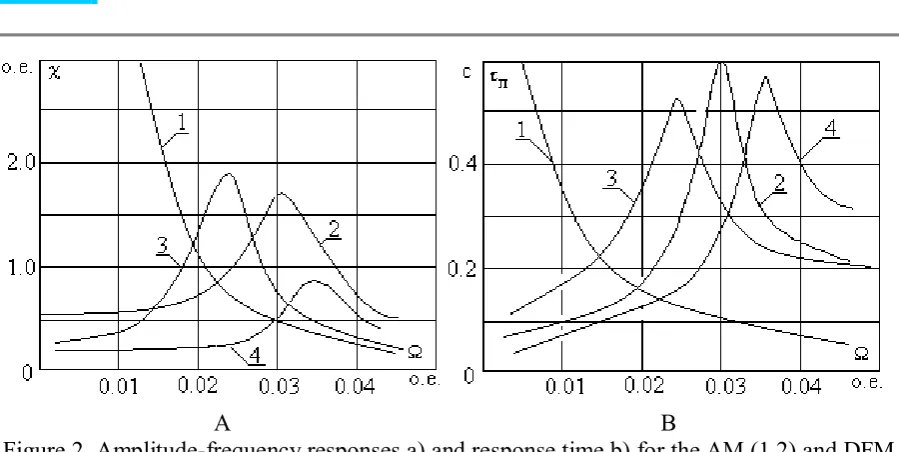
For a series of oscillation electric drives the oscillating system dynamics evalu-ation is of special value at the load parame-ters variation. In general, the complex load coefficient Zmech(Ω) is frequency-dependent,
it predetermining the general form of ampli-tude-frequency responses of the motors oper-ating in the DFM and AM modes (Fig. 1) and, thus, the drive’s transient indexes. Even moderate positional load implementation Сmech-1 leads to the AFR change and also surge current and moment values relative to the characteristics represented in the Fig. 1.
AtСmech-1 ≠ 0 near the
A B
Figure 2. Amplitude-frequency responses a) and response time b) for the AM (1,2) and DFM (3,4) modes atСmech-1 = 0 (1, 3);Сmech-1 ≠ 0 (2,4).
When analyzing the transient perfor-mance in below- or above-resonance areas, the positional load, as well as inertial one Lmech, doesn’t have any significant influence on the behavior of the dependences Isurge =f(Сmech-1,Lmech), Msurge = f(Сmech-1, Lmech), τn
= f(Сmech-1, Lmech). However, it should be
noted that the rotating masses increase fairly affects the DFM moving element generalized speed format quality. At the Lmech increase the carrying high frequency fluctuations and the impacts in the speed performance curve are essentially smoothed, that is attained by means of the response time double increase.
A significant influence on the transient indexes of periodic motion machines is made
by the damped loadRmech. Though its amount doesn’t specify the electromechanical reson-ance condition, but influences the oscillating complex general factor of quality, actively affecting the oscillating electromagnetic tor-que sinusoidal components amplitude. The Rmech increase essentially decreases the
re-sponse time and, in case of working in the asynchronous operation, regulates the oscilla-tion neutral deviaoscilla-tion, the oscillaoscilla-tion ampli-tude decreasing and the impact torque in-creasing. The comparative quantitative as-sessment of the load parameters influence on the transient indexes of oscillation machines are represented in Table 2.
Table 2. The comparative quantitative assessment of the load parameters influence on the transient indexes of oscillation machines are represented
Transient quality
in-dexes Lmech, о.е. Сmech
-1, о.е. Rmech, о.е.
0,6 1,4 0,6 1,4 0,6 1,4
AM Is, о.е.
Mt, о.е.
τn, о.е.
1,88 0,59 0,14
2,0 0,629
0,2
2,0 0,627
0,25
2,0 0,64 0,52
2,0 0,61 0,14
2,0 0,61 0,12 DFM Is, о.е.
Mt, о.е.
τn, о.е.
1,15 0,56 0,28
1,12 0,58 0,56
1,02 0,5 0,25
1,12 0,42 0,12
1,12 0,54 0,7
Technical sciences
109
The payroll results analysis testifies that, exclusive of the response time, the tran-sient indexes of electrical machines when operating in the DFM mode are notably higher than asynchronous operating regimes (α3 = α4 = 0). However, this very index in a
DFM can be considerably improved as well due to the positional load implementation.
References
1. Belyayev Ye.F., Shulakov N.V. Ma-thematical modeling of short actuating me-dium linear induction machines dynamic modes // Ural State Technical University Bulletin, 1995, pp. 28-31.