5215
Engineering Performance Evaluation Model In The
Context Of Bumdes Policy Formulation: A Study
From The Perspective Of The Political Economy
Of Accounting Management Theory
Gaguk Apriyanto, Achmad Firdiansjah, Fajar Supanto
Abstract: The purpose of this study is to engineer a regional policy model for Village-Owned Enterprises (abbreviated as BUMDes) which is based on the Political Economy of Accounting (PEA) in order to empower rural communities. The location of the study was conducted in the Malang Regency-Owned Enterprises. This research is a quantitative descriptive study with the design of several case studies in Balang district. As for research informants, this includes elements of the sub-district government, village government, BUMDes management, and BUMDes members. The results of this study are BUMDes policy formulation models based on the Political Economy of Accounting and aimed at empowering rural communities in Malang Regency. The theoretical approach used to build this model is the PEA theory with two theoretical approaches such as the premise of the theory of power distribution and the premise of the theory of wealth distribution at the sub-district, village level, BUMDes management, and BUMDes members. The design of theoretical models in this study can be seen from the implementation of the model that starts with the performance appraisal process, the results of performance appraisal, compilation of recommendations, policy formulation, and finally, empowerment of rural communities.
Keywords: Community Empowerment, Policy Formulation based on Political Economy of Accounting.
————————————————————
1.
INTRODUCTION
Since the reform era of the Republic of Indonesia in 1998, there has been a strong sense of regional autonomy in the form of decentralized government management from the central to the regions and the village (Safitri, 2017). To realize the spirit of regional autonomy, supporting structure and infrastructure is needed. One of the structures needed to realize this mission is the existence of Village-owned Enterprises (Badan Usaha Milik Desa, abbreviated as BUMDes) that is managed by paying attention to the principles of good governance (Mahardiatsyh and Mahmudah, 2016). With the active participation of the rural communities and a community empowerment program, the role of BUMDes institutions is strategic to the success of rural development (Jakarta, May 27th, 2016). The
community as the most important element in rural community empowerment is often in the subordinate position of the government. It needs a policy tool from the regional government so that the position of the rural community is not as the subordination of the regional government but rather a partner of the regional government. In Malang Regency, the existence of BUMDes institutions is highly expected because it can support the emergence of social democracy in a village. This can be done through the increasing competence of the rural communities on how to manage BUMDes institutions in a sustainable manner and through the increasing participation of the rural communities in BUMDes.
_____________________
• Gaguk Apriyanto, is lecture in University of Merdeka Malang,
Indonesia. PH-081235614705 E-mail: [email protected]
• Achmad Firdiansjah, is lecture in University of Merdeka Malang,
Indonesia
• Fajar Supanto, is lecture in University of Merdeka Malang,
Indonesia
The role of Malang Government from the village level, sub-district level, to the regency level realized in the form of regional government policy is very important to improve the performance of BUMDes. The current condition of BUMDes in Malang is based on the data submitted by the Head of
the Community Empowerment Agency (Badan
Pemberdayaan Masyarakat, abbreviated as BPM), Eko
Suwanto, who said that of 378 villages, there are only 25 active BUMDes (Hapsari, 2017). The data raises a big question that out of the number of villages in Malang, why are there only a small number of active BUMDes? Whereas, the main purpose of BUMDes establishment is to improve the welfare of rural communities through empowerment programs (Ministry of Villages, Development of Underdeveloped Regions, and Transmigration of the Republic of Indonesia, 2017). The information related to the crucial factors of BUMDes that are sourced from performance appraisal is a very important input for the Malang Government in formulating policy. The formulation of the policy pays attention to two aspects, namely fair distribution of power and fair distribution of wealth. Both of which is analyzed from the level of BUMDes institutions which include management and members, village level, and sub-district level. The basic concept of this policy formulation uses the theory of Political Economy of Accounting (PEA). The premise used in the theory is the distribution of power and the distribution of wealth adopted from Cooper and Sherer (1984) and Apriyanto (2015). Based on the description above, the researchers choose to write this study with the title of the empowerment of rural communities through a policy formulation based on the political economy of accounting theory.
2.
LITERATURE REVIEW
5216 relationship between the two. This policy formulation
focuses on a just and fair distribution of wealth and the relation of power and wealth. The greater the power, the more prosperity that follows (Tinker, 1980; Hoogvel and Tinker, 1978; Irianto, 2006; Irianto, 2007; Gaguk, 2015). This is in accordance with the purpose of establishing BUMDes that is to empower and prosper the village. There is an influence between the performance of BUMDes and the policies taken by the regional government that have a direct impact on community welfare. Policies taken by the regional government towards BUMDes institutions are not free from environmental influences. This makes the socio-political settings play a role in policymaking to maintain the sustainability of BUMDes which ultimately will succeed the rural development through community empowerment.The model used in this research is the development of a theoretical model that the researchers have built before. The theoretical model of PEA can be seen in the following figure:
Distribution of Power
Distribution of Welfare
Figure 1: The Model of Political Economy of Accounting Theory
Source: Apriyanto, 2015
The picture above illustrates the mechanism of performance appraisal in the perspective of PEA. With this perspective, performance appraisal must pay attention to the fairness of power and wealth distribution and the relationship between the two. It focuses on the just and fair distribution of wealth and the relationship between power and wealth. The stronger the power of a party, the greater the welfare it receives. Vice versa, the weaker the power of a party, the less welfare it receives. In this theoretical model, there is a positive correlation between the distribution of power (political aspects) and the distribution of wealth (economic aspects). Correlated to motivation theory, the purpose of this theory is economic motives where the political aspect is a way to achieve those economic goals. This economic goals (wealth) can be financial or not financial.The theoretical model of policy
formulation based on PEA used to empower rural communities in Malang is as follows:
Figure 2: The theoretical model of policy formulation based on PEA in the context of community empowerment.
3.
METHODOLOGY
This research is descriptive-qualitative study with multiple case study design. The reason for using the case study is because this type of research is social research. It is assumed that a case study is more appropriate for this type of research (Yin, 1996). Besides that, case studies have advantages in having a deeper understanding related to complex social problems (Dooley, 2005: 335). A case study also carried out completely, thoroughly, and deeply using a variety of data sources (Lincoln and Guba, 1985). It was reinforced by Stake (1994, 2005) and then developed by Creswell (1998, 2007) and Dooley (2002) and followed by Hancock and Algozzine (2006).This research was carried out in a number of BUMDes institutions in Malang Regency. The reason for choosing that research sites is because the researchers did not encounter significant difficulties in obtaining research data. This is related to the ease in accessing the research data as one of the considerations of the researchers in selecting research sites (Morse in Denzin and Lincoln, 1998: 60). It is also in concern with scientific meaning that by conducting the research on the above research site, it will result in the development of a wider and more integrated BUMDes performance appraisal that will measure the extent to which the distribution of power and wealth is related to the interests of stakeholders. The unit of analysis in this study is the concept of performance appraisal at BUMDes with Political Economy of Accounting Theory.In order to obtain the required data, the researchers used the techniques of data collection including documentation, observation, and interviews. Documentation includes quantitative data relating to BUMDes in Malang Regency, both from print media, electronic media, and online media. The researchers also did an observation by having direct participation in the study as a pure observer. Systematically, the researchers observed various dimensions in the study including interactions, relationships, actions, events, and so on (Mason, 1996: 60). While in the interviews, the researchers performed direct interviews with the parties related to BUMDes activities and to informants from the sub-district level, village level, BUMDes management, and BUMDes members. With the representation of these informants, it is expected that the interviews able to explore all aspects of BUMDes critically. In particular, the aspects in question are related to the information needed to compile a
Rural Communities Empowerment
BUMDes Policy Formulation
Political Economy of Accounting:
1.Distribution of Power 2.Distribution of
5217 comprehensive and in-depth concept of BUMDes
performance evaluation which includes the aspects of fair distribution of power and wealth.
4.
RESULTS
4.1 The Analysis of Power Distribution
This power analysis is carried out by looking at the role carried out by the sub-district institutions, village institutions, BUMDes management, and BUMDes members in relation to the existence of BUMDes. The data of the analysis are obtained formally through FGD and obtained informally through casual chat.
4.1.1 Sub-district Level
Sub-district is an administrative area that is under a regency or city. A sub-district is a combination of several villages. Sub-district is led by the Head of Sub-district who in carrying out the duties, he/she will be assisted by other instruments. For more details, this article will explain the organizational structure of a sub-district government. According to the Government Regulation number 41/2007, the sub-district is a working area for the Head of Sub-district as city apparatus. Thus, the Head of Sub-district has authority and is responsible for the Regent or Mayor through the Regional Secretary. It can be said that sub-district organization is functioned and is responsible for assisting the duties of the Regent in optimizing various government activities, development, and community development in sub-district area. Some of the activities in BUMDes involve the elements from the sub-district. There is a sub-district intervention in the management of BUMDes. This happens because the BUMDes manager is less able to manage BUMDes institutions. Besides this problem, the village apparatus and the Village Head in Wajak Sub-district are considered very poor in understanding BUMDes. This is due to the condition of the Village Head who believes that their task is only an extension of the government structure dealing with administrative issues and is responsible for projects and programs from the central government. As a result, it takes a great deal of effort to understand BUMDes which rely more on entrepreneurial issues. Weak understanding of BUMDes makes BUMDes discourse not well socialized to the rural communities. It will not be socialized well if the knowledge of the people is still inadequate. As a result, the issues of BUMDes only run in the circle of the village elites or village officials.
4.1.2 Village Level
A village institution is a unit of the legal community that has the authority to manage and run government affairs, the interests of the local community based on community initiatives, original rights, and/or traditional rights that are recognized and respected in the system of the Republic of Indonesia. Referring to the description above, it is proven that a legal community unit is villagers or rural communities who live in a location that has the right or authority to conduct or run their government for the benefit of the people in the area. A village is not subordinate to the sub-district because the sub-sub-district is part of a regency/city and the village institution is not part of the regional apparatus.
Unlike the urban village (kelurahan), a village has the right to manage its territory more broadly. In its development, the status of a village can be changed to be an urban village. In connection with the distribution of power at the village level, all BUMDes program development activities are carried out by the village. Most of the village apparatus are involved in BUMDes activities. Based on this finding, it is obtained that there has been an injustice distribution of power in the management of BUMDes in Pajaran village. This unfairness is in the form of village intervention, especially in the preparation of BUMDes program activities and daily activities.
4.1.3 BUMDes Management Level
The requirements to become BUMDes managers have been regulated in the Article 14 of the Village Government Regulation number 14 of 2015. The requirements to become a BUMDes operational manager are: first, must be villagers who have a strong entrepreneurial spirit because BUMDes is a business institution thus an entrepreneurial spirit is crucial to be owned. Secondly, the candidates must be domiciled and settled in the village for at least two years. In addition to the aspect of acceptance, those who have lived long enough in the area will be familiar with the potential of the village. Third, a manager must have a good personality and is honest, fair, competent, and pays attention to the economic aspects (business) of the village. Although this seems normative, BUMDes are required to be open in carrying out their activities so that honesty is a very important indicator. Fourth, a BUMDes manager must have a minimum of high school/Madrasah Aliyah/vocational high school degree. All of these requirements are applied in the BUMDes management. However, in the implementation of BUMDes, it can employ people with no minimum educational degree but are considered capable of doing the jobs. For example, it usually those who work in a retail business, waste management, and so on. The profile of the BUMDes managers will be explained in the following section: In managing BUMDes, the management hegemony is quite high. Related to the preparation of the BUMDes program, all arrangements are carried out by the management. It is known that the involvement of the managers in the BUMDes daily activities is quite large. This shows the dominant role of the BUMDes managers in the management of Pajaran Village BUMDes.
4.1.4 BUMDes Member Level
5218 There is a domination of power by BUMDes members both
in the preparation of BUMDes program activities and daily activities.
4.2 The Analysis of Wealth Distribution
Wealth is the impact or the result of power. The greater the power, the bigger the wealth. In this wealth analysis, the researchers will discuss the benefits obtained by the sub-district, village, BUMDes management, or BUMDes members. These benefits are both financial and non-financial in the management of BUMDes.
4.2.1 Sub-district Level
The sub-districts that become the objects of this study include Wajak, Jabung, and Poncokusumo. The researchers chose the three sub-districts because the three regions have quite old BUMDes. The wealth level that the researchers analyzed in this study is related to the financial and non-financial benefits received by the sub-district. In general, the sub-district does not benefit financially from BUMDes. Whereas in a non-financial basis, the sub-district has benefited greatly from the existence of the BUMDes. One of the non-financial benefits is to advance and prosper the community. Moreover, the aspects related to community empowerment are also increased.
4.2.2 Village Level
An institution is a place to carry out certain tasks and functions in order to achieve particular goals. Therefore, a village institution is a place to carry out the tasks and functions of the Village Government. The purpose of the administration of the Village Government is to improve the welfare of the community so that their task is to provide services, empowerment, and development which are aimed at the interests of the community. It can be said that there are no financial benefits obtained by the village. As for the non-financial benefits, the village does receive some benefits. One of the non-financial benefits is in the form of a financial system that is more organized. With the well-ordered financial system, the business unit is expected to stimulate and trigger the performance of BUMDes.
4.2.3 BUMDes Management Level
BUMDes manager is a person trusted by the village to manage the BUMDes. To be a BUMDes manager, someone must be competent, skilled, honest, and trustworthy in managing BUMDes. BUMDes manager must be professional in managing BUMDes so that the institutions can develop well and able to compete with other business entities. The distribution of wealth in this level is in the form of financial benefits that are received regularly (IDR 250,000.-). As for the non-financial benefit obtained by the BUMDes managers is that they become closer to the community. Besides that, these managers can develop other businesses in the village. This shows that the distribution of wealth received by BUMDes manager, either financially or non-financially, is not too big.
4.2.4 BUMDes Member Level
BUMDes members are part of the organizational elements in BUMDes. The participation of BUMDes members cannot be underestimated. The higher the participation of BUMDes
members, the better the performance of BUMDes; and vice versa, the lower the participation of BUMDes members, the worse the BUMDes performance. Therefore, in order to optimize the performance of a BUMDes, it needs a synergy of all organizational components starting from the sub-district, village, management, to the members. Financially, the BUMDes members get a fair distribution of wealth as much as IDR 700,000. Other than that, BUMDes members also receive justice for the distribution of wealth in getting jobs in the field of empowerment.
5.
DISCUSSION
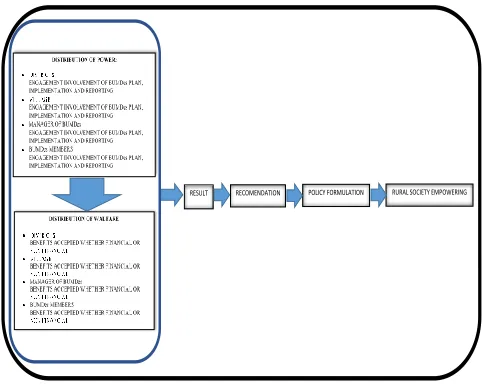
The following figure is the flexibility of the Political Economy of Accounting Theory (PEA theory) implementation. This theory uses two premises, power distribution, and wealth distribution. The greater the power, the greater the wealth obtained. The researchers used PEA as a basis to make a performance appraisal model for BUMDes. The results of the performance appraisal serve as the basis to compile recommendations for the Regency. Based on the recommendations, the Regency will make a policy formulation for BUMDes. So, a policy formulation starts with the making of academic texts. In this academic paper, the recommendations are based on the results of BUMDes performance appraisal that pays attention to the aspects of fair distribution of power and wealth starting from the district level, village level, BUMDes management, and BUMDes members. The results of this academic paper can be used as the main raw material for the Regency to formulate a policy, specifically, that is related to BUMDes.
Figure 3: Performance Appraisal Model as the Basis for Policy Formulation
Description:
1 The BUMDes performance appraisal model is built by considering the aspects of power distribution and wealth distribution. Both aspects are analyzed deeply by the researchers to find out the extent to which the fair distribution can be implemented, especially to rural communities who are one of the stakeholders in BUMDes. The measurement of these two aspects starts from the sub-district level, village level, BUMDes
5219 management level, and BUMDes member level. The
type of activity to measure the distribution of power is the participation level of each planning activity (both financial plans and activity plans), the implementation of BUMDes activities, and the whole BUMDes activity reports. The formal power distribution data are obtained from the job description contained in official documents. While on the other hand, the non-formal power distribution data are obtained from other activities outside the job description. The aspects of wealth distribution at all levels are measured on the basis of the benefits received both financial and non-financial benefits. The formal data on the aspect of wealth distribution is based on the official income received from the BUMDes institution while the informal data is in the form of other benefits outside the official income. 2 This stage shows the result of the activities presented in step number one. In other words, this is a synthesis of data analysis from step number one. The results of this analysis can be in the form of quantitative data or qualitative data. The results will be quantitative if the data obtained are in the form of financial data. Whereas, it will be qualitative analysis if the data are in the form of non-financial data such as organizational culture, local wisdom, and others. The results of this analysis provide a clear picture of the extent to which power and wealth are distributed from the sub-district level to the level of BUMDes members. If the data on information number one has been analyzed and discussed, it will generate an input to make recommendations to the stakeholders.
3 A recommendation is a suggestion that will be given to the Regency to formulate a policy that specifically is related to BUMDes. The recommendations in this study are formulated based on the results of performance appraisal. The contents on the recommendations are related to the policies needed by the Regency to improve the performance of BUMDes. Therefore, BUMDes will be able to become an institution that can develop the village through community empowerment programs. The recommendations are in the form of an academic paper compiled based on the results of the analysis which includes the aspects of power and wealth distribution at all levels of the related elements. The perspective in the academic texts consists of accounting, economics, and politics. These three perspectives always influence the daily activities at BUMDes institutions, directly and indirectly.
4 Policy formulation related to BUMDes is one of the activities carried out by the Regency to formulate a policy. In this policy formulation, one of the data is sourced from academic recommendations. These academic recommendations are in the form of academic texts related to the condition of BUMDes institutions. Academic texts are prepared to be used as a basis for the policy formulation. This study is an academic paper of BUMDes institutions that is formulated from the aspects of accounting, economics, and politics. By that, the Regency can take this study as a consideration for the formulation of the BUMDes policy. The final form of this policy formulation is in the form of regional regulations that are related to BUMDes
management covering the sub-district, village, BUMDes management, and BUMDes members.
5 Community empowerment can be done both structural and nonstructural. One of the community empowerments carried out in a structured manner is done by improving the performance of BUMDes institutions. There is a positive correlation between the performance of BUMDes institutions and village community empowerment. The better the performance of a BUMDes institution, the better the positive impact of rural community empowerment. This happens because the village community is part of the BUMDes institutions where its position is either as an administrator or member. Along with the better performance of BUMDes institutions, the participation level of the rural communities as administrators or members in managing BUMDes institutions as one of the economic drivers in the village is also getting higher.
6 The Regency as one of the policymakers, especially related to BUMDes institutions, has a fairly central role. The right policy will stimulate the institution to be better so that the performance of BUMDes institutions will improve from time to time. If the performance of BUMDes institutions is getting better, the empowerment of rural communities will also improve thus increasing the wealth of the community.
In this study, the policy formulation in the context of empowering rural communities is done through the formulation of the BUMDes performance appraisal model. The right BUMDes performance appraisal model will be able to provide proper BUMDes performance information as well. This BUMDes performance information is one of the inputs to compile an academic paper as a basis for the Regency as a regulator to formulate an appropriate policy for BUMDes institutions. With the better performance of BUMDes institutions, the active role of rural communities as BUMDes members will also increase. Through this increased role, it is expected that the empowerment of rural communities in order to improve the wealth of rural communities will be realized. It is believed to be the right step to reduce the economic gap between urban communities and rural communities. This expectation is in accordance with the ideals of the government that wants to develop the economy of Indonesia starting from the very edge; a rural economic development program is done by fully involving the village community through a community empowerment program.
6.
CONCLUSION
5220 appraisal model. Based on the concept of performance
appraisal, the information related to the results of BUMDes performance appraisal will be obtained. The results of the BUMDes performance appraisal are followed up by making a recommendation for the Regency. Before formulating policy, the Regency prepared an academic text which main material includes the recommendations related to BUMDes performance. Similar to the model in this study, a policy that is specifically related to BUMDes will be more effective. It is hoped that with the better performance of BUMDes institutions, the level of participation and empowerment of rural communities will also be increased thus will improve the welfare of the community in the village.
RECOMMENDATION
This research is important for future planning, especially regarding the performance appraisal of BUMDes. The approach used in this study can be applied to different industries besides BUMDes. This study will be better if it is focused on just one industry so that the analysis can become deeper. Besides that, each industry has different characteristics. In performance appraisal, as expressed in this study, it is not only assessed from the financial aspects, but also from the non-financial aspects (Cumby and Conrod, 2001; Kannan and Aulbur, 2004). It is recommended for future research to further develop the relevant aspects and the disclosure of power and welfare can be more fairly expressed, especially the aspects which are related to the regulator. The phenomenon of BUMDes performance appraisal is a reality and must be built socially. As a matter of fact, it requires knowledge to understand social reality (Berger and Luckmann (1990:28), The Regency as the regulator should consider the aspects of Leadership, Strategic Planning, Customer Focus, Measurement, Analysis, Knowledge Management, Workforce Focus, Operation Focus, and Result as well as aspects of Power, Prosperity and Hegemony of the parties associated with BUMDes in BUMDes performance appraisal. The researchers expect that by taking into account the above aspects, BUMDes performance appraisal can be more comprehensive. Thus, the recommendations made and the policies taken by the Regency will have higher quality.
ACKNOWLEDGMENT
This work was supported in part by the Ministry of Research and Technology of Higher Education.
REFERENCES
[1] Apriyanto G. 2015. Critical Analysis of Pension Fund Performance: A Study in the Political Economy of Accounting Perspective. Doctoral Dissertation Research. LPPM Unmer Malang.
[2] Berger, P. L. dan Luckman T. 1990. Social Interpretation of Reality: Proceedings on the Sociology of Knowledge (translated from the original book The Social Construction of Reality by Hasan Basari). Jakarta: LP3ES.
[3] Creswell, J.W. 1998. Qualitative Inquiry and Research
Design: Choosing among Five Tradition. London: Sage
Publications.
[4] Creswell. J. W. 2003. Educational Research. Planning,
Conducting, and Evaluating Quantitative and
Qualitative Reserach, Second Edition. New Jersey:
Pearson Merrill Prentice Hall.
[5] Cumby, J. dan Conrod, J. 2001. Non Financial
Performance Measures in The Canadian
Biotechnology Industry. Journal of Intellectual Capital. Vol 2 No 3, pp 261-271.
[6] Dooley, L. M. 2005. Case study research and theory building. Advances in Developing Human Resources, 4(3), 335-354, http://www.proquest.umi. com diakses pada 12 Januari 2013.
[7] East Java Governor Decree number 188, 2005. The Poverty Alleviation Integrated Movement Program (Gerdu-Taskin). Surabaya: Provincial Secretariat [8] East Java Province Bapemas p.4 in 2006 Purpose and
Objectives established Bumdes. Surabaya: Bapemas of East Java Province
[9] Hancock, D. R dan Algozzine, B. 2006. Doing Case
Study Research. New York.Teacher College Press.
[10] Hoogvelt, A dan Tinker, A. M. 1978. The Role of Colonial and Post Colonial States in Imperialism-a Case Study of the Sierra Leone Development Company, The Journal of Modern African Studies 16 (1):67-79.
[11] Irianto, G. 2004b, A Critical Enquiry into Privatitation of State-Owned Enterprises: The Case of PT Semen Gresik (Persero) Tbk, Phd Thesis, Departement of Accounting and Finance, University of Wollongong, Australia.
[12] Irianto, G. 2006. Dilema “Laba” dan Rerangka Teori Political Economy of Accounting (PEA), TEMA 7 (2): 141-53.
[13] Irianto, G. 2004. Cement Industry in Indonesia: Expansion, Debt Traps, and Ownership, Economic Tracks, Vol. XXI, No. 1, 1-12.
[14] Kannan G. dan Aul bur W. G. A. 2004. Intellectual Capital, Measurement Effectiveness. Journal of
Intellectual Capital. Vol 5 No 3, pp 389 – 413.
[15] Lincoln, Y.S. dan Guba, E.G. 1985. Naturalistic Inquiry.
Beverly Hills: Sage Publication.
[16] Mason, J., 1996. Qualitative Research, London, Sage Publications.
[17] Mahardiyatsih et al., 2016. Management Responsibilities in Implementing GCG Principles (Good Corporate Governance) in Bumdes (Village-Owned Enterprises). Faculty of Law, Diponegoro University, Indonesia
[18] Muhammad. I. 2009. Social Sciences Research Methods. Yogyakarta: Erlangga.
[19] Neimark M. dan Tinker T., 1986, The Social Construction of Management Control System,
Accounting,Organization and Society, Vol. 11 No. 4 Pp
369-395.
[20] OECD. 2015. Survei Ekonomi OECD INDONESIA. Indonesia. Originally published by the OECD in English and in French under the titles: OECD Economic Surveys: Indonesia 2015. Étude économiques de l'OCDE.
5221 Affairs of the PDTT Village Ministry on the Context of
Community Empowerment. Jakarta.
[22] Pension Fund Bureau 2015. Pension Fund Annual Report. Jakarta. Pension Fund Bureau, Bapepam L-K, Ministry of Finance of the Republic of Indonesia. [23] Riza. Y. 2003. The Effect of Distributive Justice,
Procedural Justice, Commitment to Objectives, and Motivation on Managerial Performance in Budgeting. National Symposium on Accounting VI: 707-719. [24] Safitri. Sani, 2017. History of the Development of
Regional Autonomy in Indonesia. Ciksetra Journal. Volume 5 (9).
[25] Stake, R. E. 2005. Case Study Methods in Educational Research: Seeking Sweet Water. In R. M. Jaeger (Ed.)
Complementary methods for research in education,
2nd Edition (pp, 401-414). American Educational
Research Association: Washington, DC.
[26]Supanto, Fajar and Astuti, Widji, Economic
Empowerment of Coastal Society Through
Entrepreneurship Based On Local Economic In A
Southern Cross Area Of The Province Of East Java, , International Journal of Recent Technology and Engineering (IJRTE), ISSN: 2277-3878, Volume-8 Issue-4, November 2019, Blue Eyes Intelligence
Engineering & Sciences Publication.
[27] The World Bank. 2014. Development Policy Review 2014: Indonesia: Avoiding Traps. Jakarta @ World Bank.
[28] Tinker, T., Merino, B and Neimark M. (1982), The Normative Origins of Positive Theories: Ideology and Accounting Thought, Accounting, Organizations and
Society , 7, 2: 167-200.
[29] Tinker T, 1980, Towards A Political Economic Of Accounting: An Empirical Ilustration Of The Cambridge Controversies, Accounting, Organization and Society,