Pragmatical model for highway tolls pricing
management
Emmanouil Papadimitriou, Grigorios Papageorgiou
Abstract: Highways stand for a decisive part of the road network with respect to the economic growth prism. In Europe, as well as in developed and developing countries worldwide, an extended network of highways, serves as one of the interconnection infrastructure cornerstones of touristic, professional and commercial activities. The financing of that road infrastructure investments lays mainly on toll stations at certain points of highway trafficked surface. Thus, toll stations operate as points of fee collection from road users. Tolls pricing methodology with a pragmatical approach is the scope of this paper. While many methods for pricing tolls fee are implemented according to the policy adopted by the road authorities of each country, none of them has up to now manage to calculate fee value with respect to continuously updated historical data of past expenses and revenues, due to construction, maintenance, operational and tolls fee income, accordingly. The development of a pragmatical model that reconsiders costs and revenues yearly, so tolls pricing becomes more realistic along with time, is the subject this paper investigates. A calculation formula for this goal is presented hereafter, distinct characteristics of which are realism, reconsideration and sustainability.
Index Terms": Highway management, highway toll-stations, tolls fee, tolls pricing policy
—————————— ——————————
1
INTRODUCTION
Road infrastructure is of vital importance in order to enhance a country‘s growth and development. The road network is a critical juncture in the fight against poverty, as it provides broad access to social services, health and education. It thus contributes directly to social and economic development in its neighboring areas. So, it could be said that all the assets that belong to the public are the road infrastructure (Malkoc, 2015). Roads stand for a primary mean of transportation. Various types of roads are constructed to fulfill various needs accordingly. Highways‘ main scope is to connect two or more cities or countries. As roads are an important asset, it is necessary to maintain it so that it withstands for a long service-life. A highway, throughout its life-cycle, is subject of various costs related to its construction, maintenance, operation, as well as restoration costs resulting from natural disasters (Table 1). The construction cost (Cc) depends on factors such as the type of pavement, the width and number of lanes of the road. Usually, a highway lane is 3.50-3.75 m wide. The cost will depend on the number of lanes constructed. The dimensioning of pavement is also important, depending on the layers below the trafficked surface. The type of layers is determined by the California Bearing Ratio (CBR) value, which directly shows the strength of the soil, as well as the percentage of water contained therein. The final construction cost is also related to the existing costs of selected materials. The maintenance cost (Cm) is directly related to actions that aim to heal condition deficiencies of the roadway and, by extension, other infrastructure elements, such as safety equipment, traffic lights, signs, etc.
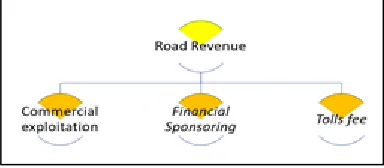
The operation cost (Co) refers to costs incurred that are directly related to operational needs such as lighting, water supply, power supply to facilities and equipment, pathway cleaning, staff payroll, toll facilities, and maintenance of existing machinery. Finally, the natural disaster cost (Cnd) refers to the rehabilitating costs facing the effects of natural disasters, such as tornadoes, hurricanes, volcanic eruptions, floods and earthquakes. Essential resources and revenues to draw from, are, commercial exploitation, financial sponsoring and tolls fee (Fig. 1). It is important to note that the three fundamental toll systems on the highways are: open to central toll stations, closed to access and exits, and open roads, where tolling does not exist. direct, but payment depending on usage is made online, at strategic points or even at entry and exit points in each piece of use. Modern highways with tolls often use a combination of the three: for example, the Pennsylvania Turnpike and Florida's Turnpike implement all three systems in different sections.
A. Tolls Station types
Road network maintenance can be achieved by different types of toll stations to cover the costs of damage caused by natural disasters. Three mechanisms for obtaining revenues are commonly used as presented in Tables 2, 3 and 4.
Fig. 1. Road revenues. ______________________________________
TABLE 1
COST TYPES OF HIGHWAY NETWORKS
Cost type Cost Analysis
Construction Cost (Cc)
a) Depending mainly on the terrain and soil conditions, as well as on the skill of operators and labourers involved; road construction costs may vary;
b) Includes road infrastructure and relevant equipment
Maintenance Cost (Cm)
a) Maintenance costs may vary according to different factors, such as weather conditions, innovative techniques and road data;
b) Includes routine, preventive, corrective maintenance
Operation Cost (Co)
Refers to costs incurred that are directly related to operational needs such as: a) lighting;
b) water supply power to facilities and equipment;
c) highway cleaning; d) staff payroll; e) toll facilities;
f) maintenance of existing machinery Natural Disaster
Cost (Cnd)
Refers to the resulting costs from the effects of natural disasters.
TABLE 2
ADVANTAGES,DISADVANTAGES,FEATURES OF DIRECT TOLLS (SOURCE: PPP.WORLDBANK.ORG)
Direct tolls
Advantages
a) Investments in infrastructure can be augmented; b) Zero cost to the Government;
c) Government has fiscal space to fund other projects; d) Optimization of use of the transport network
Disadvanta ges
High capital construction costs mean that project’s traffic volumes may be considered as an insufficient revenue stream to meet debt service.
Features
a) Road users pay for the road infrastructure use; b) Concessionaire paid for making road available for public use;
c) Tolls applied to vehicles are generally differentiated on the basis of number of axles, period of time (day/week) and emissions “Euro standard class”.
TABLE 3
ADVANTAGES,DISADVANTAGES,FEATURES OF SHADOW TOLLS (SOURCE: PPP.WORLDBANK.ORG)
Shadow tolls
Advantag es
a) The introduction of public-private partnerships (PPPs) can be established when the environment is not promising at all;
b) Ensure that traffic emergencies are covered
Disadvan tages
a) The government may pay higher "fees" when the volume exceeds the thresholds set;
b) Users do not receive price signals;
c) The total cost of the construction project is solely for the public purse
Features
a) Concessionaire is paid by authority on road use – the more the road is used the more the Concessionaire is paid; b) Usually have banding mechanism, which applies different shadow toll payments to different levels of traffic.
TABLE 4
ADVANTAGES,DISADVANTAGES,FEATURES OF INDIRECT TOLLS (SOURCE: PPP.WORLDBANK.ORG)
Indirect tolls
Advantag es
a) There is no concept of monitoring traffic flows during operation;
b) The project becomes cheaper as the risks for the
Concessionaire are minimal; c) The care required is low
Disadvan tages
a) The concessionaire's interest in the volume of traffic is negligible;
b) The total cost of the project relates solely to the public fund;
c) Limited price signals (affecting traffic behaviours).
Features
Amount of deduction/ non-availability payment usually determined by reference to factors including:
i)Duration of unavailability; ii) Time of day of unavailability; iii) Length of project road; iv) Number of lanes affected.
B. Tolls fee policies
Governments are constantly looking for ways to meet the needs of citizens to develop their road networks and other transport links. Governments are unable or unwilling to often commit budgetary expenditure to new motorways as they are very costly. The lack of public funds has led to the introduction of new models for the financing and management of tolls, from toll collection to private financing through more 'complex' concession models. Each model provides a different linkage between countries (ASECAP, 2014). Worldwide, today such a link may have different profiles:
• Direct control by the state (and by specific organizations). • Road toll concession system.
• Public-Private Companies.
Road tolls were levied traditionally for a specific access (e.g. city) or for a specific infrastructure (e.g. roads, bridges). These concepts were widely used until the last century. The different charging concepts are designed to suit different requirements regarding purpose of the charge, charging policy, tariff class differentiation etc.:
Time Based Charges and Access Fees: a road user has to pay for a given period of time in which they may use the associated infrastructure.
Distance or Area Charging: In a distance or area charging system concept, vehicles are charged per total distance driven in a defined area (Bernhard, 2004).
The policy gives direction to three options:
1. Tolling based on computation of cost recovery. The Concessionaire shall manage the road infrastructure for a period stated in the Public and Private Partnership (PPP) agreement to recoup the construction, maintenance and operation costs. Thereafter, the concessionaire shall return the infrastructure to the responsible road authority in the condition specified in the agreement.
2. Tolling based on the proportion of the benefit accrued from the use of the road infrastructure. The Concessionaire shall manage the road infrastructure for a period stated in the PPP agreement to recoup the construction, operation and maintenance costs.
2
LITERATURE
REVIEW
Tolls are often put on the roads to raise funds to repay the bonds. Road development cannot be achieved solely with budget support or even with the support of private investment. Motorway infrastructure has traditionally been funded through general government budgets and special taxes and fees rather than tolls. 90% or more of motorways are publicly funded, in most industrialized countries, while in developing countries the total cost is borne by governments. Because of the limited resources available to governments, they favor the creation of private tolls, aiming at alternative forms of meeting the needs of the road network (Fisher, 1996). In Austria since 2004, a distance-based charging system known as Go-Maut has been implemented for all cars over 3.5 tonnes. These are less than 3.5 tonnes, are required to purchase a sticker or sticker for access on the Austrian motorway network, which is owned and operated by a state-owned company called ASFINAG. However, for selected routes, such as large tunnels and expensive routes through the Alps, there is an additional toll charge (Wilson, 2012). Singapore‘s electronic road pricing system uses prices determined by optimization of traffic flow. The pricing formula was developed using a traffic flow model developed by the Land Transport Authority. When speeds fall below the target levels prices are increased. When speeds rise above the target range, prices are reduced. The benefit of this rule-based methodology is transparency. This aid understanding for both the public and decision makers and underpins public support for the system (OECD, 2018). In June 2005, Transport Secretary Alistair Darling announced a proposal for a national scheme of UK (Tempest, 2005), in which every vehicle would be fitted with a satellite receiver that would calculate charges, with prices (including fuel duty) ranging from £2 per mile on uncongested roads to £1.34 on the most congested roads at peak times (European Commission, 2004). In 2006, San Francisco authorities began a feasibility study to evaluate congestion pricing in the city and finally in July 2010 congestion tolls were implemented at the San Francisco-Oakland Bay Bridge (Cabanatuan, 2010).
3 CONCEPT
OF
PROPOSED
APPROACH
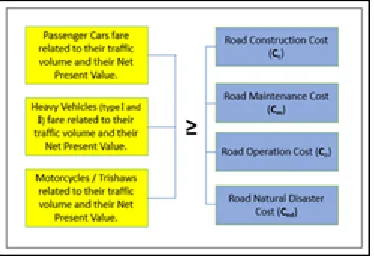
The proposed methodology combines a multitude of features that are initially directly intertwined with modern highway demands and then directly links, through the use of the present value concept, the revenue that is incurred on a highway to the costs incurred throughout their life cycle. The following Fig. 2 is a graphical representation of the proposed methodology.
Fig. 2. Tolls Road Methodology Flow Chart
The proposed methodology lies on three fundamental features that shape its innovation, namely sustainability, reconsideration and realism (Table 5). ―Sustainability‖ implies that resources are being exploited at a rate lower than that which is currently being renewed by existing systems. Otherwise the concept of degradation occurs. Theoretically, the long-term effect of downgrading is the system's inability to support the key emerging issues. ―Reconsideration‖ lies in the fact of immediate and holistic, potentially modifying data and possible solutions through the use of net present value. With regard to the concept of reconsideration, it is tempting to note that in common practice the costs of tolls are often revised, without taking into account the actual data of the existing traffic. In Greece, tolls are being revised in line with the policies pursued by the government. With regard to the concept of reconsideration, it is tempting to note that in ordinary practice the costs of tolls are often revised, without taking into account the actual data of the existing traffic. In Greece, tolls are being revised in line with the policies pursued by the government. Proper and at the same time artificially viable rates are set by the revenue and potential costs that occur throughout the life of a major motorway, so that the most appropriate and efficient financing can be sought, closer to the realistic needs, so that this innovative methodology is based on up-to-date data. Finally, an important feature of this methodology is the ―Realism‖, that is, the ability of the responsible manager to grasp the reality and the constraints that it poses and adapts to the demands of modern technology development and optimal requirements as far as sustainable development is concerned of motorways. These three features constitute a dynamic and yet accessible set of support for those who manage the highways, in appropriate and necessary situations, to act in an artificially optimized and most promising way.
TABLE 5
NECESSARY HIGHWAY TOLLS PRICING CONCEPT FEATURES FROM A PRAGMATICAL PRISM
Necessary Highway Tolls Pricing Concept Features from a Pragmatical Prism
Sustainability
a) Best financial result for road users and project owners;
b) A balance between the provision of services and the initial cost spent on the existing project.
Reconsideration
a) Cost-accounting approach and Change; b) Amendment and Review;
e) Recall of previous methods. Realism Representation of real and specific data
A. Proposed methodology
The categories studied for the implementation of this methodology are:
1. Passenger cars (pc)
2. Heavy vehicles with or without a trailer with 2 or 3 axles and a height of more than 2.20 meters (HVI)
3. Heavy vehicles with or without a trailer with 4 or more axles and a height of more than 2.20 meters (HVII) 4. Bikes/Tricycles (pv, mot) / (motorcycle, trishaw (or pedal
vehicle)
groups associated with those of passenger cars (using an average) are (http://diodia.com.):
A = 2.5 ∗ A , A = 3.5 ∗ A , A , = 0.7 ∗ A
Taking into account the present value (PV), that is, the amount of money required to be found today so that some of it will cover the cost of the original construction and the remainder, together with its performance, to cover the costs of future operations (Nikolaidis, 2005). We also consider as a percentage increase or decrease of the traffic load as λ for each vehicle category. In order to develop the proposed calculation formula, costs are as follows.
𝑪→ Construction cost.
∑ 𝑪 → refers to any form of maintenance that occurs at regular intervals t1, t2, etc. years, depending on the lifespan of each infrastructure to be maintained, after the initial stage of the road.
∑ 𝑪 → resulting operating costs across the entire road infrastructure.
𝑪 → is expressed in specific percentage values. The domain of variables is:
it ∈ (1, t) , iT ∈ (1, T) , i ∈ (t, T)
At the same time, the application of the criterion requires the reduction of all costs, including investment on an annual basis. The conversion of investment costs into annual costs is achieved by the following formula:
∑ 𝑷𝑽𝑪 =𝐶 ∗ (1 + 𝜔) ,
𝑤𝑒𝑟𝑒 𝐶 = 𝑖𝑛𝑖𝑡𝑖𝑎𝑙 𝑐𝑜𝑠𝑡 𝑣𝑎𝑙𝑢𝑒, 𝑡 = 𝑡𝑜𝑑𝑎𝑦 𝑎𝑛𝑑
𝜔 = 𝑖𝑛𝑡𝑒𝑟𝑒𝑠𝑡 𝑟𝑎𝑡𝑒 𝑜𝑛 𝑑𝑒𝑝𝑜𝑠𝑖𝑡𝑠
𝑈𝐸𝐴𝐶 = (𝑖𝑛𝑣𝑒𝑠𝑡𝑚𝑒𝑛𝑡 𝑐𝑜𝑠𝑡) ∗ 𝜀 ∗ (1 + 𝜀)
(1 + 𝜀) − 1 , 𝑤𝑒𝑟𝑒 𝑈𝐸𝐴𝐶 = 𝑈𝑛𝑖𝑓𝑜𝑟𝑚 𝐴𝑛𝑛𝑢𝑎𝑙 𝐸𝑞𝑢𝑖𝑣𝑎𝑙𝑒𝑛𝑡 𝐶𝑜𝑠𝑡 ,
𝑷𝑽 = ∑ [ 𝐹𝑉
(1 + 𝑟)] 𝑤𝑒𝑟𝑒 𝑃𝑉 = 𝑃𝑟𝑒𝑠𝑒𝑛𝑡 𝑉𝑎𝑙𝑢𝑒 , 𝑟 =
= 𝑟𝑒𝑡𝑢𝑟𝑛 𝑟𝑎𝑡𝑒 𝑎𝑛𝑑 𝑡 = 𝑛𝑢𝑚𝑏𝑒𝑟 𝑜𝑓 𝑝𝑒𝑟𝑖𝑜𝑑𝑠
𝑽 = 𝑟𝑒𝑎𝑙 𝑡𝑟𝑎𝑓𝑓𝑖𝑐 𝑣𝑜𝑙𝑢𝑚𝑒 𝑓𝑟𝑜𝑚 𝑦𝑒𝑎𝑟 1 𝑡𝑜 𝑦𝑒𝑎𝑟 𝑡, 𝑤𝑖𝑡 𝑥
= 𝑣𝑒𝑖𝑐𝑙𝑒 𝑡𝑦𝑝𝑒
𝑨 = 𝑟𝑒𝑎𝑙 𝑝𝑟𝑖𝑐𝑖𝑛𝑔 𝑐𝑜𝑠𝑡 𝑓𝑟𝑜𝑚 𝑦𝑒𝑎𝑟 1 𝑡𝑜 𝑦𝑒𝑎𝑟 𝑡, 𝑤𝑖𝑡 𝑥 = 𝑣𝑒𝑖𝑐𝑙𝑒 𝑡𝑦𝑝𝑒
𝑽 = 𝑒𝑠𝑡𝑖𝑚𝑎𝑡𝑒𝑑 𝑡𝑟𝑎𝑓𝑓𝑖𝑐 𝑣𝑜𝑙𝑢𝑚𝑒 𝑓𝑟𝑜𝑚 𝑦𝑒𝑎𝑟 (𝑡
+ 1)𝑡𝑜 𝑦𝑒𝑎𝑟 𝑇, 𝑤𝑖𝑡 𝑥 = 𝑣𝑒𝑖𝑐𝑙𝑒 𝑡𝑦𝑝𝑒
𝑨 = 𝑒𝑠𝑡𝑖𝑚𝑎𝑡𝑒𝑑 𝑝𝑟𝑖𝑐𝑖𝑛𝑔 𝑐𝑜𝑠𝑡 𝑓𝑟𝑜𝑚 𝑦𝑒𝑎𝑟 (𝑡
+ 1) 𝑡𝑜 𝑦𝑒𝑎𝑟 𝑇, 𝑤𝑖𝑡 𝑥 = 𝑣𝑒𝑖𝑐𝑙𝑒 𝑡𝑦𝑝𝑒 = 𝑑𝑒𝑠𝑖𝑔𝑛 𝑝𝑒𝑟𝑖𝑜𝑑𝑠 (𝑦𝑒𝑎𝑟𝑠)
= 𝑐𝑢𝑟𝑟𝑒𝑛𝑡 𝑦𝑒𝑎𝑟 𝑹 = 𝑟𝑒𝑝𝑟𝑒𝑠𝑒𝑛𝑡𝑠 𝑟𝑒𝑣𝑒𝑛𝑢𝑒 𝝎 = 𝑖𝑛𝑡𝑒𝑟𝑒𝑠𝑡 𝑟𝑎𝑡𝑒 𝑜𝑛 𝑑𝑒𝑝𝑜𝑠𝑖𝑡𝑠
𝑷𝑽𝑹 = 𝑉 ∗ 𝐴 ∗ (1 + 𝜔) , 𝑷𝑽 𝑹 𝑽 =
= 𝑉 ∗ 𝐴 ∗ (1 + 𝜔) , 𝑷𝑽𝑹 𝑽 = = 𝑉 ∗ 𝐴 ∗ (1 + 𝜔) , 𝑷𝑽
𝑹 , = = 𝑉 , ∗ 𝐴 , ∗ (1 + 𝜔)
𝑭𝑽𝑹 = 𝑉 ∗ 𝐴 , 𝑭𝑽𝑹 𝑽 = 𝑉 ∗ 𝐴 , 𝑭𝑽𝑹 𝑽 = = 𝑉 ∗ 𝐴 , 𝑭𝑽𝑹 , =
= 𝑉 , ∗ 𝐴 ,
𝑽 = 𝑉 ∗ (1 + 𝜆 )
⇔ 𝑉 = 𝑉 ∗ (1 + 𝜆)
𝑽 𝑽 = 𝑉 ∗ (1 + 𝜆 )
⇔ 𝑉 = 𝑉 ∗ (1 + 𝜆) 𝑽 𝑽 = 𝑉 ∗ (1 + 𝜆 )
⇔ 𝑉 = 𝑉 ∗ (1 + 𝜆)
𝑽 , = 𝑉 , ∗ (1 + 𝜆 , ) ⇔ 𝑉 , , = = 𝑉 , ∗ (1 + 𝜆)
∑ 𝑷𝑽𝑪 =𝐶 ∗ (1 + 𝜔) ,
𝑤𝑒𝑟𝑒 𝐶 = 𝑖𝑛𝑖𝑡𝑖𝑎𝑙 𝑐𝑜𝑠𝑡 𝑣𝑎𝑙𝑢𝑒, 𝑡 = 𝑡𝑜𝑑𝑎𝑦 𝑎𝑛𝑑
𝜔 = 𝑖𝑛𝑡𝑒𝑟𝑒𝑠𝑡 𝑟𝑎𝑡𝑒 𝑜𝑛 𝑑𝑒𝑝𝑜𝑠𝑖𝑡𝑠
∑ 𝑷𝑽𝑪 =∑ 𝑃𝑉 + ∑ 𝐹𝑉
(1 + 𝑘)
,
𝑤𝑒𝑟𝑒 𝐶 = 𝑙𝑎𝑠𝑡 𝑦𝑒𝑎𝑟 𝑚𝑎𝑖𝑛𝑡𝑒𝑛𝑎𝑛𝑐𝑒 𝑐𝑜𝑠𝑡 𝑓𝑟𝑜𝑚 1 𝑡𝑜 𝑡 𝑎𝑛𝑑 𝑘
= 𝑖𝑛𝑓𝑙𝑎𝑡𝑖𝑜𝑛 𝑟𝑎𝑡𝑒
𝑈𝐸𝐴𝐶 = (𝑖𝑛𝑣𝑒𝑠𝑡𝑚𝑒𝑛𝑡 𝑐𝑜𝑠𝑡) ∗ 𝜀 ∗ (1 + 𝜀)
(1 + 𝜀) − 1 , 𝑤𝑒𝑟𝑒 𝑈𝐸𝐴𝐶 = 𝑈𝑛𝑖𝑓𝑜𝑟𝑚 𝐴𝑛𝑛𝑢𝑎𝑙 𝐸𝑞𝑢𝑖𝑣𝑎𝑙𝑒𝑛𝑡 𝐶𝑜𝑠𝑡 , 𝜀 = 𝑑𝑖𝑠𝑐𝑜𝑢𝑛𝑡 𝑟𝑎𝑡𝑒 𝑝𝑒𝑟 𝑝𝑒𝑟𝑖𝑜𝑑 𝑎𝑛𝑑
𝑡 = 𝑒𝑠𝑡𝑖𝑚𝑎𝑡𝑒𝑑 𝑑𝑢𝑟𝑎𝑡𝑖𝑜𝑛 𝑖𝑛 𝑦𝑒𝑎𝑟𝑠 𝑪 = 𝑑 ∗ 𝐶 − 𝐶 ,
𝑤𝑒𝑟𝑒 𝐶 = 𝑖𝑛𝑖𝑡𝑖𝑎𝑙 𝑒𝑠𝑡𝑖𝑚𝑎𝑡𝑒 𝑜𝑓 𝑚𝑎𝑖𝑛𝑡𝑒𝑛𝑎𝑛𝑐𝑒 𝑐𝑜𝑠𝑡𝑠 ,
𝐶 = 𝑎𝑐𝑡𝑢𝑎𝑙 𝑐𝑜𝑠𝑡 𝑒𝑠𝑡𝑖𝑚𝑎𝑡𝑒 𝑜𝑓 𝑚𝑎𝑖𝑛𝑡𝑒𝑛𝑎𝑛𝑐𝑒 𝑎𝑛𝑑
∑ 𝑷𝑽𝑪 =∑ 𝑃𝑉 + ∑
𝐹𝑉 (1 + 𝑘)
,
𝑤𝑒𝑟𝑒 𝐶 = 𝑙𝑎𝑠𝑡 𝑦𝑒𝑎𝑟 𝑚𝑎𝑖𝑛𝑡𝑒𝑛𝑎𝑛𝑐𝑒 𝑐𝑜𝑠𝑡 𝑓𝑟𝑜𝑚 1 𝑡𝑜 𝑡 𝑎𝑛𝑑 𝑘
= 𝑖𝑛𝑓𝑙𝑎𝑡𝑖𝑜𝑛 𝑟𝑎𝑡𝑒
𝑑 = 𝑖𝑛𝑑𝑖𝑐𝑎𝑡𝑒𝑠 𝑡𝑒 𝑑𝑖𝑓𝑓𝑒𝑟𝑒𝑛𝑐𝑒 𝑏𝑒𝑡𝑤𝑒𝑒𝑛 𝑡𝑒 𝑡𝑤𝑜 𝑠𝑖𝑧𝑒𝑠
=𝑈𝐸𝐴𝐶𝐶
𝑈𝐸𝐴𝐶𝐶
𝑪 = 𝑑 ∗ 𝐶 − 𝐶 ,
𝑤𝑒𝑟𝑒 𝐶 = 𝑖𝑛𝑖𝑡𝑖𝑎𝑙 𝑒𝑠𝑡𝑖𝑚𝑎𝑡𝑒 𝑜𝑓 𝑚𝑎𝑖𝑛𝑡𝑒𝑛𝑎𝑛𝑐𝑒 𝑐𝑜𝑠𝑡𝑠 ,
𝐶 = 𝑎𝑐𝑡𝑢𝑎𝑙 𝑐𝑜𝑠𝑡 𝑒𝑠𝑡𝑖𝑚𝑎𝑡𝑒 𝑜𝑓 𝑚𝑎𝑖𝑛𝑡𝑒𝑛𝑎𝑛𝑐𝑒 𝑎𝑛𝑑
𝑑 = 𝑖𝑛𝑑𝑖𝑐𝑎𝑡𝑒𝑠 𝑡𝑒 𝑑𝑖𝑓𝑓𝑒𝑟𝑒𝑛𝑐𝑒 𝑏𝑒𝑡𝑤𝑒𝑒𝑛 𝑡𝑒 𝑡𝑤𝑜 𝑠𝑖𝑧𝑒𝑠
=𝑈𝐸𝐴𝐶𝐶
𝑈𝐸𝐴𝐶𝐶
[∑ 𝑃𝑉 + ∑ 𝐹𝑉 (1 + 𝑟)
] + [∑ 𝑃𝑉 + ∑𝐹𝑉
(1 + 𝑟)
] + [∑ 𝑃𝑉 + ∑𝐹𝑉 (1 + 𝑟)
] + [∑ 𝑃𝑉 , + ∑𝐹𝑉 , (1 + 𝑟)
] ≥
≥ ∑ 𝑃𝑉 +[∑ 𝑃𝑉 + ∑ 𝐹𝑉
(1 + 𝑘)
] + [∑ 𝑃𝑉 + ∑ 𝐹𝑉
(1 + 𝑘)
] + 𝐶 ⇒
⇒ [∑[𝑉 ∗ 𝐴 ∗ (1 + 𝜔) ] + ∑ 𝐹𝑉 (1 + 𝑟)
] + [∑[𝑉 ∗ 𝐴 ∗ (1 + 𝜔) ] + ∑
𝐹𝑉 (1 + 𝑟)
]
+ [∑[𝑉 ∗ 𝐴 ∗ (1 + 𝜔) ] + ∑𝐹𝑉 (1 + 𝑟)
] + [∑[𝑉 , ∗ 𝐴 , ∗ (1 + 𝜔) ] + ∑𝐹𝑉 , (1 + 𝑟)
] ≥
≥ 𝐶 ∗ (1 + 𝜔) + [∑ 𝑃𝑉 + ∑ 𝐹𝑉 (1 + 𝑘)
] + [∑ 𝑃𝑉 + ∑
𝐹𝑉 (1 + 𝑘)
] + 𝐶
𝛢 = ∑[𝑉 ∗ 𝐴 ∗ (1 + 𝜔) ]+ ∑[𝑉 ∗ 𝐴 ∗ (1 + 𝜔) ]+ ∑[𝑉 ∗ 𝐴 ∗ (1 + 𝜔) ]+ ∑[𝑉 , ∗ 𝐴 , ∗ (1 + 𝜔) ]
𝐵 = ∑ 𝑃𝑉 +∑ 𝑃𝑉
Consequently, the reconsiderable toll fee can be expressed as follows:
∑ 𝐴 ∗ [ 𝑉
(1 + 𝑟) + 2.5 ∗ 𝑉
(1 + 𝑟) + 3.5 ∗ 𝑉
(1 + 𝑟) + 0.7 ∗
𝑉 , (1 + 𝑟) ]
≥ (𝐵 − 𝐴) + 𝐶 ∗ (1 + 𝜔) + ∑ 𝐹𝑉 (1 + 𝑘)
+ ∑ 𝐹𝑉
(1 + 𝑘)
+ 𝐶 ⇒
⇒ ∑ 𝐴 =
(𝐵 − 𝐴) + 𝐶 ∗ (1 + 𝜔) + ∑ 𝐹𝑉
(1 + 𝑘)
+ ∑
𝐹𝑉 (1 + 𝑘)
+ 𝐶
[ 𝑉
(1 + 𝑟) + 2.5 ∗ 𝑉
(1 + 𝑟) + 3.5 ∗ 𝑉
(1 + 𝑟) + 0.7 ∗
𝑉 , (1 + 𝑟) ]
So, finally:
∑ 𝑨 (€) =
(𝐵 − 𝐴) + 𝐶 ∗ (1 + 𝜔) + ∑
(𝑑 ∗ 𝐶 − 𝐶 ) (1 + 𝑘)
+ ∑
(𝑑 ∗ 𝐶 − 𝐶 ) (1 + 𝑘)
+ 𝐶
∑ [𝑉 ∗ (1 + 𝜆)
(1 + 𝑟) + 2.5 ∗
𝑉 ∗ (1 + 𝜆)
(1 + 𝑟) + 3.5 ∗
𝑉 ∗ (1 + 𝜆)
(1 + 𝑟) + 0.7 ∗
𝑉 , ∗ (1 + 𝜆)
(1 + 𝑟) ]
B. Key features of proposed methodology
A key feature of the proposed methodology is its reconsideration. This methodology also includes the concept of cost due to natural disasters. If implemented correctly, tolls can have a positive impact on improving the logistics efficiency of freight. In addition, tolls can be a major source of revenue for a country's public budget. Because there is freedom in the countries in how the rates of the different categories of vehicles are determined, this methodology studies the precise determination of the prices of the respective categories of vehicles, using a range of costs and benefits resulting from a policy or investment. It is important that this methodology also takes into account and is automatically transformed based on local climatic conditions (natural disasters).
4 CONCLUSIONS
Road tolls take part to making transport more efficient in many different countries, can help to decrease the negative impacts of road transport while incentivizing the smart use of clean vehicles and can generate revenue for national budgets without adversely impacting the movement or price of goods
infrastructures.
5
REFERENCES
[1] AISCAT (Associazione Italiana Società Concessionarie Autostrade e Trafori) – AISCAT in figures 2013, Accessed at 10 October 2019.
[2] APCAP (Association of Portuguese Concession Companies of Toll Motorways or Bridges) – Anuàrio estatìstico de segurança rodoviària (2012), Accessed at 10 October 2019.
[3] APCAP (Association of Portuguese Concession Companies of Toll Motorways or Bridges) – As vantagens de viajar em autoestradas (2013), Accessed at 10 October 2019.
[4] APCAP (Association of Portuguese Concession Companies of Toll Motorways or Bridges) – Key figures 2012, Accessed at 19 October 2019.
[5] ASECAP (Association Européenne des Concessionnaires d'Autoroutes et d'Ouvrages à Péage) – Key Figures 2014, Accessed at 19 October 2019.
[6] ASECAP (Association Européenne des Concessionnaires d'Autoroutes et d'Ouvrages à Péage) – Statistical Bulletin 2014, Accessed at 21 October 2019.
[7] ASECAP (Association Européenne des Concessionnaires d'Autoroutes et d'Ouvrages à Péage) – Toll Road Operators – Strongly committed to safe and sustainable mobility (2014), Accessed at 28 October 2019.
[8] ASECAP (Association Européenne des Concessionnaires d'Autoroutes et d'Ouvrages à Péage) members – National Reports presented during the ASECAP Study and Information Days, Accessed at 27 October 2019.
[9] ASECAP (Association Européenne des Concessionnaires d'Autoroutes et d'Ouvrages à Péage): Evaluation and future of road toll concessions
/ Final Report – 2014,
http://www.asecap.com/images/documents/CONCES SIONSSTUDY/concessionsstudyfullreport.pdf, Accessed at 8 October 2019.
[10]ASETA (Asociación de Sociedades Españolas Concesionarias de Autopistas, Túneles, Puentes y Vías de Peaje) – Toll in motorways in Spain 2011, Accessed at 25 October 2019.
[11]Bernhard Oehry (2004): Tolling with Satellites – a System Concept for Everybody?" in: Jordi, Philipp (2008): "Institutional Aspects of Directive 2004/52/EC on the Interoperability of Electronic Road Toll Systems in the Community." Europainstitut der Universität Basel. Accessed at 8 October 2019.
[12]Cabanatuan Michael (13 May 2010). "Reminder: Bridge tolls go up July 1". San Francisco Chronicle. Accessed at 7 October 2019.
[13]DERD/WERD (Western European Road Directors and their Deputies) – ANALYSIS OF HIGHWAY CONCESSIONS IN EUROPE French Study for the DERD/WERD, Accessed at 1 November 2019. [14]ERSO (European Road Safety Observatory) – Traffic
Safety Basic Facts 2012 – Motorways, Accessed at 1 November 2019.
[15]Eurostat – Energy, transport and environment indicators (2013), ISSN 1725-4566, Accessed at 1 November 2019.
[16]European Commission – EU transport in figures –
Statistical pocketbook 2013,
https://ec.europa.eu/transport/facts-fundings/statistics/pocketbook-2013_en, Accessed at 1 November 2019.
[17]European Commission. 16 June 2011"The European Electronic Toll Service" (PDF). Accessed at 13 October 2019.
[18]Eurostat – Length of motorways,
https://ec.europa.eu/eurostat/web/products-datasets/product?code=TTR00002, Accessed at 8 October 2019.
[19]"Foreign lorries face £10 daily charge on UK roads". BBC News. 25 January 2012. Foreign lorry drivers could pay as much as £10 a day to use UK roads, the government has announced. UK haulage firms already have to pay to make journeys in other European Union countries, including France. Transport Minister Mike Penning said charging overseas companies would create a "fairer" situation. Accessed at 8 October 2019.
[20]Life Cycle Approaches (Life Cycle Initiative, UNenviroment), https://www.lifecycleinitiative.org/, Accessed at 8 October 2019.
[21]Fisher, G. & Babbar, S. (1996) Private Financing of Toll Roads RMC Discussion Paper Series ‗, 117. Accessed at 8 October 2019.
[22]Gordon Rachel (11 November 2010). "S.F. may hit drivers with variety of tolls". San Francisco Chronicle, Accessed at 8 October 2019.
[23]Humphreys Pat (5 March 2013). "Road Authorities:
price or tax?" (PDF). Nordic Communications Corporation. Accessed at 5 October 2019.
[24]International Transport Forum & OECD (Organisation for Economic Co-operation and Development): The Economic Impacts of Road Tolls / How tolls can be a mechanism to reduce emissions from transport while raising revenue for the public budget (April 2017), Accessed at 9 October 2019.
[25]International Transport Forum & OECD (Organisation for Economic Co-operation and Development): THE SOCIAL IMPACTS OF ROAD PRICING | SUMMARY AND CONCLUSIONS | ITF ROUNDTABLE 170 (2018), Accessed at 15 October 2019.
[26]Ishimaru Heather (10 November 2010). "SF considers downtown congestion pricing". ABC7 News San Francisco. Accessed at 1 October 2019.
[27]ITF Roundtable Reports - OECD (Organisation for Economic Co-operation and Development), Accessed at 25 October 2019.
[28]Reytas-Tamura, Kimiko (17 February 2017). "A Push for Diesel Leaves London Gasping Amid Record Pollution". The New York Times. Accessed 6 October 2019.Lilly, Chris (24 June 2016). "Congestion charge sunset period ends today". Next Green Car. Accessed at 6 October 2019.
[30]Mason Rowena (17 February 2017). "London to introduce £10 vehicle pollution charge, says Sadiq Khan". The Guardian. Accessed at 7 October 2019. [31]Malkoc Gülay (2019, June 2015) ―The importance of
road maintenance‖. World Highways, Routes du Monde.Accessed at 8 October 2019.
[32]Nagarjuna, P. and Samanta, P.K. (2015), Toll Supported Finance for Highway Development in India. IOSR Journal of Business and Management, pp. 38-44. Accessed at 8 October 2019.
[33]"New Toll Rates – Effective, 3 AM, March 2, 2008: Frequently Asked Questions (FAQS)". Port Authority of New York and New Jersey. Archived from the original on 1 March 2009. Accessed at 7 October 2019.
[34]Nikolaidis F. Athanasios, Athens 2005, ―Flexible Pavements‖, Editions: Nikolaidis Athanasios
[35]Peter Samuel (11 January 2001). "Peak/Off-Peak Tolls: Whitman whittles down PANYNJ tolls". TOLLROADSnews. Archived from the original on 2 March 2009. Accessed at 8 October 2019.
[36]Ricardo – AEA/EC DG MOVE - Evaluation of the implementation and effects of EU infrastructure charging policy since 1995 – Final, Accessed at 20 October 2019.
[37]Saarinen Martin (17 February 2017). "London introduces new £10 'T-charge' to cut vehicle pollution". Auto Express. Accessed at 8 October 2019. [38]Smothers Ronald (27 March 2001). "Grumbling, but Still Moving, Under New Rush-Hour Tolls". The New York Times. Accessed at 8 October 2019.
[39]Tempest Matthew (9 June 2005). "Darling unveils road charging plans". The Guardian. London. Accessed at 9 October 2019.
[40]"The Low Emission Zone. Cleaner air for Greater London" (PDF). Transport for London. pp. Pages 10– 12. Accessed at 13 October 2019.
[41]MnTU (THE REPUBLIC OF UGANDA - MINISTRY
OF WORKS AND TRANSPORT ROAD TOLLING POLICY) May 2017, Accessed at 15 October 2019 [42]Toll Stations, Charges, Maps, Information:
http://diodia.com.gr/diodia-athina-thessaloniki.html, Accessed at 26 September 2019.
[43]Visser Caroline (2019, February 2013) ―A Review of Revenue Sources for Roads and Highways‖. International Road Federation (IRF), UNECE Pre-ITC Road and Rail Financing Conference, Geneva. Accessed at 8 October 2019.
[44]Wilson Scott (3 May 2012). "Mileage based usage
fees – distance based charging – vehicle mileage tax – a future?". Road Pricing Blog. Accessed at 9 October 2019.
[45]Wilson Scott (25 February 2012). "Salzburg seeks vignette exemption for local motorways". Road Pricing Blog. Accessed at 9 October 2019.
[46]Wilson Scott (2019, November 2010) ―What are the different types of road pricing?‖. D'Artagnan Consulting, Accessed at 9 October 2019.
[47]Wollan Malia (4 January 2009). "San Francisco Studies Fees to Ease Traffic". The New York Times. Accessed at 7 October 2019.
[48]World Bank: PwC Elaboration based upon World Bank input:
http://ppp.worldbank.org/public-private-