Factors Affecting Industrial Property Value
Nur Shuhada Razali, Nuri Izati Menan, Soh Vuan Teng, Neo Li Ting, Nurul Hijanah Mahayuddin, Mohd Shahril AbdulRahman
Abstract: In view of the importance of industrial property, this paper explores the factors affecting the value of industrial property. To achieve the goals of this study systematic review and content analysis were performed. There are many factors affecting the value of industrial property. These include location, property characteristics, economy, government intervention, industrial agglomeration, transport and infrastructure, technology level, variable climate and environmental contamination. Those factors later divided into two categories, namely macroeconomic factors and microeconomic factors. A framework summarizing these factors is proposed for future directions.
Index Terms: Factors affecting, industrial property, determinants of industrial property value, industrial market value, and industrial land development —————————— ——————————
1.
INBTRODUCTION
Property valuation is a process of estimating the value of the property in order to obtain the market value for which the property was to be traded on the valuation date between the eager purchaser and the ready seller in an arm's length transaction, subject to appropriate promotion, where both parties acted professionally, wisely and without impulse. Industrial property discuss in this review encompasses of tangible properties i.e., buildings, factories, land, etc. Each property is different and has many variables or determinants that could affect its market value, especially in the current market (increasing in environmental awareness, advancement in IR4.0, etc). For this purpose, this study examines the factors which influence the value of industrial property. The remaining sections include Methods (Section 2), Factors affecting industrial property value (Section 3) and Conclusions and Recommendations (Section 4).
2
METHODS
The literature review (literature survey, content analysis, thematic coding and inductive reasoning) (Ayob, 2005; Bluhm et al., 2011; Denzin and Lincoln, 2000) has been used to identify factors affecting the value of industrial property. The keywords for the search for articles were 'the factors determining the value of industrial property', 'the factors affecting the value of industrial property', 'the 'price of industrial property' and 'the market price of industrial property'. The searches were conducted using Google scholars, Science Direct Journal, Emerald Scopus and SpringerLink Journals. After a thorough review, there are twenty journal articles which are directly related to the determinants of the value of industrial property. A total of 15 factors were identified and were divided into nine. These factors were later categorized into two categories: microeconomic (internal) and macro-economic (external) factors. The micromacro-economic factor is the internal influence which will have an impact on industrial value,
while the macro-economic factors are external factors which have an impact on industrial valueThese methods have also been used previously by researchers in this field of study, i.e. real estate and facility management, i.e., Haw et al. (2019), Ying and Rahman (2019), Onuoha et al. (2018) Alan et al. (2019), Rahman et al. (2015a), Rahman et al. (2015b), Rahman et al. (2015c), Rahman et al. (2015d), Awang (2014a) and Awang (2014b).
3.
FACTORS
AFFECTING
INDUSTRIAL
PROPERTY
VALUE
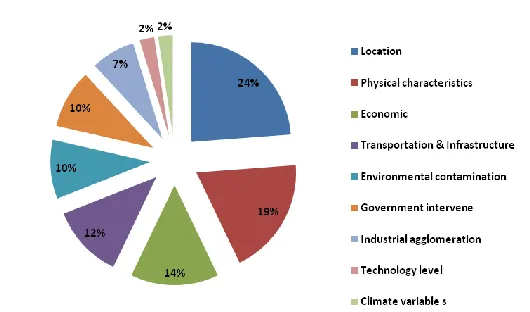
The graph (Fig. 1) shows the distribution of factors affecting the value of industrial property. There are a total of 9 key factors that will influence the value of industrial property. In particular, the level of technology, climate variables, environmental contamination, government intervention, industrial agglomeration, economy, location, transport and infrastructure, as well as the physical characteristics of industrial value. Among them, the majority of authors have argued that location is the main factor that influences value, which is 24 per cent. However, only 2% of the twenty articles indicated that technical levels and climate variables are factors which have an impact on industrial prices.
Fig 1. Distribution of determinants based on articles selected
3.1 Microeconomic Factor
The location and physical characteristics of the property are the microeconomic factors that will affect industrial property value.
3.1.1 Location
This may be the primary factor affecting the value of the property. The property market is closely linked to the economic condition of the area in which it is situated because of the ————————————————
1-6
Real Estate Department, Faculty of Built Environment and Surveying, Universiti Teknologi Malaysia (UTM), Johor Bahru, Johor,
213 longevity and immobility of the property. Based on the article
written by Kim (2004), the location aspects should be taken into account in the analysis of the value of the property market. It noted that location indicators such as economic factors, including zoning, location and topography, utilities, traffic and transport, parking, environmental and government policies. Henneberry (1988) also stated that the location, management and design of the building had an impact on the functional efficiency and investment value of the property. Essentially, the property may be situated in three types of locations, namely good, average and poor industrial areas. Industries with higher locations will naturally have higher value and the definition of a higher location will be different for each industry.
3.1.1.1. Distance To Urban
According to Lin and Ben (2009), the price of land for industry in urban areas will be higher than that for rural areas. This is more convenient because of urban accessibility than in rural areas. For example, infrastructure in urban areas such as highways and light rail (train) will reduce distances to destinations (markets). Transport costs and delivery times may therefore be reduced. In addition, a city with a higher urban hierarchy means that the city offers greater agglomeration, financial services, large populations and more economic activity. This means that urban industries can gain input sharing, labor pooling, skills matching and knowledge spillover benefits from corporate clusters. As a result, it can attract more industries which are expected to increase land prices. Hoag (1980) also points out that an area with a large amount of industrial land and sufficient area for the establishment of a factory is conducive to industrial development. Consequently, the industrial value should be higher if it is located in urban areas.
3.1.1.2. Distance to Obtain Materials
The materials used in the product are the first factor. These include raw materials and engineering components such as wood, latex, crude oil, cotton and coal. According to Hoag (1980), many of these must be regional-specific, for example in the case of raw materials which are unevenly distributed throughout the world. The availability of finished or semi-finished parts may also be partly due to the presence of raw materials in the area. In addition, the agricultural products and the perishable products sector will be located close to their source of raw materials. If it takes a long time, they're going to rot and become worthless. The value of industrial property that is close to raw materials will therefore be higher than in other regions.
3.1.1.3. Distance to Obtain Labor
Labor force is another factor that will have an impact on the value of industrial property. At the factory, enough workers are needed to operate; the lack of labor will slow down its operation and affect the progress of the production line. Labor is therefore very important for the manufacturing sector. The labor needs of the factory will vary depending on the nature of the production process. In situations where a large amount of skilled or semi-trained labor is required, it may be advantageous to locate an area near the suburbs because it is more accessible to labor in the suburbs and the price of land is less expensive (Hsia and Green, 1991). Thus, the industries closest to the suburbs could be sold at a higher price.
3.1.1.4. Distance to Obtain Market
Some categories of industries are often close to the market. It is important for these industries to be located close to the market. This is especially true in industries where the manufacturing process involves a large amount of weight or volume. In this case, transport and distribution costs can be minimized by being closer to the market. Hsia and Green (1991) also pointed out that distance from the supplier could significantly reduce costs and delivery times. For example, the agricultural and perishable products industries are often close to the market. Although its weight and volume are not large, the time to be brought to the market must be fast in order to maintain its freshness. Industrial areas close to the market will therefore be of high value.
3.1.2. Physical Characteristics
3.1.2.1. Age
Age is one of the physical characteristics that affect the value of industrial property. Benjamin, Zietz, and Sirmans (2003) agreed that there are negative effects on industrial rents, while the value of industrial land indicates future rental rates. Obsolescence may occur because of the age at which industrial recycling properties are important for other uses.
3.1.2.2. Size
In addition, size is considered to be one of the factors affecting the value of industrial property. Benjamin, Zietz, and Sirmans (2003) argue that industrial properties tend to be clustered and segmented by more flexible use, with increased demand for smaller sizes and reduced demand for storage space. The study found that the price would fall if the size of the building increased. Ming and Hin (2006) argued that the size of the lot was one of the factors that affected the value of the industrial land in Philadelphia and that the over-zoning of the industrial land caused the industrial land to be about 58% lower than the commercially zoning land. Large space is convenient if firms want to expand the size of their facilities to make industrial land more flexible and at a reasonable price (Lin and Ben 2009). Previously, Thomas (2002) found that the industrial value of the land is positively associated with the total size of the property with the actual square footage of the building where the decline in the value of the property results in an increase in the age of the property.
3.1.2.3 Property Design
The design of industrial property will also have an impact on the value of the building. The design should set out the minimum dimensions necessary for the vehicle to enter the building or area. Henneberry (1988) asserted that a non-institutional design would have lowered the value of the building.
3.2. Macroeconomic Factor
The macroeconomic factors that will affect industrial value are economic activities and conditions, government intervention, industrial agglomeration, transport and infrastructure, the level of technology, climate variables and environmental contamination.
3.2.1 Economy
conditions. Benjamin, Zietz and Sirmans (2003) and Ming and Hin (2006) argued that the main indicators of economic conditions affecting the property market include gross domestic product (GDP), per capita income and real wages, unemployment rate, consumer price index (CPI), building material index, labor cost index and vacancy rate. Economic factors are divided into supply and demand-driven economies on the basis of their influence (or resources). Economic demand includes population, total community income and distribution, as well as resources. On the economic supply side, it concerns the existing and planned supply of real estate and the competitive environment.
3.2.1.1 Demand and supply from industry
Industrial value is related to demand and supply. Usually, if industrial land supply exceeds demand, the law on supply and demand dictates that land value should be reduced. It applied to the quantity of industrial products on the country's market. It is therefore clear that the amount of industrial land available in the area (or town) is expected to have an impact on the price of industrial land.
3.2.1.2. Rent Price
In Benjamin, Zietz and Sirmans (2003), the authors attempt to explain the patterns of the rental rate and the industrial rent factor. According to them, physical characteristics are one of the factors that will influence the cost of industrial rent. Features such as ceiling height, office space, age building and sprinkler system are inversely linked to the rental price. Older property, for example, would lower the rental price. In the end, the decline in industrial rents will lead to a decline in the value of industrial property. Apart from the physical characteristics, the location variables and the general market conditions also affect the rental of industrial property. This includes access to raw materials and other markets, services available, highways, intersections and distances from airports (Foo, 2002). This means that the distance between these facilities and the industry will have an impact on the rental price. A company located in a good industrial area close to the amenities would have a higher rental price than any other. In addition, Jackson and White (2005) have associated property value with the heterogeneity of the occupants, the type of production output and the level of value added will have an impact on the rent level. The destination will also have an impact on the demand of the occupants, as the instability of the level of profit is linked to internationalization and increased competitive characteristics. On the grounds of their observation, the demand for industrial property will be influenced by historical agglomeration. In areas where traditional industries are considered to be the backbone, the rent level tends to be higher. In addition, Benjamin, Zietz and Sirmans (2003) also argued that local demand and supply are key determinants of rental growth rates. Changes in GDP have an impact on industrial rents due to increased demand. This statement was supported by Jackson and White (2005) in the view that real industrial rents are significantly affected by consumer spending and supply. There is a negative relationship between industrial rents and supply, as rents will fall if the number of industrial goods available increases. In other words, the value and rent of high-demand areas is higher than those with lower levels of demand.
3.2.1.3 Inflation and Interest Rate
Inflation and interest rates are also one of the factors mentioned by Benjamin, Zietz and Sirmans (2003). Jackson and White (2005) also explained that industrial value was also influenced by price inflation and rising interest rates. It indicates that a rise in inflation and interest rates would lead to a decline in real industrial rents and prices. Changes in interest rates and inflation will have an impact on the housing market, such as employment, investment and industrial development in the area. High interest rates and inflation, which are affected by tight monetary policy, will generally slow down economic growth and lower market demand. In addition to the demand for employment, interest rates will also have an impact on the supply of properties. As material and labor costs rise, high interest rates increase the cost of development. Thus, inflation and interest rates are clearly one of the factors that influence the value of the industry.
3.2.2 Government Intervention
According to Zhang et al. (2018), China's industrial land development has been affected by planning policies and development zones. By using subsidies below market prices, China's governments are offering large-scale suburban land to lure manufacturing companies to generate future taxes and boost industrial GDP growth. They claim that most construction zones are formed by the state with a common set of policies to attract manufacturing companies, such as ambitious planning, low-priced land, good infrastructure, tax deductions and financial subsidies. Naturally, this government policy will have an impact on the value of the industry. Previously, Hsia and Green (1991) indicated that government incentives in the form of subsidies or tax incentives could have an impact on industrial value. Lin and Ben (2009) take the same view and point out those government activities could have an impact on industrial land prices. Government activities and initiatives may include industrial policies, land use rules, subsidiaries and incentives. They also found out that there is a negative correlation between government and industrial land prices. Based on their assessment of the industrial land value in Taiwan, the price paid by the public developer (government) is NT$0.236 lower than the price charged by the private developer. In addition, industrial parks provided by the public sector may have an impact on the price of industrial land for complex reasons, including inadequate locations, and dissatisfaction with management services. The government must therefore consider the location of the industrial park when planning to establish it.
3.2.3. Industrial agglomeration
215 transportation, power, etc., based on Lin and Ben (2009). This
makes the larger the pool of common factors, the greater the tendency to lower prices or increase productivity. These advantages show why firms choose spaces together rather than other spaces. Benjamin, Zietz and Sirmans (2003) have shown that companies are more competitive in the areas of agglomerated complementary operations. Businesses can save labor and other resource costs through industrial agglomeration and reduce transport and marketing costs by reaching target markets. In addition to reducing transport and transaction costs through spatial proximity, joint ventures can also obtain surplus production value, also known as economic rents, compared to non-joint firms. Where there is an agglomeration effect, limited industrial land use may increase the price of land. A large percentage of regional manufacturing firms have shown that many firms are in a position to help firms benefit from the economy of industrial agglomeration by cutting costs or exchanging technical information. Therefore, the value of this land should also be higher. Lin and Ben (2009) also noted that the firm's agglomeration has a greater impact on industrial land prices than the agglomeration of workers. Employee pooling can provide sufficient labor, technology transfer and lower transaction costs, but without a firm agglomeration the impact is difficult to achieve. Due to the increase in aggregates, the value of industrial land is increasing. Overall, industrial agglomeration not only has a positive impact on industrial development, it also helps to increase the value of industrial land. It is therefore recommended that the government help companies establish industrial clusters, improve information and technology transfer and improve industrial competitiveness.
3.2.4 Transportation & Infrastructure
3.2.4.1. Infrastructure
Infrastructure types include transport infrastructure that facilitates domestic trade, which can be classified as domestic infrastructure, and infrastructure is an input into the production function. According to Martin and Rogers (1995), a country with poor infrastructure may have to restrict the industrial location resulting from trade integration. A low level of international infrastructure means that the firm wants to be as close to its markets as possible. In the meantime, regional integration between poor infrastructure countries, which are developing countries, will lead to less economic relocation than between countries with strong infrastructure in developed countries. Company size will be adjusted to higher demand for goods produced in better infrastructure, and higher incomes will result from better infrastructure when capital cannot be moved.
3.2.4.2. Transportation
Arauzo (2005) points out that the infrastructure has a significant impact on the location of the industries. This means setting up water, transportation, electricity, communication, and so on is necessary. This includes identifying the industry's right location, whether it is concentrated or not for concentrated industry will lower transportation system costs and vice versa. Installation of transport systems for the industrial sector must also depend on the costs involved, which will influence the value of the industrial properties. There are significant variations in transport costs between different locations, which are unlikely to attract industry to a vast
country like India, with high transport disadvantages. However, the Government of India is providing transport subsidies to industrial units located in some of the hill regions, with a view to encouraging the industrial development of these regions. Lockwood and Rutherford (1996) found that the industry is well aware that proximity to public infrastructure could increase property prices. This is due to the need for certain types of industry to be located close to port facilities or airports. This was supported by Thomas (2002), an increase in distance from the amenity or facility will lead to a negative impact that lowers property prices. Lin and Ben (2009) argued that the industrial land prices of industrial parcels with wider roads providing convenient access and ample space for heavy vehicles, such as trucks, have had positive impacts. Other factors include airport distances, highways and CBD distances. Transportation facilities are required for the transport of both goods and raw materials. Transportation costs can be reduced by reaching highways, ports or short-haul airports and by compensating for high land prices. Access to a good transport system can affect approximately 50 percent of the price of land, which will help to influence the value of the property. For example, industrial parks near the headquarters of the local government should be more competitive than industrial parks further away. According to Ko and Cao (2013), the growth of transport networks can be capitalized on nearby properties, as the land in these areas has been driven by the demand for a highly accessible location. The advantage associated with access to the LRT also declined due to the distance. For example, the price gradient for a property located 400 meters away from the LRT station is approximately $6,000 per meter, while the price gradient for a property located 800 meters away is approximately $2,000 to $4,000. This has again shown that the transport system is one of the determinants of industrial property values.
3.2.4.3 Water supply
In addition, water supply is important in terms of affecting the value of industrial property. Due to their nature, the quantity and quality of water available and its supply to certain industries, such as the paper industry, require a large amount of water. Most industries also use water for effluent disposal. When selecting locations, consideration should be given to the potential for water pollution. Entrepreneurs have found it difficult to establish industrial units in backward regions where there is a lack of infrastructure.
3.2.5 Technology level
technology.
3.2.6 Climate Variables
According to Lucas and Mendes-Da-Silva (2018), climate variables have a significant value for industrial property. Examples of climate variables are temperature and rainfall. They argue that the climate may have an impact on the energy sector from the point of view of supply and demand, and may impose risks and opportunities on companies. On the other hand, rainfall may have an impact on the distribution of energy; temperatures may have an impact on the distribution of electricity. Reduced transmitting capacity is affected by the use of electrical cables when the driver increases and that continuous operation across conductors at maximum operating temperature can damage the distribution company's water supply, particularly in systems that are dependent on the supply of electricity Temperature is considered to be one of the variables of climate that is expected to affect energy consumption. Rainfall is one of the weather variables that directly affect the output of the hydro power plant. Rainfall can change the likelihood of extreme weather and therefore precipitation will also have a direct impact on the assessment of energy distribution companies.
3.2.7 Environmental Contaminations
Last but not least, environmental contaminants are substances that, if intentionally or accidentally introduced into the environment, may have the potential to harm plants, animals or wildlife. The assessment of contaminated and previously contaminated substances would have a different focus, depending on the date of the value adversely affecting the impact. Typical types of comparison of subject property analysis include the identification and analysis of property. The central issue for the analysis of contaminated property is the estimation of a reduction in value due to contamination, and the process must become a two-part issue. First, a set of comparable contaminated property sales must be identified on the basis of typical property sales criteria such as type of property, location, age, size, etc., and the environmental condition must be considered comparable to that of the subject in the selection of contaminated property sales (Jackson, 2001). According to Benjamin, Zietz and Sirmans (2003), the presence of landfill or solid waste disposal areas has an impact on the value of industrial property. Effects may include reduced transaction rates; increased seller financing and lower sales prices. Other than this, groundwater contamination and the location near active landfills adversely affect the value of industrial property. Over 90% of mortgage lenders will not make a loan without an approved remediation plan and before cleaning up. However, more than 60 per cent would lend at normal market rates after cleaning up. Significant negative impacts have been observed over the year. Thompson (2005) investigated the potential effects of HWS in Fulton County, Georgia, which are hazardous waste sites on industrial property and lead to a loss of value. They found that the industrial value in the vicinity of HWS had decreased property value and was large enough to justify the private sharing of costs and the increase in tax financing as far as possible from the financing of the clean-up mechanisms. If contamination reduces the expected net profit for the future, the contamination and property prices should be negative. Contamination can reduce property values in a variety of ways, such as by affecting the productivity of on-site economic
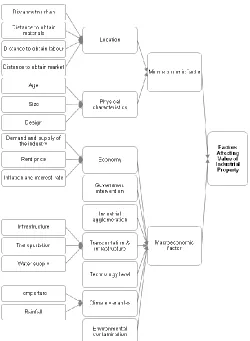
activities, by increasing the cost of cleaning up the site or financing, and by imposing higher transaction costs. In other words, prices will rise if the property is cleaned up. Figure 2 is prepared to summarize our discussion figuratively. All fifteen variables discussed were grouped into nine themes, which were later grouped into micro and macro-economic ones, forming the framework Factors Affecting Value of Industrial Property.
Fig. 2: Factors Affecting Value of Industrial Property Framework
4.
CONCLUSION
217 validate the framework. The opinions of industry players and
stakeholders as a whole may be used for this purpose.
ACKNOWLEDGEMENT
We would like to express our appreciation to the Ministry of Education, Malaysia (MOE) and Universiti Teknologi Malaysia (UTM) for providing research grants and supporting this study (Fundamental Research Grant Scheme (FRGS)-Vot No.: R.J1300000.7852.5F163).
REFERENCE
[1] Alan Kim Wing Chong, Abdul Hakim Mohammed, Mat Naim Abdullah, Mohd Shahril Abdul Rahman, (2019) "Maintenance prioritization – a review on factors and methods", Journal of Facilities Management, Vol. 17 Issue: 1, pp.18-39, doi.org/10.1108/JFM-11-2017-0058 [2] Awang, Mariah, Mohammad, A. H., Sapri, Maimunah., &
Rahman, M. S. A. (2014a). Requisite facilities management competencies for sustainable development at higher education institutions. Journal of Sustainability Science and Management, 9(2), 71-89.
[3] Awang, M., Mohammad, A. H., Sapri, M., Rahman, M. S. A., & Lah, N. M. I. N. (2014b). Measurement of Facility Management Competencies in Higher Education Institution. Jurnal Teknologi, 71(4).
[4] Ambrose, B. (1990). An analysis of the factors affecting light industrial property valuation. Journal of Real Estate Research, 5(3), 355-370.
[5] Arauzo Carod, J. M. (2005). Determinants of industrial location: An application for Catalan municipalities. Papers in Regional Science, 84(1), 105-120
[6] Benjamin, J., Zietz, E., & Sirmans, S. (2003). The environment and performance of industrial real estate. Journal of Real Estate Literature, 11(3), 279-324.
[7] Foo Sing, T. (2002). Valuing renewal options in public industrial leases in Singapore. Journal of Property Investment & Finance, 20(3), 222-241.
[8] Henneberry, J. (1988). Conflict in the industrial property market. Town Planning Review, 59(3), 241.
[9] Haw Li Ping, Janet Jemes, Lim Kian Fung, Ngoo Pei Yin, Nur Aiza Binti Maidin, Mohd Shahril Abdul Rahman. 2019. Factors Affecting Commercial Property Value. International Journal Of Scientific & Technology Research, Vol. 8 Issue: 12, pp.XXX-XXX, DOI: X
[10]Hoag, J. W. (1980). Towards indices of real estate value and return. The Journal of Finance, 35(2), 569-580. [11]Jackson, C., & White, M. (2005). Inflation and rental
change in industrial property: a multi-level analysis. Journal of Property Investment & Finance, 23(4), 342-363. [12]Jackson, T. O. (2001). The effect of previous
environmental contamination on industrial real estate prices. The Appraisal Journal, 69(2), 200.
[13]Kim, J. (2004). The Effects of Economic and Location Factors in Australian Property Market. Pacific Rim Property Research Journal, 9(4), 398-408.
[14]Ko, K., & Cao, X. J. (2010). Impacts of the Hiawatha light rail line on commercial and industrial property values in Minneapolis.
[15]Lin, S. W., & Ben, T. M. (2009). Impact of government and industrial agglomeration on industrial land prices: A Taiwanese case study. Habitat International, 33(4), 412-418.
[16]Lockwood, L. J., & Rutherford, R. C. (1996). Determinants of industrial property value. Real Estate Economics, 24(2), 257-272.
[17]Lucas, E. C., & Mendes-Da-Silva, W. (2018). Impact of climate on firm value: Evidence from the electric power industry in Brazil. Energy, 153, 359-368.
[18]M. Hsia, M. Green, (1991) "BRIEFING: European industrial property location", Property Management, Vol. 9 Issue: 1, pp.51-65
[19]Martin, P., & Rogers, C. A. (1995). Industrial location and public infrastructure. Journal of international Economics, 39(3-4), 335-351
[20]Ming, Y. S., & Hin, H. K. (2006). Planned urban industrialization and its effect on urban industrial real estate valuation: The Singapore experience. Habitat International, 30(3), 509-539.
[21]Onuoha, I. J., Aliagha, G. U., & Rahman, M. S. A. (2018). Modelling the effects of green building incentives and green building skills on supply factors affecting green commercial property investment. Renewable and Sustainable Energy Reviews, 90, 814-823.
[22]Rahman, M. S. A., Ali, H. M., Sipan, I., & Mohammed, A. H. (2015a). Space utilization survey database for Higher Education Institutions. The Role of Service in the Tourism & Hospitality Industry, 175.
[23]Rahman, M. S. A., Ali, H. M., Sipan, I., & Mohammed, A. H. (2015b). Framework of the space utilization survey for Malaysian public Higher Education Institutions. The Role of Service in the Tourism & Hospitality Industry, 169. [24]Rahman, Mohd Shahril Abdul, Hishamuddin Mohd Ali,
Ibrahim Sipan, Mariah Awang, and Abdul Hakim Mohammed. "Space Utilization Model For Higher Education Institutions." Jurnal Teknologi 75, no. 10 (2015c).
[25]Rahman, M. S. A., Ali, H. M., Sipan, I., Awang, M., & Mohammed, A. H. (2015). Factors affecting the space utilisation rate of malaysian public universities. Jurnal Teknologi, no. 10 (2015d).
[26]Thomas, J. (2002). Environmental contamination and industrial real estate prices. Journal of Real Estate Research, 23(1-2), 179-200.
[27]Thompson, B. (2005). Pan-European industrial property. Journal of Property Investment & Finance, 23(4), 379-385. [28]Wang, J. M., Shi, Y. F., & Zhang, J. (2017). Energy
efficiency and influencing factors analysis on Beijing industrial sectors. Journal of Cleaner Production, 167, 653-664.
[29]Ying Li Yap, Mohd Shahril Abdul Rahman. 2019. Quality Management in Real Estate Industries. International Journal Of Scientific & Technology Research, Vol. 8 Issue: 12, pp.XXX-XXX, DOI: X