264 |
P a g e
BUILDING VIRTUAL MACHINE INSTANCE, COMPATIBLE
WITH USER’S WEB APPLICATION IN OPEN STACK CLOUD
PROVIDER
Mrs.Niranjana A
1, Ms.A.Geetha
2Assistant Professor, Department of Computer Science and Engineering
Easwari Engineering College, Chennai
ABSTRACT
One of the key challenges in building a platform for deploying applications is to automatically compose, configure,
and deploy the necessary application that consists of a number of different components. Setting up complex
combination of appliances is costly and error prone even in traditional hosting environments. Virtual appliances
provide an elegant solution for this problem. They are built and configured with a necessary operating system and
software packages to meet software requirements of a user. In Existing System, non-expert users are not aware of
composition of cloud services, whether applications are compatible or not. They are not aware of web application
dependencies and configuration details. Real time process of virtual instances is not supported. Individual
appliances cannot be simply put together as they may not be compatible with the hosting environment. None of the
providers provide any ranking system to choose the best instance type and software solution for the deployment.
OpenStack Cloud provider which is the best to build a Virtual Instance is used in this system. This system helps
non-expert users with limited or no knowledge on legal and image format compatibility issues to deploy their services
faultlessly. Users have the flexibility to build their own instance based on his/her requirements. Even for web
applications, user can select their web application dependencies based on his/her preferences.
Key Terms: Virtual Instance, Web Application, OpenStack, Cloud Services, Virtual Appliance
I INTRODUCTION
A single Cloud service (i.e., a software image and a virtual machine), on its own, cannot satisfy all the user
requirements, a composition of Cloud services is required. Cloud service composition, which includes several tasks
such as discovery, compatibility checking, selection, and deployment, is a complex process and users find it difficult
to select the best one among the hundreds, if not thousands, of possible compositions available. Service composition
in Cloud raises even new challenges caused by diversity of users with different expertise requiring their applications
to be deployed across difference geographical locations with distinct legal constraints. The main difficulty lies in
selecting a combination of virtual appliances (software images) and infrastructure services that are compatible
265 |
P a g e
One of the key challenges in building a platform for deploying applications is to automatically compose, configure,
and deploy the necessary application that consists of a number of different components. The deployment
requirements of a web application service provider will include security devices (e.g. firewall), load balancers, web
servers, application servers, database servers, and storage devices. Setting up such a complex combination of
appliances is costly and error prone even in traditional hosting environments. Virtual appliances provide an elegant
solution for this problem. They are built and configured with a necessary operating system and software packages to
meet software requirements of a user. Non-expert users are not aware of composition of cloud services, which are
compatible or not. They are not aware of web applications dependencies and Configuration details. Their deployed
applications can be misconfigured. Real time process of virtual instances is not supported. Individual appliances
cannot be simply put together as they may not be compatible with the hosting environment. Setting up complex
combination of appliances is costly and error prone. None of the providers provide any ranking system to choose the
best instance type and software solution for the deployment.
II RELATED WORKS
Amir Vahid Dastjerdi (2014) deduced that a single Cloud service (i.e., a software image and a virtual machine), on
its own, cannot satisfy all the user requirements, a composition of Cloud services is required. Cloud service
composition, which includes several tasks such as discovery, compatibility checking, selection, and deployment, is
a complex process and users find it difficult to select the best one among the hundreds, if not thousands, of possible
compositions available. Service composition in Cloud raises even new challenges caused by diversity of users with
different expertise requiring their applications to be deployed across difference geographical locations with distinct
legal constraints. The main difficulty lies in selecting. a combination of virtual appliances (software images) and
infrastructure services that are compatible and satisfy a user with vague preferences.Therefore, they present a
framework and algorithms which simplify Cloud service composition for unskilled users. They developed an
ontology-based approach to analyze Cloud service compatibility by applying reasoning on the expert knowledge. In
addition, to minimize effort of users in expressing their preferences, they apply combination of evolutionary
algorithms and fuzzy logic for composition optimization. This lets users express their needs in linguistics terms
which brings a great comfort to them compared to systems that force users to assign exact weights for all
preferences.
Changhua Sun (2008) focused on simplifying service deployment with virtual appliances. Techniques used by them
are the use of virtual appliances as a better service for deployment and comparison of traditional deployment
mechanisms and virtual appliances type of deployment. They start with an easy to understand model to describe the
complexity of service deployment and introduce the architecture of a virtual appliance. It is observed that the
deployment process of using traditional deployment mechanisms, and quantitatively and qualitatively compares
operations and parameters of traditional approach with the use of virtual appliances. The results show virtual
appliances offer significant advantages for service deployment by making deployment process much simpler and
266 |
P a g e
Rajkumar Buyya (2010) observed that Virtual Appliances, pre-configured, ready-to-run applications are emerging as
a breakthrough technology to solve the complexities of service deployment on Cloud infrastructure. However, an
automated approach to deploy required appliances on the most suitable Cloud infrastructure is neglected by previous
works which is the focus of this work. In this paper, they proposed an effective architecture using ontology-based
discovery to provide QoS aware deployment of appliances on Cloud service providers. In addition, they tested their
approach on a case study and the result shows the efficiency and effectiveness of the proposed work.
III PROPOSED SYSTEM
Proposed system uses OpenStack Cloud provider which is the best to build Virtual Instance. OpenStack software
controls large pools of compute, storage, and networking resources throughout a datacenter, managed through
a dashboard or via the OpenStack API. Cloud services consisting of virtual appliance and units are compatible with
each other. The system helps non-expert users with limited or no knowledge on legal and image format
compatibility issues to deploy their services faultlessly. User can build their own instance based on his/her
requirements. Web applications dependencies are available, which means the user only has to select his web
application dependencies based on his/her preferences.
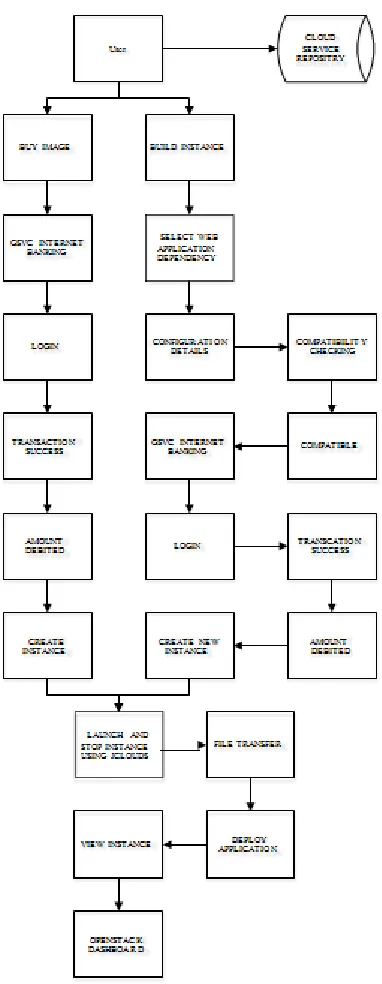
Initially, the user buys images based on personal requirements which includes Operating Systems, RAM, and
Database. Following this, Compatibility checking of cloud services is done. If the cloud services are compatible, the
user is redirected into GSVC Internet Banking. After successful transaction, the amount will be debited from his/her
account. The user checks the newly created instances in launching an Instance module. Information about User
owned instances details are stored in database. Following that, instances owned by the user and running instances
are displayed. Using jclouds, user can launch and stop the instances. User can check their active instances in web
page or in OpenStack Dashboard. The user can finally launch his web application with the help of Putty.
The proposed system consists of the following modules
• Cloud Service Composition
• Build and Configure Instance
• Launch an Instance
267 |
P a g e
Fig. 1 Overview of System Design
Cloud Service Composition
The user has to register his/her details like Username, Date of Birth, Contact Number, Email etc. on the main page.
User ID is automatically generated when the user presses the Click Button. If the user has already registered his
details, the user can directly log in. The server in turn stores the user information in its database. User can also view
268 |
P a g e
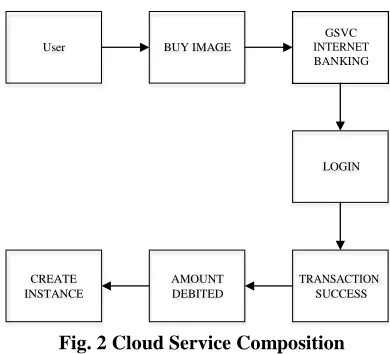
Advertisement of two default instances of service provider is available in this module.
Fig. 2 Cloud Service Composition
Default instances consist of details like OS, RAM, Web Server, Database and Price. User buys instances based on
their requirements. At buy instance stage, user is redirected into GSVC Internet Banking Web Page. The user has to
enter his Bank account User ID and password in order to log in. The user confirms his purchase by checking his
balance and entering his transaction password. After successful transaction, the amount will be debited from his/her
account. The user checks their bought instances in launching an Instance module. User owned instances details are
stored in database.
Build and Configure Instance
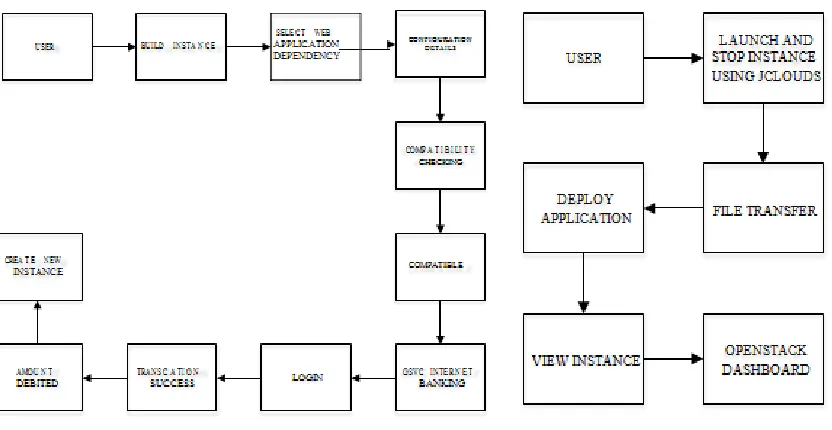
User can create new instance based on his/her requirements. In this module, user can select their Web application
dependency which includes Operating Systems, RAM, and Database, Architecture and Budget. Requested Service
will not be provided if there are budget constraints. Therefore, using high-level if-else cases, Compatibility checking
of cloud composition services is done successfully. The user is then redirected to the Web Page which gets the type
and weight of Web Application to be deployed from the user. Selection of RAM and whether the web application
needs a database is also checked. If the cloud services are fully compatible, user is redirected into GSVC Internet
Banking.
.The user has to enter his Bank account User ID and password in order to log in. The user confirms his purchase by
checking his balance and entering his transaction password after successful transaction, the amount will be debited
from his/her account. The user checks their newly created instances in launching an Instance module.
Launch Instances
In this module, instances owned by the user and running instances are displayed. Now user can launch any instances.
An Instance is launched using Apache jclouds, (which is an open source multi-cloud toolkit for the Java platform
that gives the user the freedom to create applications that are portable across clouds while giving the user
full control to use cloud-specific features) based on specified RAM and instance name. Start and end execution time
of the instance will be recorded. Instance will be created in OpenStack Dashboard. A separate IP, name and image
name will be created for each instance. Now user can view their virtual instance in OpenStack.
User BUY IMAGE
LOGIN
AMOUNT DEBITED
TRANSACTION SUCCESS
GSVC INTERNET BANKING
269 |
P a g e
Fig. 3 Build and Configure Instance Fig. 4 Launch and deploy applicationDeploy Application
Using putty, user connects to IP assigned for the virtual instance. Now user connects into Virtual Instance. Giving
file transfer command, user transfer their web application to Virtual instance. The syntax for transferring file is <
pscp – sftp filename username@instanceipaddress> and for transferring a folder is <pscp –stfp –r folder
name username@instanceipaddress> User can also transfer database files to Virtual Instance. Now user can deploy
their web applications in Virtual Instance with the help of Apache Tomcat. Real time process is shown in OpenStack
Dashboard.
IV. RESULTS AND DISCUSSION
Cloud services consisting of virtual appliance and units are made compatible with each other. This system helps
non-expert users with limited or no knowledge on legal and image format compatibility issues to deploy their
services faultlessly. User are given freedom to build their own instance based on his/her requirements. Web
applications dependencies are available, which means the user only can select his web application dependencies
based on his/her preferences.
Initially, the user buys images based on personal requirements which include Operating Systems, RAM, and
Database. Following this, Compatibility checking of cloud services is done. If the cloud services are compatible, the
user is redirected into GSVC Internet Banking. After successful transaction, the amount will be debited from his/her
account. The user checks the newly created instances in launching an Instance module. Information about User
owned instances details are stored in database. Following that, instances owned by the user and running instances
are displayed. Using jcloud, user can launch and stop the instances. User can check their active instances in web
270 |
P a g e
Fig.5 User Profile Fig.6 Cloud Composition Details
Fig.7 Transaction Page Fig.8 User Preferred Web Application
Fig.9 Display User Instances Fig.10 Instance Launched
Fig.11 Running the Instance Fig.12 Deploy Web Application
271 |
P a g e
[4] Buyya, R. and Dastjerdi, A. (2012) ‘An autonomous reliability-aware negotiation strategy for cloud computing environments,’ in Proceedings of 12th IEEE/ACM International Symposium on Cluster, Cloud and Grid Computing. IEEE.
V. CONCLUSION
In this system Virtual Machine Instance is successfully built in which compatible User Web
Application is successfully deployed in Open Stack Cloud Provider. A platform or virtual OS is provided for the
user which enables the user to launch a personal webpage with the help of Virtual Box, Apache Tomcat, Putty and
MySQL.
Thus the enhancement made solves the issues in the existing system by running complex combination of virtual
appliances using OpenStack and thoroughly checking the compatibility of the cloud service composition and
deploying applications successfully.
Future enhancement of this system includes, supporting contemporary Operating Systems for the user to work on.
Further work can be done to support deployment of multiple web applications in a single instance.
REFERENCES
[1] Bartalos, P. and Bieliková, M. (2012) ‘Automatic dynamic web service composition: A survey and problem formalization’, Computing and Informatics, Vol.30, No.4, pp.793–827.
[2] Benn, N. Domingue, J. and Lambert, D. (2010) ‘Integrating heterogeneous web service styles with flexible semantic web services groundings’, in Proceedings of the 1st International Future Enterprise Systems Workshop.
[5] Buyya, R. Dastjerdi, A. and Tabatabaei, S. (2010) ‘An effective architecture for automated appliance management system applying ontology-based cloud discovery,’ in Proceedings of the 10th IEEE/ACM International Conference on Cluster, Cloud and Grid Computing.
[6] Chen, H. and Yao, Y. (2009) ‘Qos-aware service composition using nsga-ii,’ in Proceedings of the 2nd International Conference on Interaction Sciences: Information Technology, Culture and Human, ser. ICIS ’09. New York, NY, USA: ACM.
[7] Chieu, T. Karve, A. Mohindra, A. and Segal, A. (2010) ‘Solution based deployment of complex application services on a cloud,’ in Proceedings of the 2010 IEEE International Conference on Service Operations and Logistics and Informatics. [8] Durillo, J. and Nebro, A. (2011) ‘jmetal: A java framework for multi-objective optimization,’ Advances in Engineering
Software, Vol.42, No.10, pp.760–771.
[9] Lecue, F. and Mehandjiev, N. (2009) ‘Towards Scalability of Quality Driven Semantic Web Service Composition’, Proc. IEEE International Conference on Web Services, pp. 469-476.