Research article Available online www.ijsrr.org
ISSN: 2279–0543
International Journal of Scientific Research and Reviews
Efficacy of Dynamic Muscular Stabilization Techniques (DMST) on
Non-Specific Low Back Pain, Disability and Quality of Life in
Elderly Individual
Mishra Neeti
1, Mishra Anil
2and Bidija Mansi
31
Associate Professor, Physiotherapy Department, SPB Physiotherapy College, Surat, India,
2
Professor, Director, Shreemad Rajchandra College Of Physiotherapy, Bardoli, India,
3
Assistant Professor, Shreemad Rajchandra College Of Physiotherapy, Bardoli, India,
ABSTRACT:
Low back pain is major health and socioeconomic problem in modern society, the prevalence has been found to range between6.2% to 92.To find the effectiveness of dynamic mucular stabilization exercise for pain, disability and quality of life in elderly individuals. A group of 62 subjects were selected for the study and randomly divided into two equal groups of 31 each. All subjects were selected between the age group of 65-75 years. The group A subjects were asked to perform dynamic muscular stabilization exercise program me along with conventional exercise program me and group B performed conventional exercise program me. Pain, disability and QOL were compared and assessed Pre and Post intervention using NPRS, ODI and WHOQOL BREEF respectively. The statistical analysis was done between groups as well as within groups. The result of within groups shows significant difference between pre and post score for all outcome measures. The result of between groups also shows significant difference for the post test score of group A and group B. The dynamic muscular stabilization exercise showed statistically significant improvement in reducing back pain, disability and improves quality of life in elderly individuals, when compared to the conventional exercise programme among elderly subjects having low back pain.
KEYWORDS:
Dynamic muscular stabilization techniques, Low Back Pain, elderly individuals, Disability Quality of life.* Corresponding author
Dr. Neeti Mishra
1Associate Professor, Physiotherapy Department, SPB Physiotherapy College, Surat, India,
INTRODUCTION:
India as the second most populous country in the world has 76.6 million people at or over the age of 60, constituting above 7.7% of total population. The problems faced by this segment of the population are numerous owing to the social and cultural changes that are taking place within the Indian society1.
Back pain ranks as the second most common reason for physician visits and the
third most common reason for surgery for elderlies. As many as 90% of elderly people in the India will have back pain 2. Back pain is usually a benign, self-limiting disorder resulting from strains and over-use, but can include more serious problems such as degenerative changes3
Many elderlies are currently disabled due to chronic back pain (CBP); approximately 80% of people diagnosed with back pain remain symptomatic after one year 4. This leads to health care provider's view that caring for elderlies with low back pain and to improve their QOL5.
The World Health Organization (WHO) has defined QOL as a person’s perception of his or her life position in the value system and the culture in which they live, and in addition, it is related to one’s life goals, expectations, standards and concerns. QOL of older adults has become an important issue, because of physiological changes resulting from the ageing of the population6.
An increasingly common approach used within the physical therapy management of LBP has been low load, high repetition training of the abdominal and trunk muscles7 developed partially in response to evidence indicating specific neuromuscular alterations in the control and activation of the back and abdominal muscles in the presence of back pain8 .
In such cases Dynamic muscular stablization techniques were found to be effective8. Specific trunk stabilizing exercises with co-contraction of deep abdominal and lumbar multifidus muscles enhance the spinal segmental support and control9. Though stabilization techniques were found suitable for the low back pain in adults, but the effectiveness of this form of treatment among elderlies of LBP is not reported till date11 . However, till date less prospective studies are found making the comparison between the effectiveness of DMST and Conventional Training program for low back pain , disability and QOL in the elderly population .The purpose of the study was to design DMST for elderly individual that can be implemented for low back pain .
So specific aim and objective of our study was to compare the effect of conventional therapy and DMST with conventional therapy on low back pain , disability and QOL in elderly individual. So the alternate hypothesis of our study was set as DMST may show effectiveness on low back pain , disability and QOL in elderly individuals.
METHODOLOGY:
Study design: Pre and post test experimental study
Population: Elderly individual of 65 to 75 years of age
Sampling technique: Purposive sampling
Sample size: 62
For the study the sample size was calculated in G Power 3.1.9.2 with effect size 0.80 and α =0.05. Sample size calculated was 52, with a drop out chances of 20% the total sample size was 62 samples and 31 subjects in each group.
Study Setting: Senior citizen organization committee, Surat
Volunteers of 65 -75 years of age ,Willingness to do physical exercise , Able to do daily activities by themselves and walk at least 30 feet with or without an assistive device, having low back pain history since 6 months and having medium to moderate score (0 to 40%)on ODI were included in the study. Patients having radiating pain to the legs, history of fracture, abdominal surgery in last 6 months, or constitutional symptoms like fever, malaise, etc indicating infection, any inflammatory conditions of spine, osteoporosis, bony abnormalities, scoliotic or kyphotic spine ,pregnancy, sensory impairments, vascular causes of radiating pain or neoplasms were excluded.
PROCEDURE:
Ethical clearance was taken from institutional ethical committee. The confidentiality of the patients were maintained. Subjects was preliminary screened based on the inclusion and exclusion criteria .They were allocated in to two groups using Quasi randomization .
Group A: DMST with Conventional exercises training Group B: Conventional exercise training
On the first day of first week, pre test measurements of pain was taken on NPRS , disability was measured on ODI and QOL was measured on WHOQOL BREF . In group A Conventional training programme, was done for 25 mins and DMST component was done for 15 minutes . A rest period of 5 minutes was given between both components and lasted for about 45 minutes. All subjects undergone this treatment session for 5 days per week for total 5 weeks.
GROUP A: DMST with Conventional therapy DMST COMPONENT:
1st week
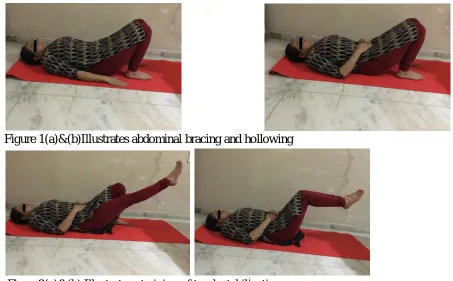
(a) Abdominal bracing Patient lying in crook lying position and is instructed to draw the navel
up and in towards the spine or feeling the muscle tighten at the waist. From the beginning patient learns to breathe normally while activating or holding the muscular contraction.
(b) Abdominal Hollowing: Patient is in supine hook lying position and is instructed to perform
abdominal hollowing by making the lower abdomen cave in with both arms elevated. (Fig. 1 (a) & 1 (b))
2nd week
2. Training of trunk stabilization under static conditions of increased load:
like:-(a) One leg with knee extended. (Images 2 like:-(a)) (b) Both legs with knees flexed. (Images 2 (b))
3rd week
3. Development of trunk stabilization during slow controlled movement of the lumbar spine:
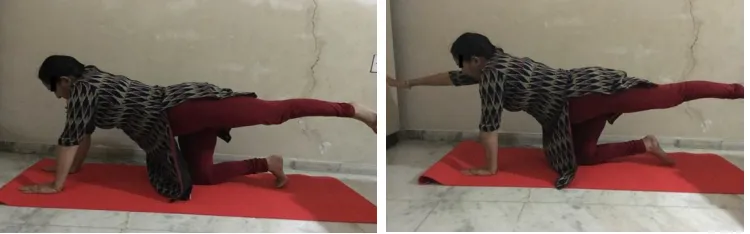
Once the stability is trained through static procedure, the movement of the trunk with appropriate activation of the supporting muscles. The first step is to produce and explore lumbo-pelvic movements and learn abdominal hollowing or bracing in quadruped position and second step is controlled loading by
(a) Movement of trunk with one lower limb elevation.( Images 3 (a))
(b) Movement of trunk with elevation of one upper limb with the diagonal lower limb. (Images 3 (b))
4th and 5th week :
• Repeat all lumbar stabilization exercises with high speed and skilled movement .
Figure 1(a)&(b)Illustrates abdominal bracing and hollowing
Figure 3(a)&(b)Illustrates development of trunk stabilization
GROUP B : CONVENTIONAL TRAINING PROGRAMME
Conventional physiotherapy includes trunk stretching exercises ie., unilateral knee to chest in supine lying and lateral trunk bending exercises in standing . It was continued for 10 mins with 10 sec hold in each repititions. Immediately hot pack was placed for 15 mins .The procedure was continued for 5 weeks for both groups. Data of all subjects was taken on first and last day .
STATISTICAL ANALYSIS
Analysis was done using SPSS-16. Descriptive analysis was used to calculate mean and standard deviation . Paired t test was used for inter group analysis. Independent t test was used for intra group analysis for all the three dependent variables. The level of significance was set at 95%.
RESULTS:
Pre and post intervention within group was done using paired t test which shows highly significant difference in both groups in all the outcome scores. Comparison between groups was done using independent t test which shows significant differences in both groups for all variables .
INTER GROUP ANALYSES FOR ALL THE OUTCOME MEASURES:
Table 1(a) illustrates pre and post comparison of pain in group 1
NPRS Group-1
Mean N
Std. Deviation
Mean difference
P-value
Pre 5.2258 31 .80456
1.258 P<0.0001
Table 1(b)illustrates pre and post comparison of pain in group 2
NPRS Group-2
Mean N
Std. Deviation
Mean difference
P-value
Pair 1 Pre 5.0968 31 .83086
0.87097 P<0.0001
Post 4.2258 31 .80456
Table 2 (a) illustrates pre and post comparison of ODI Score ODI Group -1
In group 1
Mean N
Std. Deviation
Mean difference
P-value
Pair 1 Pre 26.4194 31 4.55539
3.5483 P<0.0001
Post 22.8710 31 4.91082
Table 2(b) illustrates pre and post comparison of ODI score in group 2
ODI Group -2
Mean N
Std. Deviation
Mean difference
P-value
Pair 1 pre 24.6290 31 4.36075
2.7580 P<0.0001
post 21.8710 31 4.19318
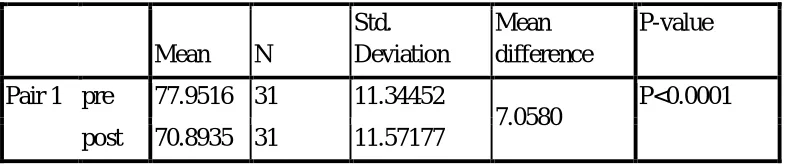
Table 3 (a) illustrates pre and post comparison of WHOQOL BREF SCORE
in group 1
WHOQOL BREEF :GROUP 1
Mean N
Std. Deviation
Mean difference
P-value
Pair 1 pre 77.9516 31 11.34452
7.0580 P<0.0001
post 70.8935 31 11.57177
in group 2
WHOQOL BREEF :GROUP 2
Mean N
Std. Deviation
Mean difference
P-value
Pair 1 pre 78.9323 31 9.13297
3.676 P<0.001
post 75.2565 31 12.03508
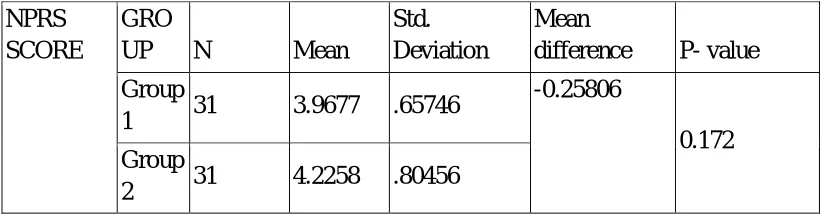
TABLE 4(1)shows intragroup comparison analyses for NPRS Score
NPRS SCORE
GRO
UP N Mean
Std. Deviation
Mean
difference P- value
Group
1 31 3.9677 .65746
-0.25806
0.172 Group
2 31 4.2258 .80456
TABLE 4(2) shows intragroup comparison analyses for ODI Score
ODI
SCORE N Mean
Std. Deviation
Mean
difference P- value
Group
1 31 22.8710 4.91082
1.000
0.392 Group
2 31 21.8710 4.19318
TABLE 4(3s) shows intragroup comparison analyses for WHQOL Score
WHOQOL BREEF SCORE
N Mean
Std. Deviation
Mean
difference P- value
Group
1 31 70.8935 11.57177 -4.3629
WHOQOL BREEF SCORE
N Mean
Std. Deviation
Mean
difference P- value
Group
1 31 70.8935 11.57177 -4.3629
0.151
Group
2 31 75.2565 12.03508
DISCUSSION :
This study showed that DMST using patients improved significantly on all outcome measures in elderly individuals .In the conventional group, although improvements were seen on all subscales, they were less than those in DMST group .
A recent study on the topic has found that the health related quality of life of patients with low back pain depends on functional status and psychological factors more than simple physical impairment.
.
Thus, in this respect it seems that DMST is a very relevant regimen to improve both patients’ physical and psychological status. DMST was more effective as it emphasizes specifically on muscle strengthening and spinal stabilization component which once gained leads to relief from physical and thus mental symptoms .In DMST the more improvement may be due to restoration of muscle strength in combination with balance, posture and coordination due to presence of pain and functional disability12.
The study has certain limitations too. As it was done only on small sample size, the results could not be generalized to the entire elderly population. More over it was not possible to blind participants to the intervention, so there may be chance of bias . There was also practical difficulty while delivering the interventions to elderly individual which may not be feasible in a non-research set- up. The total study duration was short. Follow up of the interventions was not taken.
CONCLUSION
Data analysis shows that Dynamic Muscular Stabilization Technique (DMST) is more effective in improving QOL in Low Back Pain patients, than conventional exercises.
Conventional training exercises had also shown improvement for low back pain ,disability and QOL in elderly individuals. DMST showed significant difference for all the outcome measures .
References:
2. Canale, S.T. Campbell’s operative orthopaedics, 10th edition, St. Louis: Mosby. (2003)
3.Johnson, J.E., & Johnson, K.E. Ambiguous chronic illness in women: A community health nursing concern. Journal of Community Health Nursing,(2006), 23, 159-167.
4. Grabois, M. Management of chronic low back pain. American Journal of Physical Medicine and Rehabilitation. 84(3, Supplement), (2005),S29-S41.
5. Anil mishra, Neeti mishra, Physical status of elderly people n old age homes in south Gujarat:an overview,IJHSR,Impact factor 0.35,vol.6,Issue 2(2016-12),page 254-259,2249-
6. Power, M.; Kuyken, W.; Orley, J. The World Health Organization Quality of Life Assessment (WHOQOL): Development and general psychometric properties. Soc. Sci. Med. 1998, 46, 1569– 1585.
7.Bentsen, S.B., Hanestad, et al,. Quality of life in chronic low back pain patients treated with instrumented fusion. Journal of Clinical Nursing,(2008). 17, 2061-2069.
8. Hides JA, Richardson CA, Jull GA. Multifidus muscle recovery is not automatic after resolution of acute, first-episode low back pain. Spine 1996; 21: 2763–9.
9. Hodges PW , Richardson CA. Inefficient muscular stabilization of the lumbar spine associated with low back pain: A motor control evaluation of transversus abdominis. Spine 1996;21:2640– 50.
10.Anil mishra,Neeti mishra,A retrospective study on physical status of geriatric persons in south Gujarat,IRJSH,Impact factor 0.353,vol. 3,issue 12,(2014-12),page 90-101,2320-4702.
11. Moseley GL, Nicholas MK, Hodges PW. Pain differs from non-painful attention-demanding or stressful task in it effect on postural control patterns of trunk muscles. Exp Brain Res 2004;156:64–71.
12. O’Sullivan P, Twomey L, Allison G, et al. Altered patterns of abdominal muscle activation in patients with chronic low back pain. Aust J Physiother 1997;43:91