© 2017 IJSRST | Volume 3 | Issue 4 | Print ISSN: 2395-6011 | Online ISSN: 2395-602X Themed Section: Science and Technology
Advantages with IOT in E-Commerce
1
K. Sai Santosh Kumar,
2Abdul Matheen,
3Qamer Unnisa Hina,
4V. Sharmila
1,2,3,4
M.Com, 1M.B.A
1,2,3,4
Department of Commerce
1St.Paul’s Degree & PG College, Hyderabad, Telangana, India 2
Nizam College, Hyderabad,Telangana, , India
3
S.N.Vanitha Mahavidyalay, Nampally, Hyderabad, Telangana, India
4
Holy Cross College, Tiruchirappalli,Tamilnadu, India
ABSTRACT
One of the buzzwords in the Information Technology is Internet of Things (IOT). The future is Internet of Things, which will transform the real world objects into intelligent virtual objects. The main goal of the IOT’s development is to connect the physical world and the environment to the Internet. The main objective of this paper is to provide an overview of Internet of Things, architectures, applications and impact in our daily life.
Key words: IOT, RFID, Wireless Sensor Networks, Internet, Services
I.
INTRODUCTION
Internet appears everywhere in the world, but it is still a connection between people and people. Internet connects all people, so it is called ―the Internet of People‖. IOT connects all things, so it is called ―the Internet of Things‖. The Internet is a global system of interconnected computer networks that use the standard Internet protocol suite (TCP/IP) to serve billions of users worldwide. It is a network of networks that consists of millions of private, public, academic, business, and government networks, of local to global scope, that are linked by a broad array of electronic, wireless and optical networking technologies [3]. Today more than 100 countries are linked into exchanges of data, news and opinions through Internet. While coming to the Things that can be any object or person which can be distinguishable by the real world. Everyday objects include not only electronic devices we encounter and use daily and technologically advanced products such as equipment and gadgets, but ―things‖ that we do not do normally think of as electronic at all—such as food, clothing; and furniture; materials, parts and equipment, merchandise and specialized items; landmarks, monuments and works of art and all the miscellany of commerce, culture and sophistication [4]. That means here things can be both living things like person,
animals—cow, calf, dog, pigeons, rabbit etc., plants— mango tree, jasmine, banyan and so
on and nonliving things like chair, fridge, tube light, curtain, plate etc. any home appliances or industry apparatus. So at this point, things are real objects in this physical or material world. Internet of Things is defined as ―An open and comprehensive network of intelligent objects that have the capacity to auto–organize, share information, data and resources, reacting and acting in face situations and changes in the environment‖. Internet of Things is one of the last advances in Information and Communication Technologies, providing global connectivity and management of sensors, devices, users and information [5].
II.
IOT ELEMENTS
and referred over the internet [8]. IOT,which is integrated with Sensor Technology and Radio Frequency Technology, is the ubiquitous
network based on the omnipresent hardware resources of Internet, is the Internet contents
objects together. It is also a new wave of IT industry since the application of computing fields, communication network and global roaming technology had been applied. It involves in addition to sophisticated technologies of computer and communication network outside, still including many new supporting technologies of Internet of Things, such as collecting Information Technology, Remote Communication Technology, Remote Information Transmission Technology, Sea Measures Information Intelligence Analyzes and Controlling Technology etc. [9].
A. Radio Frequency Identification (RFID)
RFID (Radio Frequency Identification) devices are wireless microchips used for tagging objects for automated identification. RFID systems consist of a reading device called a reader, and one or more tags. The reader is a powerful device with ample memory and computational resources RFID can identify objects wirelessly without line-of-sight.
B. Internet Protocol (IP)
Internet Protocol (IP) is the primary network protocol used on the Internet, developed in 1970s. IP is the principal communications protocol in the Internet protocol suite for relaying datagram’s across network boundaries.
C. Wi-Fi
Wi-Fi is the name of a popular wireless networking technology that uses radio waves to provide wireless high-speed Internet and network connections. A common misconception is that the term Wi-Fi is short for "wireless fidelity," however this is not the case. Wi-Fi is simply a trademarked phrase that means IEEE 802.11x.
D. Bluetooth
Bluetooth wireless technology is an inexpensive, short-range radio technology that eliminates the need for proprietary cabling between devices such as notebook PCs, handheld PCs, PDAs, cameras, and printers and effective range of 10 - 100 meters.
E. ZigBee
ZigBee is one of the protocols developed for enhancing the features of wireless sensor networks. ZigBee technology is created by the ZigBee Alliance which is founded in the year 2001. Characteristics of ZigBee are low cost, low data rate,relatively short transmission range, scalability, reliability, flexible protocol design.
F. Near Filed Communication (NFC)
Near Field Communication (NFC) is a set of short-range wireless technology at 13.56 MHz, typically requiring a distance of 4 cm. NFC technology makes life easier and more convenient for consumers around the world by making it simpler to make transactions, exchange digital content, and connect electronic devices with a touch. Allows intuitive initialization of wireless networks and NFC is complementary to Bluetooth and 802.11 with their long distance capabilities at a distance circa up to 10 cm. It also works in dirty environment, does not require line of sight, easy and simple connection method. It is first developed by Philips and Sony companies. Data exchange rate now days approximately 424 kbps.
G. Actuators
An actuator is something that converts energy into motion, which means actuators drive motions into mechanical systems. It takes hydraulic fluid, electric current or some other source of power. Actuators can create a linear motion, rotary motion or oscillatory motion. Cover short distances, typically up to 30 feet and generally communicate at less than 1 Mbps.
III.
IOT & DAILY LIFE
Some of the largest tech behemoths have recently joined together to make the Internet of Things a closer reality in all of our homes, cars and lives. Here are the changes coming to our everyday lives.
A. Tuning your car
As more machines speak to each other and systems integrate, you will no longer miss an oil change. Your truly "smart" car will preemptively reach out to your mechanic when it is time for the annual tune up or your tire pressure is running low, and by cross referencing your calendar, appointment suggestions will be delivered to you to confirm a time with one click.
When a prescription is running low, an appointment will be made with your physician through connected RX bottles. Doctors will be kept informed with how often and when their patients are taking their medicine and those with ongoing health issues will be able to have things such as blood pressure and sugar levels monitored remotely.
C. Energy consumption
High-energy consumption household appliances will adjust based on dynamic price signals to lower your electric bill. Thermostats and lighting will learn your habits to create the optimal setting based on your daily life, such as turning to your ideal temperature just before you arrive home. These gadgets will also sense when no one is in the house and turn off automatically to reduce wastes and costs.
D. Driving and traffic jams
Driving will get a lot safer. Traffic lights will be able to adjust to real-time traffic conditions such as when an emergency vehicle is approaching. Road sensors will make changes to the speed limit based on weather and accidents, while also communicating directly to car dashboards about unsafe conditions (e.g. slow down. The turn in a quarter mile is icey).
E. Grocery lists
Smart refrigerators will sense when you are running low on staples such as eggs or milk and will automatically populate your grocery list. Stores will push reminders to add items to your list when it predicts you about to run out based on your historical purchasing behavior and average buying trends. When you are walking through the store, reminders will get pushed to you to ensure you never have to make that dreaded second trip.
F. Smart homes
The most obvious aspect of IOT is smart homes. From the moment we wake up, devices-permitting, our homes will be reacting to our very existence.
1) Alarm clocks will be synced up to weather and traffic apps, reflecting what time we need to get up and into work. Heating systems will time it so that we have hot water in time for our shower, while lights will be synced up to turn on only in the rooms we frequent at ungodly early-morning hours.
2) Coffee machines will chug into gear just in time to hand us a fresh cup as we walk out the door, as the lights, once more, operate throughout the day to make it seem like somebody is home.
3) Smart doorbells – think Ring – will alert us when there is someone at the door, meaning we can accept deliveries even when abroad, or appear to be home even when in work. Pets won’t go unaffected, either, with a smart doggy door opening and closing as our pooch goes in and out of the back garden, while the humble smart watch connects to a home system so we can communicate with our lonely dogs, or a programmed laser toy can keep cats entertained.
G. Monitoring your baby
Through their smart phones, parents will monitor their baby's breathing, temperature and activity. Babies will don connected onesies that will send an alert when there is anything abnormal. Of course, the other babies in your life will also reap the benefits of connectivity.
H. What's on your body?
Online devices can be worn by people to track location, health, or fitness record, similar to most wearable worn today. The sensor devices can be used to monitor children, employees, or other individuals that may require special assistance. Within a decade, these devices can become smaller, lighter, or may even become embedded into our bodies–with enough advances in technology, and of course, general population approval.
IV.
ARCHITECTURE & DEPENDENCIES
given platform. For example, the correct version of the underlying OS and the required sensors and actuators can be checked when the app is installed [2]. A similar architectural approach for IOT would also have similar advantages. However, the underlying platform for IOT is much more complicated than for Smartphone’s. Nevertheless, if IOT is based on an underlying sensor and actuator network that acts as a utility similar to electricity and water, then, different IOT applications can be installed on this utility. While each application must solve its own problems, the sharing of a sensing and actuation utility across multiple simultaneously running applications can result in many systems-of-systems interference problems, especially with the actuators. Interferences arise from many issues, but primarily when the cyber depends on assumptions about the environment, the hardware platform, requirements, naming, control and various device semantics. Previous work, in general, has considered relatively simple dependencies related to numbers and types of parameters, versions of underlying operating systems, and availability of correct underlying hardware. Research is needed to develop a comprehensive approach to specifying, detecting, and resolving dependencies across applications. This is especially important for safety critical applications or when actuators can cause harm.
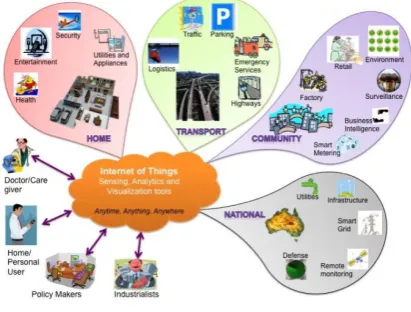
Figure 1: Internet of Things
V.
CHALLENGES
Five key IOT issue areas are examined to explore some of the most pressing challenges. These include security; privacy; interoperability and standards; legal, regulatory, and rights; and emerging economies and development.
A. Security
While security considerations are not new in the context of information technology, the attributes of many IOT implementations present new and unique security challenges. Addressing these challenges and ensuring security in IOT products and services must be a fundamental priority. Users need to trust that IOT devices and related data services are secure from vulnerabilities, especially as this technology become more pervasive and integrated into our daily lives. Poorly secured IOT devices and services can serve as potential entry points for cyber attack and expose user data to theft by leaving data streams inadequately protected.
B. Privacy
The full potential of the Internet of Things depends on strategies that respect individual privacy choices across a broad spectrum of expectations. The data streams and user specificity afforded by IOT devices can unlock incredible and unique value to IOT users, but concerns about privacy and potential harms might hold back full adoption of the Internet of Things. This means that privacy rights and respect for user privacy expectations are integral to ensuring user trust and confidence in the Internet, connected devices, and related services.
C. Interoperability / Standards
A fragmented environment of proprietary IOT technical implementations will inhibit value for users and industry. While full interoperability across products and services is not always feasible or necessary, purchasers may be hesitant to buy IOT products and services if there is integration inflexibility, high ownership complexity, and concern over vendor lock-in.
D. Legal, Regulatory and Rights
E. Emerging Economy and Development Issues
The Internet of Things holds significant promise for delivering social and economic benefits to emerging and developing economies. This includes areas such as sustainable agriculture, water quality and use, healthcare, industrialization, and environmental management, among others. As such, IOT holds promise as a tool in achieving the United Nations Sustainable Development Goals.
F. Applications
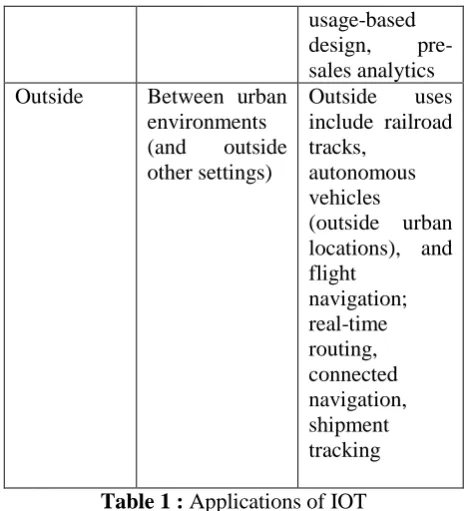
From this perspective, the IOT represents the convergence of a variety of computing and connectivity trends that have been evolving for many decades. At present, a wide range of industry sectors – including automotive, healthcare, manufacturing, home and consumer electronics, and well beyond -- are considering the potential for incorporating IOT technology into their products, services, and operations. In their report ―Unlocking the Potential of the Internet of Things’’, the McKinsey Global Institute [1] describes the broad range of potential applications in terms of ―settings‖ where IOT is expected to create value for industry and users.
VI.
VI. CONCLUSION
While the concept of combining computers, sensors, and networks to monitor and control devices has been around for decades, the recent confluence of key technologies and market trends is ushering in a new reality for the ―Internet of Things’’. IOT promises to usher in a revolutionary, fully interconnected ―smart‖ world, with relationships between objects and their environment and objects and people becoming more tightly intertwined. The prospect of the Internet of Things as a ubiquitous array of devices bound to the Internet might fundamentally change how people think about what it means to be ―online‖.
―Settings‖ for IOT Applications
Setting Description Examples Human Devices
attached or inside the human body
Devices
(wearable and ingestible) to monitor and maintain human health and wellness; disease management,
increased fitness, higher productivity Home Buildings
where people live
Home
controllers and security
systems Retail
Environmen ts
Spaces where consumers engage in commerce
Stores, banks, restaurants, arenas – anywhere consumers consider and buy; self-checkout, in-store offers, inventory optimization Offices Spaces where
knowledge workers work
Energy management and security in office
buildings; improved productivity, including for mobile
employees Factories Standardized
production environments
Places with repetitive work routines, including hospitals and farms;
operating efficiencies, optimizing equipment use and inventory Worksites Custom
production environments
Mining, oil and gas,
construction; operating efficiencies, predictive maintenance, health and safety
Vehicles Systems inside moving
vehicles
Vehicles including cars, trucks, ships, aircraft, and trains;
usage-based design, pre-sales analytics Outside Between urban
environments (and outside other settings)
Outside uses include railroad tracks,
autonomous vehicles
(outside urban locations), and flight
navigation; real-time routing, connected navigation, shipment tracking
Table 1 : Applications of IOT
VII.
REFERENCES
[1]. Manyika, James, Michael Chui, Peter Bisson, Jonathan Woetzel, Richard Dobbs, Jacques Bughin, and Dan Aharon. ―The Internet of Things: Mapping the Value Beyond the Hype.‖ McKinsey Global Institute, June 2015. p.3.
[2]. C. Dixon, R. Mahajan, S. Agarwal, A. Brush, B. Lee, S. Saroiu, and P. Bahl, An Operating System for the Home, NSDI, 2012.
[3]. Nunberg, G. (2012) The Advent of the Internet: 12th April, Courses.
[4]. Kosmatos, E.A., Tselikas, N.D. and Boucouvalas, A.C. (2011) Integrating RFIDs and Smart Objects into a Unified Internet of Things Architecture. Advances in Internet of Things: Scientific Research, 1, 5-12.
[5]. J. Antonio et al., ―Drugs interaction checker based on IOT,‖ Internet of Things (IOT), pp. 1-8, IEEE, 2010.
[6]. (2005) ITU Internet Reports, International Telecommunication Union. The Internet of Things: 7th Edition.
[7]. Want, R. (2006) An Introduction to RFID Technology. IEEE Pervasive Computing, 5, 25-33.
[8]. Razzak, F. (2012) Spamming the Internet of Things: A Possibility and its probable Solution. Procedia Computer Science, 10, 658-665.
[9]. Shao, W. and Li, L. (2009) Analysis of the Development Route of IOT in China. Perking: China Science and Technology Information, 24, 330-331.
[10]. Y. Yu, L. J. Rittle, V. Bhandari, and J. B. LeBrun, Supporting Concurrent Applications in Wireless Sensor Networks, ACM SenSys, 2006.
[11]. Apple app store.
http://www.apple.com/osx/apps/app-store.html. [12].