DAPSONE SYNDROME: A CASE REPORT
Ravishankar AC1*, Hiremath SV1, Torgal SS1
1
Dept of Pharmacology and Pharmacotherapeutics, JN Medical College, Belgaum,
India.
Summary
Dapsone syndrome is a hypersensitivitiy reaction occurring within 3-6 weeks after starting on dapsone treatment.
We present a 60 year old male patient of Indian descent who presented with history of
fever, jaundice and pruritic rash all over the body since 20 days. Patient was on dapsone
100mg/kg as a part of antileprotic treatment. It was diagnosed as Dapsone syndrome by History,
clinical examination (with the help of Richardus and Smith criteria) and biopsy.
Since therapeutic application of dapsone is increasing, physicians, especially those dealing with leprosy treatment or working in the fields of dermatology and allergy, should be aware of this infrequent but potentially fatal severe form of adverse reaction.
Key Words: Dapsone syndrome, Dapsone, Leprosy, Antileprotic drugs.
*Corresponding author: Ravishankar A. C., Post graduate,
Dept of Pharmacology and Pharmacotherapeutics, J N Medical College, Belgaum-590010, Karnataka, India.
Introduction
Sulfones are derivatives of 4,4’ diaminodiphenyl sulfone. The sulfones first attracted interest because of their chemical relationship to the sulfonamides. In the 1940s, sulfones were found to be effective in suppressing experimental infections with the tubercle bacillus and for rat leprosy.
Among sulfones dapsone is most commonly used.1
Currently dapsone has wide application. It is used to treat Pneumocystis carinii pneumonia, leprosy, acrodermatitis continua, actinomycetoma, bullous pemphigoid, cicatricial pemphigoid, cutaneous necrotizing vasculitis, dermatitis herpetiformis, dermatomyositis, epidermolysis bullosa acquisita, granuloma annulare, granuloma facilae, leukocytoclastic vascultis, lichen planus, linear IgA dermatosis, lupus erythematosus etc.2
Dapsone is usually well tolerated. Many patients develop some hemolysis, particularly if they have glucose-6-phosphate dehydrogenase deficiency. Methemoglobinemia is common, but usually is not a problem clinically. Gastrointestinal intolerance, fever, pruritus, and various rashes occur. During dapsone therapy of lepromatous leprosy, erythema nodosum leprosum often develops. It is sometimes difficult to distinguish reactions to dapsone from manifestations of the underlying illness. Erythema nodosum leprosum may be suppressed by corticosteroids or by thalidomide.3
Dapsone hypersensitivity reaction was reported as early as 1950 by Lowe and was termed
dapsone syndrome by All day and Barnes.4 It is characterized by fever, hepatitis, exfoliative
dermatitis, lymphadenopathy, haemolytic anaemia occurring 3-6 weeks after starting on dapsone treatment. 5
Case Report
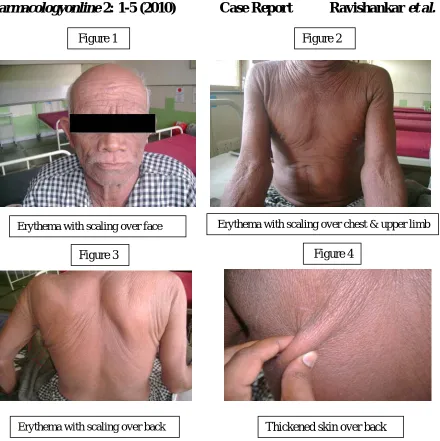
60 year old man of Indian descent came with history of fever, jaundice and pruritic rash all over the body since 20 days. Two months back patient was diagnosed to be having tuberculoid leprosy after examining skin biopsy and was started on Antileprotic treatment containing dapsone 100mg/day. Patient took medication for 5 weeks following which he developed redness all over the body with dryness and thickening of skin.
Investigations
Total IgE – 14,701 IU/ml ( normal < 100),
Haemoglobin – 13 gm%, Total count – 16,900 (N – 37, L- 28, E – 35), Absolute Eosinophil Count – 912, Peripheral smear shows eosinophilic leucocytosis, Blood urea – 18, serum creatinine – 0.7, Total protein – 5.7, Serum A: G – 1.1, direct bilirubin 1.9 mg/dL, indirect bilirubin 2.7 mg/dL, aspartate aminotransferase 190 U/L, alanine aminotransferase 264 U/L, alkaline phosphatase 132U/L,
USG Abdomen showed A cyst in each kidney and left lobe of liver.
Skin biopsy showed inflammatory infiltrate especially in perivascular and periadnexal areas of the dermis and features of Hansen’s disease
Figure 1
Erythema with scaling over back Thickened skin over back
Erythema with scaling over face Erythema with scaling over chest & upper limb
Figure 4 Figure 3
Differential Diagnosis
Several drugs, including 1. Anticonvulsants, 2. Sulfonamides, 3. Allopurinol, 4. Gold salts and 5. Minocycline,
cause a severe hypersensitivity syndrome that consists of fever, rash, lymphadenopathy and different degrees of organ involvement. This entity is also termed as drug reaction
with eosinophilia and systemic symptoms (DRESS).6
Discussion
Dapsone was first synthesized in 1908 and its antibacterial properties were recognized in 1937. Sulfones are well absorbed from the gut and widely distributed throughout body fluids and tissues. Dapsone's half-life is 1-2 days, and drug tends to be retained in skin, muscle, liver, and kidney. Skin heavily infected with M leprae may contain several times more drug than normal skin. Sulfones are excreted into bile and reabsorbed in the intestine. Excretion into urine is variable, and most excreted drug is acetylated. In renal failure, the dose may have to be adjusted. The usual adult dosage in leprosy is 100 mg daily. 1, 3, 7
Richardus and Smith have mentioned the following criteria to diagnose a case of dapsone hypersensitivity.
1. The symptoms appear within 8 weeks after commencement of dapsone and disappear after the
discontinuation of the drug. 2. The symptoms cannot be ascribed to any other drug given simultaneously with dapsone.
3. The symptoms are not attributable to lepra reaction. 4. No other disease liable to cause similar symptoms is diagnosed. 5. Two of the following signs, symptoms are present - fever, skin eruption, lymphadenopathy, liver pathology (hepatomegaly, jaundice and/or abnormal LFTs).8
Treatment consists of cessation of drug therapy and administration of corticosteroids. Prednisolone in the range of 30 – 60 mg per day may be given and should be cautiously tapered off to prevent recurrence. Since dapsone can remain in the body up to 35 days due to protein binding and enterohepatic circulation, tapering of prednisolone over a period of about one month is required.9
Generally Dapsone syndrome is a self-limiting drug reaction and most patients recover following cessation of dapsone therapy and application of corticosteroid therapy; however, deaths have been reported 10.
Conclusion
Acknowledgement
We are grateful to Dr. V. D. Patil MD, DCH, Principal, J. N. Medical College, belgaum for giving us permission to do Adverse drug reaction monitoring.
We acknowledge the support of Dr. Siddaramappa Professor and Head, and other staff of Department of Dermatology, J. N. Medical College, Belgaum for allowing us to study the case.
We are also thankful to patient and patient’s relatives for their consent and kind support.
Written informed consent is taken from the patient in his own language for examination and publication.
References
1. Laurence L Bruton, John S Lazo, Keith L Parker. Goodman & Gilman’s The Pharmacologic Basis of
Therapeutics. 11th edition. New York: Mc Graw Hill Publishers; 2006.
2. Irwin M Freedberg, Arthur Z Eisen, Klauss wolff. Fitzpatrick’s Dermatology in General Medicine. 6th
edition. Newyork: Mc Graw Hill Publishers; 2003.
3. Bertram G. Katzung, Susan B. Masters, Anthony J. Trevor. Basic and Clinical
Pharmacology. 11th edition. New Delhi: Tata McGraw Hill Education Private
Limited; 2009
4. Gokhale RN, Sule RR, Gharpure BM. Dapsone syndrome. Indian J Dermatol Venereol Leprol.
1992;58:376-8
5. Prussick R, Shear NH. Dapsone hypersensitivity syndrome. J Am Acad Dermatol 1996;35:346-349
6. Gruchalla RS. Drug allergy. J Allergy Clin Immunol. 2003;111(2): 548-59.
7. Richard A. Harvey, Pamela C. Champe. Lippincott’s Illustrated Reviews:
Pharmacology. 4th edition. New Delhi: Wolters Kluwer (India) Pvt. Ltd; 2009
8. Richardus JH, Smith TC. Increased incidence in leprosy of hypersensitivity reactions to dapsone after introduction of multidrug therapy. Lepr Rev 1989; 60 : 267-73.
9. Kumar RH, Kumar MV, Thappa DM. Dapsone syndrome – a five year retrospective analysis. Indian J
Lepr. 1998; 70: 271-6.
10. Lau G. A fatal case of drug-induced multi-organ damage in a patient with Hansen’s disease: dapsone syndrome or rifampicin toxicity? Forensic Sci Int. 1995; 73(2):109-15.