http://www.sciencepublishinggroup.com/j/com doi: 10.11648/j.com.20170506.11
ISSN: 2328-5966 (Print); ISSN: 2328-5923 (Online)
Assessment of Open Educational Resources in Tertiary
Institutions: The Computerized Information Model
Wilson Nwankwo
Department of Computer science & Information Technology, Wellspring University, Benin City, Nigeria
Email address:
To cite this article:
Wilson Nwankwo. Assessment of Open Educational Resources in Tertiary Institutions: The Computerized Information Model.
Communications. Vol. 5, No. 6, 2017, pp. 58-72. doi: 10.11648/j.com.20170506.11
Received: January 11, 2018; Accepted: January 19, 2018; Published: January 31, 2018
Abstract:
While policies are great vehicles towards planning and realization of developmental programmes, they do not translate to realities without sustained careful implementation and supervision. The Nigeria’s National Policy on Open Educational Resources (OER) for Higher Education is one of such landmark educational policies made in the fall of 2017. Following the obligations created by the said policy on tertiary institutions and the need to achieve a relatively uniform high quality OER repository across board, this paper is articulated to address the challenges envisaged in the process of evaluating/assessing the conformance of the various repositories of Nigerian Universities to ideal benchmarks set by the policy. This paper proposes a computerized information model employing the popular object-oriented approach. It documents a business logic that includes measurable parameters and predicates made dynamic to match the criteria for any evaluation scheme. The result of analysis of user and system requirements produced specifications that were used to generate comprehensive logical attribute and method models. The models provided appropriate coverage on future requirements for implementing a versatile automated evaluation system for OER repositories in Nigeria.Keywords: Open Educational Resources, Nigeria, Education, Policy on Education, NUC, OER
1. Introduction
The concept of open educational resources (OER) was first coined at a meeting of the United Nations Educational, Scientific and Cultural Organization (UNESCO) forum on ‘the impact of open courseware for higher education in developing countries’ in July, 2002. Prior to the said meeting of UNESCO, the OER movement had gained considerable visibility in 2001, when Charles Vest, the then President of the Massachusetts Institute of Technology (MIT), made public the intention of the Institute to place all of its course materials online for the benefit of all. His decision resulted in the Open Course Ware (OCW) Project which took off in 2001.
Following the 2002 forum were the Cape Town Open Education Declaration of 2007, the Dakar Declaration on Open Educational Resources in 2009, the Commonwealth of Learning (COL) and UNESCO Guidelines on Open Educational Resources in Higher Education of 2011, and the congress of 2012 in Paris. In order to drive the concept of OER globally, the Paris OER Declaration [1] was adopted at the World Open Educational Resources (OER) Congress in
June 2012(20-22 June) at UNESCO Headquarters in Paris, France. The declaration was the first step towards the development of policies supporting OER across the globe. The aims of the Declaration are to encourage governments to contribute to the awareness and the use of OER; and to develop strategies and policies to integrate OER in education. OER is a relatively complex term. It has been defined by many experts and authorities each focusing on different nuances as to: the nature of the resource; copyright permissions; structure; source of the resource; and/or the different motivations for sharing educational resources. Camilleri et al [2] state that most definitions seem to share one thing in common that is; the nature of the material which is digital media.
The Organization for Economic Co-operation and Development (OECD) in 2007[4] defines OER as: "digitised materials offered freely and openly for educators, students, and self-learners to use and reuse for teaching, learning, and research. OER includes learning content, software tools to develop, use, and distribute content, and implementation resources such as open licences".
The COL appears to broaden the scope of OER through their definition of OER wherein they define OER as “materials offered freely and openly to use and adapt for teaching, learning, development and research” [5].
According to Stephen Downes [6], OER reflects those resources that attract no fees, subscriptions, tuitions, registrations, obligations, etc. to the consumer or user of the said resources. Downes’ perspective seems to go beyond the COL’s scope of OER in that it advocates for the elimination of every obligation whatsoever to the user of the educational material. He further stressed that OER is not the same as open courseware but a mix of three components: content, tools, and capacity; all of which are aimed at ensuring resource usability, durability, accessibility, and effectiveness. Thus OER should be measured against the four quality
factors of usability, accessibility, durability, and
effectiveness.
Smith & Casserly (2006) had considered OER as an ideology. According to the duo, the ideology of OER movement and at its heart is “the simple and powerful idea that the world’s knowledge is a public good and that technology in general and the World Wide Web in particular provide an extraordinary opportunity for everyone to share, use, and reuse that knowledge” [7].
Locally, section 1.3 of Nigeria’s National Policy on Open Educational Resources for Higher Education (NPOERHE) [8] describes OER as all educational materials that have been designed for use in teaching and learning and are openly available for use by educators and students, without the need to pay royalties or license fees. The policy further clarifies the nature of materials that qualifies as OER. In section 1.4 of the said policy wherein it provides that: “materials that constitute OER include curriculum maps, course materials, textbooks, streaming videos, pictorial materials, multimedia applications, podcasts, and any other materials that have been designed for use in teaching and learning. The scope of OER, according to the NPOERHE, is completely restricted to physical materials for teaching and learning thus eliminating the earlier assertion by Downes [6] that OER includes tools and capacity. Thus it could be concluded that whether or not tools and capacity are included in OER, is a matter of policy and the implementing authority.
1.1. OER in Nigeria’s Education System
Nigeria with an estimated population of 180 million people is serviced by five hundred and eighty five (585) tertiary institutions (that spanned across Universities, Polytechnics,
Monotechnics, Colleges of Education, Health, and
Technology respectively and Vocational Educational
Institutes) grossly considered inadequate [9] in terms of
infrastructure and human capacity. The inadequacy in infrastructure to cater for the teeming population is unarguably a major factor that contributes to the high cost of education in the world’s most populous black nation.
It is crystal clear that the education sector in Nigeria requires a serious reform through technology and the injection of new innovations such as the creation of a free learning and teaching resources that are accessible regardless of one’s location. According to [10], higher education systems play major roles in social development and national economic competitiveness but are often confronted with numerous challenges mostly due to the increasing enrolment demands worldwide. It is predicted that global enrolments will grow by a further 98 million by 2025 which is more unlikely to be accompanied by equivalent increases in the human and financial resources available to the higher education sector [10].
Prior to 2017, there was no visible and formal OER project or policy in Nigeria or in Nigeria’s tertiary institutions. According to the current executive secretary of Nigeria’s top tertiary education regulator, the National Universities Commission (NUC), Professor Abubakar Rasheed, “the National Policy on Open Educational Resources for higher education in Nigeria is government’s effort at ensuring a planned and deliberate approach in the development and improvement of quality teaching and learning materials, curricula, programmes, and course design, as well as planning effective contact with students. With the development of this policy, Government hopes to address the issues of access to quality higher education and enrolment of students in excess of the carrying capacity by existing higher institutions in Nigeria.” [11] [12] [13]
1.2. Problem Definition
The National Universities Commission (NUC) in September 2017 promulgated the Nigeria University System Open Educational Resources Policy as part of the National Policy on Open educational resources for Higher education. Following the promulgation, the NUC mandated every University in Nigeria to align itself with the provisions of the policy. In order to hasten the implementation of the said policy NUC mandated the Nigeria University System Open Educational Resources (NUSOER) team led by Professor Peter Okebukola (a former executive secretary of the Commission and a Professor of science and computer education at the Lagos State University) to develop an evaluation and assessment/ranking mechanism that will support the evaluation and rating of all Nigerian University repositories with respect to the quality factors earlier stated. However, there is currently no concrete flexible software system that could support the team in conducting its mandate hence recourse is made to semi-automated mechanisms.
1.3. Objectives of the Study
NUSOER information system particularly as it affects the assessment of all NUSOER repositories.
The specific objectives are:
a. To examine the tasks associated with OER assessment in Nigeria
b.To highlight the difficulties in assessing the quality of OER presented by the various Universities in Nigeria c. To create a reliable system model that could be adapted
to implemented an efficient and effective information system that supports all the facets of OER assessment in Nigeria
2. Materials and Methods
The object-oriented analysis and design methodology (OOADM) [14] [15] is employed in this article. The OOADM enables the modelling and implementation of complex real world problems easily employing the concept of system decomposition and re-composition. A complex system could be easily split into various objects and communications among the objects are established through methods/function and messages [16].
2.1. Materials and Methods
A.Materials
The following materials are used in analysis and generation of the NUSOER Information System model:
i. Microsoft Visual Studio 2015 Ultimate [17]
ii. Microsoft SQL Server DBMS express 2016 as the
backend
iii.Erwin data modeler [18]
iv.PC running Microsoft Windows 7/8/10 with at least 8GB RAM and 2.4GHZ quad-core processor.
B.Analysis of the existing system
The existing system is a semi-automated system whereby rankers/assessors and moderators are assigned to the various Universities in a manual fashion. The assignment process is paper-oriented. It involves the enlisting of all the Universities and the universal resource locators (URLs) of their OER repositories. Following such enlistment is the creation of a google forms by the administrator/leader of the evaluation
team, for collation of assessment data. Each
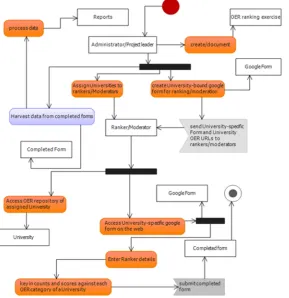
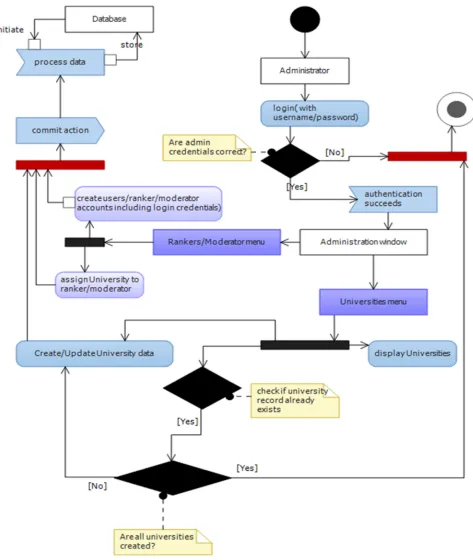
ranker/moderator is mandated to use the created google form to record the results of his/her ranking/moderation operations after which the said form is submitted. Once submission is made, the ranker/moderator has no control over the submitted form in that should there be any failure in transmission or error in the entry, a new form must be completed. In other words there is no certainty that a submission is successful unless the administrator informs the moderator or assessor of such. The administrator/project leader harvests the individual data (results) from the completed forms for further analysis and subsequent presentation. The activity diagram in Figure 1 represents the activities that are undertaken in the existing system. From the diagram it is evident that the existing system is flooded with a lot of problems including: lack of control on the system; much effort is expended on harvesting data from the various independent forms submitted by rankers/moderators; possible impersonation, etc.
2.2. Business Logic
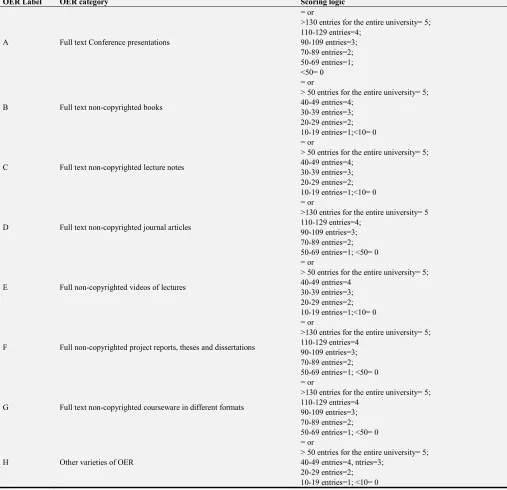
Table 1 presents the criteria that should be adhered to during the NUSOER ranking and evaluation process whether or not a computerized tool is used. Eight (8) categories of OER have been identified as shown in Table 1.
Table 1. Criteria for ranking.
OER Label OER category Scoring logic
A Full text Conference presentations
= or
>130 entries for the entire university= 5; 110-129 entries=4;
90-109 entries=3; 70-89 entries=2; 50-69 entries=1; <50= 0
B Full text non-copyrighted books
= or
> 50 entries for the entire university= 5; 40-49 entries=4;
30-39 entries=3; 20-29 entries=2; 10-19 entries=1;<10= 0
C Full text non-copyrighted lecture notes
= or
> 50 entries for the entire university= 5; 40-49 entries=4;
30-39 entries=3; 20-29 entries=2; 10-19 entries=1;<10= 0
D Full text non-copyrighted journal articles
= or
>130 entries for the entire university= 5 110-129 entries=4;
90-109 entries=3; 70-89 entries=2; 50-69 entries=1; <50= 0
E Full non-copyrighted videos of lectures
= or
> 50 entries for the entire university= 5; 40-49 entries=4
30-39 entries=3; 20-29 entries=2; 10-19 entries=1;<10= 0
F Full non-copyrighted project reports, theses and dissertations
= or
>130 entries for the entire university= 5; 110-129 entries=4
90-109 entries=3; 70-89 entries=2; 50-69 entries=1; <50= 0
G Full text non-copyrighted courseware in different formats
= or
>130 entries for the entire university= 5; 110-129 entries=4
90-109 entries=3; 70-89 entries=2; 50-69 entries=1; <50= 0
H Other varieties of OER
= or
> 50 entries for the entire university= 5; 40-49 entries=4, ntries=3;
20-29 entries=2; 10-19 entries=1; <10= 0
2.3. Analysis of the Proposed System
2.3.1. Requirements Model
The requirements model of this system is made up of five components namely: project scope, context diagram, user analysis diagram, use case model, and the interface specification.
A.Project scope
This project is expected to evolve a computerized model that will support all the ranking and evaluation operations of the NUSOER team as well as provide reliable statistics to the regulatory authorities such as NUC and the Federal Ministry of Education (FMOE).
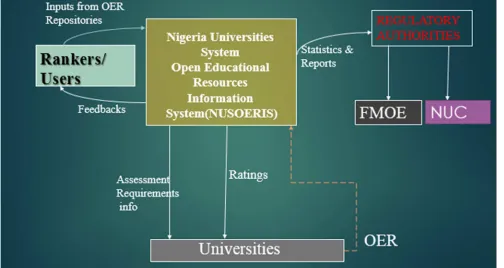
B.The Context diagram
Figure 2. Context diagram of the proposed OER information system.
C.User requirements specification
Having regard to the project scope, stated herein are the specification of the requirements of the system. The user specification is divided into four roles: administrator, ranker, moderator and regulator respectively. Similarly each role is associated with an actor on the new system.
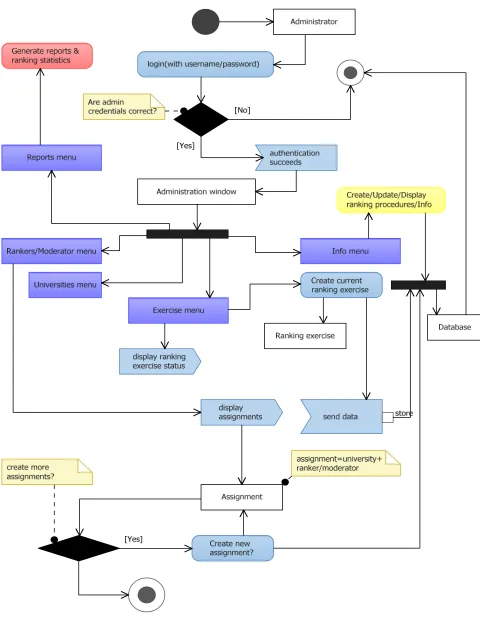
I. Administrator role
a. Administrator registers/creates user (ranker,
moderator, etc.) accounts including login credentials. b.Administrator populates Universities participating in
the ranking process.
c. Administrator creates ranking exercise entry for each ranking period (e.g. annually, bi-annually, etc.)
d.Administrator assigns Universities to rankers
following insights drawn from the system.
e. Administrator provides or updates ranking scheme. f. Administrator runs a report on all Universities and
the system displays all the details as well as the score against each university.
g.Administrator runs statistical reports on assignments (past and ongoing).
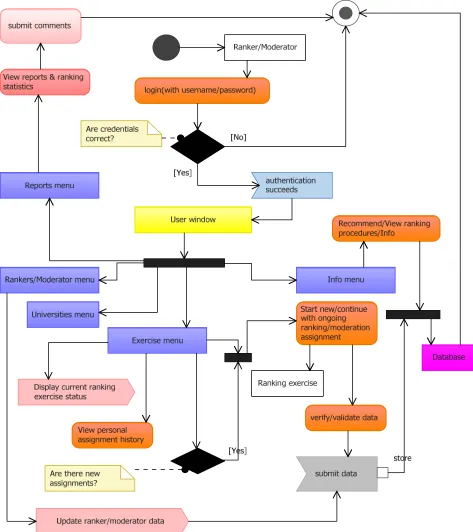
II. Ranker role
a. Every accredited ranker must have a login
comprising biodata and system access credentials. b.At the end of every login session, timestamp of
ranker/moderator’s session must be kept
c. Ranker selects one assigned University at a time; and on selection, a new window opens containing ranker information, details of University to be ranked and the categories of OER on which ranking is to be done as well as a column for comments. Against each category of OER is a field called “count”.
d.Ranker supplies numeric values against the count on
the indicated field(s) (category of OER).
e. Ranker makes comments where necessary using the comment field
f. Ranker clicks the submit button and the system saves the data in a database.
g.System computes the total OER and the associated score for the university being ranked.
h.System updates the ranking operation, associates a ranker to the ranking and the ranked university, then finalizes the ranking session so that the ranker cannot modify it once a submission is made but can view it. i. System displays feedback report to the ranker
j. System sends a short message service (SMS)
notification to the registered phone number of the Administrator that a ranking/moderation operation has been completed.
III.Moderator role
a. Every accredited moderator must have a login
comprising biodata and system access credentials. b.At every logon, timestamp reflecting the of the
moderator’s session must be kept
c. Moderator selects the assigned University and on selection, a new window opens containing relevant ranking information, details of University to be moderated and the categories of OER on which moderation is to be made as well as a column for comments. Against each category of OER is a field called “count”.
d.Moderator supplies the value for the count parameter against each field (category of OER).
f. Moderator clicks the submit button and the system saves the data in a database.
g.System computes the total OER and the associated score for the University being ranked.
h.System updates the operation and associates a
Moderator to the ranking and the ranked university indicating a higher priority against the moderated scores.
i. System sends a sms to the Administrator that a moderation operation has been completed by a moderator
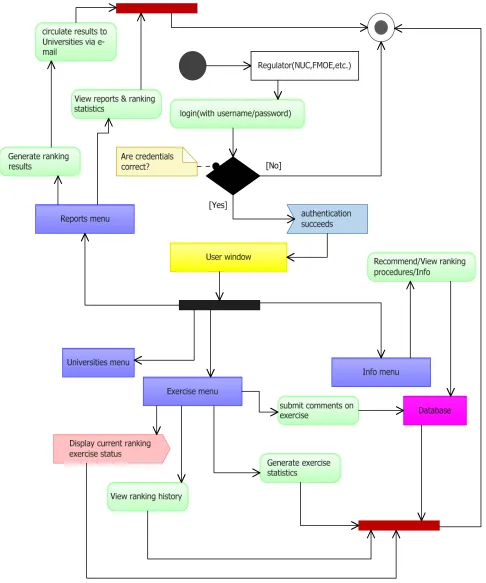
IV.Regulator role
a. Every Regulator must have valid logins
b.Regulator recommends a ranking scheme which is
saved against regulator recommendations in the database. The recommendation must be approved by the administrator before it is published on the system for rankers/moderator use.
c. Regulator runs a report on all Universities and the system displays all the details as well as the score against each university.
d.Administrator runs statistical reports on assignments for the current ranking exercise.
D.User analysis
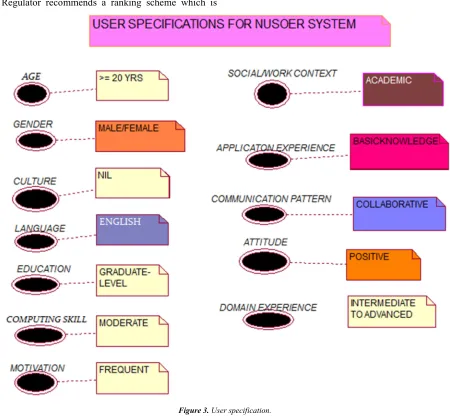
The diagram in Figure 3 shows the various specifications of actors (users) that are expected to use the NUSOER information system.
Figure 3. User specification.
E.Activity model
Figure 6. Regulator’s activity model.
F.Use case model
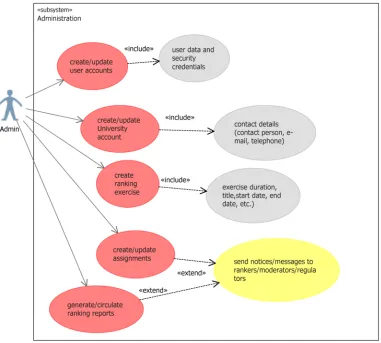
The Use case diagram in Figure 7 represents the various functions of the administrator of the system expressed as use
Figure 7. Use cade model reflecting the administration subsystem.
2.3.2. Domain Analysis
Domain analysis involves the identification/discovery of the important elements/ entities in the problem domain and their relationships with each other. The identified entities are classified into three broad groups:
a. Persons (user classes: sysadmin, ranker, moderator, regulator)
b.Physical objects (university, regulator)
c. Information objects (account, message, ranking
exercise, assignment, report). Note that information objects consist of only objects that can be stored digitally (abstract entities). The user classes are defined by role hence their classification as entities.
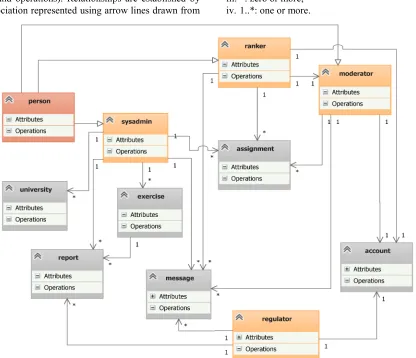
Figure 9 shows domain diagram of these entities. Each entity is represented with a rectangle with two components (attributes and operations). Relationships are established by way of association represented using arrow lines drawn from
one entity to another and defined using role multiplicity. Multiplicity is the active logical association when the cardinality of an entity in relation to another is represented. Each end of an association is a role specifying what an entity does in the association. Each role must have a name i.e. a noun. Using the Unified Modeling Language, role multiplicity is represented by a numeric expression comprising one or more of: asterisk (*), comma (,), two dots (..), numbers where: asterisk means “any quantity,” and indicates that there is no upper bound; Comma means “or”, and two dots “..” mean “up to.” Multiplicity limits are set to define the level of associations hence the following interpretations apply as may be seen in the diagram below
i. 1:exactly one; ii. 0..1: zero or one; iii.*: zero or more; iv.1..*: one or more.
Figure 9. Domain analysis diagram.
3. Logical Modeling
The logical model defines further the entities as identified in the domain analysis diagram in Figure 9 above. These entities would be rendered by the application program, including the policies and rules that would be used to operate on those entities. The logical modeling is done by way of the
entities, how these rules are grouped into interfaces and functions, and how the various objects interact among themselves to solve macro level requirements. It is worthy of note that, in using the unified modeling language, both the LAM and the LMM are designed concurrently using same
entities/objects. The object-oriented design pattern was used to establish the relationships and interactions between the various entities/objects that have been identified earlier during domain analysis.
Figure 11. Logical method model of the NUSOERIS.
4. Discussion
In the previous sections, identification and analysis of various components and parameters that are considered needful in drawing up an assessment model as well as in the implementation of the model., have been clearly shown However, the parameters as provided in section 2.2 above, are dynamic and are susceptible to change during each assessment period hence the inclusion in the analysis such possibilities. During analysis, emphasis is made on several variables such as user specification.
User analysis was considered in two ways: the role level
functionalities to be integrated in the system (see figures 4-8). Of great importance are the data characteristics to be captured by the logical attribute and method models respectively. The data characteristics are clearly identified in the logical object model and it is easy to translate these data characteristics into the equivalent data properties in the selected database technology during implementation. The implementation aspects are not discussed here in this paper but the various models reflected in the diagrams above are considered a substantial in the creation of an evaluation system.
5. Conclusion
There is no gainsaying that OER is an excellent approach towards reducing the attendant high cost of education especially in developing countries. The adoption of the National Policy on OER for Higher education in Nigeria is applauded in many quarters as the right step in the right direction towards improving the quality of education without the usual increase in the cost of acquisition of same. However, the policy in itself does not translate into the numerous benefits(unrestricted access to quality educational materials, reduced cost of learning, elimination of copyright and license restrictions, global access, etc.) idealized and
advocated by UNESCO and other authorities.
Implementation remains a challenge but could be enhanced by putting up a sustainable mechanism for driving regular assessments on various implemented OER platforms. The model discussed herein is an aid or tool expressed a
computerized information system model. The
implementation of this model would among other things, ensure the periodic monitoring and evaluation of various University OER repositories in Nigeria so as to enable the appropriate regulatory authorities (such as: National Universities Commission, National board for Technical Education, Council on Colleges of Education, Ministry of Education, etc.) to track the non-conforming institutions as well as ascertain the progress of policy implementation.
References
[1] UNESCO (2017), Paris declaration document [online], Available at
http://www.unesco.org/new/fileadmin/MULTIMEDIA/HQ/CI/ WPFD2009/English_Declaration.html, [Accessed 2 January, 2018]
[2] Camilleri, Anthony F; Ehlers, Ulf; Pawlowski, Jan (2014), State of the Art Review of Quality Issues related to Open Educational Resources (OER), Luxembourg: Publications Office of the European Union, p. 54
[3] UNESCO (2017) Communication and information, "What are Open Educational Resources OERs)?" [online], Available at
http://www.unesco.org/new/en/communication-and- information/access-to-knowledge/open-educational-resources/what-are-open-educational-resources-oers/ [Accessed 6 January, 2018]
[4] OECD-Center for Educational Research and Innovation (2007), "Giving Knowledge for Free: EMERGENCE OF OPEN EDUCATIONAL RESOURCES" [online], Available at http://www.oecd.org/edu/ceri/38654317.pdf, [Accessed 3 January, 2018]
[5] Commonwealth of learning (2013) "Open Educational Resources" [online]. Available at: http://CoL.org
[6] Stephen Downes (2009), "Open education: Projects and potential", ECOO Richmond Hill
[7] Smith, M., & Casserly, C. (2006). The promise of Open Educational Resources Change: The Magazine of Higher Learning [online]. Available at:
http://www.icde.org/The+Promise+of+OER.9UFRzIXH.ips, ]. [Accessed 5 January, 2018]
[8] National Universities Commission (2017), National Policy on Open Educational Resources for Higher Education, Abuja, Nigeria
[9] Alabi, M (2017) "585 tertiary institutions grossly inadequate for Nigeria – NUC scribe"[online]. Available at:
https://newtelegraphonline.com/2017/09/585-tertiary-institutions-grossly-inadequate-nigeria-nuc-scribe/ [Accessed 5 January, 2018]
[10] UNESCO and Commonwealth of Learning (2015), "Guidelines for Open Educational Resources (OER) in Higher Education", UNESCO, Paris, France
[11] Okeke, C. C. (September 21, 2017) "FG makes policy on open resources" [online]. Available at:
https://www.dailytrust.com.ng/fg-makes-policy-on-open-resources.html [Accessed 6 January, 2018]
[12] Adesulu, D. (September 21, 2017) "Stakeholders validate National Policy on Open Education Resources"[online]. Available at:
https://www.vanguardngr.com/2017/09/stakeholders-validate-national-policy-open-education-resources/ [Accessed 6 January, 2018]
[13] Osagie, K. B. (2017) "Nigeria gets Open Courseware policy" [online]. Available at: http://thenationonlineng.net/nigeria-gets-open-courseware-policy/ [Accessed 6 January, 2018]
[14] Booch, G. (2007), Object-oriented analysis and design (4th ed.), Addison Wesley, California, 2007
[15] Nerson, J. (1995), Seamless Object-Oriented Software Architectures: Analysis and Design of Reliable Systems, Prentice Hall, New Jersey
[16] Sommerville, I. (2011). Software Engineering (9th ed.), Addison Wesley, Boston
[17] Johnson, B. (2015) Professional Visual Studio 2015(1st ed.), John Wiley & sons, Indianapolis
[18] CA Technologies (2011) CA ERwin Data Modeler: User guide r8, CA. Available at:
https://support.ca.com/cadocs/0/CA%20ERwin%20%20Data