Improving Yarn Quality by Modification on
Drafting Zone Settings of Draw Frame
Karthikeyan M Ramasamy1, Ramesh Duraisamy2, Habib Mammo,3
1
Department of Chemistry (Textile Engineering), Arbaminch University, Ethiopia
2
Department of Chemistry, Arbaminch University, Ethiopia
3
Arbaminch Textile Share Company, Arbaminch University, Ethiopia
Abstract — Achieving yarn quality and uniform dyeing are great challenges for textile industries due to time-to-time variations in cotton fibre quality. Process parameters and machine settings are therefore has to be optimized based on the quality of fibre. The draw frame process in the yarn manufacturing sequence plays major significance in improving the quality of yarn. In this research the draw frame parameters such as the bottom roller setting, roller pressure and break draft were modified based on the properties of cotton fibre. The physical properties of yarn were evaluated by using standard testing methods. The analysis showed that the yarn unevenness and coefficient of variation, end breakages rate and hairiness index were reduced to 12.8%,16.8%, 4 per spindle hour and 14 respectively after modification on draft frame settings as referred to DRSC-2 and it shows better results than other modifications and unmodified settings. The imperfections of yarn such as thin places, thick places and neps were reduced significantly to 28, 101 and 94 per km respectively on the same modification. The yarn strength was improved to 15.21kg as compared to the unchanged settings (10.5 kg). Hence it’s concluded that the optimal changes on drafting roller parameters influence the yarn quality in a greater level.
Keywords —Break draft, Imperfections, Roller setting, Strength, Top roller pressure.
I.INTRODUCTION
Spinning technology is still developing and very essential for the production of most of the textile fabrics.An overview of the spinning process illustrates the draw frame as the last quality improvement machine. This implies that the quality achieved or the defect produced at this stage will go on influence the ultimate yarn quality [1]. A defect arising at the draw frame can effects significant proportions on the overall textile process. In textile mill, draw sliver has great influence on yarn and fabric production i.e. drawn sliver is very challenging due to unsuitable raw material input for this sector. The inconsistency in fiber length leads to several problems in the yarn process while the raw cotton converted into yarn through several processing stages is an important process affected due to the fiber length variability. At the draw frame, the drafting or
attenuation of the fiber takes place through pairs of top and bottom rollers set apart at distance and rotating at different speeds. The distances between the tips of the pairs of rollers are referring as roller setting [2]. The variability in fibre length leads to several problems in the spinning process while the raw cotton mass is converted into the yarn through several processing stages. Drafting is an important process affected due to the length variability [3].
Drafting force of sliver and roving is dependent on both fibre properties and mechanical variables of the system used to draft the material during spinning. These mechanical or process variables include draft, drafting speed and roller setting. Inter-fibre friction, crimps, fibre parallelization, incidence and direction of hooks and twist of roving determine the drafting force. Drafting force of roving has been found to affect spinning efficiency [4]. Drafting quality is controlled by process variables such as break draft, roller setting, delivery speed and top arm pressure. There is a high degree of interaction between these variables and quality of the product in this step [5,6,7]. Fiber fineness interacts with break drafting ratio to affect drafting force and sliver irregularity. The drafting force increases as the break draft ratio increases up to a maximum, after which it begins to drop, indicating a curvilinear relationship. The interaction of fiber fineness and break drafting ratio shows that each of the fineness values reacts differently and the maximum drafting force occurs at a different break draft ratio for each fiber fineness. In addition, sliver irregularity has a linear relationship with drafting ratio that significantly interacts with fiber fineness [8].
smooth fiber motion and thereby resulting in higher sliver irregularity [12].
The imperfection (thin, thick & neps), short term evenness (u%), and strength of yarn are influenced by the changes in bottom roller gauge setting, adopted for large scale working in spinning department [13]. Optimum break draft leads to both optimum fibre arrangements and minimum fibre spread at the front roller nip, which contributes to better uniformity and strength [14]. Spun yarn strength based on the draw frame parameters that are delivery speed, break draft and distance between back and middle rolls [15]. The end breakage is a critical spinning parameter that not only affects the maximum spindle speed but may also indicate the quality of yarn, the mechanical condition of the machines and the quality of raw material. Therefore, it is an important parameter, which determines the overall working of a spinning mill. Any attempt to explain the end breakage mechanism in terms of qualitative approach will provide an aid to understanding the problem and to tackling it to any possible degree [16].
.
II.MATERIALSANDMETHODS
A drawing frame selected for our study, and the pressure and drafting zone settings, including the speed of this setting are adjusted in depth. In this case, the product of this draw frame will continue to be redesigned with the guidance tool and continuously adjusted for both input and output.
A. Sample Preparation
The input sample material for draw frame is cotton sliver from carding department and input processed samples were prepared from blow room and fed to carding processed through draw frame, simplex /speed frame via ring frame. Then the fabric was made in weaving. The process flow from fibre to yarn was followed for the study is illustrated in the fig. 1.
Fig 1.The sequence of ring yarn spinning manufacturing process
Blow room to ring frame material processed through standard settings and standard atmospheric conditions except draw frame machine as it was selected for the study.[17]
TABLE I: SPECIFICATION OF THE MATERIALS [18]
Staple Length (mm)
Fineness (µg/inch)
Sliver Hank (Ne)
Yarn Count (Ne)
27-28 4.2 0.12 20
TABLE II: EXISTING PRODUCTION PARAMETERS FOR DRAWFRAME
Parameters
Particulars
Breaker Drawframe
Particulars Finisher Drawframe
Span Length
of Fibre 27-28 mm 27-28mm
Feed Sliver
Hank 0.12 Ne 0.12 Ne
Speed 360 m/min 360 m/min
Bottom Roller Setting (Middle to Front Roller)
32 mm 34.6 mm
Bottom Fluted Roller Setting (Back to Middle)
36.6 mm 39.8 mm
Break Draft 1.31 1.31
Main Draft 5.69 5.69
Total Draft 8 8
No. of
Doublings 8 8
Creel Tension
Draft 1.0 1.0
Web Tension
Draft 1.01 1.01
Delivery Hank 0.12 0.12
Back Top Roller Pressure
70 Kgs 70 Kgs
Middle Top Roller Pressure
70 Kgs 70 Kgs
Front Top Roller Pressure
50 Kgs 50 Kgs
The experimental procedure for all materials
remained the same. Before conducting the
experiments, the materials were acclimatizing in the standard temperature and relative humidity for 24 hours in laboratory room. The standard climatic
conditions mostly for cotton materials are 280C and
40% temperature and relative humidity respectively [19]. Carded cotton was selected for the study during investigations on the sliver and yarn quality characteristics. The existing drafting parameters are arranged in the table I.
changed for the optimization based on the count of yarn and parameters of the cotton fibre.
B. Modification of Drafting Roller Parameters
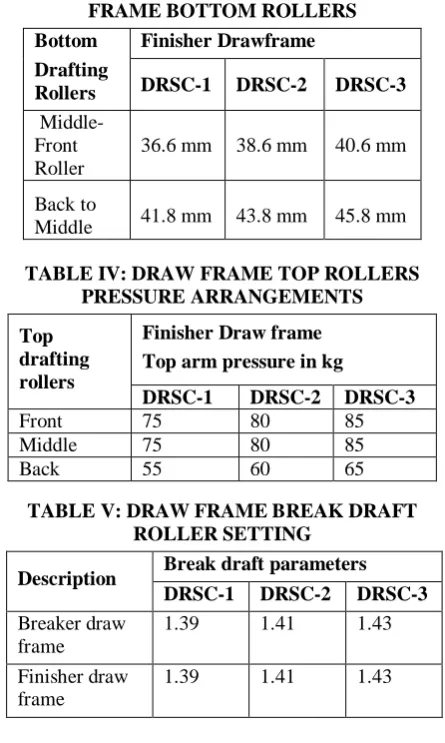
Drafting rollers setting change- the drafting or attenuating of the carded slivers was taking place through pair of rollers set apart at a pre-distinct distance and rotating at different surface speeds. By measuring the length of fibres the distance between the nips of the pairs of bottom drafting rollers were set. The bottom roller bearings were loosened and the nip between the back drafting roller to middle drafting roller and nip between the middle drafting roller to front drafting rollers were adjusted using the setting gauges based on the span length of cotton fibre. The roller bearings were tightened when the settings were adjusted properly. After the slivers were attained, they were processed up to ring frames and the quality parameters were at the sliver and yarn stages [5]. The modified settings of bottom drafting rollers are mentioned in the table III.
Setting of top roller pressure- the selected draw frame for the study is equipped with mechanical spring loaded type top arm pressure techniques. The top arm pressures were adjusted for all the three top drafting rollers based on the fibre maturity and fineness of the cotton fiber that was selected for the study. The top drafting roller pressure were changed to 80kg, 80kg and 60 kg for front roller, middle roller and back roller respectively by adjusting the spring position which was loaded by the weight hung over the bottom roller. The adjusted pressures of all the three top drafting rollers were measured by pressure meter [20,21].
The carded slivers were processed through the draw frame based on the above setting changes the draw frame slivers were collected. The quality parameters of draw frame sliver such as unevenness (U %), coefficient of variation (CV %) of sliver count were determined and recorded.
Simplex /Speed frame/ process- the slivers prepared
from draw frame with adjusted settings were processed in simplex /speed frame/ machine. The draw frame sliver fed into simplex machine has been drafted, twisted, and then converted into roving. The following process parameters were used for converting sliver into roving.
Quality Parameters of Simplex /Speed frame/ roving such as unevenness (U %), coefficient of variation (CV %), twist per inch and twist (CV %) were studied and recorded.
Ring frame process- the prepared roving was processed in ring frame machine for converting roving into yarn. The roving was fed into ring frame were drafted, twisted and wound on ring cops as yarn. The following process parameters were used for converting roving into yarn [22].
TABLE III: THE MODIFICATIONS OF DRAW FRAME BOTTOM ROLLERS
Bottom Drafting Rollers
Finisher Drawframe
DRSC-1 DRSC-2 DRSC-3
Middle-Front Roller
36.6 mm 38.6 mm 40.6 mm
Back to
Middle 41.8 mm 43.8 mm 45.8 mm
TABLE IV: DRAW FRAME TOP ROLLERS PRESSURE ARRANGEMENTS
Top drafting rollers
Finisher Draw frame Top arm pressure in kg
DRSC-1 DRSC-2 DRSC-3
Front 75 80 85
Middle 75 80 85
Back 55 60 65
TABLE V: DRAW FRAME BREAK DRAFT ROLLER SETTING
Description Break draft parameters DRSC-1 DRSC-2 DRSC-3
Breaker draw frame
1.39 1.41 1.43
Finisher draw frame
1.39 1.41 1.43
TABLE VI: RING FRAME YARN PREPARATION PROCESS PARAMETER Description Parameters
Spindle speed 11,500 RPM
Twist per inch 18
Drafting system used 3 over 3
Top roller pressure Manual Spring Type
Roller settings Fixed
Roving hank 1.8 Ne
Ring diameter 45 mm
Spacer number 3.2
Traveller number 3/0
Quality parameters of ring frame yarn such as unevenness (U %), coefficient of variation (CV %), twist per inch, twist CV% , imperfections, single yarn strength, lea strength, hairiness and yarn appearance were studied and recorded.
C. Characterization of Sliver, Roving, Yarn and Fabric
produced and their quality parameters were characterized. Unevenness (U %) of sliver, roving and yarn-the unevenness (U %) of sliver, roving and yarn were analyzed using ZellwegerUster unevenness tester (Model: Uster 3) under photo electronic principle. The sliver, roving and yarn samples were prepared according to Uster standards and they were tested for unevenness (U %).[48].
Coefficient of variation (CV %): The coefficient of variation (CV %) of sliver, roving and yarn were analyzed using wrap block and wrap reel using cut and weigh principle. The sliver, roving and yarn samples were prepared in a length of 6 yards, 15 yards and 120 yards respectively based on ASTM standards and they were tested for coefficient of variation (CV %)[49].
End breakage: The rate of end breakage and the proportion of different types of breakages were studied and recorded for draw frame, simplex (speed frame) and ring frame. It was recorded in terms of breakages /machine hour for draw frame and breakages /spindle hour for simplex and ring frame.
Yarn imperfections- The yarn samples were collected from ring frame and prepared according to Uster standards and tested in ZellwegerUster unevenness tester (Model: Uster 3) under photo electronic principle for yarn imperfections such as thin places (<50% of yarn diameter), thick places (>50% of yarn diameter), neps and slubs (>200% of yarn diameter)[23].
Single yarn strength: The yarn samples collected from ring frame were prepared according to ASTM and tester standards. The prepared samples were tested for single yarn strength (RKM) values using single yarn strength tester based on constant rate of traverse principle[24].
Lea strength (yarn bundle strength): The yarn samples were collected from ring frame and 120 yards of samples were prepared according to ASTM and tester standards. The prepared samples were tested for lea strength and CSP values using lea strength tester based on constant rate of traverse principle[24].
Yarn hairiness: Hairiness is a measure of the amount of fibers protruding from the structure of the yarn. The yarn samples were collected from ring frame and prepared according to Uster standards and tested in ZellwegerUster unevenness tester (Model: Uster 3) under photo electronic principle for yarn hairiness [23].
III.RESULTSANDDISCUSSION
A. Characterization of Input Material (Carding Sliver)
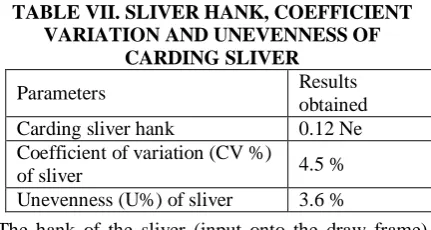
The quality parameters such as sliver hank,
coefficient of variation (CV %) and unevenness (U %) of carding sliver were measured and the
obtained results are given in Table VII
TABLE VII. SLIVER HANK, COEFFICIENT VARIATION AND UNEVENNESS OF
CARDING SLIVER
Parameters Results
obtained
Carding sliver hank 0.12 Ne
Coefficient of variation (CV %)
of sliver 4.5 %
Unevenness (U%) of sliver 3.6 %
The hank of the sliver (input onto the draw frame) was measured about 0.12 Ne hanks, which follows the standard while making 20 Ne count yarn it could be sliver hank about 0.1 - 0.15 Ne. Coefficient of variation (4.5%) and unevenness (3.6 %) of card sliver were also noticed on the input sample of the present study. Input material (card sliver) was used as
input sample for further processing and
characterization upon the modification of draw frame settings.
B. Characterization of Sliver, Roving, Yarn
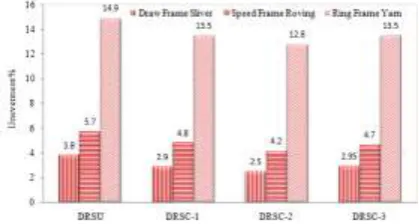
The evaluation of quality parameters such as unevenness, coefficient of variation, end breakage, yarn imperfections, lea/yarn bundle strength, yarn hairiness index of draw frame sliver, roving, yarn and fabric were performed and the results are presented. Unevenness (U %) of Sliver, Roving and Yarn : Unevenness (U %) of sliver (20 count yarn, 20), roving and yarn was evaluated as before and after draw frame machine drafting rollers setting modification, and the obtained data are described in Fig.2.. Imperfect roller drafting aggravates the uncontrolled motion of floating fibers, increasing yarn irregularity, whilst excessive short fiber content further enhance the problem. An essential objective of drawing is thus to parallelize the fibers, facilitating effective drafting at the subsequent stages of the
process. Irregularity inherited from upstream
Fig. 2.Unevenness of draw frame sliver, roving and yarn before and after drawframe setting modification. Note: DRSU: Drafting roller setting (unmodified); DRSC: Drafting roller setting change (modified)
The result of the study shows that the input ring frame yarn has slightly greater U% (i.e, 14.9) than the recommended range 10-14 % [41,51]. It reveals that the input raw material may need the reduction of unevenness by modification of draw frame settings. The U % of the presently studied card sliver delivered (output) sample after the modifications were made on drafting roller setting in the three combinations such as DRSC-1, DRSC-2 and DRSC-3 are shown in Fig.2. The unevenness of draw frame sliver was considerably reduced in the range of 2.5 - 2.95 % which was done by the modifications on break draft, top roller pressure and roller settings of all trials. This may be due to rollers not being grinded smoothly and unevenness of top roller settings.
The presently studied U % values in all the cases seem to be of lower unevenness than the reported values [27] of 40 Ne yarn ranging 9.31 - 10.33 % upon different modifications on bottom roller settings. Hence, all the modifications of the present study done on the bottom roller settings are recommended to produce lower limited number of unevenness.
Among the modified settings DRSC-2 delivered
sliver has appreciably lower unevenness
(2.5 U %) and which shows better effectiveness than other modifications on draw frame settings. Thus, the efficiency of draw frame modifications is rated in terms of unevenness (%) of sliver as:
DRSC - 2 > DRSC - 1> DRSC - 3 > DRSC The unevenness of speed frame roving had changed (as 4.2 - 4.8 U %) after modifying the setting on break draft, top roller pressure and roller arrangement (i.e., DRSC-1, DRSC-2 & DRSC-3). The changes on setting (DRSC-2) has appreciably lower U % (4.2) than unmodified setting (DRSU - 5.7 U %) and other modifications DRSC-1 (4.8 U %) and DRSC-3 (4.7 U %). The recommended value of speed frame roving unevenness is about 6 %. The result shown on speed frame roving that delivered from DRSU (unmodified) is 5.7 U %. Whereas, modified speed
frame with different roller pressure settings were delivered lower unevenness roving about 4.8 U% by 1, 4.2 U% by 2 and 4.7 U% by DRSC-3. This may be because the applied pressure made smoothness on the roller surface. According to the findings of unevenness of roving, the speed frame setting modifications are graded as:
DRSC - 2 > DRSC - 3 > DRSC - 1 > DRSC The irregularities of ring frame yarn after modification on the drafting frame have been significantly reduced from 14.9% to 12.8% as DRSU (unmodified) has greater unevenness (compared with standards 14.9 U%), but modified ring frame has lowered as 13.5 U % (in DRSC-1), 12.8 U % (DRSC-2) and 13.5 (DRSC-3). Among the roller setting combination, DRSC-2 has lower irregularity (12.8 U %) followed by DRSC-1 &
DRSC-3.Thus, ring frame modifications are
evaluated by the fact of irregularities (U %) of ring frame yarn as:
DRSC-2 > DRSC-1 DRSC-3 > DRSC
The above results show the greater influences on the improvement of regularity and uniformity of products delivered from draw frame, speed frame and ring frame. The reduction of unevenness U % on sliver, roving and yarn directly reflects in the improvements of yarn twist and it also enhances the dye affinity with flexible yarn by the modifications done on draw frame, speed frame and ring frame parameters, which is represented as DRSC-2.
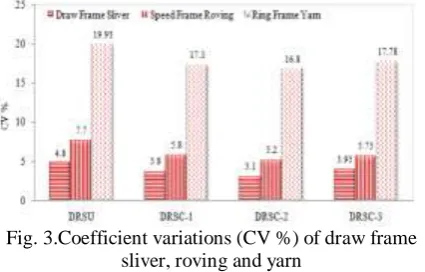
Coefficient of Variation (CV %): The irregularities
of the draw frame sliver, speed frame roving and ring frame yarn were measured in terms of CV %. It is presented in Fig.3.
Fig. 3.Coefficient variations (CV %) of draw frame sliver, roving and yarn
According to SITRA manual and Ethiopian Mill Standards [18], the CV % of unmodified speed frame roving has higher value. It seems to be bringing under the allowable limit (with CV % of 6) by modifications of draw frame settings. Surprisingly, CV of speed frame roving was observed and reduced from 7.7 (unmodified, DRSC) into range 5.2-5.75 % upon three respective combination adjustments in draw frame drafting zone.
The irregularities of ring frame yarn (in CV %) after modification of the drafting parameters have been significantly reduced from 19.93 % (higher than recommended) into 16.8 % (DRSC-2), 17.78 % (DRSC-3) and 17.3 (DRSC-1) which is shown in Fig.3 The yarn delivered from all cases of modified ring frame settings are in the allowable limit (15 -18 % CV).
These results reveal that the modification on draw frame settings by DRSC-2 show better with lower irregularities (CV%) of sliver (3.1 %), roving (5.2 %) and 16.8 % of ring frame yarn. Thus, draw frame modifications are graded as compared with unmodified settings.
DRSC - 2 > DRSC - 1 > DRSC - 3 > DRSC The sliver obtained after modification of drafting parameters of draw frame giving reduced CV % makes a consistent product in subsequent quality like roving and yarn that reflects on the reduction of end breakages and improved them accordingly.
End Breakage Study: The results for drawn sliver, speed frame roving and ring frame yarn breakages before and after changing the setting on draw frame drafting zone were determined and are recorded in Fig.4.
End breakage is a critical spinning parameter that not only affects the maximum spindle speed but may also indicate the quality of yarn, the mechanical condition of the machines and the quality of raw materials. Therefore, it is an important parameter, which determines the overall working of a spinning mill. End breakage of the studied sliver, roving and yarn was measured before and after the draw frame settings, and the obtained results are depicted in Fig.4.. The results describes the end breakages rate of the draw frame sliver, roving and yarn in terms of sliver breakages per machine hour, roving breakage per flyer hour and yarn breakages per spindle hour.
In this study, the yarn has greater rate of end breakage (over than the recommended by SITRA and Ethiopian Mill Standards) of the input sample (DRSU).These results suggest that the existing draw frame need to have some modifications on the existing draw frame. End breakages rate in all cases (with or without modifications) are ranged 3-11 on ring yarn. Besides an improvement in product appearance, proper draw frame setting parameters can contribute better productive efficiency; fewer end breakages in subsequent processes, less waste, and constant performance [18]. In this context, some modifications were undertaken on draw frame as DRSC-1, DRSC-2 and DRSC-3 and the results surprisingly reduced as ranged 2 - 6 (by DRSC-1), 1 - 4 (by DRSC-2) and 2-9 (by DRSC-3) on draw sliver, roving and ring frame yarn, respectively.
The results reveal that end breakage rate of the samples of DRSC-2 are lower as 1 (in sliver), 3 (in roving) and 4 (in yarn).End breakages rate of draw frame sliver was considerably reduced from 3 in to 1 (on DRSC-2) control per machine hour on the drafting roller settings such as break draft, top roller pressure and roller settings. Similarly, end breakage rate of speed frame roving and ring frame yarn are significantly reduced from 7 into 3 and 9 into 4, respectively, by employing the modification under DRSC-2 in break draft, top roller pressure and roller settings. Thus, the results confirm that the DRSC-2 modification is better suited with lower end breakage rate.
Fig.4. Draw frame settings end break of sliver, roving and yarn.
Yarn Imperfections (Thin, Thick and Slubs /Neps) of Ring Frame Yarn: Imperfections are the number of thin, thick places and neps present in 1000 meter of yarn. Free from neps and imperfections are an important requirement in yarns used for apparel and superior class of goods. Thin place of yarn is expressed in one or more variants, but in 1000 meter of uniform yarn length, it is expected to be at two places to break up (-50%) from the original yarn diameter. However, the quantity is too highly influencing the production process.
bottom roller gauge setting, adopted for large scale working in spinning [28]. The imperfections of yarn in thin places, thick places and slubs/neps were
determined and the results are reported in Fig.5.
Fig.5. Thin places/km (-50%) of ring yarn.
The numbers of thin places/km in ring frame yarn were measured in all cases of draw frame settings. Greater numbers of thin places were observed in unmodified (DRSU) yarn. This reflects much yarn breakages during weaving process and has greater influence in dye uptake during dyeing process. Significant variation was noticed as few thick places and some thin places in the same zone of yarn. This significant variation is depended on the mechanical settings [28]. Comparatively, modifications on draw frame setting changes in the three combinations DRSC-1, DRSC-2 and DRSC-3(see Fig. 3.4) greatly reduced the number of thin places in ring frame yarn (ranged 38 - 28). The resulting of thin places on modified settings are in good agreement with the reported data [29] where studied in the sliver characterization on bottom roller setting modification
of 40s Ne yarn count. Among the three DRSC-2 has
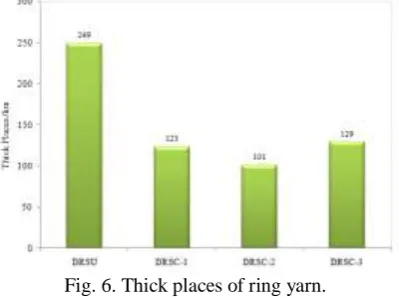
low number (28) of thin places. It was found that imperfection (thin, thick & neps), unevenness (U %) and strength of yarn were influenced by the changes in bottom roller gauge setting, adopted on large scale in spinning [30]. Thick places on ring frame yarn were determined and results were described in Fig.6.
Fig. 6. Thick places of ring yarn.
The results, shown in Fig.6 describe the number of thick places noticed in ring frame yarn on the samples without and with modification of drafting
parameter. The number of thick places in ring frame yarn are greatly reduced from 249 (unmodified, DRSU) to 101 (modified, DRSC-2) per kilometer length of yarn after modifying the break draft, top roller pressure and roller settings. This in further confirms that DRSC-2 modification has influenced reducing the imperfections well on the yarn quality than other modifications.
All exact slubs and neps are difficult terminology in the industry tends to be poor and quality defects that have been found in cotton from the field to the finished fabric. The nep of yarn is of greater strong influence on the quality of dyed fabric. The sliver thickness variation may alter continuously on draft frame, so that more draft is applied to thick places, and less to thin places resulting in less irregularity on sliver delivered.
More number of thick places in the yarn has direct influences on the choking of yarn in heald-wires and reed of loom during weaving process that affects the uniformity of fabric and creates uneven dyeing. Slubs and neps in ring frame yarn of the presently studied samples were evaluated and the obtained data are given in Fig.7.Among the current study samples the
unmodified draft frame (DRSU) has more
imperfections (i.e., has 268 neps), which shows poor drafting condition in the draw frame can lead to more imperfections in the yarn. Investigation of the quantity of neps produced during drawing reveals that neps in carded yarn outnumber those in carded web, suggesting that certain aspects of the drafting process, a lack of fiber orientation and presence of fiber hooks in the sliver, for example, contribute additional neps [25].
The number of slubs and neps in ring frame yarn samples were observed upon before (DRSU) and after modifications in the drafting parameter settings as in three combinations DRSC-1, DRSC-2 and DRSC-3. The number of slubs and neps in ring frame yarn was greatly reduced from 268 to 94upon the modification under DRSC-2 than other settings (DRSC-1 has 108 and DRSC-3 has 118) of ring frame. Thus, the efficiency of ring frame modification settings is rated showing the trend similar like earlier cases.DRSC-2 modification has lower imperfections showing better yarn quality. Based on the findings in terms of imperfections, draw frame modifications are rated as compared with unmodified ring frame setting is rated as:
DRSC - 2 > DRSC - 1 > DRSC - 3 > DRSC
The literatures reported [27,31] the total
of skilled technicians to modify settings based on the fibre properties.
Fig. 7 Slubs/Neps/km (+200 %) of ring yarn
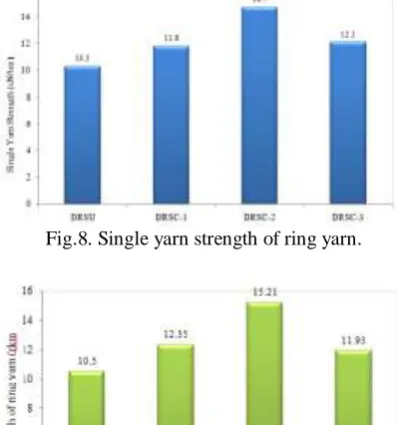
Single Yarn Strength in (cN /tex and RKM) Value : Yarn strength is one of the most significant parameters to be controlled during yarn spinning process. This parameter strongly depends on both the roving characteristics and the yarn process. Nevertheless, they often need to perform many tests before producing a yarn with a desired strength. The influence of fiber friction, top arm pressure, and roller settings at various drafting stages, namely, draw frame, roving frame, and ring frame has also been affected the yarn strength. It has been found that top arm pressure and roller settings at all three drafting stages are affecting the yarn properties in a similar way, and fiber-to-fiber friction is a leading factor and influencing the tensile properties of ring spun yarn. The carding process has a vital role in the production of staple spun yarn and has significant effect on the properties of the resulting yarn. In addition, drawing and doubling at the subsequent production stages also play an important role in determining the consequent yarn quality [30].Single yarn strength of the samples was examined in terms of centi-Newton per tex (cN/tex) and resistance kilometer or breaking kilometer (RKM) values. The single yarn strength of ring frame yarn was examined and presented in Fig.8 and Fig.9.
Fig.8 reveals that by modifying drafting parameter settings the single yarn strength relatively improved in the range of 11.8 - 14.7 cN/tex in all cases; Single yarn strength of ring frame yarn was greatly improved from 10.3 DRSU (control) to 14.7cN/tex (DRSC-2) followed by DRSC-3 (12.1 cN/tex) and
DRSC-2 (11.8 cN/tex) influenced by the
modifications on the break draft, top roller pressure and roller settings. Thus, DRSC-2 modification has greater single yarn strength as 14.7 cN/tex.
Single yarn strength (as RKM value) of ring frame yarn of samples was measured on before and after the drafting parameter setting modifications. The results were obtained and recorded in Fig9. RKM values of ring frame yarn are also greatly improved ranging from 11.93 - 15.21.
Fig.8. Single yarn strength of ring yarn.
Fig. 9. Single yarn strength of ring yarn. . The draw frame settings modified as DRSC-2 has greater single yarn RKM value (15.21) than other modifications.
The RKM value norms for the 20s Ne yarn is 18kg based on the SITRA norms and Ethiopian Mill Standards. The results of the current research for RKM value are 11.93 - 15.21 in which the highest 15.21 is nearest to the SITRA standards. The literature [34] states the RKM value 17.58, 17.81 and 17.55 for the bottom roller gauge settings of 41/45, 40/44, 42/46 respectively. The current research gives the RKM value of 12.35, 15.21 and 11.93 for the bottom roller gauge settings of 36.36/41.8, 38.6/43.8 and 40.6/45.8, respectively which correlate with the above mentioned literature and fall under norms of SITRA and Ethiopian Mill Standards [18, 26].
Fig. 10. Lea strength (kg) of ring frame yarn.
Lea Strength and Yarn Bundle Strength : The lea
Fig.11. Bundle yarn strength (as CSP) of ring yarn The results were reported in Fig.10 describes the lea strength of ring frame yarn on after the drafting parameter setting modifications and these results were compared with control (DRSU: unmodified). Lea strength of ring frame yarn was appreciably improved as 18.6 - 20.41 kilogram on modified setting of draw frame than un-modified draw frame lea strength (17.23 kg).
Moreover, these enhancements were noticed on after some modifications on break draft, top roller pressure and roller settings. With the changes on setting of draw frame,DRSC-2 has better lea strength (20.41 kg), which DRSC-2 has approached the recommended value yarn lea strength of 20 kg yarn lea strength by SITRA manual (i.e. 20 kg) [26].
Bundle yarn strength is measured as count strength product (CSP) of ring frame yarn samples by adopting the drafting parameter settings changed the three combinations are shown in Fig.11. The modifications on draft settings influenced greatly and enhance on the CSP value of yarn ranging 1808.1 - 1984.5. With respect to the modification on settings, the DRSC-2 modified draw frame delivered greater bundle strength (1984.5) of yarn.
Yarn Hairiness Index : Hairiness index of ring frame yarn was examined and reported as in Fig.12. Yarn hairiness is directly related to fiber preparation; it measures the distribution of hairs per unit length on the yarn surface according to ASTM[24]. Only the hairiness (i.e., number of hairs) greater than 3mm was considered, which is known as significantly
affecting the appearance. Yarn hairiness is
compromised with the increase in draw frame doubling up to a certain optimum point and then decreases with any further increase in this parameter. Hairiness is low when the draw frame doubling is eight, while it is higher when the draw frame doubling is six. Hairiness of carded ring yarn shows a decreasing trend when the number of doubling in finisher draw frame increases [31]. The influence of fiber friction, top arm pressure, and roller settings at various drafting stages of draw frame is affected hairiness on ring yarn [32].
The hairiness index of yarn is 26 for the samples from unmodified draw frame roller settings. This is due to the damaged rotating parts of machine, fibre breakage in drafting zone and damaged and worn out travelers and ring in a ring frame. According to
SITRA and Ethiopian Mill standard the hairiness index for 20s Ne yarn is 15 and for the DRSC-2 the hairiness index of yarn is 14. So it shows that the hairiness index is reduced in a greater level and falls under the standard of SITRA and Ethiopian Mills Standards [18, 26].
Fig.12 Yarn hairiness index of ring frame yarn. Hairiness index of ring frame yarn samples of the present study were noticed before and after modified draw frame roller settings in three combinations and the results are described in Fig.12. The Hairiness index of yarn significantly reduced from 26 to 17-14 after modification in break draft, top roller pressure and roller settings as DRSC-1 (16), DRSC-2 (14) and DRSC-3 (17). Amongst DRSC-2 modified draw frame settings reduced the number of hairiness up to 14 that comes under the permissible limit of 15 [26] than other setting parameters. The literature [31] states that the hairiness index is in a range of
4.41-4.62 for the yarn count 40s Ne which falling under
SITRA Standards and in this research the hairiness index is in the range of 14-16 for the modified settings which meet the norms of SITRA and
Ethiopian Mill Standard for the yarn count 20s
Ne.[18,26].
IV.CONCLUSIONS
This study was focused on the evaluation of unevenness of draw frame sliver and roving; yarn parameters such as yarn unevenness, coefficient of variation, yarn strength, yarn hairiness and yarn imperfections by modifying the draw frame drafting roller setting parameters such as break draft, top roller pressure and settings between bottom drafting rollers. The study was undertaken as modification on draw frame machine with three combinations represented as DRSC-1, DRSC-2 and DRSC-3 and compared with unmodified (referred as DRSU) existing setting of draw frame machine. Among these modifications, DRSC-2 setting delivered sliver, roving and yarn have better physical properties than other modifications and control. Thus, the results of DRSC-2 are concluded as follows:
bottom roller settings of 30/40.6 mm for back and front zone (Breaker) and 38.6/43.8 (Finisher) of drafting zone of a draw frame as compared to unmodified parameters (DRSU), less (DRSC-1) and high level (DRSC-3) of changes.
The imperfections of yarn such as number of thin places, thick places, and neps were reduced in greater level to 28, 101 and 94 per km for the optimum drafting roller parameters(DRSC-2) as compared to the results of 85, 249 and 268 per km with unchanged (DRSU) drafting roller parameters respectively.
Upon DRSC-2 modification parameters the yarn strength and RKM values increased to 15.21, 20.41 kgs in drafting zone of a draw frame as compared to the results of 10.5 and 17.23 kgs of unmodified drafting parameters (DRSU) respectively.
Based on the investigation of drafting roller parameters of draw frame and the evaluation of yarn quality it is confirmed that the changes in optimization of drafting roller parameters of draw frame are very essential for improving the yam. The overall yarn and fabric quality parameters are found to be better resulted by nominal drafting roller parameter settings DRSC-2 than other settings and unmodified.
REFERENCES
[1] Majeed, ACotton and textiles-the challenges ahead, Dawn the
Internet edition, retrieved 2009-02-12.
[2] Machine processes", Spinning the Web, Manchester City
Council: Libraries, retrieved 2009-01-29.
[3] J. Ochola, J. Kisato, L. Kinuthia, J. Mwasiagi and A.
Waithaka, Study on the Influence of Fiber Properties on Yarn Imperfections in Ring Spun Yarns, Asian Journal of Textile, Volume 2 (3): 32-43, 2012.
[4] Graham J S & Bragg C K, Study on drafting force of roving:
Part IV – Correlation between drafting force, roving strength and yarn quality,Text Res J, 42 (1972) 180.
[5] N. Balasubramanian,The Effect of Top-Roller Weighting,
Apron Spacing and Top-RollerSetting upon Yarn Quality, Text. Res. J., 45, 322 (1975).
[6] S. M. Ishtiaque, A. Mukhopadhyay, and A. Kumar, Influence
of Draw Frame Speed and Its Preparatory Process on Ring-Yarn Properties, J. Text. Inst., 99, 533 (2008).
[7] S. M. Ishtiaque, A. Mukhopadhyay, and A. Kumar, J.
Text.Inst., Impact of yarn extension on packing density of ring spun yarn,100, 657 (2009).
[8] YaseminAydogmusKorkmaz, Relationship Between Fiber
Fineness, Break Draft, and Drafting Force in Roller Drafting, Textile Research Journal,Volume: 74 issue: 5, page(s): 405-408,2004.
[9] Purushothama, "Modern auto leveler draw frames,
international journal of spinning textile technology," retrieved, 2010.
[10] Klien, Practical guide to opening and carding, manual of
textile technology, short-staple spinning series, Ahe textile institute, Manchester, 1987.
[11] Process Neha Gupta, Prof. Dr. P. K. Bharti, State of Art on
Yarn Manufacturing Process & its defects in Textile Industry,
International Journal of Computational Engineering
Research, Vol 03,Issue, 4,2013.
[12] Ghosh, A. Majumdar,Process control in drawing, combing
and speed frame operations in Process Control in Textile
Manufacturing, Wood head Publishing, ISBN:
9780857090270, 2013.
[13] Vijay Chaudhari,P. P. Raichurkar,Effect of Draw Frame
Bottom Roller Gauge Setting on Yarn Quality,International
Journal on Textile Engineering and Processes ISSN 2395-3578, Vol. 2, Issue 2, April 2016.
[14] Akshay Kumar, S.M Ishtiaque , K R Salhotra, M S
SenthilKannan, Impact of different stages of spinning process on fibre orientation and properties of ring, rotor and air-jet yarns: Part 1 – Measurements of fibre orientation parameters and effect of preparatory processes on fibre orientation and properties, Indian Journal of Fibre and Textile Research, Vol 33, pp.451-467, 2008.
[15] R. Moghassem and A. R. Fallahpour,Processing Parameters
Optimization of Drawframe for Rotor Spun Yarn Strength Using Gene Expression Programming (GEP), Fibers and Polymers, Vol.12, No.7, 970-975, 2011.
[16] AnindyaGhosh, SayiedIshtiaque, SeenivasanRengasamy,
AsisPatnaik, The Mechanism of End Breakage in Ring Spinning:A Statistical Model To Predict The End Break In Ring SpinningAutexResearch Journal, Vol. 4, No1, March 2004 © AUTEX.
[17] AnindyaGhosh, AbhijitMajumdar,Process Control in Draw
frame, Comber, and Speed frame,Publisher: Wood Head Publisher,2012.
[18] Ethiopian Spinning Mill Standards(Own Factory Standards),
Ethiopia, 2006
[19] J.E. Booth,Principles of Textile Testing: An Introduction to
Physical Methods of Testing Textile Fibres, Yarns, and Fabrics,3, Reprint,ButterWorths, 1986
[20] Apurba Das1, Saiyed M. Ishtiaque and RiteshNiyogi,
Optimization of Fiber Friction, Top Arm Pressure and Roller Setting at Various Drafting Stages, Textile Research Journal, 76(12).
[21] QasimSiddiqui, ZamirAbroand Chongwen Yu, Study of
drafting force variability and sliver irregularity at the break draftzone of a draw frame,Textile Research Journal, 2015, Vol. 85(14) 1465–1473.
[22] Manual of Industrial procedure of spinning mills, Ethiopia,
2005
[23] USTER® STATISTICS Application Handbook, Edition
2013, Textile Technology, V1, January 2013, ISBN: 240 840-14020.
[24] American Society for testing materials (ASTM),
https://www.astm.org/digital_ library/topics/pages/section07_stds.htm.
[25] Klein W, Short Staple Spinning Series, A practical Guide to
Combing and Drawing, Manchester, The Textile Institute Vol 3: (1987).
[26] TarakadVedamurthyRatnam, SITRA Norms for Spinning
Mills,Edition 5, South India Textile Research Association, 2000.
[27] Pankaj S. Patil, V.S. Shivankar, P.P. Raichurkar, Some
Studies on Draw Frame Scanning Roller Setting on Ring Frame Yarn Quality, International Journal on Textile Engineering and Processes ISSN 2395-3578,Vol. 3, Issue,October 2017.
[28] Vijay Chaudhari and PramodRaichurkar, Effect of Draw
Frame Bottom Roller Gauge Setting on Yarn Quality, International Journal on Textile Engineering and Processes ISSN 2395-3578 Vol. 2, Issue 2 April 2016.
[29] AbdulsalamBagwan, Ashok Aakade and Vijay Chaudhry,
Optimization of draw frame bottom roller setting on cotton yarn quality, International Journal on Textile Engineering and Processes, ISSN: 2395-3578, Vol 1, Issue 4, October 2015.
[30] Das, A.; Ishtiaque, S. M.; and Neoga, R.; Optimization of
fiber friction, top arm pressure and roller setting at various drafting stages, Textile Research Journal, 76, 913-921, 2006.
[31] Abdul Jabbar, TanveerHussain and Abdul Moqeet, Impact of
Carding Parameters and Draw Frame Doubling on the Properties of Ring Spun Yarn, Journal of Engineered Fibers and Fabrics, , Volume 8, Issue 2 – 2013.
[32] Saiyed M. Ishtiaque, Apurba Das, RiteshNiyogi,
![TABLE I: SPECIFICATION OF THE MATERIALS [18]](https://thumb-us.123doks.com/thumbv2/123dok_us/8580745.1718861/2.595.313.518.63.683/table-i-specification-of-the-materials.webp)