Age, training experience, the age of taking up
training and morphological features of top ju-jitsu
contestants
Katarzyna Sterkowicz-Przybycień
University School of Physical Education, Krakow, Poland
Source of support:
“Young Researcher 39 ½” Grant funded by the Archives of Budo
Received:
22 December 2008;
Accepted:
18 January 2009;
Published online:
27 January 2009
Abstract
Background
The recognition of contestants’ body build is essential for search for sports talents. The aim of this work is to de-termine the age, training experience and age of beginning training and the level of anthropological traits of top Polish ju-jitsu players as joint effect of selection and special training. Duo and Fighting events have been consid-ered.Material/Methods:
During the Ju-jitsu tournament anthropometrical measurements were taken for Duo System (n=6) and Fighting System (n=24) contestants. The nation team coach has selected the best contestants for this tournament. The mor-phological features were compared to those of the non-training students of the Warsaw University of Technology (n=165). Difference significance t-Student test was applied and Cohen’s d was calculated.Results:
The Duo group did not differ from the Fight group in age, training experience or the age of taking up training. When directly compared, the morphological features in those groups were similar. Morphological profiles of the contestants with the background of non-involved men in the sporting activity depended however on the practiced ju-jitsu event.Conclusions:
Polish contestants are in the optimum age for successes in ju-jitsu sport. The age of their taking up training re-flects large differentiation. The men practicing ju-jitsu – with the background of the untrained men – are charac-terized by a larger body mass shorter and broader hand, larger arm circumference arm, forearm, thigh, and lower triceps skin fold breadth. The Duo system competitors – with the background of the untrained men – are differ-entiated with larger sitting height, foot breadth, and fat mass in kg. The contestants of the Fighting system – with the background of the untrained men – have lower body height, arm span, legs length, arm length, and foot length, and elbow and wrist’s breadth. They have also bigger circumferences of shin, lower skin fold of subscapular area, percentage of fat, as well as higher fat free mass percentage.Key words: ju-jitsu • body build • duo • fighting system
Author’s address: Katarzyna Sterkowicz-Przybycień, University School of Physical Education, Al. Jana Pawła II 78, 31-571 Kraków, Poland, e-mail: [email protected]
Ju-jitsu – a contemporary sport, which emphasise the all round development of schooling.
Duo – a prearranged sparring.
B
ACKGROUNDJu-jitsu, which evolved from brutal hand-to-hand com-bat [1] has been turned into a sport in recent years and its rules emphasise the all-round development of tech-nical and tactical schooling. The Duo System is aimed at presenting the defence of one contestant against a
number of predetermined attacks from a contestant of the same team. The attacks are divided into 4 groups of 5 attacks each: 1) Gripping attacks, 2) Embracing and neck lock attacks, 3) Punches/strikes and kicking attacks 4) Weapon attacks. A couple may be formed without any restriction at all, such as weight, age or grade. It is also possible to change Tori and Uke at any time
dur-and Study Aim:
Authors’ Contribution: A Study Design
B Data Collection
C Statistical Analysis
D Manuscript Preparation
E Funds Collection
ing the competition. The couple is of course responsi-ble for each other [2]. Fighting System is composed of 3 parts: 1) blows/strikes and kicks, 2) throws, take downs, locks and strangulation, 3) Floor techniques, locks and strangulation. After evaluation of action in part second or third, the fight is resumed in part first. The fighting time per match is divided into 2 rounds of 2 minutes each with a break of 1 minute in between. In fighting system six weight categories exist [2]. During competition in this new discipline of sport, the dura-tion of the second and third part of fight as well as that of the time-outs depended on the weight catego-ry. The highest number of techniques and points for their execution occurred in the first part of fight, dur-ing which punches delivered with the hand predominat-ed. Uchi-mata and Seoi- nage were the most frequent-ly applied throwing techniques in the second part of fight. The technique executed during the third part of fight (mainly, holding techniques) received the highest scoring value in both categories. The points obtained as the result of the offences of the opponent had no significant bearing on the final result. Most of the ac-tions were executed in the centre of the contest area in the form of a single attack, which indicated a need for tactical perfecting of the competitors (drills in coun-ter-attacks and combinations). The developed techni-cal patterns indicate a direction for the schooling in sports clubs. At the same time, they inform about in-adequate defence against typical attacks in the consec-utive parts of fight [3].
According to Claessens et al. [4] connections between the body structure and its function are very important and characteristic for contestants of sport elite. In lit-erature, there are few results of anthropometric re-search of ju-jitsu contestants [5,6]. Moreover, authors do not divided of ju-jitsu players’ body build using cri-terion of their participation in different ju-jitsu events (Duo, Fight).
Therefore, the aim of research was to determine lev-el of anthropological traits of Polish ju-jitsu players as joint effect of selection and special training. The follow-ing hypotheses were formed: H1. Age, trainfollow-ing experi-ence and age of beginning training will differentiate to the contestants according to ju-jitsu event. H2. Length, breadths, circumferences dimensions, body composition, and weight-height indices will differentiate the contes-tants according to ju-jitsu-event. H3. The morphologi-cal profile of ju-jitsu players will depend on their event specialization.
Body build analysis will allow for update of the data necessary for “master model” in this new sport disci-pline.
M
ATERIALANDM
ETHODSThe material consists of results of research conduct-ed among 30 leading Polish contestants designatconduct-ed by national coach of ju-jitsu during the All Polish Senior Tournament. The data was gathered according to a broader design of my PhD thesis entitled ‘Diversification of the Somatic Build in the Leading Competitors who Practice Combat Sports’ approved by the Council of Department of Physical Education of University School of Physical Education in Krakow. A measurement of sev-en lsev-ength variables, tsev-en width features, twelve circum-ferences, and six skin folds was performed. Based on the anthropometrical measurements a Rohrer’s Index, Height-to-Weight Ratio (HWR) and Body Mass Index (BMI) was calculated. From the known indirect methods of estimation percent fat (%PF) the Keys and Brożek [7] equation was chosen calculating before the body density based on the second Piechaczek’s [8] equation.
The variables dependent on the ju-jistu event factor (Duo, Fight) were age, training experience (in years), characteristics of lengths, breadths, circumferences and body composition, as well as Rohrer index, HWR and BMI. Statistical hypothesis pertaining to differences of resemblances between group characteristics of sportsmen with regard to sport events were verified. Morphological characteristics of jujitsu contestants were also related to the general population (compare group). Due to a profile of the test the most appropriate is the data published by Polish students of Warsaw University of Technology from the last decade [9,10].
All results were expressed as mean ±SD and min and max values. Student t-test was used to determine dif-ferences between groups. When significant difdif-ferences (p<0.05) were found, then Cohen’s d was employed as an effect size (ES) measurement [11].
R
ESULTSAge, training experience and the age of taking up jujitsu training
Table 1 shows a list of average age values, practice ex-perience and the beginning of practice age, who special-ize in Duo and Fight sport concurrences.
The distance between the individual values for particu-lar contestants in the Duo group is 11.7 years, whereas in Fight group – 17.2 years. The wide variation range of the age is depending on the fact that amongst the tested, some of them were at the stage of their major sport suc-cess and others were at the end of high sports results level and moving towards the end of their sports career. Fighting system – an event is
set in a competition.
Body build – A shape of an individual characterized by measurements including lengths, breadths, circumferences and adiposity.
The above list of group characteristics (Table 1) not only has shown the lack of statistically significant differenc-es between the average age valudifferenc-es but also of the prac-tice experience. The range in Duo group was 8 years, and in Fight group even 14 years.
The comparison of individual number profiles of the contestants` age and their practice experience enabled acquiring of the data about the age of taking up train-ing. Its mean values do not significantly differ signif-icantly in the compared groups. The min-max values
Feature Statistics Group Test of diff erences signifi cance t p-value Duo (n=6) Fight (n=24)
1. Stature (cm)
X − S.D. min-max 177.63 5.30 171.00 184.00 176.35 7.56 163.00 190.00 0.39 0.699
2. Arm span (cm)
X − S.D. min-max 179.57 5.31 172.00 183.00 178.44 8.85 159.00 194.00 0.30 0.769
3. Sitting height Vertex (cm)
X − S.D. min-max 90.23 6.68 78.00 97.50 93.14 4.02 85.00 100.50 1.38 0.178
4. Trunk length (cm)
X − S.D. min-max 52.37 2.63 48.40 55.00 52.80 2.43 48.00 59.00 0.39 0.701
5. Legs length (sy) cm
X − S.D. min-max 91.28 3.38 88.40 96.80 90.24 4.43 80.00 96.80 0.53 0.597
6. Legs length – under sitting position (cm)
X − S.D. min-max 87.40 8.91 81.20 105.00 83.21 4.16 73.60 91.00 1.72 0.096
7. Arm length (cm)
X − S.D. min-max 77.43 2.69 73.50 80.20 76.70 3.67 70.00 83.00 0.46 0.649
8. Hand length (cm)
X − S.D. min-max 18.05 0.59 17.30 18.80 18.20 0.89 16.70 19.70 0.38 0.701
9. Foot length (cm)
X − S.D. min-max 26.25 0.90 25.00 27.70 26.21 1.26 23.10 28.50 0.07 0.946
Table 2. Mean values and variation measurements of length features for ju-jitsu fi ghters in Duo and Fight groups.
Feature Statistics Group Test of diff erences signifi cance t p-value Duo (n=6) Fight (n=24)
Age (years) X − S.D. min-max 22.00 3.06 18.25 29.95 23.20 4.58 16.16 33.33 0.55 0.586
Practice experience (years)
X − S.D. min-max 8.00 3.41 4.00 12.00 11.00 4.64 3.00 17.00 1.48 0.151
Age of taking up ju-jitsu training (years) X − S.D. min-max 14.00 2.75 10.29 17.35 12.20 3.94 5.13 20.07 1.11 0.276
Table 1. Age, training experience and the age of taking up ju-jitsu training with regard to division between Duo and Fight groups.
prove that as far as the individual cases are concerned the tested began the practice in their childhood and in some cases as mature men.
Differences in contestants’ morphological features
The mean values and variation measurements of the body build features are compared in tables (Tables 2–4). No statistically significant differences between the mean val-ues of length, breadth, circumference of bodies and tissue components of the contestants specializing in different ju-jitsu concurrences were noted (Duo versus Fight).
Morphological profiles of the ju-jitsu contestants against a background of men not involved in the sports activity
The body builds profiles for Duo and Fighter groups of contestants were presented with regard to length,
breadth features, adiposity, and body mass and select-ed weight-height factors.
Length features
Figure 1 presents standardized differences between ju-jitsu and untrained groups.
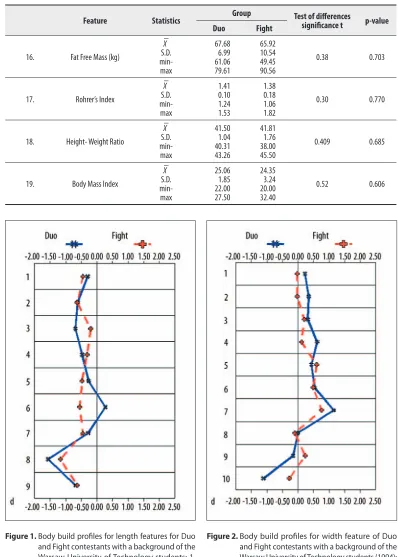
The profiles of length features for Duo specialists are partially similar to the non-training students. The con-testants however have statistically larger sitting height (t=2.71, p<0.0, medium ES) and lower value of hand length (t=3.20, p<0.01, large ES).
The Fight specialists are differentiated by a shorter hand length (t=5.10, p<0.001, large ES). They are also char-acterized by lower values in six features: body height (t=2.09, p<0.05, small ES), arm span (t=2.99, p<0.01, medium ES), legs lengths (t=2.08, p<0.05 and t=2.46,
Feature Statistics Group Test of diff erences signifi cance t p-value Duo Fight
1. Bi-acromial breadth (cm)Shoulders
X −
S.D. min-max
41.00 1.41 39.50 43.20
40.63 1.96 36.00 44.50
0.44 0.665
2. Hip breadth ic-ic (cm)
X −
S.D. min-max
28.93 1.44 27.60 31.00
28.41 1.94 25.60 32.50
0.62 0.542
3. Normal chest girth (cm)
X − S.D. min-max
29.22 1.05 28.00 30.60
29.21 2.48 25.00 34.70
0.00 1.000
4. Chest deep (cm)
X −
S.D. min-max
21.10 1.95 17.40 22.80
20.14 1.69 16.30 24.00
1.21 0.238
5. Elbow (cm)
X −
S.D. min-max
7.10 0.20 6.80 7.40
7.22 0.45 6.60 8.10
0.612 0.545
6. Wrist (cm)
X − S.D. min-max
5.90 0.35 5.50 6.30
5.92 0.49 5.20 7.80
0.10 0.924
7. Hand (cm)
X −
S.D. min-max
8.85 0.40 8.20 9.40
8.73 0.52 7.90 9.80
0.51 0.615
8. Knee (cm)
X −
S.D. min-max
9.82 0.31 9.50 10.40
9.77 0.51 8.60 10.80
0.21 0.837
9. Ankle (cm)
X − S.D. min-max
7.57 0.23 7.40 8.00
7.72 0.47 7.00 8.50
0.76 0.454
10. Foot (cm)
X −
S.D. min-max
9.57 0.37 9.00 10.10
9.93 0.64 8.80 11.10
1.30 0.204
Table 3. Mean values and variation measurements of broadth features for ju-jitsu fi ghters in Duo and Fight groups.
Feature Statistics Group Test of diff erences signifi cance t p-value Duo Fight
1. Arm (cm)
X − S.D. min-max 32.67 2.36 29.00 35.50 31.81 2.77 27.50 38.00 0.70 0.494
2. Arm -fl exed and tensed (cm) X − S.D. min-max 36.00 1.87 34.00 38.50 35.65 2.92 31.00 41.50 0.28 0.78
3. Forearm (cm)
X − S.D. min-max 28.58 2.22 25.00 31.50 28.33 1.87 24.50 31.50 0.28 0.780
4. Chest girth xi (cm)
X − S.D. min-max 93.00 4.15 88.00 98.00 89.19 5.92 80.00 97.50 1.48 0.150
5. Hips (cm)
X − S.D. min-max 94.00 4.32 86.50 99.00 92.38 6.64 82.00 108.50 0.57 0.578
6. Thigh (cm)
X − S.D. min-max 58.67 2.86 54.00 62.00 57.31 5.38 49.00 70.00 0.59 0.560
7. Shin (cm)
X − S.D. min-max 38.17 2.46 34.00 41.00 38.42 3.47 32.50 45.00 0.166 0.870
8. Body mass (kg)
X − S.D. min-max 78.73 7.26 68.90 89.40 76.03 12.96 56.70 103.90 0.48 0.630
9. Triceps skin fold (mm) 100*LOG10 (Skinfold-18) X − S.D. min-max 158.33 29.68 126.00 190.00 154.88 19.79 115.00 198.00 0.35 0.731 10.
Sub scapular skin fold (mm) 100*LOG10 (Skinfold-18) X − S.D. min-max 188.50 16.19 160.00 206.00 183.29 14.54 162.00 217.00 0.77 0.448
11. Abdomen skin fold100*LOG10 (Skinfold-18) X − S.D. min-max 187.50 23.38 148.00 215.00 177.21 18.93 148.00 227.00 1.14 0.264 12.
Body Density (g/cm3)
Keys-Brożek [1953] according to Piechaczek
[1975] X − S.D. min-max 1.063 0.009 1.0520 1.0760 1.065 0.006 1.0480 1.0730 0.86 0.396
13. Percent Fat (PF%)
X − S.D. min-max 14.06 3.31 9.26 18.04 13.12 2.12 10.22 19.42 0.87 0.392
14. Fat Mass (kg)
X − S.D. min-max 11.06 2.63 6.29 13.44 10.11 3.03 6.29 13.44 0.69 0.491
15. Fat Free Mass (%)
X − S.D. min-max 85.94 3.38 81.97 90.87 86.86 2.12 80.44 89.78 0.83 0.412
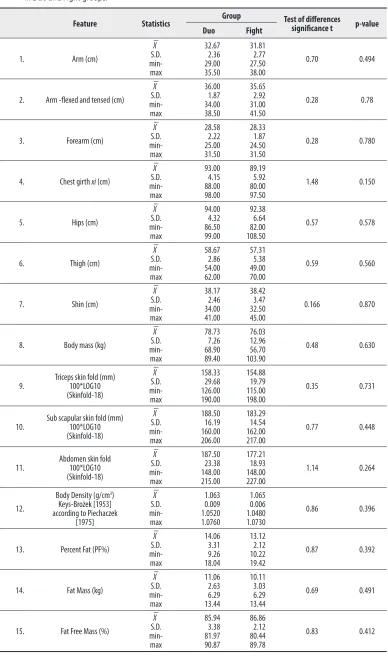
Table 4. Mean values and variation measurements of circumference of bodies and tissue components for ju-jitsu fi ghters in Duo and Fight groups.
Feature Statistics Group Test of diff erences signifi cance t p-value Duo Fight
16. Fat Free Mass (kg)
X −
S.D. min-max
67.68 6.99 61.06 79.61
65.92 10.54 49.45 90.56
0.38 0.703
17. Rohrer’s Index
X − S.D. min-max
1.41 0.10 1.24 1.53
1.38 0.18 1.06 1.82
0.30 0.770
18. Height- Weight Ratio
X −
S.D. min-max
41.50 1.04 40.31 43.26
41.81 1.76 38.00 45.50
0.409 0.685
19. Body Mass Index
X −
S.D. min-max
25.06 1.85 22.00 27.50
24.35 3.24 20.00 32.40
0.52 0.606
Table 4 continued. Mean values and variation measurements of circumference of bodies and tissue components for ju-jitsu fi ghters in Duo and Fight groups.
Figure 1. Body build profi les for length features for Duo and Fight contestants with a background of the Warsaw University of Technology students: 1. Body height, 2. Arm span, 3. Height while seated, 4. Body length, 5. Legs length, 6. Under sitting legs length, 7. Arm length, 8. Hand length, 9. Foot length; d – Cohen’s standardized diff erences between ju-jitsu competitors and the Warsaw Technical University untrained students.
Figure 2. Body build profi les for width feature of Duo and Fight contestants with a background of the Warsaw University of Technology students (1994): 1. Shoulder width (a-a), 2. Hips breadth (ic-ic), 3. Chest breadth (tl-tl), 4. Chest depth (xi-ts), 5. Elbow breadth, 6. Wrist breadth, 7. Palm breadth, 8. Knee broadth, 9. Ankle breadth, 10. Foot breadth; d – Cohen’s standardized diff erences between ju-jitsu competitors and the Warsaw Technical University untrained students.
p<0.05, medium ES), arm length (t=1.99, p<0.05, small ES), and foot length (t=2.84, p<0.01, medium ES).
Breadth feature profiles
The breadth profiles of the contestants were confront-ed in the following picture (Figure 2).
For the Duo specialists differences in hand width (t=2.63, p<0.01 large ES in plus) and in foot breadth in minus (t=2.30, t<0.05, large ES) are characteristic. Amongst the ten breadth features for ju-jitsu Fight representatives the differences in comparison to untrained students (medium ES) are present for elbow dimension (t=2.99, p<0.01),
wrist (t=2.50, p<0.05) and palm (t=3.56, p<0.001). The ju-jitsu contestants do not differ in the width of shoulders, hips (ic-ic), chest, knee, and ankle from the students.
Tissue elements and circumferences profiles and selected weight-height indices
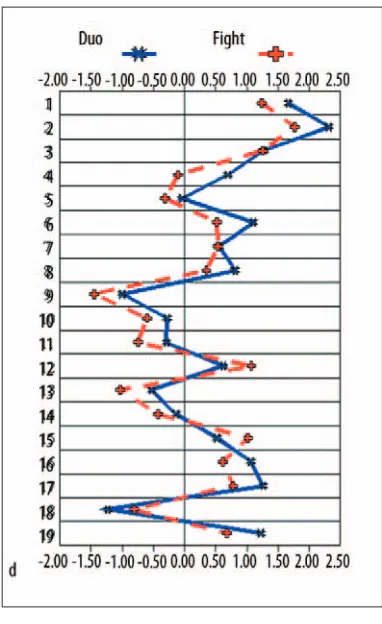
Figure 3. shows the differences in profiles of circumfer-ences and tissue elements for Duo and Fight ju-jitsu con-testants with a background of non-training students.
The graph (Figure 3) shows a similarity of the features level of the contestants practicing ju-jitsu. The Duo contestants are different to the students in 9 out of 19 features and indices of the body build. A large effect was recorded manifested by increased arm circumfer-ences (t=3.69, p<0.001) and in bend and tension arm (t=4.35, p<0.001), forearm (t=3.39, p<0.001) and thigh. Large ES was noted in regard to active tissue in kg (t=2.69, p<0.01), with limited arm fat (t=3.04, p<0.01). As a consequence of the occurring positive differences in the body mass accompanied by lowered stature a large ES in Rohrer’s index, HWR (p<0.05) and BMI (p<0.01) were noted.
Comparison of the Fight group of contestants to the non training students substantiated not only a large effect of increase of arm and forearm circumference (p<0.001) but also statistically significant differences in thigh (t=2.60, p<0.01) and shin (t=2.79, p<0.01) circumference proving the medium effect. Moreover, for this group – as in reference to the non-training – one can observe a large effect pertaining to decreased girth of triceps skin fold (t=6.44, p<0.001) and medi-um effect in sub-scapular area (t=2.42, p<0.05). These sportsmen are characterized by significantly lower ad-iposity than the non-training students are. We mean the relative fat in body mass (t=4.18, p<0.001, large ES). Percentage of fat free mass however is significant-ly higher (t=3.73, p<0.001, medium ES). The weight-height indices support the direction of difference de-scribed in Duo group (p<0.001).
D
ISCUSSIONAlthough the age and practice experience are recog-nized parameters for the so-called “champion mod-el”[12], they are rarely a subject of independent anal-ysis. The contestants’ age is given usually not only in reports pertaining to the results of anthropological re-search, but also together with the presentation of the physiologic, biochemical and psychological research re-sults. Based on the analysis of present materials the age and practice experience was determined for contestants obtaining the best sports results. Thanks to information Figure 3. Body build circumference and body composition
profi les of ju-jitsu contestants with a background of the Warsaw University of Technology students: 1. Greatest arm circumference, 2. Arm circumference in tension, 3. Greatest forearm circumference, 4. Chest circumference, 5. Hips circumference, 6. Thight circumference, 7. Greatest shin circumference, 8. Body mass, 9. Arm fold log10, 10. Fold under scapula log10, 11. Fold on the stomach (log10), 12. Body density, 13. Fat percent, 14. Fat in kg, 15. Active tissues percent in body mass, 16 Active tissue in kg, 17. Rohrer’s index, 18. HWR, 19. Body mass index BMI. d – Cohen’s standardized diff erences between ju-jitsu competitors and untrained Warsaw Technical University students.
about the practice experience, the age of taking up train-ing was calculated.
The ju-jitsu Duo contestants’ age was 22.0 years and for Fight – 23.1 years. In the light of limited materi-als pertaining to ju-jitsu specialists one can assume that the age of the Polish leaders is optimal because it makes them similar to Brazilian contestants (X_=24.5 years). The practice experience of Polish contestants in Duo (8 years) and Fight (11 years) concurrence is higher than that for the foreigners for whom it was 3.5 years (6). This comparison suggests that the age of tak-ing up ju-jitsu traintak-ing in Poland is lower than in Brazil. Some of the tested might have participated previously in the training in similar sport disciplines such as kara-te or judo. From time to time one can observe the mi-gration of contestants from different sport disciplines (eg. Pawel Nastula – Olympic champion in Judo) into the so-called Mixed martial arts or Pride.
As it was shown during, own research the statistically significant differences did not occur as a result of mea-surement of length features between Duo and Fight groups. Lower length of body parts can be explained by their natural relation to body height, which is proved by the test results of the judo contestants [13]. The dif-ferences in body lengths in relation to the comparison group from the Warsaw Technical University are rath-er a result of discipline choice and selection processes occurring during the sport specialization of the tested men. In Budo disciplines, longer legs in relation to the torso characterize the specialists who prefer leg tech-niques [14,15].
In case of breadth features of Duo contestants with a background of non-training men it was shown that the length of palms was greater, but the foot width was low-er. Identical result came from comparison of the palm, wrist and elbow breadth in Fight group.
The breadth features can be related not only to the choice of discipline but also to the sportsmen achieve-ments. This assumption is substantiated by the results gathered amongst the contestants with low and high sport level in the same judo discipline. The internation-al and domestic tournament medinternation-allists presented great-er ankle and elbow breadth, which proved their bettgreat-er bones adaptation to training loads and carrying and dragging the opponent [16].
Increased ju-jitsu practicing contestants’ limb circum-ferences inform about better muscles build, which in-directly influences higher anaerobic power influencing the achievements in similar sport discipline [16]. The morphological profiles of those fighting in lighter or
heavier category are similar but the direction suprema-cy of heavier contestants in judo [4,17] or karate [15] can be observed.
The fat percent in body mass was estimated accord-ing to the proposal of Keys-Brożek [7] and Piechaczek [1975]. As the data analysis with a background of the non-training comparison group showed, it was lower for Fight group (13.1%) and greater for Duo group (14.1%) and the greatest for non-training students (15.7%). At the same time, a reverse set of means was present in the active tissue value (%). Statistically significant differenc-es made the Fight contdifferenc-estants different form the non-training students. This phenomenon can be explained with Fighting System rules which force the tournament participants to reduce their body mass before their start in the given weight category [18].
Not many jujitsu practicing men body composition tests can be found in the literature. The results of in-dependent research [19] placed the Polish team be-tween the Duo and Fight specialists. The comparison of Polish contestants results showed lower fat than in the German team where it was 17.4% [5]. Raschka and Fröhlich [5] compared the results of their research to the literature data pertaining to karate and judo. Based on that, they stated that the specialists’ body fat per-cent was too high.
This research shows also a large difference between the height (shorter) and body mass (heavier) of men practicing ju-jitsu in relation to the comparison group. Moreover, the shown differences related to lower adipos-ity and the increase of active tissue content in the per-centage of body mass are advantageous for the sports-men. As a consequence these relations cause higher BMI and Rohrer’s index. The body build indices should be interpreted carefully as they do not consider the sports-men’s body composition.
C
ONCLUSIONS1. Polish contestants are in the optimum age for suc-cesses in ju-jitsu sport. The age of taking up training reflects large differentiation.
2. The men practicing ju-jitsu as a whole group – with a background of the untrained men – are characterized by a larger body mass, shorter and broader hand, larg-er arm circumflarg-erence arm, forearm, thigh and lowlarg-er triceps skinfold thickness.
3. The Duo contestants– with a background of the un-trained men – are differentiated with larger sitting height, foot breadth, and fat mass in kg.
4. The contestants of the Fighting System – with a back-ground of the untrained men – have lower body height, arm span, legs length, arm length, and foot length, and elbow and wrist’s breadth. They also have bigger circumferences of shin, lower skin fold of sub-scap-ular area, percentage of fat as well as higher fat free mass percentage.
Acknowledgements
Many thanks for prof. dr hab. Ryszard Żarów a Head of the Chair of Anthropology of University School of Physical Education in Krakow for his organizational help and consultation.
1. Sterkowicz S: Ju-jitsu: wybrane aspekty walki ob-ronnej. Studia i Monografie Akademii Wychowania Fizycznego w Krakowie, Kraków; 1998; 2. [in Polish]
2. Ju-jitsu International Federation (JJIF) Competition Rules 2000, Edition Approved by General Assembly 2000 (accessed on 10.10.2008) http://www.jjifweb. com/html/sub_comp.html
3. Sterkowicz S, Ambroży T: Struktura walki spor-towej ju-jitsu (in:) Czynności zawodowe trenera i problemy badawcze w sportach walki. Zesz. Nauk. Kraków: AWF 2001; 83; 187–200. [in Polish]
4. Claessens A, Beunen G, Wellens R, Geldof G: Somatotype and body structure of world top judo-ists. The Journal of Sports Medicine and Physical Fitness, 1987; 1: 105–13
5. Raschka C, Fröhlich G: Konstitutions Typen män-nlicher und weiblichen Ju-Jutsu-Wettkämpfer. Antropol Anz, 2006; 4: 435–46. [in German]
6. Franchini E, Takito MY, Pereira JNDC: Frequência cardíaca e força de preensão manual durante a luta de jiu-jitsu. Revista Digital – Buenos Aires – Ano 9, No 65, Octubre de 2003, (accessed on 9. 03. 2006.) www.efdeportes.com/efd65/jiujitsu.htm. [in Portuguese]
7. Keys A, Brożek J: Body fat in adult Man. Physiol Rev, 1953; 33: 245–25
8. Piechaczek H: The assessment of total body fat by means of anthropometric and densitometric meth-ods. Materiały i Prace Antropologiczne, 1975; 89: 3–48. [in Polish]
9. Piechaczek H, Lewandowska J, Orlicz B: Body build changes during 35 years in Warsaw Technical University students. Wychow. Fiz. Sport, 1996; 3: 3–14. [in Polish]
10. Piechaczek H: Body build of students of the Academy of Physical Education and students of the Warsaw Technical University. Wychow. Fiz. Sport, 1998; 1: 67–79. [in Polish]
11. Cohen J: Statistical power analysis for the behavior-al sciences (2nd ed.). New Jersey: Lawrence Erlbaum,
1988
12. Ważny Z: Współczesny system szkolenia w spor-cie wyczynowym. Warszawa: Sport i Turystyka; 1981. [in Polish]
13. Kuźmicki S, Jagiełło W: Niektóre różnice i podobieństwa w budowie ciała judoków. (W) Wychowawcze i utylitarne aspekty sportów wal-ki, (red.: Kalina R.M. i Jagiełło W.), Warszawa: AWF; 2000; 136–42. [in Polish]
14. Marchocka M, Nowacka E, Sikorski W: Specific body build of judo athletes depending on the fight-ing technique used. Biology of Sport, 1984; 3–4: 261–64
15. Sterkowicz S, Żarów R: Charakterystyka budowy somatycznej karateków. Wych. Fiz. i Sport, 1988; 4: 69–77. [in Polish]
16. Franchini E, Takito MY, Kiss MAPDM, Sterkowicz S: Physical fitness and anthropometrical differenc-es between elite and nonelite judo players. Biology of Sport, 2005; 14: 315–28
17. Jagiełło W, Kalina RM, Korobielnikow G: Morphological diversification of female judo ath-letes. Arch Budo, 2007; 3: 27–34
18. Sterkowicz S: Proces redukcji masy ciała (rmc) a płeć i poziom sportowy osób uprawiających sporty walki. Medicina Sportiva Practica, 2006; 4: 58–61. [in Polish]
19. Ambroży T, Klimek A, Pilch W: Wydolność an-aerobowa reprezentantów Polski w Ju- Jitsu. Medicina Sportiva Practica, 2007, 1: 5–7. [in Polish]