Influence Of Library Facilities On Students'
Academic Achievement In Colleges Of Education
In North Central Zone Of Nigeria
Aernyi, Indira. Odeh, R. C. Ph.D
Department of Educational Foundations and General StudiesFaculty of Education, Federal University of Agriculture, Makurdi. Benue State, Nigeria, Phone:08032692136
Email: [email protected]
Department of Educational Foundations and General StudiesFaculty of Education, Federal University of Agriculture, Makurdi., Benue State, Nigeria. Phone: 08036176673
Email: [email protected]
Abstract: This study investigated the influence of Library Facilities on Students' academic achievement in Colleges of Education in North Central Zone of Nigeria. The study looked at availability of Library Facilities, the utilization of Library Facilities on Students' academic achievement in Colleges of Education in North Central Zone of Nigeria. Three specific objectives were looked at while three research questions were raised and three hypotheses formulated and tested at 0.05 level of significance. The study adopted a survey research design 39,220 NCE (3) from the (14) fourteen public Colleges of Education in North Central Zone made up the population of the study while 3,800 students were proportionately sampled based on their numbers in the respective institutions. Two instruments were, used for data collection, Influence of Library Facilities on Students' Academic Achievement Questionnaire (ILFSAAQ) and 'Academic Record Profoma (ARP) was given to exam officers for collection of students grades between 2007/2010-20011/2014 sessions in English Language, Mathematics, Christian Religious Knowledge, Physical and Health Education (P.H.E) and Integrated Science for five academic sessions. The data collected was analyzed using both descriptive and inferential statistics. The research questions were answered using frequency counts, percentages, mean and standard deviation while the hypotheses were tested using Pearson Product Moment Correlation Coefficient (PPMCC) at 0.05 level of significance. The decision for the extent of influence was determined by the following parameters 3.50-4.00 for High Extent (HE), 2.50-3.49 Moderate Extent (ME), 1.50-2.49 Low Extent (LE) and 0.50-1.49 No Extent (NE). The results of the findings among others revealed that, language laboratories facilities were available in the Colleges of Education in North Central Zone of Nigeria to a moderate extent, however students’ utilization of language laboratory facilities was to a low extent. Based on the findings of this study, it was recommended that, Provost of colleges of education should always ensure that Library Facilities in their colleges are available to a high extent and Students utilization of the facilities should be improved to a high extent to positively influence their academic achievement.
INTRODUCTION
The school library has been described as the whole stock of books and other resource materials in a school. Waite, cited in Adeyemi (2010), sees the library as a collection of a wide variety of learning and teaching materials which are housed in a place and centrally organized by staff and indexed to serve readers. Waite says that it comprises not only books or periodicals but also non-print materials, films, slides and tapes. These resources could be seen in two ways, namely, material resources such as books, journals, CD Roms, dissertation abstracts and human resources such as the librarian and supporting staff. Thus, Waite sees the school library as the resource centre of any school. A school library is a school’s physical and digital learning space where reading, inquiry, research, thinking, imagination, and creativity are central to students’ information, to their knowledge journey, and to their personal, social and cultural growth. This physical and digital place is known by several terms, for example, School Media Centre, Centre for Documentation and Information, Library Resource Centre, etc. However, School Library is the term most commonly used and applied to the facility and its functions. It is a service point and a self-development centre. It is also the hub of individual studies in schools (Adeyemi,2010). A school library is an indispensable learning resource for every tertiary institution. Sanusi (2001) observes that the Colleges of Education cannot accomplish their tasks without the backup of relevant and functional libraries.
and Information Science (NCLIS, 2008), asserts that, no
longer are school libraries just for books, they have become ‘school library media centres' with computer resources that enable children to engage meaningfully with a wide variety of information. It is no gainsaying that students’ academic achievement in colleges is anchored on the availability and utilization of modern, well-equipped school libraries. The reasons are not farfetched. A strong library that is adequately staffed, resourced and funded can lead to higher student achievement regardless of socio economic or education levels of the adults in the community (Ogundele & Moronfoye, 2013). In the same direction, Ogundele and Moronfoye explain that school libraries can make a positive difference to students' self-esteem, confidence, independence and sense of responsibility about their own learning. The role of the school library is very crucial to learning as it provides the rudiments to learning, gives information that can change people’s lives to a better one, encourages students to study, learn and achieve better results as well as provides confidence to look for information on their own at different levels. School library services are very crucial and indispensable to any form of education; elementary, tertiary and eventually lifelong learning. When students are able to explore information from the library that is meaningful to them, they not only learn faster but their literacy grows rapidly. George ( 2011) sums it up that a good library launches students on a journey of exploration and discovery, teaching them how to ask questions and find answers. And the wonderful thing is that once you learn to use a library, the doors to learning are open to you throughout your life. School libraries make a difference to students’ understanding and achievement and provide support for teaching and learning throughout the school. Valenza and Johnston (2009), maintain that libraries exist as places for learners to find information, resources, services, and instruction. The school library is central to learning and plays a key role as a place for encouraging innovation, curiosity, problem solving, and as a catalyst for literacy and reading and for teaching and scaffolding inquiry learning. School libraries help users achieve their goals and it is successful if it serves the needs and priorities of its host institution, whatever those may be. Libraries play an important role in students' achievement, curriculum development, and instruction (Rodger, 2009). On the same issue of libraries' influence on students' achievement, Todd and Kuhlthau, (2004), stress that school libraries help students find information, stay organized, and provide support to deal with personal concerns or issues and make them better learners. School libraries play an important role in lowering achievement gaps and supporting at-risk students on their pathways to graduation. They provide both academic and social supports by helping at-risk students raise their grades and perform well on assignments, and they motivate students with strategies to continue learning and improving after the school day. The Library is the destination where students feel the information hub for themselves, where they can extract information in a peaceful and easiest way. It is viewed as a quiet, comfortable place where students can work independently and without distraction (Heinstrom &Todd, 2006). School library, according to Busayo (2011), is an integral part of the educational
system that cannot be ignored without jeopardizing the quality of education in schools. The school library is an important part of elementary, middle and high school programmes without which students would not thrive academically and invariably find it most difficult to conduct academic research before they reach college level. School library is very important in shaping students’ habits as regards reading for leisure, passing examinations and obtaining information on different aspects of life (George, 2011). It is an inexhaustible storehouse of unrestricted information resources in diverse, systematically organized for users. Thus, a school library cannot be separated from the school – the parent institution and expect all-round development of the students. Library users make use of the library for different purposes. While some users use it for reading their notes and personal books, others use the library to do assignments. Yet, others visit the library to prepare for examinations, recreation and relaxation. Ogunbote and Odunewu (2008) state that the performance of students could be improved considerably if they use the library regularly. School libraries provide a favourable environment where the students can discover and develop their abilities and talents as well as improving their reading and study skills for academic achievement. Flowing from the above, the need to carry this study cannot be over-emphasized.
METHODOLOGY
The study adopted survey research design. The population for the study comprises 39,220 NCE (3) students from fourteen (14) Colleges of Education in North Central Zone Nigeria with federal and state status. The information was obtained from Digest of Statistics on Colleges of Education and other NCE-Awarding Institutions in Nigeria (NCCE, 2015). Three of the Colleges of Education are Federal, eleven are State-owned colleges in North Central Zone Nigeria. The decision to use only the public colleges of education is to remove unnecessary bias that could be felt by students and proprietors of private colleges of education in the zone. And the choice of using NCE (3) students is based on the fact that their years of stay in colleges will enable them to identify what influences them most on their academic achievement. The sample size for the study was 3,800 students from the total population of 39,220 NCE (3) from the (14) fourteen Colleges of Education in North Central Zone. This size was determined from Krejele and Mogan sample size table adopted from Adikwu, Aduloju and Emaikwu (2013). The sample size of seven (7) Colleges of Education was drawn from the total population of fourteen (14) public Colleges of Education in North Central Zone of Nigeria as at the time of this study. The sample was selected using multi stage sampling technique. The proportionate sampling technique was used to select the students with sample sizes based on their numbers in their respective colleges, FCE Kontagora 238, FCE Pankshin 582, FCE Okene 314, COE Akwanga 664, COE Katsina-Ala 760, COE Illorin 738 and COE Zuba 504 respectively.
4.1 Descriptive Analysis
Table 1: Demographic analysis of Students’ academic achievement results in the sampled Colleges of Education in North Central Zone of Nigeria between 2007-2012 academic sessions. Key; Year, from year of admission to year of
graduation; SA students admitted, SG Students Graduated, LP Low Pass.
SA
SG
Dist.
Cred
Merit
pass
LP
Fail
Year N % N % N % N % N % N %
07/08-09/10 6110 3657 53 0.9 468 7.7 1689 27.6 1052 17.2 211 3.5 2343 38.3
08/09-010/011 6519 3984 95 1.5 575 8.8 1784 27.4 1127 17.3 327 5.0 2431 37.3
09/010-011/012 6866 4059 131 1.9 548 8.0 1728 25.2 1203 17.5 438 6.4 2662 38.8
010/011-012/013 7626 2987 68 0.9 403 5.3 1445 18.9 741 9.7 345 4.5 4503 59.0
011/012-013/014 8875 5000 85 1.0 758 8.5 1943 21.9 1705 19.2 553 6.2 3768 42.5
Average 7199 3937 86 1.24 550 7.66 1718 24.2 1166 16.18 375 5.12 3141 43.18
Figure 3 Bar chart of students' result between2009-2010 to 2013/2014
Table 1, and figure 3 presents the demographic analysis of Students’ academic achievement results in the sampled Colleges of Education in North Central Zone of Nigeria between 2009-2010 to 2013/2014 academic sessions. The result shows that 43.2% of the students admitted during the period under study failed. On the average, 1.2% of the total enrolment from 2009-2010 to 2013/2014 had distinction, 7.7% passed at credit level, 24.2% had merit while 16.2%, had pass and 5.1% had lower pass respectively. The bar chart in figure 3 reveals that the level of students' academic achievement in colleges of education North Central Zone of Nigeria between 2009-2010 to 2013/2014 academic sessions is low.
Question 1
To what extent are Language laboratory facilities available in Colleges of Education in North Central Zone of Nigeria?
0.0
10.0
20.0
30.0
40.0
50.0
60.0
P
er
ce
n
tage
(%
)
Dist
Cred
Merit
pass
LP
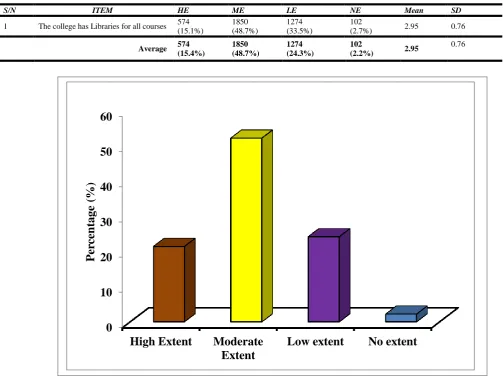
Table 2: Frequency counts, Percentages, Mean and Standard Deviation showing availability of library facilities in the Colleges of Education in North Central Zone of Nigeria
S/N ITEM HE ME LE NE Mean SD
1 The college has Libraries for all courses 574 (15.1%)
1850 (48.7%)
1274 (33.5%)
102
(2.7%) 2.95 0.76
Average 574 (15.4%)
1850 (48.7%)
1274 (24.3%)
102
(2.2%) 2.95
0.76
Figure 4: Bar chart showing percentage availability of library facilities in the Colleges of Education in North Central Zone of Nigeria
Table 1 reveal that, 574(15.1%) respondents reported high extent respectively, 1859(48%.) indicated moderate extent, 1274(33.5%) reported low extent, and 102(2.7%) respondents indicated no extent with the mean of 2.95 and SD of 0.76.. On the average, availability of library facilities percentages are (15.1%) high extent, (48.) moderate extent, (33.5%) low extent, and (2.7%) no extent,. With a grand mean score of 2.95 and a standard deviation of 0.76. The bar chart in figure four also reveals
that moderate extent had the highest percentage of 48% The bar chart therefore reveal that the availability of library facilities is at moderate extent.
Question 2
To what extent do students utilize library facilities in Colleges of Education?
Table 3: Frequency counts, Percentages, Mean and Standard Deviation showing the extent students 'utilize library facilities
in Colleges of Education.
S/N ITEMS HE ME LE NE Mean SD
3. All students in the college learn with the use of libraries
102 (2.7%)
1247 (32.8%)
1565 (41.2%)
886
(23.3%) 2.15 0.80
Average 102 (2.7%)
1247 (32.8%)
1565 (41.2%)
886
(23.3%) 2.15 0.80
Source: field survey 2017
0
10
20
30
40
50
60
High Extent
Moderate
Extent
Low extent
No extent
P
er
ce
n
tage
(%
)
0
10
20
30
40
50
60
High Extent
Moderate
Extent
Low extent
No extent
P
er
ce
n
tage
(%
Figure 5: Bar chart showing the extent of students’ utilization of library facilities in Colleges of Education in North Central Zone
Table 3 reveal that. 102(2.7%) respondents indicated to a high extent, 1247(32.8%) reported moderate extent, 1565(41.2%) indicated low extent and 886(23.3%) indicated no extent with the mean of 2.15 and SD of 0.80. On the average, students’ utilization percentages are (2.7%) high extent, (32.8%) moderate extent, (41.2%) low extent and (23.3%) no extent with the mean of 2.15 and SD of 0.80. The bar chart reveals that low extent had the
highest percentage of (41.2%). The bar chart therefore reveal that students’ utilization of library facilities is at low extent.
Question 3
To what extent do School libraries influence students' academic achievement in Colleges of Education?
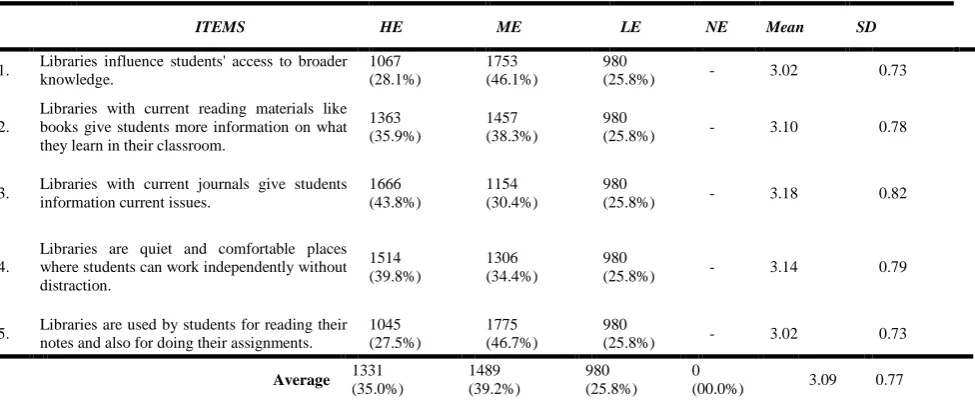
Table 4: Frequency counts, Percentages, Mean and Standard Deviation showing the extent library facilities influence students’ academic achievement in Colleges of Education
ITEMS HE ME LE NE Mean SD
1. Libraries influence students' access to broader knowledge.
1067 (28.1%)
1753 (46.1%)
980
(25.8%) - 3.02 0.73
2.
Libraries with current reading materials like books give students more information on what they learn in their classroom.
1363 (35.9%)
1457 (38.3%)
980
(25.8%) - 3.10 0.78
3. Libraries with current journals give students information current issues.
1666 (43.8%)
1154 (30.4%)
980
(25.8%) - 3.18 0.82
4.
Libraries are quiet and comfortable places where students can work independently without distraction.
1514 (39.8%)
1306 (34.4%)
980
(25.8%) - 3.14 0.79
5. Libraries are used by students for reading their notes and also for doing their assignments.
1045 (27.5%)
1775 (46.7%)
980
(25.8%) - 3.02 0.73
Average 1331 (35.0%)
1489 (39.2%)
980 (25.8%)
0
(00.0%) 3.09 0.77
0
5
10
15
20
25
30
35
40
45
High Extent
Moderate
Extent
Low extent
No extent
P
er
ce
n
tage
(%
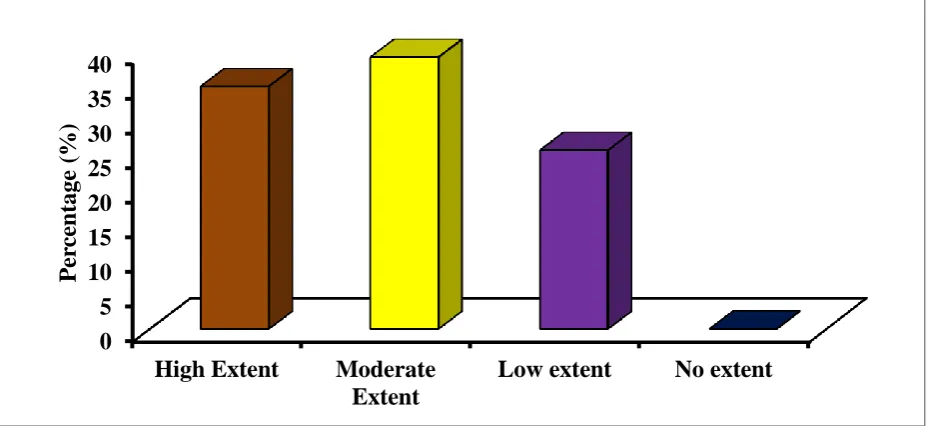
Figure 4: Bar chart showing the extent school library facilities influence on students’ academic achievement in Colleges of Education
Table 4 reveals that item one has, 1067(28.1%) respondents who agreed to a high extent, 1753(46.1%) indicated moderate extent and 980(25.8%) responded low extent with the mean of 3.02 and SD of 0.73. Item two has, 1363(35.9%) respondents who indicated high extent, 1457(38.3%) responded moderate extent and 980(25.8%) low extent with the mean of 3.10 and SD of 0.78.. Item three has, 1666(43.8%) respondents who agreed to a high extent, 1154(30.4%) responded moderate extent and 980(25.8%) reported low extent with the mean of 3.18 and SD of 0.82. Item four has 1514(39.8%) respondents who indicated high extent, 1306(34.4%) reported moderate extent and 980(25.8%) responded low extent with the mean of 3.14 and SD of 0.79. Item five has 1045(27.5%) respondents who indicated to a high extent, 1775(46.7%) reported moderate extent and 980(25.8%) reported low extent with the mean of 3.02 and SD of 0.73.. On the average, library facilities percentages are 35% for high extent, 39.2% moderate extent and 25.8% low extent. With a mean score of 3.09 and standard deviation of 0.77 for the rating scale, The bar chart on figure eight shows that moderate extent has the highest percentage of 39.2%. Hence there is urgent need to make library facilities available in the colleges of education to a high extent, and to be properly utilized by students in order to enhance academic achievement. The finding of this study is in line with Sanusi (2001) who observes that the Colleges of Education cannot accomplish their tasks without the backup of relevant and functional libraries. A school library is an indispensable learning resource for every tertiary institution. Libraries provide learning and reading resources in order to achieve the objectives of producing well-moulded students in their chosen disciplines.
Concluding Remarks
Based on the findings of this study, the study concluded that students' learn and achieve better not only when they
read wide, as library launches students on a journey of
exploration and discovery, teaching them how to ask questions and find answers. Based on these empirical
findings, the following suggestions were made to improve the students' academic achievement in colleges of education. Provosts of colleges of education should always ensure that the library facilities of various programmes in their colleges are available to a high extent and students' utilization should also be to a higher extent.
References
[1] Adeyemi, B. (2010). Teacher Related Factors as Correlates of Pupils Achievement in Social Studies in South West Nigeria. Electronic Journal of Research in Educational Psychology. 8(1): 313-332.
[2] Busayo I.O. (2011). The School Library as a Foundational Step to Children’s effective Reading habits. Library Philosophy and Practice. Retrieved on 19th November, 2013 from http://unlib.edu/LPP
[3] Egunjobi, R.A. (2006). Fundamentals of Library Practice in Nigeria. Lagos: Higher Education Book Pub.: 44-55
[4] George, A (2011). The School Library in a Megacity Setting: The case of Lagos State. In Gateway Journal. 14(1):76-86.
[5] Heinstrom, J., & Todd, R. J. (2008). The information search process revisited: Is the model still useful? Information Research, 13(4). Available at http://InformationR.net/ir/13-4/paper355.htm).
[6] Petters, J. S. & Ottong, E. J. (2012). Correlates of School Library Development in Calabar, Nigeria: Implications for Counselling. E-ISSN 2222-288X (Online) 3(12): 18-32. Retrieved on September 04, 2015 from www.iiste.org
[7] Sanusi, U.K (2001). Promotion of Library and Information Use in Nigerian Teachers Education. In R.F. Quadri, & B.O. Gbadamosi, (eds.). Issues
0
5
10
15
20
25
30
35
40
High Extent
Moderate
Extent
Low extent
No extent
P
er
ce
n
tage
(%
in Library and Information Services. Emola Joy:
108-120.
[8] National Commission for Colleges of Education (2012). Minimum Standard for Nigeria Certificate in Education. (2012 Edition).
Abuja: NCCE Press.
[9] Ogunbote K. O, & Odunewu, A. O (2008). School Library and Utilization in Ijebu North Local Government Area of Ogun State. Nigeria School Library Journal. 7:42-57.
[10]Ogundele, M. O. & Moronfoye, S. A (2013). Infrastructural Facilities and Academic Goals achievement of Kwara State Tertiary Institutions, Nigeria. Journal of Vocational Education & Technology. 10(1&2): 101-120
[11]Todd, R. J., & Kuhlthau, C. (2004). Student learning through Ohio school libraries, Part 1: How effective school libraries help students. School Libraries Worldwide, 11(1), 89-110Valenza, J. K & Johnson, D (2009). Things that keep us up at Night. in School Library Journal. 5 (3): 21-28. Retrieved on October
13, 2015 from