http://www.sciencepublishinggroup.com/j/edu doi: 10.11648/j.edu.20200901.13
ISSN: 2327-2600 (Print); ISSN: 2327-2619 (Online)
The Analysis of Science Education Lessons at Primary
Level
Svantje Schumann
Institute of Primary School, College of Education, University of Applied Sciences, Muttenz, Switzerland
Email address:
To cite this article:
Svantje Schumann. The Analysis of Science Education Lessons at Primary Level. Education Journal. Vol. 9, No. 1, 2020, pp. 14-22. doi: 10.11648/j.edu.20200901.13
Received: November 4, 2019; Accepted: January 2, 2020; Published: January 27, 2020
Abstract:
The phenomenon of "swimming and sinking" is a very demanding basic concept not only for children but also for teachers. Nevertheless, it is often taught in science lessons at primary schools. The following article analyzes a teaching sequence on the subject of "swimming and sinking" in 2nd grade, available as video recording, as well as accompanying material and transcripts. The analysis of the implementation practice serves to examine the realities that result in practical consequence. A sequence from the lesson is analyzed using objective hermeneutics. The method of objective hermeneutics is a reconstructive method in contrast to a subsuming approach. It aims to decipher the typical, i.e. characteristic, structures of phenomena to be investigated and to "bring to light the objective laws operating behind the phenomena". In the case analysis there was maximum transparency: each sequence passage is available as a transcript and as an interpretation, each reader can try to replace the existing interpretation by an even more plausible interpretation using arguments and thereby increasing their knowledge. The case study concludes that the standardized form of knowledge transfer and the schematic view of science overtax children and teachers. The present study provides indications that it must be doubted whether standardized schematic teaching of scientific theory is capable of supporting the development of a researcher's habitus. It provides clues that it should at least be examined whether science education can instead be seen as applied science logic or science pedagogy for children and as science education with the aim of promoting the development of a researcher habitus in children.Keywords:
Analysis of Science Education Lessons, Swimming and Sinking, Method of Objective Hermeneutics, Quality of Teaching1. Introduction: Didactic Concepts as a
Field of Conflict in Science Education
Science education should on the one hand "take into account the questions, interests and learning needs of children" and at the same time "link to knowledge acquired in specialist cultures" [1]. The justification for the conception of the perspective framework states that "this balanced and reciprocal consideration of the `field of tension´ is constitutive for science education", and there is a broad consensus within the scientific community [1].
However, there are completely contrary ideas about how to deal with the tension between childlike questions or childlike thinking and science, and also about which concepts deal adequately with this field of tension [2]. These different positions explain the large number of postulated concepts and
teaching and learning aids. The ideas regarding an "effective" interaction (with regard to the respective educational goal) in connection with educational processes in children vary, for example between strongly instructionally designed concepts on the one hand and concepts that assume a self-education potential in children on the other hand [3-6]. There are positions that assume that children need to be taught certain theoretical principles of science in order to learn to understand scientific findings; other positions see empirical knowledge as a good basis for science education.
of knowledge about children's reconstruction processes is probably not only due to methodological problems, but can also be traced back to a basic attitude that sees an independent knowledge of children only as "temporary" and as to be overcome. Some scientists call for research that analyses the reconstructions of children, but this demand has not yet been met [7-12]. Such research on how children explore the world needs an interdisciplinary cooperation between experts from a wide variety of disciplines. Together, they would have to find examples on how children explore the world in specific cases. The need for cooperation across disciplinary boundaries is perhaps another reason for the research desideratum.
Systematically speaking, there is no theory in science education that can link the structure of scientific knowledge to the acquisition of knowledge by children. However, didactic concepts should be able to refer to reasonably certain statements from both areas, child and expert/scientific knowledge. All existing concepts, both the concept of "education through experience" and the concept of the "scientific experiment", are empirically not yet justified and are rather the result of certain thinking styles.
2. Question, Database and Method
2.1. Question and Database
The following investigation analyzes a teaching sequence about "swimming and sinking" in 2nd grade, available as video recording, accompanying material and transcript. Analyzing the implementation practice helps examine the resulting processes for the realities that they produce in practical consequence. The transcript is taken from the video portal 'uni-muenster. de/viu' of the University of Münster [13]. This video portal provides access to videographed teaching scenes from science education at primary schools. Accompanying material is provided and used for the analysis. It includes the illustration of the blackboard picture used in this lesson and the worksheets of some children. The producers mainly made the teaching videos available to train teachers. The project itself does not analyze the lessons. Various films and film clips can be viewed against temporary permission and shown for specific occasions, e.g. teacher training and scientific work.
2.2. Method
In the following, a sequence from the lesson is analyzed using objective hermeneutics. The method of objective hermeneutics is a reconstructive method in contrast to a subsuming approach. It aims to decipher the typical, i.e. characteristic, structures of phenomena to be investigated and to "bring to light the objective laws operating behind the phenomena" [14]. Hermeneutics initially only stands for the study of the interpretation of texts (including non-linguistic forms of expression), i.e. the "understanding of texts" [15]. The term “objective hermeneutics” originates from Freyer under whom Oevermann et al. developed a method of
reconstructing latent sense structures [16-18]. Since then, the method has been continuously refined and optimized both in terms of content and in terms of research economic goals.
The method attempts to formulate possible readings/interpretations with regard to possible meaning structures and in this way to generate a case structure hypothesis. Meaning structures are empirical in themselves, but abstract (they cannot be perceived with senses, i.e. they cannot be felt, smelled, etc.). Objective structures of meaning are those abstract entities that all people "understand" more or less precisely when they communicate with each other by reading texts, looking at pictures or listening to sound sequences. These structures are created by meaning-generating rules and apply regardless of the respective subjective interpretation. Objective hermeneutics is a method of deciphering these objectively valid structures of meaning in an intersubjectively verifiable way using concrete, readable, audible and visible forms of expression [20].
According to the principle of literalism that is typical for objective hermeneutics, only those conclusions may be drawn when analyzing texts or forms of expression that are forced by the text (one can also say that they are "readable"). “What can be” interpretations are not permitted, i.e. readings that comply with the text but do not necessarily allow this conclusion. Therefore, only those readings may be explicated which are still specifically marked in the form of expression and forced by it.
The procedure will only be partially described here. There are two essential methodical "tools" that can be used frequently. On the one hand, one can proceed in such a way that one tries to develop and list as many context conditions as possible in which a similar action or utterance as depicted in the text could have taken place and suppressing a possibly available context knowledge. It is then considered which of the essential context conditions for the pragmatic fulfilment of the utterance or action represented in the text is common to all the contexts set up. Then one compares the present context with these considerations and examines possible contradictions. If there are contradictions, an obvious and plausible explanation needs to be found. A second possible procedure consists in considering what the speaking or acting person could have done or said alternatively and how these possibilities differ from each other and what characterizes them in each case. It is assumed that decisions always operate behind speaking and acting. Whether these decisions take place consciously or unconsciously is of no importance for the procedure. Due to the decision structure, a structure emerges over time as to how a person behaves, i.e. decides, and a case structure hypothesis results from this in the course of the event.
3. The Case Analysis
The following part analyzes the starting sequence of the implementation of a science lesson. Transcript and analysis are presented alternately; accompanying material may be consulted if the teaching process is directly related to it.
Teacher: (incomprehensible, probably a statement about the people in the room making audio and video recordings and making their equipment operational at that moment) Sit down once (addressing this statement to the children).
The children sit on four benches within a square.
Teacher: I sit here. OK? (With these words, the teacher pushes two children sitting next to each other on the bench apart, so that she sits exactly opposite the main camera). Good. Um. Is that okay, N. (name of a student)? Yes, to some extent. If not, there's something over there, N. (Name of a student). Move a little bit forward. Exactly. Yes. That's better.
The statement "Sit down once" contains two elements: on the one hand, it is a request in the imperative. Since there are benches arranged in a square, it is equally clear how this request is to be met. On the other hand, "once" is a reference to a spontaneous action with suggestive character (comparable to statements, such as "we can try it out in this way"). The request "sit down" is directly connected to the language form that “once” suggests which stands for spontaneity and freedom of choice. With regard to the overall context where a seating arrangement is already prepared, this contradiction points out that spontaneity and freedom of choice only seem to exist.
Teacher: We'll start with a new topic.
"We" as a plural marker most likely refers to the people in the room. These are obviously the teacher and the students (usually there is one teacher in the room and several students). In terms of language, "we" creates a relationship of "similar people" from the complementary relationship of teachers and students. "We’ll start", expressed by the teacher, suggests consensus or similarity without it being clear what this consensus is about and what this similarity consists of.
"We’ll start with a new topic" indicates that a new topic is being introduced. This topic is not suggested by the children, it is brought to them from outside. Nevertheless, "we" assumes their agreement. The phrase "We’ll start with a new topic" also shows that the topic is only "new" to the children, but not to the teacher. So the teacher is actually not included in the term "we".
"Start" also means the beginning of a chain of action that has already been defined, at least roughly. Not everything has to be defined in detail, but at least the final purpose is known or can be anticipated. The initial action must be related to the final purpose. So the formulation "We’ll start" already indicates that a given structure will follow. However, only the teacher knows about this structure. "We’ll start with a new topic" leaves no room for negotiation about the topic or the structure intended for the development of the topic. The speech act "We’ll start with a new topic" not only represents the beginning, but also tends to start the implementation. Thus, the beginning of the topic is given the character of
initializing an institutional task. One would probably place the statement "We’ll start with a new topic" in a didactic context if one had no context knowledge.
The phrase "We’ll start with a new topic" makes it difficult for a person to contradict. The request is supposed to be met. Description and execution coincide and in principle do not allow any questioning of the execution. The form of inclusion "we" makes a decisive contribution to the character of the order, but obscures this character, because it suggests a fictitious consensus ("they’ll start", on the other hand, would be a pure description, "you’ll start" a clear imperative).
The question of what to start with is only answered with "a new topic". The content is not known to the students, otherwise the topic would not be new. At best, the students can conclude that the new topic will fit the class, in this case the subject "science education". At least it would need a lot of explanation if it did not fit. However, this is the only indication the students have; they do not know what the new topic is at this point.
The category "topic" is used instead of a concrete content. This corresponds to a classificatory view of learning material or the classificatory decomposition of learning material. Accordingly, a student’s skills can be tested with regard to topics, which means a similar classificatory decomposition. "Topic" expresses the fact that the curriculum is used as a reference for thought. The term "topic" also suggests that students expect a content that has been developed top-down and is presented to the them, and not that the content that has been raised by the students themselves and taken up by the teacher.
What do all previous considerations have in common? A work alliance is neither authentically established or initiated at the factual nor at the social level between teacher and students.
Teacher: K. (name of a student), would you like to say what we do first today?
Concerning the teacher’s question to the child, it is noticeable that this is actually a request. However, it is formulated as if it was due to the child's wish. "Would you like" is a question corresponding to the desire of a specific person which becomes clear in other contexts, e.g. in an adult's question to a child about the choice of ice cream ("Would you like lemon ice cream? Or would you rather like chocolate?"). However, "Would you like to say" does not allow freedom of choice and own wish expression, but defines the formulation of what should be liked, namely to say something. Instead of an attitude that "reads the wish from the child's eyes", something is demanded of the child, one could also say that the wishes are suggested to the child. This tends to be a manipulative structure.
K. (female student): Pirate story, first assumption, researcher’s question... (the teacher stops her from continuing)
It is noticeable that the student does not fail when answering the question. She responds to the request. The most obvious explanation is that she can do this because the first step is a scheme that is always applied in this form at the beginning of the discussion of a new topic. In this case, new topics would always be developed according to a certain routine. The constitution of the thing or object would not affect the way it is developed.
The student formulates her answer in a strangely abbreviated form. For example, she could also have said "First, you tell us a pirate story, then we make first assumptions (and here we would be left to answer the question why something is assumed!) and then we ask a research question". The student only mentions headline-like keywords in a row but does not speak of them as activities. This abbreviated indication of a scheme also indicates that something new is apparently introduced habitually in the form of a ritualized procedure. The student's answer does not show any attraction of the new, of the suggestive power of the undeveloped, of the living spirit of innovation.
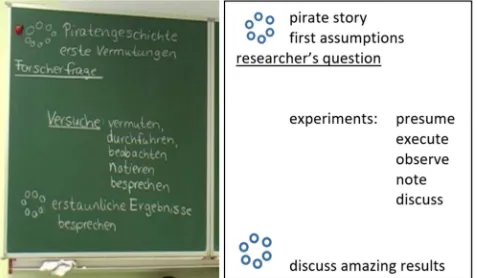
The context integration is informative at this point. The context integration also prevents the readings/interpretations from being too speculative without it being useful to clarify the case structure. The student refers in her statement to the information on the blackboard written by the teacher before the lesson. She reads the beginning from the blackboard.
Figure 1. Blackboard writing and translation.
At this point, the question posed to the child turns out to be an order to read aloud what is written on the board. The question arises why the child should read out what is visible to all. The structure of the lesson is written on the blackboard. The teacher could have asked the student to read out what is written on the blackboard. By asking a question, however, her task as a teacher seems to give the student more room for autonomy and competence than it is actually the case. The teacher's question addressed to the child seems as if a lively lesson is taking place. In fact, however, the student is only supposed to read something aloud that is already a finished concept. The character of spontaneity does not correspond to reality at all.
Teacher: Yes, wait a minute.
The student would have continued reading, but is prevented from doing so by the teacher ("Yes, wait a minute"). It can be assumed that, according to the teacher, the child reads the blackboard copy without sufficient intonation; in fact, the student's reading is characterized by a large uniformity. One could say that the child reads relatively mechanistically.
At this point, it is still not clear what will be the new topic of the lesson. It could be assumed that it is about pirates. The pirate story seems to be at least an important element of the new topic. If the pirate story comes first, it must be suitable to lead to the new topic. What could be the subject matter of a pirate story? The subject could be, for example, the history of piracy on the African Mediterranean coasts between 1200 and 1600 or in the Horn of Africa in modern times. It would also be possible to take up "pirate stories" as a literary subject or literary genre. Both assumptions seem too demanding for second graders. A third possibility remains, namely that the pirate story serves as a kind of "lure" to lure the children to "the new topic" - whatever it may be - or to make the lesson interesting. This would also add something manipulative to the pirate story.
The second point is called: "First assumptions". Assumptions always presuppose the existence of a question. "First assumptions" also allows the conclusion that there will be further assumptions, i.e. a chain of assumptions. A chain of assumptions only occurs when assumptions are based on each other because they have been examined one after the other. Only when a first assumption fails or partially fails does a new one have to be raised that is different and better than the first one. In this way, a chain of assumptions is created.
It is still unclear what question can be raised by a pirate story that leads to expressing a first assumption. It is possible, for example, that pirates ask themselves where to find ships that are worth hijacking. Pirate stories are often about making money by courageous but criminal actions. When pirates hide the riches they have conquered, other stories are often linked to them that are no longer pirate stories, but stories of those who seek treasures.
apparent that these three terms are anything but descriptions that clarify structure and content. For example, as shown above, the link between "pirate story" and "first assumptions" is missing. It also remains unclear whether the pirate story perhaps already contains assumptions or how pirate story and assumption are related to each other.
As a third term, the child reads "researcher's question" aloud. The first assumption, however, must be the reaction to a question. However, the written concept seems to provide that the researcher's question is already the progression of a much more basal question. Starting from the idea of a chain of assumptions, the researcher's question already has to consider, for example, a methodological aspect which helps verify the first assumption. Thus, the researcher's question would represent a progression by methodization of the first assumption.
The term "researcher's question" tends to turn research into a job title or elevates questions and research to expert qualification, whereas research refers to a type of questioning and answering that is open to everyone in principle, but not reserved for just a few. Particularly in the case of children, there are many indications that they are virtually naturally curious, i.e. that research-oriented thinking and action is typical of all or many children and that they therefore neither need to be educated nor trained. Research means to ask questions for their own sake and not out of practical necessity, and this is what children usually do. This also makes it possible for everyone to participate at any time. But by presenting research as a special field, it tends to be taken away from children. Research can be done especially well under the conditions of leisure, i.e. in situations where time and resources are available, and the head is clear to think in all directions.
The blackboard painting suggests that especially the first sequence of the lesson is characterized by grouping. The circle - as a symbol for group work - is a very democratic structure, all have the same position, the middle is not occupied. So far, however, the approach has only been based on guidelines; the suggested democracy is not recognizable in the sense of co-determination and autonomous expression of opinion.
The teaching structure reflected in the blackboard painting is clearly motivated by scientific theory. A high degree of scientific structuring is aimed at for a teaching approach. The process described could be supplemented and changed, for example to the series "ask, assume, explore, observe, note, describe, define, interpret, explain". The components of a methodological approach in the research process would then be indicated in such a way that they could apply to all subjects and subject areas, both natural sciences and humanities. The components "organizing" and "structuring", which are also sometimes mentioned in such series, are, on the other hand, processes which concern data management but which are not endemic to research, i.e. which are more likely to be used by data administrators but are not required in the research process. The last point, "capturing surprises/discuss amazing results", can also be useful for
research processes. Apparently, the blackboard writing is a scheme that the teacher always follows, if necessary in slightly modified form, when new topics are introduced.
It is interesting to note that the blackboard writing seems to be based on scientific knowledge, but it shows some disparities and inconsistencies. A heading is missing, so that it is unclear which topic or which superordinate question the scheme should serve. The hint "pirate story" is not very helpful to conclude on topic or question. It could be considered what is constitutive for pirates and which questions relate to "piracy", e.g. questions about how riches can be acquired as efficiently as possible by means of piracy (see above). Fights are usually of special importance for pirates. One assumption could be that fighting is the new topic of the lesson.
Teacher: We'll start with a story that'll make you want to hear - about the new topic. Then we ask a researcher’s question and put it together. Then - what comes next? N. (name of a student), look.
In her statement, the teacher confirms what has already been suspected: the story has the function of motivating the children. The teacher thus assumes that children must be made curious in the pedagogical context, as they are not sufficiently curious from the inside. It remains unclear whether pirate stories are already the topic or just a vehicle to get to the topic. The only thing that becomes clear is that the pirate story has a motivating function with regard to the children. This is a pedagogical pattern of interpretation which assumes that the topics themselves do not sufficiently motivate children and that something else has to stimulate them pedagogically. The fact that teachers do not trust in the natural curiosity of children is often found in lesson protocols. In this case, it is interesting that the teacher confronts the children very strongly with her pedagogical concept. Instead of confronting the children directly with what is planned as a "new topic" and trusting in the natural curiosity of the children, she confronts them with the concept derived from the theory of science, while at the same time she still does not clarify the factual content and the concrete implementation of the blackboard scheme.
In her interjection, the teacher only addresses the story and the question, but omits the "assumption" component. The blackboard painting suggests that an object is newly introduced that raises a question, so that initial assumptions arise, which are then transformed into a research question in a kind of methodological progression. In the teacher's explanations, however, there is now no reference to so-called first assumptions. This can also be a reason why the child, who is next instructed by her to read aloud ("look"), starts reading again at "Researcher's question".
N. (female student): Researcher’s question Teacher: Exactly. And after that?
understanding are not as important as working through the scheme. This is also reflected in the fact that it has not been clarified whether the children understand what they are reading aloud at all.
It should be noted that in this phase the entire plan of the lesson is virtually put in front of the brackets and the whole program is gone through in advance, with a focus on the work steps, not on the content. It would have to be examined more closely whether such a procedure gives children an orientation or whether it confuses them.
N. (female student): Experiments. Teacher: And what should you do during the experiments? You remember that. What are experiments about? S: Assume, execute and observe, note, discuss.
At this point, a need for clarification or a discrepancy becomes apparent. The blackboard painting contains the word "experiments", followed by a colon and individual components that can be important in research processes. The way individual components are connected with the word "experiments" is partly not comprehensible. Experiments can be carried out - here the connection is correct or possible. Experiments can also be observed. But one cannot assume them. It is noticeable that the entire research process is subsumed under the keyword "experiments". Research and experiments tend to be presented as synonyms.
The question also arises as to why assumptions are again mentioned here since they were already mentioned at the top. The clarity of references necessary for research processes is missing in the blackboard painting. It can be assumed that the teacher herself is not familiar with research practice as a living experience, but as a didactic scheme.
Teacher: Do you remember that? The tasks of a researcher, that you have to observe carefully what happens. Assume, what does that mean again? I. (Name of a female student).
The question "Do you remember that?" addresses the children as knowledgeable, not as readers. It seems as if the children had remembered what they had said, but not as if they had only read it from the blackboard in front of them. Knowledge is "obtained" through reading. As an alternative to reading aloud, it would have been possible to memorize, which means that the children would have been able to remember their approach to open up new topics.
I. (female student): What you believe. Teacher: Exactly. Great.
Up to now, great attention has been paid to the exact derivation of a didactic scheme from a scientific theory point of view. In the process, however, it is noticeable at this point that the precision is lost suddenly as soon as the process is in progress. The student equates the formation of hypotheses with faith and this is praised with "exactly" and "great" although it has not been clarified what the child actually means by "believe" and although it can be argued whether "believe" can be regarded as a sufficient explanation of "assume". The explication of the meaning of the verb "assume" is that one formulates a first hypothesis, that one formulates a first interpretation on the basis of the view, that one makes a first assignment of meaning; but this
presupposes that one formulated a question beforehand. This shows how demanding it is to answer the question of what an assumption is, described in scientific theory. It would be different, according to the imagination, if the children themselves could experience in the process what an assumption is. It is extremely difficult to formulate in theory what constitutes an assumption. When you say "believe", the assumption has already turned into a conviction. It can be assumed that second graders hardly use the word "assumption" themselves; it does not belong to their everyday vocabulary. It can also be assumed that in the course of working through the teacher's teaching scheme, the question "what do you think it is like...?" was already asked in previous lessons in phases of assumptions. Here you can see how accurately one would have to proceed linguistically in order to implement the teaching scheme derived from the theory of science in such a way that the children develop exactly those ideas that are sustainable later on, and that it does not result in the acquisition of wrong concepts or notions of concepts, which later have to be destroyed again. This shows that science-related teaching must be very precise in the language and must trace the language very precisely. Science education is particularly language education because conceptual precision is often crucial for development.
The assumption is that the verb "assume" is not one that second graders routinely use in everyday life. Making assumptions is central to a research process. However, an understanding of this process is not achieved by asking about the explication of meaning. Here, too, the creation of situations in which one can experience the essence and effect of assumptions seems to be important for the formation of educational processes. In a process of experiencing, it seems to be possible to consciously perceive how on the basis of a descriptive fact a question arises, this transforms into an assumption, this assumption is accepted in the process of development and can be further strengthened up to a conviction. This experience could, for example, also lead to an understanding of the nature of prejudice in comparison to a judgement, etc., so that a holistic understanding could develop based on a concrete educational process experience.
Teacher: And finally, at the end of the lesson, what do we do again? E. (name of a female student), look. What do we do again at the very end? E. is also asked to read aloud (”look“). E.: Discuss amazing results.
a big rock. It crashed. In the bow of his ship was a huge hole. Full of horror, Pitt Pearlsnatcher noticed that his ship was sinking. Quickly he jumped into the water and swam to save himself, full of panic on an island which fortunately was not too far away. But unfortunately, it wasn't his own island, but the neighboring island where nobody lived. He crawled to the land soaking wet. When he had recovered somewhat, he got up and went to a palm tree to rest. What did he see there? Under the palm tree, half buried in the sand, stood a wooden box. Quickly he shoveled the sand aside and opened the box excitedly. That couldn't be true! The box was full of gold! A treasure he had to take with him. He hadn't been able to capture that much gold during a raid on a ship. But the ship had sunk, how could he take the box from one island to his island? And he wondered: "Do I have to leave the treasure behind or is there a way for me to transport the box? A. (Name of a student).
The story is linguistically little elaborated (the name "Pitt Pearlsnatcher" seems artificial, the unreflected navigation towards a big rock untrustworthy, the process of resting and then looking for a palm tree to recover there is causally incoherent etc.) and thus seems relatively unmotivated. There is a large gap between the claim to teach children the theory of science and the level of the story. The story neither fulfils the criterion of being particularly authentic, nor particularly exciting or captivating, nor does it open up a possible process of development in a stimulating way. A particularly high suggestive power of the undeveloped is not unfolded in it. The framing (shipwreck etc.) does not make an important contribution to a research process, but functions in the way of an extra-functional increase in attractiveness. In the story read aloud, all questions concerning the topic of "pirates" or "piracy" are reduced to the question of what a castaway who finds a treasure should do with it. Thus, a very clichéd, almost culture-industrial use of the topic "piracy" is made, which mainly focuses on the topic "treasure". In terms of content, the story would be complete without the figure of a pirate. The presented case is anything but a routine situation typical for pirates and is not constitutive for pirates.
Based on the blackboard painting, it can be expected that the story read aloud will point to the so-called first assumption and researcher’s question. In this case, however, a story whose characteristics and routine are familiar to all children would be advantageous so that it would be possible for anyone to deduce the assumption and researcher’s question. But this is not the case. Even at the end of the story, it is still relatively open what the topic and question might be. The guidance to the topic "swimming and sinking" given by the pirate story seems very constructed. The description of the problem is not very authentic.
4. Discussion of the Results
It should always be assumed that the teacher’s intention was, also in the planning phase, to arrange lessons in such a way that children develop scientific competence at the highest possible level. What is shown in the practical
implementation? There are always moments in which the children are given instructions on research practice, but even then the focus is not so much on the phenomenon as on practicing a particular research scheme. The lesson shows itself to be relatively independent of the observed object or phenomenon, which is particularly clearly visible in the analysis of the panel painting. In other words: with the help of the scheme depicted in the blackboard painting, almost any object could generally be examined. Research is thus presented on the one hand as a very abstract structure and, above all, cognitively conveyed, and on the other hand as a routine sequence of steps. The cognitive-metacognitive implementation amounts to the fact that research with children is practiced primarily schematically, abstractly and predominantly thought experimentally.
The sequence scheme also seems to provide a framework for the teacher. However, the dialogue shows that it no longer supports cases that arise spontaneously in situ. In the present case, the teacher then tries again and again to conduct the conversation as closely as possible and to avoid deviating remarks. The solutions suggested by the children, for example one that suggests the use of magnets, are ultimately dismissed when the teacher says: "You are on the magnet idea. Leave the magnets out of it. He can't find a magnet on the island, T. (name of a student). Okay. We're exploring another topic.". Both the wooden and the metal button go down at the end of the lesson, just when the teacher wants to demonstrate that the wooden button floats in contrast to the metal button. The teacher comments it with the sentence "Normally it floats, too. I think it's really [...] a bit broken already".
In the second double lesson, which was not analyzed in the present study, the teacher focuses on the topic "Testing of different materials with regard to their buoyancy". However, the children discuss the question of how a boat must be built so it does not sink. Apparently, the question of how to build a boat so that the swimming thing works is a question that needs much more attention and a solution.
J. (Name of a male student): There are also such big ships, they have some kind of metal, why don't they sink? They weigh so much and Teacher: Mhm, are they just made of metal?
S: No.
Teacher: W. (Name of a male student).
W. (male student): Inside, they are made of wood.
Teacher: That and they have a certain shape. J. (name of a student), we can explore that later. That's a great question, we just can't answer it today, today we're focusing on things that are only made of one material, okay? Good.
S: But I think I know why that is that ships swim on the sea.
Teacher: Mhm.
S: Because I think they are also painted with tar.
that stands at the beginning: Why is that so? Yes? M. (name of a male student).
M. (male student): The ships are made of wood and if they are colored ships, then they are only painted.
Teacher: Mhm, there are even more reasons why a ship swims, many more and I notice that you feel like exploring this, we still do that, okay? We'll follow up on that question. L. (name of a student) and F. (name of a student) still have something important to say.
L. (female student): Why doesn't a ship actually sink? Teacher: This is -
L. It weighs a lot, doesn’t it? There is a lot of gold on it and there are a lot of people on it.
Teacher: That's amazing, isn't it? Can we still put the question of the ship a little back now? Because we want to find out now which material is important for the pirate? And the question why a really big, heavy ship can swim, L. (name of a student), we will answer later, okay?
This passage shows that the children's desire for knowledge is ignited by the very concrete question of how to build a ship in such a way that it does not sink. There is a hint that the children suspect that there are answers to this question that they can find themselves and that they are curious about. However, the logical subsumption scheme does not intend to address this question, at least not at this time (nor at the time of the first double lesson). In the present concept and the associated implementation practice, the teacher is expected to proceed in a structured manner and to plan the process of competence development. Accordingly, the educational processes of children are strongly directed, and subsumption-logically structured instruments are increasingly created (e.g. blackboards, worksheets). In the present case, liveliness and spontaneity suffer noticeably from the schematic-structured, subsumption-logical structure. For example, it is pretended that the entries come from the children themselves, as if they were reconstruction-logical and spontaneously situational, but this is a simple reading of specifications from the blackboard.
The pirate story in the analyzed case is also not very authentic and exciting because it does not reveal any really exciting problem and offers no strong incentive to find a solution. The attraction of the exploration is lost by the fact that the problem is recognizably a posed one, like a work order, and it becomes quickly apparent that there is already an immovably given work process, to which the students must adapt recognizably. Only by removing seemingly attractive framings from the story could it have been made attractive again.
In a way, the given scheme is presented as a suitable help for children. It turns out, however, that the children find it very difficult. In particular, it is difficult for them to form hypotheses and it is striking how much they urge to be allowed to explore immediately and directly with the materials. The research process of children, which according to the prevailing didactic knowledge is a mode of knowledge based on reconstruction, is transformed into logical didactics of subsumption. The children must
subsume this type of researcher given to them. They do not experience research as mimetic clinging to an alien object - the moment of mimesis is completely omitted.
5. Conclusion
The phenomenon of "swimming and sinking" is a very demanding basic concept not only for children but also for teachers. Only the depth and breadth of this mastery enables a teacher to engage in a dialogue with the children spontaneously, quasi freehand and without a script. Since the questions asked by children at elementary school level are characterized by an extreme diversity - e.g. references are made to previous experience and knowledge, conclusions are drawn by analogy, philosophical questions are raised, animistic transmissions are made - a teacher must be able to think along in all these directions and be able to adequately assess the phenomenon in each case, but at the same time also be able to determine how the child's utterance is to be understood [2]. In his essay "What remains?” Wagenschein describes a situation in which children place a large piece of wood in the water and then quickly pull it out again [19]. Wagenschein notes the dialogue as follows: "Thomas: There you see how the water immediately wants to go, because there is now space again. Where the piece of wood used to be, there is now water again. The water doesn't want to have a dent, it's flowing straight to it." Jörg: "In the Red Sea it snapped together again with the Pharaoh and everyone drowned. The water doesn't want a dent..." Thomas: "The higher water pushes downwards, Stephan is right, the water always wants to be the same, - no, so you can't say, the water just flows so that it becomes the same..." [19]. This example shows how demanding a (socratic-maeutical) dialogue support can be.
The case analysis comes to the following conclusion: With reference to scientific orientation and theory, children are trained in a procedure they do not understand. This standardized practice is carried out disregarding the reflection on the possibilities of giving meaning to the content for children. This indicates that both the children and the teacher are overtaxed.
References
[1] Gesellschaft für Didaktik des Sachunterrichts (GDSU) (2013) [German Association for the Didactics of Science Education]. Science education – perspective framework. Bad Heilbrunn: Julius Klinkhardt, 10.
[2] Schumann, S. (2018). Science didactics in early education. The importance of social cooperation for early science education. Aachen: Shaker. Habilitation Thesis, University of Bremen.
[3] Sodian, B. (2008). Development of Thinking. Oerter, R.; Montada, L. (Eds.), Developmental Psychology. 6th edition. Weinheim: Beltz, 436-479.
[4] Koerber, S. (2006). Development of scientific thinking of four- to eight-year-olds. Contributions to teacher training, 24 (2), 2006, 192-201.
[5] Scholz, G. (2005). Impulses for the assessment of the "Education from the beginning" plan. URL: http://grundschulforschung.de/GSA/Bildungsarbeit_5.pdf, 11/09/2019.
[6] Fischer, H.-J. (2005). Where does science education begin? Reflections following a lecture by Martin Wagenschein. Widerstreit Sachunterricht, edition 5/2005. URL:
http://www.widerstreit-sachunterricht.de/ebeneII/arch/wagenschein/fischwa.pdf, 20/11/2019, 1-3.
[7] Beck, G. (2001). Acquisition research as desideratum of teaching research. In Beck, G.; Rauterberg, M.; Scholz, G.; Westphal, K. (Hrsg.), Matters of science subject teaching. Frankfurt Contributions to Educational Science, Johann Wolfgang Goethe Universität, Frankfurt, 135-144. Also published in Fölling-Albers, M.; Richter, S.; Brügelmann, H.; Speck-Hamdan, A. (Eds.), Childhood research. Research on teaching science subjects. Jahrbuch Grundschule III, Grundschulverband-Arbeitskreis Grundschule e.V. Frankfurt am Main 2001, 89-93.
[8] Erichson, C. (2001). No more discussions about "open" and "closed": Educational process research instead of a commitment to didactic concepts. In Beck, G.; Rauterberg, M.; Scholz, G.; Westphal, K. (2001), matters of subject teaching. Documentation of a conference series 1997-2000. Frankfurt/Main, Johann Wolfgang Goethe University, 104-111.
[9] Schönknecht, G. (2011). Contemporary teaching of science. In Schönknecht, G. (Ed.), Promoting learning: German, Mathematics, English, Science Subjects. Stuttgart-Seelze: Klett-Kallmeyer, 209-254.
[10] Schönknecht, G. & Hartinger, A. (2010). Accompanying learning - assessing learning outcomes. Scientific module description G9 in the SINUS-Transfer Primary School
programme. URL:
http://www.sinus-an- grundschulen.de/fileadmin/uploads/Material_aus_STG/NaWi-Module/N9.pdf; 20/09/2019.
[11] Hempel, M. (2007). Diagnostics of the child's world as a prerequisite for promoting the acquisition of competence by learners. In R. Lauterbach, A. Hartinger, B. Feige & D. Cech (Eds.), promoting and recording the acquisition of competence in the teaching of science subjects. GDSU Band 17. Bad Heilbrunn: Julius Klinkhardt.
[12] Schumann, S.; Favre, P. (2017). Survey of childlike pre-concepts and analysis of dialogical interpretation of the world. In P. Favre & C. Mathis (Eds.), Understanding natural phenomena. Access from different perspectives in preschool and primary education. Baltmannsweiler: Schneider Verlag Hohengehren, 187-202.
[13] URL: https://www.uni-muenster.de/Koviu/filme/index.html, 18/09/2019.
[14] Oevermann, U. (1996). Crisis and leisure. Structural properties of aesthetic experience from the sociological point of view. Lecture on 19/6/1996 at the Städel school,
Frankfurt/Main; URL:
http://www.agoh.de/cms/de/downloads/overview/public/oever mann/oevermann Ulrich-crisis-and-mu%C3%9Fe-Struktur-properties-%C3%A4sthet sized-experience-from-sociological point of view-%281996%29/, 04/09/2019.
[15] Fuchs-Heinritz, W.; Lautmann, R.; Rammstedt, O.; Wienold, H. (1994). Dictionary of Sociology, Opladen: Westdeutscher Verlag.
[16] Freyer, H. (1923). Theory of the Objective Mind: An Introduction to Cultural Philosophy. Leipzig: Teubner Verlag.
[17] Oevermann, U.; Allert, T.; Konau, E.; Krambeck, J. (1979). The methodology of an "objective hermeneutics" and its general research-logical significance in the social sciences. In Soeffner, H. G. (Eds.): Interpretative Methods in the Social and Text Sciences, Stuttgart 1979, 352-434.
[18] Wernet, A. (2012). Objective hermeneutics as a method of researching educational processes. In Schittenhelm, K. (Ed.). Qualitative education and labour market research. Theoretical foundations and methods. Wiesbaden, 183-202.