
The Financing
of Small and
Medium-Sized
Enterprises with
the EU Structural
Funds in Poland
Between
2014 and 2020
International Journal of Synergy and Research
Vol. 6, 2017 pp. 43–55
The Financing of Small
and Medium-Sized Enterprises
with the EU Structural Funds
in Poland Between 2014 and 2020
Jerzy Piotr Gwizdała
Abstract
Purpose – Identification of efficiency and effectiveness of usage of the EU structural funds in Poland directed to financing of SME sector enterprises in the years 2014–2020.
Methodology – Review and assessment of Polish and international documentary and research papers concerning the financing of SME sector enterprises with EU structural funds.
Findings – The most substantial support for small and medium-sized enterprises has been planned as part of the Smart Growth or the Eastern Poland Operational Programmes and the Regional Operational Programmes. The total funding allocated to small and medium-sized enterprises within two thematic objectives stands at over EUR 15.7 billion. The European Union’s Cohesion Policy towards supporting small and medium-sized enterprises in the years 2014–2020 will provide them with easier access to EU funds thanks to new flexible rules. These include the submission of reports on the use of EU funds via the Internet, limiting to the degree of control over small enterprises, easier criteria for qualifying projects or a greater number of financial instruments and greater access to them.
Research implications – Results of the paper may be used in further researches regarding the use of European structural funds in Poland as far as SME financing is concerned.
Practical implications – Results of the paper may influence the government organisations and raise the effectiveness of the distribution of structural funds among proper enterprises, which will improve the general efficiency in spending European Union’s Structural Funds.
Social implications – Results of the paper may foster the improvement of awareness of proper allocation of European Union’s Structural Funds in Polish SME sector enterprises.
Originality/Value – The paper supplements knowledge regarding the financing of SME sector enterprises by European Union’s Structural Funds in Poland in the years 2014–2020.
Type of article – A theoretical paper.
Keywords – financing, perspective, policy, enterprise, development
1. Introduction
Poland’s membership in the European Union provides an ample opportunity for obtaining financial resources for business activity, as exemplified by the years 2007–2013. The Infrastructure and Environment and the Innovative Economy Operational Programmes have contributed to a significant increase in concern for the natural environment and an improvement in the level of innovation of Polish enterprises. The European Union also finances entrepreneurial attitudes by providing funding for the launch of new businesses.
IJSR
6
Non-grant forms of assisting entrepreneurship have proved to be particularly successful, as illustrated by the JEREMIE initiative in the 2007–2013 financial framework, used by a growing number of entrepreneurs each year. Owing to the growing popularity of non-grant instruments of financing small and medium-sized enterprises, their role in the overall assistance from the European Union has been increased in the new framework for the years 2014–2020. New programmes aimed at small and medium-sized enterprises have emerged, such as COSME and Horizon 2020. The years 2014–2020 will see significant growth in innovation both nationally (the Smart Growth Operational Programme), as well as in particular regions (as part of the Eastern Poland Operational Programme). This article aims to demonstrate the possibilities provided by the European Union’s Structural Funds as regards the financing of small and medium-sized enterprises. The article will focus on presenting the funds and resulting forms of assistance directed at the SME sector. However, the main aspect of discussion concerns European Union support for Polish enterprises and the forms of financing small and medium-sized enterprises. The aim of the article is to present the role and place of the EU structural funds in financing of SMEs in Poland. The choice of subject has been determined by the possibility of financing of SMEs by means of external EU sources. Another reason which has determined the choice of subject is the relatively low awareness in the SME sector of the possibility of benefitting from this kind of financial assistance. The EU structural funds are a very important instrument in financing SME activity and are thus worthy of attention. The European Union boasts a wide range of programmes and initiatives for the years 2014–2020, allowing this sector to make use of its potential. This article has been based on the descriptive-statistical method, mainly employing government sources of information available on Internet sites such as various kinds of scientific articles and legal acts. Most of the sources have been prepared by those European Union institutions and government bodies directly linked to the subject of funding. Significant data, extracted from information and publications prepared and released by the Central Statistical Office and the Polish Agency for Enterprise Development, was subject to due economic and comparative analysis.
2. European Union strategy concerning the financing
of the development of SMEs
The implementation of EU funds in Poland for the years 2014–2020 is based on the Partnership Agreement. This document sets forth the types of planned investments which can receive funding as well as the contribution from operational programmes. The table below presents the allocation of financial resources from the European Union to particular operational programmes for the years 2014–2020.
Within the new financial framework for the years 2014–2020, Poland will receive aid from the European Union to the value of EUR 76.6 billion. The Infrastructure and Environment Operational Programme takes second place as regards the assistance received from the EU to the value of EUR 27.5 billion. As part of the 2014–2020 framework, all EU support for Poland has been divided into 11 thematic objectives. Support for enterprise, including the micro, small and medium-sized sector, has mainly been allocated in thematic objectives no.1 and 3 (Ministerstwo Infrastruktury i Rozwoju, 2014).
The Financing
of Small and
Medium-Sized
Enterprises with
the EU Structural
Funds in Poland
Between
2014 and 2020
The allocation to the thematic objectives presented above in relation to support by the European Union for enterprises in Poland currently stands at EUR 38 832.9 million, which constitutes nearly 51% of the entire amount allocated to Poland for the years 2014–2020. However, it may be worth mentioning that entrepreneurs will not be the sole beneficiaries (Ministerstwo Gospodarki, 2014). The table below presents the two most important thematic objectives connected with the small- and medium-sized enterprises sector.
Operational programmes Value of aid in millions of euro Percentage of allocation
Smart Growth 8 614.1 11.24% Infrastructure and Environment 27 513.9 35.91% Knowledge Education Development 4 166.8 5.44% Digital Poland 2 255.6 2.95% Technical Assistance 700.1 0.91% Eastern Poland 2 117.2 2.76% Regional Operational Programmes 31 246.9 40.79% Total 76 614.6 100%
Source: Own elaboration based on: Programowanie perspektywy finansowej 2014–2020 – Umowa Partnerstwa
(2014). Ministerstwo Infrastruktury i Rozwoju, 8 styczeń, Warszawa, pp. 106–108.
Table 1.
The allocation of financial resources to operational programmes in the years 2014–2020
Objective 1 Supporting technological development, research and innovation
Objective 2 Enhancing access to, use and quality of information and communication technologies
Objective 3 Enhancing competitiveness of small and medium-sized enterprises (SMEs), the fisheries and aquaculture as well as the agricultural sectors Objective 4 Promoting efficiency and sustainable energy sources in small- and medium-sized enterprises
Objective 6 Supporting investments aimed at small and medium-sized enterprises improving air quality Objective 8 Self-employment, creating new workplaces, entrepreneurship
Source: Own elaboration based on: Materiał informacyjny dotyczący programowania Nowej Perspektywy
Finansowej 2014–2020, z uwzględnieniem priorytetów Ministra Gospodarki (2014). Ministerstwo Gospodarki, Warszawa, p. 12.
Table 2.
Thematic objectives of importance to small and medium-sized enterprises
Operational programmes 1 in millions of euroThematic Objective 3 in millions of euroThematic Objective in millions of euroTotal
Smart Growth 7 487.2 829.9 8 317.1 Eastern Poland 485.0 474.5 959.5 Regional Operational Programmes 2 472.5 4 023.0 6 495.5 Total 10 444.7 5 327.4 15 772.1
Source: Own elaboration based on: Wsparcie sektora MŚP w Regionalnych Programach Operacyjnych
2014–2020. Ministerstwo Infrastruktury i Rozwoju, Warszawa 2014.
Table 3.
IJSR
6
The most substantial support for small and medium-sized enterprises has been planned as part of the Smart Growth or the Eastern Poland Operational Programmes and the Regional Operational Programmes. The total funding allocated to small and medium-sized enterprises within two thematic objectives stands at over EUR 15.7 billion. The European Union’s cohesion policy towards supporting small and medium-sized enterprises in the years 2014–2020 will provide them with easier access to EU funds thanks to new flexible rules. These include the submission of reports on the use of EU funds via the Internet, limiting to the degree of control over small enterprises, easier criteria for qualifying projects or a greater number of financial instruments and greater access to them.
The assumption of the Cohesion Policy is to solve SMEs’ problems by increasing the use of financial resources. Such enterprises will be able to receive funding through grants, credit guarantees, loans or venture capital funds. Access to foreign markets will be provided, the risk in business activity will decrease, and entrepreneurs, managers and employees will be able to undergo training in how to adjust to changes in the market.
SMEs are a very important beneficiary which should receive assistance from the European Union, as 99% of companies within the European Union fall within the small and medium-sized sector. This means that they form the basis of the European economy and exert an influence on the economy, employment and innovation. Small and medium-sized enterprises need assistance in financing their activity because they are more affected by economic change in their activity and are of key importance in enhancing the entire economy of the European Union. April 2014 in Poland saw the adoption of the Enterprise Development Programme by 2020 which presents possible options of support for small and medium-sized enterprises with a particular stress on innovation. The programme was devised in the Ministry of Economy and will be financed from EU funds as part of the operational programmes for the years 2014–2020 as well as from government funds. Small and medium-sized enterprises constitute a particularly important sector in the Enterprise Development Programme (EDP).
The years 2014–2020 will also see the decentralisation of the system connected with the management of the Cohesion Policy, which means that the backing for enterprises and other bodies will be provided mainly at a regional rather than national level. The most important projects of vital importance to the economy will receive backing at the national level. For example, projects which will remain at the regional level are those connected with research and development (R&D), including the establishment of research and development centres in companies, providing support to the Polish economy abroad, promoting the internationalisation of Polish enterprises, supporting projects connected with innovation or providing support to the development of institutions within the business environment. Companies, while subject to central supervision, have been and will continue to be provided with support in using venture capital funds, business angels and private equity. At the regional level, support for enterprises concentrates around the strengthening of specialisations in a given region, mainly connected with the region’s location and access to services, resources and demand for particular professions. A great deal of funding will take place at the regional level, including the implementation of research results, the granting of licences or patents resulting from research activity, actions connected with the introduction of a new product or service to the market or
The Financing
of Small and
Medium-Sized
Enterprises with
the EU Structural
Funds in Poland
Between
2014 and 2020
the development of instruments conducive to an enhancement in innovation (loan and guarantee funds) (Departament Koordynacji Polityki Strukturalnej, pp. 20–21).
There are two new programmes implemented at the EU (not national) level, aimed at enterprises, including SMEs. The first of these is Horizon 2020, which is designed to increase funds for research and development in the European Union to the level of 3% GDP in the year 2020 by providing support to scientific research as well as technological and industrial investment. The backing provided to innovative enterprises is aimed at using technological achievements, crucial for everyday life. The most attractive solution for small and medium-sized enterprises in the Horizon 2020 Programme is allocating 15% of the budget exclusively to SMEs in the field of innovation. The Programme’s entire budget, the largest ever to finance scientific research in the European Union, stands at over EUR 77 billion.
The second new programme for the years 2014–2020 is COSME, the purpose of which is to raise the competitiveness and continuity of companies in the SMEs sector, with a budget of EUR 2.5 billion. COSME enhances the competitiveness of small and medium-sized enterprises in order to foster economic growth, create new work places and promote entrepreneurship by minimalising and simplifying administrative procedures, develop a culture of entrepreneurship amongst the young and facilitate access to funds in the SME sector through credit guarantees and capital for those who do not possess appropriate creditworthiness. The Enterprise Development Programme in Poland will encourage small- and medium-sized enterprises to participate in COSME, as it will facilitate preferential financing.
By the year 2020, thanks to the Enterprise Development Programme, Polish en-terprises, including small and medium-sized enen-terprises, will enjoy a stronger position in the European Union as regards innovation. The implementation of this programme will result in an increase of indicators in order to keep pace with other EU states. There will be a significant rise in small and medium-sized enterprises which imple-ment innovation. The objective behind the developimple-ment of enterprises is to put Poland into the group of innovation followers by 2020 (Departament Koordynacji Polityki Strukturalnej, p. 58). The table below presents instruments which foster the develop-ment of micro as well as small and medium-sized enterprises in the Enterprise Devel-opment Programme by 2020.
The instruments for micro-sized enterprises are similar to those aimed at small- and medium-sized enterprises. As may be noticed, they are all aimed at facilitating investment procedures thanks to their support for innovation, development in foreign markets, possible support from business environment institutions, elevated risk funds, public procurement or education for employers and staff. The total value of aid for entrepreneurs, including mainly micro- and small and medium-sized enterprises, will amount to PLN 25,489,740,000. The greatest financial resources, over 86% of the total or more than PLN 14 billion, will be allocated to supporting innovation. A much smaller amount (PLN 980 million) will be allocated to the adjustment of the financial and regulatory environments responsible for the creation of favourable conditions for enterprises, and for financing innovation. A similar amount of financial resources (PLN 947 million) will be spent on a better use of natural resources, in particular through the planned reduction in power and water consumption. The smallest amount of resources,
IJSR
6
PLN 350 million by the year 2020, will be allocated to financing the internationalisation of Polish enterprises.
The Integrated Territorial Investments (ITI) is a new instrument of the Cohesion Policy for the years 2014–2020. The objective of the Integrated Territorial Investments will be to increase the influence of voivodeship capitals and adjacent regions (other municipalities) on the implementation of the new cohesion policy. Thanks to the ITI, local towns will be able to make joint decisions with voivodeship capitals as to what undertakings should be financed from EU funds.
The ITI will be implemented in voivodeship capitals as well as adjacent regions (municipalities which form the outside zone of a functional urban area of a voivodeship centre). The aim of the ITI is to foster cooperation between administrative units, to implement integrated projects in a given area, to expand the possibilities of adjacent functional areas (smaller towns around a voivodeship capital) to implement the cohesion policy for the years 2014–2020, and to implement projects of key importance from the point of view of the needs of towns and functional areas (Ministerstwo Rozwoju Regionalnego, 2013, p. 4). Cooperation between particular towns begins with the establishment of the ITI Union. For smaller towns, the ITI is a chance for additional benefits resulting from a possibility of financing an undertaking which would never be implemented without support from the partner’s budget. Support for those units involved in the implementation of the ITI will be provided by the Technical Assistance Operational Programme (Baliński, 2013, pp. 20–21).
Micro-sized enterprises Small and medium-sized enterprises
Facilitating investment in small and medium-sized companies, grants for research and development
Grants for research and development
Supporting entrepreneurs at the initial stages of their activity Preparing companies for making use of international programmes
Elevated risk funds in supporting micro-entrepreneurs Public procurement of innovative nature for small and medium-sized companies
Increase in innovation Increase in innovation
The internationalisation of companies Support for companies in entering foreign markets Educational activities aimed at companies and their
employees from a regional perspective Educational activities aimed at companies and their employees from a regional perspective Educational services adjusted to the current economic
situation from a national perspective
Educational services adjusted to the current economic situation from a national perspective
Support from business environment institutions Increasing the role of business environment institutions
Source: Own elaboration.
Table 4.
Instruments to assist the implementation of the Enterprise Development Programme
The Financing
of Small and
Medium-Sized
Enterprises with
the EU Structural
Funds in Poland
Between
2014 and 2020
3. The influence of EU Structural Funds on the
development of SMEs in Poland – programming
perspective for the years 2014–2020
The European Union has acknowledged the role and contribution of small and medium-sized enterprises in the economy of each of its Member States. There exist around 23 million SMEs across the entire European Union, which amounts to 99% of all enterprises operating in the Community. One significant moment, and a contributing factor in focusing attention on SMEs, was the establishment of an independent SME Task Force for Member States in 1986. The group devised programmes (including financial and structural programmes, analyses and know-how) to coordinate the activities of the European Commission related to bodies within this sector. The very same year “The Action Programme for SMEs” project was presented to the European Council, resulting in the emergence of numerous programmes within the SME sector (Nowacka, 2006, p. 28). Since then, the European Union has undertaken a great number of actions to strengthen SMEs’ position in the market. Small and medium-sized enterprises “are considered as more effective in the sense of ‘employment productivity’ and ‘pay productivity’, as they tend to be characterised by higher profitability and flexibility in the face of changes in the market as opposed to large enterprises. However, the interest in and the appreciation of this sector emerged relatively late, as late as the 1970s” (Perkowski et al., 2015).
An increase in competitiveness and creation of the most dynamic knowledge-based economy in the world were set as the objectives of EU’s structural policy for the years 2014–2020. These objectives can be attained mainly through an improvement in innovation and entrepreneurship in Europe. The system of EU support for the small and medium-sized enterprise sector has been based upon a dualist approach whereby enterprises may receive support from national funds as well as from funds offered by the European Union. This dualism in financing has been inscribed in Article 3b of the Treaty on the European Union.
As mentioned previously, the structural funds have a significant impact on small- and medium-sized enterprises, particularly by setting their development priorities and the main areas in which financing may be obtained. Their chief objective for the years 2014–2020 is providing support to those companies which have been qualified as such enterprises. This objective has been expressed in the community law which determines various forms of SME support in order to foster development. It must be noted, however, that SMEs may receive funding from the structural funds only if a particular Member State has devised and presented operational programmes which take account of the most important needs of this sector.
In the 2014–2020 programming period, small and medium-sized enterprises remain the largest group of beneficiaries of EU structural funds. The EU budget allocated to the completion of projects has been increased in comparison to the previous period. Regrettably, in the current programming period, SMEs will have restricted access to financing in the form of grants which have largely been allocated to finance research and development initiatives, as in their case, the risk of investment failure is greater. Grants will also be available for newly created companies, with the task of encouraging
IJSR
6
unemployed individuals to set up their own businesses. Here the main source of funding lies in the 16 Regional Operational Programmes where over EUR 6.5 billion has been assigned to support and development. To be able to apply for financing, companies must meet pre-defined conditions and criteria. Enterprise projects must strictly adhere to the designated priorities and objectives of the current programming period (Krasuska, 2014, p. 44). A large range of fields in which funding for SMEs is possible has been made available. Depending on the programme in which a given project is being implemented, the resources available may be assigned to a wide array of instruments necessary for its completion.
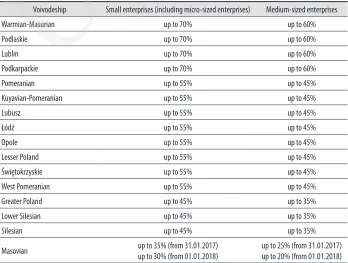
A map of regional support sets out a maximum level of financing enterprises across Polish voivodeships from regional aid and from funds, excluding de minimis aid or resources from national or European projects.
The map and percentages presented illustrate what percentage of resources invested in a given project may be returned to an enterprise in the form of state aid. The Masovian Voivodeship, considered the strongest region, will receive the lowest level of returns of the sum spent. The table clearly shows that there are four weakest voivodeships in Poland which qualify for receipt of the largest returns, i.e. the Warmian-Masurian, Podlaskie, Lublin and Podkarpackie voivodeships. Therefore, a micro-enterprise from the Świętokrzyskie region applying for financing may receive a return of up to 55% of resources. However, a similar enterprise applying for funds but operating in the Podkarpackie Voivodeship has a chance to receive a 70% return of the amount spent.
Voivodeship Small enterprises (including micro-sized enterprises) Medium-sized enterprises Warmian-Masurian up to 70% up to 60% Podlaskie up to 70% up to 60% Lublin up to 70% up to 60% Podkarpackie up to 70% up to 60% Pomeranian up to 55% up to 45% Kuyavian-Pomeranian up to 55% up to 45% Lubusz up to 55% up to 45% Łódź up to 55% up to 45% Opole up to 55% up to 45% Lesser Poland up to 55% up to 45% Świętokrzyskie up to 55% up to 45% West Pomeranian up to 55% up to 45% Greater Poland up to 45% up to 35% Lower Silesian up to 45% up to 35% Silesian up to 45% up to 35% Masovian up to 35% (from 31.01.2017)up to 30% (from 01.01.2018) up to 25% (from 31.01.2017)up to 20% (from 01.01.2018)
Source: Own elaboration study based on: www.funduszeeuropejskie.org.pl
Table 5.
Map of regional support for the SME sector for the years 2014–2020
The Financing
of Small and
Medium-Sized
Enterprises with
the EU Structural
Funds in Poland
Between
2014 and 2020
The Regulation of the Council of Ministers of 30 June 2014 on devising a map of territorial aid for the years 2014–2020 excluded some sectors from regional aid. So, for example, entrepreneurs operating in the forestry, energy production, transport or iron and steel industries cannot benefit from assistance.
Financing the activity of SMEs in the domain of R&D&I will be a priority in the 2014–2020 programming period. The Smart Growth Programme may bring around EUR 8.3 billion to the sector in order to finance research, prepare prototypes or organise test facilities. A project implemented in this domain should aim to acquire new knowledge which will subsequently be used by an enterprise to devise new products and services. In this area, assistance will also be available to enterprises to finance the purchase of technologies, machinery, equipment and other infrastructure necessary for their research activity as well as to secure intellectual property rights. As part of the Smart Growth OP, SMEs can use credit for technological innovation (so-called technological bonus), based on funding part of the repayment of an investment credit granted (to the company) by a commercial bank. Enterprises can also establish consortiums with research institutions (including higher education institutions). In addition, the programme makes it possible to introduce into the market, i.e. to commercialise, any results obtained. R&D assistance comes in the form of a grant, the amount of which is dependent on a given investment’s risk level.
The sum of EUR 959 million has been allocated to financing SMEs as part of the Eastern Poland Programme, mainly to research and development, business environment institutions, start-ups, the promotion of and an increase in the sector’s activity in foreign markets, as well as consultancy regarding entry to other markets. The assistance offered in this field includes the analysis of markets in which a company wishes to conduct its activity, trade and legal consultancy, help in establishing contact with foreign partners or establishing possible distribution channels. Amongst its priorities, the Eastern Poland OP offers a so-called Startup Platform directed at young people with a view to supporting the development of their businesses. The Platform finances consultancy, supervision, work on the development and introduction of a product or service as well as various kinds of educational activity, conferences or training sessions aimed at providing assistance to recently emerged businesses (Ministerstwo Infrastruktury i Rozwoju, 2014, p. 19).
Small- and medium-sized businesses can also receive funding as part of innovation and use the resources to obtain patents or other tangible and legal assets and for patent protection. As regards innovation, the European Union offers help to the value of 50% of the eligible costs of a given initiative, with an additional 100% funding of the costs should the enterprise accept available consulting services on innovation, with a total consultancy cost, however, not exceeding EUR 200,000 over a three-year period (Gwizda et al., 2014, p. 35).
Funding can also be obtained with regard to an increase in competitiveness. In this case, funding may be obtained by newly emerging companies or those already existing but wishing to expand their activity. Consequently, it is start-ups which have the chance to receive funding, which, in turn, will result in a rise in new enterprises. The main emphasis is on the SME sector to use information and communication technologies and to develop and implement new forms of business management.
IJSR
6
The initiatives within the structural funds which have the greatest influence on the development of small- and medium-sized enterprises are the instruments contained in the Smart Growth Operational Programme (SG OP) as well as the COSME Programme. Due to a shortage of real data concerning the influence of the Structural Funds 2014– 2020 on SMEs, I will describe the most important offers within the above-mentioned initiatives for the SME sector.
The Smart Growth Operational Programme is financed from the European Regional Development Fund. The resources allocated to the entire Programme amount to approximately EUR 8.61 million, of which around EUR 1.5 million must come from national public and private resources. The allocation of resources to particular thematic objectives is as follows:
Thematic objective in millions of euroAmount allocated
Strengthening scientific research, technological development and innovation 6.1 Enhancing competitiveness of small and medium-sized enterprises, the agricultural sector (with
regard to EAFRD) and the fisheries and aquaculture sector (with regard to EMFF) 2.2
Source: Own elaboration based on: Szczegółowy opis osi priorytetowych programu operacyjnego Inteligentny
Rozwój 2014–2020 (2016). Ministerstwo Rozwoju, Warszawa.
Table 6.
Resources allocated to thematic objectives as part of the SG OP
The table indicates that most of the resources (70% of the total) are focused around the R&D&I area, which, in turn, demonstrates that the EU places the greatest stress on the emergence of new technologies in order to enhance the growth of SME competitiveness. As part of the SG OP, major stress is placed on increasing the innovation of the economy, especially through cooperation between the science and business sectors. The aim is to provide SMEs with the greatest help in the fields of research and development and innovation. It offers assistance to small and medium-sized enterprises in increasing the quality and internationalisation of their research. All EU actions to support small companies are aimed at improving the economic results of a state and ultimately the entire European Union, while simultaneously using a small amount of resources such as water, energy or raw resources.
Numerous instruments are offered to small and medium-sized enterprises for the years 2014–2020, which they can use to finance their projects. Amongst these are the following: loan fund, complex instruments, non-returnable grants, guarantee funds, venture capital funds, capital funds, business angels or credits.
One of the important programmes for small and medium-sized enterprises is the Programme for the Competitiveness of Enterprises and Small and Medium-sized Enterprises for the years 2014–2020 (COSME). In the current programming period, the programme outlines the principles of the Competitiveness and Innovation Framework Programme (CIP) for the years 2007–2013. It must be noted that it is a programme with international and not national scope, which contributes towards the implementation of the European strategy. It was created in order to enhance the competitiveness and sustainable growth of the SME sector. For this reason, COSME offers SMEs products,
The Financing
of Small and
Medium-Sized
Enterprises with
the EU Structural
Funds in Poland
Between
2014 and 2020
services, technologies and processes on attractive terms. The programme is especially aimed at:
• micro-enterprises,
• the self-employed,
• artisan enterprises,
• young entrepreneurs,
• recent entrepreneurs.
The budget allocated to the COSME Programme stands at EUR 2.2 million, of which 1.3 million (60%) has been allocated to financial instruments.
Table 7.
Main objectives of the COSME 2014–2020 programme
Table 8.
Financial instruments of the COSME Programme
Financial instrument Principles of the financial instrument
The Loan Guarantee Facility
A debt instrument suggested by the European Investment Fund (EIF) which consists in offering free guarantees to financial institutions (guarantee funds, banks) which offer a range of financial products for SMEs;
Thanks to this solution, the risk is shared, resulting in an expansion in the range of products and services for the SME sector. For example, a bank will have the option of offering a product at a lower price and with a longer repayment period and less strict requirements regarding the collateral and private financial contribution;
Counter-guarantees are also offered as part of this instrument. These depend on the EIF granting guarantees to guarantee funds, which, in turn, grant their own guarantees to those financial institutions which offer products to SMEs;
The instrument covers loans of up to EUR 150,000 with at least 12 months maturity. The Equity Facility for Growth
Consists in the EIF offering equity financing to venture capital funds or funds which offer intermediate financing to developing SMEs. This mainly concerns elevated risk funds and also provides co-investment instruments for business angels;
It focuses on offering assistance to research projects and investment activity in particular.
Source: Own elaboration based on Regulation No 1287/2013 of the European Parliament and of the Council of 11 December 2013 establishing a Programme for the Competitiveness of Enterprises.
Main objectives
of the programme Description of instruments as part of the objectives
increase in competitiveness of SMEs
Concerns the abolition of administrative and legal burden, information on good practice in supporting enterprises and the introduction of effective tools for more effective promotion of entrepreneurship
providing SMEs with improved access to EU markets
Assistance in this area is provided by the Enterprise Europe Network which, amongst others, offers financing information and guidance, provides support in finding foreign partners and offers assistance in the transfer of innovation and technology increase in SME access to financing This objective focuses on assisting the sector in obtaining funding through the Loan Guarantee Facility and the Equity Facility for Growth promoting entrepreneurship The aim of COSME is to support education as regards entrepreneurship and to improve the conditions for operating a business
Source: Own elaboration based on: Regulation No 1287/2013 of the European Parliament and of the Council of 11 December 2013 establishing a Programme for the Competitiveness of Enterprises and Small and
IJSR
6
In the 2014–2020 programming period, the EU is focused on increasing the competitiveness of companies in the SME sector. For this reason, the above objectives are closely linked to achieving results in this domain.
The table above presents the financial instruments for SMEs offered by the COSME Programme.
The above instruments offered by the European Union in the COSME Programme are aimed at assisting the SME sector in gaining access to funding. It is common knowledge that it is small enterprises which have the greatest difficulty in securing external sources of funding. This is largely due to their low creditworthiness. As a result, the instruments in question should encourage financial institutions to offer their products to bodies within the SME sector and, consequently, extend their product offer with regard to small enterprises.
4. Conclusions
The novelty in the financing strategy is decentralisation from the national to the regional level in managing funds, which permits an increase in the importance of regional programmes, most suited to answer the needs of entrepreneurs in any given region. The perspectives of financing small- and medium-sized enterprises for the coming years will create favourable conditions and options for assistance as regards the implementation of innovative products. The level of Polish innovation is rather low when compared to the average across the European Union, which means that Poland also has a lower standard of living in contrast to other EU countries. The long-term policy of EU funding for small and medium-sized enterprises in Poland for the coming years is aimed at achieving economic growth and giving people satisfaction with new workplaces as well as modern products and services, particularly in Eastern Poland which is less developed when compared to the west of the country.
The European Union’s assistance is of great importance to small and medium-sized enterprises and should be favourably assessed as it has not only a positive impact on the SME sector itself but also on its environment. The natural environment, economy, citizens and employees remain an important focus of the European Union. It is in these areas that assistance is constantly being offered, not only directly but also indirectly through the implementation of actions in the SME sector, which are of importance from the point of view of investment for which financing is available. Between 2007 and 2013, financing from the European Union has resulted in the development of small and medium-sized Polish enterprises. Nevertheless, we are still behind the EU average as regards innovation. In the years 2014–2020, Polish SMEs will also receive financing from the European Union, which, in turn, will lead to a further increase in innovation and an improvement in the standard of living for every one of us, with small and medium-sized enterprises present at nearly every step, providing employment to a majority of Poles and generating nearly 50% of GDP.
In the 2014–2020 programming period, a great number of instruments are on offer with a view to bringing positive benefits to SMEs. It is certain that every company wishing to use EU structural funds will find a suitable instrument to allow it to develop and implement its concept. It should be noted, however, that the projects which will enjoy
The Financing
of Small and
Medium-Sized
Enterprises with
the EU Structural
Funds in Poland
Between
2014 and 2020
the greatest popularity and possibility for funding will be those related to innovation as well research and development. It is the EU’s objective that projects implemented by SMEs result in a rise in competitiveness of the Polish and EU economy in the global market. Such objectives can only be attained by means of new ideas and ambitious initiatives focused on scientific fields, new technologies and the creation of innovative solutions in every aspect of social life. It must be remarked, however, that an increase in competitiveness and a general economic and financial improvement of Polish SMEs will not happen overnight. Small enterprises will not suddenly become involved in new technologies. This is mainly due to a great reluctance on the part of Polish companies to elevate the risk. For this reason, this very process of an increase in innovation in this sector calls for great concerted effort and the combined involvement of enterprises and the state towards building a globally strong economy.
References
Baliński, D. (2013). ZIT – nowe narzędzie polityki spójności. European Funds in Poland, no. 31. Gwizda, M., Kosewska-Kwaśny, M., Żółciński, Sz. (2014). Fundusze UE 2014–2020. Nowa
perspektywa – nowe możliwości, Beck Info Biznes, Warszawa.
Krasuska, M. (2014). Fundusze Unijne w nowej perspektywie 2014–2020, Wiedza i praktyka, Warszawa.
Materiał informacyjny dotyczący programowania Nowej Perspektywy Finansowej 2014–2020,
z uwzględnieniem priorytetów Ministra Gospodarki (2014), Ministerstwo Gospodarki,
Warszawa.
Nowacka, M. (2006). Uwarunkowania działalności przedsiębiorstw w warunkach jednolitego rynku UE, PWE, Warszawa.
Perkowski, M., Żołnierski, A., and Kokot, J. (2015). MŚP i fundusze Unii Europejskiej. Przewodnik beneficjenta po programach operacyjnych w perspektywie finansowej 2014– 2020. Warszawa.
Programowanie perspektywy finansowej 2014–2020 – Umowa Partnerstwa, Ministerstwo Infrastruktury i Rozwoju, 8 styczeń 2014, Warszawa.
Programowanie perspektywy finansowej 2014–2020 – uwarunkowania strategiczne. Departament Koordynacji Polityki Strukturalnej.
Regulation No 1287/2013 of the European Parliament and of the Council of 11 December 2013 establishing a Programme for the Competitiveness of Enterprises and Small and Medium-sized Enterprises (COSME) (2014–2020).
Szczegółowy opis osi priorytetowych programu operacyjnego Inteligentny Rozwój 2014–2020, (2016). Ministerstwo Rozwoju, Warszawa.
Wsparcie sektora MŚP w RPO 2014–2020, (2014). Ministerstwo Infrastruktury i Rozwoju, Warszawa.
Zasady realizacji Zintegrowanych Inwestycji Terytorialnych w Polsce, (2013). Ministerstwo Rozwoju Regionalnego, Warszawa, lipiec.
http://www.funduszeeuropejskie.org.pl http://www.mg.gov.pl
http://cip.gov.pl
http://www.metropoliagdansk.pl
![Guidelines for the Negotiation of New Cooperation Agreements with the African, Caribbean and Pacific (ACP) Countries. COM (97) 537 final, 29 October 1997 [followup paper to the Green Paper]](data:image/gif;base64,R0lGODlhAQABAIAAAP///wAAACH5BAEAAAAALAAAAAABAAEAAAICRAEAOw==)