R E S E A R C H A R T I C L E
Open Access
Multi-topic assignment for exploratory
navigation of consumer health information in
NetWellness using formal concept analysis
Licong Cui
1, Rong Xu
2, Zhihui Luo
2, Susan Wentz
3, Kyle Scarberry
4and Guo-Qiang Zhang
1,2*Abstract
Background: Finding quality consumer health information online can effectively bring important public health benefits to the general population. It can empower people with timely and current knowledge for managing their health and promoting wellbeing. Despite a popular belief that search engines such as Google can solve all
information access problems, recent studies show that using search engines and simple search terms is not sufficient. Our objective is to provide an approach to organizing consumer health information for navigational exploration, complementing keyword-based direct search. Multi-topic assignment to health information, such as online questions, is a fundamental step for navigational exploration.
Methods: We introduce a new multi-topic assignment method combining semantic annotation using UMLS concepts (CUIs) and Formal Concept Analysis (FCA). Each question was tagged with CUIs identified by MetaMap. The CUIs were filtered with term-frequency and a new term-strength index to construct a CUI-question context. The CUI-question context and a topic-subject context were used for multi-topic assignment, resulting in a topic-question context. The topic-question context was then directly used for constructing a prototype navigational exploration interface.
Results: Experimental evaluation was performed on the task of automatic multi-topic assignment of 99 predefined topics for about 60,000 consumer health questions from NetWellness. Using example-based metrics, suitable for multi-topic assignment problems, our method achieved a precision of 0.849, recall of 0.774, andF1measure of 0.782, using a reference standard of 278 questions with manually assigned topics. Compared to NetWellness’ original topic assignment, a 36.5% increase in recall is achieved with virtually no sacrifice in precision.
Conclusion: Enhancing the recall of multi-topic assignment without sacrificing precision is a prerequisite for achieving the benefits of navigational exploration. Our new multi-topic assignment method, combining
term-strength, FCA, and information retrieval techniques, significantly improved recall and performed well according to example-based metrics.
Keywords: Consumer health information, Multi-topic assignment, Formal concept analysis, Navigational exploration
*Correspondence: [email protected]
1Department of Electrical Engineering and Computer Science, Case Western Reserve University, Cleveland OH 44106, USA
2Division of Medical Informatics, School of Medicine, Case Western Reserve University, Cleveland OH 44106, USA
Full list of author information is available at the end of the article
Background
The Internet provides an important source of consumer health information to patients, caregivers, families, and laypersons. The proliferation of online health informa-tion from government agencies, non-profit organizainforma-tions, for-profit companies, and chatting and social network-ing sites presents myriad of challenges for information access. For example, a study reported in JAMA [1] found that accessing health information using search engines and simple search terms is not sufficient. Even though the accuracy of information found on selected common top-ics is good among the top 14 selected sites, coverage is poor and inconsistent. In some cases, more than 10 steps of web-links did not lead to relevant information within the search results obtained.
One approach to addressing such challenges is to com-plement direct search with mechanisms for navigational exploration, one of the two basic modes for information access [2-4]:
1. Direct search, where a user, knowing what to look for, comes with specific pieces of information about a disease, procedure, or medication, or other related description and tries to retrieve a corresponding set of responses. For example, direct search is most effective for looking up the side effects of
medications such as Warfarin, using the drug name as a key search string.
2. Navigational exploration, where the goal is to explore and see “what is there.” For example, finding answers to questions such as “Other than prescribed medications, what are alternatives that may help with depression” involve more exploring than searching. In this mode, the consumer may not be able to easily and effectively formulate a descriptive direct search, and must rely on navigational menus or “facets” [4-6] to browse and explore the content.
In most cases, direct search may be accompanied by navigational exploration to help the user “finding needles in a haystack:” the volume of search results can be over-whelmingly large and needs to be further structured to allow relevant information to be located. For example, the same JAMA study [1] reported 3,735 links in the first page of search results from the 14 selected sites. Among 389 sampled relevant links, about a quarter did not lead to a content page within 10 clicks. This demonstrates that a mechanism for navigational exploration, complement-ing direct search, should be helpful. In related work, Mu et al. [7] presented a facet-view information navigation interface called SimMed complementing lookup search for effectively retrieving medical literatures in a subset of MEDLINE. More recently, Cui et al. [8] introduced a conjunctive exploratory navigation interface called CENI
for supporting effective retrieval of consumer health questions.
Consumer experience in navigational exploration mode depends on Information Organization, a topic centered around structures (e.g. nested folder or menu hierarchies) with which to organize a collection of contents to facili-tate browsing and exploration. For example, Community Question Answering (CQA) services on the web enable users to ask and answer questions. Such services for con-sumer health include WebMD Answers (http://answers. webmd.com/) and NetWellness (http://netwellness.org/). Questions in CQA services are often organized into cat-egories or topics to facilitate browsing, exploring and searching questions and answers.
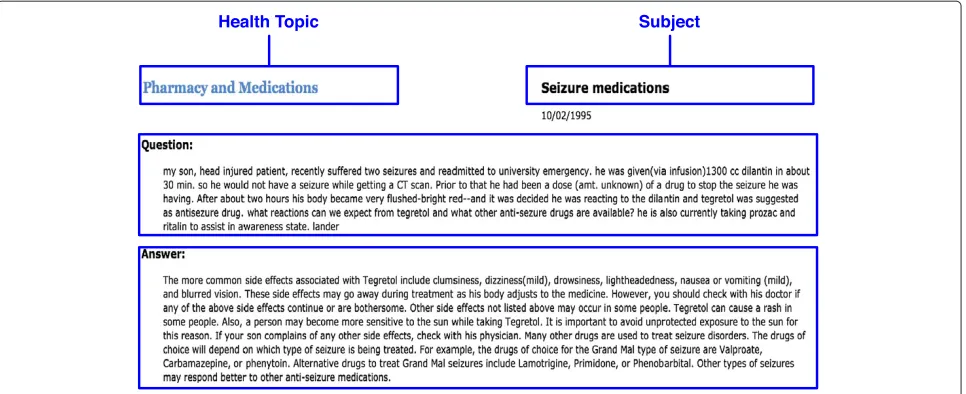
However, a common limitation of these organizational structures is that each question is assigned a single topic among a collection of topics, even though multiple topics are often relevant. For example, Figure 1 shows a health question in NetWellness, which was assigned a single topic “Pharmacy and Medications,” but it is also related to “Epilepsy.” Allowing for a single question being assigned multiple relevant topics (if applicable) enables consumers to reach it through multiple pathways, thus improving the retrieval recall in the navigational exploration mode.
The categorization of a question into multiple topics (a.k.a.multi-topic assignment) is a multi-label classifica-tion problem, a complex task where each item (quesclassifica-tion) can be associated with one or more labels (topics).
Existing machine learning methods for multi-label clas-sification can be grouped into two main categories:
problem transformation, which converts the multi-label classification problem into multiple single-label classifica-tion problems, andalgorithm adaptation, which extends specific learning algorithms for single-label classification problems to handle multi-label data directly (see [9,10] for the detailed methods). Several existing work involves multi-label classification in clinical research. A clinical coding challenge [11] organized by the Cincinnati Chil-dren’s Hospital Medical Center in 2007 focused on the assignment of ICD-9-CM codes to radiology reports. In [12], supervised binary classifiers were developed to assign 12 predefined general topics (e.g. etiology, proce-dure, and diagnosis) to clinical questions.
Figure 1A sample consumer question in NetWellness.Each question has four major components: Health Topic, Subject, Question, and Answer.
constructing a prototype navigational exploration inter-face called Concept-guided Automatic Organization of Consumer Health information (iCOACH).
Methods
Formal Concept Analysis (FCA)[13] is a lattice-based method for extracting higher-level organizational infor-mation from lower-level classification of objects according to their attributes. FCA builds from a formal context (or context), (O,A,R), with O a collection of objects (e.g. questions),Aa collection of attributes (e.g. topics), andRa binary relation fromOtoA.Ris specified by a table, where a “×” entry indicates the relation between corresponding object (row) and the corresponding attribute (column). FCA clusters objects into a concept hierarchy (called a concept lattice), suitable for visualization and quantitative analysis with considerable organizational power. Each log-ical cluster is called a formal concept, representing a basic unit of information by harmonizing subsets of objects (the
extent) and their associated attributes (theintent) using a closure operation.
We use FCA to categorize questions into multiple top-ics for content organization and to drive a dynamically navigational exploration interface for content-group gen-eration. Each use of FCA involves the creation of a formal context and the dynamic generation of the correspond-ing formal concept (i.e. its intent and extent) based on a selected subset of attributes.
Our approach involves the identification of attributes, objects, and construction of formal contexts (or just contexts), and the integration and coordination among the contexts (see Figure 2). Four formal contexts were developed:
1. Category-topic context. Health categories were adapted from a subset of UMLS’ semantic types to organize NetWellness topics. The category-topic context classified topics to relevant categories to indicate if a topic “is a” or “typically involves” the corresponding category. It was used to dynamically create a list of topics (extent) in the intersection of a selected set of categories (intent).
2. Topic-subject context. This context took subjects and topics as objects and attributes respectively. The subject of each question was annotated with UMLS CUIs, representing a set of semantic concepts involved in the subject. It provided a way to assign multiple topics to a given question.
3. CUI-question context. Each question and its subject were annotated with UMLS CUIs, representing a set of semantic concepts involved in the question. The CUIs were filtered with term-frequency and a new term-strength index to construct the CUI-question context. This context was used as another way to assign multiple topics to questions.
4. Topic-question context. This context categorized questions into multiple topics using the topic-subject context and CUI-question context. It was used to dynamically create a list of questions (extent) in the intersection of a selected set of topics (intent).
Category-topic context
Figure 2The workflow for organizing NetWellness consumer health questions for navigational exploration.Four formal contexts in FCA are the nodes shaded in grey. The category-topic context drives the dynamic, on-the-fly identification of topic groups according to selected categories in the iCOACH prototype interface; The topic-subject context and CUI-question context are used to classify a question with multiple topics, resulting in the topic-question context, which drives the dynamic, on-the-fly identification of question groups according to selected topics in the iCOACH prototype interface. The process to create the category-topic context involves manual curation using ConExp [15], all other processes are done automatically.
purpose, and relied on MetaMap [16] to identify a subset of NetWellness-relevant semantic types. This subset was further regrouped and sometimes relabeled with the help of two NetWellness experts, to narrow down to a dozen of manageable top-level categories. These categories are “Activity and Behavior,” “Anatomy and Body System,” “Dis-ease, Syndrome and Disorder,” “Drugs, Medication and Substance,” “Environmental and Risk Factors,” “Health and Wellbeing,” “Inheritance, Genetics and Genomics,” “Med-ical Device,” “Population and Subgroups,” “Prevention and Screening,” “Procedure and Process,” and “Symptom or Sign.” The curated 12 categories and 99 topics were used as the attributes and objects for FCA respectively. The corresponding formal context was manually created and verified by the NetWellness experts. ConExp [15] is a Java-based open-source FCA tool for editing formal context, building and visualizing concept lattices from a formal context, and performing attribute exploration. ConExp was used to assist the editing and validation process of constructing the category-topic context.
Topic-subject context
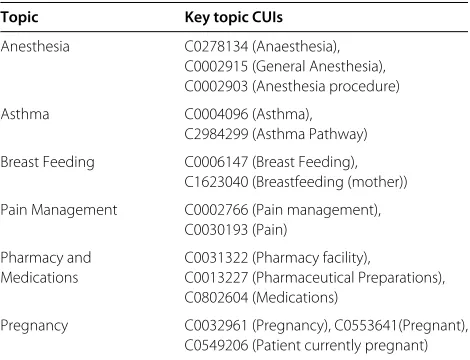
The topic-subject context serves as a bridge between topics and questions. Both topics and subjects are rep-resented as CUI-sets. We manually curated a list L of 140 key topic CUIs, and each CUI can directly deter-mine a topic. For each such topic, a set of synonyms and descendants of its CUIs inLwas automatically collected using UMLS’ semantic relations to construct the topic CUI-set, and the topic served as an attribute for FCA. Table 1 lists some topics and their corresponding key topic
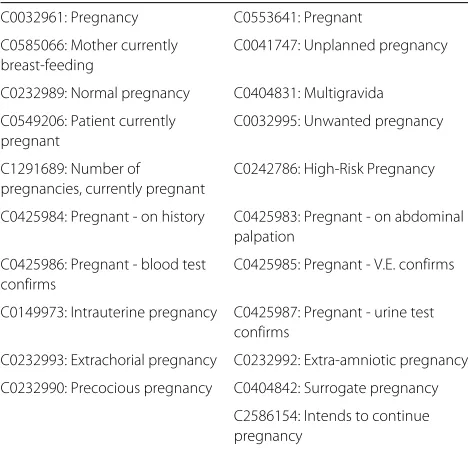
CUIs. Table 2 shows the CUI-set for the topic “Pregnancy” including 21 CUIs.
The subject of a question is usually short but more likely to convey important information. Each subject had a CUI-set assigned by MetaMap, and served as an object for FCA. Table 3 lists some subjects and their annotated CUIs.
The corresponding formal context was automatically generated using subject CUI-sets and topic CUI-sets. In this context, a “×” entry corresponding to an object (sub-ject) and an attribute (topic) indicates that the intersec-tion of the subject CUI-set and the topic CUI-set is not empty.
Table 1 Examples of topics and their corresponding key topic CUIs
Topic Key topic CUIs
Anesthesia C0278134 (Anaesthesia),
C0002915 (General Anesthesia), C0002903 (Anesthesia procedure)
Asthma C0004096 (Asthma),
C2984299 (Asthma Pathway)
Breast Feeding C0006147 (Breast Feeding), C1623040 (Breastfeeding (mother))
Pain Management C0002766 (Pain management), C0030193 (Pain)
Pharmacy and C0031322 (Pharmacy facility),
Medications C0013227 (Pharmaceutical Preparations), C0802604 (Medications)
Table 2 The CUI-set for the topic “Pregnancy” (21 CUIs)
C0032961: Pregnancy C0553641: Pregnant
C0585066: Mother currently C0041747: Unplanned pregnancy breast-feeding
C0232989: Normal pregnancy C0404831: Multigravida
C0549206: Patient currently C0032995: Unwanted pregnancy pregnant
C1291689: Number of C0242786: High-Risk Pregnancy pregnancies, currently pregnant
C0425984: Pregnant - on history C0425983: Pregnant - on abdominal palpation
C0425986: Pregnant - blood test C0425985: Pregnant - V.E. confirms confirms
C0149973: Intrauterine pregnancy C0425987: Pregnant - urine test confirms
C0232993: Extrachorial pregnancy C0232992: Extra-amniotic pregnancy
C0232990: Precocious pregnancy C0404842: Surrogate pregnancy
C2586154: Intends to continue pregnancy
Since each key topic CUI inLcan determine a topic, its synonyms and descendant can also determine the topic. Therefore, if a subject is annotated with at least one CUI in a topic CUI-set (that is, the intersection of the subject CUI-set and the topic CUI-set is not empty), then a “×” entry is added to the topic-subject context indicating that the subject relates to the topic. Table 4 shows the topic-subject context determined by the topics in Table 1 and the subjects in Table 3.
CUI-question context
The CUI-question context serves as another bridge between topics and questions. Terms in each question and its subject were annotated with UMLS CUIs and semantic types using MetaMap. This obtained 32042 distinct CUIs
Table 3 Examples of subjects and their annotated CUIs
Subject Annotated CUIs
Safety of general C1705187 (Safety),
anesthesia C0002915 (General Anesthesia)
Breast Feeding and C1623040 (Breast feeding), Asthma Medications C0004096 (Asthma),
C0013227 (Pharmaceutical Preparations)
Asthma and pregnancy C0004096 (Asthma), C0032961 (Pregnancy)
Hemorrhoids accompanied C0019112 (Hemorrhoids), by abdominal pain C0000737 (Abdominal Pain)
Breastfeeding and getting C0006147 (Breast Feeding),
pregnant C0549206 (Patient currently pregnant)
Pregnancy while on C0032961 (Pregnancy),
TB Medications C0802604 (Medications)
for all questions as well as their subjects. Since there is a large number of CUIs involved and not all of them are rel-evant to consumer heath, we used the following steps to select a subset of most relevant CUIs:
Step 1: Filtering out uninformative CUIs by their seman-tic types.We manually excluded a collection of semantic types that are not relevant to our task of assigning top-ics to questions (e.g., “Quantitative Concept,” “Intellectual Product,” “Geographic Area,” and “Organization”). CUIs with excluded semantic types were filtered out for each question. A total of 23802 distinct CUIs were left after this step.
Step 2: Filtering CUIs using CUI TF-IDF.The CUI-set for each question was filtered using TF-IDF [17]. CUI term-frequency (TF) was calculated as the number of occurrences of a CUI in a question and its subject (key CUIs are usually mentioned in the subject and repeated one or several times in the question), normalized by the number of all CUI occurrences in that question and its subject. The inverse document frequency (IDF) was used to measure the importance of a CUI in the corpus of all questions; it is the logarithm of the quotient of the number of all questions and the number of questions containing the CUI. The TF-IDF weight, TF×IDF, was used to deter-mine the importance of a CUI for a question. For each question, the top five ranked CUIs were selected. A total of 21212 distinct CUIs were left after performing CUI TF-IDF.
Step 3: Filtering CUIs using a term-strength index.
To automatically find associated questions for a given question and to assign multiple topics to questions, co-occurrences of CUIs were taken into account. We defined a term-strength index for CUIs as follows: Given a CUIC, we use{(Ci,Ni)|i=1, 2,. . .,k}to denoteC’s co-occurring CUI list among all the questions, where Ci is C’s co-occurring CUI andNirepresents the number of questions containing bothCiandC, andkis the total number ofC’s co-occurring CUIs. A CUIChas term-strength indexnif
nofC’s co-occurring CUIs have at leastncommon ques-tions each, and the other(k−n) co-occurring CUIs at mostncommon questions each. That is,
n=max
j {Ni|Ni≥j}≥j,j≤k
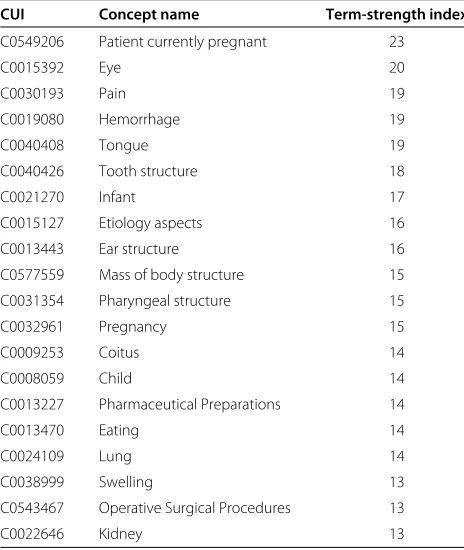
where{Ni|Ni≥j}is the size of the set{Ni | Ni ≥ j}. The top 20 CUIs ranked by the term-strength index are shown in Table 5. The CUI-set for each question was then reformulated by filtering out CUIs whose term-strength indexes are less than 2. This step resulted in a total of 8208 distinct CUIs.
Table 4 The topic-subject context determined by the topics in Table 1 and the subjects in Table 3
R Topics (attributes)
Anesthesia Asthma Breast feeding Pain management Pharmacy and Pregnancy medications
Subjects (objects)
Safety of general anesthesia ×
Breast feeding and asthma
medications × × ×
Asthma and pregnancy × ×
Hemorrhoids accompanied by
abdominal pain ×
Breastfeeding and getting pregnant × ×
Pregnancy while on TB Medications × ×
Step 5: Creating CUI-question context. The CUI-question context was automatically generated by the ques-tions and their relevant CUIs left after the previous four steps. Table 6 shows a subcontext of this context, where the attributes are three CUIs: C0232908 (concept name: “conceived”), C0025874 (concept name: “Metrorrhagia”), and C0439531(concept name: “period”), and the objects are eight questions labeled as Q1, Q2, Q3, Q4, Q5, Q6, Q7, and Q8.
Topic-question context: a question may be assigned multiple topics
The construction of topic-question context relies on the tagging of a question by multiple topics. We developed
Table 5 Top 20 CUIs ranked by our term-strength index
CUI Concept name Term-strength index
C0549206 Patient currently pregnant 23
C0015392 Eye 20
C0030193 Pain 19
C0019080 Hemorrhage 19
C0040408 Tongue 19
C0040426 Tooth structure 18
C0021270 Infant 17
C0015127 Etiology aspects 16
C0013443 Ear structure 16
C0577559 Mass of body structure 15
C0031354 Pharyngeal structure 15
C0032961 Pregnancy 15
C0009253 Coitus 14
C0008059 Child 14
C0013227 Pharmaceutical Preparations 14
C0013470 Eating 14
C0024109 Lung 14
C0038999 Swelling 13
C0543467 Operative Surgical Procedures 13
C0022646 Kidney 13
two methods of assigning topics to questions using (1) topic-subject context, and (2) CUI-question context.
Categorizing questions using the topic-subject context
The CUI-sets for most topics were constructed by first identifying CUIs directly associated with the topics, and then adding additional CUIs through the UMLS knowl-edge source. A question was categorized to a topic if the intersection of its subject CUI-set and the topic CUI-set is not empty. This has the effect of putting significant weight on a question’s subject content, which is consistent with our intuition. Since the pre-defined NetWellness topics are not incomparable, an associated set of rules reflect-ing the hierarchical relationship between topics was also used in the topic assignment. Assigning multiple topics to questions results in a comprehensive topic-question con-text, thus allowing consumers to quickly narrow down to relevant questions in iCOACH’s conjunctive organiza-tion framework while not missing those quesorganiza-tions that are relevant to a topic.
Table 6 A subcontext of the CUI-question context
CUIs
C0232908 C0025874 C0439531 (conceived) (Metrorrhagia) (Period)
Questions
Q1 × ×
Q2 × ×
Q3 × ×
Q4 × × ×
Q5 × ×
Q6 × ×
Q7 × × ×
Q8 × ×
The terms in parentheses are the concept names of the CUIs. The original NetWellness topics assigned for each question are: Q1: “Gynecology,” Q2: “Pregnancy,” Q3: “Pregnancy,” Q4: “Pregnancy,” Q5: “Gynecology,” Q6: “Infertility,” Q7: “Women’s Health,” and Q8: “Gynecology.” The final topic assignments using FCA are Q1: “Gynecology,” Q2: “Pregnancy,” Q3: “Pregnancy,” Q4: {“Pregnancy,” “Gynecology”}, Q5: “Gynecology,” Q6: {“Infertility,”
Categorizing questions using the CUI-question context
For each question in the question context, its CUI-set determines a formal concept computed using the Colibri-Java library [19]. This formal concept is a set of questions (extent) sharing the CUIs (intent) in the CUI-set of the given question. Among the questions in the extent of the formal concept, those having exactly the same CUI-set as the given question as well as their originally assigned NetWellness topics are utilized to assigned topics to questions by leveraging a voting scheme. For instance, in the context shown in Table 6, originally NetWellness assigned topic for each question is Q1: “Gynecology,” Q2: “Pregnancy,” Q3: “Pregnancy,” Q4: “Pregnancy,” Q5: “Gynecology,” Q6: “Infertility,” Q7: “Women’s Health,” and Q8: “Gynecology.”
Q1’s CUI-set {C0025874 (“Metrorrhagia”), C0439531 (“period”)} determines a set of associated questions {Q1, Q4, Q5, Q6, Q7, Q8}. Among these associated questions, Q1, Q5, Q6, and Q8 have the same CUI-set as Q1, and their originally NetWellness assigned topics (Q1: cology,” Q5: “Gynecology,” Q6: “Infertility,” Q8: “Gyne-cology”) are considered as the potential candidate topics for the associated questions. The best candidate topics are decided by a voting scheme, where each question contributes to a vote for its original topic (“Gynecol-ogy” has 3 votes, and “Infertility” has 1 vote). The top-ics excluding those with 1 vote are considered as the best candidate topics for the associated question group. Therefore, Q1, Q4, Q5, Q6, Q7, and Q8 are assigned the topic “Gynecology,” where Q4, Q6, and Q7 receive a new topic “Gynecology,” while Q1, Q5, and Q8 receive no new topics. As a result, the topic assignment determined by Q1’s CUI-set is Q1: “Gynecology,” Q2: “Pregnancy,” Q3: “Pregnancy,” Q4: {“Pregnancy,” “Gynecology”}, Q5: “Gyne-cology,” Q6: {“Infertility,” “Gynecology”}, Q7: {“Women’s Health,” “Gynecology”}, and Q8: “Gynecology.”
Q2’s CUI-Set {C0232908 (“conceived”), C0025874 (“Metrorrhagia”)} determines a set of associated ques-tions {Q2, Q3, Q4, Q7}, among which Q2 and Q3 have the same CUI-set as Q2, and their originally NetWellness assigned topics (Q2: “Pregnancy,” Q3: “Pregnancy”) are considered as the potential candidate topics for the asso-ciated questions. Since “Pregnancy” receives 2 votes, it is considered as the best candidate topic for the associated questions. Therefore, Q7 receives a new topic “Preg-nancy,” while Q2, Q3, and Q4 receive no new topics. As a result, the topic assignment determined by Q2’s CUI-set is Q1: “Gynecology,” Q2: “Pregnancy,” Q3: “Pregnancy,” Q4: {“Pregnancy,” “Gynecology” }, Q5: “Gynecology,” Q6: {“Infertility,” “Gynecology”}, Q7: {“Women’s Health,” “Gynecology,” “Pregnancy”}, and Q8: “Gynecology.” Per-forming the similar process for the remaining questions and the final topic assignment keeps the same as the topic assignment determined by Q2’s CUI-set.
Evaluation metrics
Example-based measures for multi-label classification problems were used as the evaluation metrics [9,10]. Let
Lbe a set of labels, andDbe a multi-label evaluation data set consisting of m multi-label examples (xi,Yi), where
i ∈ {1,. . .,m}andYi ⊆ L. LetZibe the set of predicted labels forxi. The example-based precision (P), recall (R) andF1measure (F1) are defined as follows:
P= 1 m
m
i=1
|Yi∩Zi| |Zi|
, (1)
R= 1 m
m
i=1
|Yi∩Zi| |Yi|
, and (2)
F1=
1
m
m
i=1
2|Yi∩Zi| |Zi| + |Yi|
. (3)
Example-based measures described above have been designed to avoid undue influence of a few questions with an unusually large number of labels. For a multi-label clas-sification problem, the traditional measures could poten-tially allow the performance on a few such questions to dominate the value of the metric. See Appendix for an example illustrating the distinctions between example-based measures and traditional measures.
Reference standard development
To create a reference standard, 300 questions were ran-domly selected using stratified sampling from NetWell-ness’ pool of over 60,000 questions. We developed a web-based interface for annotators to tag questions with topics. Three annotators (A1, A2, A3) generated the refer-ence standard in two iterations. In the initial iteration, the annotators assigned topics to questions independently. The standard kappa statistic cannot be used to mea-sure agreement between annotators in this work since it assumes each item is assigned a unique label [20], even though the candidate labels can be several. For our task, each question can be assigned one or multiple topics. We adapted the idea of computing inter-annotator agree-ment (IAA) usingF1measure [21], where one annotator’s
annotations were used as the reference standard to calcu-late theF1measure of the other annotator. We computed
example-basedF1measures for pairs of annotators: (A1,
A2)-0.819, (A1, A3)-0.828, (A2, A3)-0.755. The average example-basedF1measure among all pairs of annotators
Ethics statement This study involved no human sub-jects, and qualified as an exempt research activity under the Code of Federal Regulations [38 CFR 16.101(b) Section 3, Category 2].
Results
Summary of contexts
The category-topic context consisted of 12 categories and 99 topics. The concept lattice of this context consists of 71 concept nodes (Additional file 1: Figures S2). The CUI-question context involved 7127 CUIs and 54184 ques-tions. The topic-subject context consisted of 91 topics and 54787 subjects. Three methods were used to con-struct the topic and question context: (1) Categorizing questions using the CUI-question context gave a topic-question context containing 80781 “×” entries; (2) Using the topic-subject context resulted in 82800 “×” entries; and (3) Combining (1) and (2) obtained 92034 “×” entries.
Evaluation
For performance evaluation, we focused on improving the key metric of recall, representing the most important area for improvement that affects the experience of a user’s navigational exploration. In the reference standard, 278 questions have 497 topics assigned in total. The perfor-mance of the two methods categorizing questions and their combination were compared with that of NetWell-ness’ originally manual, single-topic assignment against the reference standard.
Table 7 shows the total numbers of correctly assigned, wrongly assigned, and missing topics for the original NetWellness’ and our multi-topic assignment methods against the reference standard. Combination of using topic-subject context and using CUI-question context produced the largest number of correct topics (364) and smallest number of missing topics (133). It also achieved the best result: an example-based precision of 0.849, recall of 0.774, andF1measure of 0.782. Compared to
NetWell-ness’ manual, single-topic assignment, a 36.5% increase in recall (from 0.567 to 0.774) was achieved with no sacrifice of precision.
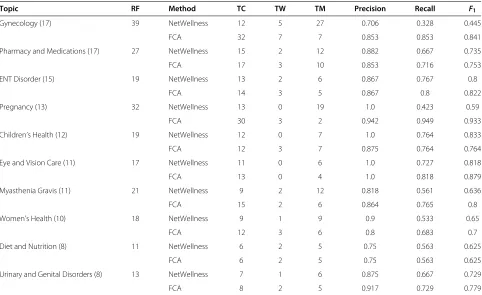
Table 8 shows the performance of our combination method for the top 10 topics ranked by the number of
questions appearing in the reference standard, compared to original NetWellness’ topic assignment (questions in the reference standard involved 77 topics according to the original NetWellness’ assignment). For our combined approach, “Pregnancy” achieved the best example-based recall (0.949) and F1 measure (0.933), and “Diet and
Nutrition” had the lowest example-based F1 measure
(0.625).
iCOACH prototype interface
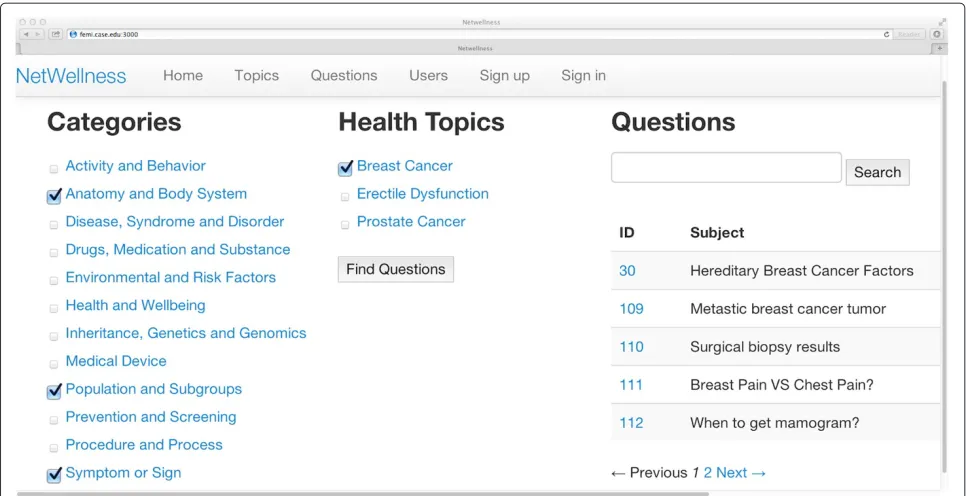
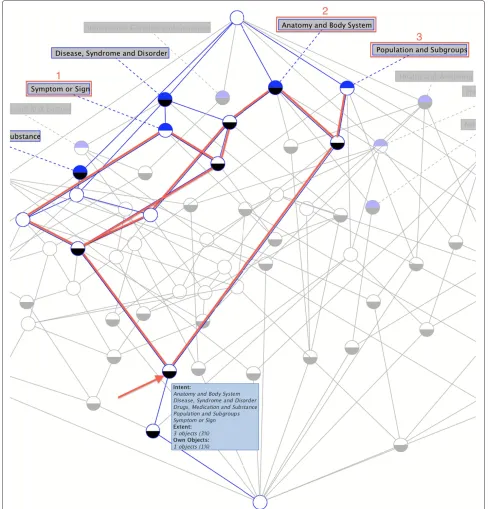
The category-topic context and topic-question context dynamically drive the iCOACH prototype interface to allow the consumer multiple paths to quickly narrow down to relevant questions (Figure 3). Based on the category-topic context, a set of selected categories (left-most column of Figure 3) dynamically generates a set of topics involving all the selected categories (middle col-umn of Figure 3). Figure 4 illustrates the corresponding concept node in the concept lattice diagram. This corre-spondence also demonstrates the elimination of the need for an explicit label for such a composite concept node, because our strategy has avoided using menu-hierarchies generated from the concept lattice. The effect of category selection and the corresponding nodes in the concept lat-tice are shown in Additional file 1: Figures S1-S6. Based on the topic-question context, a set of topics drives the dynamic generation of a set of questions (rightmost col-umn of Figure 3).
Discussion
Contribution and distinction from existing work
Multi-topic assignment is a challenging topic. When each question is assigned to one or several topics among nearly a hundred candidates, the probability of getting even a small fraction of tens of thousands of questions correct at random is virtually zero.
Our multi-topic assignment method combines seman-tic annotation using UMLS concepts (CUIs) and FCA and attained an example-based precision of 0.849, recall of 0.774, and F1 measure of 0.782, using a reference
stan-dard of 278 questions with manually assigned topics. Our approach is non-standard. It is not a typical machine learning approach since we do not start with a training set
Table 7 The example-based precision, recall, andF1measures for original NetWellness’ assignments and our multi-topic
assignments
Method Correctly Wrongly Missing Precision Recall F1
assigned topics assigned topics topics
Original NetWellness 234 44 263 0.842 0.567 0.649
Using topic-subject context 346 56 151 0.873 0.746 0.781
Using CUI-question context 318 69 179 0.835 0.7 0.731
Combination of the above two 364 77 133 0.849 0.774 0.782
Table 8 The example-based precision, recall, andF1measure for the top 10 topics
Topic RF Method TC TW TM Precision Recall F1
Gynecology (17) 39 NetWellness 12 5 27 0.706 0.328 0.445
FCA 32 7 7 0.853 0.853 0.841
Pharmacy and Medications (17) 27 NetWellness 15 2 12 0.882 0.667 0.735
FCA 17 3 10 0.853 0.716 0.753
ENT Disorder (15) 19 NetWellness 13 2 6 0.867 0.767 0.8
FCA 14 3 5 0.867 0.8 0.822
Pregnancy (13) 32 NetWellness 13 0 19 1.0 0.423 0.59
FCA 30 3 2 0.942 0.949 0.933
Children’s Health (12) 19 NetWellness 12 0 7 1.0 0.764 0.833
FCA 12 3 7 0.875 0.764 0.764
Eye and Vision Care (11) 17 NetWellness 11 0 6 1.0 0.727 0.818
FCA 13 0 4 1.0 0.818 0.879
Myasthenia Gravis (11) 21 NetWellness 9 2 12 0.818 0.561 0.636
FCA 15 2 6 0.864 0.765 0.8
Women’s Health (10) 18 NetWellness 9 1 9 0.9 0.533 0.65
FCA 12 3 6 0.8 0.683 0.7
Diet and Nutrition (8) 11 NetWellness 6 2 5 0.75 0.563 0.625
FCA 6 2 5 0.75 0.563 0.625
Urinary and Genital Disorders (8) 13 NetWellness 7 1 6 0.875 0.667 0.729
FCA 8 2 5 0.917 0.729 0.779
The top 10 topics are ranked by the number of questions (displayed in the parentheses) in the reference standard categorized by the corresponding topic in the original NetWellness assignment. The performance of the original NetWellness assignment and our combined method (see Table 7) denoted as FCA are displayed. RF: Total number of topics assigned in reference standard; TC: Total number of correctly assigned topics; TW: Total number of wrongly assigned topics; TM: Total number of missing topics.
for supervised learning. Neither is it a completely unsu-pervised approach since we do take advantage of existing knowledge in NetWellness. Our approach is perhaps best characterized as a hybrid version using a combination of information retrieval techniques and FCA.
Organizing consumer health information according to a conjunctive structure determined by FCA allows content items to be located from multiple pathways. It achieves a better “organizational precision and recall,” in the sense that items, if found, are in their right place (precision) and an item is located at where it should be (recall).
Our prototype interface iCOACH overcomes one of the disadvantages of the existing body of work on FCA-based menu-design and organization [22-24]. One of the main challenges in such an approach is finding appropriate labeling for composite concept nodes, representing a con-junctive aggregation of attributes. For example, finding a concise and accurate label for a new category representing the intersection of “Anatomy and Body System,” “Dis-ease, Syndrome and Disorder,” and “Inheritance, Genetics and Genomics” is difficult, if not impossible. iCOACH avoids this problem by allowing multiple (conjunctive) selection by a user to drill-down to the corresponding concept node in the hierarchy automatically generated
using FCA without having to name the concept node. This removes the need to navigate nested menus hierarchies as well.
Figure 3A screenshot of the conjunctive navigation interface.The category-topic context drives the on-the-fly allocation of a set of topics related to a select set of categories (leftmost column), with a total of 71 possible variations corresponding to the 71 concept nodes. Selection of multiple categories, such as “Anatomy and Body System,” “Population and Subgroups,” and “Symptom or Sign” (leftmost column) immediately guides the consumer to relevant topics (middle column) lying at the intersection of all the categories (conjunctively), rather than those belonging to the union of all the categories (disjunctively). The topic-question context drives the dynamic generation of a set of questions (rightmost column) relating to a selected set of topics.
framework, without requiring strict conformation to the mutual exclusivity of the standard notion of “facet” [26].
iCOACH is a generalization of the conjunctive exploratory navigation interface CENI [8] which allows consumer health questions in NetWellness to be retrieved from multiple health topics. CENI uses the topic-question formal context to drive the conjunctive exploration of health questions, while iCOACH uses chain-linked category-topic and topic-question contexts (two tiers) to explore health questions.
Similar to CENI, iCOACH reused NetWellness’ existing health topics, which may not represent the best choices of potential health topics. In separate work [27], a seman-tic conjunctive exploratory navigation interface (SCENI) is developed to retrieve health questions using UMLS concepts as potential topics.
Performance analysis
In this paper, we focused on evaluating the perfor-mance of categorizing questions into multiple topics. Using the combined FCA approach (both topic-subject and CUI-question contexts) achieved the best example-based recall and F1 measure (Table 7). For the top 10
topics ranked by the number of questions in the ref-erence standard according to the original NetWellness
assignment (Table 8), the topic “Pregnancy” achieved the best example-based recall andF1measure using our
com-bined FCA approach. The reason may be that although pregnancy-related questions often were very specific, but they were also related to other problems occurring dur-ing pregnancy. Note that the topic “Diet and Nutrition” achieved the lowest F1 measure for our combined FCA
approach. The reason might be that this is a “vague” topic, and questions that should be assigned to this topic did not necessarily mention the key words “diet” or “nutrition” explicitly.
Figure 4The corresponding concept node in the lattice diagram for the selected categories in Figure 3.In the concept lattice, the node pointed by the arrow reflects three topics determined by the three selected categories as selected in Figure 3 (selecting additional categories such as “Disease, Syndrome and Disorder,” and “Drugs, Medication and Substance” does not change the resulting topics, since these are consequences determined by FCA).
to the topic of “Ear, Nose, and Throat Disorders.” Fur-ther CUI-set selection including those tagged for answers may help address this issue. The quality of NetWellness contents naturally affects performance. Some NetWell-ness topics are too general. Some NetWellNetWell-ness questions
Limitation
Our evaluation has been focused the on the multi-topic assignment problem. The iCOACH interface has not been directly evaluated by external users. However, its simplification CENI [8] was evaluated through a crowd-sourcing search-interface comparative study with Ama-zon Mechanical Turk, which showed the effectiveness of the conjunctive organization and exploration of health questions by multiple topics.
Conclusions
Enhancing the recall of multi-topic assignment without sacrificing precision is a prerequisite for achieving the benefits of navigational exploration. Our new multi-topic assignment method, combining term-strength, FCA, and information retrieval techniques, significantly improved recall and performed well according to established met-rics. iCOACH provides an environment for organizing about 60,000 existing questions in NetWellness for naviga-tional exploration. By organizing consumer health infor-mation sources such as NetWellness at the levels of categories, topics, and questions (contents), multiple entry points are offered for the consumer to explore information of interest, even though the precise terms for search-ing such information may be non-trivial or difficult to formulate.
Appendix
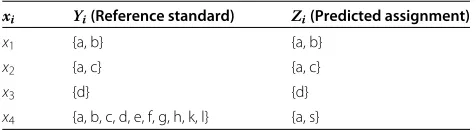
We present a brief example to help illustrate the differ-ences between example-based evaluation measures and traditional evaluation measures. Table 9 is an example consisting of four questionsx1,x2,x3,x4 and their topic
assignments in the reference standard Yi and predicted topic assignmentsZi.
Table 10 shows how the example-based precision (P), recall (R), andF1measure (F1) are computed using Eq. 1,
Eq. 2 and Eq. 3 in Subsection “Evaluation metrics.” A pre-cision of 0.875, recall of 0.775, andF1measure of 0.792 are
obtained as indicated in the last row.
The following steps show how the traditional evalua-tion metrics are calculated resulting a lower recall (0.438) and F1 value (0.584), where TP, FN, and FP represent
Table 9 Questionsx1,x2,x3,x4and their topic assignments
in the reference standardYiand predicted topic
assignmentsZi
xi Yi(Reference standard) Zi(Predicted assignment)
x1 {a, b} {a, b}
x2 {a, c} {a, c}
x3 {d} {d}
x4 {a, b, c, d, e, f, g, h, k, l} {a, s}
Table 10 Evaluation based on example-based metrics (macro-average on the example level)
xi |Yi| |Zi| |Yi∩Zi| |Y|Zi∩Zi|i| |Y|Yi∩Zi|i| |Z2|Yi|+|Yi∩Zii||
x1 2 2 2 1 1 1
x2 2 2 2 1 1 1
x3 1 1 1 1 1 1
x4 10 2 1 0.5 0.1 0.167
Macro-average P=0.875 R=0.775 F1=0.792
numbers of true positives, false negatives, and false posi-tives, respectively.
TP=4
i=1|Yi∩Zi| =2+2+1+2=7
FN=4
i=1(|Yi| − |Yi∩Zi|)=0+0+0+9=9
FP=4
i=1(|Zi| − |Yi∩Zi|)=0+0+0+1=1
P=TP/(TP+FP)=7/8=0.875
R=TP/(TP+FN)=7/16=0.438
F1=2×P×R/(P+R)=0.584
As illustrated above, using traditional methods allows the performance on a few questions (such asx4) with an
unusually large number of labels to dominate the values of evaluation metrics (which is undesirable), while example-based metrics have been designed to avoid undue influ-ence of such questions.
Additional file
Abbreviations
CQA: Community question answering; CUI: Concept unique identifier; FCA: Formal concept analysis; iCOACH: Concept-guided automatic organization of consumer health information.
Competing interests
The authors declare that they have no competing interests.
Authors’ contributions
LC and GQZ conceptualized and designed the iCOACH approach. LC implemented the algorithms and interface with input from GQZ. LC, GQZ, and RX performed the evaluation. LC, GQZ lead the writing of the paper, with critical reviews by ZL and RX. SW and KS provided domain expertise and assisted the evaluation. All authors read and approved the final manuscript.
Acknowledgements
This publication was made possible by the Clinical and Translational Science Collaborative (CTSC) of Cleveland, UL1TR000439.
Author details
1Department of Electrical Engineering and Computer Science, Case Western Reserve University, Cleveland OH 44106, USA.2Division of Medical Informatics, School of Medicine, Case Western Reserve University, Cleveland OH 44106, USA.3School of Medicine, Case Western Reserve University, Cleveland OH 44106, USA.4University Hospitals Case Medical Center, Cleveland OH 44106, USA.
Received: 2 June 2014 Accepted: 25 July 2014 Published: 3 August 2014
References
1. Berland GK, Elliott MN, Morales LS, Algazy JI, Kravitz RL, Broder MS, Kanouse DE, Muñoz JA, Puyol J-A, Lara M, Watkins KE, Yang H, McGlynn EA:Health information on the internet: accessibility, quality, and readability in English and Spanish.JAMA2001,285(20):2612–2621. 2. Broder A:A taxonomy of web search.ACM SIGIR Forum2002,36(2):3–10. 3. White RW, Kules B, Drucker SM, Schraefel MC:Supporting exploratory
search, introduction, special issue, communications of the ACM. Commun ACM2006,49(4):37–39.
4. Hearst MA:Clustering versus faceted categories for information exploration.Commun ACM2006,49(4):59–61.
5. Hearst M:Design recommendations for hierarchical faceted search interfaces.InProceedings of ACM SIGIR Workshop on Faceted Search: 10 Aug 2006; Seattle. Edited by Broder AZ, Maarek YS. New York: ACM; 2006:1–5. 6. Sacco GM, Tzitzikas Y:Dynamic taxonomies and faceted search: theory,
practice, and experience, Vol. 25. Germany: Springer; 2009. 7. Mu X, Ryu H, Lu K:Supporting effective health and biomedical
information retrieval and navigation: a novel facet view interface evaluation.J Biomed Inf2011,44(4):576–586.
8. Cui L, Carter R, Zhang G-Q:Evaluation of a novel conjunctive exploratory navigation interface for consumer health information: a crowdsourced comparative study.J Med Internet Res2014,16(2):e45. 9. Tsoumakas G, Katakis I:Multi-label classification: an overview.Int J
Data Warehousing Mining (IJDWM)2007,3(3):1–13.
10. Tsoumakas G, Katakis I, Vlahavas I:Mining multi-label data.InData Mining and Knowledge Discovery Handbook. Berlin: Springer; 2010:667–685. 11. Pestian JP, Brew C, Matykiewicz P, Hovermale D, Johnson N, Cohen KB,
Duch W:A shared task involving multi-label classification of clinical free text.InProceedings of the Workshop on BioNLP 2007: Biological, Translational, and Clinical Language Processing: 29 June 2007; Prague. Edited by Cohen KB, Demner-Fushman D, Friedman C, Hirschman L, Pestian J. Stroudsburg: ACL; 2007:97–104.
12. Cao Y-g, Cimino JJ, Ely J, Yu H:Automatically extracting information needs from complex clinical questions.J Biomed Inf2010, 43(6):962–971.
13. Ganter B, Wille R, Franzke C:Formal concept analysis: mathematical foundations. New York: Springer; 1997.
14. Bodenreider O:The unified medical language system (UMLS): integrating biomedical terminology.Nucleic Acids Res2004, 32(suppl 1):267–270.
15. The Concept Explorer.[http://conexp.sourceforge.net/]
16. Aronson AR, Lang F-M:An overview of MetaMap: historical perspective and recent advances.J Am Med Inf Assoc2010, 17(3):229–236.
17. Jones KS:A statistical interpretation of term specificity and its application in retrieval.J Doc1972,28(1):11–21.
18. Zeng QT, Tse T:Exploring and developing consumer health vocabularies.J Am Med Inf Assoc2006,13(1):24–29. 19. Colibri.[https://code.google.com/p/colibri-java/]
20. Artstein R, Poesio M:Inter-coder agreement for computational linguistics.Comput Ling2008,34(4):555–596.
21. Hripcsak G, Rothschild AS:Agreement, the f-measure, and reliability in information retrieval.J Am Med Inf Assoc2005,12(3):296–298. 22. Zhang G-Q, Shen G, Tian Y, Sun J:Concept analysis as a formal method
for menu design.InInteractive Systems. Design, Specification, and Verification. Berlin: Springer; 2006:173–187.
23. Carpineto C, Romano G:Concept data analysis: theory and applications. Hoboken: Wiley.com; 2004.
24. Priss U:Formal concept analysis in information science.ARIST2006, 40(1):521–543.
25. Tunkelang D:Faceted search.Synth Lect Inf Concepts Retrieval Serv2009, 1(1):1–80.
26. Spiteri L:A simplified model for facet analysis.Can J Inform Library Sci
1998,23(1–2):1–30.
27. Cui L, Tao S, Zhang GQ:A semantic-based approach for exploring consumer health questions using UMLS.InProceeding of AMIA Annual Symp 2014. (In Press).
doi:10.1186/1472-6947-14-63
Cite this article as:Cuiet al.:Multi-topic assignment for exploratory navigation of consumer health information in NetWellness using formal concept analysis.BMC Medical Informatics and Decision Making201414:63.
Submit your next manuscript to BioMed Central and take full advantage of:
• Convenient online submission
• Thorough peer review
• No space constraints or color figure charges
• Immediate publication on acceptance
• Inclusion in PubMed, CAS, Scopus and Google Scholar • Research which is freely available for redistribution