R E S E A R C H A R T I C L E
Open Access
Designing clinical trials for assessing the effects
of cognitive training and physical activity
interventions on cognitive outcomes: The Seniors
Health and Activity Research Program Pilot
(SHARP-P) Study, a randomized controlled trial
Claudine Legault
1*, Janine M Jennings
2, Jeffrey A Katula
3, Dale Dagenbach
2, Sarah A Gaussoin
1, Kaycee M Sink
4,
Stephen R Rapp
5,6, W Jack Rejeski
3, Sally A Shumaker
6, Mark A Espeland
1and for the SHARP-P Study Group
Abstract
Background:The efficacy of non-pharmacological intervention approaches such as physical activity, strength, and cognitive training for improving brain health has not been established. Before definitive trials are mounted, important design questions on participation/adherence, training and interventions effects must be answered to more fully inform a full-scale trial.
Methods:SHARP-P was a single-blinded randomized controlled pilot trial of a 4-month physical activity training intervention (PA) and/or cognitive training intervention (CT) in a 2 × 2 factorial design with a health education control condition in 73 community-dwelling persons, aged 70-85 years, who were at risk for cognitive decline but did not have mild cognitive impairment.
Results:Intervention attendance rates were higher in the CT and PACT groups: CT: 96%, PA: 76%, PACT: 90% (p=0.004), the interventions produced marked changes in cognitive and physical performance measures (p≤0.05), and retention rates exceeded 90%. There were no statistically significant differences in 4-month changes in composite scores of cognitive, executive, and episodic memory function among arms. Four-month improvements in the composite measure increased with age among participants assigned to physical activity training but decreased with age for other participants (intervention*age interaction p = 0.01). Depending on the choice of outcome, two-armed full-scale trials may require fewer than 1,000 participants (continuous outcome) or 2,000 participants (categorical outcome).
Conclusions:Good levels of participation, adherence, and retention appear to be achievable for participants through age 85 years. Care should be taken to ensure that an attention control condition does not attenuate intervention effects. Depending on the choice of outcome measures, the necessary sample sizes to conduct four-year trials appear to be feasible.
Trial Registration:Clinicaltrials.gov Identifier: NCT00688155
* Correspondence: [email protected]
1Division of Public Health Sciences, Department of Biostatistical Sciences -Wachovia 21st floor, Medical Center Boulevard, Winston-Salem, North Carolina, 27157, USA
Full list of author information is available at the end of the article
Background
There is growing interest in non-pharmacological inter-ventions for preventing, reducing, or postponing cogni-tive decline in late life [1-3]. The efficacy of approaches such as physical activity, strength and cognitive training for improving brain health has not been established [4]; however, results from small, short-term trials are encouraging and support the larger, more definitive trials necessary to establish efficacy and prevention guidelines [5-16].
Before definitive trials are mounted, it is important to conduct pilot studies that address important practical concerns. These include assessing whether recruitment approaches are successful and quantifying their expected yields; examining whether high levels of adherence can be maintained when interventions are multi-factorial; obtaining experience with an appropriate control condi-tion, to evaluate whether it promotes retention and how well it serves as a comparator; examining whether the retention, adherence, and relative effectiveness of train-ing-based interventions vary depending on participant’s age; and obtaining the information necessary to project the required sample size for potential outcomes. The Seniors Health and Activity Research Program Pilot trial (SHARP-P) was designed to serve these purposes for trials assessing cognitive and physical activity training. We report its primary results.
Methods
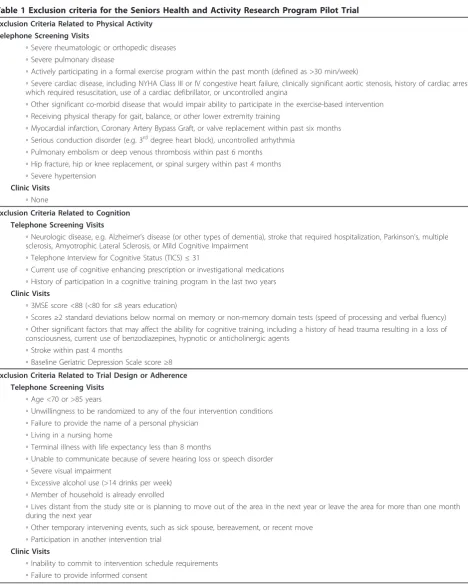
SHARP-P was a single-blinded pilot randomized con-trolled trial that involved the delivery of a cognitive train-ing intervention and/or a physical traintrain-ing intervention in a 2 × 2 factorial design. Its design was approved by the Institutional Review Board of Wake Forest University and all participants signed an informed consent. It tar-geted the enrollment of 80 community-dwelling persons, aged 70-85 years, who were at risk for cognitive decline but who did not have mild cognitive impairment [17] as defined by the inclusion/exclusion criteria related to cog-nition (Table 1). Other criteria identified individuals who were appropriate candidates for physical activity and cog-nitive training and who appeared likely to adhere to interventions and data collection protocols [18].
Enrollment proceeded in four steps. Mailing and presen-tations were used to identify interested volunteers. An initial screening phone call was used to query regarding major sources of exclusions. During a subsequent clinic screening visit, cognitive testing was used to exclude indi-viduals with marked cognitive deficits. Current medica-tions were reviewed to exclude those using anticholinergic agents, antidepressants, antihypertensives (clonidine or catapres only), anti-Parkinsonian agent, narcotic analge-sics, neuroleptics, sedatives/benzodiazepines, and demen-tia drugs. Volunteers who remained eligible and received
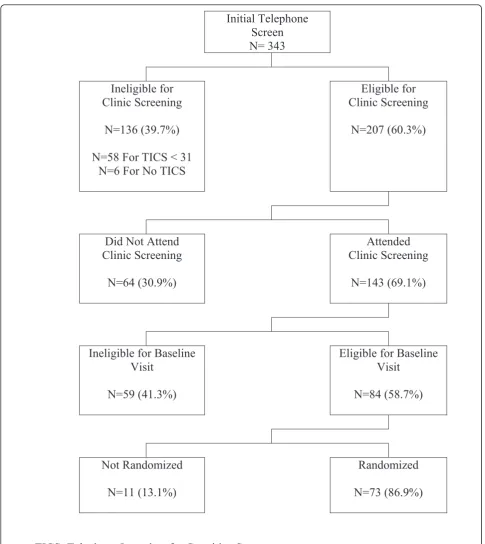
clearance from their personal physicians were invited to a final visit for additional data collection. Following this, they were randomly assigned with equal probability among the four experimental conditions. Figure 1 provides a pictorial overview of this process.
Interventions
The Cognitive Training (CT) intervention was developed to improve consciously-controlled memory processing or recollection of episodic memory information [19] and produce changes in performance that transfer to execu-tive function, such as working memory, planning, and memory monitoring; long term item memory; and cog-nitive processing speed [20]. Sessions were center-based, conducted via computer, carried out with small groups of no more than six individuals, and monitored by skilled trainers. Training consisted of four consecutive 10-12 min sessions per day, administered two times per week for two months, which then tapered to one time per week for two additional months. For each session, participants studied a list of 30 words, followed by a recognition test consisting of the 30 studied words and 30 new words with each new word repeated once, and asked to respond “yes” to study words and“no” to the new items both times they occurred. The second pre-sentation of new items was critical as participants had to consciously recollect the source of a word’s presenta-tion (studied or not) or whether they had already responded to a word to correctly respond “no”. To improve memory during training, participants started at a level where recollecting the first presentation of a repeated word was relatively easy (i.e., only one inter-vening item between the 1st and 2nd presentation of a repeated word), and underwent an increase in lag inter-val length each time they reached a criterion level of accuracy [19,20]. Training gains were assessed by the number of intervening items (i.e., lag interval) at which participants could perform to criterion between the first and last day of training. We chose this intervention as it has been shown to be successful with older adults in enhancing the ability to recollect information across increasing delay intervals [20] and in improving perfor-mance on tasks that draw on executive function [19].
40 minute walking stimulus phase and a 20-minute flex-ibility training phase. Center-based physical activity was supplemented with additional tailored home-based walk-ing sessions at 1-2 per week durwalk-ing the first month. Par-ticipants were encouraged to slowly increase the
duration, speed, and frequency of home-based walking sessions as appropriate to their circumstances so as to achieve the 150-min/week goal. The interventionists recorded center-based walking time and the participants recorded home-based walking time on physical activity
Table 1 Exclusion criteria for the Seniors Health and Activity Research Program Pilot Trial
Exclusion Criteria Related to Physical Activity Telephone Screening Visits
◦Severe rheumatologic or orthopedic diseases ◦Severe pulmonary disease
◦Actively participating in a formal exercise program within the past month (defined as >30 min/week)
◦Severe cardiac disease, including NYHA Class III or IV congestive heart failure, clinically significant aortic stenosis, history of cardiac arrest which required resuscitation, use of a cardiac defibrillator, or uncontrolled angina
◦Other significant co-morbid disease that would impair ability to participate in the exercise-based intervention ◦Receiving physical therapy for gait, balance, or other lower extremity training
◦Myocardial infarction, Coronary Artery Bypass Graft, or valve replacement within past six months ◦Serious conduction disorder (e.g. 3rddegree heart block), uncontrolled arrhythmia
◦Pulmonary embolism or deep venous thrombosis within past 6 months ◦Hip fracture, hip or knee replacement, or spinal surgery within past 4 months ◦Severe hypertension
Clinic Visits
◦None
Exclusion Criteria Related to Cognition Telephone Screening Visits
◦Neurologic disease, e.g. Alzheimer’s disease (or other types of dementia), stroke that required hospitalization, Parkinson’s, multiple sclerosis, Amyotrophic Lateral Sclerosis, or Mild Cognitive Impairment
◦Telephone Interview for Cognitive Status (TICS)≤31
◦Current use of cognitive enhancing prescription or investigational medications ◦History of participation in a cognitive training program in the last two years Clinic Visits
◦3MSE score <88 (<80 for≤8 years education)
◦Scores≥2 standard deviations below normal on memory or non-memory domain tests (speed of processing and verbal fluency) ◦Other significant factors that may affect the ability for cognitive training, including a history of head trauma resulting in a loss of consciousness, current use of benzodiazepines, hypnotic or anticholinergic agents
◦Stroke within past 4 months
◦Baseline Geriatric Depression Scale score≥8 Exclusion Criteria Related to Trial Design or Adherence
Telephone Screening Visits
◦Age <70 or >85 years
◦Unwillingness to be randomized to any of the four intervention conditions ◦Failure to provide the name of a personal physician
◦Living in a nursing home
◦Terminal illness with life expectancy less than 8 months
◦Unable to communicate because of severe hearing loss or speech disorder ◦Severe visual impairment
◦Excessive alcohol use (>14 drinks per week) ◦Member of household is already enrolled
◦Lives distant from the study site or is planning to move out of the area in the next year or leave the area for more than one month during the next year
◦Other temporary intervening events, such as sick spouse, bereavement, or recent move ◦Participation in another intervention trial
Clinic Visits
logs that were returned to the interventionists once a week.
The Combined Intervention (PACT) was designed so that participants received both cognitive and physical activity training on the same day. To avoid the potential
impact of physical fatigue on cognitive training, the cog-nitive treatment was delivered prior to the physical activity treatment.
The Healthy Aging Education control intervention consisted of weekly lectures based on health education
Initial
Telephone
Screen
N= 343
Ineligible for
Clinic Screening
N=136 (39.7%)
N=58 For TICS < 31
N=6 For No TICS
Eligible
for
Clinic Screening
N=207 (60.3%)
Did Not Attend
Clinic Screening
N=64 (30.9%)
Attended
Clinic Screening
N=143 (69.1%)
Ineligible for Baseline
Visit
N=59 (41.3%)
Eligible
for
Baseline
Visit
N=84 (58.7%)
Not
Randomized
N=11 (13.1%)
Randomized
N=73 (86.9%)
TICS: Telephone Interview for Cognitive Status
and was based on a program developed originally at Stanford [21] and adapted for the Lifestyle Interventions and Independence for Elders pilot trial [22,23]. Topics such as medications, foot care, traveling, and nutrition were covered.
Cognitive Testing
Six measures of executive functioning were included. The Self-Ordered Pointing Task [24] measured plan-ning, working memory and monitoring. Participants viewed a set of 16 abstract shapes presented in a differ-ent random order 16 times. For each of three trials, they were required to choose a shape so that every shape was selected by the 16thtrial and no shape was chosen more than once. The 1-Back and 2-Back Tests [25,26] mea-sured working memory. Participants saw individual let-ters at a 2-second rate on a computer screen and were asked to indicate whether the presented letter was the same as the nth back letter, with n equal to 1 and 2. The Eriksen flanker task [27] measured response inhibi-tion. Participants were presented with an arrow facing either right or left and were asked to press a key indi-cating its direction. The target displays could be congru-ent (flanker arrows point in the same direction as the target arrow) or incongruent (the flanker arrows point in the opposite direction). The Task Switching test [28] measured attentional flexibility. Participants were asked to quickly alternate between performing two different tasks. They were shown a letter-number pair (e.g., T 5) inside one box of a 4-box grid. When the stimulus appeared in either of the top two boxes, the participant indicated whether the number was odd or even; when the stimulus appeared in either of the two lower boxes, s/he indicated whether the letter was a vowel or conso-nant. The Trail Making Test was also used to measure alternating attention and executive function [29]. Partici-pants had a maximum of five minutes to connect 25 numbered circles in ascending order (Part A) and another maximum of five minutes to connect alterna-tively numbered and alpha-numerically labeled (1-A-2-B,...) circles (Part B). They were scored by the time it took to complete the task, and Part A scores were then subtracted from Part B.
Four measures of episodic memory derived from the Hopkins Verbal Learning Test [30] and the Logical Memory task from the Wechsler Memory Scale-III [31] were also included. The Hopkins Verbal Learning Test required individuals to listen to a list of 12 words and repeat as many as possible. Three trials were adminis-tered. After a delay of about 15 minutes, participants were asked to recall the elements. Participants were also presented a yes/no delayed recognition trial consisting of a randomized list that included the 12 target words and 12 non-target words, six of which were drawn from
the same semantic categories as the targets. Scores for delayed recall and delayed recognition were calculated. For Logical Memory Part I, participants listened to a short story and immediately recalled as many elements as possible. The individual was then read a second story twice and asked to immediately recall as many elements as possible each time. Logical Memory Part II was admi-nistered after a delay of approximately 25 to 35 minutes. Individuals were asked to recall the elements of both stories, again. For both Logical Memory I and II tasks, individuals received a“story unit score”for accuracy of re-telling the story details and a“thematic score”for recalling story themes. A primary score was calculated from a sum of the“story unit scores”. A supplemental score was calculated from a sum of the‘"thematic scores”. A composite of the ten measures described above was computed by dividing each score’s difference from the baseline mean by the baseline standard deviation, aver-aging the six executive function and four episodic mem-ory z-transformed measures, and norming this average to have standard deviation of one. The primary outcome for SHARP-P was change in this composite from base-line at four months post-randomization. The separate domains of executive function and episodic memory served as secondary outcome measures.
Other baseline measures
A timed 400-meter walk was used as a measure of phy-sical function. The Geriatric Depression Scale was admi-nistered as well as a Modified Mini Mental State Exam (3MSE) [32] to measure global cognitive function. ApoE genotyping was performed using the MassARRAY SNP genotyping system (Sequenom, Inc., San Diego, CA). Genotypes were determined by mass spectroscopy (MALDI-TOF). The data were analyzed using Spectro-TYPER software (Sequenom). Controls and blanks were included for quality and error checking.
Statistical Methods
All analyses were conducted according to intention-to-treat principles. Differences among participants assigned to the four intervention conditions were contrasted using analyses of variance and Fisher’s exact tests. Cog-nitive function data were converted to z-scores and ana-lyses of variance/covariance were used to assess differences in mean changes among participants grouped by intervention assignment following intention-to-treat principles.
Results
Participants
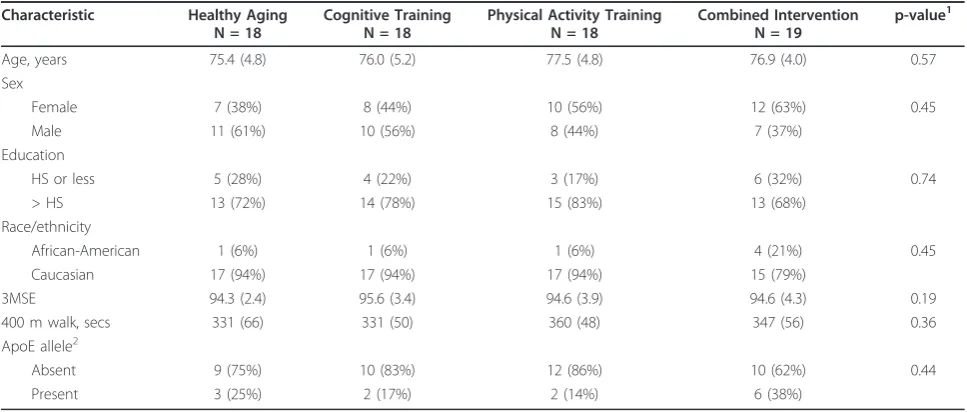
SHARP-P screened 343 participants to enroll 73 (21%) participants, with randomizations occurring from Sep-tember, 2008 through July, 2009 (Figure 1). Major sources of ineligibility were self-reported exercise levels of ≥30 minutes/week (9%), history of severe chest pain (4%), congestive heart failure (4%), and hospitalization for stroke (4%). Table 2 describes the cohort at baseline by intervention assignment. Overall, the cohort had mean age 76.4 years, 51% were women, and 75% had some education post-high school. The mean 3MSE score was 94.8 and the mean 400-meter walk time was 342 seconds. There were no marked imbalances among randomly assigned groups with respect to any of the cognitive function measures at baseline. There was only one serious adverse event in which a participant had a stroke following randomization, before receiving any training, and dropped out.
Training
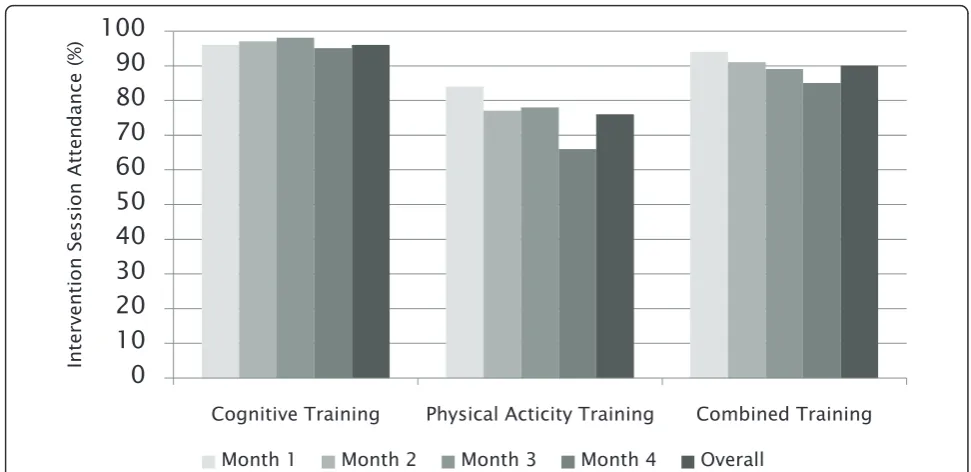
For cognitive training, 24 sessions were planned for each participant (8 per month during Months 1-2 and 4 per month during Months 3-4). For physical activity train-ing, 32 sessions were planned (8 visits per month across Months 1-4). For the combination training, 56 sessions were planned (24 cognitive training and 32 physical activity training sessions, as above). Figure 2 portrays the attendance rates for the three interventions. Overall attendance rates were higher in the CT and PACT groups: CT 96%, PA 76% and PACT 90% (p = 0.004). The highest rates were observed for the cognitive
intervention and rates tended to decline over time (p = 0.002). Overall attendance at clinic sessions was uncorrelated with age: r = -0.18 (p = 0.20).
Cognitive Training
Thirty-three participants assigned to cognitive training attended at least one session and 91% attended all 24 sessions. Improvement in the cognitive training task was assessed by the maximum lag interval between initial presentation of a new study item and its subsequent reappearance in the test list with the maximum possible lag interval of 52 intervening items. At baseline, the average maximum lag (standard error) was 3.0 (0.43) in the CT group and 2.1 (0.39) items in the PACT group (p = 0.11). Task performance increased significantly among participants assigned to CT and PACT (p < 0.0001). The mean difference between the maximum lag of the last session and the maximum lag of the first ses-sion was 43.9 (3.3) items for the CT group compared to 29.2 (4.5) items for the PACT group (p = 0.02). Neither age nor ApoE e4 were associated with differences in lags: r = 0.05 (p = 0.79) and r = -0.15 (p = 0.46), respec-tively. Participants with education higher than high school had significantly higher average difference in lags than those with less education: 40.4 (4.4) versus 24.0 (5.6) items, p = 0.02.
Physical Activity
The physical activity intervention had a goal of inducing 150 minutes of physical activity per week to be achieved via both center-based and home-based sessions. Two participants in the PA group were excluded as they did not return for their 4-month visit and one participant in each of the PA and PACT group were also excluded as
Table 2 Characteristics of SHARP-P volunteers, by intervention assignment: mean (standard deviation) or percent
Characteristic Healthy Aging N = 18
Cognitive Training N = 18
Physical Activity Training N = 18
Combined Intervention N = 19
p-value1
Age, years 75.4 (4.8) 76.0 (5.2) 77.5 (4.8) 76.9 (4.0) 0.57
Sex
Female 7 (38%) 8 (44%) 10 (56%) 12 (63%) 0.45
Male 11 (61%) 10 (56%) 8 (44%) 7 (37%)
Education
HS or less 5 (28%) 4 (22%) 3 (17%) 6 (32%) 0.74
> HS 13 (72%) 14 (78%) 15 (83%) 13 (68%)
Race/ethnicity
African-American 1 (6%) 1 (6%) 1 (6%) 4 (21%) 0.45
Caucasian 17 (94%) 17 (94%) 17 (94%) 15 (79%)
3MSE 94.3 (2.4) 95.6 (3.4) 94.6 (3.9) 94.6 (4.3) 0.19
400 m walk, secs 331 (66) 331 (50) 360 (48) 347 (56) 0.36
ApoE allele2
Absent 9 (75%) 10 (83%) 12 (86%) 10 (62%) 0.44
Present 3 (25%) 2 (17%) 2 (14%) 6 (38%)
1
Analyses of variance for continuous measures; Pearson’s chi-square or Fisher’s exact tests for categorical variables. 2
Missing for 19 participants. 3
they did not attend any of the center-based sessions. For all other participants, zero minutes were assigned for a missed session. The overall mean (standard error) num-ber of minutes per week across the 4 months of follow-up was 57.2 (5.0) for the PA grofollow-up and 57.3 (3.6) for the PACT intervention (p = 0.99). There was no signifi-cant association between minutes of physical activity and age (r = -0.09, p = 0.61) or ApoE e4 (r = -0.05, p = 0.79). High school education did not increase the aver-age number of minutes either: 59.7 (6.9) for those with a high school degree and 56.4 (3.9) for those without (p = 0.68). Participants in the PACT group tended to exer-cise at home longer on average than those in the PA group: 101.1 (13.1) minutes per week in the combined group and 66.0 (12.6) minutes per week in the PA group (p = 0.06). Combining center-based and home-based physical activity, participants in the PA condition completed an average of 123.2 (16.8) minutes per week of total physical activity and participants in the PACT condition completed an average of 135.9 (15.3) minutes per week (p = 0.58). Participants assigned to physical activity decreased the 400-meter walk times by a mean (standard error) of 16.9 (5.31) seconds (p = 0.05) and there was no difference between PA and PACT (p = 0.74). Walk times of participants assigned to HAE (p = 0.18) or CT (p = 0.80) did not improve.
Cognitive Outcomes
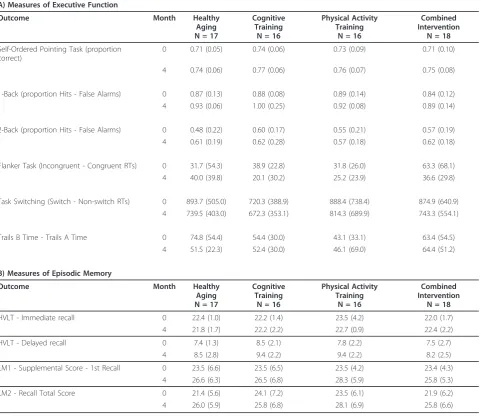
Table 3 lists means for the cognitive test measures during follow-up. The top panel includes tests that contributed to the overall executive function score; these were mea-sured at both two and four months post-randomization,
however only the four month data are included in our analyses for consistency with the measures that contribu-ted to the overall episodic memory score in the bottom panel (which were only measured at four months).
Table 4 summarizes 4-month changes in the compo-site score and the executive function and episodic mem-ory components. Included are 95% confidence intervals for mean changes, the majority of which exclude 0 and signal general improvements in test scores from baseline across all intervention conditions. None of the marginal comparisons, i.e. physical activity training versus no physical activity training and cognitive training versus no cognitive training, approached statistical significance. Similarly, none of the tests for interactions in the factor-ial design approached statistical significance.
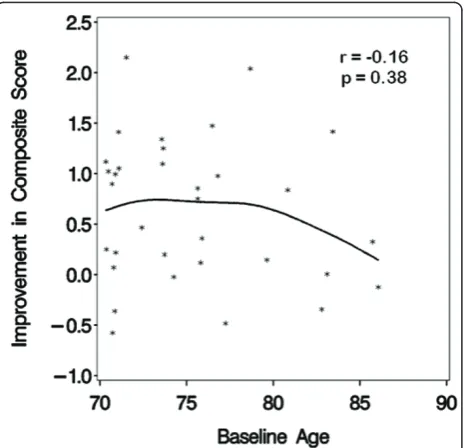
An aim specified in the SHARP-P protocol was to examine whether the interventions appeared to perform uniformly well across the age range of the cohort. With age as a continuous variable, formal tests for interac-tions between age and the cognitive and physical activity intervention effects on the composite, executive func-tion, and episodic memory outcomes were assessed. There was little evidence that the relative effects asso-ciated with the cognitive training intervention differed by age: tests of interactions yielded p-values of p = 0.93 (composite), p = 0.56 (executive function), and p = 0.48 (episodic memory). However, there was some evidence that the relative effects of the physical activity interven-tion were age-dependent: tests of interacinterven-tions yielded p = 0.01 (composite), p = 0.048 (executive function), and p = 0.11 (episodic memory). Figures 3 and 4 portray the
0
10
20
30
40
50
60
70
80
90
100
Cognitive Training Physical Acticity Training Combined Training
Inte
rv
en
tion
S
ession
A
tte
nd
anc
e
(%
)
Month 1 Month 2 Month 3 Month 4 Overall
Table 3 Scores on tests of cognitive function, by intervention assignment and time: mean (standard deviation)
A) Measures of Executive Function
Outcome Month Healthy
Aging N = 17
Cognitive Training
N = 16
Physical Activity Training
N = 16
Combined Intervention
N = 18
Self-Ordered Pointing Task (proportion correct)
0 0.71 (0.05) 0.74 (0.06) 0.73 (0.09) 0.71 (0.10)
4 0.74 (0.06) 0.77 (0.06) 0.76 (0.07) 0.75 (0.08)
1-Back (proportion Hits - False Alarms) 0 0.87 (0.13) 0.88 (0.08) 0.89 (0.14) 0.84 (0.12) 4 0.93 (0.06) 1.00 (0.25) 0.92 (0.08) 0.89 (0.14)
2-Back (proportion Hits - False Alarms) 0 0.48 (0.22) 0.60 (0.17) 0.55 (0.21) 0.57 (0.19) 4 0.61 (0.19) 0.62 (0.28) 0.57 (0.18) 0.62 (0.18)
Flanker Task (Incongruent - Congruent RTs) 0 31.7 (54.3) 38.9 (22.8) 31.8 (26.0) 63.3 (68.1) 4 40.0 (39.8) 20.1 (30.2) 25.2 (23.9) 36.6 (29.8)
Task Switching (Switch - Non-switch RTs) 0 893.7 (505.0) 720.3 (388.9) 888.4 (738.4) 874.9 (640.9) 4 739.5 (403.0) 672.3 (353.1) 814.3 (689.9) 743.3 (554.1)
Trails B Time - Trails A Time 0 74.8 (54.4) 54.4 (30.0) 43.1 (33.1) 63.4 (54.5) 4 51.5 (22.3) 52.4 (30.0) 46.1 (69.0) 64.4 (51.2)
B) Measures of Episodic Memory
Outcome Month Healthy
Aging N = 17
Cognitive Training
N = 16
Physical Activity Training
N = 16
Combined Intervention
N = 18
HVLT - Immediate recall 0 22.4 (1.0) 22.2 (1.4) 23.5 (4.2) 22.0 (1.7)
4 21.8 (1.7) 22.2 (2.2) 22.7 (0.9) 22.4 (2.2)
HVLT - Delayed recall 0 7.4 (1.3) 8.5 (2.1) 7.8 (2.2) 7.5 (2.7)
4 8.5 (2.8) 9.4 (2.2) 9.4 (2.2) 8.2 (2.5)
LM1 - Supplemental Score - 1st Recall 0 23.5 (6.6) 23.5 (6.5) 23.5 (4.2) 23.4 (4.3)
4 26.6 (6.3) 26.5 (6.8) 28.3 (5.9) 25.8 (5.3)
LM2 - Recall Total Score 0 21.4 (5.6) 24.1 (7.2) 23.5 (6.1) 21.9 (6.2)
4 26.0 (5.9) 25.8 (6.8) 28.1 (6.9) 25.8 (6.6)
HVLT: Hopkins Verbal Learning test. LM: Logical Memory.
Table 4 Mean change at Month 4 (follow-up - baseline) in standard deviations units
Outcome Healthy Aging N = 17
Cognitive Training
N = 16
Physical Activity Training
N = 16
Combined Intervention
N = 19
p-values
Mean (SE) [95% CI]
Mean (SE) [95% CI]
Mean (SE) [95% CI]
Mean (SE) [95% CI]
CT vs No CT
PA vs No PA
Interaction
Composite 0.65 (0.18) 0.62 (0.18) 0.71 (0.18) 0.71 (0.17)
[0.30, 0.99] [0.26, 0.97] [0.35, 1.06] [0.39, 0.97] 0.95 0.66 0.91
Executive Function
0.58 (0.19) 0.58 (0.19) 0.32 (0.19) 0.60 (0.18)
[-0.00, 0.76] [0.20, 0.96] [-0.06, 0.70] [0.24, 0.94] 0.48 0.55 0.47
Episodic Memory 0.47 (0.21) 0.42 (0.21) 0.84 (0.21) 0.56 (0.20)
associations, using a scatterplot that includes a curve from cubic spline regression. Among participants assigned to physical activity training, measured improve-ments in the composite score increased across the age range; among those not assigned to physical activity training, improvements decreased with age.
The trial protocol also pre-specified comparisons of relative intervention effects for subgroups based on edu-cation and the presence of the Apo-E allele. Analyses
similar to those conducted for age did not reveal any differences in the associations between ApoE e4 and the composite, executive and episodic outcomes between the different interventions (p = 0.70, 0.95 and 0.44 respectively) nor did the analyses show group differences for the association of education with the memory out-comes (p = 0.35, 0.56 and 0.57 respectively). The 4-month change in composite score was 0.62 (0.12), 0.79 (0.24) and 1.0 (0.51) for ApoE e4 equal to 0, 1 or 2, respectively (p = 0.65). It was 0.62 (0.10) for those with more than high school education and 0.85 (0.18) for those below high school (p = 0.26).
Sample Size Projections
The pilot trial was designed to provide benchmarks from which to project the sample size required for a full scale trial. These include longitudinal correlations of measures, how cross-sectional variance may change with time, and anticipated rates of follow-up. For the compo-site outcome of SHARP-P, the longitudinal correlation between baseline and four months was r = 0.89. Var-iances of cognitive measures were expected to be com-pressed at baseline due to eligibility criteria. The composite measure variance increased by 6% between baseline and four months. The 4-month missing data rate for the composite outcome was 7%. These data can be used to project required sample sizes for a full scale trial, as follows. We simulated 20,000 sequences of (nor-mally-distributed) annual measures, assuming a mean intervention effect that radiated linearly from baseline to be 0.20 standard deviations at four years, with the assumption that the longitudinal correlations were r = 0.80 (assumed to be lower than in SHARP-P due to the longer time spans), the cross-sectional variance increased by 15% post-randomization (assumed to be larger than in SHARP-P, for the same reason), and the lost follow-up rate accumulated at 8%/year. From these, we projected the sample size required for 90% statistical power to detect differences in a mean relative interven-tion across follow-up in a two-armed trial (two-sided, unadjusted significance level of 0.05) from a repeated measures model. This required the randomization of N = 290 per group. In a parallel fashion, we projected the sample size required for 90% power for a categorical outcome: measured decline ≥1.0 standard deviation from baseline in the composite outcome. This required the randomization of N = 896 per group to detect a 50% reduction in the rate of this outcome with 4 years of follow-up.
Discussion
In preparation for a subsequent full scale research study, we discuss further the recruitment, adherence and retention, the choice of a control condition, the effects of cognitive and physical activity intervention on
Figure 3Relationship between improvement in cognitive function and age with the physical activity intervention.
cognition and their consistency with age, as well as pre-dictions of future sample sizes based on the pilot data.
Recruitment for trials of training-based interventions
SHARP-P recruitment was based on mailing lists and presentations at health education meetings. SHARP-P randomized 73 out of 343 participants aged 70-85 years who were screened on the telephone for a yield of 21.3%. While this yield exceeds that of some other pilot trials [11,23], others who have used a greater breadth of approaches such as print advertisements and television features [10] or who have targeted institutionalized cohorts [12] have achieved higher yields (e.g., 45%-60%).
Adherence and Retention
Attendance rates were higher in the cognitive training group and the combined group than in the physical activity group, with the highest rates in the cognitive training group. However, this difference may be due to the availability of make-up sessions in the cognitive training condition. Participants were not provided the opportunity to make up missed physical activity visits. Attendance declined only slightly over time except in the physical activity alone arm where the decline tended to be more pronounced. SHARP-P physical activity attendance is similar to that observed in LIFE-P using a tapered contact schedule: 76% during the first 8 weeks (3 sessions per week) and 65% for weeks 9 to 25 [33] (2 sessions per week). These attendance rates are also con-sistent with what has been reported in a review of numerous randomized controlled trials of physical activ-ity and older adults [34]. The expectation for partici-pants to re-book missed cognitive training sessions may have motivated the participants in the combined group to attend both cognitive training and physical activity sessions. Furthermore, the PACT condition may have offered a more novel and interesting intervention that served to enhance interest and commitment and thus higher levels of attendance. Additionally, the fact that cognitive training and physical activity sessions were offered on the same day may have facilitated attendance at both sessions.
In terms of adhering to the physical activity goals, participants did not achieve the 150 minutes per week of aerobic physical activity goal. This goal was chosen because it represents the level of physical activity that is recommended by the American College of Sports Medi-cine [35]. However, although reporting of physical activ-ity adherence in older adults is inconsistent across studies [34], previous research indicates that achieving recommended levels of physical activity in sedentary samples of older adults is quite difficult. In a sample of formerly sedentary older adults, the LIFE-P intervention included a phased contact schedule (3-days/week during
the first 6-months) and a behavioral group-counseling module and reported approximately 128 min/wk of phy-sical activity during the first 6 months of the trial [36]. The present study included only 4 months of physical activity, did not include a behavioral group-counseling module, and had fewer center-based contacts than LIFE-P. Future randomized clinical trials investigating the impact of physical activity on cognition should include structured behavioral modules to address the multitude of barriers to physical activity encountered by sedentary older adults to maximize adherence to study protocols [36].
Choice of a control condition
We adopted, as our control condition, the Healthy Aging Education program of the Lifestyle Interventions and Independence for Elders Pilot (LIFE-P) trial, which had been developed to foster retention in a clinical trial of a physical activity training intervention while not directly affecting its outcomes, markers of mobility and physical function [22,23]. We found, across four months of follow-up, retention in this comparison condition to be equivalent to those of the training-based interven-tions, which parallels the experience of the LIFE-P trial.
A substudy, involving 102 participants, added mea-sures of cognitive function to LIFE-P Pilot at baseline and one-year post-randomization to compare a physical activity intervention to the same control condition we used [8]. Similar to our study, no significant relative benefits were found for the physical activity interven-tion. Also similar, modest improvements in cognitive function were seen in the performance of participants assigned to the Healthy Aging Education program on several measures of cognitive function. These reached statistical significance for a test of verbal learning. While these may reflect learning effects, it is also possible that the Healthy Aging Education program may have affected cognitive function. Increased social engagement and reading, both features of the Healthy Aging Education program, may produce cognitive benefits in older indivi-duals [37]. Furthermore, within the full LIFE-P trial, the Healthy Aging Education program was associated with modest mean improvements in a battery of physical function tests, which although less than for its physical activity intervention, may signal that the control condi-tion was not benign with respect to other markers of health [23].
appropriate contrast to the mechanisms specific to the physical activity and cognitive training interventions. Even so, exposure times varied among intervention con-ditions: these are often difficult to balance with beha-vioral interventions and may contribute to relative intervention effects. Although the SHARP-P control condition may produced some improvements in perfor-mance on cognitive tests, one may argue that for beha-vioral interventions to be adopted as part of clinical practice, they should be demonstrated to provide bene-fits above whatever effects the more modest and less resource intensive Healthy Aging Education program provided. However, others argue that true placebo con-trolled trials are necessary in situations where no effec-tive therapies have been established and mechanisms may be non-specific [41,42].
Short term effects of cognitive and physical training on cognitive performance
Assignment to our cognitive and physical activity inter-ventions did not produce significant relative improve-ments in our overall composite measure or in the separate components focused on executive function and episodic memory after four months. As designed, the SHARP-P trial targeted the detection of intervention mean relative effects of 20% differences on domain spe-cific tests in marginal comparisons, which was equiva-lent to an average of 0.64 standard deviations across domains. Thus, the observation of fairly substantial dif-ferences was required for statistical significance in this pilot study. For the composite primary outcome, post hoc power calculations from the observed standard errors of differences indicate 80% power was available to detect mean marginal differences of 0.49 standard devia-tions. Although SHARP-P, as conducted, provided suffi-cient power to detect the targeted differences, observed differences were smaller than these. Our composite out-come was projected to provide greater statistical power than its individual components if intervention effects were distributed among its components. Composite out-comes allow one to deal efficiently with problems of multiple comparisons [43]. However, if intervention effects vary markedly among individual components, some important differences may not be detected. Our results should be interpreted later in the context of lar-ger trials.
Of great interest, functional magnetic resonance ima-ging was conducted at the conclusion of the trial on five participants who had been assigned to the Healthy Aging Education condition and six who had been assigned to the PA. Despite the small sample size, the hippocampi of PA participants had significantly greater cerebral blood flows and network connectivity than Healthy Aging Education participants [44]. Thus, despite
the lack of an effect on our cognitive measures, four months of physical activity training may have produced beneficial effects on other measures of brain function.
Several recent small trials report stronger intervention effects on cognitive measures. Fabre, et al. found that logical memory, paired associates learning scores and memory quotient were significantly improved after two months of aerobic and/or mental training compared to a control group [5]. Smith, et al. found four months of a multi-component behavioral intervention that included physical exercise, weight loss, and diet was associated with a relative improvement in measures of executive function in overweight/obese individuals with mean age 52 years [15]. Baker, et al. found six months of aerobic exercise training produced significant benefits in mea-sures of executive function in women; these were not evident in men and did not occur after three months of intervention [11]. Liu-Ambrose found significant improvements in executive function after 12 months of resistance training in women with mean age 70 years, but not at 6 months [10]. Albinet, et al. found 12 weeks of aerobic training improved executive function in older sedentary adults compared to stretching [9]. Three other recent pilot trials, however, found no significant inter-vention effects on cognitive outcomes. Stuss, et al. found three months of a memory, goal management, and psychosocial training did not significantly affect measures of memory [45]. As noted above, Williamson, et al. found no significant differences in executive func-tion and other domains after 12 months of a physical activity intervention compared to the healthy aging con-trol condition adopted by SHARP-P; however, an analy-sis pooling data across intervention groups found a significant positive correlation between improvements in physical function and cognitive function [8]. Dechamps, et al. found little improvement in global cognitive func-tion after 12 months of an exercise program [12].
Overall, it appears that the greatest effects may be for interventions that 1) last longer than four months, 2) target executive function, 3) feature a minimal control condition and, possibly, 4) are multi-factorial. The choice of executive function as a primary outcome is supported by meta-analysis [46]. However, combining individual measures into a composite outcome, as we did, can sometimes dilute focused effects [43]. In con-trast, examining neuroimaging data following interven-tion may provide a more sensitive outcome measure than cognitive tasks.
Consistency across age ranges
older volunteers. Given issues of comorbidities and other threats to intervention participation, one might expect longer trials to face greater issues. Interestingly, however, the Diabetes Prevention Program found that older participants (>65 years of age) were more likely to achieve the physical activity and weight loss goals of the study [47]. The eligibility and recruitment approaches used in SHARP-P appeared to be effective for identify-ing older individuals who can be adequately adherent to the interventions being offered, at least in the short-term.
Of great potential interest is that we found a trend that physical activity training may convey greater rela-tive short-term benefits on cognirela-tive function among our older volunteers. Assignment to the physical activity intervention appeared to lead to improvements in cogni-tive function that increased, in a graded fashion, across the age range of 70-85 years. While this comparison was pre-specified, we cannot claim statistical significance due to the many inferences we conducted in our pilot study. All SHARP-P participants self-identified as having cognitive deficits; while this is known to be a weak risk factor for future cognitive decline [48,49], it is possible that this relationship may signal differences in responses between individuals who experience relatively earlier versus later declines. There is precedence for greater benefits of physical activity training among individuals with lower baseline functioning in other outcomes. For example, Marsh, et al. found baseline lower extremity functioning moderated the influence of two different walking programs on improvements in physical tioning [50]. Whereas those with higher levels of func-tioning responded more positively to a traditional walking program, the lower functioning participants responded more positively to a novel walking program that included more complex walking tasks, such as step-ping over obstacles.
Sample size projections for the full-scale trial
Using benchmark data generated by SHARP-P, we pro-jected that a two-armed four-year trial to detect relative differences in cognitive deficits can be mounted with fewer than 1,000 participants (continuous outcome) or 2,000 participants (categorical outcome). The required sample sizes are dependent on event rates, and thus on the risk profiles of participants. Trials aimed at affecting the endpoints of mild cognitive impairment or dementia typically would be expected to require larger sample sizes because events rates may be lower [51].
Limitations
While large enough to meet its objectives, our pilot trial involved a modest sample size and short follow-up. Our participants were predominantly Caucasian and reported
relatively high levels of education. We examined only two training-based interventions; it is likely that the most effective programs may include tool-box approaches with multiple options [1,2]. Similarly, the physical activity program was a relatively short, tradi-tional walking program and did not include anaerobic forms of activity, such as strength training. Evidence suggests that longer physical activity programs (>6 months) that include both aerobic and anaerobic exer-cise have greater effects than aerobic exerexer-cise alone [46]. Additionally, the nature of the Healthy Aging Education control condition may have influenced outcomes.
Conclusions
Pilot studies should be designed with objectives that are attainable and with the aim of informing larger studies that are feasible and important. They are not mounted as short-term underpowered prototypes of large studies. Investigators conducting pilot studies bear the ethical responsibility of disseminating findings and, as justified by the results, holding a commitment for developing the subsequent full scale research programs.
Our results support the design of rigorous large-scale trials to assess whether training-based interventions have a role in maintaining brain health in older adults. Adequate participation, adherence, and retention appear to be achievable for participants through age 85 years, at least in the short-term. An attention control condi-tion may yield levels of retencondi-tion that are comparable to active interventions; however, care should be taken to ensure that this type of active control does not unduly attenuate intervention effects. Depending on the choice of outcome measures, the necessary sample sizes to con-duct four-year trials appear to be feasible, particularly as part of a multi-site trial.
Acknowledgements and funding
The Seniors Health and Activity Research Program Pilot Study was funded by the Department of Health and Human Services, National Institutes of Health (1R01AG029285 - 01A1) and the General Clinical Research Center of Wake Forest University Baptist Medical Center (M01-RR07122).
The SHARP-P Study Group includes:
Wake Forest University:Robert Amoroso, Lee Ann Gleiser; Jerry Barnes, MA; Mary Barr; Dale Dagenbach, PhD; Patricia Davis; Meredith Dobrosielski, MS; Robin Dove; Mark A. Espeland, PhD; Deborah Felton; Sarah A. Gaussoin, MS; Janine M. Jennings, PhD; Jeff A. Katula, PhD; Mark D. King; Claudine Legault, PhD; Abbie Prescott, MS; Stephen Rapp, PhD; W. Jack Rejeski, PhD; Wes Roberson; Kaycee M. Sink, MD, MAS; Shannon Sharp; Sally A. Shumaker, PhD; and Terri Windham
University of California at San Francisco: Deborah E.Barnes, PhD, MPH Stanford University:Victor W. Henderson, MD, MS; Abby C. King, PhD; and Marcia L. Stefanick, PhD
Author details 1
27101, USA.4Sticht Center on Aging and Wake Forest University School of Medicine, Winston-Salem, North Carolina, 27157, USA.5Department of Psychiatry and Behavioral Medicine, Wake Forest University School of Medicine, Winston-Salem, North Carolina, 27157, USA.6Division of Public Health Sciences, Department of Social Sciences and Health Policy, Medical Center Boulevard, Winston-Salem, North Carolina, 27157, USA.
Authors’contributions
CL, JMJ, JAK, DD, KMS, SRR, WJR, SAS and MAE conceived of the study, participated in its design, coordination and recruitment, and drafted and revised the manuscript. CL, JMJ, JAK, DD, SAG, KMS, SRR, and MAE were involved in training, coordination and recruitment. CL, MAE and SAG performed statistical analyses. All authors read and approved the manuscript.
Competing interests
The authors declare that they have no competing interests.
Received: 3 November 2010 Accepted: 26 May 2011 Published: 26 May 2011
References
1. Acevedo A, Loewenstein DA:Nonpharmacologic cognitive interventions in aging and dementia.J Geriatr Psychiatry Neurol2007,20:239-249. 2. Desai AK, Grossberg GT, Chibnail JT:Health brain aging: a road map.Clin
Geriatr Med2010,26:1-16.
3. Middleton LE, Yaffe K:Targets for prevention of dementia.J Alzheimers Dis 2010,20:915-924.
4. Plassman BL, Williams JW, Burke JR, Holsinger T, Benjamin S:Systematic review: factors associated with risk for and possible prevention of cognitive decline in later life.Ann Intern Med2010,153(3):182-193. 5. Fabre C, Chamari K, Mucci P, Massé-Biron J, Préfaut C:Improvement of
cognitive function by mental and/or individualized aerobic training in healthy elderly subjects.Int J Sports Med2002,23:415-421.
6. Mahncke H, Connor BB, Appleman J, Ahsanuddin ON, Wood RA, Joyce NM, Boniske T, Atkins SM, Merzenich MM:Memory enhancement in healthy older adults using a brain plasticity-based training program: a randomized controlled study.Proc Natl Acad Sci USA2006,
103(33):12523-12528.
7. Vidovich MR, Lautenschlager NT, Flicker L, Clare L, Almeida OP:The PACE Study: a randomized clincial trial of cogntive activity (CA) for older adults with mild cognitive impairment (MCI).Trials2009,10:114. 8. Williamson JD, Espeland M, Kritchevsky SB, Newman AB, King AC, Pahor M,
Guralnik JM, Pruit LA, Miller ME, LIFE Study Investigators:Changes in cognitive function in a randomized trial of physical activity: results from the Lifestyle Interventions and Independence for Elders (LIFE) pilot study.J Gerontol A Biol Sci Med Sci2009,64(6):688-694.
9. Albinet CT, Boucard G, Bouquet CA, Audiffren M:Increased heart rate variability and executive performance after aerobic training in the elderly.Eur J Appl Physiol2010,109(4):617-624.
10. Liu-Ambrose T, Nagamatsu LS, Graf P, Beattie BL, Ashe MC, Handy TC:
Resistance training and executive functions.Arch Intern Med2010,
170(2):170-178.
11. Baker LD, Frank LL, Foster-Schubert K, Green PS, Wilkinson CW,
McTiernan A, Plymate SR, Fishel MA, Watson GS, Cholerton BA, Duncan GE, Mehta PD, Craft S:Effects of aerobic exercise on mild cognitive impairment: a controlled trial.Arch Neurol2010,67(1):71-79. 12. Dechamps A, Diolez P, Tulon A, Onifade C, Vuong T, Helmer C,
Boudel-Marchasson I:Effects of exercise programs to prevent decline in health-related quality of life in highly deconditioned institutionalized elderly persons: a randomized trial.Arch Intern Med2010,170(2):162-169. 13. Klusmann V, Evers A, Schwarzer R, Schlattmann P, Reischies FM, Heuser I,
Dimeo FC:Complex mental and physical activity in older women and cognitive performance: a 6-month randomized controlled trial.J Gerontol A Biol Sci Med Sci2010,65(6):680-688.
14. Smith PJ, Blumenthal JA, Hoffman BM, Cooper H, Strauman TA, Welsh-Bohmer KA, Browndyke JN, Sherwood A:Aerobic exercise and neurocognitive performance: a meta-analytical review of randomized controlled trials.Psychosom Med2010,72(3):239-252.
15. Smith PJ, Blumethal JA, Babvak MA, Craighead L, Welsh-Bohmer KA, Browndyke JN, Staruman TA, Sherwood A:Effects of the dietary approaches to stop hypertension diet, exercise, and caloric restriction
on neurocognition in overweight adults with high blood pressure. Hypertension2010,55(6):1331-1338.
16. Engvig A, Fjell AM, Westlye LT, Moberget T, Sundseth O, Larsen VA, Walhovd KB:Effects of memory training on cortical thickness in the elderly.Neuroimage2010,52(4):1667-1676.
17. Winblad B, Palmer K, Kivipelto M, Jelic V, Fratiglioni L, Wahlund LO, Nordberg A, Bäckman L, Albert M, Almkvist O, Arai H, Basun H, Blennow K, de Leon M, DeCarli C, Erkinjuntti T, Giacobini E, Graff C, Hardy J, Jack C, Jorm A, Ritchie K, van Duijn C, Visser P, Petersen RC:Mild cognitive impairment–beyond controversies, towards a consensus: report of the International Working Group on Mild Cognitive Impairment.J Intern Med 2004,256(3):240-246.
18. Espeland MA, Rapp SR, Katula JA, Andrews LA, Felton D, Gaussoin SA, Dagenbach D, Legault C, Jennings JM, Sink KM, SHARP Study Group:
Telephone Interview for Cognitive Status (TICS) screening for clinical trials of physical activity and cognitive training: The Seniors Health and Activity Research Program Pilot (SHARP-P) Study.Int J of Geriatr Psychiatry 2010,26(2):135-143.
19. Jennings JM, Jacoby LL:Improving memory in older adults: training recollection.Neuropsychol Rehab Int J2003,13:417-440.
20. Jennings JM, Webster LM, Kleykamp BA, Dagenbach D:Recollection training and transfer effects in older adults: successful use of a repetition-lag procedure.Aging Neuropsycholy and Cognition2005,
12:278-298.
21. King AC, Pruitt LA, Woo S, Castro CM, Ahn DK, Vitiello MV, Woodward SH, Bliwise DL:Effects of moderate-intensity exercise on polysomnographic and subjective sleep quality in older adults with mild to moderate sleep complaints.J Gerontol A Biol Sci Med Sci2008,63(9):997-1004.
22. Rejeski WJ, Fielding RA, Blair SN, Guralnik JM, Gill TM, Hadley EC, King AC, Kritchevsky SB, Miller ME, Newman AB, Pahor M:The Lifestyle
Interventions and Independence for Elders (LIFE) pilot study: design and methods.Contemp Clin Trials2005,26(2):141-154.
23. LIFE Study Investigators:Effects of a physical activity intervention on measures of physical performance: results of the Lifestyle Interventions and Independence for Elders Pilot Study.J Gerontol2006,11:1157-1165. 24. Petrides M, Milner B:Deficits on subject-ordered tasks after frontal-lobe and temporal-lobe lesions in man.Neuropsychologia1982,20:249-262. 25. Dobbs AR, Rule BG:Adult age-differences in working memory.Psychol
Aging1989,4:500-503.
26. John J, Jonides J, Schumacher HEric, Smith EEdward:Verbal working memory load affects regional brain activation as measured by PET.J Cog Neurosci1997,9:462-475.
27. Ericksen KL, Kramer AF:Aerobic exercise effects on cognitive and neural plasticity in older adults.Br J Sports Med2009,43:22-24.
28. Kramer AF, Hahn S, Gopher D:Task coordination and aging: explorations of executive control processes in the task switching paradigm.Acta Psychologica1999,101:339-378.
29. Reitan R:Validity of the Trail Making Test as an indicator of organic brain damage.Perceptual Motor Skills1958,8:271-276.
30. Brandt J:The Hopkins Verbal Learning Test: development of a new memory test with six equivalent forms.Clin Neuropsych1991,5:125-142. 31. Wechsler D:The Wechsler Memory Scale-3rd Edition (WHM-III)San Antonio:
Psychological Corporation, Harcourt, Inc; 1997.
32. Teng EL, Chui HC:The Modified Mini-Mental State (3MS) examination.J Clin Psychiatry1987,48:314-318.
33. Fielding RA, Katula JA, Miller ME, Abbott-Pillola K, Jordan A, Glynn NW, Goodpaster B, Walkup MP, King AC, Rejeski WJ:Activity adherence and physical function in older adults with function limitations.Med Sci Sports Exerc2007,39(11):1997-2004.
34. Martin KA, Sinden AR:Who will stay and who will go? A review of older adults’adherence to randomized controlled trials of exercise.Journal of Aging and Physical Activity2001,9:91-114.
35. Nelson ME, Rejeski WJ, Blair SN, Duncan PW, Judge JO, King AC, Macera CA, Castaneda-Sceppa C:Physical activity and public health in older adults: recommendation from the American College of Sports Medicine and the American Heart Association.Med Sci Sports Exerc2007,39(8):1435-1445. 36. Brawley LR, Rejeski WJ, King AC:Promoting physical activity for older
adults: the challenges for changing behavior.Am J Prev Med2003,25(3 Suppl 2):172-83.
37. Gallucci M, Antuono P, Ongaro F, Forloni PL, Albani D, Amici GP, Regini C:
seventy: what is the relation with cognitive decline? Evidence from“The Treviso Longeva (TRELONG) study.Arch Gerontol Geriatr2009,
48(3):284-286.
38. Schwartz CE, Chesney MA, Irvine J, Keefe FJ:The control group dilemma in clinical research: applications for psychosocial and behavioral medicine trials.Psychosomat Med1997,59:362-371.
39. Safer DL, Hugo EM:Designing a control for a behavioral group therapy. Behav Ther2006,37:120-130.
40. Baskin TW, Tierney SC, Minami T, Wampold BE:Establishing specificity in psychotherapy: a meta-analysis of structural equivalence of placebo controls.J Consult Clin Pyschol2003,71:973-979.
41. Ellenberg SS, Temple R:Placebo-controlled trials and active-control trials in the evaluation of new treatments.Ann Intern Med2000,133:464-470. 42. Walach H, Falkenberg T, Fonnebo V, Lewith G, Jonas WB:Circular instead of hierarchical methodological principles for the evaluation of complex interventions.BMC Med Res Methodology2006,6:29.
43. Freemantle N, Calvert M, Wood J, Eastaugh J, Griffin C:Composite outcomes in randomized trials. Greater precision but with greater uncertainty?JAMA2003,289(19):2554-2559.
44. Burdette JH, Laurienti PJ, Espeland MA, Morgan A, Telesford Q, Vechlekar CD, Hayasaka S, Jennings JM, Katula JA, Kraft RA, Rejeski WJ:
Using network science to evaluate exercise-associated brain changes in older adults.Front Aging Neurosci2010,2:1-10, article 23.
45. Robertson IH, Craik FI, Levine B, Alexander MP, Black S, Dawson D, Binns MA, Palmer H, Downey-Lamb M, Winocur G:Cognitive rehabilitation in the elderly: a randomized trial to evaluate a new protocol.J Int Neuropsychol Soc2007,13:120-131.
46. Colcombe S, Kramer AF:Fitness effects on the cognitive function of older adults: a meta-analytic study.Psychol Sci2003,14:125-30.
47. Wing RR, Hamman RF, Bray GA, Delahanty L, Edelstein SL, Hill JO, Horton ES, Hoskin MA, Kriska A, Lachin J, Mayer-Davis EJ, Pi-Sunyer X, Regensteiner JG, Venditti B, Wylie-Rosett J, Diabetes Prevention Program Research Group:Achieving weight and activity goals among diabetes prevention program lifestyle participants.Obes Res2004,12(9):1426-1434. 48. Haley AP, Hoth KF, Gunstad J, Paul RH, Jefferson AL, Tate DF, Ono M,
Jerskey BA, Poppas A, Sweet LH, Cohen RA:Subjective cognitive complaints relate to white matter hyperintensities and future cognitive decline in patients with cardiovascular disease.Am J Geriatr Psychiatry 2009,17(11):976-985.
49. Jonker C, Geerlings MI, Schmand B:Are memory complaints predictive for dementia? A review of clinical and population-based studies.Int J Geriatr Psychiatry2000,15:983-991.
50. Marsh AP, Chmelo EC, Katula JA, Mihalko SL, Rejeski WJ:Should physical activity programs be tailored when older adults have compromised function?J Aging Phys Act2009,17:294-30.
51. Espeland MA, Rapp SR, Robertson R, Granek I, Murphy C, Albert M, Bassford T, Women’s Health Initiative Memory Study:Benchmarks for designing two-stage studies using Modified Mini-Mental State Examinations: experience from the Women’s Health Initiative Memory Study.Clin Trials2006,3:99-106.
Pre-publication history
The pre-publication history for this paper can be accessed here: http://www.biomedcentral.com/1471-2318/11/27/prepub
doi:10.1186/1471-2318-11-27
Cite this article as:Legaultet al.:Designing clinical trials for assessing the effects of cognitive training and physical activity interventions on cognitive outcomes: The Seniors Health and Activity Research Program Pilot (SHARP-P) Study, a randomized controlled trial.BMC Geriatrics2011
11:27.
Submit your next manuscript to BioMed Central and take full advantage of:
• Convenient online submission
• Thorough peer review
• No space constraints or color figure charges
• Immediate publication on acceptance
• Inclusion in PubMed, CAS, Scopus and Google Scholar
• Research which is freely available for redistribution