R E S E A R C H A R T I C L E
Open Access
Patient-reported outcomes in randomised
clinical trials of bladder cancer: an updated
systematic review
Mieke Van Hemelrijck
1*, Francesco Sparano
2, Debra Josephs
1,3, Mirjam Sprangers
4, Francesco Cottone
2and
Fabio Efficace
2Abstract
Background:Despite international recommendations of including patient-reported outcomes (PROs) in randomised clinical trials (RCTs), a 2014 review concluded that few RCTs of bladder cancer (BC) report PRO as an outcome. We therefore aimed to update the 2014 review to synthesise current evidence-based knowledge of PROs from RCTs in BC. A secondary objective was to examine whether quality of PRO reporting has improved over time and to provide evidence-based recommendations for future studies in this area.
Methods:We conducted a systematic literature search using PubMed/Medline, from April 2014 until June 2018. We included the RCTs identified in the previous review as well as newly published RCTs. Studies were evaluated using a predefined electronic-data extraction form that included information on basic trial demographics, clinical and PRO characteristics and standards of PRO reporting based on recommendation from the International Society of Quality of Life Research.
Results:Since April 2014 only eight new RCTs for BC included PROs as a secondary outcome. In terms of
methodology, only the proportion of RCTs documenting the extent of missing PRO data (75% vs 11.1%,p= 0.03)
and the identification of PROs in trial protocols (50% vs 0%,p= 0.015) improved. Statistical approaches for
dealing with missing data were not reported in most new studies (75%).
Conclusion:Little improvement into the uptake and assessment of PRO as an outcome in RCTs for BC has been made during recent years. Given the increase in (immunotherapy) drug trials with a potential for severe adverse events, there is urgent need to adopt the recommendations and standards available for PRO use in bladder cancer RCTs.
Keywords:PROs, Quality of life, Outcome measurement, RCT, Bladder cancer
Background
With an estimated 549,000 new cases and 200,000 deaths in 2018 worldwide, bladder cancer is the 10th most common form of cancer [1]. All groups of bladder cancer patients are, not surprisingly, subjected to signifi-cant treatment burdens that are emotionally and psycho-logically taxing. Several symptoms, such as blood in the urine, pain and nausea, associated with different treat-ments may result in increased prevalence of depression, anxiety and stress and, consequently, decreased quality
of life (QoL) [2]. Given this disease burden, there is a need to further evaluate how patient-reported outcomes (PROs) are incorporated in clinical bladder cancer re-search. Inclusion of QoL or other PROs in clinical trials and methodological rigor already at the stage of protocol writing are essential to eventually generate data that can robustly inform patient care [3].
Randomized controlled trials (RCTs), across a wide range of cancer malignancies, increasingly include PROs in an effort to better understand overall treatment effect-iveness of newer drugs [4]. Inclusion of PROs in cancer research is not only valued by oncologists and patients, but also by regulatory stakeholders. To illustrate, the US Food and Drug Administration (FDA) included PROs as
© The Author(s). 2019Open AccessThis article is distributed under the terms of the Creative Commons Attribution 4.0 International License (http://creativecommons.org/licenses/by/4.0/), which permits unrestricted use, distribution, and reproduction in any medium, provided you give appropriate credit to the original author(s) and the source, provide a link to the Creative Commons license, and indicate if changes were made. The Creative Commons Public Domain Dedication waiver (http://creativecommons.org/publicdomain/zero/1.0/) applies to the data made available in this article, unless otherwise stated. * Correspondence:[email protected]
one of the clinical outcomes assessments (COAs) that can be used to determine whether or not a drug has demon-strated treatment benefit [5]. Similarly, the European Medicines Agency (EMA) has issued recent guidelines on the use of PRO endpoints in cancer research [6].
In the context of bladder cancer, a systematic review encompassing the years 2004–2014 examined the quality of PRO reporting and methodological strengths and weaknesses of RCTs. It concluded that few RCTs report PRO as an outcome and improvement in methodology was required [7]. Another more recent systematic review using the COnsensus-based Standards for the selection of health Measurement INstruments (COSMIN) [8] spe-cifically evaluated the psychometric properties of PRO measurements in bladder cancer (1990–2017) [9]. No existing PRO stood out as the most appropriate to meas-ure QoL in bladder cancer patients due to heterogeneity of the disease and its treatments and due to lack of val-idation studies [9]. Moreover, a recent systematic review highlighted the mental health implications in bladder cancer patients [10] – and hence the potential effects the disease and its treatments can have on QoL.
This study therefore aimed to update the review by Feuerstein et al. [7], by including all the RCTs of that re-view as well as newly published RCTs in order to syn-thesise current evidence-based knowledge of PROs from RCTs in bladder cancer. A secondary objective was to examine whether quality of PRO reporting improved over time and to provide evidence-based recommenda-tions for future studies in this area.
Methods
Search strategy and identification of studies
We conducted a systematic literature search using PubMed/Medline, from April 2014 until June 2018. Methodology for study identification and evaluation followed standardised criteria used in the PROMOTION Registry (http://promotion.gimema.it) and was previ-ously described in similar systematic reviews [7, 11,12]. For the purpose of this updated review on bladder can-cer RCTs, the following script was used to identify a PRO component: (“quality of life” OR “health related quality of life” OR “health status” OR “health outcomes”
OR “patient outcomes”OR “depression”OR “anxiety”OR
“emotional” OR “social” OR “psychosocial” OR
“psycho-logical” OR “distress” OR “social functioning” OR “social
wellbeing” OR “emotional” OR “patient reported
symp-tom”OR“patient reported outcomes”OR pain OR fatigue
OR“patient reported outcome”OR“PRO”OR“PROs”OR
“HRQL”OR“QOL”OR“HRQOL”OR“symptom distress”
OR “symptom burden” OR “symptom assessment” OR
“functional status” OR sexual OR functioning) AND
bladder. The search strategy was restricted to RCTs. In case of multiple publications from the same RCT, all
relevant data possibly published in secondary articles were combined.
Selection criteria
Only English-language reports of RCTs comparing con-ventional treatments and involving adult patients with bladder cancer were included – irrespective of disease stage. The minimum, overall sample size was set at 50 patients. Screening studies or those involving patients with benign disease were excluded. We did not consider conference abstracts as these did not contain sufficient information. RCTs of interventions that were psycho-logical, behavioural, complementary or alternative were also excluded.
We included all studies evaluating a PRO either as a primary or secondary outcome–either as a multidimen-sional QoL outcome or any other type of PRO. Those studies evaluating only treatment adherence or satisfac-tion were also excluded. For comparability purposes, se-lection criteria of eligible articles were the same as of the previous systematic review [7]. Details on the search strategy and selection process were documented accord-ing to the PRISMA guidelines [13].
Methods of evaluation of studies
Two reviewers (MVH, FS) extracted information from the identified studies and a third reviewer (FE) was con-sulted in case of disagreement. All data were entered by the reviewers into a password protected online database (REDCap) [14] by completing a predefined electronic-data extraction form (eDEF). Full details on information contained in the eDEF have been previously reported [11]. A double-blind data entry procedure was per-formed as each reviewer completed the eDEF independ-ently. Discrepancies in evaluations were electronically recorded and when disagreements occurred in the evalu-ation of any item included in the eDEF, the reviewers revisited the paper to reconcile any differences until con-sensus was achieved.
Type of data extraction and data analysis
investigation of the accuracy of reporting, we divided the ISOQOL item addressing the problem of missing data into two (i.e., reporting the extent of missing data and reporting statistical approaches for dealing with missing data). We thus rated each RCT with a score ranging from 0 to a maximum of 18 (RCT with PRO as a secondary outcome) or 29 (PRO as primary outcome). In both cases, a higher score indicates better quality of the PRO report-ing. Our rule of thumb for this analysis was to consider RCTs addressing less than 50% of items included in the ISOQOL recommendations [15] as having “suboptimal quality”. That is, 9 items out of 18 for RCTs which in-cluded PRO as secondary outcome and 15 items out of 29 for RCTs which included PRO as primary outcome.
Main characteristics of eligible studies were reported by proportions, means and standard deviation, according to the type of variable. Differences between studies were assessed by Fisher exact test or Wilcoxon-Mann-Whitney test. Based on the ISOQOL checklist score, comparisons of reporting quality were performed. To ensure comparability between studies with PRO as pri-mary or secondary outcome, for each study the raw
score was standardised dividing it by the number of ap-plicable items (18 for secondary or 29 for primary), then multiplied by 100. This way, we obtained an adjusted checklist score ranging from 0 (worst quality) to 100 (best quality). Based on such score, we compared studies with PRO as secondary outcome (studies until March 2014 vs those from April 2014), studies with PRO as pri-mary vs. studies with PRO as secondary outcome and studies using a validated PRO measure or not. In addition, we computed the proportion of studies that had a checklist score below or equal to the cut-off value of 50. All tests were two-sided and statistical significance was set at α= 0.05. Analyses were performed by SAS software v. 9.4 (SAS Institute Inc., Cary, NC).
Results
Overview of RCT characteristics
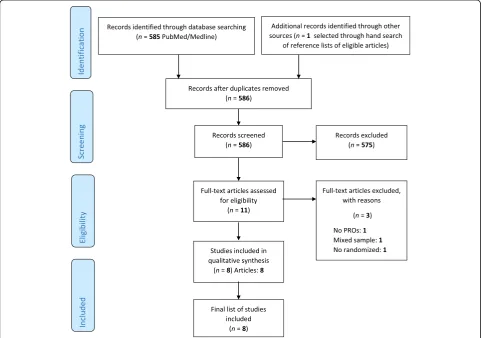
The search identified 586 abstracts published in the period 2014–2018. Eight studies fulfilled the eligibility criteria (Fig.1). In all the newly identified RCTs [16–23], PROs were secondary outcome, whereas of the nine old studies [24–33] five RCTs (55.6%) employed PROs as
Fig. 1Schematic breakdown of literature search results of Bladder Randomized Controlled Trials (Preferred Reporting Items for Systematic
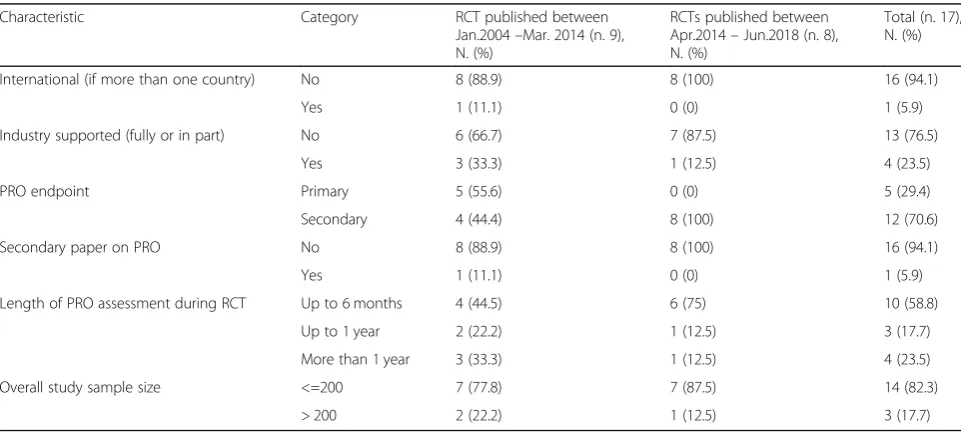
primary outcome [27–30, 33]. All but one of the newly identified RCTs were not supported by industry (87.5%) and none of the RCTs was carried out in a multinational context. The majority of new trials (5, 62.5%) enrolled patients with non-metastatic disease. Compared to the old studies, where two RCTs (22.2%) enrolled more than 200 patients, only one of the newly identified RCTs (12.5%) enrolled more than 200 patients overall. Six new RTCs (75%) assessed PROs over a time period of 6 months, one study (12.5%) up to 1 year and in one study (12.5%) the length of assessment was more than 1 year. Details are reported in Table1.
Most recent (2014–2018) evidence of bladder cancer RCTs with PROs
Among the eight newly identified RCTs, only three [18,
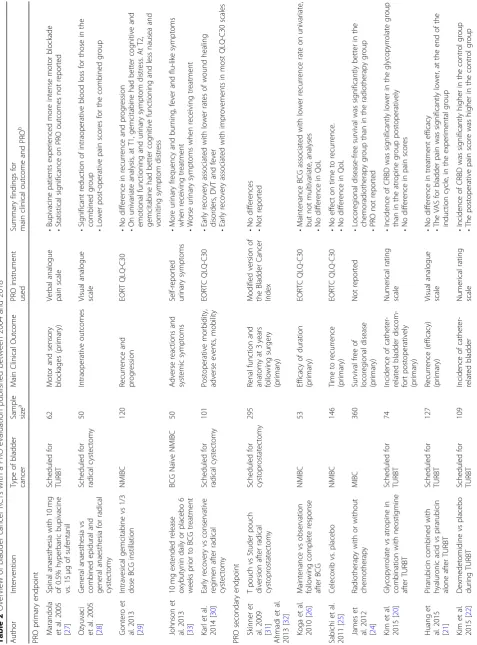
19, 23] used a multidimensional PRO instrument (e.g. the European Organization for Research and Treatment of Cancer Quality of Life Questionnaire-Core 30 (EORTC QLQ-C30) [34]) and of these, two used a blad-der cancer-specific questionnaire (the Functional Assess-ment of Cancer Therapy-Bladder (FACT-Bl) and the FACT-Vanderbilt Cystectomy Index (VCI) question-naires) (Table 2). In three studies [16,17,20], no differ-ences in pain scores were detected between the experimental treatment arms (solifenacin, sevoflurane and glycopyrrolate, respectively) and the control arms (standard care, desflurane and atropine, respectively). In the study conducted by Huang et al. [21], VAS scores for bladder pain were significantly lower at the end of the induction cycle in the group treated with pirarubicin combined with hyaluronic acid compared to pirarubicin alone, while dexmedetomidine was associated with lower postoperative pain scores compared to placebo [22]. Low
dose of Bacillus Calmette-Guerin (BCG) was associated with better outcomes in terms of global QoL, role func-tioning and financial problems, as assessed by the EORTC QLQ-C30, compared to standard dose [18]. No differ-ences in QoL, as assessed with the FACT-BI, were found between laparoscopic and robot-assisted radical cystec-tomy [19]. Finally, no difference in QoL, as assessed by the FACT-VCI, was detected between robot-assisted radical cystectomy and open radical cystectomy [23].
Comparison of PRO quality reporting between 2004 and 2014 and 2014–2018
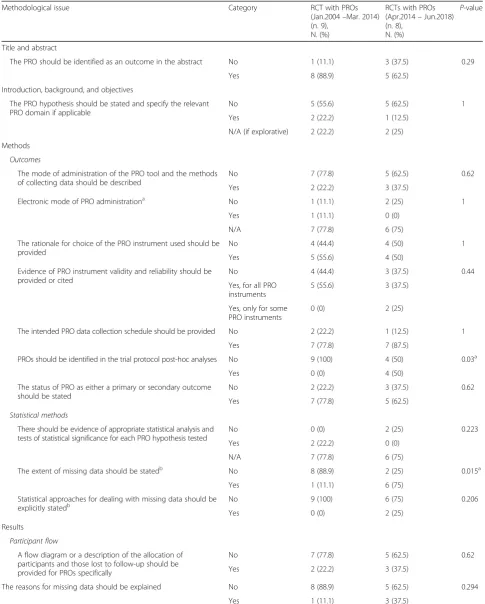
Only one (12.5%) of the eight new RCTs reported a PRO hypothesis [18] and two (25%) reported the statistical ap-proach for dealing with missing data [19,23]. Three RCTs (37.5%) documented the mode of PRO administration [16,
17, 21], four (50%) documented the rationale for the choice of PRO instrument [16, 19, 21, 23], whereas two RCTs (25%) reported generalisability issues [17,21] or in-terpretation in terms of clinical significance [21,22].
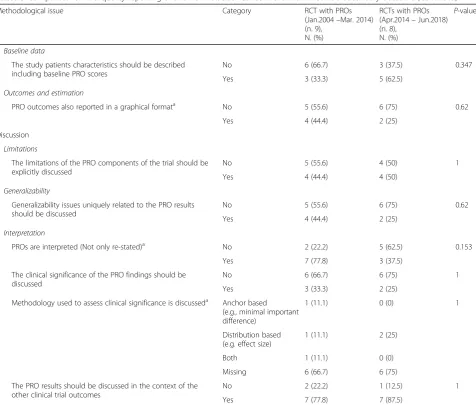
Compared to previous studies, only two statistically sig-nificant improvements were noted: there was an increase in proportion of RCTs documenting the extent of missing PRO data (75% vs 11.1%, p = 0.015) and an increase of RCTs documenting PROs in trial protocols (50% vs 0%,
p= 0.03). Further details are reported in Table3.
We compared the ISOQOL scores for studies with a PRO as secondary outcome identified in the previous re-view with those identified in this update. The quality of PRO reporting was considered as “suboptimal” for all of the old studies, while this was not the case for the new RCTs, whose quality was considered suboptimal in 50% of the studies. The mean standardized score for the old studies was 30.5 (median 33.3), while for the new studies
Table 1Overview of RCT characteristics
Characteristic Category RCT published between
Jan.2004–Mar. 2014 (n. 9), N. (%)
RCTs published between Apr.2014–Jun.2018 (n. 8), N. (%)
Total (n. 17), N. (%)
International (if more than one country) No 8 (88.9) 8 (100) 16 (94.1)
Yes 1 (11.1) 0 (0) 1 (5.9)
Industry supported (fully or in part) No 6 (66.7) 7 (87.5) 13 (76.5)
Yes 3 (33.3) 1 (12.5) 4 (23.5)
PRO endpoint Primary 5 (55.6) 0 (0) 5 (29.4)
Secondary 4 (44.4) 8 (100) 12 (70.6)
Secondary paper on PRO No 8 (88.9) 8 (100) 16 (94.1)
Yes 1 (11.1) 0 (0) 1 (5.9)
Length of PRO assessment during RCT Up to 6 months 4 (44.5) 6 (75) 10 (58.8)
Up to 1 year 2 (22.2) 1 (12.5) 3 (17.7)
More than 1 year 3 (33.3) 1 (12.5) 4 (23.5)
Overall study sample size <=200 7 (77.8) 7 (87.5) 14 (82.3)
Table 3Comparison of PRO quality reporting over time in Bladder Cancer RCTs with PROs as a secondary outcome
Methodological issue Category RCT with PROs
(Jan.2004–Mar. 2014) (n. 9),
N. (%)
RCTs with PROs (Apr.2014–Jun.2018) (n. 8),
N. (%)
P-value
Title and abstract
The PRO should be identified as an outcome in the abstract No 1 (11.1) 3 (37.5) 0.29
Yes 8 (88.9) 5 (62.5)
Introduction, background, and objectives
The PRO hypothesis should be stated and specify the relevant PRO domain if applicable
No 5 (55.6) 5 (62.5) 1
Yes 2 (22.2) 1 (12.5)
N/A (if explorative) 2 (22.2) 2 (25)
Methods
Outcomes
The mode of administration of the PRO tool and the methods of collecting data should be described
No 7 (77.8) 5 (62.5) 0.62
Yes 2 (22.2) 3 (37.5)
Electronic mode of PRO administrationa No 1 (11.1) 2 (25) 1
Yes 1 (11.1) 0 (0)
N/A 7 (77.8) 6 (75)
The rationale for choice of the PRO instrument used should be provided
No 4 (44.4) 4 (50) 1
Yes 5 (55.6) 4 (50)
Evidence of PRO instrument validity and reliability should be provided or cited
No 4 (44.4) 3 (37.5) 0.44
Yes, for all PRO instruments
5 (55.6) 3 (37.5)
Yes, only for some PRO instruments
0 (0) 2 (25)
The intended PRO data collection schedule should be provided No 2 (22.2) 1 (12.5) 1
Yes 7 (77.8) 7 (87.5)
PROs should be identified in the trial protocol post-hoc analyses No 9 (100) 4 (50) 0.03a
Yes 0 (0) 4 (50)
The status of PRO as either a primary or secondary outcome should be stated
No 2 (22.2) 3 (37.5) 0.62
Yes 7 (77.8) 5 (62.5)
Statistical methods
There should be evidence of appropriate statistical analysis and tests of statistical significance for each PRO hypothesis tested
No 0 (0) 2 (25) 0.223
Yes 2 (22.2) 0 (0)
N/A 7 (77.8) 6 (75)
The extent of missing data should be statedb No 8 (88.9) 2 (25) 0.015a
Yes 1 (11.1) 6 (75)
Statistical approaches for dealing with missing data should be explicitly statedb
No 9 (100) 6 (75) 0.206
Yes 0 (0) 2 (25)
Results
Participant flow
A flow diagram or a description of the allocation of participants and those lost to follow-up should be provided for PROs specifically
No 7 (77.8) 5 (62.5) 0.62
Yes 2 (22.2) 3 (37.5)
The reasons for missing data should be explained No 8 (88.9) 5 (62.5) 0.294
the mean score was 48.6 (median 50). However, this positive trend was not statistically significant (p= 0.072).
The quality of PRO reporting among all of the studies published between 2004 and 2018 was found to be poor. Overall, only six studies (35.3%) addressed 50% or more of the issues recommended by the ISOQOL checklist (data not shown). The mean standardised ISOQOL score for all these studies was 44.7, below the cut-off value of 50. For three of the five RCTs with PRO as primary outcome (60%) the quality of PRO reporting was considered as“ sub-optimal”. This percentage was higher for RCTs with a PRO as secondary outcomes, with eight of the twelve studies
(66.6%) considered as “suboptimal”. The mean standar-dised ISOQOL score for the RCTs with PRO as primary outcome was 49.7, while for RCTs with PRO as secondary outcome was 42.6. No statistically significant differences in the ISOQOL score were found between RCTs with PRO as primary or secondary outcomes (p= 0.459).
It needs to be noted that only one of the seven (14.3%) studies using validated PRO instruments (e.g. EORTC QLQ-C30) had a high level of quality of PRO reporting, compared to those using non-validated instruments (5 RCTs, 50%). No differences were found in the mean standardised ISOQOL scores between the studies that
Table 3Comparison of PRO quality reporting over time in Bladder Cancer RCTs with PROs as a secondary outcome(Continued)
Methodological issue Category RCT with PROs
(Jan.2004–Mar. 2014) (n. 9),
N. (%)
RCTs with PROs (Apr.2014–Jun.2018) (n. 8),
N. (%)
P-value
Baseline data
The study patients characteristics should be described including baseline PRO scores
No 6 (66.7) 3 (37.5) 0.347
Yes 3 (33.3) 5 (62.5)
Outcomes and estimation
PRO outcomes also reported in a graphical formata No 5 (55.6) 6 (75) 0.62
Yes 4 (44.4) 2 (25)
Discussion
Limitations
The limitations of the PRO components of the trial should be explicitly discussed
No 5 (55.6) 4 (50) 1
Yes 4 (44.4) 4 (50)
Generalizability
Generalizability issues uniquely related to the PRO results should be discussed
No 5 (55.6) 6 (75) 0.62
Yes 4 (44.4) 2 (25)
Interpretation
PROs are interpreted (Not only re-stated)a No 2 (22.2) 5 (62.5) 0.153
Yes 7 (77.8) 3 (37.5)
The clinical significance of the PRO findings should be discussed
No 6 (66.7) 6 (75) 1
Yes 3 (33.3) 2 (25)
Methodology used to assess clinical significance is discusseda Anchor based (e.g., minimal important difference)
1 (11.1) 0 (0) 1
Distribution based (e.g. effect size)
1 (11.1) 2 (25)
Both 1 (11.1) 0 (0)
Missing 6 (66.7) 6 (75)
The PRO results should be discussed in the context of the other clinical trial outcomes
No 2 (22.2) 1 (12.5) 1
Yes 7 (77.8) 7 (87.5)
For descriptive purposes, subheadings of this table reflect those reported in the ISOQOL recommended standards [15]; however, rating of items was independent of location of the information within the manuscript
a
These items were not included in the ISOQOL recommended standards [15] and in the calculation of the ISOQOL score but have been evaluated in our study and reported in this table to have a wider outlook on the level of reporting
b
used validated PRO instruments and those using non-validated instruments.
Discussion
Since April 2014 only eight new RCTs for bladder can-cer that also included a PRO component, were identified and in all these studies PROs were considered as sec-ondary outcomes. Also, during this time period little im-provements were noted in the quality of PRO reporting. Indeed, when comparing the new studies identified in this update with previously published RCTs between January 2004 and March 2014 [7], we did not find sig-nificant improvement in the mean standardised ISO-QOL checklist scores, possibly due to the small number of studies considered. When comparing each individual item of the ISOQOL checklist over time, we only ob-served two statistically significant improvements with re-spect to the reporting of missing data and the identification of PROs in trial protocols. Some of the key recommended issues (e.g. reporting of statistical ap-proaches for dealing with missing data, PRO hypothesis statement and generalizability issues regarding the PRO results) are still poorly documented.
The number of newly conducted RCTs of bladder can-cer with a PRO component published from 2014 is strik-ingly low when compared with the number of RCTs conducted in other cancer types, such as breast, lung and prostate cancer [4,36,37]. Nevertheless, in the current era of immunotherapy development, including monoclonal antibodies directed against inhibitory checkpoints recep-tors on T-cells (known as immune checkpoint inhibirecep-tors, ICIs), a vast number of trials for bladder cancer are under way –with several of them also assessing PROs. For in-stance, CHECKMATE 274 (ClinicalTrials.gov Identifier: NCT02632409) is an RCT of the ICI nivolumab versus placebo in patients who have undergone radical cystec-tomy for muscle-invasive bladder cancer (MIBC). In this study PROs are evaluated as an exploratory outcome using a multidimensional QoL measure. Another study of an ICI, avelumab, in the maintenance setting following first line chemotherapy (JAVELIN; ClinicalTrials.gov Identifier: NCT02603432) also evaluates PRO as a secondary outcome. POTOMAC (ClinicalTrials.gov Identifier: NCT03528694), a trial of the ICI durvalumab plus Bacillus Calmette-Guerin (BCG) versus BCG alone in patients with high risk non-muscle invasive bladder cancer (NMIBC) assesses several PROs as secondary outcome measures. Of note however, many currently ongoing studies in bladder cancer, including those evaluating PARP-inhibitors, FGFR-inhibitors and tyrosine kinase inhibitors do not in-clude PRO assessments [38,39].
Important International PRO initiatives are ongoing, for example, the standardisation of statistical analyses of PRO data in clinical trials [40]. Also, an international,
consensus-based, PRO-specific guidance, the Standard Protocol Items: Recommendations for Interventional Trials (SPIRIT)-PRO Extension, was recently made avail-able [3]. This guidance aims to support investigators with protocol writing and to ensure that all methodological is-sues are appropriately considered. Finally, the CONSORT PRO Extension has been published in 2013 and this is par-ticularly helpful to investigators at the time of publishing final results of RCTs with a PRO component [35]. Taken together these recommendations will hopefully help inves-tigators improving the design of clinical trials and the as-sessment of PROs, thus ensuring high-quality data that may inform patient-centred care. Furthermore, it is worth highlighting that the European Organisation for Research and Treatment of Cancer (EORTC) Quality of Life Group has developed various tumour and treatment-specific QoL Modules–with several currently in development, includ-ing specific ones for non-muscle invasive BC, muscle inva-sive BC, and metastatic bladder cancer [41]. Finally, it is important to note, however, that word limits in journal guidelines may sometimes limit authors in the opportunity to report on secondary outcomes (i.e. PROs) for their tri-als [42]–especially if the results for the primary outcome are negative.
This study has limitations. First, despite our comprehen-sive search strategy, it is possible that some RCTs with a PRO component might have been missed. Another limita-tion is the exclusion of non–English language papers. However, it is unlikely that such omission would have sig-nificantly altered the conclusion of this review [43]. In addition, we did not compare the published RCT results with their respective protocols, although this might have provided further information. Finally, our results cannot be generalised to RCTs investigating non-conventional medical interventions. A strength of the current review is that we used a formal, objective approach to evaluate PRO reporting in the bladder cancer literature. Since all studies use different reporting criteria and methods, the informa-tion was extracted and assessed by two independent re-searchers. In case of inconsistencies, a third arbiter helped achieving consensus.
Conclusion
Acknowledgements
We would like to thank the Dianne and Graham Roberts Charitable Settlement for their support.
Authors’contributions
Data collection and analysis: FS, FC, MVH, FE. Draft of manuscript: MVH. Final editing of manuscript: FS, DJ, MJ, FC, FE. All authors read and approved the final manuscript.
Funding
We would like to thank the Dianne and Graham Roberts Charitable Settlement for their support.
Availability of data and materials
All data was taken from publicly available resources and collated in the PROMOTION Registry. Data can be obtained on request:[email protected].
Ethics approval and consent to participate
As this was a systematic review, all data used for analysis in this work was publicly available.
Consent for publication
NA.
Competing interests
The authors declare that they have no competing interests.
Author details
1King’s College London, School of Cancer and Pharmaceutical Sciences, Translational Oncology and Urology Research (TOUR), London SE1 9RT, UK. 2Data Center and Health Outcomes Research Unit, Italian Group for Adult Hematologic Disease (GIMEMA), Rome, Italy.3Guy’s and St Thomas’NHS Foundation Trust, Medical Oncology, London, UK.4Department of Medical Psychology, Location AMC, Amsterdam University Medical Centers, Amsterdam, The Netherlands.
Received: 21 January 2019 Accepted: 2 September 2019
References
1. Bray F, Ferlay J, Soerjomataram I, Siegel RL, Torre LA, Jemal A. Global cancer statistics 2018: GLOBOCAN estimates of incidence and mortality worldwide for 36 cancers in 185 countries. CA Cancer J Clin. 2018;68(6):394–424. 2. Rutherford C, Costa DSJ, King MT, Smith DP, Patel MI. A conceptual
framework for patient-reported outcomes in non-muscle invasive bladder cancer. Support Care Cancer. 2017;25(10):3095–102.
3. Calvert M, Kyte D, Mercieca-Bebber R, Slade A, Chan AW, King MT, et al. Guidelines for inclusion of patient-reported outcomes in clinical trial protocols: the SPIRIT-PRO extension. JAMA. 2018;319(5):483–94.
4. Efficace F, Fayers P, Pusic A, Cemal Y, Yanagawa J, Jacobs M, et al. Quality of patient-reported outcome reporting across cancer randomized controlled trials according to the CONSORT patient-reported outcome extension: a pooled analysis of 557 trials. Cancer. 2015;121(18):3335–42.
5. U.S. Food and Drug Administration: Guidance for Industry and FDA Staff Qualification Process for Drug Development Tools, 2014.https://www.fda. gov/downloads/drugs/guidances/ucm230597.pdf. Accessed 14 June 2017. 6. European Medicine Agency. The use of patient-reported outcome (PRO)
measures in oncology studies. Appendix 2 to the guideline on the evaluation of anticancer medicinal products in man. 2016.http://www.ema. europa.eu/docs/en_GB/document_library/Other/2016/04/WC500205159.pdf
Accessed 9 July 2017.
7. Feuerstein MA, Jacobs M, Piciocchi A, Bochner B, Pusic A, Fayers P, et al. Quality of life and symptom assessment in randomized clinical trials of bladder cancer: A systematic review. Urol Oncol. 2015;33(7):331 e17–23. 8. Prinsen CAC, Mokkink LB, Bouter LM, Alonso J, Patrick DL, de Vet HCW, et al.
COSMIN guideline for systematic reviews of patient-reported outcome measures. Qual Life Res. 2018;27(5):1147–57.
9. Mason SJ, Catto JWF, Downing A, Bottomley SE, Glaser AW, Wright P. Evaluating patient-reported outcome measures (PROMs) for bladder cancer: a systematic review using the COnsensus-based standards for the selection
of health measurement INstruments (COSMIN) checklist. BJU Int. 2018; 122(5):760–73.
10. Pham H, Torres H, Sharma P. Mental health implications in bladder cancer patients: a review. Urol Oncol. 2019;37(2):97–107.
11. Efficace F, Feuerstein M, Fayers P, Cafaro V, Eastham J, Pusic A, et al. Patient-reported outcomes in randomised controlled trials of prostate cancer: methodological quality and impact on clinical decision making. Eur Urol. 2014;66(3):416–27.
12. Mercieca-Bebber RL, Perreca A, King M, Macann A, Whale K, Soldati S, et al. Patient-reported outcomes in head and neck and thyroid cancer randomised controlled trials: a systematic review of completeness of reporting and impact on interpretation. Eur J Cancer. 2016;56:144–61. 13. Moher D, Liberati A, Tetzlaff J, Altman DG, Group P. Preferred reporting
items for systematic reviews and meta-analyses: the PRISMA statement. J Clin Epidemiol. 2009;62(10):1006–12.
14. Harris PA, Taylor R, Thielke R, Payne J, Gonzalez N, Conde JG. Research electronic data capture (REDCap)--a metadata-driven methodology and workflow process for providing translational research informatics support. J Biomed Inform. 2009;42(2):377–81.
15. Brundage M, Blazeby J, Revicki D, Bass B, de Vet H, Duffy H, et al. Patient-reported outcomes in randomized clinical trials: development of ISOQOL reporting standards. Qual Life Res. 2013;22(6):1161–75.
16. Chung JM, Ha HK, Kim DH, Joo J, Kim S, Sohn DW, et al. Evaluation of the efficacy of Solifenacin for preventing catheter-related bladder discomfort after transurethral resection of bladder tumors in patients with non-muscle invasive bladder Cancer: a prospective, randomized, Multicenter Study. Clin Genitourin Cancer. 2017;15(1):157–62.
17. Kim HC, Hong WP, Lim YJ, Park HP. The effect of sevoflurane versus desflurane on postoperative catheter-related bladder discomfort in patients undergoing transurethral excision of a bladder tumour: a randomized controlled trial. Can J Anaesth. 2016;63(5):596–602.
18. Yokomizo A, Kanimoto Y, Okamura T, Ozono S, Koga H, Iwamura M, et al. Randomized controlled study of the efficacy, safety and quality of life with low dose bacillus Calmette-Guerin instillation therapy for nonmuscle invasive bladder Cancer. J Urol. 2016;195(1):41–6.
19. Khan MS, Gan C, Ahmed K, Ismail AF, Watkins J, Summers JA, et al. A single-Centre early phase randomised controlled three-arm trial of open, robotic, and laparoscopic radical cystectomy (CORAL). Eur Urol. 2016;69(4):613–21. 20. Kim HC, Lim SM, Seo H, Park HP. Effect of glycopyrrolate versus atropine
coadministered with neostigmine for reversal of rocuronium on postoperative catheter-related bladder discomfort in patients undergoing transurethral resection of bladder tumor: a prospective randomized study. J Anesth. 2015;29(6):831–5.
21. Huang W, Wang F, Wu C, Hu W. Efficacy and safety of pirarubicin combined with hyaluronic acid for non-muscle invasive bladder cancer after transurethral resection: a prospective, randomized study. Int Urol Nephrol. 2015;47(4):631–6.
22. Kim HC, Lee YH, Jeon YT, Hwang JW, Lim YJ, Park JE, et al. The effect of intraoperative dexmedetomidine on postoperative catheter-related bladder discomfort in patients undergoing transurethral bladder tumour resection: a double-blind randomised study. Eur J Anaesthesiol. 2015;32(9):596–601. 23. Parekh DJ, Reis IM, Castle EP, Gonzalgo ML, Woods ME, Svatek RS, et al. Robot-assisted radical cystectomy versus open radical cystectomy in patients with bladder cancer (RAZOR): an open-label, randomised, phase 3, non-inferiority trial. Lancet. 2018;391(10139):2525–36.
24. James ND, Hussain SA, Hall E, Jenkins P, Tremlett J, Rawlings C, et al. Radiotherapy with or without chemotherapy in muscle-invasive bladder cancer. N Engl J Med. 2012;366(16):1477–88.
25. Sabichi AL, Lee JJ, Grossman HB, Liu S, Richmond E, Czerniak BA, et al. A randomized controlled trial of celecoxib to prevent recurrence of nonmuscle-invasive bladder cancer. Cancer Prev Res (Phila). 2011;4(10):1580–9. 26. Koga H, Ozono S, Tsushima T, Tomita K, Horiguchi Y, Usami M, et al.
Maintenance intravesical bacillus Calmette-Guerin instillation for ta, T1 cancer and carcinoma in situ of the bladder: randomized controlled trial by the BCG Tokyo strain study group. Int J Urol. 2010;17(9):759–66.
27. Marandola M, Antonucci A, Tellan G, Fegiz A, Fazio R, Scicchitano S, et al. Subarachnoid sufentanil as sole agent vs standard spinal bupivacaine in transurethral resection of the bladder. Minerva Anestesiol. 2005;71(3):83–91. 28. Ozyuvaci E, Altan A, Karadeniz T, Topsakal M, Besisik A, Yucel M. General
29. Gontero P, Oderda M, Mehnert A, Gurioli A, Marson F, Lucca I, et al. The impact of intravesical gemcitabine and 1/3 dose Bacillus Calmette-Guerin instillation therapy on the quality of life in patients with nonmuscle invasive bladder cancer: results of a prospective, randomized, phase II trial. J Urol. 2013;190(3):857–62.
30. Karl A, Buchner A, Becker A, Staehler M, Seitz M, Khoder W, et al. A new concept for early recovery after surgery for patients undergoing radical cystectomy for bladder cancer: results of a prospective randomized study. J Urol. 2014;191(2):335–40.
31. Skinner EC, Skinner DG. Does reflux in orthotopic diversion matter? A randomized prospective comparison of the Studer and T-pouch ileal neobladders. World J Urol. 2009;27(1):51–5.
32. Ahmadi H, Skinner EC, Simma-Chiang V, Miranda G, Cai J, Penson DF, et al. Urinary functional outcome following radical cystoprostatectomy and ileal neobladder reconstruction in male patients. J Urol. 2013;189(5):1782–8. 33. Johnson MH, Nepple KG, Peck V, Trinkaus K, Klim A, Sandhu GS, et al.
Randomized controlled trial of oxybutynin extended release versus placebo for urinary symptoms during intravesical Bacillus Calmette-Guerin treatment. J Urol. 2013;189(4):1268–74.
34. Aaronson NK, Ahmedzai S, Bergman B, Bullinger M, Cull A, Duez NJ, et al. The European Organization for Research and Treatment of Cancer QLQ-C30: a quality-of-life instrument for use in international clinical trials in oncology. J Natl Cancer Inst. 1993;85(5):365–76.
35. Calvert M, Blazeby J, Altman DG, Revicki DA, Moher D, Brundage MD. Reporting of patient-reported outcomes in randomized trials: the CONSORT PRO extension. JAMA. 2013;309(8):814–22.
36. Fiteni F, Anota A, Westeel V, Bonnetain F. Methodology of health-related quality of life analysis in phase III advanced non-small-cell lung cancer clinical trials: a critical review. BMC Cancer. 2016;16:122.
37. Efficace F, Aaronson NK, Sparano F, Sprangers M, Fayers P, Pusic AL, et al. Quality of Patient-Reported Outcome (PRO) reporting in Randomized Controlled Trials (RCTs) over time. Evidence from 480 RCTs from 2004 to 2016. 24th Annual Conference of the International Society for Quality of Life Research (ISOQOL), Philadelphia, USA. Qual Life Res. 2017;26(1):139 (abs.3056). 38. Rimar KJ, Tran PT, Matulewicz RS, Hussain M, Meeks JJ. The emerging role of
homologous recombination repair and PARP inhibitors in genitourinary malignancies. Cancer. 2017;123(11):1912–24.
39. Nogova L, Sequist LV, Perez Garcia JM, Andre F, Delord JP, Hidalgo M, et al. Evaluation of BGJ398, a fibroblast growth factor receptor 1-3 kinase inhibitor, in patients with advanced solid tumors harboring genetic alterations in fibroblast growth factor receptors: results of a global phase I, dose-escalation and dose-expansion study. J Clin Oncol. 2017;35(2):157–65. 40. Pe M, Dorme L, Coens C, Basch E, Calvert M, Campbell A, et al. Statistical
analysis of patient-reported outcome data in randomised controlled trials of locally advanced and metastatic breast cancer: a systematic review. Lancet Oncol. 2018;19(9):e459–e69.
41. EORTC Quality of Life Group. EORTC Quality of Life 2019 Available from:
https://www.eortc.org/research_field/quality-of-life/.
42. Marandino L, La Salvia A, Sonetto C, De Luca E, Pignataro D, Zichi C, et al. Deficiencies in health-related quality-of-life assessment and reporting: a systematic review of oncology randomized phase III trials published between 2012 and 2016. Ann Oncol. 2018;29(12):2288–95.
43. Morrison A, Polisena J, Husereau D, Moulton K, Clark M, Fiander M, et al. The effect of English-language restriction on systematic review-based meta-analyses: a systematic review of empirical studies. Int J Technol Assess Health Care. 2012;28(2):138–44.
Publisher’s Note