Open Access
Study protocol
The INeS study: prevention of multiple pregnancies: a randomised
controlled trial comparing IUI COH versus IVF e SET versus MNC
IVF in couples with unexplained or mild male subfertility
Alexandra J Bensdorp*, Els Slappendel, Carolien Koks, Jur Oosterhuis,
Annemieke Hoek, Peter Hompes, Frank Broekmans, Harold Verhoeve,
Jan Peter de Bruin, Janne Meije van Weert, Maaike Traas, Jacques Maas,
Nicole Beckers, Sjoerd Repping, Ben W Mol, Fulco van der Veen and
Madelon van Wely
Address: Department of Obstetrics and Gynaecology, Academic Medical Centre, University of Amsterdam, Amsterdam, The Netherlands
Email: Alexandra J Bensdorp* - [email protected]; Els Slappendel - [email protected];
Carolien Koks - [email protected]; Jur Oosterhuis - [email protected]; Annemieke Hoek - [email protected];
Peter Hompes - [email protected]; Frank Broekmans - [email protected]; Harold Verhoeve - [email protected]; Jan Peter de Bruin - [email protected]; Janne Meije van Weert - [email protected]; Maaike Traas - [email protected];
Jacques Maas - [email protected]; Nicole Beckers - [email protected]; Sjoerd Repping - [email protected];
Ben W Mol - [email protected]; Fulco van der Veen - [email protected]; Madelon van Wely - [email protected] * Corresponding author
Abstract
Background: Multiple pregnancies are high risk pregnancies with higher chances of maternal and neonatal mortality and morbidity. In the past decades the number of multiple pregnancies has increased. This trend is partly due to the fact that women start family planning at an increased age, but also due to the increased use of ART.
Couples with unexplained or mild male subfertility generally receive intrauterine insemination IUI with controlled hormonal stimulation (IUI COH). The cumulative pregnancy rate is 40%, with a 10% multiple pregnancy rate.
This study aims to reveal whether alternative treatments such as IVF elective Single Embryo Transfer (IVF e SET) or Modified Natural Cycle IVF (MNC IVF) can reduce the number of multiple pregnancy rates, but uphold similar pregnancy rates as IUI COH in couples with mild male or unexplained subfertility. Secondly, the aim is to perform a cost effective analyses and assess treatment preference of these couples.
Methods/Design: We plan a multicentre randomised controlled clinical trial in the Netherlands comparing six cycles of intra-uterine insemination with controlled ovarian hyperstimulation or six cycles of Modified Natural Cycle (MNC) IVF or three cycles with IVF-elective Single Embryo Transfer (eSET) plus cryo-cycles within a time frame of 12 months.
Published: 18 December 2009
BMC Women's Health 2009, 9:35 doi:10.1186/1472-6874-9-35
Received: 29 June 2009 Accepted: 18 December 2009
This article is available from: http://www.biomedcentral.com/1472-6874/9/35
© 2009 Bensdorp et al; licensee BioMed Central Ltd.
Couples with unexplained subfertility or mild male subfertility and a poor prognosis for treatment independent pregnancy will be included. Women with anovulatory cycles, severe endometriosis, double sided tubal pathology or serious endocrine illness will be excluded.
Our primary outcome is the birth of a healthy singleton. Secondary outcomes are multiple pregnancy, treatment costs, and patient experiences in each treatment arm. The analysis will be performed according tot the intention to treat principle. We will test for non-inferiority of the three arms with respect to live birth. As we accept a 12.5% loss in pregnancy rate in one of the two IVF arms to prevent multiple pregnancies, we need 200 couples per arm (600 couples in total).
Discussion: Determining the safest and most cost-effective treatment will ensure optimal chances of pregnancy for subfertile couples with substantially diminished perinatal and maternal complications. Should patients find the most cost-effective treatment acceptable or even preferable, this could imply the need for a world wide shift in the primary treatment.
Trial registration: Current Controlled Trials ISRCTN 52843371
Background
Since the 1980s the percentage of multiple pregnancies in the Netherlands has increased, as it has in most Western European countries. The tendency of women to delay starting a family until an advanced age with subsequent higher chances of spontaneous multiple pregnancy, is a major cause of this [1]. Also, the increase in assisted-reproduction techniques such as intra-uterine insemina-tion (IUI) and in-vitro fertilisainsemina-tion (IVF) has contributed significantly tot the higher number of multiple pregnan-cies [2]. Multiple pregnancy is the most frequent and most serious iatrogenic complication of assisted repro-ductive technologies [3,4].
Women carrying multiple pregnancies have an increased risk of numerous ante- and postpartum complications, such as pregnancy-related diabetes and pre-eclampsia (12%). The chief risk for the infant is preterm birth with an incidence approaching 43%. Prematurely delivered children are prone to suffer from respiratory distress syn-drome, bronchopulmonary dysplasia, intraventricular bleeding and pneumonia. Furthermore, the prevalence of growth retardation (42 to 57%) is much higher within children delivered from multiple pregnancies. Altogether, these tribulations lead to high morbidity and a mortality rate of about 3% [5,6]. Admission costs to the neonatal intensive care unit are high and result in a two to four fold increased cost per child born. Additionally, the long-term costs due to handicaps like spastic cerebral palsy are sub-stantial, and subsequently a burden for society.
Both opinion leaders and members of the European and American Societies for Reproductive Medicine (ESHRE and ASRM) consider multiple pregnancies following ART unacceptable for patients and society at large. The presi-dents of the ESHRE and ASRM have urged their members to prioritize research to prevent multiple pregnancies fol-lowing assisted reproductive techniques.
Of subfertile couples no less than 50% are diagnosed with unexplained infertility or mild male subfertility, and particularly at risk for multiple pregnancy. In approxi-mately half of these couples the prognosis to conceive spontaneously is unfavourable. In this study we define an unfavourable prognosis as chances of spontaneous con-ception below 30% in the next 12 months according to the model of Hunault [7]. In couples with a favourable or intermediate prognosis of treatment independent preg-nancy, it has been established that expectant manage-ment during six months is most opportune [8,9].
However, in couples with an unfavourable diagnosis there is ambiguity about the preferred first line treatment. At present, the recommended fertility treatment in these patients is intra-uterine insemination (IUI) with control-led ovarian hyperstimulation (COH) over six cycles (guideline NVOG). Evidence to support this was estab-lished in two systematic reviews where IUI in the natural cycle was less effective than IUI with COH [10,11]. A recent randomised controlled trial found that there was no significant difference in live birth rate, whether stimu-lation was performed using clomiphene citrate (CC) or gonadotropins [12].
Since publication of the guideline two alternative strate-gies have been developed. Firstly, the modified natural cycle IVF (MNC-IVF) was evaluated by the research group from the University Medical Center Groningen. The cumulative clinical pregnancy rate was 37% after six cycles. Live birth rate was 32% per patient. There were 4 multiple pregnancies [14]). Currently MNC is offered as a first line treatment to IVF patients in their clinic.
Also, IVF with elective single embryo transfer (eSET) has been evaluated as a policy to prevent multiple pregnan-cies. Cumulative pregnancy rates after the embryo trans-fer of one good quality embryo have been described to be over a 30% [15-17] whereas the multiple pregnancy rates have been low, around 2-3%.
It is clear that multiple pregnancies can largely be pre-vented by with MNC-IVF and IVF-eSET. However, preven-tion of multiple pregnancies will only be opportune when high delivery rates can be maintained. Presently, the main problem is that evidence to conclude which one of these treatments is most effective, and cost efficient, is lacking. Also, up to this date, there has been no large ran-domised controlled trial investigating patient preference comparing these different treatments types. If alternative treatment types are safer and preferable from a patient point of view, this could lead to a shift in standard prac-tice in this population.
Objective
To study whether MNC IVF and IVF COH can prevent multiple pregnancies, and are effective alternatives to IUI COH in terms of a healthy singleton, multiple pregnan-cies, costs and patient preferences.
Methods
Participating centres
This study is a multicentre randomised controlled trial in IVF centres and their affiliated clinics in The Netherlands. Inclusion started in January 2009.
Inclusion criteria
Couples with female age between 18 and 38 years, diag-nosed with unexplained or mild male subfertility, failure to conceive within at least 12 months of unprotected intercourse, and poor prognosis, are eligible. In this study, a poor prognosis is defined as a chance of sponta-neous pregnancy below 30% within 12 months as calcu-lated by the validated model of Hunault [18,19], or failure to conceive within at least 3 years of unprotected intercourse. Mild male subfertility is defined as pre-wash total motile sperm count above 10 million or a post-wash total motile sperm count above 1 million.
Patients with polycystic ovary syndrome or any other anovulation, double-sided tubal pathology, endocrin-opathological disease (Cushing syndrome, adrenal hyperplasia, hyperprolactinemia, acromegaly, imminent ovarian failure, premature ovarian failure, hypothalamic amenorrhea, diabetes mellitus (type I) will not be included.
Ethical considerations
Approval for this study was obtained from the Medical Ethical Committee of the Academic Medical Centre and from the Central Committee on Research involving Human Subjects (CCMO), The Netherlands. In patients fulfilling the inclusion criteria, written informed consent is obtained before randomisation is carried out. Women refusing participation are registered.
Randomisation
Randomisation is performed by accessing a central inter-net-based randomisation program and is stratified for hospital.
Interventions
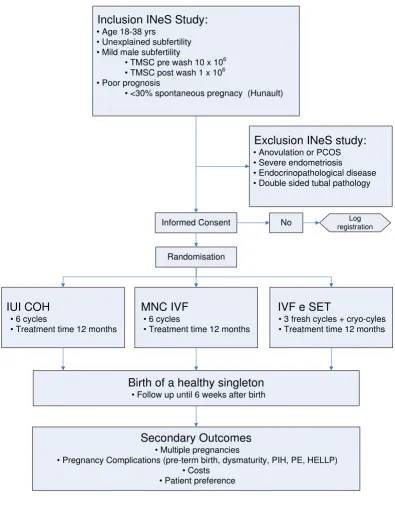
Couples are allocated to a treatment strategy consisting of 6 consecutive cycles of IUI-COH or 6 cycles of MNC-IVF or 3 cycles of IVF-eSET plus subsequent cryo-cycles. Cou-ples are treated until pregnancy occurs within a treatment time horizon of 12 months. (Figure 1).
Prior to start of IUI-COH patients will undergo Chlamy-dia antibody testing, hysterosalpingography and/or laparoscopy to exclude double sided tubal occlusion.
In IUI-COH the controlled ovarian hyperstimulation can be performed with 100 mg clomiphene citrate or by daily subcutaneous injections of 75 IU FSH starting from cycle day three or four onward. The follicular growth is strictly monitored by transvaginal ultrasound. When at least one follicle with a diameter of 17 or 18 mm is present, final oocyte maturation is induced by the administration of 5.000 IU human chorionic gonadotropin (hCG) (Preg-nyl, Organon, Oss, The Netherlands), and 36 hours there-after IUI will be performed. HCG administration and IUI will be withheld when monitoring reveals the growth of more than three follicles with a diameter of 16 mm, or more than five follicles with a diameter of 12 mm. Semen samples are processed within one hour after ejaculation, using a density gradient centrifugation followed by wash-ing with culture medium and is subsequently used for insemination.
Flowchart of study
Figure 1
Flowchart of study.
Inclusion INeS Study:
• Age 18-38 yrs
• Unexplained subfertility • Mild male subfertility
• TMSC pre wash 10 x 106 • TMSC post wash 1 x 10⁶
• Poor prognosis
• <30% spontaneous pregnacy (Hunault)
Informed Consent
Randomisation
No
Exclusion INeS study:
• Anovulation or PCOS • Severe endometriosis
• Endocrinopathological disease • Double sided tubal pathology
Birth of a healthy singleton
• Follow up until 6 weeks after birth
Secondary Outcomes
• Multiple pregnancies
• Pregnancy Complications (pre-term birth, dysmaturity, PIH, PE, HELLP) • Costs
• Patient preference
Log registration
IUI COH
• 6 cycles
• Treatment time 12 months
MNC IVF
• 6 cycles
• Treatment time 12 months
IVF e SET
• 3 fresh cycles + cryo-cyles • Treatment time 12 months
PCOS polycystic ovarian syndrome
IUI COH intra uterine insemination + controlled ovarian hyperstimulation MNC IVF Modified natural cycle IVF
IVF e SET elective single embryo IVF PIH pregnancy induced hypertension PE pre eclampsia
concomitant fall in estradiol levels. Ultrasound monitor-ing will be started on cycle day 8 or 10 and repeated daily or every other day, according to the size of the lead folli-cle. Follicle diameter will be measured in three perpen-dicular planes, and the mean value will be taken. When a lead follicle with a mean diameter of at least 14 mm is observed, daily injections of 0.25 mg of a nist together with 150 IU FSH are started. GnRH-antago-nist will be continued up to and including the day of ovulation triggering. FSH will be continued up to the day of ovulation triggering. Patients will be instructed to have their injections at the same time daily, to ensure a 24 hour interval between injections. Ovulation triggering will be achieved by subcutaneous injection of 10 000 IU of hCG (Pregnyl®, Organon, Oss, the Netherlands) when
a follicle with a diameter of 17 to 18 mm is observed.
Blood samples will be taken for assessment of serum con-centrations of LH and E2 on the days that ultrasound was performed. Cycles where an LH-rise of > 30.0 IU/L is noticed at a follicle size of < 15 mm will be cancelled. In cases where an LH-rise of > 30.0 IU/L is noticed, HCG is given and follicle aspiration will be performed the next day. There will be no flushing of the follicle. Only large (dominant) follicles will be aspirated. Embryo transfer will be performed on the second or third day after oocyte retrieval. Usually one oocyte is obtained, and one embryo is placed in utero. Should there be more than one good quality embryo, the surplus embryos will be cryo pre-served.
For luteal support, HCG 1500 IU (Pregnyl®, Organon,
Oss, the Netherlands) will be given five, eight and eleven days after oocyte retrieval.
For IVF-eSET women will undergo controlled ovarian hyperstimulation after down-regulation with a GnRH agonist in a long protocol with a midluteal start or with a fixed start antagonist protocol starting on day two. Con-trolled ovarian hyperstimulation is started with 150 IU FSH. Treatment is continued until at least 2 follicles > 18 mm have developed. Ovulation is induced by 10.000 IU human chorionic gonadotropin hormone (hCG) (Preg-nyl®, Organon, Oss, The Netherlands) and
cumulus-oocyte complexes will be recovered by transvaginal ultra-sound-guided retrieval 36 hours thereafter. Embryos will be scored with the use of validated morphological scoring criteria at the time of fertilization (pronuclear morphol-ogy) and daily until the time of transfer. Embryos will be assessed for their morphology daily by an embryologist/ IVF-technician using an Olympus IX71 inverted micro-scope or another equivalent micromicro-scope equipped with Relief Contrast optics at a magnification of 320 x. On day two, three or four, one embryo will be selected for trans-fer if one or more embryos of good quality are available.
If no good quality embryos are available two embryos will be transferred. Non-transferred good quality embryos will be cryo-preserved. Embryo scoring will be done according to the participating laboratories' own protocol. When implantation is not successful or early miscarriage occurs the frozen embryos are thawed and transferred. Again, only one embryo will be transferred per frozen-thaw cycle if it is of good quality.
Before starting a new treatment cycle with IUI-COH, MNC-IVF or IVF-eSET, women will undergo a pregnancy test (hCG measurement in serum or urine). If no preg-nancy has manifested the next treatment cycle is started according to protocol. In case of a positive pregnancy test women will be monitored using ultrasound visualisation during their pregnancy. Monitoring will take place at five to nine weeks of amenorrhea to check whether an intrau-terine gestational sac is present, i.e. a clinical pregnancy. Subsequently monitoring will take place at 11 to 12 weeks amenorrhea to register the presence of an intrauter-ine gestational sac with foetal heart beat, i.e. an ongoing pregnancy.
Follow up
Short term follow up
As the primary outcome is birth of a healthy child result-ing from a pregnancy that was established in the first 12 months after randomization, each child will be assessed at 6 weeks after the expected day of delivery. For example, a child that is born at a gestational age of 38 weeks will be assessed at 8 weeks after birth, whereas a child born after a gestational age of 30 weeks will be assessed 16 weeks after birth. Parents will be contacted by telephone to enquire on the delivery and the health of the child. When necessary, child health centres and or paediatricians will then be contacted for specific information. All children with severe morbidity will be evaluated and classified by a panel of neonatologists. Detailed information on maternal complication will be obtained from the obste-trician treating the woman concerned.
Certainly not all couples will complete the 12 months of treatment. Drop-outs will largely represent normal patient flow. We aim to keep track of all drop-outs and to document the reason for the drop-out in the database.
Long term follow up
of their singleton baby when compared to spontaneous singletons [21].
Outcome measures
Primary outcome measure
The primary outcome is the birth of a healthy singleton. A child will be considered healthy when born at term with a normal birth weight, without congenital anoma-lies [22] and with a normal paediatric examination and development assessment at 6 weeks of age.
Secondary outcome measures
Naturally, multiple pregnancy, defined as registered heartbeat of at least two foetuses at 12 weeks of gestation is a secondary outcome. A multiple birth in which al least one of the children has congenital anomalies, will con-sidered as failure of the strategy.
Further secondary outcomes are clinical pregnancy, defined as any registered embryonic heartbeat at sonogra-phy; neonatal mortality; pregnancy complications (pre-term birth < 37 weeks, birth weight < 2.500 gram, Pregnancy Induced Hypertension (PIH), (pre-) eclamp-sia, HELLP) costs and patients' preferences.
Patients' preferences are assessed by an (online) ques-tionnaire using a discrete choice experiment (DCE) based on characteristics of both interventions and will be com-pared with a control group, recruited among women vis-iting the infertility clinics of the participating hospitals.
Background and Demographic Characteristics
To assess whether the treatment groups were balanced, the study populations will be compared for baseline measurements including female age, type of infertility (primary/secondary), duration of infertility, intoxica-tions, body mass index, as well as sperm analysis accord-ing to WHO standards.
Analysis
The analysis of all outcomes is on an intention to treat basis. The analysis will be a cost-minimisation when the effectiveness is comparable in all groups. In case of differ-ences in effectiveness a cost-effectiveness study will be performed. Couples will be treated within a time horizon of 12 months
Differences in birth rate per group will be expressed as rel-ative risks with corresponding 95% confidence intervals. A formal test of the difference in pregnancy rate will be performed using chi-square test statistics. Birth rates over time will be compared using life tables.
The medical, economical and social dilemma concerns children with handicaps, which are mostly due to
pre-term birth. A literature search will therefore be performed to estimate live-long costs due to handicaps. We will sub-sequently perform a scenario analysis, in which we will model the costs and effects of the three strategies in this perspective.
Economic Evaluation
We plan an economic evaluation alongside the clinical trial. A distinction will be made between costs of medical interventions (direct costs) and costs resulting from pro-ductivity losses (indirect or time costs). Standardised unit costs will be calculated for all centres based on actual expenses made during the study. Subsequently, unit costs will be applied to resource use as observed in the partici-pating centres. Resource utilisation will be documented using individual patient data in the case record forms. In addition, each woman will receive questionnaires at 4 weeks, 8 weeks, 12 weeks, 24 weeks, 36 weeks and 48 weeks after treatment start for details on associated direct costs of professional care, and on indirect costs like trans-portation and productivity loss. Resource unit prices will reflect the unit of staff, materials, equipment, housing, depreciation, and overhead. Productivity loss will be val-ued using Dutch reference data (handbook of the Dutch health Council). Costs will be presented in Euros.
As the neonatal morbidity and mortality is likely to depend on the number of multiple births, we will per-form sensitivity analyses in which we will vary the number of multiple pregnancies in the IUI-COH strategy. Furthermore, sensitivity analyses will be performed on costs, pregnancy rates of the different treatment strategies and the valuation of different outcomes (no child, hand-icapped child, healthy child).
Power calculation
Considering an expected birth rate of a healthy child after 12 months of treatment of 40% in all three treatment groups, with an alpha of 5% and a beta of 20%, 190 patients per group are required to exclude a difference of 12.5% or more to the detriment of MNC-IVF and IVF-eSET. To account for an estimated early drop-out of 5% we will include 200 patients per group.
Discussion
Each year about 5000 couples in the Netherlands are diagnosed with unexplained or mild male and an unfa-vourable prognosis [23]. As stated earlier, in these cou-ples there is ambiguity about the preferred first line treatment.
treatments need to be considered. To this date no large randomised controlled trials which have compared IUI COH with IVF e SET, and MNC IVF in couples with unex-plained or mild male subfertility in order to prevent mul-tiple pregnancies.
Competing interests
The authors declare that they have no competing inter-ests.
Authors' contributions
AJB is responsible for the overall logistical aspects of the trial and drafted the paper. FvdV, MW, and BMW designed the trial, were responsible for the development of the protocol, applied for a grant and have overall responsibility for the trial. All authors read and approved the final paper.
Acknowledgements
This trial will receive funding from the Netherlands Organization for Health Research and Development (ZonMw) and from Zorgverzekeraars Nederland (ZN), which is the sector organisation representing the provid-ers of care insurance in the Netherlands.
The Eudract number for this trial is 2006-003003-39.
Participating hospitals, local trial coordinators:
Academic Medical Centre, Amsterdam, A.J. Bensdorp, MD, M.van Wely PhD, FvdVeen, MD, PhD, B.W.Mol, MD, PhD
Máxima Medical Centre, Veldhoven, B.W.Mol, MD, PhD
Medisch Spectrum Twente, G.J.E. Oosterhuis, MD, PhD
Onze Lieve Vrouwe Gasthuis, Amsterdam, H.R. Verhoeve, MD, PhD
Universtity Centre Amsterdam, P.G.A. Hompes, MD, PhD
University Medical Centre Rotterdam, N.G.M. Beckers, MD
University Medical Centre Nijmegen, M. Traas, MD,
University Medical Centre Maastricht, J.W.M Maas, MD PhD
University Medical Centre Groningen, A.Hoek, MD, PhD
Universtiy Medical Centre Utrecht, F.J.Broekmans, MD, PhD
References
1. Lambalk CB, Schats R, Bleker OP, Elferink PM, Orlebeke JF: [Multi-ple pregnancies: epidemiology and management]. Ned Tijd-schr Geneeskd 2004, 148:448-450.
2. Braat DD, Schonbeck Y, Kremer JA: [Multiple pregnancies: epi-demiology and management]. Ned Tijdschr Geneeskd 2003, 147:1952-1955.
3. Healy D: Damaged babies from assisted reproductive tech-nologies: focus on the BESST (birth emphasizing a success-ful singleton at term) outcome. Fertil Steril 2004, 81:512-3. discussion
4. Fauser BC, Devroey P, Macklon NS: Multiple birth resulting from ovarian stimulation for subfertility treatment. Lancet
2005, 365:1807-1816.
5. Multiple gestation pregnancy. The ESHRE Capri Workshop Group. Hum Reprod 2000, 15:1856-1864.
6. Pinborg A, Loft A, Nyboe AA: Neonatal outcome in a Danish national cohort of 8602 children born after in vitro fertiliza-tion or intracytoplasmic sperm injecfertiliza-tion: the role of twin pregnancy. Acta Obstet Gynecol Scand 2004, 83:1071-1078. 7. Hunault CC, Laven JS, van RI, Eijkemans MJ, te Velde ER, Habbema
JD: Prospective validation of two models predicting preg-nancy leading to live birth among untreated subfertile cou-ples. Hum Reprod 2005, 20:1636-1641.
8. Steures P, Steeg JW van der, Hompes PG, Habbema JD, Eijkemans MJ, Broekmans FJ, et al.: Intrauterine insemination with con-trolled ovarian hyperstimulation versus expectant manage-ment for couples with unexplained subfertility and an intermediate prognosis: a randomised clinical trial. Lancet
2006, 368:216-221.
9. Steeg JW van der, Steures P, Eijkemans MJ, Habbema JD, Hompes PG, Broekmans FJ, et al.: Pregnancy is predictable: a large-scale prospective external validation of the prediction of sponta-neous pregnancy in subfertile couples. Hum Reprod 2007, 22:536-542.
10. Cohlen BJ: Should we continue performing intrauterine inseminations in the year 2004? Gynecol Obstet Invest 2005, 59:3-13.
11. Verhulst SM, Cohlen BJ, Hughes E, Te VE, Heineman MJ: Intra-uter-ine insemination for unexplaIntra-uter-ined subfertility. Cochrane Data-base Syst Rev 2006:CD001838.
12. Dankert T, Kremer JA, Cohlen BJ, Hamilton CJ, Pasker-de Jong PC, Straatman H, et al.: A randomized clinical trial of clomiphene citrate versus low dose recombinant FSH for ovarian hyper-stimulation in intrauterine insemination cycles for unex-plained and male subfertility. Hum Reprod 2007, 22:792-797. 13. Steures P, Steeg JW van der, Hompes PG, van d V, Mol BW:
Intra-uterine insemination in The Netherlands. Reprod Biomed Online 2007, 14:110-116.
14. Pelinck MJ, Vogel NE, Hoek A, Arts EG, Simons AH, Heineman MJ: Minimal stimulation IVF with late follicular phase adminis-tration of the GnRH antagonist cetrorelix and concomitant substitution with recombinant FSH: a pilot study. Hum Reprod 2005, 20:642-648.
15. Gerris J, De ND, Mangelschots K, Van RE, Van de MM, Valkenburg M: Prevention of twin pregnancy after in-vitro fertilization or intracytoplasmic sperm injection based on strict embryo criteria: a prospective randomized clinical trial. Hum Reprod
1999, 14:2581-2587.
16. Thurin A, Hausken J, Hillensjo T, Jablonowska B, Pinborg A, Strandell A, et al.: Elective single-embryo transfer versus double-embryo transfer in in vitro fertilization. N Engl J Med 2004, 351:2392-2402.
17. Van Montfoort AP, Dumoulin JC, Land JA, Coonen E, Derhaag JG, Evers JL: Elective single embryo transfer (eSET) policy in the first three IVF/ICSI treatment cycles. Hum Reprod 2005, 20:433-436.
18. Hunault CC, Laven JS, van RI, Eijkemans MJ, te Velde ER, Habbema JD: Prospective validation of two models predicting preg-nancy leading to live birth among untreated subfertile cou-ples. Hum Reprod 2005, 20:1636-1641.
19. Steeg JW van der, Steures P, Eijkemans MJ, Habbema JD, Bossuyt PM, Hompes PG, et al.: Which factors play a role in clinical deci-sion-making in subfertility? Reprod Biomed Online 2006, 12:473-480.
20. Bonduelle M, Wennerholm UB, Loft A, Tarlatzis BC, Peters C, Hen-riet S, et al.: A multi-centre cohort study of the physical health of 5-year-old children conceived after intracytoplasmic sperm injection, in vitro fertilization and natural concep-tion. Hum Reprod 2005, 20:413-419.
21. De ND, Gerris J, Mangelschots K, Van RE, Vercruyssen M, Steyle-mans A, et al.: The obstetrical and neonatal outcome of babies born after single-embryo transfer in IVF/ICSI compares favourably to spontaneously conceived babies. Hum Reprod
2006, 21:1041-1046.
22. Guinn DA, Atkinson MW, Sullivan L, Lee M, MacGregor S, Parilla BV,
Publish with BioMed Central and every scientist can read your work free of charge
"BioMed Central will be the most significant development for disseminating the results of biomedical researc h in our lifetime."
Sir Paul Nurse, Cancer Research UK
Your research papers will be:
available free of charge to the entire biomedical community
peer reviewed and published immediately upon acceptance
cited in PubMed and archived on PubMed Central
yours — you keep the copyright
Submit your manuscript here:
http://www.biomedcentral.com/info/publishing_adv.asp
BioMedcentral
for women at risk of preterm delivery: A randomized con-trolled trial. JAMA 2001, 286:1581-1587.
23. Hunault CC, Laven JS, van RI, Eijkemans MJ, te Velde ER, Habbema JD: Prospective validation of two models predicting preg-nancy leading to live birth among untreated subfertile cou-ples. Hum Reprod 2005, 20:1636-1641.
Pre-publication history
The pre-publication history for this paper can be accessed here: