R E S E A R C H A R T I C L E
Open Access
A survey on beliefs and attitudes of trainee
surgeons towards placebo
Mathew J. Baldwin
1,2†, Karolina Wartolowska
2*†and Andrew J. Carr
1,2Abstract
Background:The aim of this study was to investigate the beliefs and attitudes of trainee surgeons regarding placebo interventions, in surgical practice and in research, and to compare them to those of senior orthopaedic surgeons.
Methods:An invitation to participate in an online survey was sent to all the email addresses in the members’ database of the British Orthopaedic Trainees Association (BOTA).
Results:All 987 members of BOTA were invited to participate in the survey and 189 responded (19 %). The majority of trainees think that the placebo effect is real (88 %), has therapeutic benefits (88 %) and that placebo manipulations are permissible (98 %). Sixty per cent of respondents agree that placebo can be used outside of research, most commonly, to distinguish between organic and non-organic symptoms (36 %). Trainees are more likely than senior surgeons to use placebo for pain management (34 % vs. 12 %). They are mainly concerned about the risk of side effects associated with the use of placebo (80 %) and prefer placebo interventions with minimal invasiveness. Seventy-three per cent respondents would recruit patients into the proposed randomised controlled surgical trial.
Conclusions:The views regarding efficacy, permissibility and indications for placebo among trainees are similar to those of orthopaedic consultants. Orthopaedic trainees regard placebo as permissible and show willingness to recruit into placebo-controlled trials. However, they seem to have limited understanding of mechanisms of placebo effect and underestimate its ubiquity.
Keywords:Orthopaedics, Placebos, Surgery, Attitudes and Beliefs
Background
Surgical interventions are being increasingly used and the number of surgical procedures performed rises each year [1, 2]. Technological advances have created new possibil-ities for surgical intervention. Yet, unlike drug products, verifying the efficacy of new procedures is not currently mandatory [3]. The issue of true efficacy is particularly im-portant in case of surgical interventions aimed primarily at improving“soft” outcome measures, such as quality of life, pain or function, as these subjective measures are prone to bias from the placebo effect; unlike“hard” out-comes, such as mortality or laboratory measures [4].
The placebo effect refers to an improvement in clinical symptoms or patients’well-being in response to placebo manipulations such as an inactive substance or a proced-ure that simulates an active therapy, but itself has no specific effects [5]. The placebo effect is a consequence of patients’ expectations, verbal and non-verbal sugges-tions by the treating health professional as well as clas-sical conditioning [5, 6]. An actual placebo pill or procedure is not necessary and even a positive consult-ation or a definitive diagnosis may have a placebo effect, with more invasive treatments potentially exerting a lar-ger effect [7–9].
The role of placebo and placebo interventions in rou-tine clinical practice remains controversial [10–12]. The majority of physicians admit that they have used placebo or non-specific treatments [13], but there is little known about the attitudes of surgeons towards placebo use in their speciality. Earlier studies suggested that surgeons * Correspondence:[email protected]
†Equal contributors
2The Botnar Institute of Musculoskeletal Sciences, Nuffield Department of
Orthopaedics, Rheumatology and Musculoskeletal Sciences (NDORMS), University of Oxford, Old Road, Oxford OX3 7LD, UK
Full list of author information is available at the end of the article
have more defensive attitude than other specialties when it comes to including their procedures into a definition of placebo [14]. A recent survey [15] demonstrated that consultant British orthopaedic surgeons generally agree with the provided definition of placebo and believe that placebo in surgery is permissible (96 %), especially in the context of research. They believe that the placebo effect is real (92 %) and it has therapeutic effects (77 %). Im-portantly, over half (58 %) recognise that surgical inter-ventions may contain a significant placebo component. However, 42 % responded that they have never per-formed a procedure that could have a significant elem-ent of placebo. The survey also demonstrated that surgeons have limited understanding of the mecha-nisms underlying the placebo effect and underestimate its ubiquity. It is important to note that this survey was conducted among surgeons who were aware of a placebo-controlled trial being currently undertaken in the UK, which could have affected their responses. Add-itionally, it is not known whether these attitudes represent the beliefs of the whole orthopaedic community or are a generational phenomenon. Understanding the attitudes of surgeons towards placebo may help to answer the ques-tion why there have been so few placebo-controlled trials of interventional procedures [15].
The aim of this study was to investigate the attitudes and beliefs of British orthopaedic trainee surgeons to-wards placebo in the context of surgical research as well as clinical practice.
Methods Participants
Surgical members of the British Orthopaedic Trainees As-sociation (BOTA) were invited via email to participate in an online survey. Although not all of the 1,111 nationally registered UK orthopaedic trainees will be BOTA mem-bers, this email database was identified as the most complete contact list available to the authors. The data collection was open between 28th July and 28th August 2014. A reminder was sent via email at the midpoint of collection. Permission for use of the email database was granted by the BOTA. This study was reviewed by the National Institute for Health Oxford Musculoskeletal Bio-medical Research Unit Board at the Nuffield Department of Orthopaedics, Rheumatology and Musculoskeletal Sci-ences, which decided it did not require a review by an ex-ternal ethics committee as it was a survey of healthcare professionals and the participation as well as the answers were fully anonymous and voluntary.
Survey instrument
A questionnaire used in this study was derived from previously published surveys to make the results com-parable with earlier studies [15–18]. Participants were
asked about their age, gender, number of years since graduation, stage of their training as well as the number of patients they treat weekly. To assess the degree of exposure to research ethics and methodology we asked about their attainments of higher degrees, Good Clin-ical Practice (GCP) accreditation, proportion of time spent in research and the number of patients they re-cruited into a randomised controlled trial (RCT) within the last 12 months.
To address the controversies surrounding definitions of placebo, the survey started with three separate defini-tions and closed quesdefini-tions on whether the participants agreed with each of them. Two further closed questions asked whether the respondents believed that the placebo effect is real, i.e., has a scientific basis, and whether it has a therapeutic effect. The next three questions were re-lated to clinical situations, in which the trainees would consider a placebo, the concerns related to placebo use as well as understanding of mechanisms underlying the pla-cebo effect. Participants were also asked how often they performed or observed operations that they believed to have a significant placebo component. The section ended with a direct question on the participants’overall position concerning the use of placebo in clinical practice.
The next section sought to investigate attitudes toward placebo in clinical research; a number of statements were posed and each response was rated on a 5-point Likert scale ranging from“strongly disagree”to“strongly agree”. Finally, respondents were asked to consider a scenario in which an old and new procedure co-existed, with dis-agreement over their efficacy and superiority. The respon-dents were asked to choose the design that they believed is superior from the scientific perspective. The next ques-tion asked whether they would personally recruit into a surgical trial with a placebo arm. Finally, we assessed whether acceptability is affected by the degree of invasive-ness of the placebo. Several study designs, with varying physical invasiveness, were described and participants were asked to choose the studies they would personally re-cruit into.
The survey document is in Additional file 1. The sur-vey was piloted on 11 orthopaedic trainees within NDORMS to ensure face validity.
Data analysis
Participants entered their responses directly into an on-line survey (http://www.surveymonkey.net)
Characteristics tested included; age, gender, training grade, time since graduation, work load, hospital type, research experience, higher degrees achieved, number of patients recruited into an RCT, GCP accreditation, belief in placebo effect, belief in therapeutic benefit of placebo, frequency of placebo use, and belief in scientific import-ance of placebo controls. Questions that overlapped with a previous survey of Orthopaedic consultants [15] (atti-tudes on placebo permissibility, indications for utilising placebo, placebo mechanisms, frequency of placebo use, belief in the placebo effect and belief in the therapeutic benefit of placebo) were compared using a χ2 analysis. All analysis was conducted with SPSS (Version 21).
Results
Respondent characteristics
There were 987 email addresses in the BOTA database but only 189 members participated in the survey and 152 of them completed the whole questionnaire, a re-sponse rate of 19 %. The respondents were most male (83 %), aged between 30 and 39 (77 %), and between 3rd and 5th year of speciality training (46 %). The majority worked in a district general hospital (51 %), and treated 31 to 50 patients per week (48 %) (Table 1). Most
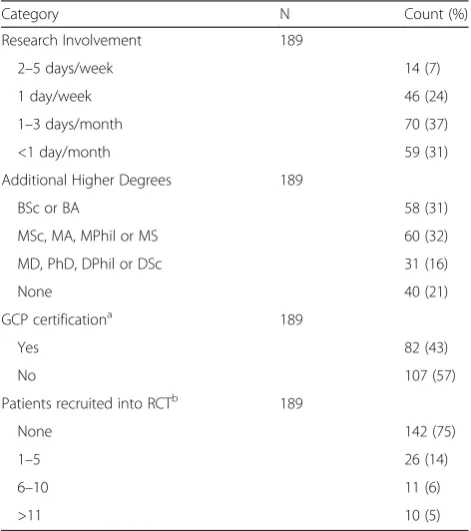
participants had another higher degree, in addition to their primary medical degree (79 %), but only 31 % were involved in research on a weekly basis. Most (75 %) had not recruited a patient into a RCT within the last 12 months (Table 2).
Definitions of placebo
The majority of participants (88 %) agreed with the def-inition of placebo as“any intervention or treatment, that objectively is known to have no specific effect, but for which a beneficial outcome occurs as a result of the pa-tient’s belief in its efficacy” [Definition 1] (Fig. 1). Ten respondents provided additional comments: nine felt the definition described placebo effect and not placebo, since the later could also be harmful and one respondent disagreed with describing a placebo as a“treatment”.
Slightly fewer participants (81 %) agreed with the def-inition of placebo for surgical practice, i.e.,“an interven-tion where patients undergo a surgical procedure that has the appearance of a therapeutic intervention, but during which the essential therapeutic manoeuvre is omitted” [Definition 2]. Of the 35 respondents who dis-agreed nine provided comments, including four who felt it should be called a“sham surgery”and not a“placebo”, two participants commented that the definition was too narrow, i.e., surgical practice was not synonymous with surgical intervention, two who disagreed purely on eth-ical grounds, and one respondent commented on the Table 1Sample characteristics
Category N Count (%)
Age 189
20–29 25 (13)
30–39 146 (77)
≥40 18 (10)
Gender 189
Male 156 (83)
Female 33 (17)
Years Since Graduation 189
0–5 25 (13)
6–10 103 (55)
11–15 51 (27)
≥16 10 (5)
Patients seen each week 189
<10 0 (0)
10–30 31 (16)
30–50 91 (48)
>50 67 (36)
Training grade 189
Locum Appointed for Training 15 (8)
Speciality Registrar (ST 3–5) 86 (46)
Speciality Registrar (ST 6–8) 67 (35)
Fellow 13 (7)
Non-training grade Registrar 8 (4)
Table 2Research experience
Category N Count (%)
Research Involvement 189
2–5 days/week 14 (7)
1 day/week 46 (24)
1–3 days/month 70 (37)
<1 day/month 59 (31)
Additional Higher Degrees 189
BSc or BA 58 (31)
MSc, MA, MPhil or MS 60 (32)
MD, PhD, DPhil or DSc 31 (16)
None 40 (21)
GCP certificationa 189
Yes 82 (43)
No 107 (57)
Patients recruited into RCTb 189
None 142 (75)
1–5 26 (14)
6–10 11 (6)
>11 10 (5)
a
Good Clinical Practice (GCP)
b
fact that the “essential manoeuvre” is often difficult to determine.
Our final definition explored whether respondents felt a definition of placebo“should include therapies which are given by a surgeon in the belief that they are effective and specific even though, and unknown to the surgeon, they are in fact non-specific” [Definition 3]. This option was the most controversial and 59 % of respondents disagreed with the given definition. Six participants expanded on their reasons for disagreement: three expressed a funda-mental objection, stating that if a surgeon believes in the efficacy, it cannot be classified as placebo, and further three respondents noted that disagreement over the effi-cacy of many procedures exists rendering the definition too broad i.e., too many therapies could be classified as placebo.
Beliefs about placebo and indications for its use
Most of the respondents believed that the placebo effect was real and had a scientific basis (88 %), with a similar proportion believing placebo could provide therapeutic benefit to patients (88 %); these two factors were associ-ated (χ2= 7.66, df = 1, p= 0.006) and were not signifi-cantly different from the views of consultants.
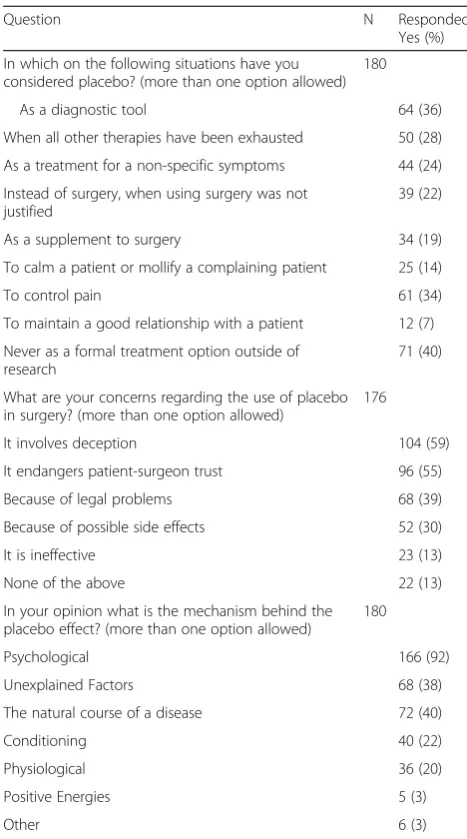
When asked about the circumstances, in which they would consider using a placebo procedure, 40 % of trainees answered that they would not use placebo out-side of research. The most common scenario, in which respondents would consider using placebo, was as a diagnostic tool to distinguish between organic and non-organic symptoms (36 %) as well as to control pain (34 %). Fourteen per cent would consider using placebo to mollify a complaining patient and 7 % would use it to maintain a good doctor-patient relationship (Table 3). There was a trend toward a greater use of placebo to control pain among trainees (34 % vs. 12 %, χ2 = 14.8, df = 1, p< 0.001), with no difference between trainees and senior surgeons for all other scenarios.
Concerns over placebo use
The main concerns expressed by trainee surgeons were similar to those of senior surgeons: the main two issues were that placebo involved deceiving the patient (59 %) and risked damaging patient-surgeon trust (55 %). Reser-vations over legal implications (39 %) and potential side-effects (30 %) were also commonly expressed. Only 13 % of trainees would not use placebo because they felt it was ineffective (Table 3).
Mechanism of the placebo effect
Most participants (92 %) answered that the placebo ef-fect is a result of psychological mechanisms but only 22 % recognised the role of conditioning and only 20 % responded there is a physiological basis for the placebo effect (Table 3). Forty per cent responded that the Fig. 1Definitions of placebo. Respondents were asked about their
position:“Agree”or“Disagree”regarding three different definitions of placebo. The definitions are listed on the y-axis and the cumulative @percentage of respondents are listed on the x-axis. See body of manuscripts for wording of each definition
Table 3Opinions regarding placebo use, mechanisms and concerns
Question N Responded
Yes (%)
In which on the following situations have you considered placebo? (more than one option allowed)
180
As a diagnostic tool 64 (36)
When all other therapies have been exhausted 50 (28)
As a treatment for a non-specific symptoms 44 (24)
Instead of surgery, when using surgery was not justified
39 (22)
As a supplement to surgery 34 (19)
To calm a patient or mollify a complaining patient 25 (14)
To control pain 61 (34)
To maintain a good relationship with a patient 12 (7)
Never as a formal treatment option outside of research
71 (40)
What are your concerns regarding the use of placebo in surgery? (more than one option allowed)
176
It involves deception 104 (59)
It endangers patient-surgeon trust 96 (55)
Because of legal problems 68 (39)
Because of possible side effects 52 (30)
It is ineffective 23 (13)
None of the above 22 (13)
In your opinion what is the mechanism behind the placebo effect? (more than one option allowed)
180
Psychological 166 (92)
Unexplained Factors 68 (38)
The natural course of a disease 72 (40)
Conditioning 40 (22)
Physiological 36 (20)
Positive Energies 5 (3)
placebo effect was a consequence of the natural history of a disease and 38 % believed that the placebo effect is the consequence of as yet unexplained factors. These be-liefs were not significantly different from those expressed by senior surgeons.
Frequency of the placebo effect in surgery
Only twenty-one per cent of participants reported that they had never observed an operation that they believed to have a significant placebo component. In comparison, 42 % of senior surgeons answered that they had never performed a procedure that they believed had a signifi-cant placebo component (21 % vs. 42 %,χ2 = 11.9, df = 1,
p< 0.001). Other trainees reported observing such proce-dures infrequently: about once a year (36 %) or less than one case per year 24 %. Only 1.8 % felt they observed op-erations with placebo components on a weekly basis.
Attitudes toward permissibility of placebo
Attitudes towards permissibility of placebo, in general, among the trainees were not significantly different from the previously reported opinions of orthopaedic consul-tants. When asked whether the use of placebo is permit-ted if patients gave informed consent, only 2.2 % of trainees felt that placebo should always be prohibited. Over a third believed that placebo should only be used in clinical research trials (36 %), whereas 22 % responded that placebo could be used in both clinical practice and clinical research trials. Twenty- nine per cent responded that placebo could be used in clinical practice if research supported its evidence. However, fewer (11 %) were comfortable with the use of placebo in clinical practice if the supporting evidence was only based on prior experi-ence, within the department or personal.
Placebo in clinical research
Participants were asked about their opinion regarding commonly expressed issues on the use of placebo in clinical research (Fig. 2). The most unanimous view-point, with over 80 % agreement, was that placebo can only be used if informed consent is sought, and if pa-tients in the placebo group are not at risk of serious harm. Respondents’views other topics were split, for ex-ample, 40 % disagreed and 41 % had a neutral stance on whether using a placebo arm prioritises the interests of society over those of an individual.
Acceptability of placebo
Out of 152 trainees who answered this question, 47 % pre-ferred a design comparing new technique with old and 40 % favoured a placebo-controlled study. The remaining 13 % would rather use an alternative design; most often a trial including all three procedures; although one
respondent suggested two separate trials comparing each technique, old and new one, to placebo.
At the practical level, 73 % of trainees responded that they would recruit patients into a proposed trial. The trainees who preferred the design comparing new treat-ment with a placebo would “definitely” (30 %) or“ prob-ably”(56 %) recruit patients into such a trial (Fig. 3). Out of respondents who chose the old versus the new design, only 11 % would definitely recruit, and 51 % would prob-ably recruit into it, whereas 13 % would not recruit into such a trial. Interestingly, four of respondents who sug-gested an alternative design, with both interventions and placebo, would not recruit into it.
Placebo invasiveness
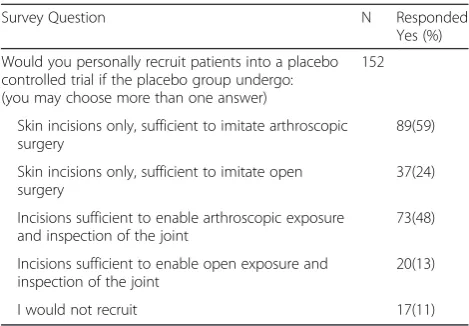
We also investigated whether acceptance of placebo sur-gery depends on the invasiveness of the placebo proced-ure. Responses were split along the line of whether the procedure should be arthroscopic or involve open surgery (Table 4). Several participants (11 %) answered that they would not recruit and expressed strong ethical objections against recruiting into any form placebo-controlled surgi-cal trial.
Willingness to recruit
Willingness to recruit into a placebo-controlled surgical trial was associated with a belief in the therapeutic effect of placebos (Odds Ratio [OR] 4.85, 95 % Confidence Interval [CI] 1.36–17.2), frequent observation of opera-tions with a placebo component (OR 10.3, 95 % CI 1.97–53.5) and a belief in the scientific importance of placebo controls (OR 5.17, 95 % CI 1.74–15.3).
Discussion
Summary of main findings
The majority of orthopaedic trainees recognise that sur-gical procedures can be classified as a placebo but fewer realise that the placebo effect can be created uninten-tionally. Most find the use of placebo in clinical practice ethically acceptable. Deception and the associated dam-age to trust are the main concerns over the use of pla-cebo. Most trainees believe the placebo effect has real and therapeutic effects, explained largely through psy-chological mechanisms. Considerably fewer would trans-late their beliefs into clinical practice. The main reason why trainees would consider using placebo would be to distinguish organic from non-organic symptoms or to manage pain.
Differences in results in comparison to other surveys There is no generally accepted definition of placebo [14, 16]. In our survey most respondents agreed with a definition of placebo as “beneficial treatment that is known to have no specific effect”and specifically accepted that surgical procedures can have a placebo effect. This is similar to the responses of senior orthopaedic surgeons [15] but this is in contrast to the earlier study that ob-served that surgeons did not believe that surgical proce-dures could be regarded as placebo because they had a strong therapeutic effect [14].
Physician’s personal expectations [19] as well as posi-tive consultations and suggestions can generate a pla-cebo effect [7] and this seems to be appreciated among physicians [18]. In contrast, fewer orthopaedic trainees demonstrate understanding of these concepts. Only 41 % would include in a definition of placebo“therapies believed by the surgeon to be effective and specific even though, and unknown to the surgeon, they are in fact non-specific”. While the views of orthopaedic surgeons toward placebo are not as restrictive as those described before [14] but it seems that they remain conservative relative to other specialities.
The respondents would recruit more willingly into stud-ies with minimally-invasive, arthroscopic, procedures ra-ther than into open surgery. Indeed, as the invasiveness of the placebo procedure increases, there is a corresponding fall in the proportion of trainees willing to recruit patients. When specifically asked about their concerns about pla-cebo in research, the most widely held beliefs are that risks to the participant must be minimised and informed con-sent granted. The attitudes and concerns of surgeons may explain, at least to some degree, why the vast majority of existing placebo-controlled surgical trials investigated minimally-invasive procedures [20]. It is important to note that some of the respondents in this survey appreciated the values of the three-arm design, i.e., of comparing two surgical procedures head to head as well as to a placebo intervention; however, they would still not recruit into such a trial.
Interestingly, in the context of clinical practice, trainees express a greater level of concern towards patient decep-tion and subsequent damage to the doctor-patient rela-tionship rather than potential side effects of placebo use. Trainees are aware of the need for informed consent and minimising harm so the obligations placed on them by the
Fig. 3Scientific acceptability of placebo and willingness to recruit. Please note old versus new therapy comparison refers to an active-control design
Declaration of Helsinki and medical regulatory bodies. Re-spondents’ opinions on other ethical issues, which are often a subject of a heated ethical debate, are divided.
The majority of our respondents believe that the pla-cebo effect is real and that is has therapeutic benefits, which is similar to our previous survey of orthopaedic consultants [15] as well as to previous studies which demonstrated that most doctors believe the placebo ef-fect is real (68–95 %) and can produce a therapeutic benefit (68–96 %) [16, 21, 22].
The circumstances in which placebos are used are com-plex. Among community physicians the most commonly reported reasons are to treat non-specific symptoms or to calm a patient [18]. In the hospital settings, it is more often used to alleviate pain or anxiety [16, 17] and as a tool to distinguish between organic and non-organic symptoms. [17, 23] Orthopaedic consultants and trainees in the UK are most likely to use placebo as a diagnostic tool, as treatment for non-specific symptoms or when all the other therapies have been exhausted [15]. The only significant difference is a greater use of placebo to control pain among trainees. It is surprising that both groups be-lieve that only non-organic symptoms may possibly im-prove after placebo treatment.
Orthopaedic trainees commonly attribute the mechan-ism of the placebo effect to psychological factors. Our find-ings are similar to the previously reported beliefs among orthopaedic consultants as well as physicians [15, 16]. Both cohorts recognise the role of psychological factors but underestimate the role of conditioning. However, only one in five respondents understands the importance of condi-tioning and the fact that the placebo response involves ac-tual physiological changes. Confusion also exists over how the placebo effect differs from the natural history of a dis-ease [5] and between the true placebo effect, i.e., specific to the placebo manipulations, and the overall change in the placebo arm. None of the respondents suggested adding an observational, non-interventional group, to control for the
natural history of disease. This is concerning as without an observational group it is not possible to separate a placebo response into the true placebo effect and non-specific ef-fects [4]. Furthermore, the absence of a observational arm results in no baseline from which to evaluate the harms and benefits of the surgical procedure [20]. However, placebo-controlled surgical randomised controlled trials tend not to include an observational group [20]. It is also concerning that over one third of trainees replied that the placebo effect is caused by unexplained phenomena.
Most doctors find the use of placebo in clinical prac-tice acceptable but only a minority have no reservations. Permissibility depends on the type of placebo and the circumstances of its use [13]. Evidence supporting pla-cebo improves acceptability, with clinical research being a more powerful determinant than personal or depart-mental experiences alone [15, 16]. Surgeons report using procedures with a possible placebo element less often than physicians [13, 15]. This may be related to a more direct involvement in treatment [24] or it may reflect the same phenomenon that was reported by Shapiro and Struening [14], namely, that surgeons acknowledge exist-ence of placebo effect but are unwilling to admit that some of the effect of surgical procedure may be associ-ated with a placebo effect. It is interesting that, com-pared to senior surgeons, fewer trainees reported that they have never observed an operation with a placebo component [15].
Strengths and limitations of this study
The participants were representative of the trainees in the UK. The responses were generated from all stages of train-ing and the proportion of males to female (17.5 %) was also similar to the gender split among current trauma and orthopaedic registrars [25].
The main limitation of this survey is that the response rate cannot be accurately calculated as it is not known how many trainees in the BOTA database actually re-ceived the invitation to participate. While a low response rate could be related to the delicate nature of the topic, the rate was smaller than in the other surveys (46–57 %) [14, 19, 23] and lower than in the survey of senior ortho-paedic surgeons (51 %) [14]. It may be that trainees are less likely to participate in survey research, perhaps owing to time pressures or survey fatigue. Additionally, it should be noted that the survey of senior surgeons [15] was distributed during a research conference, which might have primed participants to the importance of re-search and inflated response rates.
Conclusions
There may be an increasing awareness of the frequency of placebo use amongst junior orthopaedic surgeons. However, other than a greater belief in the role of Table 4Invasiveness of placebo control
Survey Question N Responded
Yes (%)
Would you personally recruit patients into a placebo controlled trial if the placebo group undergo: (you may choose more than one answer)
152
Skin incisions only, sufficient to imitate arthroscopic surgery
89(59)
Skin incisions only, sufficient to imitate open surgery
37(24)
Incisions sufficient to enable arthroscopic exposure and inspection of the joint
73(48)
Incisions sufficient to enable open exposure and inspection of the joint
20(13)
placebo in pain management, attitudes between trainees and consultants are highly comparable. Most orthopaedic trainees believe that the placebo effect is real but its mech-anisms of actions and its pervasive nature remain under-appreciated. Without an understanding that the placebo effect is a component of every medical treatment, the im-portance of placebo controlled surgical trials cannot be properly understood. High quality research that changes practice and improves care can only be successfully under-taken if there is a general support of the orthopaedic com-munity. Providing trainees with better training in research methodology, so that they understand the strengths and limitations of different trial designs, may facilitate this process.
Ethics approval and consent to participate
This study was reviewed by the National Institute for Health Oxford Musculoskeletal Biomedical Research Unit Board at the Nuffield Department of Orthopaedics, Rheumatology and Musculoskeletal Sciences, which de-cided it did not require a review by an external ethics committee as it was a survey of healthcare professionals and the participation as well as the answers were fully anonymous and voluntary.
Availability of supporting data
The datasets supporting the conclusions of this article are included within the article.
Additional file
Additional file 1:The survey document. (PDF 285 kb)
Abbreviations
95%CI:95 % confidence interval; BOTA: British Orthopaedic Trainees Association; Df: degrees of freedom; NDORMS: Nuffield Department of Orthopaedics, Rheumatology and Musculoskeletal Sciences; OR: odds ratio; RCT: randomised controlled trial; SPSS: statistical package for the social sciences; UK: United Kingdom.
Competing interests
This survey was performed in relation to a placebo-controlled surgical trial on shoulder pain (NCT01623011), in which KW and AJC are involved.
Authors’contributions
All authors were involved in the study’s concept and design, data analysis, drafting of the manuscript and the critical revision of the manuscript for important intellectual content. All authors had full access to all of the data in the study and can take responsibility for the integrity of the data and the accuracy of the data analysis. All authors revised and approved the final version of the article.
Funding
The study was funded by the NIHR Musculoskeletal Biomedical Research Unit. The funder had no role in the design and conduct of the study; collection, management, analysis and interpretation of the data; preparation, review or approval of the manuscript; and decision to submit the manuscript for publication.
Author details
1Oxford NIHR Musculoskeletal Biomedical Research Unit, Old Road, Oxford
OX3 7LD, UK.2The Botnar Institute of Musculoskeletal Sciences, Nuffield
Department of Orthopaedics, Rheumatology and Musculoskeletal Sciences (NDORMS), University of Oxford, Old Road, Oxford OX3 7LD, UK.
Received: 15 October 2015 Accepted: 20 April 2016
References
1. Kable AK, Gibberd RW, Spigelman AD. Adverse events in surgical patients in Australia. Int J Qual Health Care. 2002;14(4):269–76.
2. Zegers M, de Bruijne M, de Keizer B, Merten H, Groenewegen P, van der Wal G, Wagner C. The incidence, root-causes, and outcomes of adverse events in surgical units: implication for potential prevention strategies. Patient Safety Surgery. 2011;5(1):13.
3. McCulloch P, Altman DG, Campbell WB, Flum DR, Glasziou P, Marshall JC, Nicholl J. No surgical innovation without evaluation: the IDEAL recommendations. Lancet. 2009;374(9695):1105–12.
4. Hrobjartsson A, Gotzsche PC. Is the placebo powerless? An analysis of clinical trials comparing placebo with no treatment. N Engl J Med. 2001; 344(21):1594–602.
5. Price DD, Finniss DG, Benedetti F. A comprehensive review of the placebo effect: recent advances and current thought. Annu Rev Psychol. 2008;59:565–90. 6. Benedetti F, Pollo A, Lopiano L, Lanotte M, Vighetti S, Rainero I. Conscious
expectation and unconscious conditioning in analgesic, motor, and hormonal placebo/nocebo responses. J Neurosci. 2003;23(10):4315–23. 7. Thomas KB. General practice consultations: is there any point in being
positive? BMJ. 1987;294(6581):1200–2.
8. Benedetti F. How the doctor’s words affect the patient’s brain. Eval Health Prof. 2002;25(4):369–86.
9. Kaptchuk TJ, Goldman P, Stone DA, Stason WB. Do medical devices have enhanced placebo effects? J Clin Epidemiol. 2000;53(8):786–92. 10. Macklin R. The ethical problems with sham surgery in clinical research.
N Engl J Med. 1999;341(13):992–6.
11. Biller-Andorno N. The use of the placebo effect in clinical medicine - ethical blunder or ethical imperative? Sci Eng Ethics. 2004;10:43–50.
12. Rich B. A placebo for the pain: a medico-legal case analysis. Pain Med. 2003; 4:366–72.
13. Fassler M, Meissner K, Schneider A, Linde K. Frequency and circumstances of placebo use in clinical practice - a systematic review of empirical studies. BMC Medicine. 2010;8(1):15.
14. Shapiro A, Struening E. Defensiveness in the definition of placebo. Compr Psychiatry. 1973;14:107–20.
15. Wartolowska K, Beard DJ, Carr AJ. Attitudes and beliefs about placebo surgery among orthopedic shoulder surgeons in the United Kingdom. PLoS ONE. 2014;9(3), e91699.
16. Sherman R, Hickner J. Academic physicians use placebos in clinical practice and believe in the mind-body connection. J Gen Intern Med. 2008;23:7–10. 17. Nitzan U, Lichtenberg P. Questionnaire survey on use of placebo. BMJ.
2004;329:944–6.
18. Fassler M, Gnadinger M, Rosemann T, Biller-Andorno N. Use of placebo interventions among Swiss primary care providers. BMC Health Serv Res. 2009;9:144.
19. Gracely RH, Dubner R, Deeter WR, Wolskee PJ. Clinicians’expectations influence placebo analgesia. Lancet. 1985;1(8419):43.
20. Wartolowska K, Judge A, Hopewell S, Collins GS, Dean BJF, Rombach I, Brindley D, Savulescu J, Beard DJ, Carr AJ. Use of placebo controls in the evaluation of surgery: systematic review. BMJ. 2014;348:g3253. 21. Raz A, Campbell N, Guindi D, Holcroft C, Dery C, Cukier O. Placebos in clinical
practice: comparing attitudes, beliefs, and patterns of use between academic psychiatrists and nonpsychiatrists. Can J Psychiatry. 2011;56(4):198–208. 22. Hrobjartsson A, Norup M. The use of placebo interventions in medical practice - a
national questionnaire survey of Danish clinicians. Eval Health Prof. 2003;26:153–65. 23. Berger J. Placebo medication use in patient care: a survey of medical
interns. West J Med. 1999;170:93–6.
24. Wright JG, Katz JN, Losina E. Clinical trials in orthopaedics research. Part I. Cultural and practical barriers to randomized trials in orthopaedics. J Bone Joint Surg Am. 2011;93(5):e15. doi:10.2106/JBJS.J.00229.