R E S E A R C H A R T I C L E
Open Access
Autonomic care platform for optimizing query
performance
Kristof Steurbaut
1, Steven Latré
2*, Johan Decruyenaere
3and Filip De Turck
1Abstract
Background: As the amount of information in electronic health care systems increases, data operations get more complicated and time-consuming. Intensive Care platforms require a timely processing of data retrievals to guarantee the continuous display of recent data of patients. Physicians and nurses rely on this data for their decision making. Manual optimization of query executions has become difficult to handle due to the increased amount of queries across multiple sources. Hence, a more automated management is necessary to increase the performance of database queries. The autonomic computing paradigm promises an approach in which the system adapts itself and acts as self-managing entity, thereby limiting human interventions and taking actions. Despite the usage of autonomic control loops in network and software systems, this approach has not been applied so far for health information systems.
Methods: We extend the COSARA architecture, an infection surveillance and antibiotic management service platform for the Intensive Care Unit (ICU), with self-managed components to increase the performance of data retrievals. We used real-life ICU COSARA queries to analyse slow performance and measure the impact of optimizations. Each day more than 2 million COSARA queries are executed. Three control loops, which monitor the executions and take action, have been proposed: reactive, deliberative and reflective control loops. We focus on improvements of the execution time of microbiology queries directly related to the visual displays of patients’ data on the bedside screens.
Results: The results show that autonomic control loops are beneficial for the optimizations in the data executions in the ICU. The application of reactive control loop results in a reduction of 8.61% of the average execution time of microbiology results. The combined application of the reactive and deliberative control loop results in an average query time reduction of 10.92% and the combination of reactive, deliberative and reflective control loops provides a reduction of 13.04%.
Conclusions: We found that by controlled reduction of queries’ executions the performance for the end-user can be improved. The implementation of autonomic control loops in an existing health platform, COSARA, has a positive effect on the timely data visualization for the physician and nurse.
Background
With an increased growth of clinical support services and data sources, clinical information service platforms are becoming more and more complex. The emergence of medical devices, which monitor and collect data at high frequency, the availability of data in numerous databases and the increased utilization of the electronic patient data to support physicians’ clinical decisions, demand a high speed of data processing. Physicians and nurses
*Correspondence: [email protected]
2Department of Mathematics and Computer Science, University of Antwerp -iMinds, Middelheimlaan 1, 2020 Antwerp, Belgium
Full list of author information is available at the end of the article
put trust in electronic medical records to evaluate the patients’ conditions and to treat patients by taking ther-apeutic decisions. Slow data retrievals force the physi-cian to wait longer for results of the current state of the patient. Due to the large amount of data variables and hence a high number of database queries, manual maintenance operations are no longer possible. For exam-ple, manually disabling time-consuming non-priority data retrievals in case of high load on the system is diffi-cult. Moreover, in the medical environment the contents of the database is constantly changing with inserts of medical data or updates of existing values from medical devices which monitor the patient at high frequency or analyse the patients’ laboratory samples. Despite system
administrators’ efforts to maintain critical health systems, symptoms of data slowdown cannot be detected in time and actions cannot be taken quickly enough to prevent performance decrease or system failure. This leads to a degradation of service quality and availability. There-fore, the manual reaction to such slow processes under-mines the robustness and performance of the complete system.
Adding autonomic capabilities to the COSARA system
The autonomic computing paradigm aims to develop systems capable of self-management, which make deci-sions on their own and respond with appropriate actions on system failures or optimizations. This concept is in analogy with the autonomic nervous system, which man-ages our vital functions in the body without conscious directions [1]. In autonomic computing, an autonomic manager implements control loops in which the man-aged element and the environment is monitored, data is analyzed, and actions are taken if components are in an undesirable state. It envisions a self-aware software sys-tem. In this article, we extend the existing COSARA health care platform with autonomic components. COSARA is an infection surveillance and antibiotic management ser-vice platform for the Intensive Care Unit (ICU) [2]. We propose extensions to COSARA by introducing multiple autonomic control loops. The reactive control loop takes an immediate action when slow data query executions are detected. In the deliberative control loop the deci-sion to act is evaluated in an anomaly detection algorithm with detection of anomalies in the execution times of data retrievals. Anomalies are also predicted in the reflective control loop by detecting temporal periods with slow per-formance. A detailed analysis has been performed based on real-life data logs from the COSARA platform in the ICU of Ghent University Hospital. This article is struc-tured as follows. In Section ‘Related work’, an overview of autonomic computing architectures is presented and spe-cific models from the health care domain are explored. The problem of managing COSARA data queries is thor-oughly explained in Section ‘Problem statement’. The extended architecture of the COSARA service platform is presented in Section ‘Architecture’. Section ‘Design of FOCALE-based control loops in the COSARA architecture’ describes the multiple control loops, which enhance per-formance of data queries. This includes a reactive loop, a deliberative loop that takes a decision by executing an anomaly detection algorithm and a reflective con-trol loop that takes a proactive approach by detecting temporal patterns. Subsequently, the optimizations are evaluated in detail in Section ‘Results and discussion’. Finally, Section ‘Conclusions’ presents the conclusions of this paper.
Related work
Although autonomic management has received attention in enterprise wide network platforms, only a limited num-ber of studies apply autonomic management to health care platforms. In this section we examine related work in both domains.
Autonomic management in health care
has also been applied in the hospital’s emergency depart-ment to maintain optimal quality of service and optimize performance of operations [8]. These departments suf-fer from a high workload due to an increased demand on health resources and a limited clinicians staff. Sen-sors monitor the state of the environment (for example by using optical sensors, radio-frequency identifiers (RFIDs) and counters for people and workload). However, related work in papers covering autonomic health care mainly concentrates on the architectural models. To the authors best knowledge, no previous studies have been conducted which design, implement and evaluate autonomic con-trol loops in the intensive care, with the aim to increase performance of data retrievals.
Autonomic architectures
Autonomic architectures have been applied in industry systems to find early indications of failures and to inves-tigate fault causes. The MAGNETO project [9](2010) focuses on probabilistic fault diagnosis to find the cause of service problems, such as service degradation and ser-vice breakdowns, in home area networks. The causes of network failures and observed network variables are modeled in a bayesian network which can infer the prob-ability of the cause of a service failure. Several initiatives for building autonomic network architectures have been investigated in [10], consisting of hierarchical architec-tures, flat autonomic architectures and self-organizing networks. One of the hierarchical architectures is the Autonomic Internet project (AutoI) which deals with the autonomic management for the future internet in which autonomic management is applied to the management of virtual resources. The Component-ware for Auto-nomic, Situation-aware Communications, and Dynam-ically Adaptable Services (CASCADAS) deals with the development of an autonomic framework for creating, executing, and provisioning situation-aware and dynam-ically adaptable communication services [11]. In [12], an anomaly detection framework was proposed to provide techniques to analyze and detect anomalies in runtime data of cloud systems by applying (i) data transformation, (ii) feature selection, (iii) outlier detection. Anomalies or outliers are patterns in data that do not conform to a well defined notion of normal behavior [13]. Detection techniques have been developed to find these patterns which often represent exceptions, indications of system failure or interesting data which should lead to actions. Anomaly detection has been used in a variety of domains such as fraud detection of credit cards, fault detection in safety critical systems, insurance or health care, mili-tary surveillance using a diversity of techniques such as statistical methods, data mining, machine learning [13]. Rabatel et al. [14] addressed the problem of maintaining complex systems through preventive maintenance which
detects abnormal behavior though collecting sensor data and analysis and found that these anomalies may lead to failure. In our case, we want to detect low data query performance.
Control loops
Observe Normalize Compare Decide
Act Reason
Learn Context
Policy
Reactive Deliberative Reflective
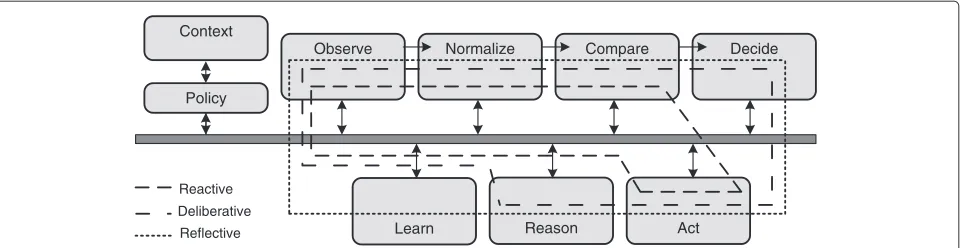
Figure 1The FOCALE control loops.FOCALE features several dynamic control loops: reactive, deliberative and reflective control loops. The control loop is formed by the following steps: Observe, Normalize, Compare, Decide, Act, Reason and Learn. The different types of control loops are shown on the figure. The reactive control loop takes immediate action based on external observations. The deliberative control loop uses long and short memory to create an action plan. The reflective control loop uses the learning component to take preventive actions in the future.
reason and learn components. Deliberative control loops receive data from and can send commands to the reactive processes. They use long and short term memory to create more elaborate plans of action. The deliberative loops run at a lower frequency and circumvent the learning com-ponent. Finally, the reflective control loops supervise the deliberative processes. They study decisions made in the past, and analyse them. The conclusions are then used to prevent sub-optimal actions from being taken again in the future. The reflective loops run at the lowest frequency.
The major advantage of the above described FOCALE cognitive control loop approach is its high variety in offered pro-activeness. As it consists of multiple control loops with different characteristics (reactive, deliberative and reflective) urgent tasks can be a less complex con-trol loop (e.g., a reactive variant) and iteratively improved later on by a more complex control loop (i.e., a deliber-ative or reflective control loop). The FOCALE cognitive control loops have mainly seen an implementation in the area of network and service management. In previ-ous work, we applied it to manage multimedia services by extending it with semantic capabilities [19]. In this work, the focus was on combining different elements to jointly manage a service such as the streaming of multi-media in a computer network. Choi et al. have embedded the FOCALE control loop in their HiMang architecture [20]. Their focus is more on the architectural aspect of the FOCALE architecture and less on the algorith-mic implementations of the different control loops: they investigate the integration with policies and information models. Moreover their application domain is different to our approach as they study cloud-based networks, Quality of Service management and fault management. Kim et al. have implemented the FOCALE control loops to manage OpenFlow-based networks (i.e., the protocol that steers the Software-Defined Networking paradigm) [21]. Their solution uses the FOCALE control loops to allow setting up and maintaining paths in OpenFlow,
even if unexpected link failures occur. Their approach focuses on maintaining datapath connectivity, while our approach has query optimization and management as pri-mary goal. For this reason, the algorithmic approach is completely different. The same authors have also imple-mented the FOCALE control loops to prioritize and group alarms raised by a network management system [16]. As this corresponds with a classification problem, it is more related to our approach. However, we use a semi-supervised learning approach through an anomaly detection algorithm, while they propose a more static rule-based approach.
Control theory approaches to query optimization
demands of software systems (e.g., a Web Server) [27]. Our approach extends this idea and introduces different levels of learnings.
Optimization of query processing often re-uses con-cepts of control theory and has mainly been studied in the context of grids [28]. More recently, with the grow-ing attention towards Big Data, new application domains of this research have been found [29]. These approaches typically focus on large scale and distributed databases. As such, they are complementary to our approach as they can be used if the scale of the database system itself increases (e.g., introducing a higher level of replication). Also in the area of query optimization, dynamic management approaches have been proposed. Paton et al. [30] propose an adaptive query processing algorithm with the same goal as our approach: reducing the overall response times of query processing. They focus mainly on the joint opti-mization of multiple queries as they are often grouped, requested by a single user. Park et al. present an approach where queries consisting of multiple joins are optimized [31]. Their main approach consists of developing mul-tiple candidate processing plans and only selecting the best plan after some initial pre-processing steps. Avnur et al. focus on adaptive query processing in large-scale and federated databases [32] by continuously reordering joins inside a sreorderingle query based on the observed -and highly dynamic - response times of subqueries in such a federated database. The above approaches can be seen as complementary solutions to our approach as they focus on the optimization of specific queries. As such, they investigate the structure of each query but are agnostic to the application demands regarding these queries. Instead, we focus on the application demands and allow the application to prioritize the queries based on the application logic and user expectations. By dis-abling less important queries we can already considerably improve the response time. This response time could even be improved further by applying the aforementioned techniques.
More generally speaking, the problem investigated in this article relates to dynamic scheduling in a resource constrained environment. In this area, several well-known techniques exist for scheduling requests (in our case: queries) such as earliest deadline first, first come first served, etc. We refer to the work of Suresh et al. for a com-plete survey of these approaches [33]. Also in grids [34] and, more recently, cloud systems [35] job and applica-tion scheduling algorithms have been successfully applied. These techniques typically have a very broad applica-tion domain but also often parameters to be set (e.g., the deadline of every request). In our approach, these tech-niques can be used as an alternative to the current applied optimization action: the disablement of less important queries. We chose not to use these actions as we observed
little effect in performance compared to a higher complex-ity in the configuration of the algorithm.
In summary, compared to the current state of the art, our approach is novel for the following reasons. First, the adopted three-layer approach, inspired by the FOCALE cognitive control loops, provides an important flexibility in the level of proactiveness that can be achieved. Com-pared to other data management approaches, we are able to quickly react to local problems and at the same time carry out more complex optimizations on a larger time scale. Second, to the best of the authors’s knowledge, our approach is the first that implements these control loops for data management. As such, the proposed anomaly detection algorithms and their integration with the three different loops, are completely novel and fundamentally different from previous approaches, which focused more on network and service management.
Methods
Problem statement
The COSARA platform is a platform for infection surveil-lance and antibiotic management in the intensive care [2]. It is being used by physicians and nurses at the ICU of Ghent University Hospital, as part of the clinical work-flow. COSARA is designed as a service oriented architec-ture and manages the antibiotic consumption and infec-tion related informainfec-tion in the ICU [2]. The COSARA system collects data from the laboratory, the clinical infor-mation system, and its own historical COSARA-database, processes these data, and presents the information or medical advice on a bedside computer, desktop at the physician’s office or at a mobile device.
The most frequently consulted data on the bedside com-puters consists of the patient’s clinical values and the microbiology results in this ICU. COSARA has a module offering a clinical overview with the values of tempera-ture, white bloodcell count (WBC), thrombocytes, organ failure score, and prescribed antibiotics, and a module giving all microbiology results (samples with cultures, antibiogram and blood analyses). The COSARA system is designed in such a way that each time a physician or nurse requests the clinical values of a patient, all necessary infor-mation is requested through a series of queries (called a query group). This typically results in a burst of queries, each time a patient record is requested.
0 20000 40000 60000 80000 100000 120000 140000 160000 180000 200000
3 4 5 6 7 8 9 10 11 12 13 14 15 16 17 18 19 20 21 22 23 0 1 2
M
ic
ro
b
iology Qu
ery
Gro
up
Exe
c
u
tio
n Time (ms)
Timeline (hours)
Mean 98th Perc
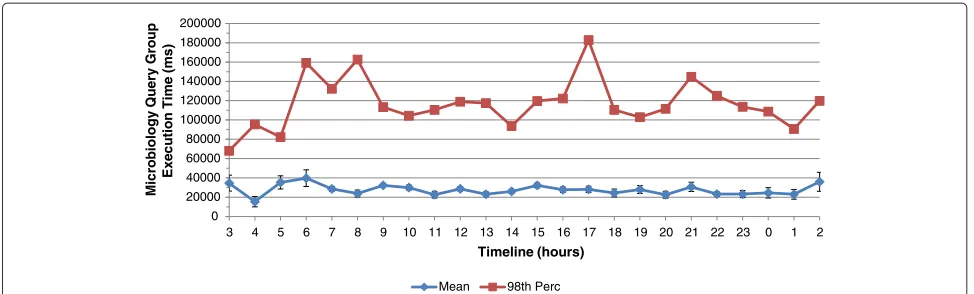
Figure 2Delay of COSARA microbiology query group over 24h window: average execution time and 98th percentile.This figure shows the delay of the COSARA microbiology query group, consisting of microbiology samples, cultures, antibiograms and analyses, over a 24h time window: the average execution time and 98th percentile. It corresponds to the page load of the microbiology module in the COSARA application. As shown, the highest peaks of the 98th percentile show execution times of 182 s, 162 s, 59 s in a 60 minutes time frame, whereas average execution times are observed around 27 s execution time.
shows the average execution time and 98th percentile required to retrieve the microbiology samples, cultures, antibiogram and analyses on the microbiology module. It shows the page load of the microbiology module in the COSARA application. As shown, the highest peaks of the 98th percentile show execution times of 182 s, 162 s and 59 s in a 60 minutes time frame, whereas average execu-tion times are observed around 27 s execuexecu-tion time. As physicians depend on the application to support their clin-ical decision, high delays have to be prevented. The human operator is unable to guard the execution of the 150 dif-ferent query types in the COSARA database. Therefore, potential delays in the data retrieval should be prevented autonomously by system components.
Architecture
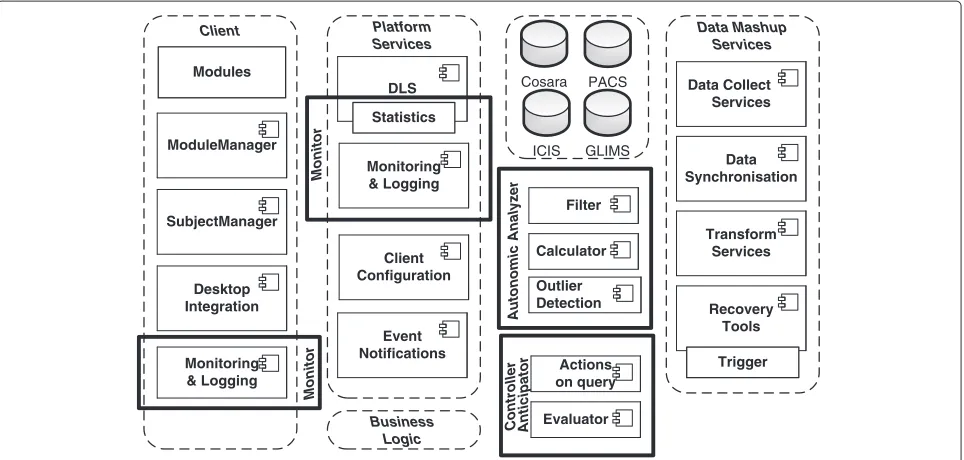
The system should identify, manage and thus prevent the performance issues autonomously by reacting quickly on behavior changes in the system components. These changes can result, for example, from high utilization or an increased frequency of data retrievals. To make appropriate and reliable decisions, the concern is to pos-sess data that is accurate enough, timely enough and consistent enough [36]. Figure 3 illustrates the domain where autonomic management is applied in health care: (i) the data management of timely bedside procedures and (ii) the management of data retrieval and process-ing. The COSARA service-oriented architecture consists of layers for presentation, business processing and data persistence [2]. We extended the architecture with com-ponents, as shown in Figure 4. The client is designed in a modular way (Modules and Module Manager) using the OSGi technology as basis. Modules can be added, removed or updated on all bedside clients by chang-ing the configuration on the server. Both in client and
platform services, monitoring and logging components
are added in order to be able to track the state of bed-side client and server-bed-side components. The Data Lookup Service (DLS), which forms the interface towards the data sources, is extended with a statistics component. The DLS logs every data access and includes the invocation time, the logical query name and the query’s execution time (in milliseconds). The DLS executes all queries (antibi-otics, laboratory, microbiology, infection-related queries) on the different data sources (the laboratory database GLIMS, the intensive care information system (ICIS) or
the COSARA database). Theautonomic analyzerensures
that the monitored data and logs are examined dynam-ically (as detailed in the control loops). In the iterative design and evaluation of COSARA, we already started with the addition of recovery tools and limited detection mechanisms, but the loop was not closed and the human administrator had to take action. The analyzer now detects performance decreases in the execution of queries
and instructs theController-Anticipator to respond and
adapt the query executions autonomously to optimize the quality of service. In the implemented control loops, the Controller-Anticipator responds by temporarily disabling less important queries, which are typically part of the query group stemming from a physician’s or nurse request for a patient record or background queries.
Figure 3Overview of the COSARA setting in ICU.This figure illustrates the domain where autonomic management is applied in health care. It includes the data management of timely bedside procedures and the management of data retrieval and processing. On the bedside screen the retrieval time for the microbiology data should be optimized. On the server side, the data management with underlying query executions on the database should be optimized further. The bedside and serverside management are linked with each other.
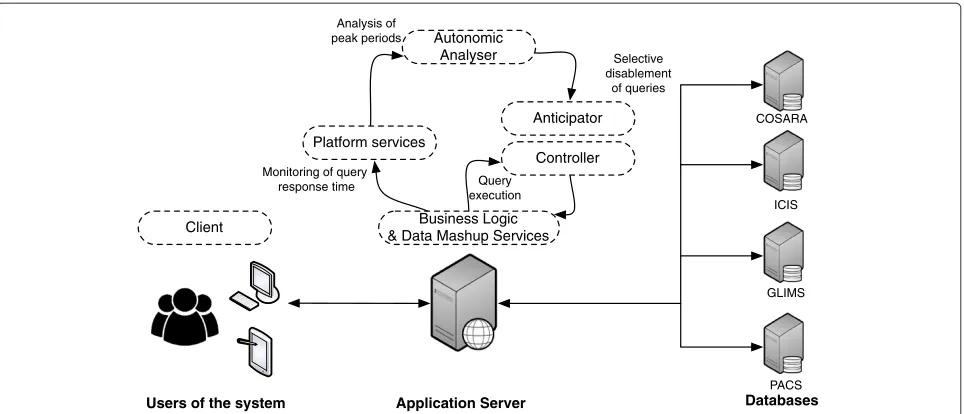
query execution and return of the result is monitored and grouped in the according query group. A query group is a group of queries that are all executed as a reaction to a user operation (e.g., the retrieval of a patient’s record). Note that the monitoring of these response times occurs completely locally. As discussed above, the result of these
measurements are analysed, which can potentially lead to the selective disablement of queries.
Note that we chose to disable the queries instead of opting for more complex scheduling algorithms as dis-cussed in Section ‘Related work’. The reason for this is the following: priority-based algorithms would assign lower
DLS
Client Configuration
Monitoring & Logging
Event Notifications
Platform Services
Statistics
Monit
or
Auton
omic
Analy
z
er
Cosara Data Collect ..
Services
Transform Services
Data Synchronisation
Data Mashup Services
Recovery Tools Filter
Calculator
Outlier Detection ModuleManager
SubjectManager
Desktop Integration
Modules
Client
Monitoring & Logging
Monitor
Business
Logic A
nt
icip
ator
Trigger
Controller
Actions on query
Evaluator . PACS
ICIS GLIMS
Figure 4The extended COSARA architecture.The COSARA architecture has been extended with components to enable autonomic
Client
Platform services
Business Logic & Data Mashup Services
Autonomic Analyser
Controller Anticipator
Users of the system Application Server Databases
Monitoring of query response time
Analysis of peak periods
Selective disablement
of queries
COSARA
ICIS
GLIMS
PACS Query
execution
Figure 5Mapping of the functional architecture to the physical topology of the application.This figure depicts how the functional architecture of Figure 4 maps to physical locations. Moreover, it shows how different functional modules in the architecture are connected with each other to form an autonomic control loop. Finally, it clarifies how response times are measured on the application server by interacting with the databases.
priorities to less relevant queries. The particular problem tackled in this manuscript, however, has to deal with long peak periods. As during peak periods, new high prior-ity queries are constantly being introduced, low-priorprior-ity queries are continously ignored, until their relevance becomes obsolete. As a result, their execution becomes useless and the effect is similar to action we chose, which is disabling the less important queries from the start.
Query selection process
As described above, the approach presented in this arti-cle aims at reducing the response times of queries during peak hours in the COSARA architecture by temporarily disabling less important queries. A first step in achieving this is the selection of queries, which have lower prior-ity for the users of the COSARA system. This requires domain knowledge about the application. In this section, we first describe how this knowledge is modelled and subsequently present an algorithm for selecting candidate queries.
Knowledge model
We model the domain knowledge of the COSARA
appli-cation using RDFa, which is a standardized model for data
interchange. One advantage of RDF is that models for well-known and generic concepts are available in RDF or
the ontology language OWLb, which uses RDF-based
seri-alization. For this reason, we re-use existing models for incorporating the relevant knowledge as much as possible.
More specifically, we use the IntelLEO Workflow
ontologyc to model how users and background
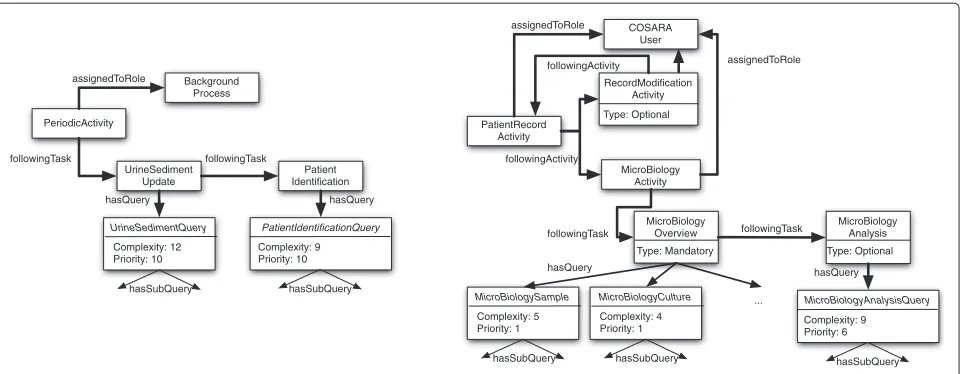
pro-cesses interact with the COSARA system. The IntelLEO Workflow ontology defines concepts such as roles and users, and allows defining a sequence of activities and tasks. As will be described below, this is used to define the clinical decision process of the users in combination with the COSARA system. In defining these workflows, we often need to refer to medical terminology. Therefore, we use the Galen ontology [37], which defines this ter-minology and their links. Finally, we need to model the application specific knowledge linked with the COSARA application (e.g., which queries are executed when). We do this by linking newly defined concepts to the tasks and activities defined in the workflow. More specifically, we allow a task to refer to a set of queries: each query can have subqueries and has attributes such as a value defining its complexity and priority.
PatientRecord Activity
MicroBiology Overview
MicroBiology Analysis
MicroBiologySample Complexity: 5 Priority: 1
MicroBiologyAnalysisQuery Complexity: 9 Priority: 6 COSARA
User
hasSubQuery hasSubQuery
hasQuery assignedToRole
followingActivity
Activity Type: Optional
MicroBiology Activity
assignedToRole followingActivity
MicroBiologyCulture Complexity: 4 Priority: 1
hasSubQuery
followingTask followingTask
...
Type: Mandatory Type: Optional hasQuery
PeriodicActivity
UrineSediment Update
Patient
UrineSedimentQuery Complexity: 12 Priority: 10
Complexity: 9 Priority: 10 Background
Process
hasSubQuery hasSubQuery
hasQuery hasQuery
assignedToRole
followingTask followingTask
Figure 6Knowledge modelling of two illustrative workflows in the COSARA system: one periodic background process and one user-triggered process.This figure shows an example of how domain knowledge about the COSARA application, and more specifically the interaction between workflow and query optimization, is modeled in our approach. Two illustrative workflows are shown: one corresponding with an automated background process and one corresponding with a sequence of activities carried out by a COSARA user.
value, corresponds to a low priority). The user-triggered activity details how a user accesses microbiology results in the COSARA application. The user is first shown a summarized view on the patient’s details. To create this view several queries are required. The user then has the option to either modify the patient’s details (after which he returns to the patient overview) or to get an overview of the microbiology details. This microbiology activity con-sists of one mandatory task (with several queries required to create this view) and one optional task, which performs the analysis of the results.
Identification of candidate queries for disablement
In this section, we present an assisted algorithm for iden-tifying less important queries. The algorithm ranks the different queries in the COSARA system based on their importance for the users. This ranking is then given to an administrator as an aid in selecting the queries that can be disabled when a scarcity in resources occur.
Overall, the ranking is done based on three factors (i) the visibility of the queries in the application, (ii) the query’s complexity and (iii) the importance of the queries in the clinical decision process. The algorithm provides a formal implementation of a manual heuristic, which was initially carried out by the administrator of the COSARA system. An overview of the algorithm is given in Algorithm 1. As shown, the algorithm iterates on all dif-ferent activities and corresponding tasks and queries in the workflow. Each query is given an initial rank of 1, which corresponds to the highest importance. However, several factors can increase the rank value (i.e., lower the query’s importance). For example, background processes
and optional activities or tasks are penalized with a factor (PenaltyNonUser, PenaltyOptionalActivity and Penalty-OptionalTask, respectively). Moreover, high complexity and priority values further increase the rank value. The set of queries and their according rank are stored, sorted and finally presented to the administrator for revision. The query selection process only determines the order of the queries and leaves it up to the administrator to select the actual queries for disablement.
Algorithm 1 Algorithmic details of the query selection process.
1: queries←φ
2: activities←getAllActivities()
3: for allactivity∈activitiesdo 4: rank←1
5: if activity.assignedToRole == BackgroundProcess
then
6: rank←rank×PenaltyNonUser
7: ifactivity.type == Optionalthen
8: rank←rank×PenaltyOptionalActivity 9: for alltask∈activity.tasksdo
10: iftask.type == Optionalthen
11: rank←rank×PenaltyOptionalTask 12: for allquery∈task.queriesdo
13: qrank←rank×query.complexity
14: qrank←qrank×query.priority
15: queries←queries +{query→qrank}
16: sort(queries)
Design of FOCALE-based control loops in the COSARA architecture
Following the FOCALE cognition model, we define three dynamic control loops with the aim of optimizing the per-formance of query execution. The goal of all three control loops is to keep the response time of a query group below a threshold, which corresponds with an acceptable delay. Note that the quantization of an acceptable delay is a sub-jective matter as it relates to how the users of the system perceive it quality (i.e., the so called Quality of Experience). Furthermore, what is acceptable also depends both on the type of application and type of operation performed (i.e., the type of query group). For our COSARA system, an acceptable delay for the most occurring query group (i.e., the microbiology query group) is up to approximately 25 seconds. This value was determined through discus-sions with the users of the COSARA system and based on their day-to-day experience with the system.
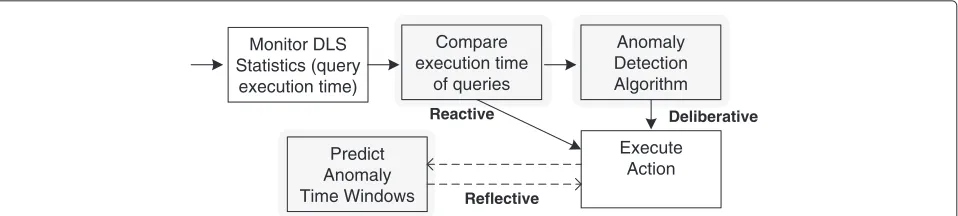
Performance is monitored via a statistics component in the data lookup service (DLS) which stores the execu-tion time for each query. By analyzing the execuexecu-tion time and deciding when a serious performance delay occurs, other queries can be disabled temporarily to ensure faster retrieval of patient’s data in the displayed client mod-ule. The method to decide and take action differs in the three presented control loops. Figure 7 depicts the activ-ities of each control loop as explained below. Reactive control loops take immediate actions based on immedi-ately perceived external stimuli, while the deliberative and reflective loops feature an increased level of learning: the first based on anomaly detection, while the later focuses on the clustering and detection of temporal patterns. We describe the details of all three loops in the remainder of this section.
Reactive control loop
The goal of the reactive control loop is to detect the occur-rence of a large disruption of the system. Only if the per-formance of the system is severely affected, an immediate action is taken corresponding with the disablement of less
important queries. As such, the reactive control loop con-tinuously monitors the delay of page loads, as observed by the physician, in the COSARA application. To do this, the execution times of all all queries in the DLS component are monitored (FOCALE’s monitor step) and summed to a total delay as several queries will be responsible for a single page load (observe step). When this total delay is
unac-ceptably high, denoted by the thresholdtreactive, an alarm
is raised in the control loop (Compare step). The effect of this alarm is the following: on one hand the administrator gets notified of the data problem to allow him to have a closer look of the root cause of the anomaly. On the other hand, an automatic action is also taken to ensure a grace-ful degradation of the system. Therefore, the automatic execution of a subset of queries, corresponding to less important data retrievals (e.g., cron jobs, side
informa-tion) is disabled for a time windowWreactive. As the total
number of queries will decrease, the goal of the reactive control loop is to considerably reduce the overall per-ceived delay. For example, to improve the execution of microbiology samples, redundant queries of urine sedi-ment are disabled because these queries are not shown in the module. If the physician wants to consult this urine value, a warning informs him that the query is disabled temporarily. The physician can retrieve the value by click-ing a request button, in which case the value is retrieved using a duplicate urine sediment query (which can only be executed on request and is not filtered). As these urine sediment queries will only be executed when the data is actually required by the physician, the number of queries will be considerably reduced.
Deliberative control loop
In the deliberative control loop, decisions and actions are made using an anomaly detection algorithm. In this loop there is an explicit evaluation of the decision before act-ing. This control loop continuously monitors the query execution time of each individual query and groups them according to the query type. Note that, in contrast to the reactive control loop, the monitoring occurs based on
Monitor DLS Statistics (query
execution time)
Compare execution time
of queries
Anomaly Detection Algorithm
Reactive Deliberative
Predict Anomaly Time Windows
Execute Action
Reflective
each individual query and not on the grouped perceived page load. By monitoring each query type, a specific model is built that represents the typical expected query execution time of each query type. Based on this model, an anomaly detection algorithm can detect out of profile behaviour, i.e., outliers. If the share of recently detected outliers becomes abnormally high, a similar query disable-ment action as carried out in the reactive control loop is executed. Queries are proactively disabled when a dis-ruption of the system is likely to occur (i.e., signalled by an increased share of abnormal individual query execu-tions). This is in contrast to the reactive control loop where queries are disabled after a system disruption is detected. Therefore, the deliberative control loop detects patterns that typically occur just before a shortage of resources (leading to high response times) and enforces a pro-active disablement of queries to avoid the resource shortage. Additionally the deliberative control loop incor-porated knowledge from a domain expert to detect the outliers. As such, the control loop consists of a training phase, where the system is trained to build the model and detect outliers, and a deployment phase, where the outliers are detected on-line and appropriate actions are taken. We discuss the algorithmic details of both phases in the remainder of this section.
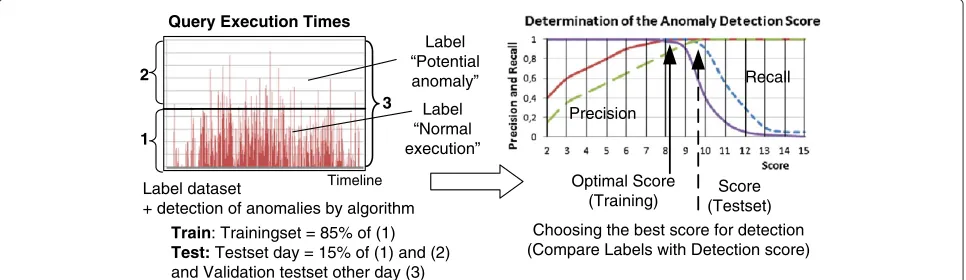
Training phase During the training phase, a model is built for each query type based on knowledge from a domain expert. This is shown in Figure 8. In a first step, a
historical data setDcontaining the query execution times
and query types over the course of a day is labeled by the domain expert (e.g., the system operator). The goal of the
labelling is to select a subsetDnormalcorresponding with
normal query execution times for each query type.
Conse-quently, the subsetDoutlier≡D\Dnormalcorresponds with
abnormal or out of profile query executions. In a second
step, a random subsetDtrain ⊂ Dnormalis taken as
train-ing set. In our case, we take 85% of random samples out ofDnormal. Based onDtrain, a model can be built of normal
query execution times by calculating the mean and
stan-dard deviation of the population in Dtrain. These values
are then used to determine whether a random samplex
of query execution times belongs to the calculated model or not. To do this, a z-score is calculated, which is a well known anomaly detection algorithm, as follows:
z(x)= |x−μ(Dtrain)| σ (Dtrain)
(1)
Here, μ(Dtrain) denotes the mean of Dtrain, while
σ (Dtrain)is the standard deviation ofDtrain. The larger the
calculated z-score is, the more likely the samplex is to
be an outlier. However, it is difficult to define a threshold for this as this depends on the distribution of the dataset, which is unknown. To address this, in a third and final
step, the remaining datasetDtest ≡ D\Dtrainis used for
determining a thresholdzt. Based on this threshold, a
ran-dom samplexcan be classified as an outlier (ifz(x) >zt)
or not. Note thatDoutlier ⊂ Dtest: hence,Dtest will
con-tain both normal and out of profile query execution times.
For eachx ∈ Dtest, the z-score as defined in Equation
(1) is calculated. Furthermore, for several possible values
of zt, the samples x are classified and the classification
is compared with the labelling ofDoutlier andDnormal by
the domain expert. By comparing the classification for a
givenztparameter configuration and the classification by
the domain expert, the bestzt parameter configuration
can be chosen. More specifically, we select thezt
param-eter that maximises the precision and recall values, two metrics that are used to assess the accuracy of a classi-fication system. Precision is calculated as the number of
Precision
Recall
Optimal Score
(Training) (Testset)Score
Choosing the best score for detection (Compare Labels with Detection score) Label dataset
+ detection of anomalies by algorithm Query Execution Times
1 2
3 Label
“Normal execution”
Train: Trainingset = 85% of (1) Test:Testset day = 15% of (1) and (2) and Validation testset other day (3)
Label “Potential anomaly”
Timeline
true positives (i.e. the number of true outliers) divided by the total number of elements belonging to the posi-tive/outliers class (i.e. the number of detected outliers by the algorithm, and also including those that were listed as outlier but are not observed outlier). Recall is defined as the number of true positives divided by the total number of elements observed as outlier (i.e. the number of out-liers that were detected, and also including those that were missed by the outlier detection). The result of the training phase is (i) a model for each query type, defined through the mean and standard deviation of a population of that type, that defines the normal behaviour of query execution
times for that query type and (ii) a thresholdzt for each
query type that can be used to perform an on-line outlier detection in the deployment phase.
Deployment phase Once trained, the calculated model and threshold can be used to detect the occurrence of outliers on-line for each query type and act accordingly. Therefore, the deliberative control loop will continuously monitor the query execution times for each individual query and will classify each execution time as being nor-mal or out profile according to the trained configuration. Next, the share of outliers compared to the total set of
queries in the last time window Wdelib is continuously
calculated. If the calculated share exceeds a predefined
threshold soutlier, the deliberative control loop assumes
that there is a high risk of system degradation. As a reac-tion, it decides to execute actions that can reduce the typical query execution times (e.g., disabling other queries as discussed in Section ‘Identification of candidate queries for disablement’.
Reflective control loop
In the reflective control loop, the long term memory is taken into account to take proactive actions (i.e, before the execution of the actual queries). The reflective loop detects temporal patterns in the occurrence of outliers and proactively disables low priority queries. In practice, the COSARA system often experiences quality degrada-tions during peak periods (e.g., at the beginning and end of the work day of physicians). The goal of the reflective con-trol loop is to autonomically detect these peak periods and disable the queries accordingly. Therefore, the reflective control loop has a similar goal as the deliberative control loop: it proactively disables queries to avoid high response times. The main difference is that the reflective control loop focuses on diurnal effects (i.e., patterns that can be observed on a daily basis) and disables queries for a longer time period (i.e., at least 30 minutes) based on detected historical patterns on a very long time frame (i.e., several weeks).
The reflective control loop works as follows. Based on the data setDoutlier, constructed in the deliberative control
loop using the z-score-based anomaly detection algo-rithm, a new data setDreflis derived. As discussed,Doutlier
contains all queries (with their response time and time of execution information), which are identified by the delib-erative control loop of having abnormally high execution times (i.e., being outliers).
Based on this set of outliers, the data setDrefl denotes
the frequency of outliers given the current time of day. To determine the frequency, we use bins of
correspond-ing to a 30 minute time window. Hence,Drefl contains 48
elements. Note that, two outliers occurring on complete different days but on the same time of day will be assigned to the same bin. The relevance of this newly constructed data set is the following: we observed that peak periods often occur at the moment in time across days. This is because the physicians and nurses often use the COSARA system, as part of their routine, at the same time each day. The typical busy hours every day correspond with the start and end of every working day as well as the lunch break (around noon).
By deriving the data setDrefl we can identify the
afore-mentioned busy hours, as they will correspond with a
high number of outliers inDoutlier and thus in large
val-ues for the frequency in that time zone. In order to detect the highest values, we apply the same anomaly detection algorithm as discussed above: we calculate the z-score as well as the optimal z-score threshold and classify a time window as an outlier if its z-score is above the defined threshold. This process is illustrated in Figure 9.
In this context, the detection of an outlier signifies a time window of 30 minutes, where the deliberative control loop has found an abnormal amount of high response times. Hence, this builds further on the knowl-edge learned in the previous control loop. If such a time window is identified as an outlier, the queries are disabled during that time window. This is done pro-actively on every day in the future, until the reflective control loop no longer flags this as a busy period.
Results and discussion
In this section we study the influence of the actions of the FOCALE based reactive and deliberative control loops on the query execution time. The executed queries of a ran-dom day in January 2012 were taken and executed again in a test environment, as described in the evaluation setup. The duration of each COSARA query was measured. In these experiments we evaluated the impact of an imme-diate action in reactive control loop, the decision to take action by the described anomaly detection algorithm in the deliberative loop and its impact.
Evaluation setup
Learn where anomalies occur in time and take action in that time window
Query Execution Times
Timeline
Query Execution Times
Timeline
Determine time window with high frequency of anomalies
Take action in that predicted time window to optimize the queries
Figure 9Schematic illustration of the choice of a time window with high frequency of anomalies.This schematic illustration shows the reflective control loop step. In a time window with a constant high frequency of anomalies an action is taken. The action prevents the high execution times in a time window. It is learned where anomalies occur in time and the action is taken in that specific time window.
logging the performed queries in the production environ-ment, we were able to emulate the query executions on the COSARA database in a test environment and evaluate the impact of optimization without interfering in the clinical workflow of the production environment. Due to the sen-sitivity of the patients’ electronic health records and the medical decisions based on this data, we have replicated the COSARA database queries on test servers. In this section, we detail the used experimental setup to repli-cate COSARA’s behavior. In the experiments we measure the query execution times by replicating the COSARA queries in a multi-threaded application. By replaying the queries again with a specific action, we are able to eval-uate the impact of action by the control loops on the query execution time. In the action we disable the queries COSARA UrineSediment and Identification as these were identified as less important by our query selection pro-cess. For executing the query selection process, we set the penalty parameters PenaltyUser, PenaltyOptionalActivity and PenaltyOptionalTask to 10, 5 and 3, respectively. The UrineSediment queries retrieve the urine sediment value. The Identification queries retrieve changes made to the identification. Both queries are not important when the physician is actually displaying the patients’ microbiology.
The results include the average query execution time of the query executions. These percentiles show the worst execution times. These executions cause delay on the physicians screen while displaying microbiology samples. The experiments were carried out on one core Intel Xeon E5620 processor with 2.40 GHz and 3.0 GB RAM. We emulated the client and server interaction by replicat-ing the COSARA queries of the trace log. As such, it shows behavior identical to the query executions in pro-duction environment. Figure 10 shows the test setup. On the server node a MySQL database server 5.0.51 is running and on the client node we rerun the real exe-cuted queries and measure its execution time and the improvements by the actions in the presented control loops.
Performance evaluation of the control loops Performance evaluation of the reactive control loop
In the reactive control loop an action is immediately taken if the performance is severely affected. We set parameter
treactive to 90,000 ms and parameter Wreactive to 2
min-utes. The valuetreactivecorresponds to the execution time,
which is considered very obstructive by the COSARA user. It is expected that similar high execution times are
0 5000 10000 15000 20000 25000 30000 35000 40000 45000 50000
3 4 5 6 7 8 9 10 11 12 13 14 15 16 17 18 19 20 21 22 23 0 1 2
Microbiology Query
Group
Exe
c
ution
Time
(m
s)
Time (hours)
Mean Mean React
Figure 11Average execution time of microbiology query group without management and with actions by reactive loop.This figure shows the average execution time of the microbiology query group over 24 hours without autonomic management and with actions taken by the reactive control loop. The average exeution time is 27 s without autonomic action and 24 s with the reactive action.
prevented by setting a time window of 2 minutes for the action.
Figure 11 depicts the average execution time of a COSARA microbiology group without autonomic man-agement actions and with the action taken in the reactive control loop. The average execution time is 27,308 ms without autonomic action and 24,956 ms with the reac-tive action. The reacreac-tive control loop provides a gain of 8.61% or 2,352 ms on the average query execution time of the microbiology query group. The impact of the con-trol loops on the query execution times of microbiology queries group is analysed per hour, as shown in Figure 11. The highest gain is observed in the period from 9 to 10 am with a reduction of 15.92% on the average execution time.
Performance evaluation of the deliberative control loop
The reactive control loop already offers an important gain but optimizations are still possible. In the deliberative
control loop the decision and action are made using an anomaly detection algorithm. In this section we evaluate the effect of the deliberative control loop on the query execution times. First we determine the detection score
zt, as discussed in Section ‘Deliberative control loop’.
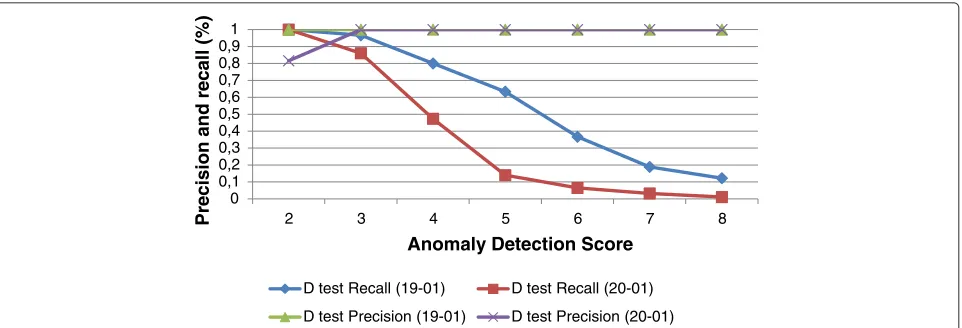
We varied the score from 2 to 8. Figure 12 shows an example of the determination of the anomaly detection score with precision and recall (based on training set, data log of January, 19, 2012). Based on this we set the
anomaly detection scoreztto 2 because of its highest
pre-cision and recall. The figure also shows the prepre-cision and
recall of Dtest (log results of January, 20, 2012, the test
set). We analysed the queries which retrieve microbiology samples, cultures, antibiogram and analyses and
deter-mined the scores. Then, we setWdelibto a time period of
1000 ms in which queries were executed. The parameter
soutlier was set to 20% to obtain the best share of outliers. The action, identical to the disabling of queries in the
reactive loop, was performed whensoutlier was exceeded.
0 0,1 0,2 0,3 0,4 0,5 0,6 0,7 0,8 0,9 1
2 3 4 5 6 7 8
Pr
e
c
ision
a
nd r
e
c
a
ll (%)
Anomaly Detection Score
D test Recall (19-01) D test Recall (20-01)
D test Precision (19-01) D test Precision (20-01)
0 5000 10000 15000 20000 25000 30000 35000 40000 45000 50000
3 4 5 6 7 8 9 10 11 12 13 14 15 16 17 18 19 20 21 22 23 0 1 2
Microbiology Query
Gro
up
Ex
ecu
tio
n
Time
(m
s)
Time (hours)
Mean Mean React + Delib
Figure 13Average execution time of microbiology without management and with actions taken by reactive, deliberative loops.The figure shows the average execution time of the microbiology query group over 24 hours without autonomic management and with actions taken by the reactive and deliberative control loops.
Figure 13 shows the average query execution time without autonomic management and with actions taken in the reactive and deliberative control loop. We compared each observation with its original execution time. The combi-nation of the reactive and deliberative control loop per-forms better than only the reactive one. The combination gives a reduction of 2,980 ms or 10.92% to the original average execution time without management. The com-bined actions give an average execution time of 24,327 ms. The highest reduction of the average execution time is observed in the period from 9 to 10 am with a reduction of 19.69%.
Performance evaluation of the reflective control loop
In the reflective control loop, queries are disabled proac-tively during peak periods of high query execution times. In the detected time intervals (7h to 7h30), (9h to 10h), (12h to 12h30) and (16h to 17h), we disable the UrineSed-iment and Identification query proactively. The combi-nation of the reactive, deliberative and reflective actions
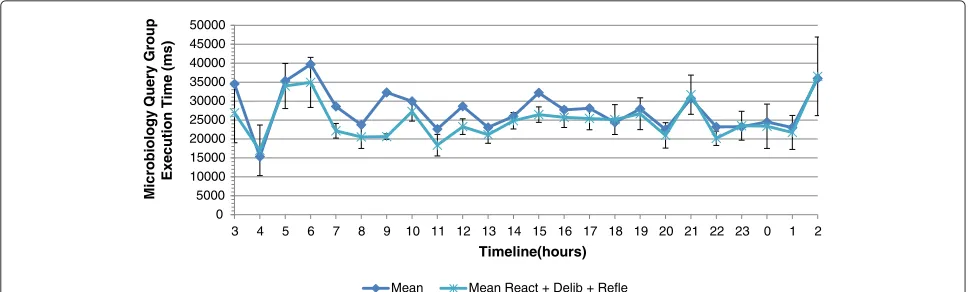
affects the query group execution times additionally during the selected time intervals. Figure 14 shows the average query group execution time per hour. The micro-biology group query execution time without autonomic management is 27,308 ms, where the execution time with the combination of reactive, deliberative and reflective actions is 23,747 ms or a reduction with 13.04%. In abso-lute values, the above results show that we can keep the average response times below 25 seconds with the excep-tion of peaks caused by nightly background tasks, which are not perceivable by the users. As discussed above and based on feedback from the users of the COSARA system, this is an acceptable response time. In the selected time interval from 9 to 10 am, a reduction of 36.11% is observed on the average exeution time by applying the three con-trol loops where the reactive gave only a reduction of 15.92% and the reactive and deliberative gave a reduction of 19.69%. The reflective control loop acts proactively dur-ing predicted peak periods and hence prevents high query execution times.
0 5000 10000 15000 20000 25000 30000 35000 40000 45000 50000
3 4 5 6 7 8 9 10 11 12 13 14 15 16 17 18 19 20 21 22 23 0 1 2
M
ic
robiology Que
ry
Gro
up
Exe
c
ution Time
(ms)
Timeline(hours)
Mean Mean React + Delib + Refle
14000 16000 18000 20000 22000 24000 26000 28000
Mean
Av
erage Mi
c
robi
o
lo
gy Query
G
roup
Execution Time (ms)
Without Mgmt
React
React+Delib
React+Delib+Refle
Baseline
Figure 15Comparison of the average microbiology query execution time without and with autonomic management.The average microbiology query execution time is compared. The figure shows the query exeuction time of the reactive, deliberative and reflective control loops. It shows the affected average query execution times with the combined control loops and the baseline over 24 hours.
Discussion
The proposed solution introduces an alternative to sim-ply increasing the amount of resources by upgrading the physical infrastructure. The control loop solution is viable as the response times in query processing experience important peak periods during certain moments in time (e.g., the beginning and end of the day). Upgrading the physical infrastructure to accommodate these peaks is possible, but at the same time costly as the infrastructure would often be idle during less busy periods. As our solu-tion takes care of the abnormally high peaks in response
time, the result is a more flat behaviour of response time over the day. Therefore, if the system’s usage would increase further, deploying alternative solutions such as database replication in combination with our proposed solution will be more advantageous.
Figure 15 and Figure 16 summarize all the evalu-ation results. Figure 15 compares the average query group execution times. The reactive control loop reduces the average execution time by 8.61%. The combination of the actions of the reactive and deliberative control loop reduce the average execution time by 10.92%. The
50000 60000 70000 80000 90000 100000 110000 120000 130000
95th Percentile 98th Percentile
Aver
age Microbiology
Q
u
ery
Group
Exe
c
ution Ti
me (ms)
Without Mgmt React React+Delib React+Delib+Refle Baseline
combination with the reflective control loop affects the average execution time with 13.04%. By disabling the queries during the whole day the baseline is set. Although this shows the highest possible gain, the queries COSARA UrineSediment and Identification are disabled completely. Compared to the baseline, the control loops provide a reduction of more than one third of the possible improve-ment. The baseline showed a difference of 32.09% com-pared to the average execution time without actions. We also compared the effect on the 95th and 98th percentile, as shown in Figure 16. The reactive control loop, reac-tive and deliberareac-tive control loop, and reacreac-tive, delibera-tive and reflecdelibera-tive show reductions of 8.79%, 11.04% and 13.57% respectively in the 95th percentile. In the 98th per-centile the execution time is reduced by 6.27%, 8.07% and 8.50% respectively.
Overall, the solution has a high scalability for several reasons. All three control loops rely on detecting peaks based on summarized data. This means that the memory consumption does not grow linearly with an increasing number of users of the system. Furthermore, the control loops introduce only a marginal overhead in terms of com-putational complexity. Finally, in the design of all three loops, care has been taken to maintain a good scalabil-ity. For example, the reactive control loop was deliberately kept relatively simple in terms of computational complex-ity and memory consumption as it needs to run at a very high frequency (i.e., in the order of seconds). Control loops which run on a more daily basis (e.g., the reflective control loop) are allowed to introduce a higher complex-ity. Note that, as the reflective control loop mainly relies on clustering, it also has a high scalability as the number of users increases.
Conclusions
This paper presents the extension of the existing health care platform COSARA in the ICU with autonomic con-trol loops. The introduced concon-trol loops provide an auto-mated mechanism to detect low performance and to take action, thereby limiting human technical interventions. The monitoring of the execution times of the data queries of this real life intensive care platform allow the inves-tigation of low performance. A reactive, deliberative and reflective control loop have been proposed to optimize the data query performance and thus the page load of the microbiology module. In the reactive control loop the action is immediately taken when the performance of the system is affected. The action disables less important queries not relevant for the display of microbiology data. In the deliberative control loop we use an anomaly detec-tion algorithm with an explicit evaluadetec-tion of the decision before the action is taken. In the reflective control loop, proactive actions are taken after temporal patterns of out-liers are detected. We evaluated the impact of the reactive,
deliberative and reflective control loop on the query exe-cution of the microbiology data. The results show a time reduction of 8.61% by the reactive control loop on the average query execution times. The addition of the delib-erative control loop reduced the average query execution time by 10.9% and by combining the three control loops the average execution time was reduced by 13.04%.
Endnotes
a Resource Description Framework (RDF) - http://
www.w3.org/RDF/
b OWL Web Ontology Language Overview - http://
www.w3.org/TR/owl-features/
c IntelLEO Workflow ontology - http://www.intelleo.
eu/ontologies/workflow/spec/
Competing interests
The authors declare that they have no competing interests.
Authors’ contributions
The work presented was carried out in collaboration between all authors. KS and SL carried out the study of the control loops on the COSARA platform, participated in the design and development of the control loops as described in this paper and drafted the manuscript. FDT and JD supervised the study, participated in the design and coordination and helped to draft the final manuscript. All authors read and approved the final manuscript.
Acknowledgements
The authors would like to thank the Institute for the Promotion of Innovation by Science and Technology in Flanders (IWT) for supporting the COSARA research project.
Author details
1Department of Information Technology, Ghent University - iMinds Gaston Crommenlaan 8 Bus 201, 9050 Gent, Belgium.2Department of Mathematics and Computer Science, University of Antwerp - iMinds, Middelheimlaan 1, 2020 Antwerp, Belgium.3Department of Intensive Care, Ghent University Hospital, De Pintelaan 185, 9000 Gent, Belgium.
Received: 22 February 2013 Accepted: 16 October 2013 Published: 27 October 2013
References
1. Kephart JO, Chess DM:The vision of autonomic computing.Computer
2003,36:41–50. http://dx.doi.org/10.1109/MC.2003.1160055. 2. Steurbaut K, Colpaert K, Gadeyne B, Depuydt P, Vosters P, Danneels C,
Benoit D, Decruyenaere J, De Turck F:COSARA: integrated service platform for infection surveillance and antibiotic management in the ICU.J Med Syst2012,36(6):3765–3775. http://dx.doi.org/10.1007/ s10916-012-9849-8.
3. Pour G:Prospects for expanding telehealth: multi-agent autonomic architectures.InComputational Intelligence for Modelling, Control and Automation, 2006 and International Conference on Intelligent Agents, Web Technologies and Internet Commerce, International Conference on. Sydney: IEEE; 2006:130. http://dx.doi.org/10.1109/CIMCA.2006.166.
4. Strowes S, Badr N, Heeps S, Lupu E, Sloman M:An event service supporting Autonomic Management of Ubiquitous Systems for e-Health.In26th IEEE International Conference on Distributed Computing Systems Workshops (ICDCSW‘06). Lisbon: IEEE; 2006:22. http://dx.doi.org/ 10.1109/ICDCSW.2006.17.
5. Lupu E, Dulay N, Sloman M, Sventek J, Heeps S, Strowes S, Twidle K, Keoh SL, Filho AS:AMUSE: Autonomic Management of Ubiquitous e-Health Systems.Concurr Comput Pract Exper2008,20(3):277–295. http://dx.doi.org/10.1002/cpe.v20:3.
International ICST Conference on Pervasive Computing Technologies for Healthcare. London: ICST; 2009:1–8. http://dx.doi.org/10.4108/ICST. PERVASIVEHEALTH2009.5939.
7. Omar WM, Samir K, Taleb-Bendiab A:Autonomic model for managing complex healthcare applications.InFourth IEEE International Workshop on Engineering of Autonomic and Autonomous Systems (EASe‘07). Newcastle-under-Lyme: IEEE; 2007:94–98. http://dx.doi.org/10.1109/EASE. 2007.7.
8. Almomen S, Menascé DA:An autonomic computing framework for self-managed emergency departments.InHEALTHINF. Edited by Traver V, Fred ALN, Filipe J, Gamboa H, Traver V, Fred ALN, Filipe J, Gamboa H. Rome: SciTePress; 2011:52–60. [http://dblp.uni-trier.de/rec/ bibtex/conf/biostec/AlmomenM11]
9. Arozarena P, Toribio R, Kielthy J, Quinn K, Zach M:Probabilistic fault diagnosis in the MAGNETO autonomic control loop mechanisms for autonomous management of networks and services.InHEALTHINF Volume 6155 of Lecture Notes in Computer Science. Berlin, Heidelberg: Springer Berlin / Heidelberg; 2010:102–105. http://dx.doi.org/10.1007/ 978-3-642-13986-4_14.
10. Movahedi Z, Ayari M, Langar R, Pujolle G:A survey of autonomic network architectures and evaluation criteria.Commun Surv Tutorials, IEEE2012,14(2):464–490. http://dx.doi.org/10.1109/SURV.2011. 042711.00078.
11. Marquezan CC, Granville LZ:State of the art self-* and P2P for network management.InCommunications Surveys & Tutorials, IEEE,SpringerBriefs in Computer Science. London: Springer London; 2012:5–25.
http://dx.doi.org/10.1007/978-1-4471-4201-0_2.
12. Smith D, Guan Q, Fu S:An anomaly detection framework for autonomic management of compute cloud systems.InComputer Software and Applications Conference Workshops (COMPSACW) 2010 IEEE 34th Annual: IEEE; 2010:376–381. http://dx.doi.org/10.1109/COMPSACW. 2010.72.
13. Chandola V, Banerjee A, Kumar V:Anomaly detection: a survey.ACM Comput Surv2009,41(3):1–72. http://dx.doi.org/10.1145/1541880.1541882. 14. Rabatel J, Bringay S, Poncelet P:Anomaly detection in monitoring
sensor data for preventive maintenance.Expert Syst with Appl2011, 38(6):7003–7015. http://dx.doi.org/10.1016/j.eswa.2010.12.014. 15. Strassner J, Hong JWK, van der Meer S:The design of an autonomic
element for managing emerging networks and services.InUltra Modern Telecommunications & Workshops, 2009, ICUMT. International Conference on. Saint-Petersburg: IEEE; 2009:1–8. http://dx.doi.org/ 10.1109/ICUMT.2009.5345533.
16. Kim SS, Seo S s, Kang JM, Hong JWK:Autonomic fault management based on cognitive control loops.InNetwork Operations and Management Symposium (NOMS) 2012 IEEE. Maui: IEEE; 2012:1104–1110. http://dx.doi.org/10.1109/NOMS.2012.6212036.
17. Lozano JA, Castro A, González JM, López de Vergara JE, Villagrá VA, Olmedo V:Autonomic Provisioning Model for Digital Home Services Modelling Autonomic Communications Environments.InModelling Autonomic Communications Environments Volume 5276 of Lecture Notes in Computer Science. Edited by Meer S, Burgess M, Denazis S. Berlin, Heidelberg: Springer, Berlin / Heidelberg; 2008:114–119. http://dx.doi.org/10.1007/978-3-540-87355-6_11.
18. Sloman A:Designing human-like minds.InIn Proceedings of the 1997 European Conference on Arti Life (ECAL-97). Brighton, Heidelberg: Springer Berlin; 1997. [http://citeseerx.ist.psu.edu/viewdoc/summary?doi=10.1.1. 210.3370]
19. Famaey J, Latré S, Strassner J, Turck FD:Semantic context dissemination and service matchmaking in future network management.Int J Netw Manag2012,22(4):285–310. http://dx.doi.org/10.1002/nem.805. 20. Choi T, Lee TH, Kodirov N, Lee J, Kim D, Kang JM, Kim S, Strassner J, Hong
JK:HiMang: Highly manageable network and service architecture for new generation.Commun Netw, J2011,13(6):552–566.
21. Kim S, Kang JM, Seo S s, Hong JWK:A cognitive model-based approach for autonomic fault management in OpenFlow networks.Int J Netw Manag2013. pre–print. http://dx.doi.org/10.1002/nem.1839.
22. Abdelzaher T, Diao Y, Hellerstein J, Lu C, Zhu X:Introduction to control theory and its application to computing systems.InPerformance Modeling and Engineering. Edited by Liu Z, Xia C. US: Springer; 2008:185–215. http://dx.doi.org/10.1007/978-0-387-79361-0_7.
23. Abdelzaher T, Stankovic J, Lu C, Zhang R, Lu Y:Feedback performance control in software services.Control Syst IEEE2003,23(3):74–90. 24. Lu C, Lu Y, Abdelzaher T, Stankovic J, Son SH:Feedback control
architecture and design methodology for service delay guarantees in web Servers.Parallel Distributed Syst IEEE Trans2006,17(9):1014–1027. 25. Hellerstein JL, Morrison V, Eilebrecht E:Applying control theory in the
real world: experience with building a controller for the .NET thread pool.SIGMETRICS Perform Eval Rev2010,37(3):38–42.
http://doi.acm.org/10.1145/1710115.1710123.
26. Parekh S, Gandhi N, Hellerstein J, Tilbury D, Jayram T, Bigus J:Using control theory to achieve service level objectives in performance management.InIntegrated Network Management Proceedings, 2001, IEEE/IFIP International Symposium on. Seattle: IEEE; 2001:841–854. 27. Hellerstein JL, Zhang F, Shahabuddin P:A statistical approach to
predictive detection.Comput Netw2001,35:77–95. [http://www. sciencedirect.com/science/article/pii/S1389128600001511].
28. Hameurlain A, Morvan F, El Samad M:Large scale data management in grid systems: a survey.InInformation and Communication Technologies: From Theory to Applications, 2008. ICTTA 2008. 3rd International Conference on. Damascus; 2008:1–6.
29. Doulkeridis C, Nørvåg K:A survey of large-scale analytical query processing in MapReduce.The VLDB J2013. pre–print. http://dx.doi.org/10.1007/s00778-013-0319-9.
30. Paton NW, de Aragão MA, Fernandes AA:Utility-driven adaptive query workload execution.Future Generat Comput Syst2012,28(7):1070–1079. [http://www.sciencedirect.com/science/article/pii/S0167739X11002123] 31. Park HK, Lee WS:Adaptive optimization for multiple continuous
queries.Data Knowl Eng2012,71:29–46. [http://www.sciencedirect. com/science/article/pii/S0169023X11001054]
32. Avnur R, Hellerstein JM:Eddies: continuously adaptive query processing.InProceedings of the 2000 ACM SIGMOD International Conference on Management of Data,SIGMOD ’00. New York: ACM; 2000:261–272. http://doi.acm.org/10.1145/342009.335420.
33. Suresh V, Chaudhuri D:Dynamic scheduling—a survey of research.
Int J Production Econom1993,32:53–63. [http://www.sciencedirect.com/ science/article/pii/0925527393900078]
34. Jiang C, Wang C, Liu X, Zhao Y:A survey of job scheduling in grids.In
Advances in Data and Web Management, Volume 4505 of Lecture Notes in Computer Science. Edited by Dong G, Lin X, Wang W, Yang Y, Yu J. Heidelberg: Springer Berlin; 2007:419–427. http://dx.doi.org/10.1007/ 978-3-540-72524-4_44.
35. Bharathi S, Chervenak A:Scheduling data-intensive workflows on storage constrained resources.InProceedings of the 4th Workshop on Workflows in Support of Large-Scale Science, WORKS ‘09. New York: ACM; 2009:3:1–3:10. http://doi.acm.org/10.1145/1645164.1645167. 36. Kerr K, Norris T, Stockdale R:Data quality information and decision
making: A Healthcare case study.In18th Australasian Conference on Information Systems. Melbourne: Association for Information Systems Research; 2007.
37. Rector A, Rogers J, Zanstra P, Van der Haring E:OpenGALEN: open source medical terminology and tools.InProceedings of the AMIA Annual Symposium. American Medical Informatics Association: Washington; 2003.
doi:10.1186/1472-6947-13-120