Preparation, spectral characterization, structural study, and
evaluation of antibacterial activity of Schiff base complexes
for VO
II, Cr
III, Mn
II, Zn
II,Cd
IIand Ce
IIIAbbas A. S. Al-Hamdani*
Naser D. Shaalan*
Shaimaa R. Bakir*
Moid S. Mohammed*
Received 9, November, 2014 Accepted 5, January, 2015
This work is licensed under a Creative Commons
Attribution-NonCommercial-NoDerivatives 4.0 International Licens
Abstract:
A new series of metal ions complexes of VO(II), Cr(III), Mn(II), Zn(II), Cd(II) and Ce(III) have been synthesized from the Schiff bases (4-chlorobenzylidene)-urea amine (L1) and (4-bromobenzylidene)-urea amine (L2). Structural features were obtained from their elemental microanalyses, magnetic susceptibility, molar conductance, FT-IR, UV–Vis, LC-Mass and 1HNMR spectral studies. The UV–Vis, magnetic susceptibility and molar conductance data of the complexes suggest a tetrahedral geometry around the central metal ion except, VOII complexes that has square pyramidal geometry, but CrIII and CeIII octahedral geometry. The biological activity for the ligand (L1) and its Vanadium and Cadmium complexes were studied. Structural geometries of compounds also were suggested in gas phase by using theoretical treatments, using Hyper Chem-6 program for the molecular mechanics and semi-empirical calculations. The heat of formation (∆Hf о)and binding energy (∆Eb) in
the temperature of 298K for the free ligand (L1) and their metal complexes were calculated by PM3 and ZINDO/I methods. The electrostatic potential of the free ligands were calculated to investigate the reactive sites of the molecules.
Bacteriological evaluation of considerable number of these compounds were maintained using organisms Escherichia coli and Staphylococcus aureus,and they were found to exhibit the high effect of activity. This may be attributed to the impact of both the Schiff bases and the metal present in these complexes.
Key words: (4-chlorobenzylidene)-urea amine, Schiff base complexes, Bacteriological activity.
Introduction:
Semicarbazide is a urea
derivative in which one amide group of urea is replaced by hydrazine residue. The formula is H2NNH(C=O)NH2. The
hydrochloride salt of semicarbazide is a white; it is used in preparing pharmaceuticals including nitro furan
antibacterial (furazolidone,
nitrofurazone, and nitrofurantoin) and related compounds. It is used as a derivatization reagent for aldehydes and ketones. It produces crystalline compounds with characteristic melting points with aldehydes and ketones and thus used as a derivation reagent. It is
used as a solvent to separate hormones and essential oils. Semicarbazone is a ketone form of semicarbazide which is derived by the condensation reaction between a ketone (or aldehyde) and a semicarbazide, R2C=NNHC(=O)NH2.
A search through literature reveals that there is no work has been done on the transition metal complexes of the Schiff base[1-6]. Keeping this in view, the present paper describes the results of an investigation on Schiff base complexes.
Schiff bases ligands are reported.
These compounds have been
characterized in the basis of analysis of the Schiff bases liquid and solid
complexes.1HNMR, elemental
microanalysis (C.H.N and M),
magnetic measurements, UV-Visible, LC-Mass, FT-IR spectra, conductivity measurement and Molar ratio.
Experimental:
Materials and Methods:
Reagent grade
4-chlorobenzaldehyde, Semicarbazide
hydrochloride 4-bromobenzaldehyde
DMSO, DMF Vanadyl sulphate
monohydrate and ethanol were
obtained from Aldrich. Double
distilled and used as received while Ce(NO3)3.9H2O, Cr(NO3)3.9H2O,
Cd(NO3)2.4H2O, MnCl2.4H2O and
ZnCl2 were available from BDH
chemicals. Solvents were purified by standard methods. The elemental microanalyses C, H and N were carried out on a EUROEA-Elemental analyzer Italia, Fourier Transfer Infrared Rays (FT-IR) the spectra were recorded on a
Shimadzu 3800, FTIR
spectrophotometer as KBr discs in range (4000-400)cm-1 while the solid
reflectance, Molar conductivity
measurements of the complexes at 25°C in freshly prepared 10-3 M solutions in DMF were determined using a PW9526 Digital Conductivity
meter. LC-Mass 100P Shimadzu
obtained mass spectra. The UV-Vis.
spectra of the complexes were
recorded in the range (200-1100) nm
on a Shimadzu UV-160
spectrophotometer. Magnetic
susceptibilities were measured on
Johnson Matthey magnetic
susceptibility balance and diamagnetic
corrections were calculated
using(Balance magnetic susceptibility model MSR-MKi), metal contents of the complexes were determined using a Shimadzu A.A680G atomic absorption
Spectrophotometer, Nuclear magnetic resonance spectra 1H-NMR for the ligands were recorded using Burker (400MHz) spectrophotometer with a tetramethylsilane (TMS) as an internal standard in DMSO-d6. Syria. The chloride contents for complexes were determined by potentiometric titration by use platen electrical, the melting points of the prepared compounds were
measured using Gallen Kamp
apparatus while.
Preparation of ligands (4-chlorobenzylidene)-urea amine (L1) and (4-bromobenzylidene)-urea amine (L2)
The ethanolic solution of 4-chlorobenzaldehyde (1.4g, 10 mmol) or 4-bromobenzaldehyde (1.85g, 10
mmol) was refluxed with
semicarbazide hydrochloride (1.11g, 10 mmol) add the sodium acetate (1.23g, 15mmol) for 10 hrs, the volume of the solution was reduced to one third. On cooling, a whit solid was separated, filtered and recrystallised from ethanol. After that, the product precipitated (L1) and (L2) yield (78%) and (88%), mp.(214-216) and (210)°C respectively. The LC-Mass for (L1) (197.5m/z) with (C8H8N3OCl) and (80
m/z) with (C5H6N), (L2) (242 m/z)
with (C8H8N3OBr) and (110 m/z) with
(C5H6N2O). The 1HNMR spectrum of
ligands L1 and L2, in DMSO–d6 solvent shows a singlet signal at ( =3.43 ppm) and ( =3.41 ppm) equivalent to two protons assigned to (N–H2) group and singlet signal at (
=6.55 ppm) and ( =6.47 ppm) equivalent to first protons assigned to
(N–H) group respectively. First
C H
N N H
C O
NH2 CH H2N
N H
C O
NH2
X X
O
X=Cl and Br
HCl -H
2O
ethanol
Semicarbazide hydro chloride
sodium acetate
+ H2O
Preparation of complexes
The complexes of VO(II), Cr(III), Mn(II), Zn(II) and Cd(II) were prepared by the reaction of ethanolic solution of the ligand L1 and L2 (0.04 mol) and the metal ions (0.02 mol) in 2:1 ratio with vigorous refluxed for 6 hrs, keeping the pH of the solution at 8. The reaction mixture was kept at 0°C for 12 hrs. The solid complexes formed were filtered and washed with ethanol and dried in vacuo. Approximately 80-85% of the yield was obtained for all the complexes.
The Ce(III) complex was also precipitated by a similar procedure in ethanol medium of the ligand L1 and L2 (0.06 mol) and the metal nitrate (0.02 mol) in 3:1 ratio.
Programs used in theoretical calculations
Hyper Chem-6 program is a sophisticated molecular modeler, editor and powerful computational package, that is known for its quality, flexibility
and ease of use. uniting 3D
visualization and animation with
quantum chemical calculations,
molecular mechanics and dynamic
[7,8]. In the present work,
parameterization method 3(PM3) was used for the calculation of heat of formation and binding energy for all metal complexes. PM3 is more popular than other semi-empirical methods due to the availability of algorithms and
more accurate than with other
methods[8]. PM3/TM is an extension of thePM3 method to include orbital’s for use with metal ions. It has
parameterized primarily for organic molecules and selected metal ions.
Bacteriological Activity
Bactericidal activity of the ligands and its complexes were evaluated against representative gram-positive and gram-negative bacteria by
agar-plate method[9]. All the
compounds were prepared freshly by dissolving them in DMF to obtain a final concentration of 5 mM and10 mM. All bacteria were cultivated in nutrient agar. The results obtained are shown in Table (6).
Results and Discussion:
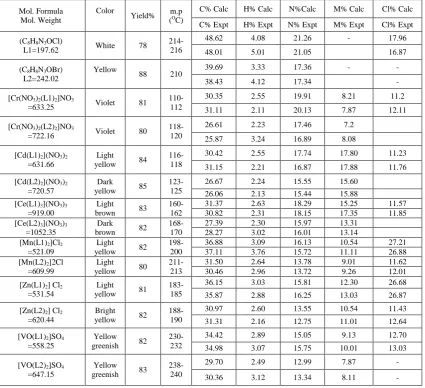
All the complexes are air stable, and insoluble in water DMSO, DMF, CHC13 and CH2C12. They were
identified by their physical and analytical data. The analytical data, Table (1) are in good agreement with the general formula [M(L)2](X)n. with
M= Zn(II), Mn(II),VO(II) and Cd(II); and L=L1 and L2 and X= Cl, SO4 and
NO3; and n= 1 for (VO), 2 for (Mn, Zn
and Cd), [Cr(L)2(NO3)2]NO3 and
[Ce(L)3](NO3)3 The monomeric nature
Table 1: Physical Characteristics and analytical data for (L1), (L2) and its metal complexes
Mol. Formula Mol. Weight
Color
Yield% m.p
(OC)
C% Calc H% Calc N%Calc M% Calc Cl% Calc
C% Expt H% Expt N% Expt M% Expt Cl% Expt
(C8H8N3OCl)
L1=197.62 White 78
214-216
48.62 4.08 21.26 - 17.96
48.01 5.01 21.05 16.87
(C8H8N3OBr)
L2=242.02
Yellow
88 210 39.69 3.33 17.36 - -
38.43 4.12 17.34 -
[Cr(NO3)2(L1)2]NO3
=633.25 Violet 81
110-112
30.35 2.55 19.91 8.21 11.2
31.11 2.11 20.13 7.87 12.11
[Cr(NO3)2(L2)2]NO3
=722.16 Violet 80
118-120
26.61 2.23 17.46 7.2
25.87 3.24 16.89 8.08
[Cd(L1)2](NO3)2
=631.66
Light
yellow 84
116-118
30.42 2.55 17.74 17.80 11.23
31.15 2.21 16.87 17.88 11.76
[Cd(L2)2](NO3)2
=720.57
Dark
yellow 85
123-125
26.67 2.24 15.55 15.60
26.06 2.13 15.44 15.88
[Ce(L1)3](NO3)3
=919.00
Light
brown 83
160-162
31.37 2.63 18.29 15.25 11.57
30.82 2.31 18.15 17.35 11.85
[Ce(L2)3](NO3)3
=1052.35
Dark
brown 82
168-170
27.39 2.30 15.97 13.31
28.27 3.02 16.01 13.14
[Mn(L1)2]Cl2
=521.09
Light
yellow 82
198-200
36.88 3.09 16.13 10.54 27.21
37.11 3.76 15.72 11.11 26.88
[Mn(L2)2]2Cl
=609.99
Light
yellow 80
211-213
31.50 2.64 13.78 9.01 11.62
30.46 2.96 13.72 9.26 12.01
[Zn(L1)2] Cl2
=531.54
Light
yellow 81
183-185
36.15 3.03 15.81 12.30 26.68
35.87 2.88 16.25 13.03 26.87
[Zn(L2)2] Cl2
=620.44
Bright
yellow 82
188-190
30.97 2.60 13.55 10.54 11.43
31.31 2.16 12.75 11.01 12.64
[VO(L1)2]SO4
=558.25
Yellow
greenish 82
230-232
34.42 2.89 15.05 9.13 12.70
34.98 3.07 15.75 10.01 13.03
[VO(L2)2]SO4
=647.15
Yellow
greenish 83
238-240
29.70 2.49 12.99 7.87 -
30.36 3.12 13.34 8.11 -
Infrared spectra
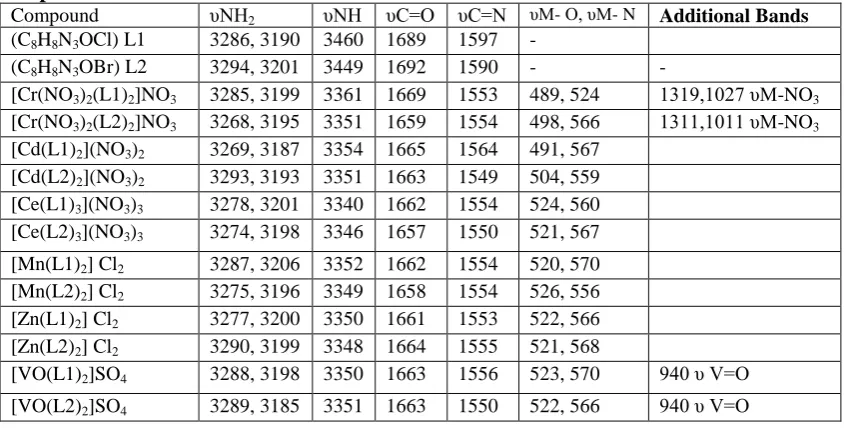
The IR spectra provide valuable information regarding the nature of functional group attached to the metal atom. The IR spectra of the ligands L1 and L2 showed strong bands in the 3286, 3190 cm-1 and 3294, 3201 cm-1 respectively assignable attributed to the −NH2 group and the strong bands in
the 3460 cm-1 and 3449 cm-1
respectively assignable attributed to the −NH group The appearance of this peaks in all the spectra of the complexes indicates that the –NH2 and
−NH groups is free from
complexation[13]. The two bands observed in the range 1689-1692 cm-1
and 1590-1597 cm-1 can be assigned to ν(C=O) and ν(C=N) respectively for ligands L1 and L2[14]. In spectra of all the metal complexes, these bands show red shifts indicating the coordination of metal ions through carbonyl oxygen as
well as imine nitrogen of
Table 2: FT-IR spectral data (wave number) cm-1 for the ligands (L1 and L2)and its complexes
Compound υNH2 υNH υC=O υC=N υM- O, υM- N Additional Bands
(C8H8N3OCl) L1 3286, 3190 3460 1689 1597 -
(C8H8N3OBr) L2 3294, 3201 3449 1692 1590 - -
[Cr(NO3)2(L1)2]NO3 3285, 3199 3361 1669 1553 489, 524 1319,1027 υM-NO3
[Cr(NO3)2(L2)2]NO3 3268, 3195 3351 1659 1554 498, 566 1311,1011 υM-NO3
[Cd(L1)2](NO3)2 3269, 3187 3354 1665 1564 491, 567
[Cd(L2)2](NO3)2 3293, 3193 3351 1663 1549 504, 559
[Ce(L1)3](NO3)3 3278, 3201 3340 1662 1554 524, 560
[Ce(L2)3](NO3)3 3274, 3198 3346 1657 1550 521, 567
[Mn(L1)2] Cl2 3287, 3206 3352 1662 1554 520, 570
[Mn(L2)2] Cl2 3275, 3196 3349 1658 1554 526, 556
[Zn(L1)2] Cl2 3277, 3200 3350 1661 1553 522, 566
[Zn(L2)2] Cl2 3290, 3199 3348 1664 1555 521, 568
[VO(L1)2]SO4 3288, 3198 3350 1663 1556 523, 570 940 υ V=O
[VO(L2)2]SO4 3289, 3185 3351 1663 1550 522, 566 940 υ V=O
Magnetic susceptibilities and electronic spectral studies:
The spectra of the ligands L1, L2 and their metal complexes were recorded in DMSO solution at room temperature. From the data Table (3), it’s observed that all the complexes exhibit octahedral, tetrahedral and square pyramidal geometry around the metal ions.
Vanadium complexes:
Vanadium complexes showed two bands related to square pyramid Vanadium complexes[17] they were observed at 795, 565 nm and 783,563
nm respectively for Vanadium
complexes with L1 and L2 Table (3) for the first and second transition and were assigned to 2B2g→2Eg and 2B2g
→2
B1g transition respectively[18-19]
the magnetic moment (1.7 B.M) is lower than spin only value, this is due to spin coupling[19]. Conductivity in DMSO showed that the complexes were ionic (1:2) electrolytic nature.
Zinc and Cadmium complexes:
The prepared complexes are Light yellow and diamagnetic which are expected d10 ions. The UV-Vis spectrum of the compound shows a relative change in the band position compared to that of the free. The
conductivity measurement for this complexes in DMSO at 25 °C showed to be (1:2) electrolytic nature[16,17]. The most propable structural of that complexes are tetrahedral geometry.
Cerium (III) complexes:
The magnetic moments values,
μeff of the CeIII complexes are the 2.34
and 2.57 B.M. respectively, being
consistent with mononuclear
complexes and free from ant
ferromagnetism. All CeIII complexes show a new absorption bands at 314 and 333 nm respectively for cerium with L1 and L2, which may be related to metal ligands charge transfer excitations[10]. The complexes have a coordination number 6 and may exist in octahedral geometries.
Manganese (II) complexes:
Manganese (II) complexes for ligands L1 and L2 showed peaks at 760nm and 706 nm respectively ,the peaks ware attributed to the (d-d) transition of the type (6A1→4A1) .the
complexes are tetrahedral geometry [20].
Chromium (III) Complexes:
The magnetic moments values,
μeff of the Cr(III) complexes are the 3.9
and 3.9 B.M. respectively, being
consistent with mononuclear
complexes and free from ant
ferromagnetism. Chromium (III)
complexes show a new absorption
bands at 318, 455, 631nm and 327,
452, 631 nm respectively for
chromium with L1and L2, for the first, second and third transition and were assigned to 4A2g4T1g (P), 4
A2g4T1g (F) and 4A2g4T2g (F)
transition respectively. The complexes have a coordination number 6 and may exist in octahedral geometries[18,19].
Table 3: U.V-Visible spectra of free ligands and their complexes in 10-3 M in DMSO, Magnetic Moments and Molar Conductance in DMSO.
Compound λmax
nm
Wave
Number cm-1
(d-d) Transitions
Molar Conduct-ance
Λm(Ω-1 cm2 mol-1)
μeff (BM)
Suggested Structure
(C8H8N3OCl) L1 300 33333.3 n→π* - -
(C8H8N3OBr) L2 316 31645.5 n→π* - -
[Cr(NO3)2(L1)2]NO3
318 455 631
31446.5 21978 15847
4A
2g4T1g (P) 4A
2g4T1g (F) 4A
2g4T2g (F)
25 3.9 Octahedral
[Cr(NO3)2(L2)2]NO3
327 452 631
30581 22123 15847
4A
2g4T1g (P) 4A
2g4T1g (F) 4
A2g4T2g (F)
31 3.9 Octahedral
[Cd(L1)2](NO3)2 - - - 43 diam Tetrahedral
[Cd(L2)2](NO3)2 - - - 47 diam Tetrahedral
[Ce(L1)3](NO3)3 - - - 157 2.34 Octahedral
[Ce(L2)3](NO3)3 - - - 154 2.57 Octahedral
[Mn(L1)2] Cl2 760 13157 6A1→4A1 51 5.55 Tetrahedral
[Mn(L2)2] Cl2 706 14164 6A1→4A1 47 5.42 Tetrahedral
[Zn(L1)2] Cl2 - - - 48 diam Tetrahedral
[Zn(L2)2] Cl2 - - - 49 diam Tetrahedral
[VO(L1)2]SO4
795 565
12577 17699
2B 2g→2Eg 2B
2g→2B1g
55 1.7 Square
pyramidal
[VO(L2)2]SO4 783
563
12769 17679
2B 2g→2Eg 2
B2g→2B1g 59 1.7
Square pyramidal
Theoretical study
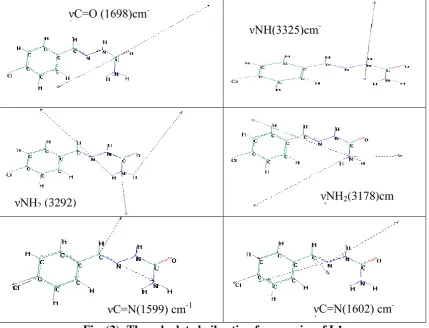
The vibration spectra of the Schiff base (L1) were calculated by using a semi-empirical (PM3) and
(ZINDO/I) method. The results
obtained for wave numbers are presented in Table (5) Fig (2), and the comparison with the experimental values indicates a some deviation. These deviation may be due to the harmonic oscillator approximation and lack of electron correlation. It was reported [21] that frequencies coupled with Hartree- Fock Theory (HFT)
approximation and a quantum
harmonic oscillator approximation tends to be 10% too high.
(ZINDO/I) Zerners INDO method: Is the most suitable semi- empirical
method for determining structures and energies of molecules with the first or second transition row metal[22].
Parameterization model, Version 3 (PM3): It a recently developed semi- empirical method that may contain as
yet undiscovered defect[22] the
Optimized geometries energy of metal complexes for Schiff base
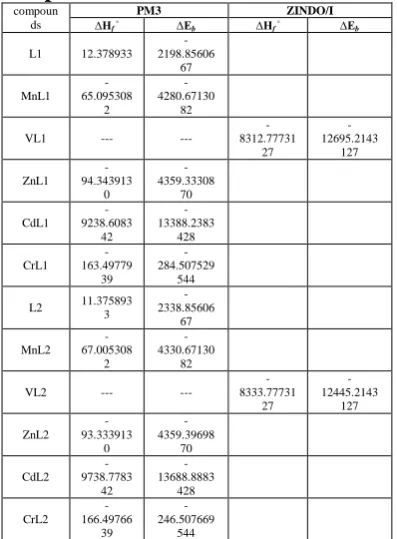
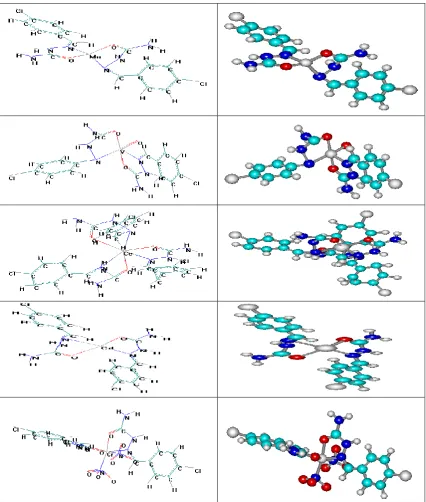
A theoretically probable structures of metal complexes with Schiff base have been calculated to search the most probable model building stable structure Fig (1), the calculated optima geometries for ligands and it’s metal complexes. The result of PM3 method of calculation in gas phase for the binding energies and heat of formation of Cr(III), Mn(II), Cd(II) ,Zn(II) and V(IV) these are describe in Table (4).
The results reflected that the complexes of imine exhibited to be more stable than the donor chelating ligand, this difference in stability of complexes might be related to the chelating effect Fig (3).
Table (4): Conformation energetic in (KJ.mol-1) for ligands and its metal complexes
compoun ds
PM3 ZINDO/I
∆Hf ◦ ∆Eb ∆Hf ◦ ∆Eb
L1 12.378933 -2198.85606 67 MnL1 -65.095308 2 -4280.67130 82
VL1 --- ---
-8312.77731 27 -12695.2143 127 ZnL1 -94.343913 0 -4359.33308 70 CdL1 -9238.6083 42 -13388.2383 428 CrL1 -163.49779 39 -284.507529 544
L2 11.375893 3 -2338.85606 67 MnL2 -67.005308 2 -4330.67130 82
VL2 --- ---
-8333.77731 27 -12445.2143 127 ZnL2 -93.333913 0 -4359.39698 70 CdL2 -9738.7783 42 -13688.8883 428 CrL2 -166.49766 39 -246.507669 544
Table (5): Comparison of experimental and theoretical vibration Frequencies for the ligands
ligan
d NH2 NH C=O C=N
L1 (3286) * (3292) ** (-0.18)* ** (3190) * (3178) ** (0.37)* ** (3460) * (3225) ** (3.9)** * (1689) * (1698) ** (-0.53)* ** (1597) * (1599) ** (-0.12)* ** (1597) * (1602) ** (-0.31)* ** L2 (3294) * (3288) ** (-0.18)* ** (3201) * (3189) ** (0.37)* ** (3449) * (3443) ** (-0.18)* ** (1692) * (1690) ** (-0.12)* ** (1590) * (1588) ** (-0.12)* **
*: Experimental frequency, **: Theoretical frequency, ***: Error % due to main difference in the experimental measurements and theoretical treatments of vibration spectrum.
Bacteriological activity:
The bacteriological activity of the ligand L1 and it is metal complexes was studied by using inhibition method for two types of pathogenic bacteria. One type of bacteria was gram positive, which is Staphylococcus. The second one was gram negative, which is Escherichia coli. The biological effect of the chemical complexes was studied for the (2) types of bacteria as shown in Table (6).The rate of
inhibition diameter was varied
according to the variation in the complex type and Bacterial, the complexes high effective on the ligand.
Table (6): Antibacterial activities for Schiff base and its complexes
Compounds Staphylococcus
aureus )+(
Escherichia coli (-)
5mM 10mM 5mM 10mM
L1 - - + -
VOL1 - - ++++ -
CrL1 + - + ++
MnL1 + + + ++
ZnL1 ++ +++ +++ ++++
CdL1 ++ +++ +++ -
CeL1 ++ ++ ++++ ++++
Fig. (2): The calculated vibration frequencies of L1
Electrostatic Potential for L2 Electrostatic Potential for L1
-28.4587 ev
-26.03858 ev
-20.40847 ev -19.53327 ev
Fig. (3): HOMO and Electrostatic Potential for L1 and L2
νC=O )3393(cm -1
νNH)0035(cm -1
νNH2 (3292)
cm-1
νNH2(3178)cm -1
νC=N)3333( cm -1
References:
1- Hughes, M. N. 1984. The Inorganic Chemistry of Biological Processes. 2nd Ed. Wiley.
2- Harlal, S. and Varshney, A. K. 2006. Synthetic Structural and
Biochemical Studies of
Organizing(IV) with Schiff bases Having Nitrogen and Sulfur Donor Ligands. Bioinorg. Chem. and Applic., Article ID 23245: 1-7. 3- Arjun, K. R.; Nayan, R. P.; Harish,
R. D. and Sunil, S. N. 2009. Novel Synthesis and Characterization of
Thiosemicarbazone Compounds
Containing 4-Acyl-2-pyrazolin-5-ones. E-J. Chem. 6(3):747-752. 4- Raman, N.; Kulandaisamy, A. and
Jeyasubramanian, K. 2002.
Chemistry, Sythesis Spectral
Redox and Antimirobial Activity of
Schiff Transition metal (II)
complexes Derived from
4-aminoantipyrine and Benzil. Synth. React. Inorg. Met-org and Nano-Meta. 32(9):1583.
5- Al-Hamdani, A. A.; Mahmud, M. A. and Bakir, R. Sh. 2013. Synthesis, Structural Studies of Some New Transition Metals Complexes of Semicarbazide hydro chloride Schiff Base Derivatives. Indian J. Che.10 (3):583-596. 6- Kumar,D.; Syamal, A. and Singh,
A. K. .2003.Synthesis and
characterization of manganese(II), cobalt(II), nickel(II), copper(II), zinc(II), cadmium(II), iron(III),
zirconium(IV), dioxo-
molybdenum(VI) and
dioxouranium(VI) coordination
compounds of
polystyrene-supported tridentate dibasic Schiff base derived from semicarbazide and 3- formylsalicylic acid. Indi. J. Chem. 42A (2):18-24.
7- Dorestt, H A. 1996. A review of
quantum chemical studies of
energetic materials. DSTO
Technical report.
8- Foresman,J. and Frish, C. 1996.
Exploring Chemistry with
Electronic Structure Methods.
Gaussian Inc, Pittsburgh, PA. 9- Atlas, M. R.; Alfres, E.; Brown, P.
and Lawrence, C. 1995. Laboratory Manual Experimental Microbiolog. Mosby, yearbook, Inc.
10-Geary, W. J. 1971. The used
conductivity measurements
inorganic solvents for the
characterization of coordination compounds. Coord. Chem. Rev.7-81.
11-Al-Hamdani, A. A. and Shaker, Sh. A. 2011. Synthesis, characterize-ation, Structural Studies and Biological Activity of a New Schiff
Base –Azo Ligand and its
Complexation with Selected Metal Ions. Oriental J. Chem., 27(3): 825-845.
12-Shaker, Sh. A.; Mohammed, H. A. and Al-Hamdani, A. A. 2010. Preparation, Physico-Chemical and Spectroscopic Investigation of
Thiacetazone and Quinalizarin
Complexes with Mn (II), Fe (II), Co (II), Ni (II), Cu (II), Zn (II), Cd (II) and Pb (II). Aus. J. Basic. & Ap. Sci. 4(10):5178-5183.
13-Nakamato, N. 1986. Infrared and Raman Spectra of inorganic and Coordination Compounds. 4th Ed Wiley, Inter Science, New York. 14-Nakamoto, N. 1997. Infrared and
Raman Spectra of Inorganic and Coordination Compounds. Wiley-Inter Science, New York, 1997. 15-Shaker, Sh. A.; Yang, F. and
Al-Hamdani, A. A. 2009. Synthesis and Characterization of Mixed
Ligand Complexes of
8-Hydroxyquinoline and
16-Manrao, M. R.; Balbir, K.; Matharu, K. K.; Gill, V.; Kaul, K. and Sharma, J. R. 2009. Synthesis and biological potential of nitrones
of 4-chlorobenzaldehyde and
ethylvanillin. J. Indian Chem. Soc. 86:531-534.
17-Osowole, A. A. 2008. Syntheses and Characterization of Some
Tetradentate Schiff-Base
Complexes and Their Heteroleptic Analogues. E-J. Chem. 5(1):130-135.
18-Lever, A. B. P. 2003. From Coello to Inorganic Chemistry: A Lifetime of Reactions - By Fred Basolo, Profiles in Inorganic Chemistry, John P. Fackler Jr. (Series Ed.),
Kluwer Academic Publishers/
Plenum Press, New York, NY, Hardbound. Coord. Chem. Rev. 247(1):197-197.
19-Al-Hamdani, A. A. 2010. Synthesis and Characterization of some new transition metal complexes with
2,5- di(4-amino phenazonyl)
hexane. J. of Al-Nahrain Univ.. 13(4):15-22.
20-Al-Hamdani, A.A. 2013. Metal Complexes of Multidentate Schiff
Base-Azo Ligand: Synthesis,
Characterization and Biological Activity. Dirasat, Pure Sci. 39 (1): 61-72.
21-Anderson,W. P.; Behm, P.;
Glennon, T. M.;"Searching the Conformational Space of Cyclic
Molecules: A Molecular
Mechanics and Density Functional Theory Study of 9-Crown-3"; J.
Phys. Chem. A101:1920-1926,
1997.
22-Al-Hamdani, A. A.; Balkhi, A. M. and Falah, A. 2013. Synthesis,
Spectroscopic and biological
activity Studies of Azo-Schiff base and Metal Complexes derived from
5-Methyltryptamine. Damascus
ةيئانث فش دعاوق تادقعمل ةيريتكب ةيلاعفو بيكارت ةسارد،يفيط صيخشت،ريضحت
نسلا
حلاص يلع سابع
ينادمحلا
نلاعش ءايضرصان
رقاب بجر ءاميش
ديؤم
حلاص
دمحم
قارعلا دادغب.دادغب ةعماج، تانبلل مولعلا ةيلك، ءايميكلا مسق
: ةصلاخلا
مويريسلاو موركلا ،يعابرلا هؤفاكتب مويدانفـلل ةديدجلا ةينويلاا نداعملا تادقعم نم ةلسلس ريضحت
،زينغنملاو يثلاثلا مهؤفاكتب وق عم يئانثلا مهؤفاكتب مويمداكلا ،نيصراخلا
ةرضحملا فش دعا
( 3 -نيدلزنبورولك )
(و نيما ايروي 3
-) نيدلزنبومورب
ةطاسوب اهصيخشت مت ةرضحملا تابكرملا .نيما ايروي
ليلحت قيقدلا ايفيط تسردو ،ةيرلاوملا ةيليصوتلاو ةيسيطانغملا ةيساسحلا ،رصانعلل ،ءارمحلا تحت ةعشلااب
ةيجسفنب قوفلا
ةيجسفنبلا قوف ةعشلاا فايطأ جئاتن ءوض ىلع .يسيطانغملا يوونلا نينرلاو ةلتكلا ،ةيئرملا
حوطسلا يعابر لكش تاذ تادقعملا نا جئاتنلا ترهظأ ةيرلاوملا ةيليصوتلاو ةيسيطانغملا ةيساسحلا ،ةيئرملا عبرم مره لكش مويدانفلا ىطعا امنيب . حوطسلا ينامث لكش مويريسلاو موركلا يدقعمو ةدعاقلا
( جمانرب مادختسأب يزاغلا روطلا يف ايرظن تادقعملا نيوكت ةجلاعم تيرجأ Hyper Chem-6
)
لاودلا مادختسأب كلذو باسحلا يف يبيرجت هبشلاو يئيزجلا كيناكيملا قيبطتب PM3
و ZINDO/I باسحل
نيوكتلا ةرارح (∆Hf о
) طبارتلا ةقاطو
(∆Eb)
ةرارح ةجردبو 393
دهجلا باسح يرجأ امك نفلك
ةلادلا مادختسأبو ايرظن يزازتهلاا ددرتلا باسح ىرجو فش يتدعاق يف ةلاعفلا عقاوملا نايبل يكيتاتسورتكللاا PM3 ةبوسحملاو ةيلمعلا ميقلا نيب ريبك قفاوت كانه نا دجوو ايلمع ةساقملا ميقلا عم اهتنراقمو فش يتدعاقل
ايرظن امك . ةلاعفلا عقاوملا ديدحتو يكيتاتسورتكللاا دهجلا باسح مت (HOMO)
و (LUMO) نيدناكيلل
فلا تسرد .نيرضحملا دناكيللا نم لكل ةيريتكبلا ةيلاع
( 3 -) نيدلزنبورولك
عاونا دض هتادقعمو نيما ايروي
ايرتكبلا نم ةبختنم
Escherichia coli and Staphylococcus aureus
مادختسابو. رهظا ثيح نيزيكرت
.دقعملا نمض دناكيللاو ندعملا نم لك رزآت ىلا كلذ ىزعيو تادقعملل ةيلاعفلا ةدايز ريثاتلا
:ةيحاتفملا تاملكلا
3 -نيدلزنبورولك ،
نيما ايروي .ةيويح ةيلاعف ،فش تادقعم ،