Partial Generalized Probability Weighted Moments
for Exponentiated Exponential Distribution
Neema Mohamed El Haroun Institute of Statistical Research Mathematical Statistics Department Cairo University, Egypt
Abstract
The generalized probability weighted moments are widely used in hydrology for estimating parameters of flood distributions from complete sample. The method of partial generalized probability weighted moments was used to estimate the parameters of distributions from censored sample. This article offers new method called partial generalized probability weighted moments (PGPWMs) for the analysis of censored data. The method of PGPWMs is an extended class from partial generalized probability weighted moments. To illustrate the new method, estimation of the unknown parameters from exponentiated exponential distribution based on doubly censored sample is considered. PGPWMs estimators for right and left censored samples are obtained as special cases. Simulation study is conducted to investigate performance of estimates for exponentiated exponential distribution. Comparison between estimators is made through simulation via their biases and mean square errors. An illustration with real data is provided.
Keywords: Generalized Probability Weighted Moments, Partial Probability Weighted Moments, Partial generalized Probability Weighted Moments, Generalized Exponential Distribution, Censored Samples.
1. Introduction
Gupta and Kundu (1999), introduced the generalized exponential distribution which, also known as exponentiated exponential (EE) distribution. It is observed that the EE distribution can be considered for situation where a skewed distribution for a non- negative random variable is needed. Also, it is observed that it can use quite effectively to analyze lifetime data in place of gamma, Weibull and log-normal distributions.
The probability density function of the two parameter EE distributions given by;
x; ,
1e
1e , , ,x0f x x
The corresponding cumulative distribution function is given by:
x; ,
1e
, , ,x0F x (1)
The initial idea of PPWMs was to remove the smaller observations from the process of fitting the distribution because such observations are of little interest in flood frequency analysis and such observations can a nuisance to the fitting process. The method is computationally simple, robust and possesses the same merit as the original method of probability weighted moments.
Zafirakou-Koulouris et al (1998) introduced the evaluation of L- moments for a left censored observation from PPWMs. Deng and Pandey (2009) presented a new distribution for estimating quantile function of a non-negative random variable using a censored sample of data, which is based on the principle of partial maximum entropy in which PPWMs are used as constraints.
This article presents new method which is called partial generalized probability weighted moments for estimating the unknown parameters of distributions from censored samples. The PGPWMs will be used to estimate unknown parameters of EE distribution under doubly censored samples. Then, the PGPWMs estimators of the unknown parameters from left and right censored samples will be obtained as special cases. At the same time, the generalized probability weighted moments can be obtained as the special case from PGPWMs. To illustrate the properties of the new estimators, an extensive numerical study will be performed. Analysis of a real data set has been performed.
This article is organized as follows. In Section 2, the definition of PGPWMs and their sample estimators from doubly, right, and left censored samples is introduced. Section 3 discusses the PGPWMs method of estimation for the EE distribution from doubly, left and right censored samples. A simulation study is performed to investigate the properties of the new estimators from censored samples with two special cases in Section 4. Real data example is given in Section 5. Finally, the conclusions are included in Section 6. Tables and some Figures are included in the appendix.
2. The PGPWMs and Their Sample Estimators
The generalized probability weighted moments (GPWMs) were introduced by Rasmussen (2001) as a tool for estimating the parameters of probability distribution, for complete sample, expressible in inverse form. The GPWMs can be defined as
p u v
v u
p E X F X F X
M , , ( ) 1 ( )
x
F
pFu
1F
vdF1
0
, (2)
whereX is a random variable and F(x) is cumulative distribution function.
We introduce the method of PGPWMs as an extension class of GPWMs and PPWMs methods. The general form of PGPWMs with double bound censoring for the random variable X is defined as follows:
v u p
W , ,
v u
p
X F X
F X
E ( ) 1 ( )
x
F
Fu
F
vdFd
c
p
where, p1, u and v to be real values (i.e. exponents uand v of the PGPWMs can be ratio or integers). Also, cF(x01) and d F(x02), x01 and x02 are lower and upper
bound censoring respectively; Therefore, forp1, andv0, Wp,r,s becomes;
u
u E X F X
W1, ,0 ( )
x
F
FudFd
c
, (4)
It is noted when d 1 and the lower bound c0then the PGPWMs with double bound censoring is reduced to GPWMs in complete samples as defined in (2).
The PGPWMs with lower bound (left) censoring, denoted by LW1,u,0, can be obtained as a special case from (4)by putting d 1.Therefore, the general form of PGPWMs with left censoring for the random variable X takes the following form
u
u E X F X
LW1, ,0 ( )
x
F
F dFu
c
1 . (5)
The PGPWMs with upper bound (right) censoring, denoted by RW1,u,0, can be defined as a special case from (4) by putting c0.Therefore, the general form of PGPWMs with right censoring for the random variable X takes the following form
u
u E X F X
RW1, ,0 ( )
x
F
FudFd
0
. (6)
Let x 1 ,x 2 ,...,x n be a random sample of size n from the distribution functionF
X , and x 1 x 2 ,... x n be the corresponding ordered sample. According to Hosking (1986), the estimates of W1,u,0,LW1,u,0 and RW1,u,0is defined as the following. 35 . 0 ˆ
1 ) ( 0
, , 1
u n
i i u
n i x
W
(7)
. 35 . 0 ˆ
1 ) ( 0
, , 1
u n
i i u
n i x W
L
(8)
. 35 . 0 ˆ
1 ) ( 0
, , 1
u n
i i u
n i x W
R
(9)
Note that, the PGPWM estimators with doubly, left or right censoring is obtained by equating the theoretical PGPWM with the corresponding sample PGPWM.
3. PGPWMs Estimation of the EE
(3.1) PGPWMs Estimation of the EE from Doubly Censored Sample
The theoretical PGPWMs with double bound censored, W1,u,0 for the EE distribution can be found from (4) after setting u u1and uu2as the following;
0 , , 1u1
W
x
F
FudFd c 1
1 1 1 1 ] ) 1 ( [1 1 1
j u j u j u j j c d (10) 0 , , 1u2
W
x
F
Fu dFd c 2
1 2 1 1 ] ) 1 ( [1 2 2
j u j u j u j j c d (11)
From Equations (10) and (11), the two parameters, and , can be expressed as follows: 0 , , 1 1 1 1 1 1 1 1 ] ) 1 ( [ u j u j u j W u j j c d
. (12)
0 ] ) 1 ( [ ] ) 1 ( [ 1 2 1 1 0 , , 1 1 1 1 1 0 , , 1 2 2 1 1 1 2
j u j u j u j u j u j u u j j c d W u j j c d W . (13)
The PGPWMs estimators of and from doubly censored samples, can be obtained by solving equations (12) and (13) in terms of and; where W1,u1,0 and W1,u2,0 are replaced
by their sample estimators, 1, ,0 1 ˆ
u
W and 1, ,0 2 ˆ
u
W given by Equation (7) by setting uu1,u2,
therefore 0 , , 1 1 1 1 ˆ 1 ˆ 1 1 1 ˆ ] ) 1 ˆ ( [ ˆ u j u j u j W u j j c d
. (14)
0 ] ) 1 ˆ ( [ ˆ ] ) 1 ˆ ( [ ˆ 1 2 1 ˆ 1 ˆ 0 , , 1 1 1 1 ˆ 1 ˆ 0 , , 1 2 2 1 1 1 2
j u j u j u j u j u j u u j j c d W u j j c d W , (15)
Some special cases can be obtained from the above the PGPWMs
1. For u1 0and u2 1, the PPWMs can be obtained from PGPWMs with doubly censored as obtained by Al-Khodary et al (2008).
2. For c0and d 1, the GPWMs can be obtained from PGPWMs with doubly censored as obtained by El Haroun (2009).
3. Foru1 0,u2 1, c0and d 1, the PWMs can be obtained from PGPWMs with doubly censored as obtained by Al-Khodary et al (2007).
(3.2) PGPWMs Estimation of the EE from Left Censored Sample
The theoretical PGPWMs with left bound censored, LW1,u,0 for the EE distribution can be found from (5) after setting uu1and u u2as the following;
0 , , 1u1
LW
x
F
Fu dFc 1 1
1 1 1 ] ) 1 ( 1 [ 1 1 j u j u j j c (16) 0 , , 1u2LW
x
F
Fu dFc 2 1
1 2 1 ] ) 1 ( 1 [ 1 2 j u j u j j c (17)From Equations (16) and (17), the two parameters, and, can be expressed as follows:
0 , , 1 1 1 1 1 1 ] ) 1 ( 1 [ u j u j LW u j j c
. (18)
0 ] ) 1 ( 1 [ ] ) 1 ( 1 [ 1 2 1 0 , , 1 1 1 1 0 , , 1 2 1 1 2
j u j u j u j u u j j c LW u j j c LW . (19)
To compute the PGPWMs estimators of and , denoted by ˆL and ˆL, from left
censored samples, 1, ,0 1
u
LW and 1, ,0 2
u
LW are replaced by their sample estimators, 1, ,0 1 ˆ
u
W L
and LWˆ1,u2,0 by setting u u1,u2 in Equation (8), hence
0 , , 1 1 1 1 ˆ 1 1 ˆ ] ) 1 ˆ ( 1 [ ˆ u j L u j L W L u j j c L
0 ] ) 1 ˆ ( 1 [ ˆ ] ) 1 ˆ ( 1 [ ˆ 1 2 1 ˆ 0 , , 1 1 1 1 ˆ 0 , , 1 2 1 1 2
j L u j u j L u j u u j j c W L u j j c W L L L (21)Solving numerically by iteration Equation (20) to obtain ˆ . Once the estimate of L is determined, an estimate of is obtained by substitute ˆ in Equation (21). L
(3.3) PGPWMs Estimation of the EE from Right Censored Sample
The theoretical PGPWMs with right bound censored, RW1,u,0 for the EE distribution can be obtained from (6) after setting uu1 and u u2 as the following
0 , , 1u1
RW
x
F
Fu dFd 1 0
1 1 1 ] ) 1 ( [ 1 1 j u j u j j d (22) 0 , , 1u2RW
x
F
Fu dFd 2 0
1 2 1 ] ) 1 ( [ 1 2 j u j u j j d (23)From Equations (22) and (23), the two parameters, and , can be expressed as follows: 0 , , 1 1 1 1 1 1 ] ) 1 ( [ u j u j RW u j j d
. (24)
0 ] ) 1 ( [ ] ) 1 ( [ 1 2 1 0 , , 1 1 1 1 0 , , 1 2 1 1 2
j u j u j u j u u j j d RW u j j d RW . (25)
The PGPWMs estimators of and , denoted byˆ and R ˆ , from right censored R samples, can be obtained by solving Equations (24) and (25); where 1, ,0
1
u
RW and 1, ,0 2
u
RW
are replaced by their sample estimators, RWˆ1,u1,0 and RWˆ1,u2,0by setting uu1,u2, in
Equation (9) as follows
0 , , 1 1 1 1 ˆ 1 1 ˆ ] ) 1 ˆ ( [ ˆ u j R u j R W R u j j d R
. 0 ] ) 1 ˆ
( [ ˆ
] ) 1 ˆ
( [ ˆ
1
2 1 ˆ
0 , , 1 1
1 1 ˆ
0 , , 1
2
1 1
2
j
R u j
u j
R u j
u
u j j
d W
R u
j j
d W
R
R R
(27)
A numerical procedure is required to estimate based on iterative technique. Thus the value of ˆ can be obtained by substituting the value ofR ˆ in Equation (27). R
4.
Numerical Experiments and Discussions
An extensive numerical study is carried out to investigate the properties of the PGPWMs method of estimation for the EE distribution from censored samples. The investigated properties are biases and mean square error (MSE) of the PGPWMs estimators of the two parameters and . The simulation procedure can be summarized as the following steps:
Step (1): 1000 random sample, x1,x2,...,xn, of sizes n = 15, 20, 25, 30, 35and 50 are generated from the EE distribution.
Step (2): The true parameter selected values for the shape parameter are 0.5, 0.6, 0.7 with scale parameter1. Choosing the exponent values of PGPWMs as u1 0,0.1,0.5and u2 1,0.4,1.5. Levels of censoring are considered, namely c0.2 and d 0.8.
Step (3): For each combination of values of sample size n, and , the parameters of distribution are estimated using three different estimation methods; PGPWMs with doubly, left and right censored samples.
Step (4): PGPWMs of the unknown parameter for EE distribution with doubly censored samples are obtained by solving numerically the non-linear Equation (15). The estimate of the scale parameteris obtained by substituting the value of ˆ in (14).
Step (5): Based on left censored samples, PGPWMs of the shape parameter for EE distribution is obtained by solving iteratively the non-linear Equation (21). Hence the ˆ is obtained by substituting the value of L ˆLin (20)
Step (6): Based on right censored samples, PGPWMs of the shape parameter for EE distribution is obtained by solving numerically the non-linear Equation (27). To compute ˆ , substituteR ˆRin (26)
Step (7): PPWMs estimators with doubly, left and right censored samples for for EE distribution is obtained by solving numerically the non-linear Equations (15),(21) and (27) after setting u1 0and u2 1. Then, the
estimates ofis obtained by substituting the estimate of in Equations (14), (20) and (26).
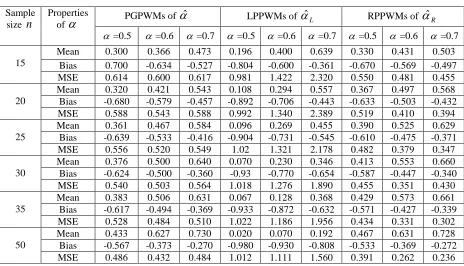
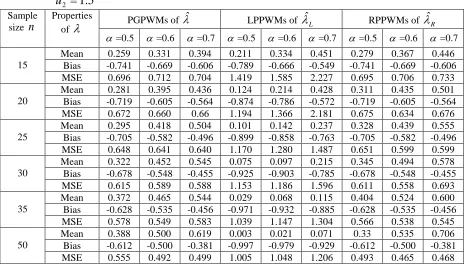
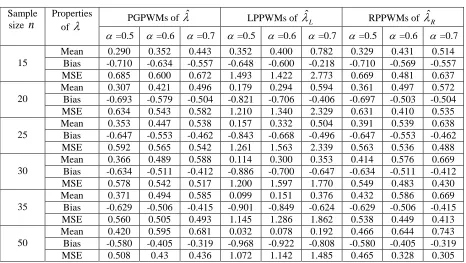
All simulation studies presented here are obtained via the MathCAD14 software. The MSE of the different estimators of and are reported in Tables (1-6) and described in Figures (1-18). From simulation study many observations can be made on the performance of PGPWMs estimators with doubly, left and right censored samples. These observations are summarized as follows:
1. It is observed from Tables (1),(2)and (3) that the MSE of estimators for decreases as the sample size increases. This indicate that PGPWMs based on doubly, left and right censoring provided consistent estimators for [see Figures(1-9)]
2. It is observed from Tables (4),(5)and (6) that the MSE of estimators for decreases as the sample size increases. This indicates that PGPWMs with doubly, left and right censoring provided consistent estimators for [see Figures (10-18)]
3. When the exponents of PGPWMs u1 and u2decrease, the MSE of estimators for
and decreases [see Figures (1-18) and Tables (1-5)]
4. Considering the MSE of the different estimators of , it is clear from Tables (1) (2)and (3) that the PGPWMs under right censoring estimator has the minimum MSE in almost all of the cases followed by PGPWMs under doubly censoring and the PGPWMs under left censoring [see Figures(1-9)]
5. Considering the MSE of the different estimators of , it is clear from Tables (4), (5)and (6) that the PGPWMs under right censoring estimator has the minimum MSE in almost all of the cases followed by PGPWMs under doubly censoring and PGPWMs under left censoring [see Figures (10-18)].
5. Data Analysis
This section presents a real data set for illustrative purposes. Lawless (1982) provided real data, which represents the numberof million revolutions before failure for each of 23 ball bearings in a life test: 17.88, 28.92, 33.00, 41.52, 42.12, 45.60, 48.80, 51.84, 51.96, 54.12, 55.56, 67.80, 68.64, 68.64, 68.88, 84.12, 93.12, 98.64, 105.12, 105.84, 127.92, 128.04, and 173.40.
Data analysis is presented to illustrate different PGWMs estimators from doubly, left and right censored samples. The data set is carried out to investigate the properties of the PGPWMs method of estimation for the EE distribution. The investigated properties of estimators for the two parametersand are biases and MSEs. The results are displayed in Tables 7 and 8 and some observations are summarized as follows:
1. Considering the MSE of the estimator for , it is clear from Table (7) that the PGPWMs under doubly censoring estimator has the minimum MSE in almost all of the cases considered for estimating follow it PGPWMs under right censoring and the final PGPWMs under left censoring.
6. Concluding Remarks
In this study, the method of PGPWMs is introduced as a new method for estimating the parameters of distribution from censored sample. This framework covers the methods; PWMs, PPWMs and GPWMs. The GPWMs can be obtained via PGPWMs by setting the lower bound c=0 and upper bound d=1. Also, the PPWMs can be obtained from PGPWMs by setting the exponents of methods uequal integer numbers. Finally, the PWMs can be obtained from PGPWMs by setting the exponents of methods uequal integer numbers and the lower and upper bound equal 0 and 1 respectively
The method of PGPWMs has been applied for estimating the unknown parameters of EE distribution from doubly censored sample. This method has two special cases the left and right censored samples. All methods have provided consistent estimators for shape and scale parameters of EE distribution in terms of MSE. Comparing the performance of estimators from doubly, left and right censored samples the PGPWMs with right censored have the smallest MSE.
References
1. Al-Khodary, E., Hassan, A., and Allam, S. (2007). Self-determinant probability weighted moments method for estimating the parameters of the generalized exponential distribution. Proceeding of the 19st Annual Conference Statistics and Computer Modeling in Human and Social Sciences, Faculty of Economics and Political Science, Cairo University. 19, 159-176.
2. Al-Khodary, E., Hassan, A., and Allam, S. (2008). Double Censoring Partial Probability Weighted Moments Estimation of the Generalized Exponential Distribution, InterStat, pp. 1–24.
3. Deng, J. and Pandey, M.D. (2009). Using Partial Probability Weighted Moments and Partial Maximum entropy to estimate Quantiles from Censored Samples
Probabilistic Engineering Mechanics, 24, 407- 417.
4. ElHaroun, N.M. (2009). Generalized Probability Weighted Moments Estimators for Some Distributions. M.Sc. Thesis, Cairo University.
5. Hosking, J. R. M. (1986). The Theory of Probability Weighted Moments. Research Report RC 12210, IBM Research Division, Yorktown Heights, NY.
6. Gupta, R.D. and Kundu, D. (1999). Generalized exponential distributions,
Australian and New Zealand Journal of Statistics, 41(2), 173-188.
7. Lawless, J. F. (1982). Statistical Models and Methods for Lifetime Data, John Wiley & Sons, New York
8. Rasmussen, P. (2001). Generalized Probability Weighted Moment: Application to the Generalized Pareto Distribution. Water Resources Research, 37, 6, 1745-1751.
9. Wang, Q.J. (1990a). Estimation of the GEV distribution from censored samples by method of partial probability weighted moments, Journal of Hydrology, 120
10. Wang, Q. J. (1990b). Unbiased estimation of probability weighted moments and partial probability weighted moments from systematic and historical flood information and their application to estimating the GEV distribution. Journal of Hydrology 120, 115–124.
11. Wang, Q. J. (1996). Using partial probability weighted moments to fit the extreme value distributions to censored samples. Water Resources Research, 32(6), 1767– 1771.
Appendix
Figure1: The MSE of ˆ,ˆL,ˆRwhen u1=0.1
u2=0.4for =0.5
Figure2: The MSE of ˆ,ˆL,ˆRwhen u1=0.1,
u2=0.4 for =0.6
Figure3: The MSE of ˆ,ˆL,ˆRwhen u1=0.1,
u2=0.4 for =0.7
Figure4: The MSE of ˆ,ˆL,ˆRwhen u1=0.5
u2=1.5for =0.5
Figure5: The MSE of ˆ,ˆL,ˆRwhen u1=0.5
u2=1.5for =0.6
Figure6: The MSE of ˆ,ˆL,ˆRwhen u1=0.5
u2=1.5for =07
10 20 30 40 50
0.2 0.4 0.6 0.8 1 1.2
MsE_D1
MsE_L1
MsE_R1
n
10 20 30 40 50
0 0.5 1 1.5
MsE_D2
MsE_L2
MsE_R2
n
10 20 30 40 50
0.4 0.6 0.8 1 1.2
MsE_D4
MsE_L4
MsE_R4
n
10 20 30 40 50
0 1 2 3
MsE_D6
MsE_L6
MsE_R6
n
10 20 30 40 50
0 0.5 1 1.5
MsE_D5
MsE_L5
MsE_R5
n
10 20 30 40 50
0 1 2 3
MsE_D3
MsE_L3
MsE_R3
Figure7: The MSE of ˆ,ˆL,ˆRwhen u1=0
u2=1for =0.5
Figure8: The MSE of ˆ,ˆL,ˆRwhen u1=0
u2=1for =0.6
Figure10: The MSE of ˆ,ˆL,ˆRwhen u1=0.1
u2=1 for =0.5
Figure11: The MSE of ˆ,ˆL,ˆRwhen u1=0.1
u2=1 for =0.6
Figure12: The MSE of ˆ,ˆL,ˆRwhen u1=0.1
u2=1 for =0.7 Figure9: The MSE of ˆ,ˆL,ˆRwhen u1=0
u2=1for =0.5
10 20 30 40 50
0.4 0.6 0.8 1 1.2
MsE_D7
MsE_L7
MsE_R7
n
10 20 30 40 50
0 0.5 1 1.5
MsE_D8
MsE_L8
MsE_R8
n
10 20 30 40 50
0 1 2 3
MsE_D9
MsE_L9
MsE_R9
n
10 20 30 40 50
0 0.5 1 1.5 2
MsE_D11
MsE_L11
MsE_R11
n
10 20 30 40 50
0 0.5 1 1.5 2 2.5
MsE_D12
MsE_L12
MsE_R12
n
10 20 30 40 50
0.4 0.6 0.8 1 1.2 1.4 1.6
MsE_D10
MsE_L10
MsE_R10
Figure13: The MSE of ˆ,ˆL,ˆRwhen u1=0.1
u2=0.4 for =0.5
Figure14: The MSE of ˆ,ˆL,ˆRwhen u1=0.1
u2=0.4 for =0.6
Figure16: The MSE of ˆ,ˆL,ˆRwhen u1=0.5
u2=1.5 for =0.5 Figure15: The MSE of ˆ,ˆL,ˆRwhen u1=0.1
u2=0.4 for =0.7
Figure17: The MSE of ˆ,ˆL,ˆRwhen u1=0.5
u2=1.5 for =0.6
Figure18: The MSE of ˆ,ˆL,ˆRwhen u1=0.5
u2=1.5 for =0.7
10 20 30 40 50
0 0.5 1 1.5
MsE_D13
MsE_L13
MsE_R13
n
10 20 30 40 50
0 0.5 1 1.5 2
MsE_D14
MsE_L14
MsE_R14
n
10 20 30 40 50
0 0.5 1 1.5 2
MsE_D16
MsE_L16
MsE_R16
n
10 20 30 40 50
0 0.5 1 1.5 2
MsE_D17
MsE_L17
MsE_R17
n
10 20 30 40 50
0 0.5 1 1.5 2 2.5
MsE_D18
MsE_L18
MsE_R18
n
10 20 30 40 50
0 1 2 3
MsE_D15
MsE_L15
MsE_R15
Table 1: Mean, Bias and MSE of PGPWMs Parameter Estimators for EE distribution from Doubly, Left and Right Censoring for u1 0.5 and
5 . 1
2
u
Sample size n
Properties of
PGPWMs of ˆ LPPWMs of ˆL RPPWMs of ˆR
=0.5
=0.6
=0.7
=0.5
=0.6
=0.7
=0.5
=0.6
=0.7
15
Mean 0.277 0.349 0.425 0.137 0.281 0.464 0.290 0.369 0.436
Bias -0.723 -0.651 -0.575 -0.863 -0.719 -0.536 -0.710 -0.631 -0.564
MSE 0.644 0.637 0.664 1.078 1.466 2.581 0.614 0.582 0.725
20
Mean 0.296 0.417 0.489 0.078 0.196 0.458 0.318 0.440 0.519
Bias -0.704 -0.583 -0.511 -0.922 -0.804 -0.542 -0.682 -0.560 -0.481
MSE 0.625 0.598 0.662 1.034 1.369 2.683 0.586 0.517 0.537
25
Mean 0.316 0.437 0.555 0.077 0.136 0.278 0.340 0.439 0.571
Bias -0.684 -0.563 -0.445 -0.923 -0.864 -0.722 -0.660 -0.561 -0.429
MSE 0.606 0.574 0.627 1.061 1.292 2.053 0.561 0.508 0.494
30
Mean 0.348 0.489 0.601 0.058 0.102 0.265 0.361 0.505 0.597
Bias -0.652 -0.511 -0.399 -0.942 -0.898 -0.735 -0.639 -0.495 -0.403
MSE 0.570 0.555 0.626 1.063 1.240 2.172 0.532 0.456 0.484
35
Mean 0.388 0.490 0.601 0.018 0.069 0.144 0.407 0.525 0.617
Bias -0.612 -0.510 -0.399 -0.982 -0.931 -0.856 -0.593 -0.475 -0.383
MSE 0.540 0.521 0.627 1.004 1.172 1.625 0.489 0.433 0.464
50
Mean 0.405 0.533 0.688 0.003 0.024 0.098 0.442 0.544 0.724
Bias -0.595 -0.467 -0.312 -0.997 -0.976 -0.902 -0.558 -0.456 -0.276
MSE 0.519 0.482 0.579 1.003 1.074 1.482 0.462 0.400 0.389
Table 2: Mean, Bias and MSE of PGPWMs Parameter Estimators for EE distribution from Doubly, Left and Right Censoring for u1 0.1 and
4 . 0
2
u
Sample size n
Properties
of PGPWMs of ˆ LPPWMs of ˆL RPPWMs of ˆR
=0.5 =0.6 =0.7 =0.5 =0.6 =0.7 =0.5 =0.6 =0.7
15
Mean 0.300 0.366 0.473 0.196 0.400 0.639 0.330 0.431 0.503
Bias 0.700 -0.634 -0.527 -0.804 -0.600 -0.361 -0.670 -0.569 -0.497
MSE 0.614 0.600 0.617 0.981 1.422 2.320 0.550 0.481 0.455
20
Mean 0.320 0.421 0.543 0.108 0.294 0.557 0.367 0.497 0.568
Bias -0.680 -0.579 -0.457 -0.892 -0.706 -0.443 -0.633 -0.503 -0.432
MSE 0.588 0.543 0.588 0.992 1.340 2.389 0.519 0.410 0.394
25
Mean 0.361 0.467 0.584 0.096 0.269 0.455 0.390 0.525 0.629
Bias -0.639 -0.533 -0.416 -0.904 -0.731 -0.545 -0.610 -0.475 -0.371
MSE 0.556 0.520 0.549 1.02 1.321 2.178 0.482 0.379 0.347
30
Mean 0.376 0.500 0.640 0.070 0.230 0.346 0.413 0.553 0.660
Bias -0.624 -0.500 -0.360 -0.93 -0.770 -0.654 -0.587 -0.447 -0.340
MSE 0.540 0.503 0.564 1.018 1.276 1.890 0.455 0.351 0.430
35
Mean 0.383 0.506 0.631 0.067 0.128 0.368 0.429 0.573 0.661
Bias -0.617 -0.494 -0.369 -0.933 -0.872 -0.632 -0.571 -0.427 -0.339
MSE 0.528 0.484 0.510 1.022 1.186 1.956 0.434 0.331 0.302
50
Mean 0.433 0.627 0.730 0.020 0.070 0.192 0.467 0.631 0.728
Bias -0.567 -0.373 -0.270 -0.980 -0.930 -0.808 -0.533 -0.369 -0.272
Table 3: Mean, Bias and MSE of the PPWMs Parameter Estimators for EE distribution from Doubly, Left and Right Censoring when u1 0 and
1
2
u
Sample size n
Properties of
PGPWMs of ˆ LPPWMs of ˆL RPPWMs of ˆR
=0.5 =0.6 =0.7 =0.5 =0.6 =0.7 =0.5 =0.6 =0.7
15
Mean 0.298 0.387 0.508 0.197 0.352 0.524 0.330 0.409 0.519
Bias -0.702 -0.613 -0.492 -0.803 -0.648 -0.476 -0.670 -0.591 -0.481
MSE 0.619 0.593 0.650 1.022 1.337 2.316 0.557 0.506 0.473
20
Mean 0.326 0.423 0.543 0.103 0.268 0.430 0.367 0.468 0.552
Bias -0.674 -0.577 -0.457 -0.897 -0.732 -0.570 -0.633 -0.532 -0.448
MSE 0.589 0.561 0.618 1.011 1.372 2.276 0.515 0.448 0.432
25
Mean 0.358 0.485 0.599 0.079 0.185 0.455 0.388 0.503 0.604
Bias -0.642 -0.515 -0.401 -0.921 -0.815 -0.545 -0.612 -0.497 -0.396
MSE 0.559 0.521 0.609 1.024 1.233 2.374 0.488 0.413 0.388
30
Mean 0.366 0.506 0.610 0.043 0.130 0.322 0.409 0.546 0.644
Bias -0.634 -0.494 -0.390 -0.957 -0.817 -0.678 -0.591 -0.454 -0.356
MSE 0.553 0.515 0.572 1.007 1.183 1.941 0.470 0.378 0.358
35
Mean 0.389 0.525 0.653 0.026 0.148 0.346 0.431 0.565 0.675
Bias -0.611 -0.475 -0.347 -0.974 -0.852 -0.654 -0.569 -0.435 -0.325
MSE 0.525 0.491 0.542 1.004 1.251 2.180 0.441 0.351 0.331
50
Mean 0.417 0.547 0.736 0.008 0.067 0.142 0.456 0.627 0.72
Bias -0.583 -0.453 -0.264 -0.992 -0.933 -0.858 -0.544 -0.373 -0.280
MSE 0.503 0.469 0.515 1.007 1.123 1.480 0.416 0.301 0.273
Table 4: Mean, Bias and MSE of PGPWMs Parameter Estimators for EE distribution from Doubly, Left and Right Censoring for u1 0.5 and
5 . 1
2
u Sample
size n
Properties
of PGPWMs of
ˆ LPPWMs of
L
ˆ RPPWMs of
R
ˆ
=0.5 =0.6 =0.7 =0.5 =0.6 =0.7 =0.5 =0.6 =0.7
15
Mean 0.259 0.331 0.394 0.211 0.334 0.451 0.279 0.367 0.446
Bias -0.741 -0.669 -0.606 -0.789 -0.666 -0.549 -0.741 -0.669 -0.606
MSE 0.696 0.712 0.704 1.419 1.585 2.227 0.695 0.706 0.733
20
Mean 0.281 0.395 0.436 0.124 0.214 0.428 0.311 0.435 0.501
Bias -0.719 -0.605 -0.564 -0.874 -0.786 -0.572 -0.719 -0.605 -0.564
MSE 0.672 0.660 0.66 1.194 1.366 2.181 0.675 0.634 0.676
25
Mean 0.295 0.418 0.504 0.101 0.142 0.237 0.328 0.439 0.555
Bias -0.705 -0.582 -0.496 -0.899 -0.858 -0.763 -0.705 -0.582 -0.496
MSE 0.648 0.641 0.640 1.170 1.280 1.487 0.651 0.599 0.599
30
Mean 0.322 0.452 0.545 0.075 0.097 0.215 0.345 0.494 0.578
Bias -0.678 -0.548 -0.455 -0.925 -0.903 -0.785 -0.678 -0.548 -0.455
MSE 0.615 0.589 0.588 1.153 1.186 1.596 0.611 0.558 0.693
35
Mean 0.372 0.465 0.544 0.029 0.068 0.115 0.404 0.524 0.600
Bias -0.628 -0.535 -0.456 -0.971 -0.932 -0.885 -0.628 -0.535 -0.456
MSE 0.578 0.549 0.583 1.039 1.147 1.304 0.566 0.538 0.545
50
Mean 0.388 0.500 0.619 0.003 0.021 0.071 0.33 0.535 0.706
Bias -0.612 -0.500 -0.381 -0.997 -0.979 -0.929 -0.612 -0.500 -0.381
Table 5: Mean, Bias and MSE of PGPWMs Parameter Estimators for EE distribution from Doubly, Left and Right Censoring for u1 0.1 and
4 . 0
2
u
Sample size n
Properties of
PGPWMs of ˆ LPPWMs of ˆL RPPWMs of ˆR
=0.5 =0.6 =0.7 =0.5 =0.6 =0.7 =0.5 =0.6 =0.7
15
Mean 0.290 0.352 0.443 0.352 0.400 0.782 0.329 0.431 0.514
Bias -0.710 -0.634 -0.557 -0.648 -0.600 -0.218 -0.710 -0.569 -0.557
MSE 0.685 0.600 0.672 1.493 1.422 2.773 0.669 0.481 0.637
20
Mean 0.307 0.421 0.496 0.179 0.294 0.594 0.361 0.497 0.572
Bias -0.693 -0.579 -0.504 -0.821 -0.706 -0.406 -0.697 -0.503 -0.504
MSE 0.634 0.543 0.582 1.210 1.340 2.329 0.631 0.410 0.535
25
Mean 0.353 0.447 0.538 0.157 0.332 0.504 0.391 0.539 0.638
Bias -0.647 -0.553 -0.462 -0.843 -0.668 -0.496 -0.647 -0.553 -0.462
MSE 0.592 0.565 0.542 1.261 1.563 2.339 0.563 0.536 0.488
30
Mean 0.366 0.489 0.588 0.114 0.300 0.353 0.414 0.576 0.669
Bias -0.634 -0.511 -0.412 -0.886 -0.700 -0.647 -0.634 -0.511 -0.412
MSE 0.578 0.542 0.517 1.200 1.597 1.770 0.549 0.483 0.430
35
Mean 0.371 0.494 0.585 0.099 0.151 0.376 0.432 0.586 0.669
Bias -0.629 -0.506 -0.415 -0.901 -0.849 -0.624 -0.629 -0.506 -0.415
MSE 0.560 0.505 0.493 1.145 1.286 1.862 0.538 0.449 0.413
50
Mean 0.420 0.595 0.681 0.032 0.078 0.192 0.466 0.644 0.743
Bias -0.580 -0.405 -0.319 -0.968 -0.922 -0.808 -0.580 -0.405 -0.319
MSE 0.508 0.43 0.436 1.072 1.142 1.485 0.465 0.328 0.305
Table 6: Mean, Bias and MSE of PPWMs Parameter Estimators for EE distribution from Doubly, Left and Right Censoring for u1 0 and
1
2
u
Sample size n
Properties of
PGPWMs of ˆ LPPWMs of ˆL RPPWMs of ˆR
=0.5 =0.6 =0.7 =0.5 =0.6 =0.7 =0.5 =0.6 =0.7
15
Mean 0.286 0.367 0.472 0.343 0.497 0.562 0.328 0.415 0.535
Bias -0.714 -0.633 -0.528 -0.657 -0.503 -0.437 -0.714 -0.633 -0.528
MSE 0.707 0.686 0.662 1.601 1.923 2.219 0.694 0.659 0.644
20
Mean 0.311 0.400 0.502 0.162 0.332 0.442 0.359 0.469 0.561
Bias -0.689 -0.600 -0.498 -0.838 -0.668 -0.558 -0.689 -0.600 -0.498
MSE 0.641 0.606 0.633 1.193 1.653 2.043 0.625 0.593 0.571
25
Mean 0.337 0.454 0.531 0.124 0.243 0.442 0.381 0.505 0.600
Bias -0.663 -0.546 -0.469 -0.876 -0.757 -0.558 -0.663 -0.546 -0.469
MSE 0.596 0.553 0.564 1.201 1.514 2.085 0.583 0.519 0.517
30
Mean 0.350 0.481 0.566 0.070 0.158 0.328 0.409 0.547 0.656
Bias -0.650 -0.519 -0.434 -0.093 -0.842 -0.672 -0.650 -0.519 -0.434
MSE 0.585 0.542 0.556 1.104 1.291 1.796 0.578 0.480 0.489
35
Mean 0.371 0.494 0.600 0.040 0.168 0.326 0.428 0.566 0.685
Bias -0.629 -0.506 -0.400 -0.960 -0.832 -0.674 -0.629 -0.506 -0.400
MSE 0.562 0.515 0.514 1.050 1.345 1.834 0.547 0.468 0.452
50
Mean 0.405 0.519 0.682 0.012 0.077 0.135 0.457 0.637 0.733
Bias -0.595 -0.481 -0.318 -0.988 -0.923 -0.865 -0.595 -0.481 -0.318
Table 7: Mean, Bias and MSE of the shape parameter estimators for EE distribution by the methods of PGPWMs with doubly, left and right censored based on real data
Sample size n
Properties Of
1
u u2
28 . 5
PGPWMs of ˆ LPGPWMs of ˆ RPGPWMs of ˆ
23
Mean
0.5 1.5
0.8948 1.1401 0.9034
Bias 0.3943 0.6401 0.4034
MSE 0.1554 0.4098 0.1627
Mean
0.1 0.4
0.8308 1.0817 0.9472
Bias 0.3308 0.5817 0.4472
MSE 0.1094 0.3384 0.2000
Mean
0 1
0.9383 1.2248 1.0088
Bias 0.4383 0.7248 0.5088
MSE 0.1921 0.5254 0.2589
Table 8: Mean, Bias and MSE of the scale parameter estimators for EE distribution by the methods of PGPWMs with doubly, left and right censored based on real data
Sample size n
Properties Of
1
u u2
1
PGPWMs of ˆ LPGPWMs of ˆ RPGPWMs of ˆ
23
Mean
0.5 1.5
0.0320 0.0263 0.0314
Bias -0.9680 -0.9688 -0.9686
MSE 0.9370 0.9386 0.9382
Mean
0.1 0.4
0.1547 0.0279 0.0282
Bias -0.8453 -0.9664 -0.9659
MSE 0.7145 0.9339 0.9300
Mean
0 1
0.0261 0.0098 0.0211
Bias -0.9690 -0.9902 -0.9761