Open Access
Research article
Innovations in curriculum design: A multi-disciplinary approach to
teaching statistics to undergraduate medical students
Jenny V Freeman*
†1, Steve Collier
†2, David Staniforth
†3and Kevin J Smith
†1Address: 1School of Health and Related Research, University of Sheffield, Sheffield, UK, 2Learning and Teaching Service, University of Sheffield,
Sheffield, UK and 3Independent Educational Consultant, Sheffield, UK
Email: Jenny V Freeman* - [email protected]; Steve Collier - [email protected]; David Staniforth - [email protected]; Kevin J Smith - [email protected]
* Corresponding author †Equal contributors
Abstract
Background: Statistics is relevant to students and practitioners in medicine and health sciences and is increasingly taught as part of the medical curriculum. However, it is common for students to dislike and under-perform in statistics. We sought to address these issues by redesigning the way that statistics is taught.
Methods: The project brought together a statistician, clinician and educational experts to re-conceptualize the syllabus, and focused on developing different methods of delivery. New teaching materials, including videos, animations and contextualized workbooks were designed and produced, placing greater emphasis on applying statistics and interpreting data.
Results: Two cohorts of students were evaluated, one with old style and one with new style teaching. Both were similar with respect to age, gender and previous level of statistics. Students who were taught using the new approach could better define the key concepts of p-value and confidence interval (p < 0.001 for both). They were more likely to regard statistics as integral to medical practice (p = 0.03), and to expect to use it in their medical career (p = 0.003). There was no significant difference in the numbers who thought that statistics was essential to understand the literature (p = 0.28) and those who felt comfortable with the basics of statistics (p = 0.06). More than half the students in both cohorts felt that they were comfortable with the basics of medical statistics.
Conclusion: Using a variety of media, and placing emphasis on interpretation can help make teaching, learning and understanding of statistics more people-centred and relevant, resulting in better outcomes for students.
Background
As Medicine has moved to become more evidence based, Medical Statistics has become ever more important and relevant both to the practice of medicine and the educa-tion of tomorrow's doctors. However, it is common for students across all disciplines to dislike and
under-per-form in courses involving mathematics, numeracy or sta-tistics [1,2]. Medical students have varied backgrounds and it is increasingly clear that teaching statistics in a tra-ditional didactic way neither engages the students nor meets their needs; comments from previous student eval-uations at our institution have included:
Published: 1 May 2008
BMC Medical Education 2008, 8:28 doi:10.1186/1472-6920-8-28
Received: 12 December 2007 Accepted: 1 May 2008
This article is available from: http://www.biomedcentral.com/1472-6920/8/28
© 2008 Freeman et al; licensee BioMed Central Ltd.
'Medical statistics – YAWN!!! - could be taught in a more interesting way'
'I did not really find the module valuable, as a lot of the content seemed unimportant and difficult to understand'
'Medical statistics lectures were poorly presented and not explained well'
'Statistics sessions were not well presented, too rushed, no handouts'
'it was difficult to know exactly what we needed to know'.
Many students fail to understand even the basic concepts, which impacts negatively on their use and interpretation of statistics. This is in contrast with the growing awareness of the importance of statistics to current medical practice, dating back to the 1993 General Medical Council report
Tomorrow's Doctors which recommended that medical
education be required to promote 'the critical evaluation of evidence' [3], something which is impossible without at least a basic knowledge of statistics. Nowadays medical students need to be able to interpret statistics so that they can use them to appropriately inform their medical prac-tice, both during training and most importantly post-qualification when they will be treating patients. The edu-cation and training that medical students receive is funda-mental to the formation of their attitudes and behaviours. Doctors increasingly need to use statistics to help them understand medical issues. However, this has come at a time when statistics teaching is being squeezed out of an already crowded curriculum and in recent years there has been a move away from teaching techniques towards the teaching of concepts, so as to best utilise the time availa-ble [4].
In designing, or indeed redesigning any new module, it will be more effective if its designer determines from the start what it is that they really want the students to know and do [5]. In addition to this consideration it is impor-tant to be aware that different students learn in different ways. There are many acknowledged models of learning, for example information processing models which focus on the way that students sense, think, solve problems and remember information [6], or personality models which focus on attention, emotion and values [7]. The fact that there are differences in individual learning styles, however they may be categorized, needs to be appreciated when redesigning any module. Thus, within the limits of what may be possible with regards to time and resources, as wide a variety of approaches as are practicable should be employed
Educational setting
The current annual intake to the medical undergraduate degree programme in our institution is 260 students. It is a clinically led programme and currently students received only 10 hours of instruction in medical statistics, deliv-ered in their first year. Unless they elect to do a research year, they receive no further training in statistics during their undergraduate training. Thus the challenge is to give students enough instruction to ensure that they under-stand the basics well, without overloading them with unnecessary detail, within the limited time available.
We describe below an evaluation of a project to reconcep-tualise the teaching of medical statistics to undergraduate medical students as a result of concerns expressed both by lecturers involved in the teaching and students studying the course. The old course used lectures followed by large group seminars (32 students per group). It was a mathe-matically-orientated course with much theory and for-malae. It was an unpopular and little understood part of the students' early medical education. There was little attempt to contextualize the learning and students often failed to comprehend the relevance of the teaching to both their education and their future practice as medical professionals. We recognized this as a key area for improvement and following a successful bid for institu-tional teaching and learning development funds, we set about revamping the way in which statistics was taught, in order to make the subject more relevant to the students.
Methods
Project description
to concentrate the teaching on ensuring that students had an understanding of how to interpret the basic statistical concepts that they would encounter in the literature and in patient information leaflets. The amount of formulae that they encountered was minimized and little time was spent covering the mechanics of individual statistical tests.
The project aims and objectives were set in terms of both educational aspirations and the production of new mate-rials. The goals of the project were to:
• ensure that students were equipped with skills in inter-preting data that would enhance their future performance as doctors
• improve student awareness of the growing importance of medical statistics in medical practice
• improve students' ability to use data to inform their medical practice, thus arriving at greater understanding of the underlying statistical principles
• increase the amount of learner-centeredness in appreci-ating the role of statistics
• develop materials that allowed students flexible access, and more opportunities to interact with materials at their own pace
• provide materials giving support and feedback to stu-dents at various levels, and allowing stustu-dents to interact with materials until a deeper level of understanding was achieved. Extra or 'extension' work would be a feature for those who needed it.
Although there had been previous revamps to the mod-ule, with an increasingly diverse and large student body statistics was still failing to touch many students. Ways of addressing this were sought, so that the revamped approach would provide real alternatives for learning, both for students who had previously studied maths/sta-tistics at High school diploma level and for those who had not. A number of factors were identified that the literature suggested could be helpful to learners, such as the use of medical examples, the use of a variety of visual forms and the provision of an online learning resource for students to access materials repeatedly [8,11-14]. Importantly, materials were created that presented the same informa-tion in a number of ways, maximizing the opportunities for students with different learning styles and approaches.
The one hour lecture session was kept as the main form of input, and the approach of using a statistician to present the statistics and a clinician to contextualize them, was
introduced as this appeared to hold promise particularly with respect to the contextualization of learning. As previ-ous student feedback from other part of the degree course suggested that in addition to large lectures, the students liked small group tutorials, each lecture was followed up by small group tutorial sessions with 8 students to a tutor. As there were 260 students per year this required approxi-mately 16 faculty giving the same tutorial twice. Not all tutors were statisticians, but all were either statistics PhD students or quantitative researchers with several years experience. An information session was held prior to the commencement of teaching to discuss the main points to be covered in the tutorials and answer any queries that the facilitators might have. During these tutorials the con-cepts introduced in the lectures were reinforced by means of problem solving exercises based on the medical litera-ture. After significant discussion within the project team, some new additions were made to the teaching:
• Each of the five lectures would open with a short dram-atised video-clip designed to contextualise statistical methods being investigated in that lecture. Each clip depicted a scenario based in a family practitioner's office, and set up a realistic problem that required the use of applied statistical methods in order for it to be resolved. These scenarios featured a trainee family practitioner, cho-sen to be someone the students might be able to relate to tackling problems that they were likely to encounter in their everyday practice. For example, in one of the scenar-ios the trainee was initially consulted by an elderly patient with asthma who was on a range of medications to treat it. Following a discussion with one of the other doctors in the practice she decided to look at a recent research paper investigating the impact of stepping down therapy. A sec-ond video clip at the end of each lecture showed how the fictitious characters resolved the issues and how statistics played a vital role in diagnosis and treatment. In the example above, having looked at the evidence as pre-sented in the research paper the trainee decided that it would be fine to reduce therapy for the patient concerned. Each 'learning episode' was carefully considered in order that the topic of the week was addressed, by applying the relevant statistical approach to the process of making medical judgements. The video scenarios were informed through a number of consultations both with clinicians working in family practice and medical statisticians, in order that they accurately reflected both medical and sta-tistical perspectives.
spent lecturing and a change of pace, so as to improve stu-dent concentration and attention.
Statistical Methods
In order to evaluate the new teaching approach and com-pare it with the old one an evaluation questionnaire was distributed to students at the end of the final teaching ses-sion, for two cohorts: the last cohort to be taught using the old approach and the first cohort to be taught using the new approach. Ethics approval for this was sought and but as it was regarded as a teaching evaluation in line with standard departmental teaching policy full ethics approval was not deemed necessary. The final teaching session occurred at the same point in the academic calen-dar for both cohorts. Every student who attended the final statistics session for both cohorts was asked to fill in the evaluation questionnaire and hand it in as they left the lecture theatre. The questionnaires were all anonymous and completion was not compulsory. As completion was anonymous, no attempt was made to link individual stu-dent responses to grades. In addition to collecting basic data on the students including their age, sex and previous level of statistics learning, they were asked to define two of the most fundamental concepts of statistics, a p-value and confidence interval, and answer some questions about their beliefs and attitudes to the subject. These beliefs were measured on a 5-point likert-type scale, from strongly dis-agree to strongly dis-agree. For each student their ability to define a P-value and a confidence interval was graded from zero (no idea) to 5 (text-book perfect answer) by two of the research team, both of whom had extensive knowl-edge of statistics. This grading process was undertaken with the assessors blinded to which cohort the students belonged to. Where the individual assessors were unsure of which category value (0 to 5) to assign, agreement was reached after moderation between assessors.
The Chi-squared test with continuity correction (χcc2) was
used for comparing nominal outcomes. For those varia-bles on an ordinal scale (ordered categories) responses between the two cohorts were initially compared using the Mann-Whitney U test. They were further compared using a multiple regression analysis to adjust for age and sex differences between the cohorts. All analyses were con-ducted using the SPSS© statistical package. The cut-off for
statistical significance was p < 0.05. No adjustments were made for multiple significance testing [15].
Results
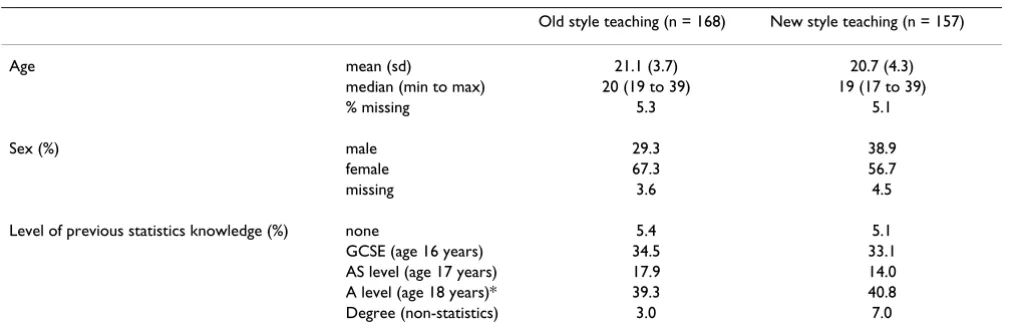
Approximately 260 students are admitted annually onto the medical degree course at our institution. There were 168 respondents for the old approach (old) cohort and 158 respondents for the new approach (new) cohort. There were no significant differences in the mean age (diff: 0.4 years, 95% CI: -0.5 to 1.3 years, p = 0.38) or the previ-ous level of statistical knowledge for the two cohorts (Mann-Whitney U p = 0.34). Whilst there was a higher percentage of male responders in the new cohort (38.9%) compared to the old cohort (29.3%), this difference was not statistically significant (χcc2 p = 0.07) (Table 1).
Following the teaching there were significant differences between the two cohorts in their ability to define both a P-value and a confidence interval, with students in the new cohort demonstrating an improved ability for both concepts (Figure 1). These differences remained even after adjustment for age and sex. Student ability to define these concepts was graded on a 6 point scale from 0 (no idea or missing) to 5 (textbook definition). After adjustment for age and sex the new cohort scored 1.1 points higher (95% CI: 0.84 to 1.38 points) for the p-value definition and 0.75 points higher (95% CI: 0.42 to 1.09 points) for the confidence interval definition.
Table 1: Baseline Characteristics of respondents
Old style teaching (n = 168) New style teaching (n = 157)
Age mean (sd) 21.1 (3.7) 20.7 (4.3)
median (min to max) 20 (19 to 39) 19 (17 to 39)
% missing 5.3 5.1
Sex (%) male 29.3 38.9
female 67.3 56.7
missing 3.6 4.5
Level of previous statistics knowledge (%) none 5.4 5.1
GCSE (age 16 years) 34.5 33.1
AS level (age 17 years) 17.9 14.0
A level (age 18 years)* 39.3 40.8
Degree (non-statistics) 3.0 7.0
In addition to their ability to define the two key concepts of p value and confidence interval, students were asked to rate their agreement with four statements about their atti-tudes towards the relevance of statistics to medical prac-tice. Figure 2 summarises these results. There were significant differences between the two cohorts for their responses to the statements 'A knowledge of statistics is integral to medical practice' (p = 0.02) and 'I expect to use statistics in my medical career' (p = 0.008), with the new cohort being more likely to agree with these statements. These differences persisted after adjustment for age and sex (p = 0.03 and 0.003 respectively). However, there were no significant differences between the cohorts with respect to the two statements 'A knowledge of statistics is essential for me to understand the medical literature' (p = 0.16) and 'I feel comfortable with the basics of medical statistics' (p = 0.18). Adjustment for age and sex did not alter these results (p = 0.28 and 0.06 respectively). Over half of all individuals in both cohorts felt comfortable with the basics of medical statistics with slightly more tending to agree for the new cohort (55.3%) than for the old cohort (52.1%), though as stated above this difference is not statistically significant.
The majority of students in both cohorts felt that the ses-sions had delivered what they had expected. Though the percentage was higher for the old cohort (74.1% com-pared to 66.7%) this difference is not statistically signifi-cant (Table 2).
Discussion
Entry criteria to the MB ChB course have recently been changed to favour entrants from non-traditional back-grounds. Additionally, numbers have risen. The challenge has therefore been to motivate these students to gain a better understanding of statistics in medicine. This is against a background of practice becoming increasingly evidence-based and the requirement on students when they become practitioners to demonstrate that they can reach correct diagnoses using both clinical and statistical data [3,9].
We have described above a project that brought together experts from a range of disciplines to produce a new learn-ing package for medical students. The development of new and remodelled teaching materials and approaches placed greater emphasis on the application of statistics and interpretation of data rather than the mechanics of particular statistical techniques. We evaluated this new approach and demonstrated that we have made a statisti-cally significant difference to both students' understand-ing of some key concepts, includunderstand-ing confidence intervals and P-values, and their ability to view statistics in relation to their medical practice. The new course did place much greater emphasis on obtaining a basic understanding of key concepts and this might in part explain the big differ-ence in the number of students able to define these, although we would argue that this could not account for all the difference between the groups. We did much more than change the emphasis, we completely remodelled the teaching materials and increased the variety of approaches
Ability to define key concepts
Figure 1
and it is this multi-dimensional approach that we would recommend to others; in order to engage (non-statistics) students in learning about statistics you need to think very carefully about what you want them to learn, make sure you cover the basics well, embed the learning within a rel-evant context and use a variety of approaches.
Negative attitudes and beliefs towards statistics can impact on how students learn and apply what they have learnt outside the classroom [16]. Introductory statistics courses are important as they may often be the only course that students undertake and they are important in shaping students' beliefs and attitudes [17]. In redesigning the syllabus and the way in which medical statistics is taught we have sought to make the students' learning experience more relevant to their eventual medical prac-tice and ensure that the teaching reflects what is to be learned [10,18].
Although a recent article by Herman et al advocated that medical students be taught techniques in addition to con-cepts, their conclusion that this resulted in better knowl-edge retention was not supported by any evidence in their paper [19]. In addition the course they outlined included a large number of contact hours, culminating in a substan-tial piece of research in the final year. Whilst this might be seen by some as desirable, it is not relevant to the majority of medical degrees where only a limited amount of
curric-ulum time is given over to the teaching of statistics. As has been commented on by several authors, the majority of medical students are likely to become consumers of research and are thus most likely to need to understand basic concepts rather than the details of particular statisti-cal tests and the mathematics that underpin these [9,20-22]. Along with the recommendations of Evans [20] the amount of mathematics taught has been kept to a mini-mum and the teaching has been rooted in real examples.
Although there have been several calls for changes to med-ical statistics education so that it is more concept-driven as outlined above, there have been few evaluations of changes to teaching practice for this subject. In addition, as early as 1990, Clayden suggested that collaboration between medical statisticians and non-statistically quali-fied teachers offered potential benefits for student learn-ing. This current study is the first to do this and to demonstrate the advantages of such an approach. Those that have evaluated new teaching initiatives have tended to concentrate on process and quality issues [21,23], rather than systematically evaluating differences in knowl-edge between the traditional mathematically orientated teaching compared to concept driven teaching. Only Marantz et al have previously compared outcomes between a more traditional teaching with a new 'case-based' approach that attempts to contextualize learning [11]. They demonstrated that outcomes were comparable
Responses to attitudinal questions
Figure 2
between the two and the students were very positive about the new-approach teaching. While the Marantz study dif-fers from this current study in that they used individual cases to illustrate key concepts, its results are in agreement with this current study and reinforces the advantages of contextualized learning.
In addition the Marantz approach did not use the variety of different approaches that the current study has used [11]. We sought to maximize the opportunities for stu-dents with different learning styles and approaches using a variety of media and materials, such as lectures, small group tutorials, videos and animations. This is in line with the recommendations of several authors including Noori-afshar & Maraseni who demonstrated that irrespective of background, students preferred visual explanations and recommended that learning be facilitated using a multi-media approach, including animations [13]. The videos that we produced were used to introduce students to the scenarios to be explored during the teaching. While videos have been criticized as a medium for sole instruction, Moore also highlighted its benefits for introducing topics and providing a narrative structure [12]. By increasing the small-group problem-solving component of the teaching we have increased the opportunities for students to explore in greater detail the concepts introduced in the lectures.
We recognise that the work that we have done on this project has relied upon the fact that we have all collabo-rated well together. This project would not have been as successful had this not been the case and in recommend-ing a collaborative approach to others we would empha-size that this approach will only work if all participants are prepared to work closely together and value the other members of the team. Whilst we have demonstrated improvements in both student attitudes and knowledge, we remain keen to improve knowledge for all and con-tinue to strive to find new ways of improving our teach-ing, particularly for those who continue to fail to understand. In addition to all that we have done to improve the experience of learning statistics and the understanding that students take away from the sessions, we are currently developing an online resource, as there is a clear need for this [14]. This is designed to serve as an easy reference guide for consolidation of learning and revision. Students will be able to access the content of the lectures, a glossary of terms covered in the lectures, further
materials (including links to other web-based statistical resources) and also additional scenarios to contextualise key statistical principles, which include quizzes designed to self-check their knowledge. The resource will also pro-vide more advanced materials for those students inter-ested in delving deeper, beyond the level of the lectures.
In addition, there has been much discussion above of the advantages of contextualising learning, particularly in the learning and teaching of statistics. When we initially began this project, we were keen to use a problem-based learning approach (PBL), but found that given the restric-tions of the curriculum, particularly with respect to the time available, it would not be possible at the present. These problems have also been raised by Bland, who investigated the use of PBL to teach statistics in Australian medical schools, [24]. He found that whilst many of the Australian schools used PBL for teaching, there were no instances of a truly integrated approach to the teaching of statistics through PBL. This remains an area for future work that we are now pursuing through the development of PBL materials for our students that fit within the current curriculum.
Conclusion
We are committed to improving learning, both the stu-dent experience of learning and the knowledge that they take away, and it remains our goal that following our teaching the students – who will become doctors – should have more positive attitudes towards statistics, their possi-ble meanings and their impact on the process of consulta-tion. Ultimately we are seeking to make a difference to the skills that students will need when they become medical practitioners dealing with patients. The implications of this learning, therefore, are likely to extend far beyond their time as an undergraduate. This important issue coin-cides with current wider interest in professional standards. The education and training that medical students receive is fundamental to the formation of their attitudes and behaviours. Doctors increasingly need to use statistics to help them understand medical issues. We are seeking to counter phobias relating to statistics that may exist among students and, by presenting materials in different ways, we have given more students more opportunities to learn important content and principles. It is the pursuit of these professional standards that drives our efforts.
Table 2: Percentage whose expectations were met?
Old style teaching (n = 162) New style teaching (n = 138) Difference (95% CI) P-value*
74.1 66.7 7.4% (-2.9 to 17.7) 0.20
Publish with BioMed Central and every scientist can read your work free of charge "BioMed Central will be the most significant development for disseminating the results of biomedical researc h in our lifetime."
Sir Paul Nurse, Cancer Research UK
Your research papers will be:
available free of charge to the entire biomedical community
peer reviewed and published immediately upon acceptance
cited in PubMed and archived on PubMed Central
yours — you keep the copyright
Submit your manuscript here:
http://www.biomedcentral.com/info/publishing_adv.asp
BioMedcentral
Competing interests
The authors declare that they have no competing interests.
Authors' contributions
All authors made substantial contributions to the concep-tion and design of the innovaconcep-tions outlined in the paper, the acquisition of the data and the interpretation of the results of the analysis. All authors helped in revising the draft critically for important intellectual content. All authors approved the final version of the paper prior to submission. In addition JVF was responsible for the anal-ysis of the data and wrote the first draft of the paper.
References
1. Windish DM, Huot SJ, Green ML: Medicine Residents' Under-standing of the Biostatistics and Results in the Medical Liter-ature. Journal of American Medical Association 2007, 298:1010-1022. 2. Williams M: Baseline Study of Quantitative Methods in British
Sociology. 2001.
3. General Medical Council: Tomorrow's Doctors: recommenda-tions on undergraduate medical education. . 1993
4. Campbell MJ: Statistical training for doctors in the U.K. In Sixth International Conference on Teaching Statistics Cape Town, South Africa; 2002.
5. Garfield J: How students learn statistics. International Statistical Review 1995, 63:25-34.
6. Kolb D: Experiential Learning: experience as the source of learning and development Englewood Cliffs, NJ, Prentice Hall; 1984.
7. Lawrence G: People Types and Tiger Stripes. 3rd edition. 1993. 8. Yilmaz MR: The challenge of teachings statistics to non-spe-cialists. Journal of Statistics Education 1996, 4: [http:// www.amstat.org/publications/jse/v4n1/yilmaz.html].
9. Morris RW: Does EBM offer the best opportunity yet for teaching medical statistics? Statistics in Medicine 2002,
21:969-977.
10. Sterne JAC: Teaching significance tests - time for significant change? Statistics in Medicine 2002, 21:994.
11. Marantz PR, Burton W, Steiner-Grossman P: Using the case-dis-cussion method to teach epidemiology and biostatistics. Aca-demic Medicine 2003, 78:365-371.
12. Moore DS: The place of video in new styles of teaching and learning statistics. The American Statistician 1993, 47:172-176. 13. Nooriafshar M, Maraseni TN: A comparison of learning
prefer-ences and perceptions of students for statistics concepts and techniques. International Journal for Mathematical Teaching and Learn-ing 2005.
14. Smeeton N: Statistical education in medicine and dentistry.
The Statistician 1997, 46:521-527.
15. Perneger TV: What's wrong with Bonferroni adjustments? Brit-ish Medical Journal 1998, 316:1236-1238.
16. Gal I, Ginsburg L: The role of beliefs and attitudes in learning staitstics: towards an assessment framework. Journal of Statis-tics Education 1994, 2: [http://www.amstat.org/publications/jse/v2n2/ gal.html].
17. Roiter K, Petocz P: Introductory statistics courses - a new way of thinking. 1996, 4: [http://www.amstat.org/publications/jse/v4n2/ roiter.html].
18. Astin J, Jenkins T, Moore L: Medical students' perspective on the teaching of medical statistics in the undergraduate medical curriculum. Statistics in Medicine 2002, 21:1003-1006.
19. Herman A, Notzer N, Libman Z, Braunstein R, Steinberg D: Statis-tical education for medical students: concepts are what remain when the details are forgotten. Statistics in Medicine 2007, 26:4344-4351.
20. Evans SJW: Statistics for medicla students in the 1990's: how should we approach the future. Statistics in Medicine 1990,
9:1069-1075.
21. Ambrosius WT, Manatunga AK: Intensive short courses in biostatistics for fellows and physicians. Statistics in Medicine 2002, 21:2739-2756.
22. Mintz E, Ostbye T: Teaching statistics to health professionals: the legal analogy. Medical Teacher 1992, 14:371-374.
23. Boyle CR: A problem-based learning approach to teaching biostatistics. Journal of Statistics Education 1999, 7: [http:// www.amstat.org/publications/jse/secure/v7n1/boyle.cfm].
24. Bland JM: Teaching statistics to medical students using prob-lem-based learning: the Australian experience. BMC Medical Education 2004, 4:.
Pre-publication history
The pre-publication history for this paper can be accessed here: