R E S E A R C H A R T I C L E
Open Access
Dysequilibrium of the PTH-FGF23-vitamin D
axis in relapsing remitting multiple
sclerosis; a longitudinal study
Mark Simon Stein
1,2,3*, Gregory John Ward
4, Helmut Butzkueven
1,5,6,7, Trevor John Kilpatrick
1,5,6and Leonard Charles Harrison
1,3,6Abstract
Background:Parathyroid glands of people with relapsing remitting multiple sclerosis (RRMS) fail to respond to low serum 25-hydroxyvitamin D (25OHD) and low serum calcium, which are stimuli for parathyroid hormone (PTH) secretion. This led us to hypothesise: that there is suppression of PTH in RRMS due to higher than normal serum concentrations of fibroblast growth factor 23 (FGF23). We therefore sought evidence for dysregulation of the PTH-FGF23-vitamin D axis in RRMS.
Methods:Longitudinal study (winter to summer) with fasting venepunctures. For RRMS subjects who recruited a healthy control (HC) friend, pairs analyses were performed. For each pair, the within-pair difference of the variable of interest was calculated (RRMS minus HC). Then, the median of the differences from all pairs was compared against a median of zero (Wilcoxon) and the 95% confidence interval of that median difference (CI) was calculated (Sign Test).
Results:RRMS had lower winter PTH than HC,P= 0.005, (CI -2.4 to 0.5 pmol/L,n= 28 pairs), and lower summer PTH, P= 0.04, (CI -1.8 to 0.5,n= 21 pairs). Lower PTH associates physiologically with lower intact FGF23 (iFGF23), yet RRMS had higher iFGF23 than HC in winter,P= 0.04, (CI -3 to 15 pg/mL,n= 28 pairs) and iFGF23 levels comparable to HC in summer, P= 0.14, (CI -5 to 13,n= 21 pairs). As PTH stimulates and FGF23 reduces, renal 1-alpha hydroxylase enzyme activity, which synthesises serum 1,25-dihyroxyvitamin D (1,25(OH)2D) from serum 25OHD, we examined the ratio of serum 1,25(OH)2D to serum 25OHD. In winter, this ratio was lower in RRMS versus HC,P= 0.013, (CI -1.2 to - 0.3,n= 28 pairs).
Conclusions:This study revealed a dysequilibrium of the PTH-FGF23-vitamin D axis in RRMS, with lower plasma PTH, higher plasma iFGF23 and a lower serum 1,25(OH)2D to 25OHD ratio in RRMS compared with HC subjects. This dysequilibrium is consistent with the study hypothesis that in RRMS there is suppression of the parathyroid glands by inappropriately high plasma concentrations of iFGF23. Studying the basis of this dysequilibrium may provide insight into the pathogenesis of RRMS.
Keywords:Multiple sclerosis, Vitamin D, Parathyroid hormone, Fibroblast growth factor 23
Background
Vitamin D is synthesised in skin upon exposure to ultravio-let light and converted in the liver to 25-hydroxyvitamin D (25OHD), the main vitamin D metabolite in serum and the clinical indicator of vitamin D nutrition (Parfitt et al.1982; Hollis 1996). Serum 25OHD is converted in the kidney
tubules and immune cells (macrophages, dendritic cells, and potentially B and T lymphocytes) to a very potent form of vitamin D, 1,25-dihydroxyvitamin D (1,25(OH)2D), by 1-alpha hydroxylase (Tanaka and DeLuca 1981; Reichel et al.1987a; Reichel et al. 1987b; Bacchetta et al. 2013; Shimada et al. 2004; Shimada et al. 2005; Enioutina et al. 2009; Carvalho et al. 2017), which is increased by parathyroid hormone (PTH) and reduced by fibroblast growth factor-23 (FGF23) (Tanaka and DeLuca 1981; Bacchetta et al. 2013; Shimada et al. 2004; Shimada et al. 2005; Gattineni et al. 2011). Serum 1,25(OH)2D is
* Correspondence:[email protected]
1The Royal Melbourne Hospital, Parkville, Australia
2Department of Diabetes and Endocrinology, The Royal Melbourne Hospital,
Parkville, VIC 3050, Australia
Full list of author information is available at the end of the article
degraded by renal 24-hydroxylase, which is reduced by PTH and increased by FGF23 (Tanaka and DeLuca 1981; Shimada et al. 2004; Gattineni et al. 2011). PTH and FGF23 thus regulate serum 1,25(OH)2D concentra-tions through opposite effects on synthetic and de-gradative hydroxylases.
These regulatory pathways include serum 1,25(OH)2D
itself, which feeds back both on the enzymes
1-alpha-hydroxylase and 24-hydroxylase (Colston et al.
1977) and on the hormones PTH and FGF23.
1,25(OH)2D directly stimulates the synthesis of FGF23 by osteoblasts and osteocytes (Shimada et al. 2004; Nguyen-Yamamoto et al.2017). It can increase the absorp-tion of dietary calcium and phosphate, and higher serum concentrations of calcium and phosphate may feedback to stimulate FGF23 secretion (Shimada et al. 2005; Nguyen-Yamamoto et al.2017; Quinn et al.2013). Serum 1,25(OH)2D also feeds back directly on the parathyroid glands to reduce PTH synthesis (Silver et al. 1986) and also indirectly by its action to increase serum concen-trations of FGF23, which may then further reduce PTH synthesis and secretion (Ben-Dov et al. 2007; Lavi-Moshayoff et al. 2010). Completing another feed-back loop, PTH, the secretion of which is reduced by FGF23, in turn stimulates FGF23 synthesis by
osteo-blasts and osteocytes (Ben-Dov et al. 2007;
Lavi-Moshayoff et al. 2010).
FGF23 circulates as an intact molecule (iFGF23), which is cleaved to release a C-terminal fragment (cFGF23) (Razzaque and Lanske 2007; Blau and Collins 2015). FGF23 binds a variety of FGF receptor subtypes, either directly or in conjunction with the Klotho recep-tor (Gattineni et al. 2011; Razzaque and Lanske 2007; Blau and Collins 2015; Kurosu et al. 2006). A soluble alpha fragment of the Klotho receptor may also circulate and may serve to stimulate FGF23 synthesis (Smith et al. 2012).
In winter, a decrease in sunlight exposure and vitamin D synthesis is associated with an increase in serum PTH, which maintains the serum calcium concentration. In people with relapsing remitting multiple sclerosis (RRMS), Soilu-Hänninen et al. (Soilu-Hänninen et al. 2008) observed that the winter rise in serum PTH was blunted and was associated with lower serum calcium, compared to healthy controls (HC). It appeared that the parathyroid glands of people with RRMS failed to respond to two stimuli for PTH secretion, namely lower concentrations of vitamin D and serum calcium. This led us to hypothesise that there is suppression of PTH in RRMS due to higher than normal serum concentra-tions of FGF23. In the present study, we sought evi-dence for dysregulation of the PTH-FGF23-vitamin D axis in RRMS, in a longitudinal study from winter to summer.
Methods
Subjects
People with RRMS (aged≥18 years) were recruited from hospital clinics and through publicity on the MS Australia Victoria website in July–August 2011. They were asked to bring one or more healthy friends (aged ≥18 years) to serve as healthy controls (HC).
The study was approved by the Human Research Eth-ics Committees of Melbourne Health and Eastern Health, Victoria. All subjects provided written informed consent.
Exclusions to filter out conditions affecting mineral metabolism were:
Pregnancy, breast-feeding, fracture, bone/joint surgery, treatment with raloxifene, alendronate, risedronate, zole-dronate, strontium ranelate or teriparetide in the previ-ous 6 months.
Except for the oral contraceptive, treatment with es-trogen or progesterone, testosterone, phenytoin, valpro-ate or levetiracetam in the previous 3 months.
Treatment with oral or systemic glucocorticoid in the previous month.
Treatment with furosemide or thiazide diuretic in the previous week.
Inability to ambulate 300 m without assistance of an-other person.
HC were excluded if a 1st- or 2nd-degree relative had a history of demyelination.
The following were permitted: oral contraceptives, asthma inhalers, over-counter vitamin/mineral supplements.
We sought to enrol at least 20 individuals with RRMS and 20 HC based on the sample size used to report that people with RRMS failed to increase their serum PTH concentrations in winter (Soilu-Hänninen et al.2008).
Between August 19th-September 28th 2011 subjects had fasting‘winter’venepuncture at collection centres of Melbourne Pathology (Sonic Healthcare, Collingwood, Victoria). Venepuncture was performed between 7:30 am–10 am to control for circadian variation in PTH. Subjects were asked to avoid alcohol for at least 24 h before venepuncture. Each RRMS-HC friend pair attended the same centre at the same time and was ran-domised (via central computer) as to within-pair vene-puncture order. They completed questionnaires regarding anthropometrics, personal and family health. Body mass index (BMI) was calculated as weight (kg)/ [height (m)]2.
Subjects were invited to return February 2012 for identical ‘summer’ collections, preserving within-pair venepuncture order.
Laboratory assays
EDTA blood tubes were centrifuged immediately, as were serum separator tubes after blood had clotted. Plasma for PTH assay was transported at ambient temperature (Glendenning et al. 2002). Remaining plasma and sera were frozen on site then transported for same day general biochemistry analysis or for storage at −80 C. Melbourne Pathology Central Laboratory (Col-lingwood, Melbourne) measured serum biochemistry (Modular c701 chemistry analyser; Roche, Mannheim, Germany), plasma human intact PTH (Modular e602 immunoassay analyser; Roche, Mannheim, Germany) with coefficient of variation (CV) = 4.0% (2–50 pmol/L) and serum 25OHD (Liaison analyser in winter, Liaison XL analyser in summer; DiaSorin, Turin, Italy), with CV = 7.5% (40–280 nmol/L). Calcium corrected for albumin (Cacorr) was calculated as total calcium (mmol/L) + (40-albumin [g/L]) × 0.02.
Sullivan Nicolaides Pathology, (Sonic Healthcare, Bris-bane, Australia) measured plasma intact FGF23 (iFGF23) by ELISA (CY4000; Kainos Laboratories, Tokyo, Japan) (Yamazaki et al.2002 and see also Imel et al.2006 and Smith et al. 2013), with interassay CV = 3% (at mean 71.8 pg/mL) and 4% (at mean 203.3 pg/mL), plasma C-terminal FGF23 peptide (FGF23c) by ELISA (Immu-notopics, San Clemente, USA) with interassay CV = 9% (at mean 32.3) and 1% (at mean 293) and plasma soluble
alpha klotho (Klotho) by ELISA (IBL, Hamburg
Germany), with interassay CV = 4% (at mean 1130.8 pg/ mL) and 4% (at mean 1322.3 pg/mL). Serum ferritin was assayed with the Architect kit, (Abbott, Abbott Park, Illinois, USA). Serum 1,25OH2D was measured by im-munoassay (IDS iSYS, Tyne and Wear, UK).
For ELISAs, summer and winter specimens from each RRMS-HC pair were measured in the same assay (within the same ELISA plate). Laboratory personnel were blind to source of specimens.
Statistics
The frequencies of characteristics of RRMS and HC sub-jects were compared by Fisher’s exact test. Cohort me-dian values for biochemical analytes of RRMS and HC subjects were compared by Mann-Whitney test. The 95% confidence intervals (CIs) for differences between cohort medians were calculated by Moods Median Test.
For RRMS subjects who had recruited an HC friend, pairs analyses were performed. For each pair, the within-pair difference of the variable of interest was cal-culated (RRMS minus HC). Then, the median of the dif-ferences from all pairs was compared against a median
of zero (Wilcoxon) and the 95% CI of that median dif-ference was calculated (Sign Test).
Modelling (general linear modelling/multiple regres-sion/path analysis) was not performed as bi-directional causality (Ben-Dov et al. 2007) renders such approaches invalid (personal communication, Professor Terry Speed, Bioinformatics Division, Walter and Eliza Hall Institute of Medical Research, Melbourne).
Statistical analyses were performed on Minitab 13.1 and 17 (http://www.minitab.com). Outliers were defined by the Minitab definition, i.e. > 1.5 x interquartile range (IQR) outside the IQR.P< 0.05 was considered significant. Hypotheses with an a priori direction, viz. lower PTH, higher FGF23 (RRMS versus HC), were tested one-tailed (Armitage and Berry1994). Other hypotheses were tested two-tailed.
Results
55 RRMS and 35 HC subjects were recruited in winter. Their median (IQR) ages were 46.5 (36.5–52.5) and 49.5 (38.5–56.0) years, respectively (P= 0.2). RRMS and HC were 71% and 43% female (F), respectively, (P= 0.007). Subjects were excluded for non-return of the questionnaire (3 RRMS, 2 HC) and confounding medication (2 HC), leaving 83 winter subjects. Of RRMS, 14 (27%) were on no therapy, 6 (12%) took glatiramer acetate, 26 (50%) interferon-beta, 2 (4%) natalizumab and 4 (8%) fingolimod; 38% were taking vitamin D compared to 16% HC (P= 0.02), and 12% were taking calcium compared to 6% HC (P= 0.4).
Median (IQR) BMIs were: RRMS 23.9 (21.2–29.2) and HC 26.2 (22.8–29.0) kg/m2
(P= 0.4). Two RRMS females with outlier BMIs (43.3, 43.0) and 1 RRMS female with BMI 16.9 (not clinically consistent with normal mineral metabolism) were excluded. One female HC had a failed winter venepuncture. This left 79 subjects (49 RRMS, 30 HC) for whom winter plasma PTH and other analytes were studied for cohort analyses. Of these, 61 (38 RRMS, 23 HC) agreed to return for summer venepuncture for measurement of plasma PTH and other analytes. After the above exclusions, 28 RRMS-HC pairs remained for winter analyses and 23 RRMS-HC pairs for summer ana-lyses. We did not ascertain the reasons why some sub-jects declined to return in summer.
25OHD and 1,25(OH)2D
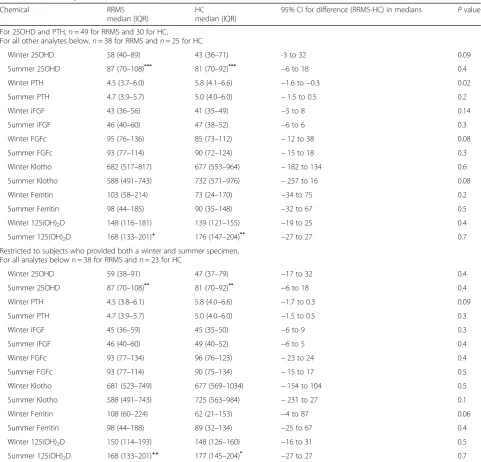
Serum 25OHD increased from winter to summer in both RRMS and HC (P< 0.01). However, for serum 1,25(OH)2D a significant seasonal rise was detected only in the HC (P= 0.02) (Fig.1, Table1).
PTH and iFGF23
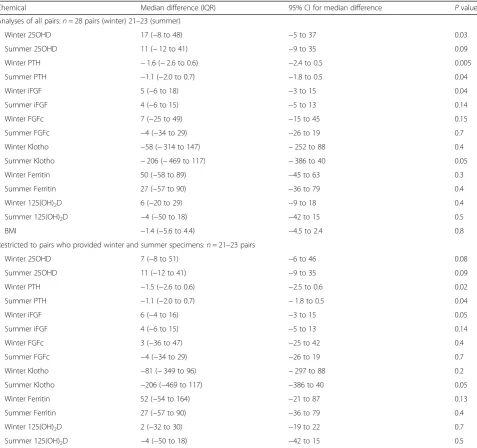
(Fig. 2, Table 2). For example, the median winter within-pair difference (RRMS-HC) in plasma PTH was −1.6 pmol/L (P= 0.005). To put the magnitude of this difference in context, it is over half the magnitude of the HC IQR for winter plasma PTH (Table1).
In subjects with RRMS, plasma iFGF23 was the same as or higher than in HC (Fig. 3, Table 2). For example, the median winter within-pair difference (RRMS-HC) in plasma iFGF23 was 5 pg/mL (P= 0.04). To put the mag-nitude of this difference in context, it approximates one third the magnitude of the HC IQR for winter plasma iFGF23 (Table1).
Ratio of serum 1,25(OH)2D to 25OHD
As PTH increases and iFGF23 reduces the activity of renal 1-alpha hydroxylase, which synthesises serum 1,25(OH)2D from serum 25OHD, (and as PTH reduces and iFGF23 in-creases the activity of renal 24-hydroxylase which de-grades serum 1,25(OH)2D) we compared the ratio of the serum concentrations of 1,25(OH)2D and 25OHD be-tween RRMS and HC. Subjects with RRMS had a lower ratio of serum 1,25(OH)2D (pmol/L) to serum 25OHD (nmol/L). The median winter within-pair difference (RRMS-HC) in this ratio was−0.7 (P= 0.013, 95% CI -1.2 to−0.3,n= 28 pairs) (Fig.4). To put the magnitude of this difference in context, it is over one third the magnitude of the HC IQR for the winter ratio of serum 1,25(OH)2D (pmol/L) to serum 25OHD (nmol/L); as the median (IQR) HC winter ratio was 3.1 (2.0–3.8).
In the smaller sample of summer pairs, the median within-pair difference (RRMS-HC) of the ratio of serum 1,25(OH)2D to serum 25OHD was −0.3, which did not reach significance (P= 0.07, 95% CI -0.9 to 0.1,n= 22 pairs) (Fig.4), potentially because of the smaller sample size.
Examination of potential confounders
The RRMS cohort contained a higher proportion of fe-males, and plasma PTH may vary with renal function and plasma FGF23 with serum magnesium and ferritin (Takeda et al. 2011; Braithwaite et al. 2012; Durham et al. 2007). Therefore, we explored post-hoc whether the lower plasma PTH and paradoxically similar or higher plasma iFGF23 in subjects with RRMS could be due to confounding by sex or serum creatinine, magnesium, ferritin or 25OHD.
Either for all subjects combined, or within the separate RRMS and HC cohorts, plasma PTH and plasma iFGF23 did not differ by sex and in winter neither was associated with serum creatinine, which itself did not differ be-tween RRMS and HC.
The median within-pair difference (RRMS-HC) in serum magnesium was not significantly different from zero (both in winter and summer). The median within-pair difference (RRMS-HC) in serum ferritin was not significantly different from zero (both in winter and summer). Furthermore, there was no correlation between within-pair differences in plasma iFGF23 and within-pair differences in serum ferritin.
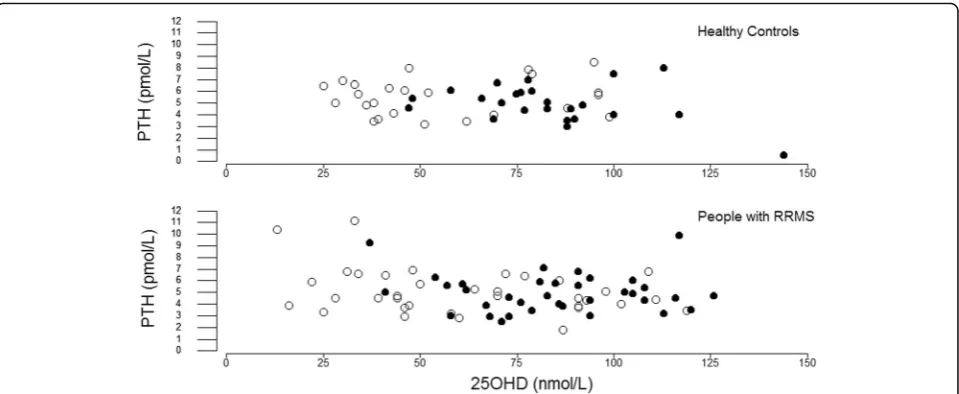
The bivariate relationship between serum 25OHD and plasma PTH was weak (Fig. 5). Winter serum 25OHD correlated inversely with winter plasma PTH for all subjects combined (r=−0.27, P= 0.02) and within the RRMS (r=−0.32, P= 0.03) but not the HC cohort (r=−0.06, P= 0.7). In summer, serum 25OHD did not correlate with plasma PTH. Furthermore, serum 25OHD did not correlate with plasma iFGF23, plasma FGF23c, plasma klotho or serum ferritin.
In summary, lower plasma PTH and similar or higher plasma iFGF23 in RRMS compared with HC subjects was not due to confounding by sex or serum creatinine, magnesium, ferritin or 25OHD.
Fig. 1Serum 25OHD and serum 1,25(OH)2D Individual values (open circles), cohort medians and interquartile ranges (boxes) are plotted for those
subjects who had both winter and summer measurement of serum 1,25(OH)2D. Serum 25OHD increased from winter to summer in both HC and
Discussion
We present evidence for dysequilibrium of the PTH-FGF23-vitamin D axis in RRMS. Subjects with RRMS had lower plasma PTH concentrations than HC, yet their plasma iFGF was the same as or higher than HC. In winter, when vitamin D nutrition was lowest, they had a lower serum 1,25(OH)2D to 25OHD ratio and in summer they failed to demonstrate a rise in serum 1,25(OH)2D, as observed in HC. These findings are consistent with our initial hypothesis that there is suppression of PTH in RRMS, associated with higher serum FGF23. The magnitude of this dysequilibrium was
Table 1Cohort analyses
Chemical RRMS median (IQR)
HC median (IQR)
95% CI for difference (RRMS-HC) in medians Pvalue For 25OHD and PTH,n= 49 for RRMS and 30 for HC.
For all other analytes below,n= 38 for RRMS andn= 25 for HC
Winter 25OHD 58 (40–89) 43 (36–71) -3 to 32 0.09 Summer 25OHD 87 (70–108)***
81 (70–92)*** −6 to 18 0.4 Winter PTH 4.5 (3.7–6.0) 5.8 (4.1–6.6) −1.6 to−0.3 0.02 Summer PTH 4.7 (3.9–5.7) 5.0 (4.0–6.0) −1.5 to 0.5 0.2 Winter iFGF 43 (36–56) 41 (35–49) −5 to 8 0.14 Summer iFGF 46 (40–60) 47 (38–52) −6 to 6 0.3 Winter FGFc 95 (76–136) 85 (73–112) −12 to 38 0.08 Summer FGFc 93 (77–114) 90 (72–124) −15 to 18 0.3 Winter Klotho 682 (517–817) 677 (553–964) −182 to 134 0.6 Summer Klotho 588 (491–743) 732 (571–976) −257 to 16 0.08 Winter Ferritin 103 (58–214) 73 (24–170) −34 to 75 0.2 Summer Ferritin 98 (44–185) 90 (35–148) −32 to 67 0.5 Winter 125(OH)2D 148 (116–181) 139 (121–155) −19 to 25 0.4
Summer 125(OH)2D 168 (133–201)+ 176 (147–204)** −27 to 27 0.7
Restricted to subjects who provided both a winter and summer specimen, For all analytes belown= 38 for RRMS andn= 23 for HC
Winter 25OHD 59 (38–91) 47 (37–79) −17 to 32 0.4 Summer 25OHD 87 (70–108)** 81 (70–92)** −6 to 18 0.4
Winter PTH 4.5 (3.8–6.1) 5.8 (4.0–6.6) −1.7 to 0.3 0.09 Summer PTH 4.7 (3.9–5.7) 5.0 (4.0–6.0) −1.5 to 0.5 0.3 Winter iFGF 45 (36–59) 45 (35–50) −6 to 9 0.3 Summer iFGF 46 (40–60) 49 (40–52) −6 to 5 0.4 Winter FGFc 93 (77–134) 96 (76–123) −23 to 24 0.4 Summer FGFc 93 (77–114) 90 (75–134) −15 to 17 0.5 Winter Klotho 681 (523–749) 677 (569–1034) −154 to 104 0.5 Summer Klotho 588 (491–743) 725 (563–984) −231 to 27 0.1 Winter Ferritin 108 (60–224) 62 (21–153) −4 to 87 0.06 Summer Ferritin 98 (44–188) 89 (32–134) −25 to 67 0.4 Winter 125(OH)2D 150 (114–193) 148 (126–160) −16 to 31 0.5
Summer 125(OH)2D 168 (133–201)++ 177 (145–204)* −27 to 27 0.7 Abbreviations:IQRinterquartile range
P:*< 0.05,**< 0.005,***< 0.0005,+0.07,++0.23 for within-cohort, winter versus summer values for 25OHD and 1,25(OH)2D tabulated above
Table 2Pairs analyses (subject with RRMS minus HC friend)
Chemical Median difference (IQR) 95% CI for median difference Pvalue Analyses of all pairs:n= 28 pairs (winter) 21–23 (summer)
Winter 25OHD 17 (−8 to 48) −5 to 37 0.03 Summer 25OHD 11 (−12 to 41) −9 to 35 0.09 Winter PTH −1.6 (−2.6 to 0.6) −2.4 to 0.5 0.005 Summer PTH −1.1 (−2.0 to 0.7) −1.8 to 0.5 0.04 Winter iFGF 5 (−6 to 18) −3 to 15 0.04 Summer iFGF 4 (−6 to 15) −5 to 13 0.14 Winter FGFc 7 (−25 to 49) −15 to 45 0.15 Summer FGFc −4 (−34 to 29) −26 to 19 0.7 Winter Klotho −58 (−314 to 147) −252 to 88 0.4 Summer Klotho −206 (−469 to 117) −386 to 40 0.05 Winter Ferritin 50 (−58 to 89) −45 to 63 0.3 Summer Ferritin 27 (−57 to 90) −36 to 79 0.4 Winter 125(OH)2D 6 (−20 to 29) −9 to 18 0.4
Summer 125(OH)2D −4 (−50 to 18) −42 to 15 0.5
BMI −1.4 (−5.6 to 4.4) −4.5 to 2.4 0.8 Restricted to pairs who provided winter and summer specimens:n= 21–23 pairs
Winter 25OHD 7 (−8 to 51) −6 to 46 0.08 Summer 25OHD 11 (−12 to 41) −9 to 35 0.09 Winter PTH −1.5 (−2.6 to 0.6) −2.5 to 0.6 0.02 Summer PTH −1.1 (−2.0 to 0.7) −1.8 to 0.5 0.04 Winter iFGF 6 (−4 to 16) −3 to 15 0.05 Summer iFGF 4 (−6 to 15) −5 to 13 0.14 Winter FGFc 3 (−36 to 47) −25 to 42 0.4 Summer FGFc −4 (−34 to 29) −26 to 19 0.7 Winter Klotho −81 (−349 to 96) −297 to 88 0.2 Summer Klotho −206 (−469 to 117) −386 to 40 0.05 Winter Ferritin 52 (−54 to 164) −21 to 87 0.13 Summer Ferritin 27 (−57 to 90) −36 to 79 0.4 Winter 125(OH)2D 2 (−32 to 30) −19 to 22 0.7
Summer 125(OH)2D −4 (−50 to 18) −42 to 15 0.5 No significant differences were detected across season
Abbreviations:IQRinterquartile range
Fig. 3Within-pair differences (RRMS-HC) in plasma iFGF23
Fig. 4Within-pair differences (RRMS-HC) in the serum 1,25(OH)2D to
large. The median winter RRMS-HC difference in plasma PTH exceeded half the HC IQR for winter plasma PTH and the median winter RRMS-HC differ-ence in plasma iFGF23 approximated a third of the HC IQR for winter iFGF23. Similarly, the median winter RRMS-HC difference in the ratio of serum 1,25(OH)2D to 25OHD exceeded a third of the HC IQR for the win-ter value of this ratio.
Dysequilibrium of the PTH-FGF23-vitamin D axis data exhibited internal consistency. Thus, lower plasma PTH and higher plasma iFGF23 observed in RRMS would be expected to lead to lower renal 1-alpha hydroxylase ac-tivity in RRMS and thus decreased synthesis of serum 1,25(OH)2D from 25OHD (Tanaka and DeLuca 1981; Bacchetta et al.2013; Shimada et al.2004; Shimada et al. 2005). Lower plasma PTH and higher plasma iFGF23 in RRMS would also be expected to lead to higher renal 24-hydroxylase activity in RRMS with increased degrad-ation of serum 1,25(OH)2D (Tanaka and DeLuca 1981; Bacchetta et al.2013; Shimada et al.2004; Shimada et al. 2005). Accordingly, the winter serum 1,25(OH)2D to 25OHD ratio was lower in RRMS than HC and subjects with RRMS did not demonstrate the expected summer rise in serum 1,25(OH)2D observed in HC. Unlike the Finnish study of Soilu-Hänninen et al. (Soilu-Hänninen et al. 2008), we did not find a lower winter serum cal-cium concentration in RRMS, which might be explained by the fact that the winter serum 25OHD was higher in the Australian subjects. Irish researchers examined PTH at low levels of 25OHD (Lonergan et al.2011; McKenna et al.2018). In one study (Lonergan et al.2011) a signifi-cant inverse correlation of PTH with 25OHD was present in controls but not in people with MS. Those studies, however, did not report plasma calcium and
their MS cohort grouped primary progressive and sec-ondary progressive MS together with RRMS (Lonergan et al.2011; McKenna et al.2018). Blau and Collins (Blau and Collins 2015) wrote “The action of FGF23 on the parathyroid gland has been reported to suppress PTH secretion in vitro and in rodent models, but demonstra-tion of a similar effect in humans is lacking.” Although our findings are correlative they are consistent with a physiological effect of FGF23 to suppress the parathyroid glands in RRMS.
We were not able to determine if dysequilibrium of the PTH-FGF23-vitamin D axis precedes or follows the pathophysiology of RRMS. It is interesting, however, that while we find differences (RRMS vs HC) in the levels of hormones (PTH and iFGF23) that regulate the activity of the enzymes 1-alpha hydroxylase and 24-hydroxylase, which respectively synthesise and degrade the potent vitamin D metabolite 1,25(OH)2D, others find differ-ences between people with MS versus HC in the genes coding for these same enzymes (Pierrot-Deseilligny and Souberbielle 2017). This certainly raises the possibility that dysequilibrium of the PTH-FG23-vitamin D axis could have a pathogenic role. In addition, because PTH and FGF23 also regulate extra-renal 1-alpha hydroxylase in innate and adaptive immune cells, (for example see Ref Bacchetta et al. 2013) this dysequilibrium has the potential to modify immune-inflammatory processes in MS via autocrine as well as endocrine vitamin D metab-olism, in keeping with evidence that impaired vitamin D nutrition is associated with MS (Pierrot-Deseilligny and Souberbielle2017; Munger et al.2006; van der Mei et al. 2007; Simpson Jr et al.2010).
identify individuals at risk for RRMS or predict disease course and response to therapy. It will also be important to determine whether there is dysequilibrium in the PTH-FGF23-vitamin D axis in other autoimmune dis-eases such as type 1 diabetes, systemic lupus erythema-tosus and rheumatoid arthritis that exhibit an incidence or disease activity which correlates with vitamin D nutri-tion (Munger et al.2013; Watad et al.2017).
This study has several limitations. Not all of the
differ-ences between RRMS and HC demonstrated by
within-pair analysis were seen in comparison of RRMS and HC cohort medians. Furthermore, not all subjects with RRMS recruited a HC friend to the study. While cohort analyses have the advantage of larger sample size, analysis of RRMS-HC pairs may be more sensitive as it controls for pre-analytical specimen handling measure-ment error (each RRMS-HC friend pair attended the same specimen collection centre at the same time), which may contribute up to 50% of total analyte meas-urement error (Plebani 2006). To reduce analytical la-boratory error, winter and summer specimens from each RRMS-HC pair were analysed within the same ELISA plate. In addition, we deliberately recruited HC from friends of the people with RRMS to minimise bias from unmeasured lifestyle, social and demographic variables that could potentially mask disease-specific differences. A further potential limitation is that we did not measure markers of inflammation, which could confound the in-terpretation of serum ferritin concentrations, if people with RRMS had more inflammation than HC. Lower serum ferritin concentrations have been associated with higher serum concentrations of FGF23c and iFGF23 (Braithwaite et al.2012; Durham et al.2007), but this re-lationship appears to be assay specific (Durham et al. 2007). In particular, the Kainos iFGF23 assay used in this study was not affected by low concentrations of serum ferritin (Durham et al.2007). Hence, potential confound-ing of serum ferritin by inflammation in the RRMS
co-hort would not explain higher RRMS plasma
concentrations of iFGF23 in this study. Finally, the fact that some subjects chose not to return for summer venepuncture may have introduced bias into the study. However, subjects were recruited both from hospital MS clinics and from the community, supporting the generalizability of the results.
Conclusions
This study revealed a dysequilibrium of the
PTH-FGF23-vitamin D axis in RRMS, with lower plasma PTH, higher plasma iFGF23 and a lower serum 1,25(OH)2D to 25OHD ratio in RRMS compared with HC subjects. This dysequilibrium is consistent with the study hypothesis that in RRMS there is suppression of the parathyroid glands by inappropriately high plasma concentrations of iFGF23. The
basis of this dysequilibrium may provide insight into the pathogenesis of RRMS and requires further investigation.
Abbreviations
1,25(OH)2D:1,25-dihydroxyvitamin D; 25OHD: 25-hydroxyvitamin D;
CI: Confidence interval; FGF23: Fibroblast growth factor 23; FGFc: c-terminal fibroblast growth factor 23; HC: Healthy control(s); iFGF23: Intact fibroblast growth factor 23; IQR: Interquartile range; Klotho: Soluble alpha klotho; PTH: Parathyroid hormone; RRMS: Relapsing remitting multiple sclerosis
Acknowledgements
Professor TJ Martin (St Vincent’s Institute of Medical Research, Melbourne) and Professor Seiji Fukumoto (University of Tokyo) gave helpful advice on the iFGF23 assay. Professor Terry Speed (Walter and Eliza Hall Institute of Medical Research) and Professor Ian Gordon (Statistical Consulting Centre, University of Melbourne) provided statistical advice and review. Mary Tanner (Royal Melbourne Hospital), Kelly-Jane Lazarus (Box Hill Hospital) and Elizabeth McDonald (Medical Director, MS Australia Victoria) helped with recruitment. Bob Hutton (Royal Melbourne Hospital Information Technology Department) assisted with the study website. Dr. Ken Sikaris (Pathologist, Melbourne Pathology and Chair, International Federation Clinical Chemistry Committee on Analytical Quality) advised and supervised general biochemistry. Hayley Tacon, Eliza Ticknell and Marzi DeGaris (Melbourne Pathology) advised and assisted with specimen collection. Melissa Gresle (University of Melbourne) helped with sample storage. Karen Young, Michael Freemantle, Melissa Nelson, Eric Simons (Sullivan Nicolaides Pathology) performed the iFGF, FGFc, klotho, ferritin and 1,25(OH)2D assays. Advanced Professional Systems Pty Ltd. assisted with Medilink software to remind subjects of venepuncture arrangements.
Funding
This study was funded by charitable research grants from The Myer Foundation Australia (Martyn Myer [President], Christine Edwards [then CEO]) and Multiple Sclerosis Research Australia (Professor Bill Carroll [then Director], Heather Cato [then MS Grants Research Co-ordinator]). These funding bodies gave generous support and encouragement but had no role in the design of the study, in the collection, analysis, and interpretation of data or in writing the manuscript.
Availability of data and materials
Clinical data set not available. As was standard at the year of study inception and institutional human research ethics committees review, human research ethics committee permission was not sought or granted and informed consent was not obtained for public repository deposition of patient data or sharing the data set with researchers outside our institutions’research team.
Authors’contributions
Study concept and design: All authors. Acquisition, analysis, or interpretation of data: All authors. Drafting of the manuscript: MS, LCH. Critical revision of the manuscript for important intellectual content: All authors. Statistical analysis: MS. Obtained funding: All authors. Administrative, technical, or material support: All authors. Study supervision: All authors. All authors read and approved the final manuscript.
Ethics approval and consent to participate
The study was approved by the Human Research Ethics Committees of Melbourne Health and Eastern Health, Victoria. All subjects provided written informed consent.
Competing interests
The authors declare that they have no competing interests.
Publisher’s Note
Springer Nature remains neutral with regard to jurisdictional claims in published maps and institutional affiliations.
Author details 1
The Royal Melbourne Hospital, Parkville, Australia.2Department of Diabetes and Endocrinology, The Royal Melbourne Hospital, Parkville, VIC 3050, Australia.3Walter and Eliza Hall Institute of Medical Research, Parkville,
Neuroscience Institutes, Parkville, Australia.6University of Melbourne, Parkville,
Australia.7Monash University, Melbourne, Australia. Received: 18 January 2018 Accepted: 17 May 2018
References
Armitage P, Berry G. Statistical Methods in Medical Research. 3rd ed. London: Blackwell Scientific Publications; 1994. p. 96–7.
Bacchetta J, Sea JL, Chun RF, Lisse TS, Wesseling-Perry K, Gales B, et al. FGF23 inhibits extra-renal synthesis of 1,25-dihydroxyvitamin D in human monocytes. J Bone Miner Res. 2013;28:46–55.
Ben-Dov IZ, Galitzer H, Lavi-Moshayoff V, Goetz R, Kuro-o M, Mohammadi M, et al. The parathyroid is a target organ for FGF23 in rats. J Clin Invest. 2007;117: 4003–8.
Blau JE, Collins MT. The PTH-vitamin D-FGF23 axis. Rev Endocr Metab Disord. 2015;16:165–74.
Braithwaite V, Prentice AM, Doherty C, Prentice A. FGF23 is correlated with iron status but not with inflammation and decreases after iron supplementation: a supplementation study. Int J Pediatr Endocrinol. 2012;2012:27.
Carvalho JTG, Schneider M, Cuppari L, Grabulosa CC, Aoike DT, Redublo BMQ, et al. Cholecalciferol decreases inflammation and improves vitamin D regulatory enzymes in lymphocytes in the uremic environment: a randomized controlled pilot trial. PLoS One. 2017;12:e0179540.https://doi.org/10.1371/ journal.pone.0179540.eCollection 2017.
Colston KW, Evans IM, Spelsberg TC, MacIntyre I. Feedback regulation of vitamin D metabolism by 1,25-dihydroxycholecalciferol. Biochem J. 1977;164:83–9. Durham BH, Joseph F, Bailey LM, Fraser WD. The association of circulating ferritin
with serum concentrations of fibroblast growth factor-23 measured by three commercial assays. Ann Clin Biochem. 2007;44:463–6.
Enioutina EY, Bareyan D, Daynes RA. TLR-induced local metabolism of vitamin D3 plays an important role in the diversification of adaptive immune responses. J Immunol. 2009;182:4296–305.
Gattineni J, Twombley K, Goetz R, Mohammadi M, Baum M. Regulation of serum 1,25(OH)2 vitamin D3 levels by fibroblast growth factor 23 is mediated by FGF receptors 3 and 4. Am J Physiol Renal Physiol. 2011;301:F371–7. Glendenning P, Laffer LAL, Weber HK, Musk AA, Vasikaran SD. Parathyroid
hormone is more stable in EDTA plasma than in serum. Clin Chem. 2002;48: 766–7.
Hollis BW. Assessment of vitamin D nutritional and hormonal status: what to measure and how to do it. Calcif Tissue Int. 1996;58:4–5.
Imel EA, Peacock M, Pitukcheewanont P, Heller HJ, Ward LM, Shulman D, et al. Sensitivity of fibroblast growth factor 23 measurements in tumor-induced osteomalacia. J Clin Endocrinol Metab. 2006;91:2055–61.
Kurosu H, Ogawa Y, Miyoshi M, Yamamoto M, Nandi A, Rosenblatt KP, et al. Regulation of fibroblast growth factor-23 signaling by klotho. J Biol Chem. 2006;281:6120–3.
Lavi-Moshayoff V, Wasserman G, Meir T, Silver J, Naveh-Many T. PTH increases FGF23 gene expression and mediates the high-FGF23 levels of experimental kidney failure: a bone parathyroid feedback loop. Am J Physiol Renal Physiol. 2010;299:F882–9.
Lonergan R, Kinsella K, Fitzpatrick P, Brady J, Murray B, Dunne C, et al. Multiple sclerosis prevalence in Ireland: relationship to vitamin D status and HLA genotype. J Neurol Neurosurg Psychiatry. 2011;82:317–22.
McKenna MJ, Murray B, Lonergan R, Segurado R, Tubridy N, Kilbane MT. Analysing the effect of multiple sclerosis on vitamin D related biochemical markers of bone remodelling. J Steroid Biochem Mol Biol. 2018;177:91–5. Munger KL, Levin LI, Hollis BW, Howard NS, Ascherio A. Serum 25-hydroxyvitamin
D levels and risk of multiple sclerosis. JAMA. 2006;296:2832–8.
Munger KL, Levin LI, Massa J, Horst R, Orban T, Ascherio A, et al. Preclinical serum 25-hydroxyvitamin D levels and risk of type 1 diabetes in a cohort of US military personnel. Am J Epidemiol. 2013;177:411–9.
Nguyen-Yamamoto L, Karaplis AC, St-Arnaud R, Goltzman D. Fibroblast growth factor 23 regulation by systemic and local osteoblast-synthesized 1,25-dihydroxyvitamin D. J Am Soc Nephrol. 2017;28:586–97.
Parfitt AM, Gallagher JC, Heaney RP, Johnston CC, Neer R, Whedon GD. Vitamin D and bone health in the elderly. Am J Clin Nutr. 1982;36:1014–31.
Pierrot-Deseilligny C, Souberbielle JC. Vitamin D and multiple sclerosis: an update. Mult Scler Relat Disord. 2017;14:35–45.
Plebani M. Errors in clinical laboratories or errors in laboratory medicine? Clin Chem Lab Med. 2006;44:750–9.
Quinn SJ, Thomsen AR, Pang JL, Kantham L, Brauner-Osborne H, Pollak M, et al. Interactions between calcium and phosphorus in the regulation of the production of fibroblast growth factor 23 in vivo. Am J Physiol Endocrinol Metab. 2013;304:E310–20.
Razzaque MS, Lanske B. The emerging role of the fibroblast growth factor-23–klotho axis in renal regulation of phosphate homeostasis. J Endocrinol. 2007;194:1–10. Reichel H, Koeffler HP, Barbers R, Norman AW. Regulation of
1,25-dihydroxyvitamin D3 production by cultured alveolar macrophages from normal human donors and from patients with pulmonary sarcoidosis. J Clin Endocrinol Metab. 1987b;65:1201–9.
Reichel H, Koeffler HP, Norman AW. 25-Hydroxyvitamin D3 metabolism by human T-lymphotropic virus-transformed lymphocytes. J Clin Endocrinol Metab. 1987a;65:519–26.
Shimada T, Hasegawa H, Yamazaki Y, Muto T, Hino R, Takeuchi Y, et al. FGF-23 is a potent regulator of vitamin D metabolism and phosphate homeostasis. J Bone Miner Res. 2004;19:429–35.
Shimada T, Yamazaki Y, Takahashi M, Hasegawa H, Urakawa I, Oshima T, et al. Vitamin D receptor-independent FGF23 actions in regulating phosphate and vitamin D metabolism. Am J Physiol Renal Physiol. 2005;289:F1088–95. Silver J, Naveh-Many T, Mayer H, Schmelzer HJ, Popovtzer MM. Regulation by
vitamin D metabolites of parathyroid hormone gene transcription in vivo in the rat. J Clin Invest. 1986;78:1296–301.
Simpson S Jr, Taylor B, Blizzard L, Ponsonby AL, Pittas F, Tremlett H, et al. Higher 25-hydroxyvitamin D is associated with lower relapse risk in multiple sclerosis. Ann Neurol. 2010;68:193–203.
Smith ER, McMahon LP, Holt SG. Method-specific differences in plasma fibroblast growth factor 23 measurement using four commercial ELISAs. Clin Chem Lab Med. 2013;51:1971–81.
Smith RC, O'Bryan LM, Farrow EG, Summers LJ, Clinkenbeard EL, Roberts JL, et al. CirculatingαKlotho influences phosphate handling by controlling FGF23 production. J Clin Invest. 2012;122:4710–5.
Soilu-Hänninen M, Laaksonen M, Laitinen I, Erälinna JP, Lilius EM, Mononen I. A longitudinal study of serum 25-hydroxyvitamin D and intact parathyroid hormone levels indicate the importance of vitamin D and calcium homeostasis regulation in multiple sclerosis. J Neurol Neurosurg Psychiatry. 2008;79:152–7.
Takeda Y, Komaba H, Goto S, Fujii H, Umezu M, Hasegawa H, et al. Effect of intravenous saccharated ferric oxide on serum FGF23 and mineral metabolism in hemodialysis patients. Am J Nephrol. 2011;33:421–6. Tanaka Y, DeLuca HF. Measurement of mammalian 25-hydroxyvitamin D3
24R-and lα-hydroxylase. Proc Natl Acad Sci USA. 1981;78:196–9.
van der Mei IA, Ponsonby AL, Dwyer T, Blizzard L, Taylor BV, Kilpatrick T, et al. Vitamin D levels in people with multiple sclerosis and community controls in Tasmania, Australia. J Neurol. 2007;254:581–90.
Watad A, Azrielant S, Bragazzi NL, Sharif K, David P, Katz I, et al. Seasonality and autoimmune diseases: the contribution of the four seasons to the mosaic of autoimmunity. J Autoimmun. 2017;82:13–30.