BioMed Central
Algorithms for Molecular Biology
Open Access
Research
A polynomial time biclustering algorithm for finding approximate
expression patterns in gene expression time series
Sara C Madeira*
1,2,3and Arlindo L Oliveira
1,2Address: 1Knowledge Discovery and Bioinformatics (KDBIO) group, INESC-ID, Lisbon, Portugal, 2Instituto Superior Técnico, Technical University
of Lisbon, Lisbon, Portugal and 3University of Beira Interior, Covilhã, Portugal
Email: Sara C Madeira* - [email protected]; Arlindo L Oliveira - [email protected] * Corresponding author
Abstract
Background: The ability to monitor the change in expression patterns over time, and to observe the emergence of coherent temporal responses using gene expression time series, obtained from microarray experiments, is critical to advance our understanding of complex biological processes. In this context, biclustering algorithms have been recognized as an important tool for the discovery of local expression patterns, which are crucial to unravel potential regulatory mechanisms. Although most formulations of the biclustering problem are NP-hard, when working with time series expression data the interesting biclusters can be restricted to those with contiguous columns. This restriction leads to a tractable problem and enables the design of efficient biclustering algorithms able to identify all maximal contiguous column coherent biclusters.
Methods: In this work, we propose e-CCC-Biclustering, a biclustering algorithm that finds and reports all maximal contiguous column coherent biclusters with approximate expression patterns in time polynomial in the size of the time series gene expression matrix. This polynomial time complexity is achieved by manipulating a discretized version of the original matrix using efficient string processing techniques. We also propose extensions to deal with missing values, discover anticorrelated and scaled expression patterns, and different ways to compute the errors allowed in the expression patterns. We propose a scoring criterion combining the statistical significance of expression patterns with a similarity measure between overlapping biclusters.
Results: We present results in real data showing the effectiveness of e-CCC-Biclustering and its relevance in the discovery of regulatory modules describing the transcriptomic expression patterns occurring in Saccharomyces cerevisiae in response to heat stress. In particular, the results show the advantage of considering approximate patterns when compared to state of the art methods that require exact matching of gene expression time series.
Discussion: The identification of co-regulated genes, involved in specific biological processes, remains one of the main avenues open to researchers studying gene regulatory networks. The ability of the proposed methodology to efficiently identify sets of genes with similar expression patterns is shown to be instrumental in the discovery of relevant biological phenomena, leading to more convincing evidence of specific regulatory mechanisms.
Availability: A prototype implementation of the algorithm coded in Java together with the dataset and examples used in the paper is available in http://kdbio.inesc-id.pt/software/e-ccc-biclustering.
Published: 4 June 2009
Algorithms for Molecular Biology 2009, 4:8 doi:10.1186/1748-7188-4-8
Received: 14 July 2008 Accepted: 4 June 2009
This article is available from: http://www.almob.org/content/4/1/8
© 2009 Madeira and Oliveira; licensee BioMed Central Ltd.
Background
Time series gene expression data, obtained from microar-ray experiments performed in successive instants of time, can be used to study a wide range of biological problems [1], and to unravel the mechanistic drivers characterizing cellular responses [2]. Being able to monitor the change in expression patterns over time, and to observe the emer-gence of coherent temporal responses of many interacting components, should provide the basis for understanding evolving but complex biological processes, such as disease progression, growth, development, and drug responses [2]. In this context, several machine learning methods have been used in the analysis of gene expression data [3]. Recently, biclustering [4-6], a non-supervised approach that performs simultaneous clustering on the gene and condition dimensions of the gene expression matrix, has been shown to be remarkably effective in a variety of applications. The advantages of biclustering in the discov-ery of local expression patterns, described by a coherent behavior of a subset of genes in a subset of the conditions under study, have been extensively studied and docu-mented [4-8]. Recently, Androulakis et al. [2] have emphasized the fact that biclustering methods hold a tre-mendous promise as more systemic perturbations are becoming available and the need to develop consistent representations across multiple conditions is required. Madeira et al. [9] have also described the use of bicluster-ing as critical to identify the dynamics of biological sys-tems as well as the different groups of genes involved in each biological process. However, most formulations of the biclustering problem are NP-hard [10], and almost all the approaches presented to date are heuristic, and for this reason, not guaranteed to find optimal solutions [6]. In a few cases, exhaustive search methods have been used [7,11], but limits are imposed on the size of the biclusters that can be found [7] or on the size of the dataset to be analyzed [11], in order to obtain reasonable runtimes. Furthermore, the inherent difficulty of this problem when dealing with the original real-valued expression matrix and the great interest in finding coherent behaviors regardless of the exact numeric values in the matrix, has led many authors to a formulation based on a discretized version of the expression matrix [7-9,12-23]. Unfortu-nately, the discretized versions of the biclustering prob-lem remain, in general, NP-hard. Nevertheless, in the case of time series expression data the interesting biclusters can be restricted to those with contiguous columns leading to a tractable problem. The key observation is the fact that biological processes are active in a contiguous period of time, leading to increased (or decreased) activity of sets of genes that can be identified as biclusters with contiguous columns. This fact led several authors to point out the rel-evance of biclusters with contiguous columns and their importance in the identification of regulatory mecha-nisms [9,20,22,24].
In this work, we propose e-CCC-Biclustering, a bicluster-ing algorithm specifically developed for time series expression data analysis, that finds and reports all maxi-mal contiguous column coherent biclusters with approxi-mate expression patterns in time polynomial in the size of the expression matrix. The polynomial time complexity is obtained by manipulating a discretized version of the original expression matrix and by using efficient string processing techniques based on suffix trees. These approx-imate patterns allow a given number of errors, per gene, relatively to an expression profile representing the expres-sion pattern in the bicluster. We also propose several extensions to the core e-CCC-Biclustering algorithm. These extensions improve the ability of the algorithm to discover other relevant expression patterns by being able to deal with missing values directly in the algorithm and by taking into consideration the possible existence of anti-correlated and scaled expression patterns. Different ways to compute the errors allowed in the approximate patterns (restricted errors, alphabet range weighted errors and pat-tern length adaptive errors) can also be used. Finally, we propose a statistical test that can be used to score the biclusters discovered (by extending the concept of statisti-cal significance of an expression pattern [9] to cope with approximate expression patterns) and a method to filter highly overlapping, and, therefore, redundant, biclusters. We report results in real data showing the effectiveness of the approach and its relevance in the process of identify-ing regulatory modules describidentify-ing the transcriptomic expression patterns occurring in Saccharomyces cerevisiae in response to heat stress. We also show the superiority of e -CCC-Biclustering when compared with state of the art biclustering algorithms, specially developed for time series gene expression data analysis such as CCC-Biclus-tering [9,22].
Related Work: Biclustering algorithms for time series gene expression data
Although many algorithms have been proposed to address the general problem of biclustering [5,6], and despite the known importance of discovering local tem-poral patterns of expression, to our knowledge, only a few recent proposals have addressed this problem in the spe-cific case of time series expression data [9,20,22,24]. These approaches fall into one of the following two classes of algorithms:
1. Exhaustive enumeration: CCC-Biclustering [9,22] and q-clustering [20].
2. Greedy iterative search: CC-TSB algorithm [24].
Algorithms for Molecular Biology 2009, 4:8 http://www.almob.org/content/4/1/8
time points with coherent expression patterns. CCC-Biclustering and q-clustering work with a discretized ver-sion of the expresver-sion matrix while the CC-TSB-algorithm works with the original real-valued expression matrix. In additional file 1: related_work we describe in detail these algorithms and identify their strengths and weaknesses. Based on their characteristics, we decided to compare the performance of e-Biclustering with that of CCC-Biclustering, but not with that of the q-clustering and CC-TSB algorithms. The decision to exclude the last two algo-rithms from the comparisons is mainly based on existing analysis of these algorithms [9], and is basically related with complexity issues, in the case of q-clustering, and on poor results on real data obtained by the heuristic approach used by the CC-TSB algorithm.
Biclusters in discretized gene expression data
Let A' be an |R| row by |C| column gene expression matrix defined by its set of rows (genes), R, and its set of columns (conditions), C. In this context, represents the
expres-sion level of gene i under condition j. In this work, we address the case where the gene expression levels in matrix
A' can be discretized to a set of symbols of interest, Σ, that
represent distinctive activation levels. After the discretiza-tion process, matrix A' is transformed into matrix A, where
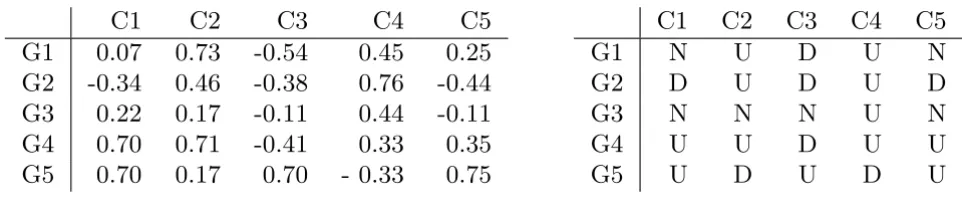
Aij ∈ Σ represents the discretized value of the expression level of gene i under condition j (see Figure 1 for an illus-trative example).
Given matrix A we define the concept of bicluster and the goal of biclustering as follows:
Definition 1 (Bicluster) A bicluster is a sub-matrix AIJ
defined by I ⊆ R, a subset of rows, and J ⊆ C, a subset of
col-umns. A bicluster with only one row or one column is called
trivial.
The goal of biclustering algorithms is to identify a set of biclusters Bk = (Ik, Jk) such that each bicluster satisfies spe-cific characteristics of homogeneity. These characteristics vary in different applications [6]. In this work we will deal with biclusters that exhibit coherent evolutions:
Definition 2 (CC-Bicluster) A column coherent bicluster AIJ
is a bicluster such that Aij = Alj for all rows i, l ∈ I and columns
j ∈ J.
Finding all maximal biclusters satisfying this coherence property is known to be an NP-hard problem [10].
CC-Biclusters in discretized gene expression time series
Since we are interested in the analysis of time series expression data, we can restrict the attention to potentially overlapping biclusters with arbitrary rows and contiguous columns [9,20,22,24]. This fact leads to an important complexity reduction and transforms this particular ver-sion of the biclustering problem into a tractable problem. Previous work in this area [9,22] has defined the concept of CC-Biclusters in time series expression data and the important notion of maximality:
Definition 3 (CCC-Bicluster) A contiguous column
coher-ent bicluster AIJ is a subset of rows I = {i1, ..., ik} and a subset
of contiguous columns J = {r, r + 1, ..., s - 1, s} such that Aij =
Alj, for all rows i, l ∈ I and columns j ∈ J. Each CCC-Bicluster
defines a string S that is common to every row in I for the
col-umns in J.
′
Aij
Illustrative example of the discretization process Figure 1
Illustrative example of the discretization process. This figure shows: (Left) Original expression matrix A'; and (Right)
Discretized matrix A obtained by considering a simple discretization technique, which uses a three symbol alphabet Σ = {D, N,
U}. The symbols mean down-regulation (D), up-regulation (U) or no-change (N). In this case, the values ∈ ]-0.3, 0.3[ were
discretized to N, and the values ≤ -0.3 and ≥ 0.3 were discretized to D and U, respectively.
C1
C2
C3
C4
C5
G1
0.07
0.73
-0.54
0.45
0.25
G2
-0.34
0.46
-0.38
0.76
-0.44
G3
0.22
0.17
-0.11
0.44
-0.11
G4
0.70
0.71
-0.41
0.33
0.35
G5
0.70
0.17
0.70
- 0.33
0.75
C1
C2
C3
C4
C5
G1
N
U
D
U
N
G2
D
U
D
U
D
G3
N
N
N
U
N
G4
U
U
D
U
U
G5
U
D
U
D
U
′
Aij
′
Definition 4 (row-maximal CCC-Bicluster) A
CCC-Bicluster AIJ is row-maximal if we cannot add more rows to I
and maintain the coherence property referred in Definition 3.
Definition 5 (left-maximal and right-maximal CCC-Bicluster) A CCC-Bicluster AIJ is left-maximal/right-maximal if we cannot extend its expression pattern S to the left/right by adding a symbol (contiguous column) at its beginning/end
without changing its set of rows I.
Definition 6 (maximal CCC-Bicluster) A CCC-Bicluster
AIJ is maximal if no other CCC-Bicluster exists that properly
contains AIJ, that is, if for all other CCC-Biclusters ALM, I ⊆ L
∧ J ⊆ M ⇒ I = L ∧ J = M.
Lemma 1 Every maximal CCC-Bicluster is right, left and
row-maximal.
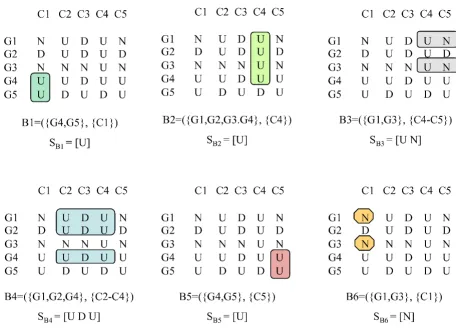
Figure 2 shows the maximal CCC-Biclusters with at least two rows (genes) present in the discretized matrix in Fig-ure 1. CCC-Biclusters with only one row, even when max-imal, are trivial and uninteresting from a biological point of view and are thus discarded.
Maximal CCC-Biclusters and generalized suffix trees
Consider the discretized matrix A obtained from matrix A'
using the alphabet Σ. Consider also the matrix obtained by preprocessing A using a simple alphabet transforma-tion, that appends the column number to each symbol in the matrix (see Figure 3), and considers a new alphabet Σ'
= Σ × {1, ..., |C|}, where each element Σ' is obtained by concatenating one symbol in Σ and one number in the range {1, ..., |C|}. We present below the two Lemmas and the Theorem describing the relation between maximal CCC-Biclusters with at least two rows and nodes in the generalized suffix tree built from the set of strings
Maximal CCC-Biclusters in a discretized matrix Figure 2
Algorithms for Molecular Biology 2009, 4:8 http://www.almob.org/content/4/1/8
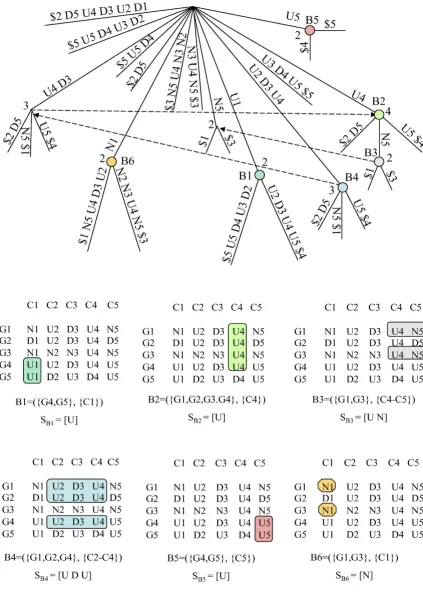
obtained after alphabet transformation [9,22]. Figure 4 illustrates this relation using the generalized suffix tree obtained from the rows in the discretized matrix after alphabet transformation in Figure 3 together with the maximal CCC-Biclusters with at least two rows (B1 to B6) already showed in Figure 2.
Lemma 2 Every right-maximal, row-maximal CCC-Bicluster with at least two rows corresponds to one internal node in T and every internal node in T corresponds to one right-maximal,
row-maximal CCC-Bicluster with at least two rows.
Lemma 3 An internal node in T corresponds to a left-maximal
CCC-Bicluster iff it is a MaxNode.
Definition 7 (MaxNode) An internal node v in T is called a MaxNode iff it satisfies one of the following conditions:
a) It does not have incoming suffix links.
b) It has incoming suffix links only from nodes ui such that,
for every node ui, the number of leaves in the subtree rooted
at ui is inferior to the number of leaves in the subtree rooted
at v.
Theorem 1 Every maximal CCC-Bicluster with at least two rows corresponds to a MaxNode in the generalized suffix tree T, and each MaxNode defines a maximal CCC-Bicluster with at
least two rows.
Note that this theorem is the base of CCC-Biclustering [9,22], which finds and reports all maximal CCC-Biclus-ters using three main steps:
1. All internal nodes in the generalized suffix tree are marked as "Valid", meaning each of them identifies a
row-maximal, right-maximal CCC-Bicluster with at least two nodes according to Lemma 2.
2. All internal nodes identifying non left-maximal CCC-Biclusters are marked as "Invalid" using Theorem 1, discarding all row-maximal, right-maximal CCC-Biclusters which are not left-maximal.
3. All maximal CCC-Biclusters, identified by each node marked as "Valid", are reported.
Methods
In this section we propose e-CCC-Biclustering, an algo-rithm designed to find and report all maximal CCC-Biclusters with approximate expression patterns (e -CCC-Biclusters) using a discretized matrix A and efficient string processing techniques. We first define the concepts of e -CCC-Bicluster and maximal e-CCC-Bicluster. We then for-mulate two problems: (1) finding all maximal e -CCC-Biclusters and (2) finding all maximal e-CCC-Biclusters satisfying row and column quorum constraints. We dis-cuss the relation between maximal e-CCC-Biclusters and generalized suffix trees highlighting the differences between this relation and that of maximal CCC-Biclusters and generalized suffix tree, discussed in the previous sec-tion. We then discuss and explore the relation between the two problems above and the Common Motifs Problem
[25,26]. We describe e-CCC-Biclustering, a polynomial time algorithm designed to solve both problems and sketch the analysis of its computational complexity. We present extensions to handle missing values, discover anticorrelated and scaled expression patterns, and con-sider alternative ways to compute approximate expression patterns. Finally, we propose a scoring criterion for e -CCC-Biclusters combining the statistical significance of their expression patterns with a similarity measure between overlapping biclusters.
Illustrative example of the alphabet transformation performed after the discretization process Figure 3
Illustrative example of the alphabet transformation performed after the discretization process. This figure shows: (Left) Discretized matrix A in Figure 1; (Right) Discretized matrix A after alphabet transformation.
C1
C2
C3
C4
C5
G1
N
U
D
U
N
G2
D
U
D
U
D
G3
N
N
N
U
N
G4
U
U
D
U
U
G5
U
D
U
D
U
C1
C2
C3
C4
C5
G1
N1
U2
D3
U4
N5
G2
D1
U2
D3
U4
D5
G3
N1
N2
N3
U4
N5
G4
U1
U2
D3
U4
U5
Algorithms for Molecular Biology 2009, 4:8 http://www.almob.org/content/4/1/8
CCC-Biclusters with approximate expression patterns
The CCC-Biclusters defined in the previous section are per-fect, in the sense that they do not allow errors in the expression pattern S that defines the CCC-Bicluster. This means that all genes in I share exactly the same expression pattern in the time points in J. Being able to find all max-imal CCC-Biclusters using efficient algorithms is useful to identify potentially interesting expression patterns and can be used to discover regulatory modules [9]. However, some genes might not be included in a CCC-Bicluster of interest due to errors. These errors may be measurement errors, inherent to microarray experiments, or discretiza-tion errors, introduced by poor choice of discretizadiscretiza-tion thresholds or inadequate number of discretization sym-bols. In this context, we are interested in CCC-Biclusters with approximate expression patterns, that is, biclusters where a certain number of errors is allowed in the expres-sion pattern S that defines the CCC-Bicluster. We intro-duce here the definitions of e-CCC-Bicluster and maximal
e-CCC-Bicluster preceded by the notion of e -neighbor-hood:
Definition 8 (e-Neighborhood) The e-Neighborhood of a
string S of length |S|, defined over the alphabet Σ with |Σ|
sym-bols, N(e, S), is the set of strings Si, such that: |S| = |Si| and
Hamming(S, Si) ≤ e, where e is an integer such that e ≥ 0. This
means that the Hamming distance between S and Si is no more
than e, that is, we need at most e symbol substitutions to obtain
Si from S.
Lemma 4 The e-Neighborhood of a string S, N(e, S), contains
elements.
Definition 9 (e-CCC-Bicluster) A contiguous column
coher-ent bicluster with e errors per gene, e-Bicluster, is a
CCC-Bicluster AIJ where all the strings Si that define the expression
pattern of each of the genes in I are in the e-Neighborhood of
an expression pattern S that defines the e-CCC-Bicluster: Si ∈
N (e, S), ∀i ∈ I. The definition of 0-CCC-Bicluster is
equiva-lent to that of a CCC-Bicluster.
Definition 10 (maximal e-CCC-Bicluster) An
e-CCC-Bicluster AIJ is maximal if it is row-maximal, left-maximal and
right-maximal. This means that no more rows or contiguous columns can be added to I or J, respectively, maintaining the
coherence property in Definition 9.
Given these definitions we can now formulate the prob-lem we solve in this work:
Problem 1 Given a discretized expression matrix A and the integer e ≥ 0 identify and report all maximal e -CCC-Biclusters .
Similarly to what happened with CCC-Biclusters, e -CCC-Biclusters with only one row should be overlooked. A sim-ilar problem is that of finding and reporting only the max-imal e-CCC-Biclusters satisfying predefined row and column quorum constraints:
Problem 2 Given a discretized expression matrix A and three integers e ≥0, qr ≥ 2 and qc ≥ 1, where qr is the row quorum (minimum number of rows in Ik) and qc is the column quorum (minimum number of columns in Jk), identify and report all maximal e-CCC-Biclusters such that, Ik and Jk have at least qr rows and qc
columns, respectively.
Figure 5 shows all maximal e-CCC-Biclusters with at least rows (genes), which are present in the discretized matrix in Figure 1, when one error per gene is allowed (e = 1). Fig-ure 6 shows all maximal e-CCC-Biclusters identified using row and column constraints. In this case, the maximal 1-CCC-Biclusters having at least three rows and three col-umns (qr = qc = 3) are shown. Also clear in these figures is the fact that, when errors are allowed (e > 0), different expression patterns S can define the same e -CCC-Biclus-ter. Furthermore, when e > 0, an e-CCC-Bicluster can be defined by an expression pattern S, which does not occur
CjS j S e e
j e | |
(| |Σ − ) ≤| | | |Σ
=
∑
10
Bk AI J
k k =
Bk AI J
k k = Maximal CCC-Biclusters and generalized suffix trees
Figure 4 (see previous page)
Maximal CCC-Biclusters and generalized suffix trees. This figure shows: (Top) Generalized suffix tree constructed for the transformed matrix in Figure 3. For clarity, this figure does not contain the leaves that represent string terminators that are direct daughters of the root. Each internal node, other than the root, is labeled with the number of leaves in its subtree. We show the suffix links between nodes although (for clarity) we omit the suffix links pointing to the root. All maximal CCC-Biclusters are identified using a circle. The labels B1 to B6 identify the nodes corresponding to all maximal CCC-CCC-Biclusters with at least two rows/genes. Note that the rows in each CCC-Bicluster identified by a given node v are obtained from the string terminators in its subtree. The value of the string-depth of v and the first symbol in the string-label of v provide the information needed to identify the set of contiguous columns. (Bottom) Maximal CCC-Biclusters B1 to B6 showed in the discretized matrix as subsets of rows and columns. The strings SB1 = [U], SB2 = [U], SB3 = [U N], SB4 = [U D U], SB5 = [U] and SB6 = [N]
Maximal e-CCC-Biclusters in a discretized matrix Figure 5
Maximal e-CCC-Biclusters in a discretized matrix. This figure shows all maximal 1-CCC-Biclusters with at least two rows that can be identified in the discretized matrix in Figure 1. Note that several of these 1-CCC-Biclusters can be defined by more than one expression pattern. For example, B1 can be defined by SB1 = [D], as shown in the figure, but can also be defined by SB1 = [N] or SB1 = [U]. Other 1-CCC-Biclusters are defined by expression patterns not occurring in the discretized matrix in the contiguous columns identifying the biclusters. This is the case of 1-CCC-Bicluster B2, for example, defined by the pattern
Algorithms for Molecular Biology 2009, 4:8 http://www.almob.org/content/4/1/8
in the discretized matrix in the set of contiguous columns in the e-CCC-Bicluster.
Maximal e-CCC-Biclusters and generalized suffix trees
In the previous section we showed that each internal node in the generalized suffix tree, constructed for the set of strings corresponding to the rows in the discretized matrix after alphabet transformation, identifies exactly one CCC-Bicluster with at least two rows (maximal or not) (see Lemma 2). We also showed that each internal node corre-sponding to a MaxNode (see Definition 7) in the general-ized suffix tree identifies exactly one maximal
CCC-Bicluster and that each maximal CCC-CCC-Bicluster is identi-fied by exactly one MaxNode (see Lemma 3 and Theorem 1). This also implies that a maximal CCC-Bicluster is iden-tified by one expression pattern, which is common to all genes in the CCC-Bicluster within the contiguous col-umns in the bicluster. Moreover, all expression patterns identifying maximal CCC-Biclusters always occur in the discretized matrix and thus correspond to a node in the generalized suffix tree (see Figure 4).
When errors are allowed, one e-CCC-Bicluster (e > 0) can be identified (and usually is) by several nodes in the gen-Maximal e-CCC-Biclusters with row and column quorum constraints in a discretized matrix
Figure 6
eralized suffix tree, constructed for the set of strings corre-sponding to the rows in the discretized matrix after alphabet transformation, and one node in the generalized suffix tree may be related with multiple e-CCC-Biclusters (maximal or not) (see Figure 7). Moreover, a maximal e -CCC-Bicluster can be defined by several expression pat-terns (see Figure 5 and Figure 6). Upon all this, a maximal
e-CCC-Bicluster can be defined by an expression pattern
not occurring in the expression matrix and thus not
appear-ing in the generalized suffix tree (see Figure 6 and Figure 7).
Furthermore we cannot obtain all maximal e -CCC-Biclus-ters using the set of maximal CCC-Biclus-CCC-Biclus-ters by: 1) extend-ing them with genes by lookextend-ing for their approximate patterns in the generalized suffix tree, or 2) extending them with e contiguous columns (see Figure 5 and Figure 8). It is also clear from Figure 8 that extending maximal CCC-Biclusters can in fact lead to the discovery of non maximal e-CCC-Biclusters. For the reasons stated above we cannot use the same searching strategy used to find maximal CCC-Biclusters when looking for maximal e -CCC-Biclusters (e > 0). We therefore need to explore the relation between finding e-CCC-Biclusters and the
Com-mon Motifs Problem, as explained below.
Finding e-CCC-Biclusters and the common motifs problem
There is an interesting relation between the problem of finding all maximal e-CCC-Biclusters, discussed in this work, and the well known problem of finding common motifs (patterns) in a set of sequences (strings). For the first problem, and to our knowledge, no efficient algo-rithm has been proposed to date. For the latter problem
(Common Motifs Problem), several efficient algorithms
based on string processing techniques have been pro-posed to date [25,26]. The Common Motifs Problem is as follows [26]:
Common Motifs Problem Given a set of N sequences Si (1 ≤ i ≤ N) and two integers e ≥ 0 and 2 ≤ q ≤ N, where e is the number of errors allowed and q is the required quo-rum, find all models m that appear in at least q distinct sequences of Si.
During the design of e-CCC-Biclustering, we used the ideas proposed in SPELLER [26], an algorithm to find
common motifs in a set of N sequences using a generalized
suffix tree T. The motifs searched by SPELLER correspond
to words, over an alphabet Σ, which must occur with at
most e mismatches in 2 ≤ q ≤ N distinct sequences. Since these words representing the motifs may not be present exactly in the sequences (see SPELLER for details), a motif is seen as an "external" object and called model. In order to be considered a valid model, a given model m of length |m|
has to verify the quorum constraint: m must belong to the e -neighborhood of a word w in at least q distinct sequences.
In order to solve the Common Motifs Problem, SPELLER builds a generalized suffix tree T for the set of sequences Si
and then, after some further preprocessing, uses this tree to "spell" the valid models. Valid models verify two prop-erties [26]:
1. All the prefixes of a valid model are also valid mod-els.
2. When e = 0, spelling a model leads to one node v in
T such that L(v) ≥ q, where L(v) denotes the number of leaves in the subtree rooted at v.
When e > 0, spelling a model leads to a set of nodes v1,
..., vk in T for which , where L(vj)
denotes the number of leaves in the subtree rooted at
vj.
In these settings, and since the occurrences of a model are in fact nodes of the generalized suffix tree T, these occur-rences are called node-occurrences [26]. The goal of SPELLER is thus to identify all valid models by extending them in the generalized suffix tree and to report them together with their set of node-occurrences. We present here an adaptation of the definition of node-occurrence used in SPELLER. In SPELLER, a node-occurrence is defined by a pair (v, verr) and not by a triple (v, verr, p), as in this work. For clarity, SPELLER was originally exempli-fied [26] in an uncompacted version of the generalized suffix tree, that is, a trie (although it was proposed to work with a generalized suffix tree). However, and as pointed out by the authors, when using a generalized suffix tree, as in our case, we need to know at any given step in the algo-rithm whether we are at a node or in an edge between nodes v and v'. We use p to provide this information, and redefine node-occurrence as follows:
Definition 11 (node-occurrence) A node-occurrence of a
model m is a triple (v, verr, p), where v is a node in the
gener-alized suffix tree T and verr is the number of mismatches
between m and the string-label of v computed using
Ham-ming(m, string-label(v)). The integer p ≥ 0 identifies a
posi-tion/point in T such that:
1. If p = 0: we are exactly at node v.
2. If p > 0: we are in E(v), the edge between fatherv and v,
in a point p between two symbols in label(E(v)) such that 1
≤ p < |label(E(v))|.
L vj q
j k
( )≥
=
Algorithms for Molecular Biology 2009, 4:8 http://www.almob.org/content/4/1/8
Consider a model m, a symbol αin the alphabet Σ, a node
v in T, its father fatherv, the edge between fatherv and v,
E(v), the edge-label of E(v), label(E(v)) and its edge-length, |label(E(v))|. The modified version of SPELLER described below is based on the following Lemmas (adapted from SPELLER):
Lemma 5 (v, verr, 0) is a node-occurrence of a model m' = mα, if, and only if:
1. Match:
(fatherv, verr, 0) is a node-occurrence of m and
label(E(v)) = α.
The edge-label of E(v) has only one symbol and this
symbol is α.
or
(v, verr, |label(E(v))| -1) is a node-occurrence of m and
label(E(v)) [|label(E(v))|] = α.
The last symbol in label(E(v)) is α.
2. Substitution:
(fatherv, verr -1, 0) is a node-occurrence of m and
label(E(v)) = β≠ α.
The edge-label of E(v) has only one symbol and this
symbol is not α.
or
(v, verr - 1, |label(E(v))| - 1) is a node-occurrence of m
and label(E(v)) [|label(E(v))|] = β≠ α.
The last symbol in label(E(v)) is not α.
Lemma 6 (v, verr, 1) is a node-occurrence of a model m' = mα, if, and only if:
1. Match:
(fatherv, verr, 0) is a node-occurrence of m and
label(E(v))[1] = α.
2. Substitution:
(fatherv, verr - 1, 0) is a node-occurrence of m and
label(E(v))[1] = β≠ α.
Lemma 7 (v, verr, p), 2 ≤ p < |label(E(v)| is a node-occurrence
of a model m' = mα, if, and only if:
1. Match:
(v, verr, p - 1) is a node-occurrence of m and label(E(v) [p] = α.
2. Substitution:
(v, verr - 1, p - 1) is a node-occurrence of m and
label(E(v)) [p] = β≠ α.
Consider now the discretized matrix A obtained from matrix A' using the alphabet Σ. We preprocess A using the same alphabet transformation used in CCC-Biclustering. Remember that we append the column number to each symbol in the matrix and consider a new alphabet Σ' = Σ
× {1, ..., |C|} (see Figure 3). We will now show that SPELLER can be adapted to extract all right-maximal e -CCC-Biclusters from this transformed matrix A by build-ing a generalized suffix tree for the set of |R| strings Si
obtained from each row in A and use it to "spell" the valid models using the symbols in the new alphabet Σ'.
Given the set of |R| strings Si, the number of allowed errors e ≥ 0 and the quorum constraint 2 ≤ q ≤ |R|, the goal is now to find the set of all right-maximal valid models m, identifying expression patterns that are present in at least
q distinct rows starting and ending at the same columns. Note that the valid models identified by the original SPELLER algorithm are already row-maximal. However they may be e-CCC-Biclusters (e > 0) and generalized suffix trees
Figure 7 (see previous page)
e-CCC-Biclusters (e > 0) and generalized suffix trees. This figure shows: (Top) Generalized suffix tree constructed for the transformed matrix in Figure 3 (the information stored in the nodes correspond to the number of leaves and row identifi-ers in their subtree and is used by e-CCC-Biclustering). The circles labeled with B1, B2, B3, B4 and B5 identify the nodes related with the five maximal 1-CCC-Biclusters discovered when e = 1 and qe = qc = 3, shown in Figure 6; (Bottom) Maximal 1-CCC-Biclusters B1 to B5 showed in the matrix as subsets of rows and columns. The strings SB1 = [D U D U], SB2 = [D D U],
Algorithms for Molecular Biology 2009, 4:8 http://www.almob.org/content/4/1/8
non right-maximal, non left-maximal, and start at differ-ent positions in the sequences. Under these settings, the set of node-occurrences of each valid model m and the model itself in our modified version of SPELLER identifies one row-maximal, right-maximal e-CCC-Bicluster with q
rows and a maximum of |C| contiguous columns. Further-more, it is possible to find all right-maximal e -CCC-Biclusters by fixing the quorum constraint, used to specify the number of rows/genes necessary to identify a model as valid, to the value q = 2. In this context, and in order to be able to solve not only Problem 1 but also Problem 2, we adapted SPELLER to consider not only a row constraint, 2 ≤ qr ≤ |R|, but also an additional column constraint, 1 ≤ qc ≤ |C|.
Figure 7 shows the generalized suffix tree used by our modified version of SPELLER when it is applied to the dis-cretized matrix after alphabet transformation in Figure 3. We can also see in this figure the five maximal 1-CCC-Biclusters B1, B2, B3, B4 and B5, already shown in Figure 6, identified by five valid models, when e = 1 and the val-ues qr and qc, specifying the row and column constraints, respectively, are set to 3. The maximal 1-CCC-Biclusters B1 to B5 are defined, respectively, by the following valid models: m = [D1 U2 D3 U4 N5] (three node-occurrences labeled with B1); m = [D2 D3 U4] (three node-occur-rences labeled with B2), m = [D3 U4 N5] (four node-occurrences labeled with B3), m = [N2 D3 U4] (four node-occurrences labeled with B4) and m = [U2 D3 U4 D5] (four node-occurrences labeled with B5). It is also possi-ble to observe in this figure that, when e > 0, a model can
be valid without being right/left-maximal and that several
valid models may identify the same e-CCC-Bicluster. For
example, m = [D1 U2 D3] is valid but it is not right-maxi-mal, m = [D3 U4 D5] is also valid but it is not left-maxi-mal, and finally the models m = [D1 U2 D3 U4 N5] and
m = [N1 U2 D3 U4 D5] are both valid but identify the
same 1-CCC-Bicluster B1. Figure 4 shows the generalized suffix tree used when e = 0, qr = 2 and qc = 1. Since no errors are allowed the generalized suffix tree is the same as the one used by CCC-Biclustering and the maximal 0-CCC-Biclusters identified correspond in fact to the maximal CCC-Biclusters in Figure 2.
In the next section we describe the details of the modified version of SPELLER that we used to identify all right-max-imal e-CCC-Biclusters. However, and for clarity, we sum-marize here the main differences between the original version of SPELLER and the modified version (procedure computeRightMaximalBiclusters in the next sec-tion), which we use as the first step of the e -CCC-Biclus-tering algorithm. While reading the differences listed below have in mind that in order to be maximal, an e -CCC-Bicluster must be row-maximal, right-maximal and left-maximal. Moreover, all the approximate patterns identifying genes in an e-CCC-Bicluster must start and end at the same columns.
1. In SPELLER a node-occurrence is defined by a pair (v, verr) since (for clarity) the algorithm was exempli-fied using a trie and not a generalized suffix tree, as explained above. As such we redefined the original concept of node-occurrence to use the triple (v, verr, p) (see Definition 11), adapted the three original Lem-mas in SPELLER to use the new definition of node-occurrence (see Lemma 5, Lemma 6 and Lemma 7), and rewrote SPELLER to use a generalized suffix tree.
2. In SPELLER a model can be valid without being right/left-maximal. As such all models satisfying the quorum constraint are stored for further reporting. This means that the valid models reported by SPELLER are only row-maximal. We only store valid models that cannot be extended to the right without loosing Maximal CCC-Biclusters and maximal e-CCC-Biclusters
Figure 8 (see previous page)
Algorithms for Molecular Biology 2009, 4:8 http://www.almob.org/content/4/1/8
genes, that is valid models which are both row-maxi-mal are right-maxirow-maxi-mal. This implied modifying the original procedure storeModel in SPELLER in order to include the procedure checkRightMaximality (see procedure spellModels in the next section, for details).
3. In SPELLER the node-occurrences of a valid model can start in any position in the sequences. In our mod-ified version of this algorithm all node-occurrences of a valid model must start in the same position (same column in the discretized matrix) in order to guaran-tee that they belong to an e-CCC-Bicluster. As such we modified the construction of the generalized suffix tree used in SPELLER in order to be constructed using the set of strings corresponding to the set of rows in the discretized matrix after alphabet transformation. We also modified all the procedures used in SPELLER for model extension. Note that it is not possible to modify SPELLER in order to check if a valid model that is right-maximal is also left-maximal. This is so since we can only guarantee that a model is/is not left-max-imal once we have computed all valid models corre-sponding to right-maximal e-CCC-Biclusters. This justifies why we need to discard valid models which are not left-maximal in the next step of the algorithm and did not integrate this step in our modified version of SPELLER.
In this context, we also show in the next section that the proposed e-CCC-Biclustering algorithm will need three
steps to identify all maximal e-CCC-Biclusters without
rep-etitions: a first step to identify all right-maximal e -CCC-Biclusters (for this we use the modified version of SPELLER), a second step to discard all right-maximal e -CCC-Biclusters which are not left-maximal, and finally a third step to discard repetitions, that is maximal valid models identifying the same maximal e-CCC-Bicluster.
Note that the original SPELLER algorithm does not elimi-nate repetitions (different valid models with the same set of node-occurrences). Furthermore, we also cannot inte-grate the elimination of valid models corresponding to the same right-maximal e-CCC-Biclusters in our modified version of SPELLER since we need the set of all valid mod-els corresponding to right-maximal e-CCC-Biclusters in order to discard valid models which are not left-maximal in the second step of e-CCC-Biclustering.
e-CCC-Biclustering: Finding and reporting all maximal e -CCC-Biclusters in polynomial time
This section presents e-CCC-Biclustering, a polynomial time biclustering algorithm for finding and reporting all maximal CCC-Biclusters with approximate patterns (e -CCC-Biclusters), and describes its main steps. Algorithm 1
is designed to solve Problem 2: identify and report all maximal e-CCC-Biclusters such that Ik and Jk
have at least qr rows and qc columns, respectively. The pro-posed algorithm is easily adapted to solve problem 1 (identify and report all maximal e-CCC-Biclusters without quorum constraints) by fixing the
val-ues of qr and qc to the values two and one, respectively. The proposed algorithm is based on the following steps (described in detail below):
[Step 1] Computes all valid models corresponding to right-maximal e-CCC-Biclusters. Uses the discretized matrix A after alphabet transformation, the quorum constraints qr and qc, a generalized suffix tree and a modified version of SPELLER.
[Step 2] Deletes all valid models not corresponding to left-maximal e-CCC-Biclusters. Uses all valid models computed in Step 1 and a trie.
[Step 3] Deletes all valid models representing the same e-CCC-Biclusters. Uses all valid models corre-sponding to maximal e-CCC-Biclusters (both left and right) computed in Step 2 and a hash table. Note that this step is only needed when e > 0.
[Step 4] Reports all maximal e-CCC-Biclusters.
Algorithm 1: e-CCC-Biclustering
Input : A, Σ, e, qr, qc
Output: Maximal e-CCC-Biclusters.
1 {S1, ..., S|R|} ← alphabetTransformation(A, Σ)
2 modelsOcc ←{}
3 computeRightMaximalBiclusters(Σ, e, qr, qc, {S1, ..., S|R|}, modelsOcc)
4 deleteNonLeftMaximalBiclusters(modelsOcc)
5 if e > 0 then
6 deleteRepeatedBiclusters(modelsOcc)
7 reportMaximalBiclusters(modelsOcc)
Detailed discussions can be found in additional file 2:
algorithmic_complexity_details.
Bk=AI Jk k
Computing valid models corresponding to right-maximal e -CCC-Biclusters
In step 1 of e-CCC-Biclustering we compute all valid mod-els m together with their node-occurrences Occm corre-sponding to right-maximal e-CCC-Biclusters. The details are shown in the procedure computeRightMaximal Biclusters below, which corresponds to a modified version of SPELLER.
Procedure computeRightMaximalBiclusters
Input: Σ, e, qr, qc, {S1, ..., S|R|}, modelsOcc
/* The value of modelsOcc is updated. */
1 Tright ← constructGeneralizedSuffixTree({S1, ..., S|R|})
2 addNumberOfLeaves(Tright) /* Adds L(v) to each node v in Tright. */
3 if e ≠ 0 then
4 addColorArray(Tright)
/* Adds colorsv to every node v in Tright: colorsv [i] = 1, if there is a leaf in the subtree rooted at v that is a suffix ofS i; colorsv [i] = 0, otherwise. */
5 m ← "" /* model m is a string [m [1] ... m [lengthm -1]] */
6 lengthm← 0
7 fatherm← "" /* fatherm is a string [m[1] ... m
[lengthm-1]] */
8 ← 0
9 Occm ← {} /* List of node-occurrences (v, verr,
p) */
10 addNodeOccurrence(Occm, (root(Tright), 0, 0))
11 Extm ← {} /* Extm is the set of possible sym bols αto extend the model m. */
12 if e = 0 then
13 forall edges E(vi) leaving from node root(Tright) to a node
vi do
14 if label(E(vi))[1]is not a string terminator then
15 addSymbol(Extm, label(E(vi))[1])
16 else
17 forall symbols in Σ' do
/* Σ' must be in lexicographic order. */
18 addSymbol(Extm, Σ' [i])
19 lengthm ← 0
20 spellModels(Σ, e, qr, qc, modelsOcc, Tright, m, lengthm,
Occm, Extm, fatherm, )
In this procedure we use the transformed matrix A as input and store the results in the list modelsOcc, which stores triples with the following information (m,
genesOccm, numberOfGenesOccm), where m is the model,
genesOccm is a bit vector containing the distinct genes in
the node-occurrences of m, Occm, and numberOfGenesOccm
is the number of bits set to 1 in genesOccm and, therefore, the number of genes where the model occurs. This infor-mation is computed using the procedure spellModels described below, which corresponds to a modified ver-sion of the procedure with the same name used in SPELLER).
Procedure spellModels
/* Called recursively. Stores right-max imal e-CCC-Biclusters in modelsOcc. */
Input : Σ, e, qr, qc, modelsOcc, Tright, m, lengthm, Occm,
Extm, fatherm,
/* The value of modelsOcc is updated. */
1 keepModel(qr, qc, modelsOcc, Tright, m, lengthm, Occm,
fatherm,
2 if lengthm ≤ |C| then
/* |C| is the length of the longest model */
3 forall symbols α in Extm do
4 if αis not a string terminator then
numberOfGenesOccfatherm
numberOfGenesOccfatherm
numberOfGenesOccfather
m
numberOfGenesOccfather
Algorithms for Molecular Biology 2009, 4:8 http://www.almob.org/content/4/1/8
5 maxGenes ← 0/* Sum of L(v) for all node-occurrences (v, verr, p) in Occmα */
6 minGenes← ∞/* Minimum L(v) in all node-occurrences (v, verr, p) in Occmα */
7 Colorsmα← {}
8 if e > 0 then
9 Colorsmα[i] ← 0, 1 ≤ i ≤ |R|
/* colorsmα [i] = 1, if there is a
node-occurrence of m in Si; */
/* colorsmα[i] = 0, otherwise */
10 Extmα← {}
11 Occmα← {}
12 forall node-occurrences (v, verr, p) in Occm do
/* If p = 0 we are at node v. Otherwise, we are at edge E(v) between nodes father(v) andv
at point p > 0. */
13 if p = 0 then
14 extendFromNodeWithoutErrors(Σ, e,
Tright, (v, verr, p), m, α, Occmα, Colorsmα, Extmα, maxGenes,
minGenes)
15 if (verr <e) then
16 extendFromNodeWithErrors(Σ, e, Tright,
(v, verr, p), m, α, Occmα, Colorsmα, Extmα, maxGenes,
min-Genes)
17 else
18 extendFromEdgeWithoutErrors(Tright,
Σ, e, (v, verr, p), m, α, m, Occmα, Colorsmα, Extmα, maxGenes,
minGenes)
19 if xerr <e then
20 extendFromEdgeWithErrors(Σ, e, Tright,
(v, verr, p), m, α, Occmα, Colorsmα, Extmα, maxGenes,
min-Genes)
21 if modelHasQuorum(maxGenes, minGenes,
Color-smα, qr) then
22 spellModels(Σ, e, qr, qc, modelsOcc, Tright, mα,
lengthm + 1, Occmα, Extmα, fathermα, numberOfGenesOccm)
The recursive procedure spellModels (modified to extract valid models corresponding to right-maximal e -CCC-Biclusters) is now able to:
1. Use a generalized suffix tree Tright and define node-occurrences as triples (v, verr, p), where p is used throughout the algorithm to find out whether we are at node v (p = 0) or in an edge E(v) between nodes v
and fatherv (p > 0).
2. Check if a valid model m corresponds to a right-maximal e-CCC-Bicluster. This is performed using the procedure checkRightMaximality inside the pro-cedure keepModel. This procedure deletes from the list of stored models, modelsOcc, a valid model m when the result of its extension with a symbol α, mα, is also a valid model and the set of node-occurrences of mα,
Occmα, has as many genes as the set of node-occur-rences of its father m, Occm. When this is the case, m no longer corresponds to a right-maximal e -CCC-Biclus-ter since its expression pat-CCC-Biclus-tern can be extended to the right with the symbol αwithout losing genes.
3. Restrict the extensions of a given model m, Extm, to the level of the model in the generalized suffix tree (column of the last symbol in m). When we are extending a model m with a symbol α (eventually extracting a valid model mα), the column number of the last symbol in m, m [lengthm], is C(m [lengthm]),
where C(m [lengthm]) ∈ {1, ..., |C|}, and errors are still
allowed, αcan only be one of the symbols in the set , where corresponds to
the subset of elements in Σ' whose column is equal to
C(m [lengthm])) + 1. For example, if Σ = {D, N, U} and
the model m = [D1] is being extended, the possible symbols αwith which m can be extended to mαmust be in = {D2. N 2, U 2}. In the same way, if m = [D2
U3], the possible symbols α with which m can be extended to mαare in = {D4, N 4, U 4}.
The algorithmic details of the procedures and functions called in the recursive procedure spellModels are described in additional file 2:
algorithmic_complexity_details.
′ +
ΣC m length( [ m]) 1 Σ′C m length( [ m]) 1+
′ Σ2
Deleting valid models not corresponding to left-maximal e -CCC-Biclusters
In step 2 of e-CCC-Biclustering (details in procedure deleteNonLeftMaximalBiclusters below), we remove from the valid models stored in modelsOcc (iden-tifying right-maximal e-CCC-Biclusters) those not corre-sponding to left-maximal e-CCC-Biclusters. These models are removed from modelsOcc by first building a trie with the reverse patterns of all (right-maximal) models m and storing the number of genes in numberOfGenesOccm in its corresponding node in the trie. After this, it is sufficient to mark as "non left-maximal" any node in the trie that has at least one child with as many genes as itself. This is easily achieved by performing a depth-first search (dfs) of the trie and computing, for each node, the maximum value amongst the values of numberOfGenesOccm stored in its children. The models whose corresponding node in the trie is marked as "non left-maximal" are then removed from modelsOcc.
Procedure deleteNonLeftMaximalBiclusters
Input: modelsOcc
/* The value of modelsOcc is updated. */
1 Tleft← createTrie ()
/* Array which will store references to nodes in Tleft */
2 Rnodes← {}
3 foreach model and occurrences (m, genesOccm,
numberOf-GenesOccm) in modelsOcc do
4 mr← ReverseModel(m)
5 nodeRepresentingModel ← addReverseModelToT
rie(Tleft, mr)
/* Each node in Tleft stores two integers1) the number of genes in the model it rep resents, genesv (0 if it does not represent
the end of a model); and 2) the maximum number of genes in the subtree rooted atv,
(computed later). Both these
values are initialized with 0. */
6 addNumberOfGenes(nodeRepresentingModel,number
OfGenesOccm)
7 addReferenceToNode(Rnodes,
nodeRepresenting-Model)
8 forall nodes v in Tleft do
/* Performed using a depth-first search
(dfs) */
9 if genesv > 0 then
/* Node v represents a model and is potentially left-maximal. */
10 Mark v as "left-maximal"
11 else
12 Mark v as "non left-maximal"
13 Compute the maximum number of genes in the sub-tree rooted at v
14 foreach node v in Tleft do
/* Performed using a depth-first search
(dfs) */
15 if genesv > 0 and genesv = then
16 Mark v as "non left-maximal"
17 pmodelsOcc ← 0
18 foreach model and occurrences (m, genesOccm,
numberOf-GenesOccm) in modelsOcc do
19 if Rnodes [pmodelsOcc] is marked as "non-left maximal" then
20 deleteModelAndOccurrences(modelsOcc, m)
21 pmodelsOcc ← pmodelsOcc + 1
Deleting valid models representing the same e-CCC-Biclusters When errors are allowed, different valid models may iden-tify the same e-CCC-Bicluster. Step 3 of e -CCC-Bicluster-ing, described in detail in procedure deleteRepeatedBiclusters below, uses a hash table to remove from modelsOcc all the valid models that, although maximal (left and right), identify repeated e -CCC-Biclusters. This is needed because all valid models m
with the same first and last columns and the same set of genes represent the same maximal e-CCC-Bicluster.
Procedure deleteRepeatedBiclusters
Input: modelsOcc
/* The value of modelsOcc is updated. */
maxGenessubtreev
Algorithms for Molecular Biology 2009, 4:8 http://www.almob.org/content/4/1/8
1 H ←createHashTable()
2 foreach model and occurrences (m, genesOccm,
numberOf-GenesOccm) in modelsOcc do
3 firstColumnm = C(m [1])
4 lastColumnm = C(m [lengthm])
5 key ← createKey(firstColumn, lastColumn, genesOccm)
6 value ← (firstColumn, lastColumn, genesOccm)
7 if containsKey(H, key) then
8 valuekey ← getValue(H, key)
9 if value = valuekey then
/* H already has a value representing the same e-CCC-Bicluster */
10 deleteModelAndOccurrences(modelsOcc,
m)
11 else
12 insertKeyValue(key, value)
13 else
14 insertKeyValue(key, value)
Reporting all maximal e-CCC-Biclusters
After the three main steps of e-CCC-Biclustering the list
modelsOcc stores all valid models corresponding to
maxi-mal e-CCC-Biclusters satisfying the quorum constraints qr
and qc. In this context, the reporting procedure report MaximalBiclusters, described below, lists these e -CCC-Biclusters using the information stored in the model
m (needed to identify the expression pattern and the col-umns in each e-CCC-Bicluster) and the bit vector genesOcc
(needed to identify the genes in the e-CCC-Bicluster).
Procedure reportMaximalBiclusters
Input: modelsOcc
1 foreach model and occurrences (m, genesOccm,
numberOf-GenesOccm) in modelsOcc do
2 firstColumnm = C(m [1])
3 lastColumnm = C(m [lengthm])
4 print(m, firstColumnm, lastColumnm, genesOccm)
e-CCC-Biclustering: Complexity analysis
In this section we sketch an analysis of the complexity of
e-CCC-Biclustering. For a detailed complexity analysis see additional file 2: algorithmic_complexity_details.
Given a discretized matrix A with |R| rows and |C| col-umns, the alphabet transformation performed using the procedure alphabetTransformation takes O(|R||C|) time.
The complexity of computing all valid models corre-sponding to right-maximal e-CCC-Biclusters using proce-dure computeRightMaximalBiclusters takes
O(|R|2|C|1 + e|Σ|e) operations. The construction of T right and the computation of L(v) for all its nodes takes
O(|R||C|) time each, using Ukkonen's algorithm with appropriate data structures, and a dfs, respectively. The increase in the alphabet size from |Σ| to |C||Σ| due to the
alphabet transformation does not affect the O(|R||C|) construction and manipulation of the generalized suffix tree [9]. When e > 0, adding the color array to all nodes in
Tright takes O(|R|2|C|) time. Initializing Ext m takes
O(|C||Σ|) and spellModels is O(|R|2|C|1 + e|Σ|e). The complexity of this step of the algorithm is bounded by the complexity of spellModels and is thus
O(|R|2|C|1+e|Σ|e). The complexity of deleting from
model-sOcc all valid models that are not left-maximal using
pro-cedure deleteNonLeftMaximalBiclusters is
O(|R||C|2+e|Σ|e). Since the number of models in
model-sOcc is O(|R||C|1+e|Σ|e) and the size of the models is
O(|C|), the trie Tleft can be constructed and manipulated in
O(|R||C|2 + e|Σ|e).
The complexity of deleting from modelsOcc all models rep-resenting the same e-CCC-Biclusters with procedure del eteRepeatedBiclusters takes O(|R|2|C|1 + e|Σ|e). Since computing the hash key for each of the O(|R||C|1 + e|Σ|e) models in modelsOcc takes O(|R|) time, the overall complexity of this step is O(|R|2|C|1 + e|Σ|e).
Since the number of genes in genesOccm is O(|R|) and computing the first and last column of the valid model m
takes constant time, reporting all maximal e -CCC-Biclus-ters using procedure reportMaximalBiclusters is
O(|R|2|C|1+e|Σ|e).
Extensions to handle missing values, anticorrelated and scaled expression patterns
In this section we present extensions to e -CCC-Bicluster-ing able to handle miss-CCC-Bicluster-ing values and discover anticorre-lated (opposite patterns) and scaled (patterns with different expression rates) expression patterns. In the sub-sections below we consider the illustrative example in Fig-ure 9, corresponding to a modified version of the example in Figure 1. We now assume that some expression values are missing.
Handling missing values
Since e-CCC-Biclustering cannot deal with missing values directly, genes with missing values have to be removed, or missing values have to be filled, as a preprocessing step. In this section we present extensions that enable direct processing of the expression matrix with missing values. Our goal is to consider all available time points and thus always include the expression pattern of a gene as input to the extended version of the algorithm. Nevertheless genes with more than a predefined percentage of missing values can still be discarded in a preprocessing step.
Dealing with missing values in e-CCC-Biclustering is straightforward and can be performed in two ways:
1. Considering missing values as valid errors.
2. "Jumping over" missing values.
In order to consider missing values as valid errors we modify e-CCC-Biclustering as follows:
• The initialization of Extm in procedure compu teRightMaximalBiclusters must include the symbol used for missing value, when e > 0, and ignore all edges descending from the root starting with this symbol, when e = 0.
• The extension of a model m with a symbol α in spellModels must take into account the following:
αcan either be, or not be, the symbol used for missing
value, depending on whether we are performing an
extension without errors or performing an extension with
errors, respectively.
For details, see procedures extendFromNodeWith outErrors and extendFromEdgeWithoutEr rors, in case of extensions without errors, or proce-dures extendFromNodeWithErrors and extend FromEdgeWithErrors, in case of extensions with errors. These procedures are called in spellModels and described in additional file 2:
algorithmic_complexity_details.
Consider the illustrative example in Figure 9, where some gene expression values are missing.
Figure 10 shows the generalized suffix tree Tright and the two maximal 1-CCC-Biclusters (B1 and B2) identified by two valid models when e = 1, qr = qc = 3 and missing values are considered as valid errors.
In order to "jump over" missing values we modify e -CCC-Biclustering as follows:
• After alphabet transformation, we construct the gen-eralized suffix tree Tright, used in procedure compu teRightMaximalBiclusters, using the set of strings without missing values , where ri is
the number of contiguous sets of symbols without missing values in row i. The set of substrings of each string Si (gene i), , is inserted in T using the
same terminator $i.
Consider, for example, the string corresponding to the expression pattern of gene G2 in the illustrative exam-ple in Figure 9. In this case, and in order to "jump over" the missing value in the time points C3 and C5, we insert in Tright two strings corresponding to each of { ,..., ,..., ,..., ,..., | | ,..., | | }
| |
S S S S S S
r i iri R Rr R
11 11 1 1
{Si ,...,Si } ri
1
Illustrative example with missing values Figure 9
Illustrative example with missing values. This figure shows: (Left) Original expression matrix, (Middle) Discretized matrix and (Right) Discretized matrix after alphabet transformation.
C1 C2 C3 C4 C5
G1 0.73 -0.54 0.45 0.25 G2 -0.34 0.46 0.76
G3 0.44 -0.11
G4 0.70 -0.41 0.33 0.35 G5 0.70 0.70 -0.33 0.75
C1 C2 C3 C4 C5
G1 U D U N
G2 D U U
G3 U N
G4 U D U U
G5 U U D U
C1 C2 C3 C4 C5 G1 1 U2 D3 U4 N5 G2 D1 U2 3 U4 5
G3 1 2 3 U4 N5
Algorithms for Molecular Biology 2009, 4:8 http://www.almob.org/content/4/1/8
the two contiguous sets of symbols without missing values in the expression pattern of G2: = [D1 U2
$2] and = [U4 $2]. Note that the same terminator
$2 is used for all the substrings of row i: and .
Figure 11 shows the generalized suffix tree Tright con-structed for the matrix after alphabet transformation in Figure 9 together with the four maximal 1-CCC-Biclusters (B1, B2,
![Figure 1. These 1-CCC-Biclusters are defined, respectively, by the following patterns: SU N], B1 = [D U D U], SB2 = [D D U], SB3 = [D SB4 = [N D U] and SB5 = [U D U D]](https://thumb-us.123doks.com/thumbv2/123dok_us/350670.1527607/9.612.76.540.91.422/figure-ccc-biclusters-defined-respectively-following-patterns-sb.webp)



![Figure 9. The circles labeled with B1 and B2 identify the node-occurrences of the two maximal 1-CCC-Biclusters discovered when N5] (three node-occurrences labeled with B1) and e = 1 and qe = qc = 3; (Bottom) Maximal 1-CCC-Biclusters corresponding, respectively, to the valid models m = [D3 U4 m = [U2 D3 U4] (three node-occurrences labeled with B2).](https://thumb-us.123doks.com/thumbv2/123dok_us/350670.1527607/21.612.123.481.102.451/occurrences-biclusters-discovered-occurrences-biclusters-corresponding-respectively-occurrences.webp)