Open Access
Research
A scoring matrix approach to detecting miRNA target sites
Simon Moxon, Vincent Moulton and Jan T Kim*
Address: School of Computing Sciences, University of East Anglia, Norwich, NR4 7TJ, UK
Email: Simon Moxon - [email protected]; Vincent Moulton - [email protected]; Jan T Kim* - [email protected] * Corresponding author
Abstract
Background: Experimental identification of microRNA (miRNA) targets is a difficult and time consuming process. As a consequence several computational prediction methods have been devised in order to predict targets for follow up experimental validation. Current computational target prediction methods use only the miRNA sequence as input. With an increasing number of experimentally validated targets becoming available, utilising this additional information in the search for further targets may help to improve the specificity of computational methods for target site prediction.
Results: We introduce a generic target prediction method, the Stacking Binding Matrix (SBM) that uses both information about the miRNA as well as experimentally validated target sequences in the search for candidate target sequences. We demonstrate the utility of our method by applying it to both animal and plant data sets and compare it with miRanda, a commonly used target prediction method.
Conclusion: We show that SBM can be applied to target prediction in both plants and animals and performs well in terms of sensitivity and specificity. Open source code implementing the SBM method, together with documentation and examples are freely available for download from the address in the Availability and Requirements section.
Background
microRNAs (miRNAs) are small non-coding RNAs of around 21 nt in length, which are currently receiving a great deal of attention [1,2]. They are derived from a pre-cursor RNA hairpin structure by RNAse III-like enzymes [3], and are incorporated into the RNA induced silencing complex (RISC). Via this complex, the microRNA guides either the cleavage or translational repression of messen-ger RNAs (mRNAs) by binding to a region of the mRNA known as the target site [4]. In this way, miRNAs regulate a variety of cellular and molecular functions [5,6], playing important roles in, for example, organism growth and development [7,8].
New miRNAs are being discovered at an increasingly rapid rate [9]. Since they play an important role in eukaryotic gene regulation, the problem of determining their func-tion is thus of utmost importance. Accordingly, several computational methods have been developed for miRNA target prediction – see e.g. [10-13]. These methods usually rely on finding target sequences based on a single miRNA input, and employ nucleotide complementarity and min-imum free energy (MFE) calculations to identify candi-date miRNA/target duplexes. Although these methods have been successfully used in target prediction e.g. [14], their specificity can be limited, i.e. they may produce many false positives [15].
Published: 31 March 2008
Algorithms for Molecular Biology 2008, 3:3 doi:10.1186/1748-7188-3-3
Received: 5 October 2007 Accepted: 31 March 2008
This article is available from: http://www.almob.org/content/3/1/3
© 2008 Moxon et al; licensee BioMed Central Ltd.
Various methods have been proposed to improve the spe-cificity of miRNA target prediction methods. For example, comparative genomics has been used to focus on sites that are conserved between species [14]. Here we concentrate on an alternative approach, the Stacking Binding Matrix (SBM), in which we can incorporate all of the known tar-gets for a given miRNA (in general a miRNA may target several sites) into a search for additional targets. The number of experimentally validated miRNA targets is steadily growing, and as this number increases so too should the usefulness of the SBM method.
Our approach is an adaptation of the binding matrix (BM) technique for transcription factor binding site classifica-tion [16], a method that was designed to systematically maximise specificity in searches for transcription factor binding sites. In contrast to computation of the BM, which uses single nucleotide information and results in a 4 × l matrix for scoring words of length l, the SBM is a 16 × (l - 1) matrix based on dinucleotides (i.e. consecutive pairs of nucleotides). In this way, it is possible to incorpo-rate the fundamental principle of RNA stacking energies [17] which is commonly used in miRNA detection.
Methods
In brief, the SBM is computed from a multiple sequence alignment consisting of the reverse complement of the miRNA in question together with any known target sequences. The resulting matrix (or set of matrices in case the alignment contains gaps) is then used to scan and score a set of potential target sequences. Sequences having a score exceeding a user-defined threshold are returned as potential targets.
Scoring matrices and the Binding Matrix
A scoring matrix for nucleotide words of length l is an {A,
C, G, U} × l matrix M = (mbk). Given a word w = w[1] w[2] ... w[l] in the alphabet {A, C, G, U} its score S(w) is the sum of the matrix elements "selected" by the symbols in the word, that is,
Given a threshold Smin, a word w is classified as a binding word if S(w) ≥Smin and otherwise it is classified as a non-binding word. Generally, the threshold can be used to adjust sensitivity and specificity of classification: Assum-ing a positive correlation between density of true positives and score, lowering the threshold increases sensitivity and decreases specificity. Also, notice that for any λ> 0, scor-ing a word with the matrix λ M and using the threshold λ Smin results in the same classification. A matrix classifier is called consistent with a set B = {b1, ..., bN}, of known bind-ing words if it classifies them all correctly [18], i.e. if S(b)
≥Smin for all b ∈B. There are various ways of constructing a scoring matrix from a set of binding words [19]. The
Binding Matrix (BM) is defined to be the matrix for which the number of words classified as binding words is mini-mal, under the condition that it is consistent. A method for computing the BM and a discussion of its properties is given in [16].
Incorporating stacking into binding matrix computations
A key feature in RNA structure prediction is the incorpora-tion of stacking energies [17]. So as to capture informa-tion from both nucleotide complementarity and base pair stacking energies, in the computation of the SBM we score
dinucleotides. Formally, for nucleotide words of length l,
SBM is a {A, C, G, U}2 × (l - 1) matrix. It is computed by
first converting each word w into the sequence w[1]w[2],
w[2]w[3], ..., w[l - 1]w[l] of dinucleotides in {A, C, G, U}2
and then optimising as with the BM. For performance rea-sons, to compute the SBM we use the optimisation approach described in [20] rather than the quadratic pro-gramming technique used in [16]. All SBMs are scaled so that a threshold of 1 corresponds to the most specific con-sistent classifier.
Note that in contrast to transcription factors, where only binding site sequences (binding words) are available, the reverse complement of the miRNA sequence itself pro-vides information about the accepted target site sequences. Thus we include the reverse complement of the miRNA within the alignment of the known target sites.
Incorporating gaps
The complementarity of a miRNA binding to a target site is usually imperfect and commonly involves bulges (see Figure 1), which results in gapped alignments.
However, in common with scoring matrix-based classifi-cation approaches, the SBM cannot accommodate gaps directly. To address this, we employ a set of SBMs rather than a single SBM.
For N = {A, C, G, U}, let A = {S1, S2, ..., Sn} denote an alignment consisting of (possibly) gapped sequences over
N of length l. Denote the gap character by -, and let si,j be the j-th symbol of Si. Suppose that D ⊆ {1, 2, ..., l}. Given a sequence Si ∈ A, let denote the subsequence of Si with jk <jk+1 and jk ∈ {1, 2, ..., l} - D, and define the subsequence alignment of A corresponding to D
to be (i.e. the alignment obtained
from A by removing the columns indexed by elements of
D). The gap pattern of a sequence Si ∈A, denoted G(Si), is
S w mw k k k
l
( )= [ ], . =
∑
1SiD=si j,1si j,2...si j,l−D
the set G(Si) = {j : si,j = -}. In particular, for each Si ∈A the ungapped sequence corresponding to Si equals . Correspondingly, the gap pattern of A is defined as G(A) =
∪i G(Si), i.e. the set of indices of those columns in A that contain at least one gap.
Now, let be a subset of 2G(A) (in practice we take either
= 2G(A) or = {G(S) : S ∈A}). For each of the
alignments we calculate a SBM. In
case an alignment A' in contains some gaps, each sequence S in A' that contains gaps is replaced by the set of all sequences obtained by replacing the gaps in S with all possible nucleotide symbol combinations (or the set of nucleotides actually observed at the gap containing posi-tion).
Once the set of SBMs has been computed for each align-ment in , query sequences are then scanned with each of the matrices, and the final score at a given base in a query sequence is taken to be the largest of the scores attained by the individual SBMs. As usual, a target site is predicted in case the final score exceeds a user-defined threshold. This extension to gapped alignments allows the detection of target sites with varying lengths whilst pre-serving specificity and consistency, both of which are key features of the original BM approach. Note that consist-ency is ensured since, for each sequence Si ∈A, we have
G(Si) ∈ as one alignment in must contain . Computing SBMs based on makes most
use of the gap information contained in the alignment. As an alternative, computing a (larger) SBM set based on
may allow detection of target sites that are recognised by a pairing structure different from those formed by the tar-get sites known so far, which may be used to improve sen-sitivity.
Computational complexity
The number of alignments in the set used in the
calculation of SBM set is of order 2|G(A)|, and so grows
exponentially with the number of columns in A contain-ing gaps. Hence, our approach will not scale to long align-ments containing many gaps. Even so, in practice we have found the approach to be applicable to miRNA target pre-diction, since usually |G(A)| ≤ 6 (as miRNAs are about 21 nt in length), resulting in at most 26 = 64 alignments in
. Obviously, choosing rather than
can considerably reduce | |, particularly if
gaps occur in only a few distinct patterns. Likewise, the number of alignments obtained after the gap filling proce-dure is performed also grows exponentially, although the approach is still feasible for miRNA targets, again due to their short length.
Implementation
We have implemented our method in Python [22] and R [23]. The code, together with documentation and exam-ples, is freely available for download (see Availability and Requirements).
Results
To demonstrate the utility of the SBM method, we present an application to the problem of miRNA target detection for nematode worm (Caenorhabditis elegans), fruit fly ( Dro-sophila melanogaster), mouse (Mus musculus), human (Homo sapiens) and thale cress (Arabidopsis thaliana). We also present a leave one out analysis, and a comparison
SiG S( )i
all observed
( )={AD:D∈}
( )
( )
SiG S( )i
observed
all
( )
( ) =observed
=all
Alignment of the Drosophila melanogaster let-7 miRNA to a cognate target site in the 3' UTR of the ab gene adapted from [21, Fig. 1]
Figure 1
with miRanda [10], a commonly used miRNA target pre-diction algorithm.
Data
We extracted C. elegans, D. melanogaster, M. musculus and
H. sapiens miRNA entries from the miRBase database,
release 9.1 [9] that had more than one unique, experimen-tally validated target in the TarBase database [24]. The reverse complement of each miRNA was then aligned with its validated target regions using the ClustalW align-ment package [25]. If local alignalign-ment algorithms are used, terminal gaps carry much less significance than internal gaps. Therefore, alignments were trimmed by removing columns containing terminal gaps at the 5' or 3' end.
SBM sets were computed for these alignments as described in the Methods section. The SBM sets were used to search for potential new targets in the UTR sequence sets obtained from BioMart [26] (see Table 1 for details). To test the applicability of the method to plant target pre-diction, we took a selection of A. thaliana miRNAs from miRBase together with validated target regions from the the Arabidopsis Small RNA Project Database (ASRP) [27], aligned these sequences with ClustalW, and computed
SBMs.
Summary of SBM Scan
On the animal data sets, we determined for each of the
SBM sets the number of predicted targets obtained by scanning the UTR data set, using a score threshold of 1 [see Additional file 3]. As in [16], we used the number of predicted targets obtained with a consistent classifier as an indicator of the classifier's specificity.
Plant miRNA targets usually occur in the protein coding region of genes and therefore we searched the gene sequence set TAIR6_cdna_20051108 obtained from The
Arabidopsis Information Resource (TAIR) [28] again using a threshold of 1. A summary of these results can be seen in Table 2 with full datasets available in the supplemen-tary materials [see Additional file 1].
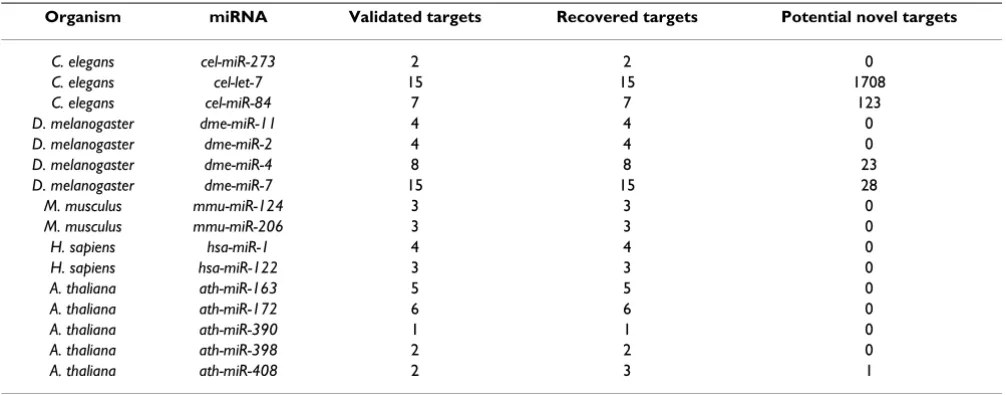
In accordance with the definition of the SBM method, in Table 2 we see that all validated targets present in the
input alignment are recovered in the scan output using a threshold of 1. In many cases no additional candidate tar-gets are predicted using this stringent threshold, especially when there are few sequences provided in the input SBM
set. Larger sets of validated targets tended to result in the prediction of more new candidate target sites, as illus-trated in Table 2 by the cases of dme-miR-4, dme-miR-7, cel-let-7 and cel-miR-84. This reflects the consistency criterion built into the binding matrix definition; a larger input set of sequences generally tended to reduce the stringency of the classifier.
cel-let-7 returned 1708 predicted targets at threshold 1 which appears to be relatively high compared with the other results, but given the size the searched database (2,274,326 nt) it is a small proportion of all possible tar-get regions. A possible reason for the large number of pre-dicted targets is that the input sequence set used to build the SBM set was misaligned by ClustalW. The validated targets used to create the alignment showed a greater degree of heterogeneity that those in other alignments. Another possible explanation is that cel-let-7 is known to have several paralogs (cel-miR-84, cel-miR-48 and cel-miR-241) [29] and therefore its targets are likely to overlap with other members of this miRNA family. It has also been suggested that some miRNAs may target thousands of different genes [30] making it possible that many of the targets predicted are in fact true positives.
Leave one out analysis
While the SBM method used with Smin = 1 recovers all
gets that are present in the input alignment, unknown tar-gets that receive a score below 1 are likely to exist. It is possible to detect such sequences using the SBM method by lowering the threshold. This increases the classifier's sensitivity at the expense of reducing its specificity. To assess this effect quantitatively we conducted a leave one out analysis. In particular we constructed leave one out alignments by deleting one target site sequence from an input alignment. Then, for each alignment in which the target sequence w was left out, we computed a SBM set and determined the score S(w) of the target site that was left out. If S(w) < 1, the threshold needs to be adjusted to
Smin = S(w) in order to detect w. We therefore scanned the
Table 1: Summary of UTR datasets
Organism No. Sequences Sequence type No. Nucleotides
C. elegans 12,172 UTR 2,724,326
D. melanogaster 11,277 UTR 4,612,168
M. musculus 20,271 UTR 20,009,781
H. sapiens 27,685 UTR 30,673,888
A. thaliana 31,527 cDNA 46,447,255
respective UTR set with Smin = min {1, S(w)} and
deter-mined the number of predicted targets.
An input alignment of n sequences allows construction of
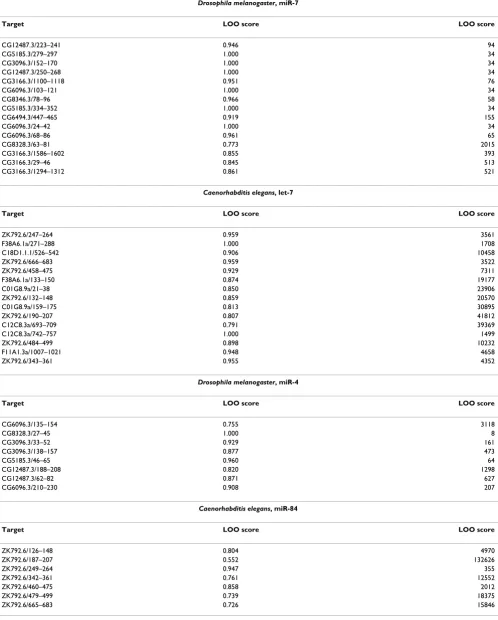
n - 1 leave one out alignments (we did not leave out the reverse complement of the miRNA), so data sets contain-ing more experimentally validated target sites clearly result in more meaningful leave one out analyses. We therefore chose the four miRNAs that had the greatest number of known experimentally validated targets; D. melanogaster miR-7 and C. elegans let-7, which both tar-geted 15 unique UTR regions as well as D. melanogaster miR-4 (8 unique targets) and C. elegans miR-84 (7 unique targets). In total 2,484,850 UTR regions were scanned in the C. elegans set compared with to 4,409,641 regions in the D. melanogaster set. The score of each left out target along with the number of regions with a score equal to or greater than this value in the scan using the full alignment are shown in Table 3.
The SBM method appears to show a greater degree of accuracy in the D. melanogaster miR-7 results. Here the mean score of the left out target is 0.9385 and the mean number of target regions scoring greater than or equal to the left out sequence is 273 (0.006% of the total UTR regions scanned). The C. elegans let-7 scan indicates a lower degree of specificity, with an average score of 0.9032, returning a mean of 14869 regions with a score greater than or equal to the score of the left out validated target sequence. This represents 0.598% of the sequence database that was searched. For D. melanogaster miR-4 the
SBM method gave a mean score of 0.890 with an average of 745 target regions scoring greater than or equal to the
left out sequence (0.017% of the total UTR regions scanned), and for C. elegans miR-84 a mean score of 0.770 was obtained and an average of 26677 target regions scor-ing greater than or equal to the left out sequence was returned (1.074% of the total UTR regions scanned). The decrease in specificity in the C. elegans miR-84 results is largely due to a single leave one out test in which over 132626 sequences scored higher than the left out sequence (which received a score of 0.552).
Overall, the lowering of the threshold required to detect a word not in the input set results in a moderate increase in the number of reported hits, which is indicative of a high specificity even with the reduced threshold.
In order to assess the performance of the algorithm when few known targets are provided in the input alignment were-ran the C. elegans let-7 and D. melanogaster miR-7
scans but this time split each of the alignments of 15 val-idated targets into two subalignments containing 8 and 7 sequences respectively. Table 4 shows that as the number of sequences used to build the SBM decreases, so does the mean score of the left out sequences. This indicates, as might be expected that as the number of sequences left out of the alignment increases the specificity decreases.
Comparison with miRanda
We also compared the performance of the SBM method with miRanda v1.9, a commonly used target prediction tool [10]. miRanda takes a single miRNA sequence as input and searches a sequence dataset for potential target regions. It uses two different criteria to detect potential tar Table 2: SBM scan summary obtained using a score threshold of 1
Organism miRNA Validated targets Recovered targets Potential novel targets
C. elegans cel-miR-273 2 2 0
C. elegans cel-let-7 15 15 1708
C. elegans cel-miR-84 7 7 123
D. melanogaster dme-miR-11 4 4 0
D. melanogaster dme-miR-2 4 4 0
D. melanogaster dme-miR-4 8 8 23
D. melanogaster dme-miR-7 15 15 28
M. musculus mmu-miR-124 3 3 0
M. musculus mmu-miR-206 3 3 0
H. sapiens hsa-miR-1 4 4 0
H. sapiens hsa-miR-122 3 3 0
A. thaliana ath-miR-163 5 5 0
A. thaliana ath-miR-172 6 6 0
A. thaliana ath-miR-390 1 1 0
A. thaliana ath-miR-398 2 2 0
A. thaliana ath-miR-408 2 3 1
Table 3: Leave one out analysis
Drosophila melanogaster, miR-7
Target LOO score LOO score
CG12487.3/223–241 0.946 94
CG5185.3/279–297 1.000 34
CG3096.3/152–170 1.000 34
CG12487.3/250–268 1.000 34
CG3166.3/1100–1118 0.951 76
CG6096.3/103–121 1.000 34
CG8346.3/78–96 0.966 58
CG5185.3/334–352 1.000 34
CG6494.3/447–465 0.919 155
CG6096.3/24–42 1.000 34
CG6096.3/68–86 0.961 65
CG8328.3/63–81 0.773 2015
CG3166.3/1586–1602 0.855 393
CG3166.3/29–46 0.845 513
CG3166.3/1294–1312 0.861 521
Caenorhabditis elegans, let-7
Target LOO score LOO score
ZK792.6/247–264 0.959 3561
F38A6.1a/271–288 1.000 1708
C18D1.1.1/526–542 0.906 10458
ZK792.6/666–683 0.959 3522
ZK792.6/458–475 0.929 7311
F38A6.1a/133–150 0.874 19177
C01G8.9a/21–38 0.850 23906
ZK792.6/132–148 0.859 20570
C01G8.9a/159–175 0.813 30895
ZK792.6/190–207 0.807 41812
C12C8.3a/693–709 0.791 39369
C12C8.3a/742–757 1.000 1499
ZK792.6/484–499 0.898 10232
F11A1.3a/1007–1021 0.948 4658
ZK792.6/343–361 0.955 4352
Drosophila melanogaster, miR-4
Target LOO score LOO score
CG6096.3/135–154 0.755 3118
CG8328.3/27–45 1.000 8
CG3096.3/33–52 0.929 161
CG3096.3/138–157 0.877 473
CG5185.3/46–65 0.960 64
CG12487.3/188–208 0.820 1298
CG12487.3/62–82 0.871 627
CG6096.3/210–230 0.908 207
Caenorhabditis elegans, miR-84
Target LOO score LOO score
ZK792.6/126–148 0.804 4970
ZK792.6/187–207 0.552 132626
ZK792.6/249–264 0.947 355
ZK792.6/342–361 0.761 12552
ZK792.6/460–475 0.858 2012
ZK792.6/479–499 0.739 18375
ZK792.6/665–683 0.726 15846
get sites, the alignment score and the MFE of the miRNA bound to the potential target sequence.
In order to obtain results with miRanda that could be meaningfully compared with the SBM method, we used miRanda to score every potential target site across each of the UTR sequences. To do this we split each of the UTRs into 30 nt sequence windows covering the entire length of each UTR and used this as our sequence database for the miRanda scan. Since the same target region may be scored more than once using this approach, we removed any duplicate regions from the results before the comparison. By default miRanda uses relatively stringent threshold val-ues which do not necessarily recover all known target regions, i.e. classification is not consistent. For this reason miRanda was run using a negative score threshold and a positive energy threshold which allowed us to obtain a wide distribution of scores and to ensure consistency.
Table 5 provides an overview of the miRanda comparison, the full results can be found in the supplementary materi-als [see Additional file 1]. In general the SBM method compared favourably with miRanda. This is not unex-pected as we incorporate additional information into our searches. For example the cel-let7 results show that an average of 14869 regions had a score that was at least as high as the left out sequence using SBM whereas an aver-age of 92332 regions scored at least as high as the vali-dated target using miRanda. This difference was more pronounced in the dme-miR-7 results where an average of 273 sequences scored equal to or better than the left out
sequences and an average of 8868 sequences scored at least as high as the validated target using miRanda. The
SBM method returned an average of 745 sequences scor-ing equal to or better than the left out sequence for dme-miR-4 in comparison to an average of 11488 sequences that scored at least as high as the validated target using miRanda. An average of 26677 target regions were returned using the SBM method for cel-miR-84 compared with 190693 using miRanda.
We determined the maximal consistent threshold for miRanda results by filtering out all candidates with an alignment score lower than the lowest scoring validated target. The remaining candidates are then filtered further by removing any sequence with an MFE of greater than the MFE of the highest (least stable) of the validated targets. The number of regions returned using the maximal con-sistent threshold in miRanda were 23992 for cel-let7 in contrast to the 1708 returned using the SBM method with maximal consistent threshold. 48538 regions were recov-ered for cel-miR-84 compared with 123 using SBM, 2129 for dme-miR-4 in comparison to 23 with SBM and 5325 for dme-miR-7, with the SBM method returning 28.
Discussion
We have presented a new method, SBM, that allows the use of miRNA target site sequences in addition to the miRNA sequence itself to search for novel target sites. We have demonstrated its application to target prediction for a variety of miRNA examples from different organisms and have shown that it performs well in comparison to
Table 5: Summary of results for the leave one out analysis
miRNA LOO score LOO score miRanda(s) miRanda(s) miRanda(e) miRanda(e) miRanda(se)
cel-let-7 0.903 14869 119 92332 -15.46 60266 23992
cel-miR-84 0.770 26677 106 190693 -10.19 150137 48538
dme-miR-7 0.938 273 159 8868 -21.69 7227 2129
dme-miR-4 0.890 745 131 11488 -8.51 184134 5325
"miRNA" gives miRBase accession of the miRNA sequence; "LOO score" gives mean score of the targets left out of the SBM; " LOO score" gives mean number of regions scoring equal to or greater than the left out sequence; "miRanda(s)" gives raw score of the miRanda hit of lowest scoring target region; " miRanda(s)" gives number of regions with returned using the maximal consistent score threshold; "miRanda(e)" gives minimum free energy (MFE) of the miRanda hit of the least stable target region; " miRanda(e)" gives number of regions with returned using the maximal consistent MFE threshold; " miRanda(se)" gives number of regions with returned using the maximal consistent combined score and MFE threshold.
Table 4: Leave several out analysis
15 targets 14 targets 8 targets 7 targets
Mean score C. elegans let-7 1.000 0.903 0.851 0.810
Mean number returned C. elegans let-7 1708 14869 18032 17225
Mean score D. melanogaster miR-7 1.000 0.938 0.908 0.890
Mean number returned D. melanogaster miR-7 28 273 509 138
miRanda. Many computational methods for target predic-tion tend to suffer from a lack of specificity [15]. The SBM
method allows the use of all known target sequences in the search, and is designed to provide maximum specifi-city whilst recovering all members present in the starting alignment. Thus, as the number of experimentally vali-dated miRNA targets grows, the SBM method should pro-vide an attractive addition to the available miRNA target site detection methods.
Many current target prediction techniques are based on algorithms with fixed parameters (such as base pairing rules or binding energies) that are used to assess potential targets by matching them to the miRNA sequence. These algorithms are designed to reflect molecular target recog-nition mechanisms that are assumed to apply to miRNA target recognition in general. Tailoring these algorithms to reflect mechanisms that are specific to the miRNA is diffi-cult or impossible. In contrast to this, the SBM method can capture aspects of specific binding mechanisms by extracting such specific information from the set of vali-dated target site sequences. This also makes the method generic in that it can be applied to any organism without having to assume any prior knowledge of specific target recognition mechanisms.
Due to the small number of validated targets for each miRNA, the maximal consistent threshold used in the
SBM method is rather stringent. We chose this threshold to facilitate comparison of the method to miRanda. For many applications lowering thresholds to increase sensi-tivity at the cost of losing some specificity may be advisa-ble. The specificity advantage of the SBM method can be expected to be partly independent of the threshold, since moderate relaxation of the threshold for a classifier that attains a high level of specificity with a given threshold can be assumed to retain some of the specificity advan-tage.
As with all scoring matrix approaches, the SBM method is limited by the quality of the input data. Firstly if a false positive target sequence is provided as input the method will be adversely affected, therefore only experimentally validated targets should generally be used as input. Sec-ondly the quality of the input alignment is extremely important and a poor quality alignment will lead to poor performance. miRNAs are relatively short (~21 nt) which means that in many cases they can be aligned quite accu-rately using multiple alignment algorithms such as Clus-talW [25] and MUSCLE [31]. In some cases however, the conservation between sites targeted by the same miRNA is very low, meaning that an accurate sequence alignment is hard to produce using automated methods. In such cases it may be favourable to hand curate alignments in order to ensure quality and obtain optimal SBM results. Thirdly,
although the short length of miRNAs also allows for the integration of gapped alignments in the SBM method, the method will only search for the gap patterns contained in the input alignment. Thus, if targets contain insertion/ deletion patterns which are not specified in this way, then they may receive a lower score or even be missed com-pletely depending on the threshold used in the search.
Several miRNA target prediction systems have imple-mented post-processing steps in order to increase their specificity. The most commonly used filtering approach is to look for cross-species conservation of target sites. Here target sites that appear not to be conserved between mul-tiple species are filtered out from the search results, removing false positives, and leading to increased specifi-city. This type of approach could be applied to results obtained with SBM to further increase the specificity of target predictions. However, we note that this might also lead to a reduction in sensitivity as it is now known that miRNAs themselves are not always conserved between related species (e.g. [32]). Another possibility is to post-process based on target site accessibility. It has recently been shown that taking into account target site accessibil-ity in the 3' UTR can improve target prediction accuracy [33]. For instance if a predicted target site is part of a stable secondary structure (and is therefore already involved in base-pairing) it is less likely that the miRNA will be able to bind to the target causing the translational repression of the mRNA. In conclusion, we have presented a promising new method for miRNA target prediction, SBM, that employs a generic scoring matrix approach and incorpo-rates experimentally validated targets. Since the number of validated targets is constantly growing, SBM should provide a useful new addition to the current target predic-tion toolbox.
Availability and Requirements
The code, together with documentation and examples, is freely available for download from http:// www.cmp.uea.ac.uk/~jtk/stackbm/.
Additional material
Additional file 3
Raw result files. Raw SBM results files, alignments of miRNA targets used in the analysis and a list of overlapping targets predicted by both SBM and miRanda.
Click here for file
Acknowledgements
We would like to thank the referees for their helpful comments. Vincent Moulton thanks Biotechnology and Biological Sciences Research Council (grant BB/E004091/1) for its support.
References
1. Carrington JC, Ambros V: Role of microRNAs in plant and ani-mal development. Science 2003, 301(5631336-338 [http:// dx.doi.org/10.1126/science.1085242].
2. Calin GA, Croce CM: MicroRNA-cancer connection: the begin-ning of a new tale. Cancer Res 2006, 66(157390-7394 [http:// dx.doi.org/10.1158/0008-5472.CAN-06-0800].
3. Reinhart BJ, Weinstein EG, Rhoades MW, Bartel B, Bartel DP: Micro-RNAs in plants. Genes Dev 2002, 16(131616-1626 [http:// dx.doi.org/10.1101/gad.1004402].
4. Hammond SM, Bernstein E, Beach D, Hannon GJ: An RNA-directed nuclease mediates post-transcriptional gene silencing in Drosophila cells. Nature 2000, 404(6775293-296 [http:// dx.doi.org/10.1038/35005107].
5. Mallory AC, Vaucheret H: Functions of microRNAs and related small RNAs in plants. Nat Genet 2006:S31-S36 [http://dx.doi.org/ 10.1038/ng1791].
6. Jovanovic M, Hengartner MO: miRNAs and apoptosis: RNAs to die for. Oncogene 2006, 25(466176-6187 [http://dx.doi.org/10.1038/ sj.onc.1209912].
7. Válóczi A, Várallyay E, Kauppinen S, Burgyán J, Havelda Z: Spatio-temporal accumulation of microRNAs is highly coordinated in developing plant tissues. Plant J 2006, 47:140-151 [http:// dx.doi.org/10.1111/j.1365-313X.2006.02766.x].
8. Kloosterman WP, Plasterk RHA: The diverse functions of micro-RNAs in animal development and disease. Dev Cell 2006,
11(4441-450 [http://dx.doi.org/10.1016/j.devcel.2006.09.009]. 9. Griffiths-Jones S, Grocock RJ, van Dongen S, Bateman A, Enright AJ:
miRBase: microRNA sequences, targets and gene nomencla-ture. Nucleic Acids Res 2006:D140-D144 [http://dx.doi.org/10.1093/ nar/gkj112].
10. Enright AJ, John B, Gaul U, Tuschl T, Sander C, Marks DS: Micro-RNA targets in Drosophila. Genome Biol 2003, 5:R1 [http:// dx.doi.org/10.1186/gb-2003-5-1-r1].
11. Zhang Y: miRU: an automated plant miRNA target prediction server. Nucleic Acids Res 2005:W701-W704 [http://dx.doi.org/ 10.1093/nar/gki383].
12. Krüger J, Rehmsmeier M: RNAhybrid: microRNA target predic-tion easy, fast and flexible. Nucleic Acids Res 2006:W451-W454 [http://dx.doi.org/10.1093/nar/gkl243].
13. Mazière P, Enright AJ: Prediction of microRNA targets. Drug Dis-cov Today 2007, 12(11–12452-458 [http://dx.doi.org/10.1016/ j.drudis.2007.04.002].
14. John B, Enright AJ, Aravin A, Tuschl T, Sander C, Marks DS: Human MicroRNA targets. PLoS Biol 2004, 2(11e363 [http://dx.doi.org/ 10.1371/journal.pbio.0020363].
15. Rajewsky N: microRNA target predictions in animals. Nat Genet 2006:S8-13 [http://dx.doi.org/10.1038/ng1798].
16. Kim JT, Gewehr JE, Martinetz T: Binding matrix: a novel approach for binding site recognition. J Bioinform Comput Biol
2004, 2(2):289-307.
17. Turner DH, Sugimoto N, Jaeger JA, Longfellow CE, Freier SM, Kierzek R: Improved parameters for prediction of RNA struc-ture. Cold Spring Harb Symp Quant Biol 1987, 52:123-133.
18. Wolff H, Brack-Werner R, Neumann M, Werner T, Schneider R:
Integrated Functional and Bioinformatics Approach for the Identification and Experimental Verification of RNA Signals: Application to HIV-1 INS. Nucleic Acids Research 2003,
31:2839-2851.
19. Stormo GD: DNA Binding Sites: Representation and Discov-ery. Bioinformatics 2000, 16:16-23.
20. Madany Mamlouk A, Kim JT, Barth E, Brauckmann M, Martinetz T:
One-Class Classification with Subgaussians. In DAGM Sympo-sium Edited by: Michaelis B, Krell G. Berlin Heidelberg: Springer Ver-lag; 2003:346-353.
21. Burgler C, Macdonald PM: Prediction and verification of micro-RNA targets by MovingTargets, a highly adaptable predic-tion method. BMC Genomics 2005, 6:88 [http://dx.doi.org/10.1186/ 1471-2164-6-88].
22. The Python Programming Language [http://www.python.org] 23. R Development Core Team: R: A language and environment for statisti-cal computing 2004 [http://www.R-project.org]. R Foundation for Sta-tistical Computing, Vienna, Austria [ISBN 3-900051-07-0].
24. Sethupathy P, Corda B, Hatzigeorgiou AG: TarBase: A compre-hensive database of experimentally supported animal micro-RNA targets. RNA 2006, 12(2192-197 [http://dx.doi.org/10.1261/ rna.2239606].
25. Chenna R, Sugawara H, Koike T, Lopez R, Gibson TJ, Higgins DG, Thompson JD: Multiple sequence alignment with the Clustal series of programs. Nucleic Acids Res 2003, 31(13):3497-3500. 26. Kasprzyk A, Keefe D, Smedley D, London D, Spooner W, Melsopp C,
Hammond M, Rocca-Serra P, Cox T, Birney E: EnsMart: a generic system for fast and flexible access to biological data. Genome Res 2004, 14:160-169 [http://dx.doi.org/10.1101/gr.1645104]. 27. Gustafson AM, Allen E, Givan S, Smith D, Carrington JC, Kasschau
KD: ASRP: the Arabidopsis Small RNA Project Database. Nucleic Acids Res 2005:D637-D640 [http://dx.doi.org/10.1093/nar/ gki127].
28. Rhee SY, Beavis W, Berardini TZ, Chen G, Dixon D, Doyle A, Garcia-Hernandez M, Huala E, Lander G, Montoya M, Miller N, Mueller LA, Mundodi S, Reiser L, Tacklind J, Weems DC, Wu Y, Xu I, Yoo D, Yoon J, Zhang P: The Arabidopsis Information Resource (TAIR): a model organism database providing a centralized, curated gateway to Arabidopsis biology, research materials and community. Nucleic Acids Res 2003, 31:224-228.
29. Hayes GD, Frand AR, Ruvkun G: The mir-84 and let-7 paralo-gous microRNA genes of Caenorhabditis elegans direct the cessation of molting via the conserved nuclear hormone receptors NHR-23 and NHR-25. Development 2006,
133(234631-4641 [http://dx.doi.org/10.1242/dev.02655].
30. Miranda KC, Huynh T, Tay Y, Ang YS, Tam WL, Thomson AM, Lim B, Rigoutsos I: A pattern-based method for the identification of MicroRNA binding sites and their corresponding heter-oduplexes. Cell 2006, 126(61203-1217 [http://dx.doi.org/10.1016/ j.cell.2006.07.031].
31. Edgar RC: MUSCLE: a multiple sequence alignment method with reduced time and space complexity. BMC Bioinformatics
2004, 5:113 [http://dx.doi.org/10.1186/1471-2105-5-113].
32. Fahlgren N, Howell MD, Kasschau KD, Chapman EJ, Sullivan CM, Cumbie JS, Givan SA, Law TF, Grant SR, Dangl JL, Carrington JC:
High-Throughput Sequencing of Arabidopsis microRNAs: Evidence for Frequent Birth and Death of MIRNA Genes. PLoS ONE 2007, 2:e219 [http://dx.doi.org/10.1371/jour nal.pone.0000219].
33. Kertesz M, Iovino N, Unnerstall U, Gaul U, Segal E: The role of site accessibility in microRNA target recognition. Nat Genet 2007,
39(101278-1284 [http://dx.doi.org/10.1038/ng2135].
Additional file 1
tableS1 – SBM comparison with miRanda. Full results of the SBM com-parison with miRanda for each of the four miRNAs tested.
Click here for file
[http://www.biomedcentral.com/content/supplementary/1748-7188-3-3-S1.pdf]
Additional file 2
tableS2 – Number of overlapping predictions. Summary table showing the number of target regions predicted by SBM and miRanda using default parameters and their overlap.
Click here for file
![Figure 1Fig. 1]Alignment of the Drosophila melanogaster let-7 miRNA to a cognate target site in the 3' UTR of the ab gene adapted from [21, Alignment of the Drosophila melanogaster let-7 miRNA to a cognate target site in the 3' UTR of the ab gene adapted f](https://thumb-us.123doks.com/thumbv2/123dok_us/351831.1527733/3.612.67.540.97.222/figure-alignment-drosophila-melanogaster-alignment-drosophila-melanogaster-adapted.webp)