R E S E A R C H
Open Access
DCJ-Indel sorting revisited
Phillip EC Compeau
Abstract
Background: The introduction of the double cut and join operation (DCJ) caused a flurry of research into the study of multichromosomal rearrangements. However, little of this work has incorporated indels (i.e., insertions and deletions of chromosomes and chromosomal intervals) into the calculation of genomic distance functions, with the exception of Braga et al., who provided a linear time algorithm for the problem of DCJ-indel sorting. Although their algorithm only takes linear time, its derivation is lengthy and depends on a large number of possible cases. Results: We note the simple idea that a deletion of a chromosomal interval can be viewed as a DCJ that creates a new circular chromosome. This framework will allow us to amortize indels as DCJs, which in turn permits the application of the classical breakpoint graph to obtain a simplified indel model that still solves the problem of DCJ-indel sorting in linear time via a more concise formulation that relies on the simpler problem of DCJ sorting. Furthermore, we can extend this result to fully characterize the solution space of DCJ-indel sorting.
Conclusions: Encoding indels as DCJ operations offers a new insight into why the problem of DCJ-indel sorting is not ultimately any more difficult than that of sorting by DCJs alone. There is still room for research in this area, most notably the problem of sorting when the cost of indels is allowed to vary with respect to the cost of a DCJ and we demand a minimum cost transformation of one genome into another.
Keywords: Genome rearrangements, DCJ, Indels, Sorting, Solution space
Background
In the simplest terms, DNA may mutate in two fundamen-tally different ways. On the one hand, single-nucleotide polymorphisms alter the base at a single position of the nucleic acid polymer; on the other hand, huge mutations called chromosomal rearrangements can move around, duplicate, insert, or delete huge blocks of DNA, often from one chromosome to another.
Chromosomal rearrangements were first observed by Dobzhansky and Sturtevant in 1938 ([1]), but extensive efforts to quantify their study did not take off until the early 1990s. In the last two decades, a number of dis-crete genomic models have been proposed and studied (see [2] for an overview of the combinatorics of genome rearrangements).
Having selected a genomic model and a collection of genome operations to consider, the standard algorithmic problem is the computation of thedistancebetween two
Correspondence: [email protected]
Department of Mathematics, UC San Diego, 9500 Gilman Drive 0112, San Diego, CA 92093, United States
genomes and , or the minimum number of allow-able operations required to transforminto; the more difficult problem ofsortingdemands the operations them-selves. The first historical example of such a discrete genomic distance is the prefix reversal distancefor per-mutations (which model the order of genes along a single linear chromosome), introduced in [3] and bounded in [4-6]. The computation of prefix reversal distance has been proposed to beNP-Hard (see [7]).
More recent research has moved past permutations and toward multichromosomal genomic models that incorpo-rate both linear and circular chromosomes. One of these models, which we will study in this paper, models the chromosomes of a genome with paths and cycles in a graph. For this model, the double cut and join operation (DCJ) was introduced in [8] and incorporates segment reversals with a number of other operations. Interestingly, a linear time greedy algorithm exists for DCJ sorting two genomes having equal gene content (see [9]).
The incorporation of insertions and deletions of chro-mosomes and chromosomal intervals (collectively called indels) into DCJ distance was discussed in [10] and quanti-fied rigorously in [11]. The latter authors provided a linear
time algorithm for the associated problem of DCJ-indel sorting, which gives a minimum collection of DCJ and indel operations required to transform one genome into another. Yet their argument is case-ridden, and so in this paper, which builds upon [12], we wish to provide a much simpler presentation of DCJ-indel sorting that still yields a linear-time solution to the problem.
Main text
Preliminaries
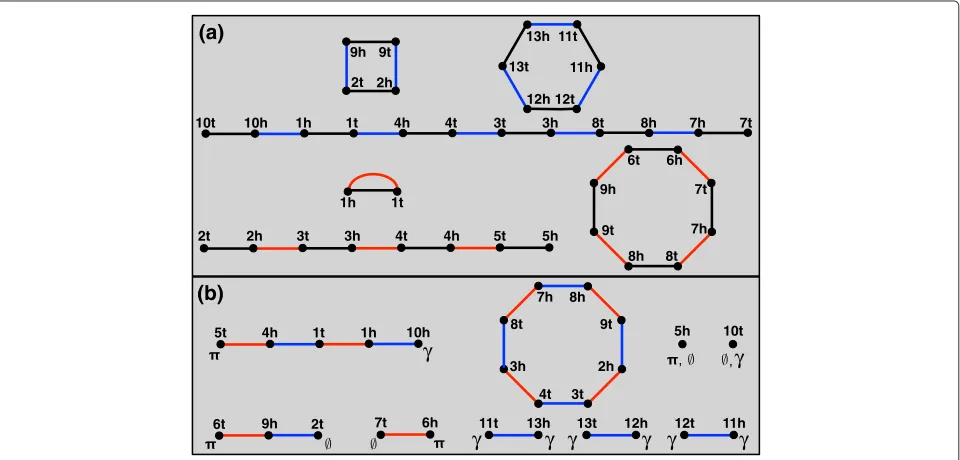
Say that we are given a perfect matching on 2N labeled verticesV, forming a setG ofN edges calledgenes; the vertices of each gene form itsheadandtail. We define a genome as the edge-disjoint union of two matchings. Thegenesof, denotedg(), form a matching onV such thatg()⊆G; theadjacenciesof, denoteda(), form a matching onV(g()). We color the genes ofblack and the adjacencies ofblue (see Figure 1(a)).
A consequence of these definitions is thatcomprises a disjoint collection of paths and cycles, where each con-nected component alternates between black genes and blue adjacencies. Each component of is called a chro-mosome; paths (cycles) ofdefinelinear(circular) chro-mosomes of. The endpoint vof a path inis called atelomereof;vis not incident to an adjacency, and so for clerical purposes, we say thatvhas thenull adjacency {v,∅}. A genome consisting of only circular (linear) chro-mosomes is called acircular(linear)genome. Note that
is circular if and only if the edges ofa()form a perfect matching onV().
Henceforth, we only consider genome pairs{,}such that g() ∪ g() = G. A workhorse data structure encoding the relationship betweenand is the break-point graph([13]), denoted by B(,)and defined as the edge-disjoint uniona of a() and a(), where
adjacen-cies of will be colored red (Figure 1(b)). Observe that B(,)is also a collection of disjoint paths and cycles, which alternate between red and blue edges. Thelength of a connected component of B(,) is its total num-ber of edges; we consider an isolated vertex in B(,)
to be a path of length 0. The breakpoint graph is also the line graph of the adjacency graph, which was first defined in [9] and has also been used in rearrangement studies.
Adouble cut and joinoperation (DCJ) on(introduced in [8]) uses one or two adjacencies of via one of the following four operations to produce a new genome:
1. {v,w},{x,y} −→ {v,x},{w,y}
2. {v,w},{x,∅} −→ {v,x},{w,∅}
3. {v,∅},{w,∅} −→ {v,w}
4. {v,w} −→ {v,∅},{w,∅}
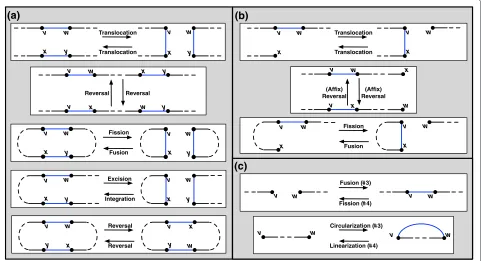
The DCJ incorporates a wide range of genome rearrange-ments, as shown in Figure 2.
For the particular case thatandhave the same genes (i.e.,g()=g()=G), theDCJ distancebetweenand
, writtendDCJ(,), is the minimum number of DCJs
required to transformintoOne can easily verify that dDCJforms a metric on the set of all genomes having gene
2t 2h 9h 9t
13h
13t
12h 12t 11h 11t
10t 10h 1h 1t 4h 4t 3t 3h 8t 8h 7h 7t
2t 2h 3t 3h 4t 4h 5t 5h
1h 1t
8h 8t 7h
7t 6h 6t
9t 9h (a)
7t 6h 11t 13h 13t 12h 12t 11h
6t 9h 2t
4t 3t 2h
9t 8h 7h
3h 8t
5t 4h 1t 1h 10h
γ ,
5h 10t
(b)
γ γ
γ γ
γ γ
γ ,
v w
x y
v w
x y
Translocation
Translocation
v w x y
Reversal Reversal
Fission
Fusion
Excision
Integration
Reversal
Reversal
Reversal Reversal
Fission
Fusion
Fusion (#3) Fission (#4) Circularization (#3) Linearization (#4)
(a) (b)
(c)
Translocation
Translocation x
w v
x w v
y w
v x
y x
w v
y x
w v
y x
v w
y x
w v
x y
w v
w y
x v
x
v w
w
v x
x w v
x w v
v w v w
v w
v w
Figure 2The Collection of All Possible DCJ Operations.The DCJ incorporates many operations, depending on the structure of the chromosomes involved and whether the adjacencies used belong to the same chromosome.(a)Operation 1 in the definition of the DCJ incorporates linear internal translocations, reversals, circular fusions/fissions, the excision of a circular chromosome from a linear chromosome, and the integration of a circular chromosome into a linear chromosome.(b)Operation 2 incorporates telomeric translocations, affix reversals (which involve the telomere of a linear chromosome), and the fission of a linear chromosome into a circular and linear chromosome (together with its inverse).(c)Operations 3 and 4 include linear fusions/fissions as well as the linearization/circularization of a single chromosome.
setG. A closed formula for DCJ distance was derived in [9] and translated into breakpoint graph notation in [14]:
dDCJ(,)=N−c(,)−
peven(,)
2 (1)
Here,c(,)andpeven(,)denote the number of cycles
and even-length paths in B(,), respectively.
For the more general case that and do not share the same genes, adeletion of a chromosomal interval of
replaces adjacencies{v,w}and{x,y}(contained in the order(v,w,x,y)along a chromosome of) with the adja-cency{v,y}and removes the path connectingwtox. We also allow deletions of entire chromosomes; however, we must stipulate (following the lead of the authors in [11]) that every vertex removed from must belong toV − V().bTheinsertion of a chromosome or chromosomal interval intoto obtainis defined as the inverse of a corresponding deletion fromthat yields. Note that a consequence of this definition is that we may not insert a gene unless it is contained inG. Insertions and deletions are collectively calledindels; thus, we define theDCJ-indel distancebetweenand, writtendind
DCJ(,), as the
min-imum number of DCJs and indels required to transform
into.
Because insertions and deletions are inverse opera-tions, it follows thatdindDCJ(,) = dindDCJ(,). However, althoughdindDCJis symmetric, unlikedDCJit does not form
a metric, as the triangle inequality does not hold; see [15] for a more complete discussion.
DCJ-Indel sorting
Handling circular singletons
We begin our discussion of DCJ-indel sorting by defining acircular singleton of (adapted from[11]) as a circu-lar chromosome C such that V(C) ∩V() = ∅. Note thatCis defined with respect to as well as. Ideally, we could delete (insert) all circular singletons of and
immediately to simplify the problem of DCJ-indel sort-ing; fortunately, this is indeed the case, as shown by the following two results.
Proposition 1.If is formed by removing a circular singleton C from, then dindDCJ(,) = dDCJind(,)−1. Furthermore, when transformingintovia a minimum collection of DCJs and indels, no gene belonging to a circu-lar singleton ofcan ever appear in the same chromosome as a gene of.
Proof.Any collection ofkDCJs and indels transforming
yieldk+1 DCJs and indels transforminginto; thus, dindDCJ(,)≥dindDCJ(,)−1.
To obtain the reverse bound, let us view a transforma-tionTofintoas a sequence(0,1,. . .,n)(n≥1), where 0 = , n = , and i+1 is obtained from i as the result of a single DCJ or indel. Consider the sequence(0,1,. . .,n), whereiis constructed from
i by removing the subgraph of i induced by the ver-tices ofCunder the stipulation that whenever we remove a pathPconnectingvtow, we replace adjacencies{v,x}and {w,y}inwith{x,y}ini. It is easy to see that0=,
n =, and for everyiin range, eitheri+1is the result of a DCJ or indel applied to i or i+1 = i; thus,
(0,1,. . .,n) encodes a transformation of into
using at most nDCJs and indels. Furthermore, one can verify thati+1=ionly when an adjacency ofCis used by a DCJ inTchangingitoi+1or wheni+1is
pro-duced fromiby a deletion of vertices that all belong to C. At least one such operation must always occur inT; hence,dindDCJ(,)≤dDCJind(,)−1.
The proposition’s second conclusion follows from the fact that if for somej(1≤j≤n−1), a chromosome ofj contains a geneg1ofand a geneg2ofC, then one DCJ
was required to combine g1and g2into the same
chro-mosome, and another will be needed to separate them, yielding two distinct values of i for which i+1 = i. From the first part of the proof, we may conclude that dindDCJ(,) <n.
Letting sing(,) denote the total number of circular singletons ofand, we have an immediate corollary.
Corollary 2.The DCJ-indel distance is given by the following:
dindDCJ(,)=sing(,)+dindDCJ(0,0) (2)
where0(0) is formed by removing all circular singletons from().
With respect to DCJ-indel sorting, Corollary 2 allows us to assume without loss of generality thatanddo not contain any circular singletons.
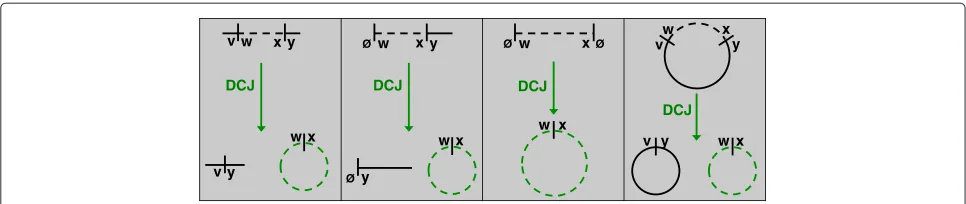
We next make an observation taken from [16], which is that the deletion of a chromosomal interval of con-nectingwto xmay be viewed as a DCJ:{v,w},{x,y} → {v,y},{w,x}; this operation produces a circular chromo-some containingwandx that is scheduled for removal, including the case that vor y equals∅ (the deletion of an entire linear chromosome is handled byu = x = ∅); see Figure 3. Because insertions are the inverses of dele-tions, we would like to conclude that indels may be placed in a one-to-one correspondence with the removal of cir-cular chromosomes. Ironically, the apparent exception to
this proposed rule is the deletion of an entire circular chromosome.
Yet if a deleted circular chromosomeCis not produced as the result of a DCJ, thenCmust be a circular single-ton of in order to be deleted. Otherwise,C has been produced as the result of a DCJ applied to a chromoso-mal interval; by the method we just described, we can amortize the deletion in this DCJ unless the DCJ also cre-ates another circular chromosome C that is scheduled for deletion. However, this sequence of operations cannot arise in a minimum collection of DCJs and indels trans-forminginto, as we could simply delete the original chromosome from whichCandCwere produced by the DCJ in question, thus requiring a single operation instead of three.
Toward a new model of Indels
We will follow the observation made in [16] that the actual removal of deleted chromosomes can occur as a final step in the transformation of into . As a result, we may view the transformation ofintoas composed of three steps: inserting chromosomes intoto yield a new genomewithg() =G; applying a sequence of DCJs to produce a genomehaving the same genes as; and finally, deleting chromosomes fromto produce. Note that we can equivalently view the first step as the dele-tion of chromosomes from to obtain . Combining this observation with our correspondence between indels and circular chromosomes above, we may introduce the following framework.
Define acompletionofas a genomehavingg()= Gand for whicha()is composed ofa()together with a perfect matching onV()−V(). We call the adja-cencies ofa()−a()new. Note that the chromosomes ofembed as chromosomes ofand that the compo-nents of−form cycles because the new adjacencies ofinduce a perfect matching onV()−V(); we may now without ambiguity call these circular chromosomes oftheindelsof. Acompletionof a pair of genomes
(,)is simply a pair (,)for which and are completions ofand, respectively. The above discus-sion implies that for any minimum cost transformation of
into, the indels of correspond bijectively to DCJ operations, so that we will amortize each unit indel cost by that of a DCJ operation. This amortization yields the following equation for DCJ-indel distance:
dindDCJ(,)= min
(,)
dDCJ(,)
(3)
where the minimum is taken over all completions of
w x
v w x y w x y v
w x
y
v y
w x w x
y
w x
w x v y
DCJ DCJ DCJ
DCJ
Figure 3Encoding the Deletion of a Chromosomal Interval as a DCJ.The deletion of a chromosomal interval connectingwtoxcan be encoded by a DCJ that turns the interval connectingwtoxinto a circular chromosome. The four possible deletions of a chromosomal interval are shown in the above figure; this correspondence holds even when the interval in question is taken to be an entire linear chromosome.
Theorem 3.The DCJ-indel distance is given by the fol-lowing equation:
dDCJind(,)=N− max
(,)
c(,)+peven( ,)
2
(4)
where the maximum is taken over all completions of
(,).
Constructing an optimal completion
In light of Theorem 3, we have reduced DCJ-indel sorting to the problem of constructing indels intelligently to max-imize a weighted sum of breakpoint graph components. Once we have produced an optimal completion(∗,∗), we can simply invoke theO(N)-time sorting algorithm described in [9] to transform∗into∗via a minimum collection of DCJs.
Our goal is to construct(∗,∗) by direct analysis of B(,). Because and do not necessarily share the same genes, B(,)may contain path endpoints that are not telomeres. Accordingly, we define a vertex v to be
π-open (γ-open) if v ∈/ (v ∈/ ). In other words, vmust be matched to some other π-open vertex when constructing the indels of ∗.c The paths of B(,)
are therefore classified according to their endpoints: a
π-path(γ-path) ends in oneπ-open (γ-open) vertex and one telomere (of either or); a{π,γ}-path ends in a
π-open vertex and aγ-open vertex (such a path must have even length at least 2); a {π,π}-path ({γ,γ}-path) ends in twoπ-open (γ-open) vertices and must therefore have odd length. We should also provide statistics for counting these different components. Define pπ,γ as the number
of{π,γ}-paths in B(,);pπ
evenas the number of
even-length π-paths in B(,); and p0even as the number of even-length paths in B(,)containing no open vertices (i.e., ending in two telomeres). Similar statistics count-ing odd-length paths can be defined analogously. We have dropped the genomes{,}from these statistics for the sake of simplicity; all component statistics will be taken with respect to B(,)unless otherwise noted.
We first present a proposition regarding the parity of the paths of B(,).
Proposition 4.The component statistics ofB(,) sat-isfy the following condition:
pπ,γ ≡pπodd−pπeven ≡pγodd−pγeven mod 2 (5)
Proof.The total number ofπ-open vertices is equal to V()−V()and must therefore be even. Of course, the same is the case forγ-open vertices, and countingπ-open andγ-open vertices over the connected components of B(,)thus produces the following equivalences:
pπodd+pπeven+pπ,γ ≡0 mod 2 (6) pγodd+pγeven+pπ,γ ≡0 mod 2 (7)
Addingpπ,γto both sides of (6) and (7) gives the following:
pπ,γ ≡pπodd+pπeven≡pγodd+pγeven
mod 2 (8)
The equivalence of (5) and (8) is an arithmetical fact.
We next establish two necessary conditions on optimal completions by culling the set of possible adjacencies of any such completion. Our general strategy is to consider the addition of a new adjacency{v,w}to a completion
aslinkingthe component(s) of B(,)whose endpoints are the (π-open) verticesvandw. Our first result states that we must always link the endpoints of any{π,π}-path to each other.
Lemma 5.If (∗,∗) is an optimal completion of
(,), then every{π,π}-path ({γ,γ}-path) of length2k−1 in B(,) (k ≥ 1) embeds into a cycle of length 2k in B(∗,∗).
Proof.Let P be a path of length 2k − 1 connecting
P does not embed into a cycle of length 2kin B(,); in this case, we must have adjacencies{v,x}and{w,y}in a(), where all four vertices are distinct.
Consider the completion that is identical to
except that{v,x}and{w,y}are replaced by{v,w}and{x,y}. In B(,), we have closedPinto a cycle of length 2k, and at the same time, we have changed neither the parity nor the linearity/circularity of the component contain-ing x and y. Because we have increased the number of breakpoint graph cycles by 1 without changing the total number of paths, it follows from (1) thatdDCJ(,) =
dDCJ(,)−1, and so(,)cannot be optimal.
Having dealt with{π,π}- and{γ,γ}-paths of B(,), any remaining component of B(∗,∗)must be either a j-bracelet, which is a cycle linking j{π,γ}-paths (where j ≥ 2 andjis even), or a k-chain, in which twoπ-paths or two γ-paths are linked via an intermediate number of{π,γ}-paths to form a path containingkcomponents from B(,) (k ≥ 2). Note that when k is even, a k-chain C must contain either two π-paths or two
γ-paths, and whenkis odd,Cmust contain oneπ-path and oneγ-path.
For the sake of simplicity, we will represent aj-bracelet by(P1:P2:· · ·:Pj)and ak-chain by [P1: P2:· · ·:Pk], where every Pi is linked to Pi+1, and in the case of a
j-bracelet, P1 is linked to Pj. Because we wish to maxi-mize a weighted sum of breakpoint graph components, we might guess that we should look for many short bracelets and chains. Indeed, the length of a bracelet or chain in B(∗,∗)is heavily restricted by the following lemma.
Lemma 6. If(∗,∗)is an optimal completion, then a component C∗ofB(∗,∗)can only contain two or more {π,γ}-paths if C∗is a 2-bracelet.
Proof. Again, say for the sake of contradiction that we have an optimal completion(,)for which a compo-nentCof B(,)contains two or more{π,γ}-paths. If C is not a 2-bracelet, then it must contain{π,γ}-paths P1andP2that are linked by precisely one new adjacency.
Say thatP1joinsπ-open vertexvtoγ-open vertexwand
thatP2joinsπ-open vertexxtoγ-open vertexy. To meet
the assumption thatP1andP2are linked by precisely one
new adjacency, suppose that{v,x} ∈ a() but{w,y} ∈/
a(), where instead{w,w}and{y,y}are ina(). Replac-ing these two adjacencies with{w,y}and{w,y} defines a different completion for which B(,) contains
(P1 : P2). Viewed as an operation on B(,) to yield
B(,), we have two cases.
First, ifCwas a bracelet, then we have formed two new bracelets fromC, one of which is(P1 : P2). Otherwise,
Cwas a chain, in which case we have formed a chain (of the same parity) in addition to(P1 : P2). In either case,
dDCJ(,) < dDCJ(,), and so (,) cannot be
optimal.
Following Lemma 6, we may only have 2-bracelets, 2-chains, and 3-chains in B(∗,∗). After a simple result about 2-chain components, we will be ready to state our main result on DCJ-indel sorting.
Proposition 7. The breakpoint graph of an optimal
completion cannot have one 2-chain joining two odd
π-paths and another 2-chain joining two even π-paths. The same holds forγ-paths.
Proof. Once again, proceed by contradiction and assume that(,)is an optimal completion with such 2-chains [P1:P2] and [P3:P4]. Replacing these 2-chains
with [P1 : P3] and [P2 : P4] replaces two odd paths in
B(,)with two even paths; hence,(,) cannot be optimal.
Theorem 8.Algorithm 9, given below, defines an O(N)
time algorithm for DCJ-indel sorting. For pairs{,} hav-ingsing(,) =0, the DCJ-indel distance is given by the following equation:
dDCJind(,)=N− c+pπ,π+pγ,γ +
pπ,γ
2
+1 2
p0even+minpπodd,pπeven
+minpγodd,pγeven
+δ (9)
Here, δ = 1 when pπ,γ is odd and either pπ
odd > pπeven,
pγodd > pγeven or pπodd < pπeven,p γ odd < p
γ
even; otherwise, δ=0.
Proof. We aim to construct an optimal completion
(∗,∗)having
c(∗,∗)=c+pπ,π+pγ,γ +
pπ,γ
2
(10)
peven(∗,∗)=p0even+min
pπodd,pπeven +minpγodd,pγeven
+δ (11)
First, we count the cycles of B(∗,∗). By Lemma 5, every{π,π}-path or{γ,γ}-path of B(,)must be closed into a cycle by adding a single new adjacency (Step 1 of Algorithm 9). We now claim that there exists an optimal completion containing pπ2,γ 2-bracelets. Note that we may always replace 3-chains [P1 : P2 : P3] and [P4 :
P5 : P6] (whereP1 andP4 areπ-paths) with [P1 : P4], (P2 : P5), and [P3 : P6], without increasing the DCJ
Step 2 of Algorithm 9 and produces the value ofc(∗,∗)
stated above.
As for the even paths of B(∗,∗), let us operate under the assumption that pπ,γ is odd. Then after forming a
maximal collection of 2-bracelets, we will be left with one additional{π,γ}-pathP. We claim that(∗,∗) will be optimal if we link as manyπ-paths (γ-paths) of opposite parity as possible. On the one hand, Proposition 7 states that we cannot have 2-chains [P1 : P2] and [P3 : P4],
whereP1andP2are evenπ-paths andP3andP4are odd π-paths. On the other hand, say that we have a 2-chain [P1 : P2] and a 3-chain [P3 : P : P4], where without loss
of generality we assume thatP1andP2are oddπ-paths,
P3is an evenπ-path, andP4is aγ-path. Replacing these
chains with the chains [P1:P3] and [P2:P:P4] does not
change the number of paths of even length in B(∗,∗), implying Step 3 of Algorithm 9.
As a result, all remainingπ-paths must have the same parity, as must all theγ-paths; thus, we may choose any
π-path andγ-path to link toP(Step 4 of Algorithm 9) and form a 3-chain. The length of this 3-chain may be even (δ = 1) or odd (δ = 0) depending on whether the length of its π-path and γ-path have equal parity or not. All remaining paths must therefore be 2-chains linking pairs ofπ-paths or pairs ofγ-paths (Step 5 of Algorithm 9).
If insteadpπ,γ is even, then δ = 0, and the argument for constructing an optimal completion proceeds simi-larly, except that no{π,γ}-paths will remain after forming a maximal collection of 2-bracelets, eliminating the need for Step 4.
Algorithm 9.Given genomes (,), the following
algorithm constructs an optimal completion (∗,∗) in O(N)time.
0 Remove all circular singletons fromand. 1 Close every{π,π}-path ({γ,γ}-path) into a cycle by
adding a single new adjacency to∗(∗). 2 Form a maximum set of 2-bracelets.
3 Form a maximum set of even 2-chains by linking pairs ofπ-paths (γ-paths) having opposite parity. 4 Ifpπ,γis odd, then link the remaining{π,γ}-path with any remainingπ-path andγ-path to form a 3-chain.
5 Arbitrarily link pairs of remainingπ-paths, all of which have the same parity, to form 2-chains. Do the same for remainingγ-paths.
The solution space of DCJ-Indel sorting
The problem of DCJ sorting is well understood, its solution space having been described in [17]. Thus, by Theorem 3, to identify the solution space of DCJ-indel sorting (an open problem), we simply need to enumerate the construction of indels of an optimal completion. We
mentioned this enumeration in [12], but here we will explore the details of the calculation.
Handling circular singletons
By Proposition 1, we may consider the circular single-tons ofandindependently of other chromosomes; for that matter, because insertions and deletions are defined symmetrically, we may assume that containsk chro-mosomes and that is the empty genome. Then by Corollary 2 and the trivial fact that any DCJ applied to
changes the total number of chromosomes ofby at most 1 (see [8]), we may obtainfrominksteps if and only if we performjsuccessive DCJs (0≤j< k), each of which fuses two circular chromosomes into one, followed by applyingk−jchromosome deletions.
Assuming thatkis relatively small, the enumeration of all such transformations ofinto poses a tedious but straightforward task, as a fusion of two circular chromo-somes corresponds to a DCJ using two adjacencies from different chromosomes.
Genomes lacking circular singletons
Having handled circular singletons, we may assume that sing(,)=0. Fortunately, the lemmas presented before Theorem 8 have greatly reduced the collection of possi-ble optimal completions, which we now continue to pare down.
Proposition 10.Everyπ-path (γ-path) embedding into a 3-chain of an optimal completion must have the same parity.
Proof.Say for the sake of contradiction that we have an optimal completion(,)such that B(,)contains 3-chains [P1 : P2 : P3] and [P4 : P5 : P6], whereP1and
P4 areπ-paths of opposite parity. Consider the
comple-tion(,), which is defined by rejoining adjacencies of
(,) to form [P1 : P4],(P2 : P5), and [P3 : P6] in
B(,). The 2-chain [P1 : P4] must have even length,
and(P2:P5)is a cycle; thus,dDCJ(,) <dDCJ(,),
and so(,)cannot be optimal.
Proposition 11.If pπ,γ is even, then the breakpoint graph of an optimal completion must contain a maximum set of even-length 2-chains.
Proof.We proceed by contradiction. Say that(,)is an optimal completion for which an oddπ-pathP1and an
evenπ-pathP2are contained in different components of
B(,), neither of which is an even 2-chain. By Propo-sitions 7 and 10, we may assume thatP1andP2embed
into an odd-length 2-chain [P1 : P5] and a 3-chain [P2 :
P3 : P4] . Becausepπ,γ is even by Proposition 4, we must
(again by Proposition 10)P6is an even-lengthπ-path, and
the γ-pathsP4 andP8have the same parity. With these
assumptions in hand, we may rejoin adjacencies to form the four components [P1 : P2] (even), [P5 : P6] (even), (P3 :P7), and [P4 : P8] (odd), producing a cycle and two
even 2-chains from our original three paths. Hence, by (4),
(,)cannot be optimal.
We are now ready to fully describe the collection of optimal completions whenpπ,γ is even. To construct an optimal completion, after closing each {π,π}-path and {γ,γ}-path, which can be done uniquely, we must form a maximum collection of even 2-chains by Proposition 11. Recall that our aim is to maximize the statisticc(∗,∗)+
peven(∗,∗)
2 , and consider the following two subcases.
Case 1. pπ,γ is even,pπodd ≤ pπeven, andpγodd ≥ pγeven.
First, a maximal collection of even-length 2-chains will total pπ
odd + p γ
even components, which requires simply
choosingpπ
oddeven-lengthπ-paths, then matching them
to odd-lengthπ-paths. This can be achieved inA1ways,
where
A1=
pπeven pπodd
·pπodd!=Ppπeven,pπodd (12)
Next, we follow the same method for forming even-length 2-chains by linkingγ-paths of opposite parity, yieldingB1
total matchings:
B1=P
pγodd,pγeven
(13)
Here, we use P(n,k) to denote the partial permutation statistic: P(n,k)= (n−n!k)!. We will be left withpπ
even−pπodd
evenπ-paths andpγodd−pγevenoddγ-paths. It is
impossi-ble to create any more even-length paths in B(∗,∗), and so we must form a maximum collection ofpπ2,γ 2-bracelets from the{π,γ}-paths:
C1=
pπeven,γ −1
! !=pπeven,γ −1 pπeven,γ −3
· · ·(5)(3)(1)
(14)
Note the definition of double factorial. Finally, we link arbitrary remaining π-paths to each other and arbitrary remainingγ-paths to each other:
D1=
pπeven−pπodd−1! !·pγodd−pγeven−1
! ! (15)
By the independence of these four procedures, the total number of optimal completions is simply given by the productA1·B1·C1·D1.
Case 2. pπ,γis even,pπodd >pπeven, andpγodd >pγeven. In
this case, we first form a maximum set of 2-chains:
A2=P
pπodd,pπeven·Ppγodd,pγeven
(16)
We then havepπodd−pπevenodd-lengthπ-paths andpγodd− pγevenodd-lengthγ-paths remaining. Assume without loss
of generality thatpπ
odd−pπeven≥p γ odd−p
γ
even, and setm=
min{pπ,γ,pγ odd−p
γ
even}. We may attain the formula in (9)
if and only if we form 2jeven-length 3-chains for some integerjsatisfying 0 ≤ j ≤ m2, then create pπ2,γ −jtotal 2-bracelets from the remaining{π,γ}-paths. Any remain-ing odd-lengthπ-paths (γ-paths) must then be linked to each other to form (odd-length) 2-chains in B(∗,∗). The number of such possibilities can be counted by the following statisticB2:
B2=
m/2
j=0
pπodd−pπeven 2j
pγodd−pγeven
2j
pπ,γ 2j (2j)!
2 ·
pπodd−pπeven−2j−1! !pγodd−pγeven−2j−1
! !
pπ,γ −2j−1! !
(17)
Again, the two statistics can be carried out independently, yieldingA2·B2total optimal completions.
In both of the first two cases, reversing the inequalities will lead to analogous arguments. For the next two cases, suppose instead thatpπ,γis odd, and select a single{π,γ}
-pathPthat must belong to a 3-chain.
Case 3.pπ,γ is odd,pπ
odd < pπeven, and p γ odd > p
γ even.
Note that there areA3=pπ,γ total ways to select a{π,γ}
-pathP. Of the four possibilities for the parity of the paths to whichPmay be linked to form a 3-chain, one may wish to verify that the only way we cannot attain the maximum in (9) is if we linkPto an odd-lengthπ-path and an even-lengthγ-path. Thus, we arrive at three mutually exclusive subcases.
In our first subcase,Pis linked to an even-lengthπ-path and an odd-lengthγ-path:
B3=pπeven·p γ
odd (18)
We now have an even number of {π,γ}-paths remain-ing and have reduced our problem to a simpler one that falls under Case 1 above, from which we may obtain some numberC3of optimal completions.
In the second subcase, we join P to an odd-length
π-path and an odd-lengthγ-path. First, select two such paths:
D3=pπodd·p γ
odd (19)
Again we have reduced the problem to a subproblem falling under Case 1, from which we may obtainE3total
optimal completions. In our third and final subcase, we joinPto an evenπ-path and an evenγ-path:
F3=pπeven·p γ
even (20)
independence, the total number of optimal completions over all three subcases will be given byA3·(B3·C3+D3·
E3+F3·G3).
Case 4.pπ,γ is odd, pπ
odd > pπeven, and p γ odd > p
γ even.
Having selectedPfrom theA4 = pπ,γ total{π,γ}-paths,
one may verify that the only way we can achieve the max-imum in (9) is by linkingPto an odd-lengthπ-path and an odd-lengthγ-path, of which there areB4=pπodd·pγodd
total choices. We have therefore reduced our problem of linking components of B(,)to a smaller problem, falling under Case 2, for whichpπ,γis even. If there areC4
total solutions to this smaller problem, then the number of optimal completions is given byA4·B4·C4.
As in the first two cases, reversing the inequali-ties defining Cases 3 and 4 will result in analogous arguments.
Conclusions
In this paper, we have demonstrated how the prob-lem of DCJ-indel sorting, first solved in [11], can equally be handled via direct inspection of the break-point graph. Unfortunately, we still do not see a nat-ural correspondence between the two approaches to DCJ-indel sorting, which appear to be at odds because their definitions of indels are equivalent but motivated differently.
Furthermore, modeling an indel as a circular chromo-some resulting from a DCJ has uncovered the solution space of DCJ-indel sorting, thus resolving an open prob-lem. We wonder if other operations could be adapted to a similar model to yield a straightforward calculation of other genomic distances involving indels. We are also curious whether this model applies to the case of find-ing a minimum-cost transformation of one genome into another as we vary the parameter associated with the (constant) indel cost.
Endnotes
aThis definition allows B(,) to contain cycles of
length 2.
bIn particular, this requirement bars the trivial
transfor-mation ofintoin which every chromosome fromis deleted, and then all the chromosomes ofinserted.
cNote thatv cannot be simultaneouslyπ- and γ-open,
although it may be a telomere of both and or be
π-open and a telomere of(in both cases,vis an isolated vertex of B(,), i.e., a path of length 0).
Competing interests
The author declares that he has no competing interests.
Acknowledgements
The author would like to acknowledge the support of Pavel Pevzner (UC San Diego Department of Computer Science), who offered guidance during the drafting of the manuscript.
Received: 21 December 2012 Accepted: 7 February 2013 Published: 1 March 2013
References
1. Dobzhansky T, Sturtevant AH:Inversions in the chromosomes of
drosophila pseudoobscura.Genetics1938,23:28–64.
2. Fertin G, Labarre A, Rusu I, Tannier E, Vialette S:Combinatorics of Genome Rearrangements. Cambridge: MIT Press; 2009.
3. Harry Dweighter (pseudonym of Goodman J):Problem E2569.Am Math Mon1975,82:1010.
4. Gates WH, Papadimitriou CH:Bounds for sorting by prefix reversal. Discrete Math1979,27:47–57. [http://www.sciencedirect.com/science/ article/pii/0012365X79900682]
5. Heydari MH, Sudborough I:On the diameter of the pancake network. J Algorithms1997,25:67–94. [http://www.sciencedirect.com/science/ article/pii/S0196677497908749]
6. Chitturi B, Fahle W, Meng Z, Morales L, Shields C, Sudborough I, Voit W:
An upper bound for sorting by prefix reversals.Theor Comput Sci2009,
410(36):3372–3390. [http://www.sciencedirect.com/science/article/pii/ S0304397508003575]. [Graphs, Games and Computation: Dedicated to Professor Burkhard Monien on the Occasion of his 65th Birthday]. 7. Bulteau L, Fertin G, Rusu I:Pancake flipping is hard.CoRR. preprint,
abs/1111.0434.
8. Yancopoulos S, Attie O, Friedberg R:Efficient sorting of genomic permutations by translocation, inversion and block interchange. Bioinformatics2005,21(16):3340–3346. [http://bioinformatics. oxfordjournals.org/content/21/16/3340.abstract]
9. Bergeron A, Mixtacki J, Stoye J:A unifying view of genome
rearrangements.WABI 2006. LNCS (LNBI)2006,4175:163–173.
10. Yancopoulos S, Friedberg R:DCJ path formulation for genome transformations which include insertions, deletions, and duplications.J Comput Biol2009,16(10):1311–1338.
11. Braga MDV, Willing E, Stoye J:Genomic distance with DCJ and indels. Proc 10th Int Conf Algorithms Bioinformatics2010:90–101. [http://portal. acm.org/citation.cfm?id=1885783.1885793]
12. Compeau PEC:A simplified view of DCJ-Indel distance.InWABI Volume 7534 ofLecture Notes in Computer Science. Edited by Raphael BJ, Tang J: Springer; 2012:365–377. [http://dblp.uni-trier.de/db/conf/wabi/ wabi2012.html#Compeau12]
13. Bafna V, Pevzner PA:Genome rearrangements and sorting by reversals.SIAM J Comput1996,25(2):272–289.
14. Tannier E, Zheng C, Sankoff D:Multichromosomal median and halving
problems under different genomic distances.BMC Bioinformatics
2009,10:120. [http://www.biomedcentral.com/1471-2105/10/120] 15. Braga M, Machado R, Ribeiro L, Stoye J:On the weight of indels in
genomic distances.BMC Bioinformatics2011,12(Suppl 9):S13.
[http://www.biomedcentral.com/1471-2105/12/S9/S13]
16. Ma J, Ratan A, Raney BJ, Suh BB, Miller W, Haussler D:The infinite sites
model of genome evolution.Proc Natl Acad Sci USA2008,
105(38):14254–14261. [http://dx.doi.org/10.1073/pnas.0805217105] 17. Braga MD, Stoye J:The solution space of sorting by DCJ.J Comput Biol
2010,17(9):1145–1165.
doi:10.1186/1748-7188-8-6