Open Access
Research article
Impact of medical students' descriptive evaluations on long-term
course development
Mats Wahlqvist*
1, Annika Skott
1, Cecilia Björkelund
1, Gösta Dahlgren
2,
Kirsti Lonka
3and Bengt Mattsson
1Address: 1Department of Primary Health Care, the Sahlgrenska Academy at Göteborg University, Sweden, 2Department of Education, Göteborg University, Sweden and 3Department of Applied Educational Sciences, University of Helsinki, Finland
Email: Mats Wahlqvist* - [email protected]; Annika Skott - [email protected];
Cecilia Björkelund - [email protected]; Gösta Dahlgren - [email protected]; Kirsti Lonka - [email protected]; Bengt Mattsson - [email protected]
* Corresponding author
Abstract
Background: In medical education, feedback from students is helpful in course evaluation. However, the impact of medical students' feedback on long-term course development is seldom reported. In this project we studied the correspondence between medical students' descriptive evaluations and key features of course development over five years.
Methods: Qualitative content analysis was used. The context was consultation skills courses in the middle of the Göteborg undergraduate curriculum during five years. An analysis of 158 students' descriptive evaluations was brought together with an analysis of key features of course development; learning objectives, course records, protocols from teachers' evaluations and field notes. Credibility of data was tested by two colleagues and by presenting themes at seminars and conferences. Authors' experiences of evaluating the course over many years were also used.
Results: A corresponding pattern was found in students' descriptive evaluations and key features of course development, indicating the impact of students' open-ended feed-back. Support to facilitators and a curriculum reform also contributed.
Students' descriptive feedback was both initiating and validating longitudinal course implementation. During five years, students' descriptive evaluations and teachers' course records were crucial sources in a learner-centred knowledge-building process of course development.
Conclusion: Students' descriptive evaluations and course records can be seen as important instruments in developing both courses and students' learning. Continuity and endurance in the evaluation process must be emphasized for achieving relevant and useful results.
Background
How can students' views be used for developing courses in the transition to clinical education? This question is
dis-cussed in recent reports of students' opinions and learning experiences in the transitional phase [1,2].
Published: 25 April 2006
BMC Medical Education 2006, 6:24 doi:10.1186/1472-6920-6-24
Received: 01 February 2006 Accepted: 25 April 2006
This article is available from: http://www.biomedcentral.com/1472-6920/6/24 © 2006 Wahlqvist et al; licensee BioMed Central Ltd.
Since the days of Flexner, a conventional 20th century
ver-sion of the medical curriculum contain a preclinical phase of biomedical sciences followed by a later clinical phase [3]. To students, the transition from the first phase to the second forms a critical stage in which the term 'shock of practice' has been introduced to characterize students' learning problems [4]. Even though many curricula have undergone changes in order to integrate preclinical and clinical studies, the shift and the overall template still have a large influence. Students perceive the transition as a stressful part of the curriculum [5]. On basis of these results, an extensive introduction and increased support for students are suggested to be explored in the future [1,2,5].
On a course level, students' course descriptions or portfo-lios might be a suitable instrument for monitoring
changes of the transition. Students' evaluations are often used for developmental purposes. However, administra-tive purposes are also involved and these aims need to be separated from the developmental purposes [6,7]. Scien-tific reports on the importance of students' evaluations are however scarce and in a review of student evaluations, researchers in higher education states "there is very little research evidence on the usefulness of students evalua-tions in improving any of the processes thought to benefit from them" [8]. Moreover, processes in course develop-ment are often complex and are difficult to analyse. Attempts to study the role of students' evaluation feed-back in long-term course development and implementa-tion are seldom reported in medical educaimplementa-tion, there is only one match found in Pub Med [9].
Evaluation cycle in course development Figure 1
Evaluation cycle in course development. Evaluation cycle of teachers' systematic course evaluation and development. Consultation skills course, Medical faculty, Göteborg university.
2. Teachers’
feed-back
3. Reflection
1. Analysis of
students’ descriptive
evaluations
4
.
Adjustments
of course
design
In this study we intend to analyse the impact of students' descriptive feedback in the transition to clinical education during five years of factual course development.
Context
In 1993, a nine-week clinical introduction course 'Consul-tation Skills' started in the Göteborg undergraduate curric-ulum. The consultation was launched as a unique concept by British researchers in the 1980' [10]. A patient-centred approach in communication is an essential part of the concept [11]. In the course, students' first encounter between patients and physicians took place in general practice and was integrated with learning clinical exami-nation skills, medical psychology and medical ethics [12]. Learning in small groups and learning in practice together with facilitators and clinical supervisors was imple-mented. Students met facilitators in four settings: in pri-mary health care centres; in an art-of-interviewing week using the Kagan video method [13]; in geriatric wards and in continuous small groups of skills training and reflec-tion. In cooperation with the three leaders of the course, the first author (MW) was working as a course assistant, coordinating group facilitators, organizing and evaluating courses. AS and CB were two of three course leaders. At the beginning of course implementation, extensive formats were used consisting of structured evaluation items cover-ing the particular parts of the course.
In 1995, two years later, we felt more familiar with the new context and searched for a student-centred, global and uncomplicated evaluation approach. Two of the authors (CB, MW) attended university courses of learning in higher education. Qualitative research methods and a local study on course evaluations inspired in trying unconventional descriptive evaluation methods [14,15].
The general idea was to adapt and harmonize the evalua-tion idiom to the central knowledge of the course. Stu-dent-centred descriptive evaluations would better correspond to the patient-centred approach learned in the course. Instead of asking for structured, closed and short answers, we invited students to expand on their learning
experiences during the course. A very substantial student evaluation in the form of a letter also contributed to the shift. This meant that we deliberately used evaluations pri-marily as a tool for listening and understanding in course development. Consequently, the purpose of students' evaluations shifted, from mapping values of particular events to grasping students' learning experiences in the course as a whole.
After each course, the documentation including teachers' views and reflections were also collected, forming an eval-uation cycle in course development (Fig 1). Thus, two sources of rich data were available; students open-ended descriptions and course documentation.
The aim of the project was to study the correspondence between students' descriptive evaluations and key features of course development over five years.
Methods
The study started in 1995 and covers five years of course development.
Participants and materials
Five hundred and thirty seven medical students attended nine Consultation Skills courses during the study period.
Materials from students
During the last day of the Consultation Skills course, stu-dents were asked to anonymously answer only one open-ended question:"What do you think of the course in Con-sultation Skills, with reference to the course design and examination? "From spring 1996, a tick box for marking students' gender was included in evaluations.
Materials from teachers and course organizers
Materials from teachers were course records and docu-ments; plan of learning objectives, course schedules, teachers' schedules and assessment guides; teachers' pro-tocols from systematic evaluations after each course and weekly protocols from course team meetings.
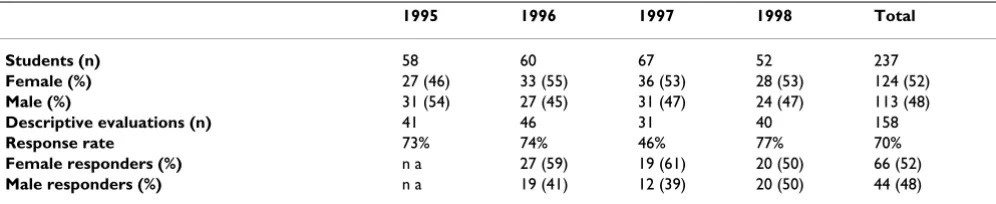
Table 1: Study sample. Students and course evaluations, n = 158. Autumn 1995, spring 1996, spring 1997, autumn 1998. Consultation skills course, Medical faculty, Göteborg university.
1995 1996 1997 1998 Total
Students (n) 58 60 67 52 237
Female (%) 27 (46) 33 (55) 36 (53) 28 (53) 124 (52)
Male (%) 31 (54) 27 (45) 31 (47) 24 (47) 113 (48)
Descriptive evaluations (n) 41 46 31 40 158
Response rate 73% 74% 46% 77% 70%
Female responders (%) n a 27 (59) 19 (61) 20 (50) 66 (52)
Male responders (%) n a 19 (41) 12 (39) 20 (50) 44 (48)
Procedures
Students were given 45 minutes of the last part of the course schedule to finish their evaluations. The evaluation question was attached to two blank sheets of paper and was distributed to students in a lecture room. Most stu-dents spent over 30 minutes writing their evaluation.
Data collection
Data from students
Four evenly distributed courses over the five-year period produced 158 evaluation stories that were used as sample. Student data consisted of 214 pages of written text from autumn 1995, spring 1996, spring 1997 and autumn 1998. (Table 1). Gender proportions of the whole mate-rial were retained.
Data from teachers
Records and documents described under Materials from a series of courses were included as data: autumn 1995, spring 1996, spring 1997, autumn 1998 and autumn 1999. In all, course documents comprised about 250 pages of text.
Six weeks after termination of a course, results from stu-dents' evaluations were presented in follow-up seminars. The work of facilitators and teachers was also discussed in small groups and followed by reflection. Evaluation results were collected and discussed by the course com-mittee and after critical reflection; some were imple-mented in the next course. The course committee met once a week throughout the years and notes were taken.
Data analysis
Step one. Analysis of students' descriptive evaluations
A content analysis of text was performed [16,17]. Data were analysed twice; first as part of teachers' immediate evaluation analysis after each course and then in a retro-spective more thorough analysis. In the immediate analy-sis, evaluations were coded by writing core quotations, addressing main teaching and learning events and stu-dents' experiences. Similar citations were summarized and major patterns of students' statements and course experiences were identified. Recurrent themes emerged from these preliminary analyses.
The research analysis of students' descriptive evaluations was performed in 2002–2005 and consisted of the follow-ing steps:
1. Answers were first thoroughly read in extenso, reaching for a global understanding of the content in each student's course story.
2. Students' statements were coded into general catego-ries.
3. Tabulations were also used in order to encompass an overall picture of students' statements in their course descriptions.
4. Categories were established on basis of 2 and 3.
5. Main themes were condensed.
6. Deviant cases of students' statements not fitting main themes were identified.
Step two. Analysis of key features of course development
Key features in course development were identified by content analysis of a series of course records and docu-ments (see above). The text material was abundant. There-fore, Biggs' framework of main components in university education (learning objectives, teaching and learning activities, assessment, learning climate and institutional climate, rules and procedures) was used [18]. Thus, changes of main course components were focused in the analysis and a template style was used [19,20]. It implied that data were arranged according to the framework, units were identified, and the achieved material was read sev-eral times in close chronologic comparison. Finally, key feature themes were formed.
Step three. Correspondence between main themes of students' descriptive evaluations and key features of course development In the last, third step, results from content analysis of stu-dents' descriptive evaluations and content analysis of key features of course development were brought together. By these measures a corresponding pattern was searched for, thus reflecting the impact of students' open-ended evalu-ations on course development.
To increase reliability and concordance of the three steps of analysis, AS and CB who participated in course devel-opment read half of the evaluations, assessed and checked analysis themes. Interpretations were discussed by main author and co-authors AS and CB during several meetings. Initial data was expanded and after re-analyses, concord-ance was reached. Theoretical perspectives used in inter-pretation were an educational learner-centred perspective and patient-centeredness in medicine. The trustworthi-ness of data was further tested at a seminar by two external assessors from the medical faculty and at a Nordic confer-ence of education and research in medical communica-tion. The assessors and research colleagues recognized our main experiences and it seems as if our findings are trans-ferable to their context.
Results
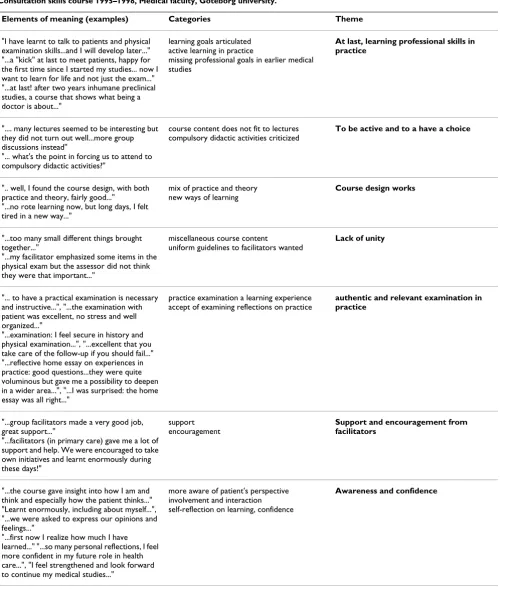
Table 2: Main themes of students' descriptive evaluations. Framework of content analysis of students' descriptive evaluations (n = 158), Consultation skills course 1995–1998, Medical faculty, Göteborg university.
Elements of meaning (examples) Categories Theme
"I have learnt to talk to patients and physical examination skills...and I will develop later..." "...a "kick" at last to meet patients, happy for the first time since I started my studies... now I want to learn for life and not just the exam..." "...at last! after two years inhumane preclinical studies, a course that shows what being a doctor is about..."
learning goals articulated active learning in practice
missing professional goals in earlier medical studies
At last, learning professional skills in practice
".... many lectures seemed to be interesting but they did not turn out well...more group discussions instead"
"... what's the point in forcing us to attend to compulsory didactic activities?"
course content does not fit to lectures compulsory didactic activities criticized
To be active and to a have a choice
".. well, I found the course design, with both practice and theory, fairly good..."
"...no rote learning now, but long days, I felt tired in a new way..."
mix of practice and theory new ways of learning
Course design works
"...too many small different things brought together..."
"...my facilitator emphasized some items in the physical exam but the assessor did not think they were that important..."
miscellaneous course content
uniform guidelines to facilitators wanted
Lack of unity
"... to have a practical examination is necessary and instructive...", "...the examination with patient was excellent, no stress and well organized..."
"...examination: I feel secure in history and physical examination...", "...excellent that you take care of the follow-up if you should fail..." "...reflective home essay on experiences in practice: good questions...they were quite voluminous but gave me a possibility to deepen in a wider area...", "...I was surprised: the home essay was all right..."
practice examination a learning experience accept of examining reflections on practice
authentic and relevant examination in practice
"...group facilitators made a very good job, great support..."
"...facilitators (in primary care) gave me a lot of support and help. We were encouraged to take own initiatives and learnt enormously during these days!"
support encouragement
Support and encouragement from facilitators
"...the course gave insight into how I am and think and especially how the patient thinks..." "Learnt enormously, including about myself...", "...we were asked to express our opinions and feelings..."
"...first now I realize how much I have learned..." "...so many personal reflections, I feel more confident in my future role in health care...", "I feel strengthened and look forward to continue my medical studies..."
more aware of patient's perspective involvement and interaction self-reflection on learning, confidence
The third step analyse the correspondence between stu-dents' descriptive evaluations and key features of course development over five years.
I Analysis of students' descriptive evaluations
Seven main themes emerged in the analysis of students' descriptive evaluations. A framework of the content anal-ysis is presented in Table 2. Main themes and categories supporting their establishment are presented below.
At last, learning professional skills in practice Learning goals articulated
Some students articulated basic learning goals; how to interview patients, how to perform a physical examina-tion and how to write a medical record.
Active learning in practice
Most students were eager to express the importance of meeting GPs and to be trained in physical examination skills. Consultation training was specially appreciated in primary care.
Missing professional training in earlier medical studies
A rather harsh tone of disappointment was present in some of these statements of students' learning experiences in earlier medical studies. Expressions used were e.g. "cramming" and an "anonymous" or even "inhumane" learning environment.
To be active and to have a choice Course content does not fit to lectures
Some students expressed that the content in lectures of consultation skills and issues of the professional role would be more suitable for interactive group discussions.
Compulsory didactic activities criticized
In the first parts of the material compulsory activities were put in question and a clear protest could be traced. This category vanished after changes in 1997 to a reduction in compulsory activities.
Lack of unity
Miscellaneous course content
Some students were confused by too many different learn-ing activities, not findlearn-ing "the red thread" of the course.
Uniform guidelines to facilitators wanted
These statements were complaints of different standards in training of physical examination skills and assessment.
Course design works Mix of practice and theory
Students made a positive remark on the course design's mixture of practice training and didactic modules. Some
were surprised that their fast introduction to patient encounters in primary care turned out so well.
New ways of learning
New ways of learning in new settings compared to earlier studies were mentioned. In some of these statements, stu-dents were astonished that they became so emotionally tired from clinical experiences.
Authentic and relevant practical examination Practice examination a learning experience
The practical examination was appreciated throughout the study period. Some students expressed satisfaction of their growing clinical competence shown in the examina-tion.
Acceptance of examining reflections on practice experiences From 1997, students were asked in a home essay assign-ment to reflect on observed consultations in primary care and to use conceptions of core learning objectives. Stu-dents admitted that they were initially hesitant but were later surprised that the home essay served its purpose.
Support and encouragement from facilitators Support
Students expressed that they were well received by facilita-tors in practice and appreciated that facilitafacilita-tors were stu-dent-centred.
Encouragement
Students were challenged by facilitators to perform new tasks for which they were highly motivated. A sense of optimism and hope is clearly present in these statements.
Awareness and confidence
More aware of patient's perspective
These statements were conveyed as a consequence of events and experiences during the course.
Involvement and interaction
A combination of personal involvement and team work were elicited in statements of an art-of- interviewing week and of small group work.
Self-reflection and confidence
These reflecting statements express that the awareness and the confidence in becoming a physician had changed, often in comparison to experiences in earlier stages of medical education.
Deviant cases
spring 1996 and consisted of extensive comments on a debate held in a single lecture.
II Analysis of key features of course development
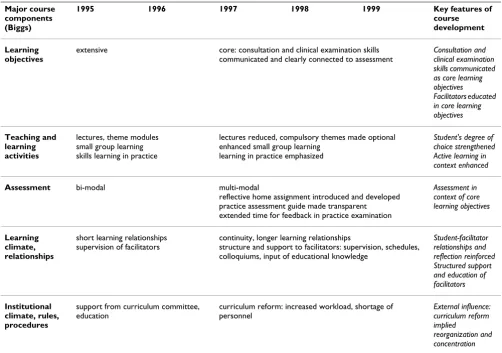
Analysis of key features of course development is depicted in Table 3.
As seen from Table 3, according to Biggs' framework, a process of development occurred during the study period with respect to major course components. Active learning in practice was enhanced and student's degree of choice was strengthened. Consultation and clinical skills were identified as core learning objectives in a process of con-centration. Education of facilitators in core learning objec-tives, including an introduction of a practice assessment guide, enabled assessment in context of core learning objectives. Of great importance in course development was the structured support and education of facilitators in 1997. Together with increased continuity, student-facilita-tor relationships and reflection were reinforced. External influences are seen in the last theme, a curriculum reform
in 1996 implied reorganization and concentration of the course. Consequences of the curriculum reform were larger volumes of students and comparatively less teach-ers, doubled student courses during one semester and coordination with a course in clinical pharmacology.
There were also dead ends and drawbacks in course devel-opment. Many of them were due to over-ambitious goals and efforts to cover too much content. Thus, learning from less successful events was also an important part of course development and applies in particular to the key features 'concentration' and 'core learning objectives'.
III Correspondence between main themes of students' descriptive evaluations and key features of course development
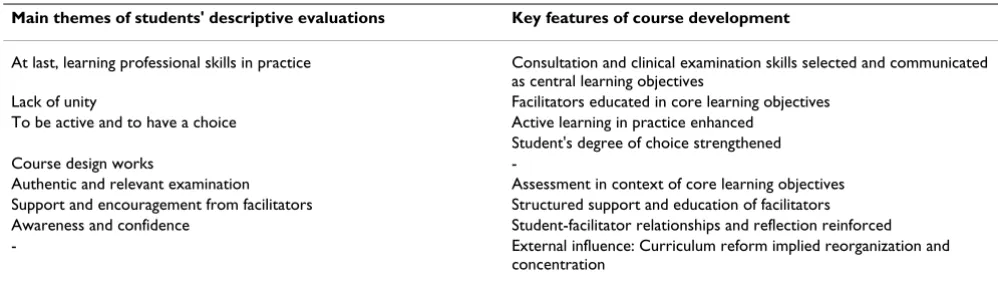
Main themes of students' descriptive evaluations and key features of course development are brought together and depicted in Table 4.
Table 3: Key features of course development 1995–1999. Content analysis using Biggs' structure of major course components in university education. Consultation Skills course, Medical faculty, Göteborg university.
Major course components (Biggs)
1995 1996 1997 1998 1999 Key features of
course development
Learning objectives
extensive core: consultation and clinical examination skills communicated and clearly connected to assessment
Consultation and clinical examination skills communicated as core learning objectives
Facilitators educated in core learning objectives
Teaching and learning activities
lectures, theme modules small group learning skills learning in practice
lectures reduced, compulsory themes made optional enhanced small group learning
learning in practice emphasized
Student's degree of choice strengthened Active learning in context enhanced
Assessment bi-modal multi-modal
reflective home assignment introduced and developed practice assessment guide made transparent extended time for feedback in practice examination
Assessment in context of core learning objectives
Learning climate, relationships
short learning relationships supervision of facilitators
continuity, longer learning relationships
structure and support to facilitators: supervision, schedules, colloquiums, input of educational knowledge
Student-facilitator relationships and reflection reinforced Structured support and education of facilitators
Institutional climate, rules, procedures
support from curriculum committee, education
curriculum reform: increased workload, shortage of personnel
External influence: curriculum reform implied
A corresponding pattern is seen in main themes of descriptive evaluations and key features of course devel-opment. A number of observations support this relation.
Students' reported urge to learn professional knowledge and skills mirrors that these areas being gradually selected and communicated as core learning objectives. In addi-tion, a lack of unity of course content perceived by the stu-dents corresponds with education of facilitators in core learning objectives. Students' main theme 'To be active and to have a choice' corresponds to themes 'Active learn-ing in practice enhanced' and 'Student's degree of choice strengthened' in course development. Assessment in con-text of core learning objectives matches students' percep-tion of an authentic and relevant examinapercep-tion. The pattern of correspondence indicates that students' descrip-tive evaluations had an impact on course development.
Since course development occurred in a process over five years, it is possible to discern reciprocity. Students' evalu-ations affected course development and course develop-ment also affected students' evaluations. Thus, structured support and education of facilitators parallels students' main theme 'Support and encouragement from facilita-tors'. Similarly, reinforcement of student-facilitator rela-tionships might be associated with students' theme 'Awareness and confidence'.
In addition, external factors contributed to course devel-opment. A curriculum reform in 1996 implied reorganiza-tion and concentrareorganiza-tion of course content. Another external influence was input of educational knowledge; from local scientific evaluations of the Göteborg curricu-lum and attending university courses of learning in higher education [14,15].
Discussion
In an evaluation of a course in the transition to clinical education, students' descriptive evaluations and teachers'
course documentation was analysed. A corresponding pattern of students' descriptive evaluations and key fea-tures of course development was seen in several dimen-sions, indicating the impact of students' feed-back on course development.
Comments on method
In three consecutive steps of analysis, a quite voluminous text material covering five years of systematic evaluation and course development was brought together and con-densed.
Limitations of the qualitative method in our study con-cerns credibility of data and the analysis method. Credi-bility is increased by conveying the analysis performed and the theoretical perspective used in interpretation [16,20]. Credibility was also achieved by many short and recurrent evaluation cycles during five years (Fig 1). Sev-eral learner-centred evaluation loops were thus forming a spiral of increased knowledge. The process has several similarities to action research, recommended as a poten-tially productive method for improving practice in medi-cal education [21]. In order to ensure reliability, fifty percent of course documentation and students' evalua-tions respectively were read by two authors. In addition, main authors' participation and involvement in course development might have disturbed the trustworthiness of information obtained. Four strategies were used to bal-ance this risk. First, in order to increase awareness and reflexivity, main author's preconceptions were clarified in writing before analysis [20]. Second, the theoretical per-spective used in interpretation was presented and third; two co-authors read and checked analyses of data, result-ing in expansion of data and re-analyses. Finally, credibil-ity was tested by external assessment in seminars and in a Nordic research conference.
Research on student ratings of university teaching has been thoroughly reviewed by Marsh [22]. University
stu-Table 4: Correspondence between main themes of students' descriptive evaluations and key features of course development. Consultation skills course, 1995–1999, Medical faculty, Göteborg university.
Main themes of students' descriptive evaluations Key features of course development
At last, learning professional skills in practice Consultation and clinical examination skills selected and communicated as central learning objectives
Lack of unity Facilitators educated in core learning objectives
To be active and to have a choice Active learning in practice enhanced Student's degree of choice strengthened
Course design works
-Authentic and relevant examination Assessment in context of core learning objectives Support and encouragement from facilitators Structured support and education of facilitators Awareness and confidence Student-facilitator relationships and reflection reinforced
- External influence: Curriculum reform implied reorganization and
dent ratings are reported as quite reliable and reasonably valid and that useful information can be obtained in rat-ings. In educational research, as well as in medical prac-tice, the utility and functional aspect is highly relevant [23]. Even though our research method is different from structured ratings, the functional aspect and the relevance to colleagues in medical education is similar.
Another concern may be the questions put in evaluations. Some students might have been restricted by asking about their thoughts of the course, course design and examina-tion. The opening question could perhaps have been even more open-ended to cover a wider spectrum of student's learning experiences. However, the material we received in descriptive evaluations was rich and many facets of stu-dents' personal experiences and thoughts emerged spon-taneously in statements, thus transforming students' evaluation feed-back into a "legible choir of students' voices". Despite the restricting components, we think the question was open enough to yield useful feed-back in course development.
Content analysis as a method of analysing evaluation data is discussed by Lincoln & Guba [24]. They separate analy-sis of manifest content and interpretation of latent con-tent and argue the validity of interpreting concon-tent which is latent in documents and records. In our analysis of stu-dents' evaluations, the last phase of forming themes used latent content to some extent but the emphasis was put on analysis of manifest data. A combination of a scientific approach with context knowledge from clinical practice was required in the interpreting process. Listening to stu-dents was prioritized and that could be applied to doctors listening to patients.
Group dynamics may represent another source of bias. Student-teachers relationships in medical education are not symmetrical [25]. Enlarged group reactions to e.g. the compulsory requirements for passing the course should be appreciated as a potential source of distortion in data.
Comments on selection
The student sample was collected from four evenly distrib-uted courses in order to avoid accidental results. Students in the study were not different from other courses in terms of student characteristics and passed/approved rates. In a Scandinavian context of undergraduate medical educa-tion, a mean response rate of 70% of voluntary evalua-tions, obtained over four years, seems acceptable [26]. However, the relatively low (46%) response rate in 1997 should be noted. The reason for the low 1997 response rate remains unclear, but a course party held the night before might be a factor to consider. On the other hand, gender proportions are retained and the overall response pattern in 1998 students (70% response rate) was similar
to 1997 students. Our assumption is that students who actively chose to respond were more positive to the course than non-responders.
Comments on results
Students descriptive feed-back was both initiating and val-idating a longitudinal process of course development and implementation. Through the analysis, an overview of five years of this process was achieved. A corresponding pattern between students' descriptive evaluations and key features of course development was found.
An eagerness for professional training was evident in stu-dents' descriptive evaluations. The analyses enabled a deeper understanding of students' perceptions of learning conditions and resulted in a selection of core learning goals. It emerged that hands-on training of clinical exam-ination skills is pivotal in the transition to clinical educa-tion, forming a rite of passage in student's professional socialization process. A student's self-image as a future physician appears to depend on learning doctor's profes-sional skills [5]. The concept of the consultation acknowl-edges the clinical context and learning examination skills seems to enhance motivation for learning consultation skills in the transitional period [12].
An important part of the result are the corresponding themes 'To be active and to have a choice' and adherent changes carried out in course development. From stu-dents' point of view, the correspondence of these themes may be interpreted as signs of an empowering process in which students' voices were heard. The examination in an authentic setting was clearly appreciated throughout the study period and corresponded in course development to assessment of core learning objectives and extended time for feed-back. In fact, a change of the examination was the main tool to achieve clarity of learning goals in relation to students. An obvious linkage of learning objectives, learn-ing activities and assessment was organised and commu-nicated [18]. Introduction of a transparent assessment guide to practice examination seems to have translated learning objectives into comprehensible performance tasks for students. By this move, group facilitators also became more aware of core learning goals since they were involved in assessment.
Interestingly, students theme 'Awareness and confidence' might be associated with the key feature 'Student-facilita-tor relationships and reflection reinforced' (see Table 3 and 4).
The role of external influences
As mentioned earlier, external factors affected the results. Biases seen here are organizational factors and bias from input of 'external' learning. A curriculum reform was implemented in the middle of the study period and due to shortage of personnel, a reorganization and concentra-tion was necessary. However, these changes were well informed and guided by knowledge acquired from sys-tematic analyses in course development. Furthermore, cooperation between the Curriculum Committee of the Medical Faculty and researchers in the Department of Education at Göteborg University played an important role. One of the authors (AS) chaired the Curriculum Committee of the Medical Faculty and another author (CB) was a member of the committee during the study period. These circumstances probably contributed to a cli-mate positive to educational development and to imple-mentation of the Action Programme in Education of Göteborg University [29]. Moreover, new perspectives from teachers' courses of learning in higher education and a scientific educational report on students' evaluations inspired us to try a new, unconventional approach of course evaluation [14,15]. Thus, aside of 'internal' learn-ing from students' descriptions, input from 'external' knowledge of learning in higher education gradually increased course leaders' educational competence. An active intention and financial support to the initiation of the Consultation Skills course by the Curriculum Com-mittee of 1989–1995 were also important factors in the overall course development.
Conclusion
Students' descriptive evaluations and teachers' course records were helpful in a long-term evaluation forming a learner-centred knowledge-building process. Students' feedback was both initiating and validating longitudinal course implementation. Asking students to write an indi-vidual course description appears to bring a sense of mutuality to evaluations and create a new understanding of how students' learning events were experienced in the whole of a course. Evaluators and course organizers should also consider organizational factors affecting course development. Continuity and endurance in the evaluation process must be emphasized for achieving rel-evant and useful results. In conclusion, students' descrip-tive evaluations and can be seen as important instruments in developing both courses and students' learning.
Competing interests
The author(s) declare that they have no competing inter-ests.
Authors' contributions
MW acted as the principal researcher, collected data and performed analyses. BM substantially contributed to
con-ception and design of the study and revised the manu-script. AS and CB made substantial contributions in interpretation of analyses performed, in revising the man-uscript and in the acquisition of data. GD and KL contrib-uted to conception and design of the study and in revision of the manuscript.
Acknowledgements
We wish to thank the participating students and facilitators of the Consul-tations skills course. This study could not have been done without their contribution and interest in improving education. The project was sup-ported by The Primary Health Care Organization of Göteborg, Region Västra Götaland, Sweden and the Göteborg Medical Society.
References
1. Pitkälä K, Mantyranta T: Feelings related to first patient experi-ences in medical school. A qualitative study on students' per-sonal portfolios. Patient Educ Couns 2004, 54:171-177.
2. Prince KJ, Boshuizen HPA, Van der Vleuten CPM, Scherpbier AJ: Stu-dents' opinions about their preparation for clinical practice.
Med Educ 2005, 39:704-712.
3. Flexner A: Medical Education in the United States and Can-ada. A report to the Carnegie Foundation for the Advance-ment of Teaching. Boston: Updyke; 1910.
4. Boshuizen HPA: The shock of practice: effects on clinical rea-soning. In Paper presented at the Annual Meeting of the American Edu-cational Research Meeting New York; 1996.
5. Radcliffe C, Lester H: Perceived stress during undergraduate medical training: a qualitative study. Med Educ 2003, 37:32-38. 6. Ramsden P, Dodds A: Improving teaching and courses. A guide to evaluation. Melbourne: The University of Melbourne, Centre for the Study of Higher education; 1988.
7. Newble DI, Cannon R: A Handbook for Medical Teachers 4th edition. Dordrecht: Kluwer; 2001.
8. Dunkin MJ, Barnes J: Research on Teaching in Higher Educa-tion. In Handbook of Research in Teaching Edited by: MC Wittrock. New York: MacMillan; 1986.
9. Hoeks TW, van Rossum HJ: The impact of student ratings on a new course: the general clerkship (ALCO). Med Educ 1988, 22:308-313.
10. Pendleton D, Schofield T, Tate P, Havelock P: The Consultation: an Approach to Learning and Teaching Oxford: Oxford University Press; 1984.
11. Levenstein JH, McCracken EC, McWhinney IR, Stewart MA, Brown JB: The patient-centered clinical method.1. A model for the doctor-patient interaction in family medicine. Fam Pract 1986, 1:24-30.
12. Wahlqvist M, Björkelund C, Gause-Nilsson I, Dahlin B, Mattsson B: [The best way to learn consultation skills is through tutoring in clinical situations. Experiences from a course in Göte-borg]. Läkartidningen 2001, 98(28-29):3238-3244. Swedish 13. Kagan N, Schauble P, Resnikoff A, Danish SJ, Krathwohl DR:
Inter-personal process recall. J Nerv Ment Dis 1969, 148:365-74. 14. Marton F, Säljö R: On qualitative differences in learning I-
Out-come and process. Br Jour of Educ Psychol 1976, 46:115-127. 15. Toshach Gustafsson I: Vad värderas i enkursvärdering? (What
is valued in a course evaluation? Medical students' percep-tions of two variapercep-tions of a course in basic chemistry). In
Licentiate thesis. Report 1 Medical Faculty, Göteborg University; 1994. 16. Pope CP, Mays N: Qualitative Research in Health Care BMJ Books:
Lon-don; 2000.
17. Graneheim UH, Lundman B: Qualitative content analysis in nursing research: concepts, procedures and measures to achieve trustworthiness. Nurse Educ Today 2004, 24:105-112. 18. Biggs JB: Teaching for quality learning at university. What the student does
2nd edition. Buckingham: Open University Press; 2003.
19. Miller WI, Crabtree BF: Primary Care research: Multimethod typology and qualitative road map. In Doing qualitative research
Edited by: Crabtree BF, Miller WI. Newsbury Park: Sage; 1992. 20. Malterud K: Kvalitative metoder i medisinsk forskning. (Qualitative
Publish with BioMed Central and every scientist can read your work free of charge "BioMed Central will be the most significant development for disseminating the results of biomedical researc h in our lifetime."
Sir Paul Nurse, Cancer Research UK
Your research papers will be:
available free of charge to the entire biomedical community
peer reviewed and published immediately upon acceptance
cited in PubMed and archived on PubMed Central
yours — you keep the copyright
Submit your manuscript here:
http://www.biomedcentral.com/info/publishing_adv.asp
BioMedcentral
21. Harris IB: Qualitative methods. In InternationalHandbook of Research in Medical Education Edited by: Norman GR, van der Vleuten CPM, Newble DI. Dordrecht: Kluwer:45-96.
22. Marsh HW: Students' evaluations of university teaching: research findings, methodological issues and direction for future research. Internat Jour of Educ Res 1987, 11:253-388. 23. Custers EJ, Boshuizen HPA: The Psychology of Learning. In
Inter-national Handbook of Research in Medical Education Edited by: Norman GR, van der Vleuten CPM, Newble DI. Dordrecht: Kluwer:163-204. 24. Lincoln YS, Guba EG: Effective Evaluation: Improving the Usefulness of Evaluation Results Through Responsive and Naturalistic Approaches Jos-sey-Bass: San Francisco; 1992.
25. Tiberius RG, Sinai J, Flak EA: The role of the teacher-learner relationship in medical education. In International Handbook ofResearch in Medical Education Edited by: Norman GR, Van der Vleu-ten CPM, Newble DI. Dordrecht: Kluwer; 2002:463-497.
26. Gude T, Baerheim A, Holen A, Anvik T, Finset A, Grimstad H, Hjort-dahl P, Risberg T, Vaglum P: Comparing self-reported communi-cation skills of medical students in traditional and integrated curricula: a nationwide study. Patient Educ Couns 2005, 58:271-278.
27. Howe A: Patient-centred medicine through student-centred teaching: a student perspective on the key impacts of com-munity-based learning in undergraduate medical education.
Med Educ 2001, 35:666-672.
28. Hellquist G, Rödjer S, von Below B, Sveinsdottir G, Björkelund C: Tidig yrkeskontakt stärker läkarstudentens professionella utveckling. TYK- en ny kurs i Göteborgs läkarutbildning. (Early professional contact supports professional develop-ment of medical students. EPC- a new course in medical education in Göteborg) English summary. Läkartidningen 2005, 102:2646-2651.
29. Delegationen för kvalitetsutveckling vid Göteborgs universitet: Ped-agogiskt handlingsprogram. Rekommendationer för förbät-tring av undervisningens och utbildningens kvalitet. (Action programme in education. Recommendations for improving the quality of education.). Göteborg University; 1994.
Pre-publication history
The pre-publication history for this paper can be accessed here: