R E S E A R C H
Open Access
Developing a multiscale, multi-resolution
agent-based brain tumor model by graphics processing
units
Le Zhang
1,2*†, Beini Jiang
1†, Yukun Wu
3, Costas Strouthos
4, Phillip Zhe Sun
5, Jing Su
6and Xiaobo Zhou
6** Correspondence: zhangle@mtu. edu; [email protected]
1Department of Mathematical Sciences, Michigan Technological University, Houghton, MI, 49931, USA
6
Department of Pathology, the Methodist Hospital, Research Institute & Weill Cornell Medical College, 6565 Fannin St, Houston, Texas, USA
Full list of author information is available at the end of the article
Abstract
Multiscale agent-based modeling (MABM) has been widely used to simulate Glioblastoma Multiforme (GBM) and its progression. At the intracellular level, the
MABMapproach employs a system of ordinary differential equations to describe quantitatively specific intracellular molecular pathways that determine phenotypic switches among cells (e.g. from migration to proliferation and vice versa). At the intercellular level,MABMdescribes cell-cell interactions by a discrete module. At the tissue level, partial differential equations are employed to model the diffusion of chemoattractants, which are the input factors of the intracellular molecular pathway. Moreover, multiscale analysis makes it possible to explore the molecules that play important roles in determining the cellular phenotypic switches that in turn drive the wholeGBM expansion. However, owing to limited computational resources,MABMis currently a theoretical biological model that uses relatively coarse grids to simulate a few cancer cells in a small slice of brain cancer tissue. In order to improve this theoretical model to simulate and predict actualGBMcancer progression in real time, a graphics processing unit (GPU)-based parallel computing algorithm was developed and combined with the multi-resolution design to speed up theMABM. The simulated results demonstrated that theGPU-based, multi-resolution and multiscale approach can accelerate the previousMABMaround 30-fold with relatively fine grids in a large extracellular matrix. Therefore, the new model has great potential for simulating and predicting real-timeGBMprogression, if real experimental data are incorporated.
Background
Glioblastoma multiforme (GBM) is the most common and aggressive brain cancer [1,2]. Statistics show that it has the worst prognosis of all central nervous system malignancies [3,4]. However, with the resolution of functional magnetic resonance ima-ging (fMRI) [5,6], currently limited to around 2-3 mm, even the most experienced clin-ical personnel cannot accurately forecastGBMprogression. The difficulties of making such forecasts motivated computational biologists to develop multiscale mathematical models to explore the expansion and invasion ofGBM[7-9].
Cancer behaves as a complex, dynamic, adaptive and self-organizing system [10], and agent-based models (ABM) are capable of describing such a system as a collection of autonomous and decision-making agents, which represent the cells. Therefore, compu-tational biologists hope that with the ABM approach they can surpass the current
limitations of imaging technology and predict tumor progression [11-16]. Our previous studies [15,16] developed various multiscale ABMsto simulateGBM progression. In these models, a cell’s intracellular epidermal growth factor receptor (EGFR) signaling pathway is stimulated by a chemoattractant (such as transforming growth factor a (TGFa)), which diffuses at the tissue level. We also assumed that the transient rate of change of phospholipase Cg(PLCg), an important molecule in the EGFRpathway, will result in cancer cell migration, whereas a smooth rate of change of PLCgwill result in cancer cell proliferation [11,12,15,16]. At the intercellular scale, the behaviors of cells (such as the autocrine or paracrine secretion of chemoattractants and migration or proliferation phenotypes) remodel the tumor microenvironment and affect the overall tumor dynamics at the tissue level.
An important advantage of multiscale agent-based modeling (MABM) [15,16] is that we can employ multiscale analysis to investigate the incoherent connections among various scales. For example, we can depict the intracellular (molecular) profiles that lead to phenotypic switches at any cell’s dynamic cross points (migration cell number crosses with proliferation cell number) [15] or in the interesting tumor regions [16]. Thus,MABMmodels [15-17] can be used as tools for generating experimentally testa-ble hypotheses. The consequent validation experiments may reveal potential therapeu-tic targets.
Though MABM approaches have a great potential for investigating GBM progres-sion, their complexity necessitates immense computational resources [15,17], which becomes forbidding for real-time simulations of spatio-temporal GBMprogression. In fact, two problems prevent MABM doing real-time simulation. The first is that the computation time required for intracellular pathway computing for cancer cells will become huge, since a real cancer system may consist of millions of cells. The second is that it is impossible to employ a conventional sequential numerical solver to model the real-time diffusion of chemoattractants in a large extracellular matrix (ECM) with rela-tively fine grids.
To overcome the computation time problems, this study incorporates a graphics pro-cessing unit (GPU)-based parallel computing algorithm [18] into a multi-resolution design [16] to speed up the previous MABM[15,17]. The multi-resolution design [16] classified the cancer cells into heterogeneous and homogeneous clusters. The heteroge-neous clusters consisted of migrating and proliferating cancer cells in the region of interest, whereas the homogeneous clusters comprised dead or quiescent cells. The limited computational resource was concentrated on the heterogeneous clusters to investigate the molecular profiles of migrating and proliferating cancer cells, while the quiescent and dead cells in the homogeneous clusters were treated with less of the resource. TheGPU-based parallel computing algorithm can not only model the diffu-sion of chemoattractants in a large ECMwith relatively fine grids in real time, but also process computing queries concerning the intracellular signaling pathways of millions of cancer cells in a real cancer progression system.
The results presented in this paper demonstrate that theGPU-based multi-resolution
concentration changes, we can tell which molecular species are the important biomar-kers that impact tumor progression. Third, a multi-resolution design [16] not only allows us to visualize cancer progression by displaying all the cancer cell clusters in the tissue, but also enables us to track each cancer cell’s trajectory.
In the following sections, we will introduce the previously-developed multiscale and multi-resolution ABM, describe how to useGPU to accelerate the simulation of the model, and finally illustrate the advantages of the model that can be used to analyze important biomarkers to inhibitGBMexpansion and predictGBMprogression.
Mathematical model
Multiscale perspective
The multiscale approach was incorporated intoABMs to simulateGBMprogression by incorporating into the model the interactions between different scales - the intracellu-lar (gene-protein interaction) and the celluintracellu-lar (including cell-cell interactions and phe-notypic switches e.g. from migration to proliferation and vice versa) - which in turn affect the spatio-temporal evolution of GBM(tissue scale). The relationships among the intracellular, cellular and tissue scales were conceptually defined as “interfaces”. As indicated in Figure 1: (a) A cell’s phenotype is defined as an interface between the intracellular and intercellular levels. The signaling pathway at intracellular level deter-mines the cell’s phenotype, which regulates intercellular behaviors. (b) We denote the diffusion of chemoattractants as an interface between the intercellular and tissue levels. At the tissue level, cells secrete chemoattractants that diffuse according to their con-centration gradients and remodel the microenvironment of the tumor. (c) A cell’s pathway receptors are defined as an interface between tissue and intracellular level. The paracrine or autocrine effects of chemoattractants on the tissue level are sensed by cellular receptors and trigger intracellular signaling pathways to determine a cell’s phenotype.
Intracellular scale
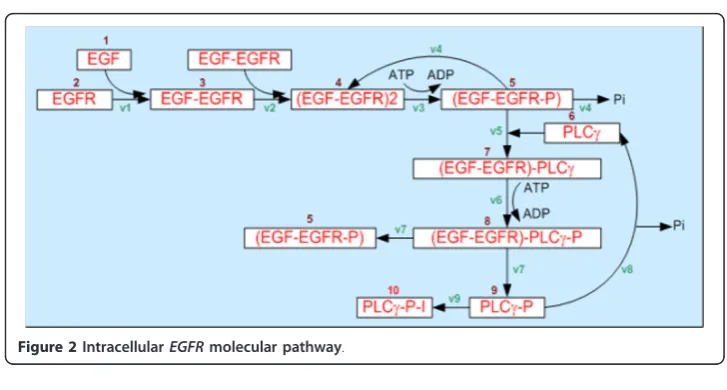
At the intracellular scale, the model employs a system of ordinary differential equations (ODEs) to describe the intracellular EGFR molecular pathway (Figure 2) shown in
equation 1.
dXi
dt =αi·Xi−βj·Xj (1)
where Xi is the mass ofithmolecule of the implemented EGFRsignaling network,
andaiandbiare respectively the rates of synthesis and degradation of that molecule.
The details ofequation 1are listed in Table 1 [16].
Giese et al. [19] indicated that a GBM cell will not migrate and proliferate at the same time (known as the proliferation-migration dichotomy). In addition, Dittmar et al. [20] reported that a transient increase in phospholipaseCg(PLCg) results in (breast) cancer cell migration. Therefore, we assumed [11,12,15] that once the rate of change of aGBM cell’s phosphorylated PLCgexceeds the average rate of change of phosphory-lated PLCgin cells switching phenotype, the cell becomes migratory; otherwise, it adopts the proliferative phenotype. These conditions for a phenotypic switch are repre-sented by equation 2.
⎧ ⎪ ⎨ ⎪ ⎩
migration,ifd(PLCγ ) dt >Avg proliferation,ifd(PLCγ )
dt ≤Avg
(2)
where d(PLCγ )
dt denotes the rate of change of phosphorylatedPLCgconcentration,
and Avgdescribes the average rate of change of phosphorylatedPLCgof cells switching phenotype at the time step.
Intercellular scale
A discrete module is employed to simulate a cell’s intercellular behaviors. At each time step, a cell will choose the location with highest attraction value to migrate or spawn its off-spring. This process is represented by equation 3[9,15,17,21].
Tij=ψ·Eij+ (1−ψ)·εij, (3)
whereTijdenotes the attractiveness of location (i,j),Eijis the concentration ofTGFa
at location (i,j), and εij ~N[μ,s2] is an error term that is normally distributed with
meanμand variances2. The parameterΨ takes on a positive value between zero and
one and represents the precision of search. Here we choose Ψ= 0.7 on the basis of previous works [9,13,15,17].
Tissue scale
The chemoattractant diffusion in the tissue is modeled by the diffusionequation 4.
∂Y
∂t =D· ∇
2Y−U+S, (4)
whereYis the concentration of chemoattractant,Dis the diffusivity of chemoattrac-tant,tis the time step, andUandSare respectively the cell’s chemoattractant uptake and secretion rates.
Table 1 [16] - (1) Components of theEGFRgene-protein interaction network, (2) Kinetic equations employed to describe the reactions between theEGFRspecies, (3) Coefficients of theEGFRgene-protein interaction network taken from the literature
(1)
Symbol Molecular variables Initial Condition
X0 Glucose 25mM
X1 TGFa 9010.55nM
X2 EGFR 100nM
X3 TGFa-EGFR 0nM
X4 (TGFa-EGFR)2 0nM
X5 TGFa-EGFR-P 0nM
X6 PLCg 10nM
X7 TGFa-EGFR-PLCg 0nM X8 TGFa-EGFR-PLCg-P 0nM
X9 PLCg-P 0nM
X10 PLCg-P-I 0nM
(2)
dX1/dt=-v1 (1) v1 =k1X1X2-k-1X3 (11) dX2/dt=-v1 (2) v2 =k2X3X3-k-2X4 (12) dX3/dt = v1-2v2 (3) v3 =k3X4-k-3X5 (13) dX4/dt = v2+v4-v3 (4) v4 =V4X5/(K4+X5) (14) dX5/dt = v3+v7-v4-v5 (5) v5 =k5X5X6-k-5X7 (15) dX6/dt = v8-v5 (6) v6 =k6X7-k-6X8 (16) dX7/dt = v5-v6 (7) v7 =k7X8-k-7X5X9 (17) dX8/dt = v6-v7 (8) v8 =V8X9(K8+X9) (18) dX9/dt = v7-v8-v9 (9) v9 =k9X9-k-9X10 (19)
dX10/dt = v9 (10) (3)
Forward rate (s-1) Reverse rate (s-1) Michaelis constants (nM) Maximal enzyme rates (nMs-1)
k1= 0.003 k-1= 0.06 K4= 50 V4= 450
k2= 0.01 k-2= 0.1 K8= 100 V8= 1
k3= 1 k-3= 0.01 K5= 0.06 k-5= 0.2
K6= 1 k-6= 0.05 K7= 0.3 k-7= 0.006
In general, the multiscale approach incorporates three different scales: intracellular, intercellular and tissue. The intracellular gene-protein interaction pathway affects the intercellular scale by determining a cell’s phenotype. In turn, the chemoattractants dif-fusing at the tissue level affect both the intracellular and tissue scales by stimulating a cell’s molecular pathway and remodeling the tumor cells’ microenvironment. An important advantage of the multiscaleABM approach is that it can be used to analyze and expose the incoherent relations among the different scales. Such analysis may result in experimentally testable hypotheses. However, owing to the complexity of these types of models, real-time simulations of systems with realistic sizes are extre-mely difficult because forbiddingly huge computation is required. For example, it took approximately seven computing hours on a high performance CPU(IBM Bladecenter machine, dual-processor, 32-bit Xeons ranging from 2.8-3.2 GHz, 2.5 GB RAM, and Gigabit Ethernet) to simulate approximately twenty thousand cells (final state) in a 100*100*100 extracellular matrix with relatively coarse grids (around 20 μm) for 20 days [15,17]. Therefore, a realisticin vitro tumor simulation with millions of cells on relatively fine grids would require an immense simulation time. To minimize the simu-lation time and simulate real-time cancer progression, a multi-resolution design [21] was incorporated into the multiscaleABM.
Multi-resolution perspective
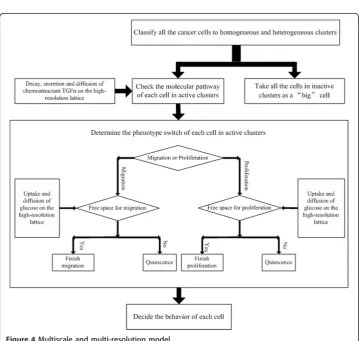
A multi-resolution design is used to relieve the huge computational resource demand of MABM and visualize tumor progression at various resolutions. In this approach, more computational resource is allocated to heterogeneous regions of the cancer and less to homogeneous regions. In summary, the aim of the multi-resolution approach is to reduce the simulation computing time by sacrificing the accuracy of the simulated results compared with the originalMABM.
To implement the multi-resolution design, a double resolution lattice is developed [16] as in Figure 3. The low resolution lattice size spacing is set to 62.5 μm, which is equal to the smallest unit of the hemocytometer [22] used in experiments. A high-resolution grid with a lattice spacing of 10 μm (approximately equal to a GBMcell dia-meter) is superimposed on the low resolution grid. Here, we define a cell cluster as a group of cells located at a grid point of the low resolution lattice. If cells occupy all the locations of the high resolution lattice affiliated with the grid point of the low reso-lution lattice, this cell cluster is denoted as a dense cluster.
Figure 4Multiscale and multi-resolution model.
pathways in real time. Furthermore, in order to simulate a realistic cancer progression system, we must employ relatively fine grids to model the tumor’s microenvironment. This makes it hard to use current sequential PDE solvers to simulate the diffusion of chemoattractants. For these reasons, this study incorporated a GPU-based parallel computing algorithm into the multi-resolution MABMto accelerate both theODEand
PDEnumerical solvers.
GPU-based parallel computing algorithm
A modern GPUis essentially a massively-parallel, explicitly programmable co-proces-sor consisting of hundreds of programmable procesco-proces-sors with a natural programming hierarchy [23]. This hierarchy can mimic the bottom-up organization of ABMmodels by setting the intracellular and intercellular scale computations at the bottom (com-municating locally via the fast shared memory of the GPU) of the hierarchy on the
GPU while coordinating the logic control module of the model on theCPU. Modern
GPU programming is sufficiently flexible to take advantage of the multi-resolution design by dynamically focusing GPUcomputing resources on the currently heteroge-neous regions of the cancer. Fermi GPUs (GTX 480) have up to 480 processors, which can be bundled together to provide thousands of individual GPU processors. This system can provide significant benefits towards scaling feasible MABMmodel computations, which help us to approach the target of simulating realistic tumor growth problems [23]. To speed up the current multi-resolution MABM, we paralle-lized both the chemoattractant diffusion module and the intracellular EGFRpathway module.
Speeding up the computation of the intracellular EGFR molecular pathway module
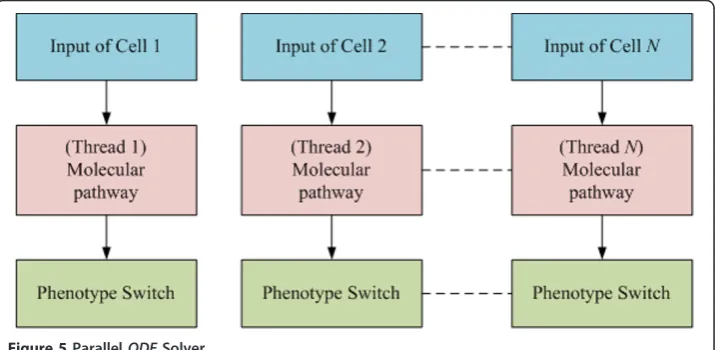
A GPU-based parallel ODEsolver (Figure 5) was developed to process intensive com-puting queries from tens of thousands of GBM cells during simulations of tumor expansion. For cancer cells in the aforementioned heterogeneous clusters, equation 1
is used to determine a phenotypic switch. If we still use a sequential ODE solver to process the computation cell by cell in the heterogeneous clusters, it would be impos-sible to obtain the results in a reasonable time range. For example, it took around 25 seconds to run one step of ODEprocessing for 260 thousand cells with the sequential
solver. The GPU-based ODEparallel computing algorithm can simultaneously process the computing queries for the cells in the heterogeneous clusters by assigning each cell a thread as shown in Figure 5, which results in a significant increase in the model’s performance up to 5.2-fold. In this case, only global memory is employed to accelerate the computation.
Speeding up the diffusion module
Previous research [18] has already developed three GPU-based parallel algorithms to accelerate the numerical solution of the reaction-diffusionPDE equation (equation 4)
by integrating an alternating direction scheme (ADI) [24], Thomas algorithm [24,25] and domain decomposition strategy [26,27], which were incorporated into the new fea-tures of GPU technology. The first approach is a parallel computing algorithm with global memory (PGM). The second is a parallel computing algorithm with shared memory, global memory andCPUsynchronization [18,28-30] (PSGMC). The third is a parallel computing algorithm using shared memory, global memory andGPU synchro-nization [18,29,31] (PSGMG).PSGMCand PSGMGuse a“tiles” strategy to decompose the data and utilize both global memory and shared memory with the classical alter-nating Schwarz domain-decomposition method [24,26,27,32,33]. Our recent publication [18] demonstrated that PSGMG (Figure 6 [18]) is the fastest parallel algorithm for speeding up the numerical solver of the diffusion equation. Thus, this research employedPSGMGto accelerate the diffusion solver ofMABM.
Results
Our code was written in Microsoft Visual Studio C++ [34,35] andNVCC[36] pro-gramming languages, We ran the simulation 10 times with different random number seeds (1-100 time steps, one time step being equivalent to one hour) on a Dell work-station with Fermi GeForce GTX 480 [37-39] and obtained the average result. The initial condition is described in Table 1.
Multiscale analysis
Relationship between the tumor cell population and switching molecular profile
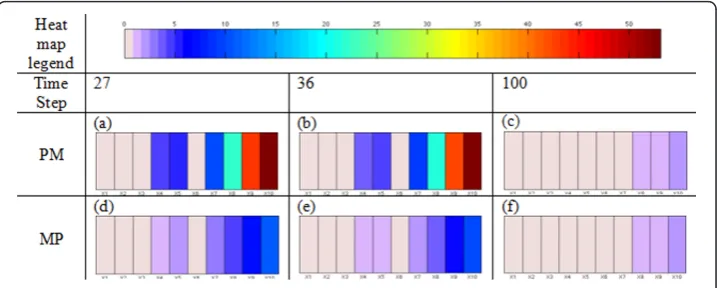
Figure 7 describes the population of tumor cells as a function of time, where red, blue and black represent migratory cells, proliferative cells and all the tumor cells, respec-tively. Since the cell cycle requires several time steps to switch a cell’s phenotype, a marked change appears at aroundt= 25 . From Figure 7, we observed that the prolif-eration curve (blue) crossed the migration curve (red) at t= 27 and 36; moreover, both curves became flatter when approaching t= 100. As mentioned earlier [15,17], a multi-scale analysis can be used to investigate the incoherent relationships between the cells’ behaviors (phenotypic switches) and their intracellular molecular profiles. Such an investigation is presented in Figure 8, where we depict the concentrations of different molecules in theEGFRnetwork at the three time points mentioned above when phe-notypic switches from proliferation to migration or from migration to proliferation occur. In particular, Figure 8(a), (b) and 8(c) show the molecular profiles of cells that switch their phenotypes from proliferation to migration at time points 27, 36 and 100, respectively; Figure 8(d), (e) and 8(f) show the molecular profiles of cells that switch their phenotypes from migration to proliferation at time points 27, 36 and 100, respec-tively. We infer that the average percentage rates of change ofX8(TGFa-EGFR-PLCg
-P), X9 (PLCg-P) andX10 (PLCg-P-I) are larger than the average percentage rates of change of X1, X2, X3 andX6 (TGFa,EGFR,TGFa-EGFRandPLCg). In the early time stages (time steps 27 and 36), the average percentage rates of change of the molecular species of cells switching their phenotype from proliferation to migration (Figure 8(a) and 8(b)) are significantly greater than the average percentage rates of change of the
molecular species of cells switching their phenotype from migration to proliferation (Figure 8(d) and 8(e)). Also, a significant percentage rate of change of X9 (PLCg-P) resulted in the phenotypic switch. However, the difference between these two molecu-lar profiles (Figure 8(c) and 8(f)) is not as obvious at the final stage (t= 100) as in the early stages. In addition, a very trivial percentage rate of change ofX9(PLCg-P) caused a phenotypic switch.
Advantages of the multi-resolution approach
Visualization of cancer progression at various resolutions
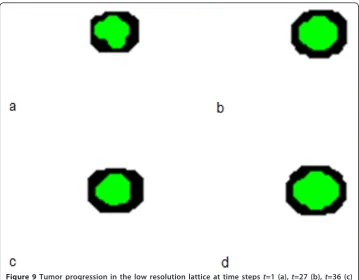
The multi-resolutionMABMis capable of describing tumor progression at various resolu-tions. Figure 9 shows tumor progression in the low resolution lattice at time points 1, 27, 36 and 100. The black represents heterogeneous cell clusters and the green represents homogeneous cell clusters. We can already see from Figure 9 that the tumor has a core of homogeneous clusters and a rim of heterogeneous clusters. We can visualize theGBM
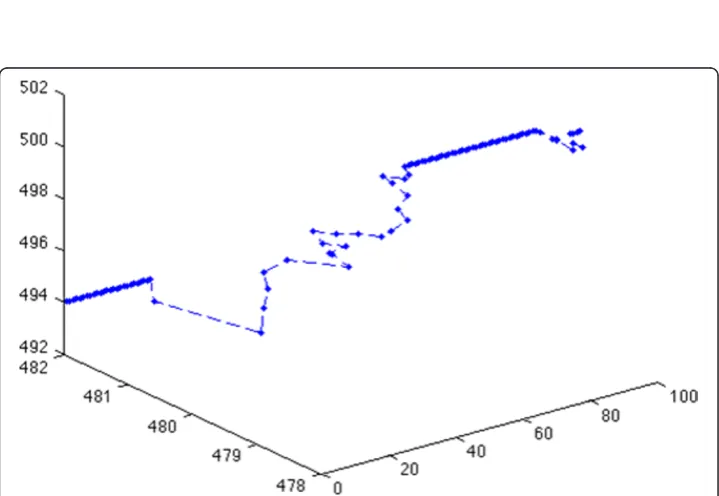
cancer cells’behaviors in the high-resolution lattice at the same time steps. For example, we can choose any cluster and show each cell’s phenotype and position in the cluster as shown in Figure 10. Here, red represents migratory cells, blue represents proliferating cells and green represents quiescent cells. Finally, we can track each cell’s trajectory as shown in Figure 11, where we show the position of a single cell from time steps 1 to 100.
Speed-up of the multiscale and multi-resolutionABMbyGPU GPU-based MABM versus sequential MABM
Figure 12(a) shows that the GPU-basedMABM is much faster than the sequential
MABM model. It is clear from this figure that the parallelized code runs at least an order of magnitude faster than the sequential algorithm. In particular, the speedup is markedly increased with respect to the finer grids.
GPU-based multi-resolution MABM versus GPU-based MABM
The GPU-basedMABM is accelerated further when the multi-resolution design is incorporated into it. Figure 12(b) shows that the GPU-based multi-resolution MABM
has a better performance than the GPU-based MABM.
Speeding up the multi-resolution MABM model with a large cell population
As indicated in Figure 12(b), the GPU-based parallelizedODEsolver cannot exhibit its advantage in significantly increasing the performance of the code when the cell popula-tion is small, because the diffusion module consumes most of the computapopula-tional resource. However, Figure 12(c) demonstrates that as the tumor cell number increases on a 514 by 514 high-resolution lattice, theGPU-based parallelizedODEcan signifi-cantly increase the performance of the model.
Discussion and Conclusions
Recently, a variety of cancer research reports have indicated that the EGFR pathway plays an important role in the directional motility [40-42], mitogenic signaling [43,44] and phenotypic switching of cancer cells [20,45]. In particular, Dittmar et al. [20] demonstrated that PLCg , a molecular species in the EGFR downstream pathway [46,47], is transiently activated in breast cancer cells to a greater extent during migra-tion. In addition, experimental observations of GBM suggested that at the same time interval, migrating tumor cells seldom proliferate and proliferating cells seldom migrate [19]. On the basis of these experimental results, Athale et al. [11] assumed that if the percentage rate of change of the phosphorylated PLCgconcentration exceeds a pre-specified threshold, GBMcells will migrate; otherwise, they will proliferate. Using this assumption, Athale et al. [11,12] and Zhang et al. [15] developed several in silico2D and 3D MABMsto investigate how perturbations in the intracellular EGFR gene-pro-tein network affect the progression of the entire tumor at the intercellular and tissue scales.
Figure 10Cells’behavior on the high-resolution lattice at time stepst=1 (a),t=27 (b),t=36 (c) and
t=100 (d). The red color represents migratory cells, the blue color represents proliferating cells, and green represents quiescent cells. Thexandyaxes represent thex- andy-coordinates of the grid points on the high-resolution lattice, respectively.
However, the above works [11,12,15] were limited by the available computational resources. As indicated by previous research [16], simulating 3D cell growth with an
ABM model is very time consuming. Scale-up analysis showed that one such simula-tion would take about 40 days with an IBM Bladecenter machine (dual-processor, 32-bit Xeons ranging from 2.8-3.2 GHz, 2.5 GB RAM, and Gigabit Ethernet), which is practically impossible. This limitation prevents simulation using MABMsfrom model-ing more realistic large cancer systems. Therefore, the present research incorporated
GPU-based parallel computing algorithms combined with a multi-resolution design into a multiscale ABM to simulate real-time actualGBM cancer progression. Thein silico results demonstrated that ourGPU-based multi-resolution MABMcan be used not only to investigate the incoherent relationships among various scales during cancer progression and visualize tumor progression at different resolutions, but also to over-come the computational resource shortage problem and simulate actual cancer pro-gression in real time.
As is well known, computer simulations of complex agent-based systems result in various emergent behaviors due to non-linear interactions among the agents, which in
Figure 12(a) Computation time ofGPU-based multiscale model and sequential multiscale model. Thex-axis represents the high-resolution lattice size and they-axis represents the computation time (logarithmic scale with base 10) in milliseconds. The blue bar represents the computation time of the sequential multiscale model and the red bar represents the computation time ofGPU-based multiscale model. The number on each red bar indicates the speed of the parallelized algorithm divided by the speed of the sequential algorithm.(b) Computation time ofGPU-based multi-resolution and
multiscale model andGPU-based multiscale model. Thexaxis represents the high-resolution lattice size andyaxis represents the computation time (logarithmic scale with base 10) in milliseconds. The blue bar represents the computation time ofGPU-based multiscale model and the red bar represents the computation time of theGPU-based multiscale and multi-resolution model. The number on the red bar indicates the speed-up of theGPU-based multiscale model.(c) Computation time ofGPU-based multi-resolution and multiscale model with parallelODEandPDEmodules and with only parallelPDE
our case are the cancer cells. Similarly, the multiscale analysis of our simulation results revealed various emergent findings. First, the molecular profiles of cells switching phe-notypes from proliferation to migration (PM) and from migration to proliferation (MP) have very similar patterns (Figure 8). Second, we found that X8 (TGFa-EGFR-PLCg-P) andX10 (PLCg-P-I) correlated strongly with the rate of change ofX9 (PLCg-P), which determined the cell’s phenotypic switch (Equation 2), whereasX1(TGFa), X2 (EGFR),
X3 (TGFa-EGFR) andX6 (PLCg) were independent of the rate of change ofX9 (PLCg
-P). Third, at early time stages, a high percentage rate of change ofPLCg caused the cell’s phenotype to switch from proliferation to migration and a comparatively low per-centage rate of change in PLCg caused a switch from migration to proliferation; but the difference in PLCgbetween these two molecular profiles (MPand PM) was very small in the final simulation stage. It is noted that the simulation data are from a four day experiment, so we set the simulation duration at 100 hours. These findings imply that the external input (TGFa), the major stimulator of the EGFR pathway, cannot change the concentration ofPLCgsubstantially at the end stage of simulation.
The multi-resolution design allowed us to visualize the tumor progression at various resolutions. Our simulated results revealed that the heterogeneous clusters consisting of cells with various phenotypes were always on the outer regions of the tumor. In addition, we were able to explore the cells’ behavior in the heterogeneous clusters. Using a high resolution lattice we investigated the cells’positions and phenotypes at different time steps. Moreover, the multi-resolution design enabled us to track a cell’s trajectory.
We also showed that the performance of the model was significantly improved by employingGPU-based parallel computing algorithms. We showed that the parallelized algorithm (PSGMG) is much better than the sequential algorithm on large lattices or when the cell population is large.
In summary, the simulation results demonstrated that the GPU-based multi-resolu-tionMABM has great potential for simulating actualGBMtumor progression in real time. In the near future, we plan to incorporate more parameters from experiments into the model, which will enable us to simulate GBMprogression patterns at various resolutions in a more realistic way. Such simulations will enable us to investigate mole-cular biomarkers that play an important role in inhibiting cancer expansion and pre-dict real GBMprogression. Subsequently, we plan to work with experimentalists to use actual data to validate the effectiveness of the model.
Acknowledgements
This work has been supported by a start-up grant from Michigan Tech University to Prof. Le Zhang.
Author details
1Department of Mathematical Sciences, Michigan Technological University, Houghton, MI, 49931, USA.2College of Computer and Information Science, Southwest University, Chongqing, 400715, China.3Center for Vaccine
Development, University of Maryland School of Medicine, Baltimore, MD 21201, USA.4Computation-based Science and Technology Research Center, The Cyprus Institute, 1645 Nicosia, Cyprus.5Harvard-MIT (HST) Athinoula A. Martinos Center for Biomedical Imaging, Massachusetts General Hospital, Charlestown, MA, USA.6Department of Pathology, the Methodist Hospital, Research Institute & Weill Cornell Medical College, 6565 Fannin St, Houston, Texas, USA.
Authors’contributions
Competing interests
The authors declare that they have no competing interests.
Received: 1 November 2011 Accepted: 16 December 2011 Published: 16 December 2011
References
1. Robert MC, Wastie ML:Glioblastoma multiforme: a rare manifestation of extensive liver and bone metastases. Biomed Imaging Interv J2008,4(1).
2. Brat DJ, Kaur B, Van Meir EG:Genetic modulation of hypoxia induced gene expression and angiogenesis: relevance to brain tumors.Frontiers in Bioscience2003,8.
3. Lipsitz D, Higgins RJ, Kortz GD, Dickinson PJ, Bollen AW, Naydan DK, LeCouteur RA:Glioblastoma multiforme: clinical findings, magnetic resonance imaging, and pathology in five dogs.Vet Pathol2003,40:659-669.
4. Tai CK, Kasahara N:Replication-competent retrovirus vectors for cancer gene therapy.Front Biosci2008, 13:3083-3095.
5. Raichle ME, Mintun MA:Brain work and brain imaging.Annu Rev Neurosci2006,29:449-476.
6. Gusnard DA, Raichle ME, Raichle ME:Searching for a baseline: functional imaging and the resting human brain.Nat Rev Neurosci2001,2:685-694.
7. Deisboeck TS, Zhang L, Yoon J, Costa J:In silico cancer modeling: is it ready for prime time?Nat Clin Pract Oncol 2009,6:34-42.
8. Wang Z, Deisboeck TS:Computational modeling of brain tumors: discrete, continuum or hybrid?Sci Model Simul 2009,68:381-393.
9. Zhang L, Wang Z, Sagotsky JA, Deisboeck TS:Multiscale agent-based cancer modeling.J Math Biol2009,58:545-559. 10. Deisboeck TS, Berens ME, Kansal AR, Torquato S, Stemmer-Rachamimov AO, Chiocca EA:Pattern of self-organization in
tumour systems: complex growth dynamics in a novel brain tumour spheroid model.Cell Prolif2001,34:115-134. 11. Athale C, Mansury Y, Deisboeck TS:Simulating the impact of a molecular‘decision-process’on cellular phenotype
and multicellular patterns in brain tumors.J Theor Biol2005,233:469-481.
12. Athale CA, Deisboeck TS:The effects of EGF-receptor density on multiscale tumor growth patterns.J Theor Biol2006, 238:771-779.
13. Mansury Y, Deisboeck TS:The impact of“search precision”in an agent-based tumor model.J Theor Biol2003, 224:325-337.
14. Mansury Y, Kimura M, Lobo J, Deisboeck TS:Emerging patterns in tumor systems: simulating the dynamics of multicellular clusters with an agent-based spatial agglomeration model.J Theor Biol2002,219:343-370. 15. Zhang L, Athale CA, Deisboeck TS:Development of a three-dimensional multiscale agent-based tumor model:
simulating gene-protein interaction profiles, cell phenotypes and multicellular patterns in brain cancer.J Theor Biol 2007,244:96-107.
16. Zhang L, Chen LL, Deisboeck TS:Multi-scale, multi-resolution brain cancer modeling.Math Comput Simul2009, 79:2021-2035.
17. Zhang L, Strouthos C, Wang Z, Deisboeck TS:Simulating brain tumor heterogeneity with a multiscale agent-based model: Linking molecular signatures, phenotypes and expansion rate.Mathematical and Computer Modelling2009, 49:307-319.
18. Jiang B, Struthers A, Zhang L, Sun Z, Feng Z, Zhao X, Dai W, Zhao K, Zhou X, Berens M:Employing graphics processing unit technology, alternating direction implicit method and domain decomposition to speed up the numerical diffusion solver for the biomedical engineering research.International Journal for Numerical Methods in Biomedical Engineering2010.
19. Giese A, Loo MA, Tran N, Haskett D, Coons SW, Berens ME:Dichotomy of astrocytoma migration and proliferation.Int J Cancer1996,67:275-282.
20. Dittmar T, Husemann A, Schewe Y, Nofer JR, Niggemann B, Zanker KS, Brandt BH:Induction of cancer cell migration by epidermal growth factor is initiated by specific phosphorylation of tyrosine 1248 of c-erbB-2 receptor via EGFR. Faseb J2002,16:1823-1825.
21. Zhang L, Chen LL, Deisboeck TS:Multi-scale, multi-resolution brain cancer modeling.Math Comput Simul2009. 22. Strober W:Monitoring cell growth.Current Protocols in Immunology2001,5.
23. NVIDIA:NVIDIA CUDA Programming Guide.NVIDIA2008.
24. Morton kQ, Mayers DF:Numerical solution of partial differential equations.2 edition. New York: Cambridge University Press; 2008.
25. Dai W:A Parallel Algorithm for Direct Solution of Large Scale Five-Diagonal Linear Systems.InProceedings of the Seventh SIAM Conference on Parallel Processing for Scientific Computing; 1995.Edited by: Bailey DH. San Francisco, CA; 1995:875, SIAM.
26. Smith B, Biqrstad P, Gropp W:Domain Decomposition: Parallel multilevel methods for elliptic partial differential equation.1 edition. New York: Cambridge University Press; 2004.
27. St-Cyr A, Gander MJ, Thomas SJ:Optimized Restricted Additive Schwarz Methods.16th International Conference on Domain Decomposition Methods; Jan 11, 2005; New York2005.
28. NVIDIA:NVIDIA CUDA Programming Guide.NVIDIA2009.
29. Xiao SC, Aji AM, Feng WC:On the Robust Mapping of Dynamic Programming onto a Graphics Processing Unit. International Conference on Parallel and Distributed SystemsShenzhen, China; 2009.
30. Boyer M, Sarkis M, Weimer W:Automated Dynamic Analysis of CUDA Programs.Third Workshop on Software Tools for MultiCore Systems in conjunction with the IEEE/ACM International Symposium on Code Generation and Optimization (CGO) Boston, MA; 2008.
31. Xiao SC, Feng WC:Inter-Block GPU Communication via Fast Barrier Synchronization.In Proc of the IEEE International Parallel and Distributed Processing SymposiumAtlanta, GA; 2010.
33. Zhu JP:Solving Partial Differential Equations On Parallel ComputersLondon: World Scientific Publishing Co. Pte. Ltd; 1994. 34. Kernighan BW, Ritchie DM:The C Programming Language.2 edition. Englewood Cliffs, New Jersey: Prentice Hall; 1988. 35. Kochan SG:Programming in C.3 edition. Indianapolis, Indiana: Sams; 2004.
36. NVIDIA:The CUDA Compiler Driver NVCC.NVIDIA2007. 37. NVIDIA:Tuning CUDA Applications for Fermi.NVIDIA2010.
38. Glaskowsky PN:NVIDIA’s Fermi: The First Complete GPU Computing Architecture.2009. 39. Halfhill TR:Looking Beyond Graphics.2009.
40. Wyckoff JB, Segall JE, Condeelis JS:The collection of the motile population of cells from a living tumor.Cancer Res 2000,60:5401-5404.
41. Soon L, Mouneimne G, Segall J, Wyckoff J, Condeelis J:Description and characterization of a chamber for viewing and quantifying cancer cell chemotaxis.Cell Motil Cytoskeleton2005,62:27-34.
42. Bailly M, Wyckoff J, Bouzahzah B, Hammerman R, Sylvestre V, Cammer M, Pestell R, Segall JE:Epidermal growth factor receptor distribution during chemotactic responses.Mol Biol Cell2000,11:3873-3883.
43. Chen P, Xie H, Wells A:Mitogenic signaling from the egf receptor is attenuated by a phospholipase C-gamma/ protein kinase C feedback mechanism.Mol Biol Cell1996,7:871-881.
44. Chen P, Xie H, Sekar MC, Gupta K, Wells A:Epidermal growth factor receptor-mediated cell motility: phospholipase C activity is required, but mitogen-activated protein kinase activity is not sufficient for induced cell movement.J Cell Biol1994,127:847-857.
45. Demuth T, Nakada M, Reavie LB, Nakada S, Henrichs A, Anderson E, Hoelzinger DB, Beaudry C, Zhang L, Wang Z,et al: A molecular‘switch’between cell migration and proliferation in human gliomas: Characterizing the role of Phospholipase-C-γand its MKK3 signaling effector., submitted.
46. Schoeberl B, Eichler-Jonsson C, Gilles ED, Muller G:Computational modeling of the dynamics of the MAP kinase cascade activated by surface and internalized EGF receptors.Nat Biotechnol2002,20:370-375.
47. Araujo RP, Petricoin EF, Liotta LA:A mathematical model of combination therapy using the EGFR signaling network. Biosystems2005,80:57-69.
doi:10.1186/1742-4682-8-46
Cite this article as:Zhanget al.:Developing a multiscale, multi-resolution agent-based brain tumor model by graphics processing units.Theoretical Biology and Medical Modelling20118:46.
Submit your next manuscript to BioMed Central and take full advantage of:
• Convenient online submission
• Thorough peer review
• No space constraints or color figure charges
• Immediate publication on acceptance
• Inclusion in PubMed, CAS, Scopus and Google Scholar
• Research which is freely available for redistribution

![Table 1 [16] - (1) Components of the EGFRequations employed to describe the reactions between theof the gene-protein interaction network, (2) Kinetic EGFR species, (3) Coefficients EGFR gene-protein interaction network taken from the literature](https://thumb-us.123doks.com/thumbv2/123dok_us/315679.1524050/5.595.121.481.123.561/components-egfrequations-reactions-interaction-kinetic-coefficients-interaction-literature.webp)