_____________________________________________________________________________________________________ SCIENCEDOMAIN international
www.sciencedomain.org
Students’ Perceptions of Tuition Fees:
An Interpretative Phenomenological Analysis
John Galvin
1*, Marlon Nieuwenhuis
1, Bethan Phillips
1, Lynsey Thain
1and Christina Kokkori
11
School of Psychology, Cardiff University, UK.
Authors’ contributions
This work was carried out in collaboration between all authors. Author JG drafted and revised the article. Authors JG and MN worked together on the conception and design of the study and carried out the interviews with participants. Authors BP, LT and CK prepared the transcripts for the data to be analysed. Authors JG, MN, BP, LT and CK analysed the data and interpreted the results. All authors checked the manuscript for intellectual content and approved the final manuscript for publication.
Article Information
DOI: 10.9734/BJESBS/2015/18981 Editor(s): (1)Shao-I Chiu, Taipei College of Maritime Technology of Center for General Education, Taiwan. (2)Chih-Wei Pai, Taipei Medical University, Taiwan ROC. Reviewers: (1)Anonymous, State University of Padang, Indonesia. (2)Joseph S. Mukuni, College of Liberal Arts and Human Sciences, Virginia Tech, USA. Complete Peer review History:http://sciencedomain.org/review-history/9942
Received 19th May 2015 Accepted 16th June 2015 Published 29th June 2015
ABSTRACT
Aims: In light of the changes to tuition fees introduced by the UK government in 2010, the present study aimed to gain a deeper understanding of how students perceive their tuition fees.
Methodology: Interpretative Phenomenological Analysis (IPA) was used to gain a deeper understanding of students’ perceptions of tuition fees.
Results: Two superordinate themes describing the fairness of tuition fees and the impact of the change in legislation on perceptions emerged from the analysis. In addition, findings revealed that a lack of knowledge regarding tuition fees appears to increase stress in the students.
Conclusion: The findings of this study indicated that more responsibility should lie with institutions to educate their students about their finances, with possible benefits for student wellbeing and satisfaction. We also draw caution to policy and structural changes within universities that may occur to meet the increasing demands of students.
Keywords: Undergraduate students; tuition fees; UK higher education; student finances; student health.
1. INTRODUCTION
1.1 Tuition Fees in the UK
The change in legislation in regards to tuition fees introduced in 2010 by the UK coalition government of the time was one of the most controversial policy changes of recent times. Many students, lecturers and those who invest in higher education institutions protested and expressed their dissatisfaction at the time of policy change. However, the government continued with their plans and the policy was passed through parliament for its introduction in academic year 2012/2013. As a result, students who have enrolled in university since 1st September 2012 are being charged a maximum of £9000 per year in tuition fees at a large number of universities in the UK. The consequence of this change is that students will be leaving university with significantly higher levels of debt than ever before. For example, the average student taking a three-year course charged at £9000 per year, with a full maintenance loan, will leave university with around £44,000 worth of debt. In contrast, the average student entering university the year before (academic year 2011/2012) will leave university with around £24,000 worth of debt.
A limited number of European countries such as Norway and Finland still provide free undergraduate higher education for their citizens. The justification amongst these countries for this ‘free for all’ policy is founded on the principle of ‘equal access’, whereby free education ensures that financial barriers do not prevent those students with the required abilities, but lack of funds, to access higher education [1]. Furthermore, these countries tend to invest in higher education because of the perceived benefits of education to society as a whole. For example, Biffl and Isaac [2] noted a number of societal benefits such as better health, more educated citizens, greater social cohesion, and greater scientific and technological advances that increase both productivity and economic growth. However, the position amongst other countries, and particularly the UK, tends to focus more towards the benefits for the individual, including increased earnings, greater employment security and personal satisfaction [2]. Additionally, this general trend towards the “fee-paying” student has largely been justified as a relief in the
financial burden that was previously placed on taxpayers.
The aim of the present study was to explore the perceptions of different tuition fee paying student groups in regards to their tuition fees using a qualitative research method known as Interpretative Phenomenological Analysis (IPA) [3]. Exploration of these perceptions is particularly interesting during a time of significant changes to the amount of tuition fees being charged to undergraduate students in the UK. The timing of the data collection of this study allowed qualitative comparisons to be made between groups of students paying unequal amounts of debt.
1.2 Is the Tuition Fee System in the UK Fair?
Fairness can be defined as a judgement of whether an outcome and/or the process to attain an outcome are reasonable, acceptable or just [4]. According to the relative deprivation theory of justice [5,6] this judgement is not derived from the actual value of people’s outcomes but from comparisons between what they have and what they expected to have. Thus, the larger the overlap between expectation and outcome, the greater the perceived fairness. As a result of the increase in tuition fees, students’ expectations of their university experiences could change, resulting in greater levels of perceived unfairness in instances of disparity between such expectations and the realities of their experiences. Indeed, Jones [7] predicted that the increase in tuition fees would be coupled with a further increase in student expectations, with students demanding better value for money in terms of quality and services, and complaining if these expectations are not met or if resources are not focused towards the areas they regard as highly important. As the actual outcomes (in terms of quality of education and services) are likely to remain the same for all students regardless of tuition fee being paid, the gap between expectations and outcomes is likely to result in greater levels of perceived unfairness for those students paying higher fees.
disparity in the cost of tuition fees than ever before, especially amongst British home students, tuition fees are likely to be perceived as most unfair by those undergraduate students who are paying higher fees, such as English students (paying £9000 tuition fees), in comparison to students paying less, such as Welsh students who are subsidised by the Welsh Assembly (paying £3465 tuition fees) or others who entered university in the year before the change was introduced (also paying £3465). Students comparing their situation to the situation of others is likely to result in perceived unfairness as the disparities exist despite them being part of the same in group, namely undergraduate students, and are likely to receive the same outcome with respect to their university experience (in terms of quality and services). Fortunately, the timing of the present study meant that comparisons could be made between different groups of students with unequal amounts of debt and, therefore, we can consider whether this appears to be the case.
1.3 What will this Mean for Student Mental Health?
A survey-based study by Cooke et al. [8] focused on the relationship between debt and mental health. The researchers used a large sample of the same cohort of university undergraduates across their three years of university, including 2146 first, 1360 second and 1390 third year students. It was found that attitudes towards debt were related to mental health levels and that as students progressed through their degree the more concerned they became about their finances. However, there was no relationship between amount of debt and mental health, suggesting that attitudes towards debt could have a greater influence than the amount of debt itself. Interestingly, however, research has shown that students with higher levels of debt are more tolerant of debt [9] and they tend to regard the debt they acquire at university as normal and unavoidable [10]. This is concerning, as tolerance and acceptance of debt could set a precedent for students’ future financial management.
Stress has been defined as a transaction between a person and their environment [11]. Research adopting the transactional model of stress incorporates the cognitive appraisal of the stressor and tends to consider the individuals coping resources as having a major influence on stress outcomes. There are two main kinds of
coping strategies identified in this model; emotion-focused and problem-focused [11]. Problem-focused coping aims to reduce or eliminate the stressor by engaging in problem-solving activities, seeking out information and attempting to manage or alter the problem. In contrast, emotion-focused coping aims to change one’s emotional reaction to the stressor and can include avoiding the problem, blaming oneself or daydreaming about a better situation. Research suggests that emotion-focused coping strategies are positively associated with distress [12] whereas problem-focused coping strategies are positively associated with positive affect [13], suggesting the latter is more favourable than the former.
The perception of stress has been found to be an important mediator between stressors and mental health outcomes in students [14]. An important aspect of the interview protocol in this study was the use of open-ended questions with none of the questions asking students about a specific perception they might have regarding their tuition fees. For example, none of the questions directly related to the students’ experiences of stress, or explicitly mentioned the word ‘stress’. This was done purposely by the researcher due to the emphasis of this investigation being on the context of the phenomenon. For example, a participant reporting stressful experiences without being directly asked about them allows the context in which these experiences emerge to be observed more clearly. On the contrary, there was always the possibility that the participants would not report stress at all. This leaves the researcher in a masterly position, and presents a remarkable opportunity for discovery and recognition.
2. METHODS
2.1 Participants
second-year English-domicile students (intake academic year 2011/2012, paying £3465 per year) and group D five second-year Welsh-domicile students (intake academic year 2011/12, paying £3465 per year). Comparisons are therefore made between group A students (i.e. the £9000 fee paying students) and the other groups who all have different situations in terms of domicile and year of study, but are paying the same amount of tuition fees.
2.2 Design
The qualitative method presented in this research is a rapidly growing approach to qualitative research, known as Interpretative Phenomenological Analysis (IPA) [3]. The main aim of IPA is to investigate the meaning that particular experiences hold for certain individuals. This is central to the aims of this research, as the desire is to obtain an insider’s perspective on the phenomenon of increased tuition fees. However, IPA acknowledges that the participants’ world is not directly accessible. Firstly, researchers can only gain an understanding of this world through the participants’ interpretations of it (the first interpretation). This process is then open for further interpretation, as the researcher attempts to make sense of the participants’ interpretation (the second interpretation). This captures the dual role of the IPA researcher, in that they only have access to the participant’s experience through the participant’s own account of it. This phenomenon is otherwise known as a double hermeneutic [15]. Rather than being viewed as biasing, this interpretative journey is seen as a requirement for making sense of the participants’ experiences.
2.3 Procedures
The first two named authors conducted semi-structured in-depth interviews with the participants that lasted between 30 and 45 minutes. Before the interviews commenced, participants completed a demographic questionnaire comprising questions on their tuition fees, their maintenance loans, their ethnicity, their place of birth, and their employment status. Additionally, two measures of their socioeconomic status were included; a measure of parental education [16] and a subjective measure of their perceived social class [17]. The interview protocol included open-ended questions, allowing participants to discuss the reasons they came to university, their own and others tuition fees, and their current financial
situation. The interviews were digitally recorded and were later transcribed. Once all interviews were transcribed, they were read and coded by the researchers using procedures typical of qualitative research.
2.4 Analysis
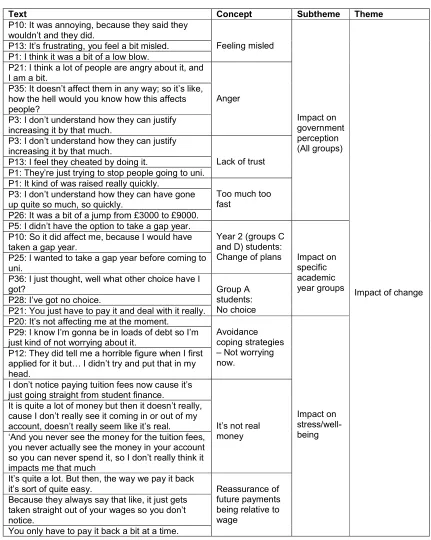
The information provided by the participant in the demographic questionnaire was attached to the transcript. This allowed the researchers to make an informed interpretation of the data based on the participant’s background. The analysis firstly involved all five authors reading the transcripts in great detail and becoming familiar with the data, whilst recording their initial ideas in the left-hand margin of the transcript. Once the researchers had absorbed the data, the transcripts were re-read and more abstract categories and concepts were recorded in the right-hand margin. The researchers then met for an analysis session, involving each transcript being discussed on an individual basis. Importantly, none of the data was collectively discussed before this point, as a general consensus would strengthen the trustworthiness of the findings. Once each transcript was discussed on an individual basis, the researchers discussed more abstract categories and concepts and these were organised into tables (Tables 1 and 2). This led to the development of two superordinate themes. Further reviews of the data were carried out to confirm that the researchers’ interpretations were traceable. First, re-reading the transcripts after the themes were established further validated the findings. Second, a colleague within the university, but external to the project, read the transcripts and made credibility checks of the findings.
3. RESULTS
In the analysis session, the authors’ individual interpretations of the transcripts were almost identical. The small number of differences that did occur was resolved by discussion. This section presents two superordinate themes that emerged from the analysis; Fairness and Impact of Change.
3.1 Theme 1: Fairness
participants expressed their concerns that it separates social classes and that the current arrangements do not provide all with equal opportunities.
Participant 7: “I guess it’s only the elite then… It’s a bit like everywhere has become Cambridge and Oxford in terms of money, if you can’t afford it then you can’t afford it.”
Participants described how the new system is unfair for students from low-income families. Specifically, participants expressed their concerns that the new tuition fees system takes away the opportunity for low-income students to go to university because they simply cannot afford it. One participant who was in the second year of their degree programme (group C) described how they would not be able to go to university if they were in the same position as a year one student.
Participant 4: “I think that it’s very, very, very unfair, because if I was in their position now I wouldn’t be able to go to university. It’s taking the option away from a lot of working class people I think.”
This particular participant had strong feelings towards the policy change and held strong beliefs that education should not involve money at all.
Participant 4: “It’s just very unfair that money has to be such a big sort of thing in education. If you want to learn and you want to be educated, money shouldn’t have to be involved really.”
Participants described how the new tuition fee system will put people off coming to university altogether. Year one participants (groups A and B) even reported knowing individuals who did not come to university because of cost.
Participant 1: “I’ve seen lots of people turning away from university because they couldn’t afford to pay it.”
Many second year students (group C and D) also stated that they would have reconsidered going to university had they been in the year below, and claimed it was likely that this could have led them to not going to university at all.
Participant 13: “I know personally from sort of not having as much money in my family
and not coming from a family that is wealthy or kind of academically oriented, I think my mum would have been put off by me spending so much and I would have been put off by spending so much and it probably would have stopped me from going.”
Additionally, all participants described how the policy change would make people seriously consider whether or not it will be worthwhile going to university.
Participant 5: “I think they have made people really consider whether they want to go to university because it’s a lot of money, it’s triple we’d say. You can’t just go if you don’t know what you want to do, you really have to be set on a course to be paying all that money.”
One participant expressed the view that less people going to university would actually be a positive change and that having a degree will now be more worthwhile.
Participant 21: “I think the fees will make people consider other options more which I think is a good thing really, because you know, if you’ve got a lot of people with degrees then it doesn’t really mean anything.”
However, this was a minority view, with the majority of participants describing how it would be a shame if people were discouraged from going to university for financial reasons.
Participant 7: “It’s a shame really because lots of people aren’t going to go to uni and they could have like flourished and done so much more.”
For some participants from middle class backgrounds, dissatisfaction was expressed at the amount of financial support they received.
Participant 27: “I didn’t get grants or, like I only got the loans and it turns out that with the accommodation I get it’s something like £14 extra for like, living expenses, like, a term! Which obviously isn’t very good.”
Participant 14: “Because I’m in like, the middle class group where, you’re not getting all of the grants and like, you’re not getting loads from the government because you’re poor, but you’re not getting loads from your family because you’re rich. So you’re kind of in the middle. So, I feel like I do have less money than people who are technically poorer than me, which is weird.”
An interesting finding was that some participants described how the new system was fairer for the taxpayer and could see the change in policy from their point of view. A small number of participants described how they themselves would be in favour of the change had they not been going to university.
Participant 14: “Obviously people complain about it but I think maybe, if I hadn’t gone to uni, then I probably would have been more for the fees going up. So, I see the other side of the story.”
One participant from group A described how the change is fair because it is an option to come to university.
Participant 16: “It’s an option to come to uni, it’s not compulsory like school and college and things are, so yeah, I suppose it is fair.”
Another participant from group A feels that they are contributing to society and the current economic climate by paying tuition fees.
Participant 33: “I think it’s quite harsh, because previous people have not had to pay that much money but if it gets us out of the recession faster then I don’t really mind.”
For this particular student, there was a strong sense of patriotism and they felt that the change was a positive move for the UK economy.
Participant 33: “If it’s good for the UK economy then it’s probably the right change. As long as they’re giving us support, because you might not be able to afford it, then I think it’s the right change.”
However, once again, this was a minority view with the majority of participants showing discontent towards the government in regards to the change. These ill feelings towards the government are discussed further in the theme “Impact of Change.”
Participants discussed the fairness of their tuition fees in comparison with other groups of students. Specifically, when participants commented on the fairness of the change in legislation, they often described how much they were paying in comparison to others. As expected, participants paying £3465 tuition fees per year (groups B, C and D) believe it is unfair for those students paying £9000 tuition fees per year. For example, a group B student said:
Participant 30: “Erm, my tuition fees are a bit high but I suppose within reason. But for some other people, like English people, they are paying three times as much as I am, which seems very unfair.”
Both group B and D (Welsh) participants empathised with group A students.
Participant 25: “I feel sorry for people in England, because I only have to pay £3000 something because I’m Welsh but there’s other people doing the exact same course as me that have to pay the full £9000 back.”
Indeed, a sense of good fortune to have escaped the higher fees was evident from all the comparison groups. This further reflected the sense of empathy towards group A students.
Participant 17: “I feel very privileged to be at university paying a third of what like other people are paying.”
However, for group A students, there was a sense of envy towards the other groups of students.
Participant 36: “I will always know that there are people a year older than me that don’t have to pay as much back.”
A further difference between the different fee paying groups was the sense of getting value for money. Again, this was evident from the comparisons the participants made with their peers. For example, the comparison groups felt that they were getting value for money compared to Group A students.
When the comparison groups were asked if they felt year one English students (group A) were getting value for money, every participant said no.
Participant 2: “They seem to be doing the exact same thing as I’m doing and yet I’m paying a third of the price.”
One participant made comparisons with other European countries to communicate this unfairness.
Participant 11: “I think that it’s a ridiculous amount you’ve got to pay. I mean when you compare it to people in different countries all over Europe and things, we have to pay so much more. It just seems like an absolutely huge amount to pay.”
Indeed, group A students agreed with their fellow students and had strong feelings that the amount of tuition fees they were paying was unfair.
Participant 35: “Compared to my brother I always get pissed off because he won’t have to pay it and I will.”
However, it should be noted that this was not the case for all group A participants. A number of these students were satisfied that coming to university was a worthwhile investment. One participant summed this up nicely when they said:
Participant 12: “I don’t think you can really put a price on a good degree.”
In terms of university expectations and the fairness of tuition fees, group A participants clearly expected more from their institution than the other groups and made their feelings towards university standards clear. In particular, group A students raised concerns that they are not provided with sufficient academic provisions. Amount of contact hours, having to pay for their own textbooks, and not being provided with lecture handouts were frequently mentioned by these participants. One participant even communicated their anger that the photocopier had run out of ink.
Participant 22: “It's ridiculous when you’re paying nine grand a year, you’d think they could afford ink for the photocopier.”
In addition, it was clear across the transcripts that group A participants expected higher standards of teaching from their institution than their peers. A number of participants from this group communicated their frustration when a lecture was not up to their expected standards.
Participant 35: “When I don’t have the best lecture that’s like quite boring or something I’ll be like, for fuck sake I’m paying nine grand! That’s when I get pissed off, because I’m like, I pay so much money and he’s just looking at his thing and like mumbling and you’re like, come on dude, engage me!”
Students in all groups appreciated the quality of the research at the university, but explained that this did not guarantee high quality teaching.
Participant 12: “Just because they’re such great researchers it doesn’t automatically mean they’re the best teachers.”
Overall, expectations of outcomes appeared higher in group A students in this study, and in line with the relative deprivation theory [5,6], as expectations increased, perceived unfairness occurred. The development of this theme is described in Table 1.
3.2 Theme 2: Impact of Change
The second theme to surface from the transcripts was Impact of Change. This theme highlighted some of the main impacts of the policy change, both positive and negative. A clear finding was the negative impact on government perceptions of all the participants. In particular, participants described how they felt misled by the government when the policy was introduced.
Participant 13: “I think considering the fact that it was a correlation in the government and the fact that part of that correlation was people that said they wouldn’t do what they did, it’s frustrating, you feel a bit misled.”
The Liberal Democrats were frequently mentioned, there were some strong feelings towards this particular political party.
wouldn’t even be in the position they are in now if they hadn’t appealed to the massive student population that we’ve got in our country... And we thought, yea cool, these are people that we can support and
politicians that we can actually get behind and they want to do something, and actually no they just completely, not even, they didn’t even try, I mean it’s just ridiculous.”
Table 1. The development of theme 1: fairness. From left to right shows the text examples, the concepts, the sub-themes and finally the superordinate theme
Text Concept Subtheme Theme
P8: It separates, like, social class.
Lack of equality
Unfair towards low-income students
Fairness P16: I don’t think it gives people an
equal opportunity any more. P26: It’s not giving everyone equal opportunity to experience it.
P8: For people who come from a low working background, three, like £4000 is a lot already.
Will put people off P13: I think the rate that I’m paying
(as a Welsh student)… I would accept that. I don’t know if I’d have gone with the increased rate though. P26: The year below me, a lot of them have said they’re not gonna bother.
P14: I feel like I do have less money than people who are technically poorer than me.
Lower income students having more money
Unfair towards middle class students P13: There’s so much more support
to the lower earning brackets. P14: I’m in like, the middle class group where you’re not getting all of the grants and you’re not getting loads from the government. P26: Just because your parents are earning a higher wage does not mean they can afford to fund you
through university. Falling through the cracks
P9: My maintenance loan literally covers my rent. I think if I didn’t have my job I would really struggle. P14: You’re kind of in the middle. P14: If I hadn’t gone to uni, then I probably would have been more for
the fees going up. Understanding their point
of view
Fair for taxpayer P16: It’s an option to come to uni, it’s
not compulsory like school. P22: I understand why they did it. P14: It means the money that I’m giving would go to like hospitals and schools and things like that.
My benefit vs societies benefit
P21: Because of the economic climate people had to take the hits and things.
Text Concept Subtheme Theme
P9: My three years will cost the same as one year [for them].
Empathy towards group A members
Comparisons between fee-paying groups
Fairness P13: I feel for people who have
actually been impacted by it. P29: We are the first year so it’s like “if I just was one year older I would miss this”
Envy from Group A members
P23: I’m from England and I pay £9000, people from Wales pay £3000, people from anywhere else pay like nothing, so I think 9000 is a bit much.
P33: I think it’s quite harsh, because previous people have not had to pay that much money.
P13: I am really lucky with what I get, I know there’s a lot of people that aren’t in my situation.
Value for money for groups B, C and D. P2: They [English students] seem to
be doing the exact same thing I’m doing and yet I’m paying a third of the price.
P11: I am very very lucky [to have missed out on higher fees].
P3: Why should someone be paying triple what I’m paying for something that’s definitely not worth £9000?
Not value for money for group A members P28: Why are we having to pay that
much more?
P35: It seems massively unfair because like, my brother pays 3 and I pay 9 and we both get the same thing.
P22: We only have 7 hours of contact time a week. If I added all that up and divided it out I’d be paying hundreds of pounds per lecture.
More academic provisions
University expectations P16: That’s one thing that does
irritate me, you pay a tuition fee, and you get one book at the beginning of the year.
P8: I don’t think it’s fair when we pay loads of money for lecturers that don’t give us a handout.
P3: I could do with getting a bit more for the money that I pay!
Higher standards P35: When I don’t have the best
lecture that’s quite boring… I’ll be like, for fucks sake I’m paying 9 grand!
One student had to refrain from the use of stronger language when they said:
Participant 15: “I think it’s a load of crap, but I won’t use a stronger word than that. But I think it’s an absolute disappointment, a shambles.”
Even when the participants were not quite as explicit as this participant, there was still a clear sense of anger towards the policy makers.
Participant 8: “The people that make these decisions are the people who can afford for their children to pay that much back.”
The participants’ comments often portrayed a distinct lack of trust towards politicians. One participant made an observation about Members of Parliament that further reflected this lack of trust.
Participant 14: “Sometimes you felt like the MP’s, they kind of answered but without giving an answer, like politicians do.”
Participants expressed their opinion that the increase in tuition fees was “too much too fast”. Specifically, they felt that it would have been more understandable if the policy introduced smaller increases over a longer period of time.
Participant 28: “Like such a big jump, if they’d increase it a bit and then a little bit more the next year and then a little bit more it would’ve been more, like, reasonable. Such a massive jump up, you’re a bit like, I don’t know if that was really needed.”
Interestingly, the change in legislation had also affected year two participants. Many second year participants explained how they wanted to take a gap year, but decided to go straight to university because of the tuition fees going up.
Participant 10: “I couldn’t take a gap year or I would have had to pay triple fees. So it did affect me, because I would have taken a gap year but I just went straight to university.”
Indeed, many year two students explained how they felt the needed to change their plans to avoid the change.
Participant 16: “I know I want to travel in the future, because that’s originally what I would’ve done.”
Group A students had no such choice however, and they seemed resigned to their fate.
Participant 21: “You just have to pay it and deal with it really. Don’t have a choice.”
All groups reported feelings of financial stress with regard to the tuition fees, although there were no clear differences in the level of financial stress between the groups. Such findings are beyond the scope of the present research. However, some important findings in regards to stress will now be discussed.
Within transcripts, a clear finding was that the less informed the student was about their tuition fees system, the more stressed they appeared to be about paying them back. The researchers made this within-transcript comparison by including questions on the participants’ knowledge of the tuition fees system that applies to them in the research protocol. For example, when asked if they feel that their student finances will impact them in the future, a group A participant said:
Participant 27: “I am slightly worried, because obviously like I’m going into life with loads of debt.”
However, this participant had very little knowledge of the tuition fees system that applied to them.
Participant 27: “I don’t know how much debt I’ll have at the end of it.”
Additionally, the questions that the participant did attempt to answer were answered incorrectly. For example, when asked about their repayment system, the participant was unsure in their response.
Participant 27: “Erm, once you get past 65, it gets wiped? I dunno! But I think that’s how it works, but I’m not like, positive on it.” In contrast, the more informed the student was about their tuition fees system the less stressed they appeared to be about paying them back. Another group A participant who was asked if they felt that their student finances will impact them in the future replied:
I’m not charged at all… Erm, so not really, no, not bothering me that much.”
In particular, the reassurance that future payment will be relative to their wages helped relieve participant stress.
Participant 24: “It’s quite a lot. But then, the way we pay it back it’s sort of quite easy.”
This reassurance was coupled with a perception that student loans are “not real money.” In other words, some participants perceived student debt as not being real debt.
Participant 10: “It’s quite a lot of money but then it doesn’t really, because I don’t really see it coming in or out of my account, it doesn’t really seem like it’s real.”
Most participants adopted avoidance coping strategies to deal with their financial stress. A sense of “not worrying now” was clear across the transcripts.
Participant 17: “I think definitely afterwards when you’d stop and you’d have to think about jobs and all that it will definitely [have an impact]… but not worrying about that now, it’s not the time.”
The development of this theme is described in Table 2.
4. DISCUSSION
The results of the present study met with the researchers’ objectives by providing a deeper understanding of students’ perceptions of tuition fees. These are important findings as they highlight, for the first time, the views of those students affected by the change in legislation in regards to tuition fees. To consider the implications of the findings, it is important to consider both policy and previous research to contextualise, confirm and clarify the researchers’ conclusions.
The present study demonstrated that students are aware of the large disparities in tuition fees and they base their decisions of fairness upon them. Group A students, the £9000 tuition fee paying group in this study, were the group who felt most strongly that they were not getting ‘value for money’ and did not hold back about raising concerns about their institution. A particular frustration for students was if a lecture was “boring” or if the lecturer failed to engage the student in the way they expected. Indeed, it is
clear that students assume a certain level of engagement from their lecturers, with a focus on both education and entertainment. With the widespread use of formal student appraisal of courses and instructors, it is clear that the pressure on instructors to incorporate entertainment into their teaching is ever increasing.
It was interesting that students used their tuition fees when evaluating their instructors. For example, a common theme was students making comments such as ‘I’m paying all this money’ or
‘I’m paying £9000 for this!’ when describing their dissatisfaction towards teaching standards. These comments suggest that the students’ evaluations of teaching standards are influenced by the ‘price tag’ of tuition fees. If this is the case, students’ expectations of teaching standards are likely to increase dramatically with the increase in tuition fees, and perhaps somewhat unrealistically, supporting Jones’ [7] assumption that the increase in tuition fees will increase expectations. Future research by the first author will consider the relationship between the burden of the ‘£9000 price tag’ and student evaluations of staff. Specifically, over a population of students, do participants paying higher fees evaluate members of staff more negatively in terms of teaching quality than those paying lower fees? If this is the case, the validity of staff evaluations comes further into question.
Table 2. The development of theme 2: impact of change. From left to right shows the text examples, the concepts, the sub-themes and finally the superordinate theme
Text Concept Subtheme Theme
P10: It was annoying, because they said they wouldn’t and they did.
Feeling misled
Impact on government perception (All groups)
Impact of change P13: It’s frustrating, you feel a bit misled.
P1: I think it was a bit of a low blow.
P21: I think a lot of people are angry about it, and I am a bit.
Anger P35: It doesn’t affect them in any way; so it’s like,
how the hell would you know how this affects people?
P3: I don’t understand how they can justify increasing it by that much.
P3: I don’t understand how they can justify increasing it by that much.
Lack of trust P13: I feel they cheated by doing it.
P1: They’re just trying to stop people going to uni. P1: It kind of was raised really quickly.
Too much too fast
P3: I don’t understand how they can have gone up quite so much, so quickly.
P26: It was a bit of a jump from £3000 to £9000. P5: I didn’t have the option to take a gap year.
Year 2 (groups C and D) students:
Change of plans Impact on
specific academic year groups P10: So it did affect me, because I would have
taken a gap year.
P25: I wanted to take a gap year before coming to uni.
P36: I just thought, well what other choice have I
got? Group A
students: No choice P28: I’ve got no choice.
P21: You just have to pay it and deal with it really. P20: It’s not affecting me at the moment.
Avoidance coping strategies – Not worrying now.
Impact on stress/well-being P29: I know I’m gonna be in loads of debt so I’m
just kind of not worrying about it.
P12: They did tell me a horrible figure when I first applied for it but… I didn’t try and put that in my head.
I don’t notice paying tuition fees now cause it’s just going straight from student finance.
It’s not real money It is quite a lot of money but then it doesn’t really,
cause I don’t really see it coming in or out of my account, doesn’t really seem like it’s real.
‘And you never see the money for the tuition fees, you never actually see the money in your account so you can never spend it, so I don’t really think it impacts me that much
It’s quite a lot. But then, the way we pay it back
it’s sort of quite easy. Reassurance of
future payments being relative to wage
Because they always say that like, it just gets taken straight out of your wages so you don’t notice.
You only have to pay it back a bit at a time.
Molesworth et al. [19] argued that the new breed of ‘student consumers’ arrive at university as fee-paying customers, who all have previous experience of being a customer in commercial
paid for by their fees [20]. We suggest that the impact of this on policy and structural changes in universities must be considered more than it currently is being. For example, we note from our own experiences of teaching in a UK higher education institution how we have seen significant changes in marking criteria over the last year. Specifically, we have recently expressed concerns about the marking criteria in our school in that it has made it more difficult for staff to award the lower grade boundaries, and coursework that previously would not be afforded a 2.1 grade are now achieving such boundaries. Albeit a single, anecdotal, and potentially isolated example, this does highlight how some institutions may adapt policy to accommodate for the increasing expectations of students. Although such policy changes are likely to increase student satisfaction, they can also have major implications for quality and standards. Furthermore, if institutions find themselves yielding to the idea that students are ‘entitled’ to their degree, the credibility of higher education must come under serious scrutiny.
The majority of participants in this study showed some level of dissatisfaction towards the government. An acceptance of the rise in tuition fees amongst students has not yet surfaced and the ill feelings towards the change in legislation still remain. In particular, the focus of the anger appears to fall at the feet of the Liberal Democrat Party with more students citing them than their coalition partners, the Conservative Party. Indeed, no participants in this study mentioned the Conservatives, despite them being the party that introduced the policy and advocated the tuition fees rise. Evans [21] noted that a number of controversial policies introduced by the UK coalition government, in particular tuition fees, has led to the Liberal Democrats, at least in the short term, bearing the brunt of public anger. From this article, Evans concluded that the Conservatives have gained more from the coalition arrangement than the Liberal Democrats. The present research and the recent electoral failures of the Liberal Democrats support this idea even further and highlight the need for the party to strive to regain public faith, and their own unique identity, following coalition politics.
Finally, we should consider the implications of the present findings in regards to student health. Participants who were more knowledgeable about their tuition fees appeared less stressed about paying them back, suggesting that educating students about their tuition fees is likely to be
beneficial to student well-being. The increase in tuition fees means this is even more essential now than ever before. This finding, along with the finding that students have a distinct lack of trust towards politicians, suggests that perhaps it is not only important that we educate students about their tuition fees, but the source of this information might be just as important. Fellow students, the Students’ Union, or a popular member of university staff could well be a better source for the communication of financial information to students, rather than the government or media. Additionally, the findings suggest participants’ predominantly adopted avoidance coping strategies to reduce their stress. However, once again, more knowledge of the tuition fees system that applies to them may allow the student to face up to their debt, to not avoid the problem, and to help alleviate any longer term negative consequences of such emotion-based coping strategies. One possible idea is to provide students with this information in a postgraduate seminar setting as this would allow the students to debate a topic that is directly relevant to their lives while being able to ask questions to the tutor and explore specific issues. This kind of setting is ideal for the discussion of such topics in a friendly and informal environment with very low cost to the institution.
sample sizes, such as those identified in this paper.
5. CONCLUSION
This study has brought to attention a number of key observations in regard to students’ perceptions of tuition fees and, indeed, their student finances in general. The timing of this research allowed a unique opportunity to compare a number of different groups in regards to their perceptions of tuition fees. Although many of the findings are the same across groups, there are some important differences which have been highlighted, in particular regarding increasing expectations. In this paper, we draw caution to policy and structural changes within universities that may occur to meet the increasing demands of students. Additionally, this study indicates that more responsibility should lie with institutions to educate their students about their finances, with possible benefits for student wellbeing and satisfaction. Future research by us will investigate these findings further in larger samples using quantitative-based methods.
ETHICAL APPROVAL
Ethical approval was provided by Cardiff University School of Psychology.
COMPETING INTERESTS
Authors have declared that no competing interests exist.
REFERENCES
1. European Commission. National Student Fee and Support Systems; 2012.
Available:http://eacea.ec.europa.eu/educati on/eurydice/documents/facts_and_figures/f ees_and_support.pdf (accessed 29 October 2014)
2. Biffl G, Isaac J. Should higher education students pay tuition fees? Eur J Educ. 2002;37(4):433-55.
DOI: 10.1111/1467-3435.00120
3. Smith JA. Beyond the divide between cognition and discourse: Using interpretative phenomenological analysis in health psychology. Psychol Health. 1996; 11(3):261-271.
DOI: 10.1080/08870449608400256
4. Bolton LE, Warlop L, Alba JW. Consumer perceptions of price (un) fairness. J Consum Res. 2003;29(4):474-491.
DOI: 10.1086/346244
5. Davis J. A formal interpretation of the theory of relative deprivation. Sociom. 1959;22(4):280-296.
DOI: 10.2307/2786046
6. Runciman WG. Relative deprivation and social justice: A study of attitudes to social inequality in twentieth-century England. Berkeley: University of California Press; 1966.
7. Jones G. Managing student expectations: The impact of top-up tuition fees. Perspectives. 2010;14(2):44-48.
DOI: 10.1080/13603101003776135
8. Cooke R, Barkham M, Audin K, Bradley M, Davy J. Student debt and its relation to student mental health. J Further Higher Educ. 2004;28(1):53-66.
DOI: 10.1080/0309877032000161814 9. Davies E, Lea EG. Student attitudes to
student debt. J Econ Psychol. 1995; 16(4):663-679.
DOI: 10.1016/0167-4870(96)80014-6 10. O’Loughlin D, Szmigin I. “I’ll always be in
debt”: Irish and UK student behavior in a credit led environment. J Consum Mark. 2006;23(6):335-343.
DOI: 10.1108/07363760610701878
11. Lazarus RS, Folkman S. Stress, appraisal, and coping. New York: Springer; 1984. 12. Cohen M. Coping and emotional distress in
primary and recurrent breast cancer patients. J Clin Psychol Med Settings. 2002;9(3):245-251.
DOI: 10.1023/a:1016007529278
13. Ben-Zur H. Coping, affect and aging: the roles of mastery and self-esteem. Personal Individ Differ. 2002;32(2):357-372.
DOI: 10.1016/s0191-8869(01)00031-9 14. Galvin J, Smith AP. Stress in UK mental
health training: A multidimensional comparison study. Br J Educ Soc Behav Sci. 2015;9(3):161-175.
DOI: 10.9734/BJESBS/2015/18519
15. Smith JA, Osborn M. Interpretative phenomenological analysis. In: Smith JA, editor. Qualitative psychology: A practical guide to research methods. London: Sage; 2004.
16. European Social Survey. ESS-4 2008 Documentation Report. Bergen: Norwegian Social Science Data Services; 2012. 17. Freed M. British household panel survey
Technical Report and Appendices. Colchester: University of Essex; 2010. 18. Callender C, Jackson J. Does the fear of
debt deter students from higher education? J Soc Policy. 2005;34(4):433-455.
DOI: 10.1017/s004727940500913
19. Molesworth M, Nixon E, Scullion R. Having, being and higher education: The marketization of the university and the transformation of the student into consumer. Teach Higher Educ. 2009;14(3):277-287. DOI: 10.1080/13562510902898841
20. Naidoo R, Jamieson I. Empowering participants or corroding learning? Towards a research agenda on the impact of student consumerism in higher education. J Educ Policy. 2005;20(3):267-281.
DOI: 10.1080/02680930500108585
21. Evans E. Two heads are better than one? Assessing the implications of the Conservative-Liberal Democrat coalition for UK politics. Polit Sci. 2012;63(1):45-60. DOI: 10.1177/0032318711404532
_________________________________________________________________________________
© 2015 Galvin et al.; This is an Open Access article distributed under the terms of the Creative Commons Attribution License
(http://creativecommons.org/licenses/by/4.0), which permits unrestricted use, distribution, and reproduction in any medium,
provided the original work is properly cited.
Peer-review history: