Journal of Information Literacy
ISSN 1750-5968
Volume 9 Issue 1
June 2015
Article
Forster,M. 2015. Refining the definition of information literacy: the experience
of contextual knowledge creation.
Journal of Information Literacy
, 9(1), pp.
62-73
http://dx.doi.org/10.11645/9.1.1981
Copyright for the article content resides with the authors, and copyright for the
publication layout resides with the Chartered Institute of Library and
Information Professionals, Information Literacy Group. These Copyright
holders have agreed that this article should be available on Open Access.
“By 'open access' to this literature, we mean its free availability on the public internet, permitting any users to read, download, copy, distribute, print, search, or link to the full texts of these articles, crawl them for indexing, pass them as data to software, or use them for any other lawful purpose, without financial, legal, or technical barriers other than thoseForster. 2015. Journal of Information Literacy, 9(1).
http://dx.doi.org/10.11645/9.1.1981 62
Refining the definition of information literacy: the
experience of contextual knowledge creation
Marc Forster, Academic Support Librarian, University of West
London. Email: [email protected]
Abstract
A recently-conducted phenomenographic research study described six ways of experiencing information literacy (IL) in nursing practice. These findings and a re-interpretation of those of several other studies into IL experience, appear to show that such experience is always focused on context-specific knowledge creation. This suggests that those definitions of IL which focus on information gathering processes but not on their outcomes could be refined in a way which shows its role and value in a more explicit manner. Such a refinement might yield greater understanding and prominence for IL outside the information professions.
Keywords
information literacy; nursing; phenomenography; evidence-based practice; knowledge; UK
1. Introduction
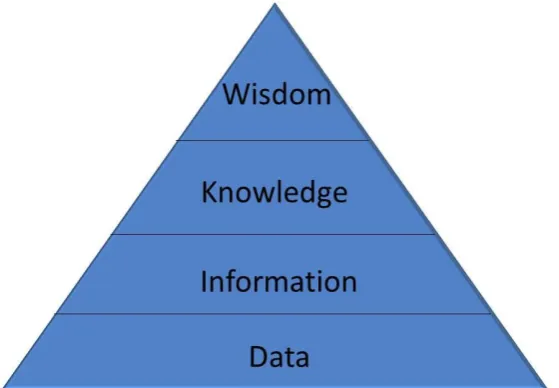
Information may be defined as data that has meaning (Mingers 1997; Ratzan 2004). Both data and information relate to knowledge, which can be defined as information regarded as true in its meaning, a sufficiency of which leads to understanding (Megill 2012; Hoyt et al. 2012). The critical use of knowledge to make intelligent decisions might be called wisdom (Hoyt et al. 2012). This can be represented in a developmental hierarchy (see Figure 1 below for an example).
Forster. 2015. Journal of Information Literacy, 9(1).
http://dx.doi.org/10.11645/9.1.1981 63
Information literacy (IL) appears to be a critical phenomenon in the context of this hierarchy. It is experienced by someone who can:
demonstrate an awareness of how they gather, use, manage, synthesise and create information and data in an ethical manner and … [has] the information skills to do so effectively.
(SCONUL 2011, p. 3) And as a result, they can:
synthesis[e] …information and data to create new knowledge
(SCONUL 2011, p. 11)
Research into the contextual experience of IL in recent years, acknowledged by such bodies as the Association of College and Research Libraries (ACRL) (2014), suggests that the Society of College, National and University Libraries (SCONUL) definition and others like it could be extended and developed further. This research can be interpreted to show that such experience is always focused on the creation of subjective knowledge, knowledge of a kind very focused on the context of the individual’s experience. This is knowledge in the sense of coming to a personal understanding of a topic new to the information user, not creation of knowledge from scratch, extending human understanding. Although IL may be regarded as coming at the very beginning of that process too: the literature search which starts off the primary research project.
Although the seventh of the seven pillars of IL (Present) is described as ”synthesising new and old information and data to create new knowledge” (SCONUL 2011, p. 11), the current SCONUL definition, like other widely-used definitions, does not incorporate this relationship between knowledge and information in an explicit way. Such incorporation, by making the purpose and value of IL clearer to some, might have a positive effect on its understanding and acceptance outside the information professions.
This paper originated in possible implications derived from a study of the experience of IL in the nursing profession (Forster 2015a). The findings from the study appeared to show that IL for nurses is always an experience of contextual knowledge creation, of the development of the knowledge and knowledge-based decision-making abilities that nurses need in the specific contexts of their practice. The findings from this study, together with the evaluation (or re-evaluation) of several previous studies based on the study’s findings, as well as consideration of recent work by Bruce and various colleagues (Bruce and Hughes 2010; Bruce et al. 2012; Bruce et al. 2014), led to the hypothesis that this may be true of IL experience in general.
In recent years, the awareness of IL as inherently focused on contextual knowledge generation, and its corresponding role and significance within education, has led to the development by Christine Bruce and her colleagues of the concept of informed learning (Bruce and Hughes 2010; Bruce et al. 2012) in which IL’s role within learning is described and made explicit. Informed learning is based on the belief, derived from “a program of research which has illuminated the experience of using information to learn in many contexts” (Bruce and Hughes 2010, p. A3), that IL and informed learning are almost one in the same. IL is something experienced in, and transferable to, a range of contexts and settings, and is fundamental to the learning process as a transformativegenerator of
Forster. 2015. Journal of Information Literacy, 9(1).
http://dx.doi.org/10.11645/9.1.1981 64
2. Information literacy as a phenomenon
In order to understand how it is experienced by information users in their day-to-day lives, a number of research studies have approached IL as a phenomenon (an experienced
concept) rather than a skills-knowledge mix or a competency. Such studies, applying the methodology of phenomenography, involve the interpretation of descriptions of such experiences, usually derived from semi-structured interviews (Marton 1988). The experiences are generalised, categorised and arranged in a logically-inclusive structure giving a picture of the collective experience of the concept within the group under analysis (Marton 1994), and hence yielding the range of its contextual meanings. Christine Bruce (Bruce 1997) was the first to use phenomenography to investigate IL. From her research into a group of Australian academics, she derived seven such generalised and categorised archetypes of experience, known in phenomenography as categories of description. An individual from the studied group might experience IL in any of the seven ways, as the context and purpose of information use varied. This approach to IL goes a step beyond other models in its sensitivity to the subjective, contextual way in which IL is experienced. As a result, this relational approach to IL is beginning to find mainstream acceptance:
ACRL’s previous definition of information literacy describes it as a set of skills or competencies that are uniform among all learners… Other conceptions growing out of the research of Bruce, Lupton, Lloyd, and Limburg identify the limitations of this skill- and- individual-attribute-based conception… [and] emphasize [instead] the highly relational, context-specific nature of information literacy.
(ACRL 2014, p. 4)
3. A research study into IL experiences in nursing
One group whose experience of IL has been investigated using phenomenography is the nursing profession (Forster 2015a). ILis believed to play a key role in nursing, especially in the context of evidence-based practice (EBP), the key initiative in which clinical practice is based on research and other evidence (Shorten et al. 2001; Barnard et al. 2005; Bailey et al. 2007; Ross 2010; Glasper 2011). Nurses must be able to gather, use, manage and
synthesise research evidence and other information sources, to create from them the knowledge and wisdom required to conceptualise, develop and deliver the safest, most effective care possible (Nursing and Midwifery Council (NMC) 2010a; NMC 2010b; Hughes 2008; Pearson et al. 2007; Sackett et al. 1997).
The study employed methods adapted from previous phenomenographic research, including the more recently developed transcript-based data analysis technique (Åkerlind 2005;
Forster 2015b). This builds categories of description from partial experiences: experiences of each of the several aspects of which IL consists for the studied group. As we will see, the high level of structural detail in the analysis of experience provided by these methods was critical to the development of the hypothesis set out in this paper.
Forster. 2015. Journal of Information Literacy, 9(1).
http://dx.doi.org/10.11645/9.1.1981 65
The seven contexts or aspects are:
1. IL experienced in processes of professional self-development
2. IL experienced in development and maintenance of relationships (with patients, patients’ families, colleagues and other professionals)
3. IL experienced through its role in helping to achieve best practice 4. IL experienced within understandings and experiences of EBP
5. IL experienced within application of skills and processes of evidence and other information gathering
6. IL experienced in the context of an understanding and knowledge of the principles and concepts behind evidence and other information gathering 7. IL experienced through applicable conceptions of information
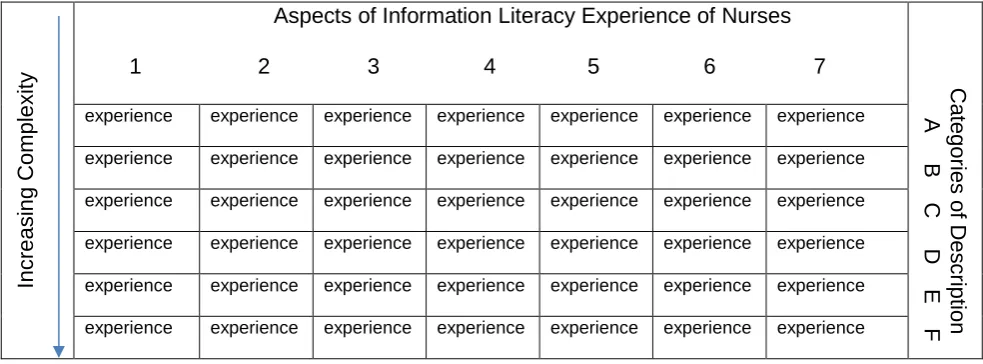
Under each of the seven aspects, a range of experiences of that aspect of IL could be listed. These vary in complexity and focus (these two variables being intimately dependent on each other).
These partial experiences, some process- and some knowledge-focused, will become significant when we look at how categories of description from other studies, ones which seem to involve only processes rather than knowledge development, can be redefined as partial experiences of IL.
Six categories of description: Six variations in the ways of experiencing IL in nursing, were identified. These six ways were related to each other by means of increasing complexity of experience (from A to F, see below). That is, an ever greater ability to experience the potentialities (Marton and Booth 1997; Åkerlind 2008) of IL in the context of nursing, and so initiating the development of ever more complex knowledge.
The categories of description, as they are descriptions of complete experiences, incorporate partial experiences from each of the seven aspects or contexts of IL experience.
Figure 2. The relationship between aspects of experience of IL, experiences of
each aspect of varying complexity and categories of description
Increasi ng C ompl exi ty
Aspects of Information Literacy Experience of Nurses
1 2 3 4 5 6 7
C a teg orie s of D es cr iptio n A B C D E F
experience experience experience experience experience experience experience
experience experience experience experience experience experience experience
experience experience experience experience experience experience experience
experience experience experience experience experience experience experience
experience experience experience experience experience experience experience
experience experience experience experience experience experience experience
Forster. 2015. Journal of Information Literacy, 9(1).
http://dx.doi.org/10.11645/9.1.1981 66
Each category could be described by means of a persona, an uncommon technique in defining categories of description but one thought justified due to the professional role context of the experiences. It was also found that each category of description, each archetypal experience of IL in nursing, could be described in terms of the contextual knowledge developed through the IL experience they described. The complexity of knowledge (as with complexity of experience) increasing from A to F:
A The passive minimalist
The facts are obtained to deal with the immediate and simple issue or context. (creating knowledge to perform specific basic tasks)
B The knowledgeable goal achiever
A focusing on specific goals. Information is sought out, identified and applied in the context of specific clinical requirements (creating knowledge for specific planned goals).
C The focused, competent and evolving professional
IL informs processes of professional effectiveness and achieved functionality. Through a widening awareness of the value of finding and applying evidence to improve practice and patient outcome (creating knowledge to develop professional competence – to function effectively in particular day-to-day roles).
D The confident and trusted promoter of justifiable change
In which the nurse is functioning in a way that is confident, trusted and with that increasing grasp of the parameters of practice which results in an understanding of the potential value of change (creating knowledge that can be used as an agent of change through an understanding of situations and contexts).
E The teacher and promoter of an evidence-based culture
Development of an information-rich culture in the workplace, often in a teaching role, especially with junior staff (developing knowledge infrastructures which allow specific
roles to be performed which areof the kind which must be based on a complete or
almost complete understanding of a context or activity).
F The leader, philosopher and strategist
The development of the ability to think strategically and philosophically. The strategic use of evidence and other information (developing knowledge infrastructures which allow one to act as an established source or vector of ‘wisdom’ and decision-making in various specific contexts)
In the most complex experiences, this was expressed in terms of the associated decision-making contexts the knowledge facilitated:
Hence, although the categories of description all contained aspects of experience which were process-focused, the categories themselves were all context-specific and knowledge-development focused, incorporating aspects which were focused on the knowledge required for particular clinical functions.
Forster. 2015. Journal of Information Literacy, 9(1).
http://dx.doi.org/10.11645/9.1.1981 67
4. Researching the IL experience: other studies
As mentioned above, phenomenographic methods have been taken up by other researchers to investigate how IL is experienced in various specific groups and contexts. Five such studies will be used as examples: Limberg 1999; Williams 2007; Boon et al. 2007; Lupton 2008; and Diehm and Lupton 2012.
4.1 Lupton(2008): College students
Lupton (2008) found three categories of description to describe the ways first-year college students experienced IL:
1. Seeking of evidence to back up an existing argument; 2. Seeking information to develop an argument;
3. Seeking information in the process of “learning as a social responsibility”.
Category 1 involves knowledge accumulation for a specific intellectual task; In category 2 as knowledge extension, again for an intellectual purpose which is fully context-specific.
Category 3, a wider and more sophisticated experience: knowledge accumulation as a function within learning. Learning is always about something specific; always therefore contextualised.
4.2 Boon et al. (2007): Academics
Boon et al. (2007) investigated UK English Literature academics’ experiences of IL and identified the following categories of description:
1. IL was experienced as locating information as text
2. A focus on the location of information by means of IT. - A more systematic
accumulation of information than in category one, based on knowledge requirements expressed as keywords.
3. The experience of IL as part of the deployment of research skills – a development of knowledge in order to form a new perspective, or at a smaller scale problem-solve. 4. IL experienced as a contribution to personal growth and development and the
acquisition of higher order information skills in order to become confident autonomous learners and critical thinkers.
Category four goes beyond the problem-solving of category three to the more sophisticated experience of an individual who has absorbed IL into an attitude and an instinctive approach to work and life in general in which knowledge is obtained to make relevant decisions.
Categories one and two appear not to be focused on contextual knowledge accumulation. How these basic, function-focused information gathering categories can be understood as partial and incomplete will be discussed later in the paper.
4.3 Limberg (1999): University students
Forster. 2015. Journal of Information Literacy, 9(1).
http://dx.doi.org/10.11645/9.1.1981 68
perhaps the ability to undertake “knowledge-based decision making”of the type referred to above.
4.4 Williams (2007): Secondary school teachers
Williams (2007) looked into conceptions (different meanings derived from contextual experiences) of IL of secondary school teachers, in the context of information-based interactions with their students. She found the following six categories of description:
1. Finding information– emphasising the ability to obtain simple knowledge by navigating the sources
2. Linguistic understanding – involving comprehension of the significance of new information and how it adds to existing knowledge.
3. Making meaning – deriving meaning from information within the context of the specific subject under consideration.
4. Skills – applying information from many sources to make meaning and evaluating and reflecting on decisions.
5. Critical awareness of sources– evaluating the quality and validity of Information 6. Independent learning – the ability to select and apply relevant skills and strategies for
current purpose in and in a variety of situations, in order to learning independently
Although skills are highlighted, IL is always about adding to the information user’s knowledge in specific contexts.
4.5 Diehm and Lupton (2012): Learning IL
Diehm and Lupton (2012) used phenomenography to investigate experiences of “learning IL” (Diehm and Lupton 2012, p. 218). This was defined in terms of learning the roles information had in learning experiences and varied in terms of complexity of the knowledge and ability to use knowledge it generated.
The six categories of description were:
1. Learning to find information
2. Learning a process to use information
3. Learning to use information to create a product
4. Learning to use information to build a personal knowledge base 5. Learning to use information to advance disciplinary knowledge
6. Learning to use information to grow as a person and to contribute to others
Again, the least-sophisticated categories seem to be process-focused, the later (two to five) on knowledge generation for specific learning goals and the sixth category seemed to involve knowledge-based decision making.
4.6 Summary
These studies and others like them can be summarised as producing categories of description of three types:
1. Process categories in which the experience is focused on Information skills and competence
Forster. 2015. Journal of Information Literacy, 9(1).
http://dx.doi.org/10.11645/9.1.1981 69
3. Knowledge-based decision-making or wisdom categories, in which knowledge is developed to enable effective decision-making, teaching or similar knowledge-backed creative activities.
Categories of description of types two and three clearly support the hypothesis set out at the beginning of the paper. Type one categories, which apparently contradict it, will be
discussed in the next section, where it will be demonstrated how they can be re-interpreted in a way which reconciles them to that hypothesis.
5. Contradictory evidence? Non-knowledge development focused
categories of description
Evidence for an immediate challenge to the hypothesis set out in this paper seems easy to find. Less sophisticated categories of description in some studies (such as Bruce’s original study (1997); and those by Boon et al. (2007) and Diehm and Lupton (2012) – the process categories described in the previous section) - don’t seem to be focused in this way.
However such categories seemed to be reinterpretable based on the findings of the nursing study (Forster 2015a) and these reinterpretations reconciled themselves to the hypothesis.
As we have seen, the nursing study showed that complete experiences of IL as described by the categories of description consisted of all seven of its aspects or contexts. Some of these aspects, primarily numbers five, six and seven, had functional characteristics. However, functional experiences of IL were always partial ones and always formed part of a complete experience focused on contextual knowledge development, as defined and contextualised by the category of description personas.
This view of categories of description (archetypal descriptions of experiences of phenomena) as containing several aspects including necessarily both functional and meaning-focused ones, is supported by Husserl’s analysis of the essential nature of the experience of phenomena (Cerbone 2006). Husserl described such experience as a composite of an awareness of process (or noetic themes, which describe the “activity across time”
component of the experience of a phenomenon) and an awareness of meaning. Experiences must have meaning as well as functionality. That meaning, in the experience of IL, is the knowledge developed for the purposes experienced in the context of that experience.
In the analysis below, Bruce’s well-known original study (Bruce 1997) will be used as an example of how what appear to be process categories of description can be reconciled to the hypothesis put forward by this paper: that all experiences of IL are information-to-knowledge/understanding focused.
As mentioned above, Bruce’s study described seven categories of description representing the variation in the IL experience of a sample of Australian academics:
1. As a user of IT
2. As knowing what information sources to use 3. Knowing processes to search those sources
4. Information control: having information stored and easily to hand 5. Knowledge construction: building a personal knowledge base
6. Knowledge extension: combining knowledge and personal perspectives to create new insights
Forster. 2015. Journal of Information Literacy, 9(1).
http://dx.doi.org/10.11645/9.1.1981 70
Although the knowledge-focused categories four to seven:knowledge construction (four and five); developing knowledge into decision-making ability (six); and acting as a source of wisdom (seven) can be seen as similar to those in the nursing study, what of the less sophisticated ones?
Categories one, two and three in Bruce’s study would appear to be process categories: descriptions of technical functionality within the IL experience rather than knowledge development as such. Bruce’s categories one, two and three and similar categories from other studies are recognisable in the findings of the nursing study, but only as a partial IL experience. That is, described only by one or two of the aspects which make up the whole experience of IL. These whole experiences always had other aspects which gave them a meaning, in the form of the contextual knowledge being developed; a meaning missing in these categories.
For example, category three in Bruce’s study ”Knowing processes to search those sources” can be matched to only two of the seven aspects or contexts: number six ”Understanding and knowledge of the principles and concepts behind evidence and other information gathering” and number five: “Application of skills and processes of evidence and other information gathering” and the experiences of these partial aspects of IL in their varying complexity. For instance, those for aspect five:
Negotiating the technology
Knowing how to use a library/ Library resource website Practising time efficient information gathering
Structuring evidence searches effectively Finding all or sufficient evidence
Critiquing relevant evidence effectively
Gathering and applying key information within the ward environment Gathering evidence effectively for a team, or group project: guideline
development or policy change
Having ‘clarity of purpose and action’ when gathering evidenceIncreasing in complexity of experience from top to bottom.
Bruce 1997
Category one “As a user of IT” (as might be expected) seems even more limited. It can only be matched to Aspect number five, and only the least complex experiences: “Negotiating the technology” and “Knowing how to use a library/ Library resource website”. Category two: “As knowing what information sources to use” can only be matched to some experiences of aspect number six. Hence categories of description of the less-sophisticated information gathering activities/knowledge type found in some studies, could (and perhaps should) be redefined as partial experience of IL, not complete categories of description at all.
This leaves us with only the second and third type of category mentioned in the previous section: Knowledge categories in which the experience is clearly marked as developing knowledge; knowledge of something, for a particular purpose; and knowledge-based
decision-making or wisdom categories. Experiences of IL, as described in archetypal form by categories of description are either those (in terms used in the introduction) which develop knowledge of the subject in the information user and those more advanced experiences which create enough understanding from extensive, well-structured knowledge, to facilitate effective decision-making.
Forster. 2015. Journal of Information Literacy, 9(1).
http://dx.doi.org/10.11645/9.1.1981 71
6. Conclusion
What would be the value of explicit recognition of the contextual knowledge-focused nature of the IL experience? By modifying the SCONUL definition of IL with this recognition in mind, it might give it a meaning it could be said to lack for some. Non-information professionals often fail to grasp what IL is, beyond a generalised description of activities, missing its role in learning and personal and professional development. This has surely limited its acceptance and appreciation. The limitations and inadequacies of a behaviourist definition of IL (Bruce 1998) reinforces this point. An alteration of the definition to make explicit that IL is always involved in the development of specific, contextual knowledge and hence, as Bruce and colleagues have proposed (Bruce and Hughes 2010), part of the learning process, may finally drive home the significance and importance that information professionals and researchers know it to have.
Therefore, a modified definition could be:
An information-literate person can demonstrate an awareness of how they gather, use, manage and synthesise information and data in an ethical manner in the development of their contextual knowledge and understanding … and [has] the information skills to do so effectively.
Further studies, making use of the methods described in Åkerlind (2005) and Forster
(2015b), are needed. As indicated in this paper, the structural detail of IL experiences which these methods make available for analysis was key to the development of this hypothesis, and could be used to confirm (or undermine) it.
References
ACRL 2014. First part of the draft framework for information literacy for higher education. [Online]. Available at: http://acrl.ala.org/ilstandards/wp-content/uploads/2014/02/Framework-for-IL-for-HE-Draft-1-Part-1.pdf [Accessed: 28 May 2015
].
Åkerlind, G.S. 2005. Phenomenographic methods: a case illustration. In: Bowden, J. & Green, P. (eds.) Doing developmental phenomenography. Melbourne: RMIT University Press, pp. 103-127.
Åkerlind, G.S. 2008. A phenomenographic approach to developing academics’
understanding of the nature of teaching and learning. Teaching in Higher Education 13(6), pp. 633-644.Available at: http://dx.doi.org/10.1080/13562510802452350
Bailey, P. et al. 2007. Assessing the impact of a study skills programme on the academic development of nursing diploma students at Northumbria University, UK. Health Information & Libraries Journal 24(Suppl 1), pp. 77-85. Available at: http://dx.doi.org/10.1111/j.1471-1842.2007.00741.x
Barnard, A. et al. 2006. Information literacy: developing lifelong skills through nursing education . Journal of Nursing Education 44(11), pp. 505-10.
Boon, S. et al. 2007.A phenomenographic study of English faculty's conceptions of information literacy. Journal of Documentation 63(2), pp. 204-228. Available at: http://dx.doi.org/10.1108/00220410710737187
Bruce, C. 1997. Seven faces of information literacy. Adelaide: AUSLIB Press.
Forster. 2015. Journal of Information Literacy, 9(1).
http://dx.doi.org/10.11645/9.1.1981 72
Bruce, C. and Hughes, H. 2010. Informed learning: a pedagogical construct connecting information and learning. Library and Information Science Research 32(4), pp. A2-A8. Available at: http://dx.doi.org/10.1016/j.lisr.2010.07.013
Bruce, C. et al. 2012. Supporting informed learners in the 21st century. Library Trends 60(3), pp. 522-545. Available at: http://dx.doi.org/10.1353/lib.2012.0009
Bruce, C. et al. 2014. Diversifying information literacy research: an informed learning perspective. In: Bruce, C.et al. (eds) Information experience: approaches to theory and practice. London: Emerald, pp. 169-189.
Cerbone, D.R. 2006. Understanding phenomenology. Durham, UK: Acumen.
Diehm, R. and Lupton, M. 2012. Approaches to learning information literacy: a
phenomenographic study. The Journal of Academic Librarianship 38(4), pp. 217-225. Available at: http://dx.doi.org/10.1016/j.acalib.2012.05.003
Forster, M. 2015a. 6 ways of experiencing information literacy in nursing - the findings of a phenomenographic study. Nurse Education Today 35(1), pp. 195–200. Available at: http://dx.doi.org/10.1016/j.nedt.2014.06.005
Forster, M. 2015b. Phenomenography: A methodology for information literacy research. Journal of Librarianship and Information Science. Available at:
http://dx.doi.org/10.11770961000614566481
Glasper, E.A. 2011. The RCN's literacy competences for evidence-based practice. British Journal of Nursing 20(3), pp. 188-9. Available at:
http://dx.doi.org/10.12968/bjon.2011.20.3.188
Hoyt, R.E. Bailey, N. and Yoshihashi, A. 2012. Health informatics: practical guide for healthcare and information technology professionals. 5th ed. Raleigh, N.C.: Lulu.
Hughes, R.G. 2008. Nurses at the “sharp end” of patient care. In: Hughes, R.G. ed. Patient safety and quality: an evidence-based handbook for nurses. Rockville (MD): Agency for Healthcare Research and Quality, pp. 7-36.
Limberg, L. 1999. Three conceptions of information seeking: a use. In: Wilson. T.D. and Allen, D.K. eds. Exploring the contexts of information behavior. London: Taylor and Graham, pp. 116—135.
Lupton, M. 2008. Evidence, argument and social responsibility: first-year students’
experiences of information literacy when researching an essay. Higher Education Research & Development 27(4), pp. 399–414. Available at:
http://dx.doi.org/10.1080/07294360802406858
Marton, F. 1988. Phenomenography: a research approach to investigating different understandings of reality. In: Sherman, R.R. and Web R.B (eds). Qualitative research in education: focus and methods. London: Routledge Farmer, pp. 141-161.
Marton, F. 1994. Phenomenography. In: Husen, T. and Postlethwaite. T.N. (eds). International Encyclopedia of Education vol. 8, 2nd ed. London: Pergamon.
Forster. 2015. Journal of Information Literacy, 9(1).
http://dx.doi.org/10.11645/9.1.1981 73
Megill, K.A. 2012. Thinking for a living: the coming age of knowledge work. Boston, MA: Walter De Gruyter. Available at: http://dx.doi.org/10.1515/9783110289671
Mingers, J. 1997. The nature of information and its relationships to meaning. In: Winder, R. et al. (eds). Philosophical aspects of information systems. London: Taylor and Francis. pp. 73-84.
Nursing and Midwifery Council (NMC) 2010a. The code: standards of conduct, performance and ethics for nurses and midwives. [Online]. Available at:
http://www.nmc-uk.org/Publications/Standards/The-code/Introduction/ [Accessed: 4 September 2012].
Nursing and Midwifery Council (NMC) 2010b. Standards for pre-registration nursing education. London: NMC.
Pearson, A. et al. 2007. Evidence-based clinical practice in nursing and health care: assimilating research, experience and expertise. Oxford: Blackwell Publishing.
Ratzan, L. 2004. Understanding information systems: what they do and why we need them. New York: American Library Association.
Ross, J. 2010. Information literacy for evidence-based practice in perianesthesia nurses: readiness for evidence-based practice. Journal of PeriAnesthesia Nursing 25(2), pp64-70. Available at: http://dx.doi.org/10.1016/j.jopan.2010.01.007
Sackett, D.L. et al. 1997. Evidence based medicine: how to practice and teach EBM .Edinburgh: Churchill Livingstone.
SCONUL. 2011. SCONUL seven pillars of information literacy. [Online]. Available at: http://www.sconul.ac.uk/groups/information_literacy/papers/Seven_pillars2.pdf [Accessed: 23 December 2011].