(will be inserted by the editor)
Deep Imitation Learning for 3D Navigation Tasks
Ahmed Hussein · Eyad Elyan ·
Mohamed Medhat Gaber · Chrisina Jayne
Received: date / Accepted: date
Abstract Deep learning techniques have shown success in learning from raw high dimensional data in various applications. While deep reinforcement learn-ing is recently gainlearn-ing popularity as a method to train intelligent agents, uti-lizing deep learning in imitation learning has been scarcely explored. Imitation learning can be an efficient method to teach intelligent agents by providing a set of demonstrations to learn from. However, generalizing to situations that are not represented in the demonstrations can be challenging, especially in 3D environments. In this paper, we propose a deep imitation learning method to learn navigation tasks from demonstrations in a 3D environment. The su-pervised policy is refined using active learning in order to generalize to un-seen situations. This approach is compared to two popular deep reinforcement learning techniques: Deep-Q-networks (DQN) and Asynchronous actor critic (A3C). The proposed method as well as the reinforcement learning methods employ deep convolutional neural networks and learn directly from raw visual input. Methods for combining learning from demonstrations and experience are also investigated. This combination aims to join the generalization abil-ity of learning by experience with the efficiency of learning by imitation. The proposed methods are evaluated on 4 navigation tasks in a 3D simulated en-vironment. Navigation tasks are a typical problem that is relevant to many real applications. They pose the challenge of requiring demonstrations of long trajectories to reach the target and only providing delayed rewards (usually terminal) to the agent. The experiments show that the proposed method can successfully learn navigation tasks from raw visual input while learning from
Ahmed Hussein·Eyad Elyan·Chrisina Jayne E-mail: [email protected]
School of Computing Science and Digital Media, Robert Gordon University, The Sir Ian Wood Building, Garthdee Rd, Aberdeen AB10 7GE, United Kingdom
Mohamed Medhat Gaber
experience methods fail to learn an effective policy. Moreover, it is shown that active learning can significantly improve the performance of the initially learned policy using a small number of active samples.
Keywords Deep Learning· Convolutional Neural Networks·Learning from Demonstrations·Reinforcement Learning·Active Learning·3D Navigation·
Benchmarking
1 Introduction
Recent years have seen a rise in demand for intelligent agents capable of per-forming complex motor actions. Advances in robotics and computational ca-pabilities provide opportunities for many potential applications such as assis-tive robots, autonomous vehicles and human computer interaction. However the challenge remains to create intelligent agents capable of robust and ef-fective behavior. Most applications are dynamic and involve many variables and are therefore not suitable for manually designed policies. It is also dif-ficult to breakdown and articulate how humans perform tasks in order to program intelligent agents to replicate this behavior. For instance it is hard for an experienced driver to describe to another human how to drive well. A more intuitive and effective method of imparting this knowledge is to show the student examples of good driving.
challenges of imitation learning by utilizing deep learning to learn feature rep-resentations and active learning to improve generalization using a relatively small number of samples. The main extension in this paper is comparing the proposed methods with state of the art deep reinforcement learning methods as well as creating methods for combining reinforcement learning with learning from demonstrations. Utilizing both taught behavior and experience in learn-ing aims to mitigate the limitations of each approach. By allowlearn-ing the agent to explore using trial and error, it is exposed to new scenarios and is able to gen-eralize without requiring a teacher’s involvement. While demonstrations can provide a starting point to learn more efficiently than learning from scratch using trial and error.
The proposed learning method is generic and doesn’t require any prior knowledge of the task. The only information presented to the agent is the demonstrations, which are acquired by controlling the agent using a determin-istic optimal policy. For each frame, the agent’s point of view and the action performed are captured and used to construct a dataset of observation/action pairs. A deep convolutional neural network is trained on the captured dataset to learn a policy that mimics the demonstrated behavior. Since direct imi-tation can lead to poor generalization, active learning is employed to adapt to situations that are not represented in the demonstrations. Active samples are selected based on the confidence of the agent’s current policy. The agent queries the optimal policy to suggest actions for these instances. The trained policy interacts with the 3D environment in real time, observing the current state, extracting features and predicting the action to perform in a timely man-ner. The proposed learning from demonstration method is compared to two popular deep reinforcement learning methods: Deep-Q-networks (DQN) which has shown human level behavior on learning Atari games from raw pixels and paved the road for deep reinforcement learning methods, and Asynchronous actor critic (A3C) learning that is considered the state of the art in deep reinforcement learning and has shown success on a 3D navigation task. More-over, we investigate methods for combining learning from demonstrations and reinforcement learning to alleviate the generalization limitations of imitation methods and help reduce the search space of trial and error methods. Ex-tensive experiments are conducted on four navigation tasks in the 3D MASH simulator [2] as well as a simple 2D navigation task to analyze the performance of the methods used in this paper. The evaluation highlights the challenges and advantages of the different approaches.
2 Background
Deep learning methods have shown great success in learning from high dimen-sional raw data in a variety of applications. Convolutional Neural Networks (CNN) are used in many computer vision applications to learn from raw pixels and achieve state of the art results in various image classification tasks [3, 4]. CNNs are effective because they employ multiple convolution layers that au-tomatically extract higher level patterns from the input features which are more useful for learning. Automatically extracting feature representations can greatly facilitate creating generic learning processes for learning from demon-stration. Where the same network architecture can extract relevant features for different situations depending on the provided demonstrations.
A different approach for creating intelligent behavior in agents is learning from experience. Learning from experience relies on trial and error and uses reinforcement learning to train a policy based on feedback from a reward func-tion. Deep reinforcement learning is rapidly gaining attention due to recent successes in a variety of problems [5, 6, 7, 8, 9, 10]. The combination of deep learning and reinforcement learning allows for a generic learning process that does not consider specific knowledge of the task and learns from raw data. Reinforcement learning (RL) is a popular choice for learning motor actions because most tasks can be modeled as a Markov decision process. Moreover, optimizing a reward function arguably provides a better description of a task than optimizing a policy [11]. Learning from experience can produce robust policies that generalize to dynamic scenarios by balancing exploration and ex-ploitation of rewards. However, finding a solution through trial and error may take too long. Especially in problems that require performing long trajectories of actions with delayed rewards. In such cases it may be extremely difficult to stumble upon rewards by chance. And the time to learn a policy to maximize the rewards exponentially increases. Such challenges are present in many real life applications and pose limitations to current methods. Another drawback is that learning through trial and error may result in a policy that solves the problem differently to how a human would. Performing a task in a manner that is intuitive to a human observer may be crucial in applications where humans and intelligent agents interact together in an environment.
ini-tially learned policy. Moreover, supervised learning needs a sufficient number of demonstrations which for deep network architectures may be large.
Navigation is an important skill for intelligent agents due to its relevancy to a variety of applications. Navigation can be a main task as in autonomous vehicle applications [14, 15, 16, 17, 18, 19, 20] or as a base skill for other tasks such as humanoid robots which need to move before performing other tasks [21, 22]. Navigation tasks present a set of problems where the agent is typically required to perform long trajectories and receives rewards at the end of the trajectory. In many applications it is not realistic to design intermediate rewards and is common in navigation tasks to only provide terminal rewards after reaching the target. Navigation from visual input also poses an extra challenge as the view of the agent changes constantly as it moves around the environment making it more difficult to observe relations between subsequent states. This is in contrast for example to object manipulation tasks where a static view contains all the information needed by the agent, and changes from one frame to the next can be more easily tracked.
3 Related Work
In this section we present related work and review methods that utilize deep learning in imitation learning and reinforcement learning methods. This sec-tion also surveys different methods proposed in the literature to combine learn-ing from demonstrations and experience.
3.1 Navigation
agent learns to identify sub-goals from its observations. A more detailed repre-sentation of the environment can be provided by visual data. High dimensional visual data can be efficiently provided to intelligent agents thanks to advances in computational resources and communication technology. An agent learns to play a racing game from visual data in [26]. A teacher plays the game using a controller, and the controller’s input is captured along with the game’s video stream to create a training dataset. The video stream is stored as raw pixels and down sampled versions of the frames are input into a neural network. In [9] a deep reinforcement learning algorithm is used to teach an agent in a racing simulator from raw visual features. The learned policy maps the high dimensional visual input to multiple continuous outputs such as steering and pressing the acceleration pedal. Another racing application is demonstrated in [27] where the training algorithm uses features extracted from the simulator (such as the position and speed of the car). It is shown that learning from demonstration can be used to handle high degree of freedom low level actions, however, features such as those extracted from the simulator are difficult to produce in real world applications. Learning from visual information is not limited to the point of view of the agent. In [17] an imitation learning method is proposed to train a vehicle to navigate over long distances by learning from overhead data captured from satellite and aerial footage. Recently, state of the art deep reinforcement learning methods have been evaluated on 3D navigation tasks [28][29]. However, these benchmark tools are not publicly released.
3.2 Deep learning from demonstrations and experience
with continuous action spaces, [9] adapt the contributions of DQN are adapted to an actor-critic reinforcement learning method. This algorithm consists of an acting step, in which a convolutional neural network outputs an action in continuous space, and a critic step where the rewards from the environment are used to evaluate the performed action. This approach is demonstrated to successfully learn tasks that require continuous input such as racing simulators from raw pixels. In [29] a number of asynchronous deep reinforcement learning methods are proposed. Instead of the replay buffer, these methods enforce di-versity in the training samples by creating parallel threads in which multiple agents are acting; each in its own environment. Discarding the replay buffer and relying on parallel online learning allows both on-policy and off-policy re-inforcement learning methods to be adapted to this approach. The best results from the methods proposed in this work belonged to Asynchronous advantage actor-critic (A3C) and set a new state of the art on the Atari benchmark and showed success on a 3D navigation task. A3C has been evaluated using a feed forward network similar to the one used in DQN and a Long-short-term-memory (LSTM) network that considers the past when predicting a new action. A version of A3C has been modified in [10] to take an image of the target as input in addition to the current view of the agent. The results show that this extra information significantly decreases the time required to reach the target.
3.3 Combining learning from demonstrations and experience
A common paradigm in combining learning from demonstrations and experi-ence is to train the agent using reinforcement learning while using demonstra-tions to provide information that helps the reinforcement learning process. One such method is apprenticeship learning [11] where demonstrations are used to infer a reward function rather than to directly train a policy. There-fore apprenticeship learning doesn’t need to receive explicit rewards from the environment. Instead, it is assumed that the demonstrator is attempting to solve the task in a manner that optimizes an unknown reward function. The demonstrations are then used to learn an estimation of this reward function. The learned reward function provides feedback to the reinforcement learning algorithm in order to learn a policy. This approach in addition to not requiring an explicit reward system, has the advantage of creating a policy that follows the demonstrator’s priorities. However, insufficient demonstrations that don’t cover possible scenarios can affect the generalization ability of the agent by creating an inadequate estimation reward function. Deep learning has been integrated with apprenticeship learning to train the reinforcement learning algorithm from raw pixels using a convolutional neural network [35].
In [6] supervised learning is used in two different ways to assist deep rein-forcement learning to learn to play the board game ’GO’. Firstly a dataset of previous games is used to train a supervised convolutional neural network to play the game. The weights of the network are used to initialize the network used for reinforcement learning, so the agent starts exploring from a good starting policy. Secondly a set of recorded games is used to train a network to predict whether the game will end in a win or a loss given the current state. This evaluation function provides feedback to the reinforcement learn-ing algorithm so it can learn from the estimated consequences of each action. This method significantly outperforms direct imitation [36] and has shown the ability to beat human experts.
applications may not be practical. Therefore demonstrations are used to train an initial policy using supervised loss as well as temporal difference (TD) loss. DQN is then used to retrain the policy by continuing to optimize the TD loss. This method shows significantly faster learning than using DQN from scratch, and outperforms using RL only on a number of Atari games.
3.4 Active learning
4 Methods
This section presents the proposed method for learning from demonstration us-ing active learnus-ing and deep neural networks. Methods for combinus-ing learnus-ing from demonstrations and experience using deep networks are also described.
4.1 Deep Active Imitation Learning
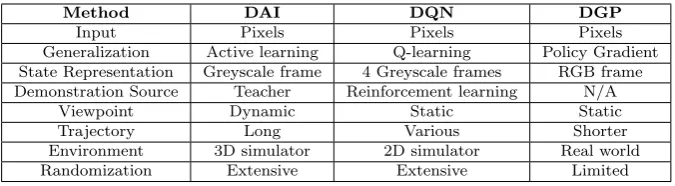
The proposed method is divided into three processes: 1- Collecting Demon-strations. 2- Supervised training of the neural network. 3- Active learning to refine the initially learned policy. This novel method combines supervised deep learning with data aggregation using active learning to produce a robust imitation learning approach with a relatively small number of training sam-ples. Table 1 summarizes key differences between the proposed method, Deep Active Imitation (DAI), and other approaches that use deep learning that learn from raw pixels, Deep-Q-Networks (DQN) [30] and Deep Guided Policy (DGP) [7]. The table shows differences in the approaches such as the methods used to generalize the policy to unseen scenarios, the methods used to gather demonstrations and how the states are constituted from the captured frames. Moreover, it shows differences in the tasks and environments in which the dif-ferent approaches are utilized. The viewpoint is the perspective from which the state of the environment is captured. Having a fixed point of view may help keep track of changes in the state while having a dynamic viewpoint can be more challenging as the scene changes completely with small movements in the viewpoint. The trajectory refers to the sequence of steps typically needed to successfully complete the task. A longer trajectory can be harder to learn as small errors mid trajectory can propagate and cause failure to reach the target. The environments refers to the settings in which the experiments are conducted. The environment can be randomized at every run, so the agent is faced with unfamiliar states. The more random the environment, the more the agent’s policy needs to generalize to the changing circumstances.
Table 1: A comparison of deep learning agent approaches
Method DAI DQN DGP
Input Pixels Pixels Pixels
Generalization Active learning Q-learning Policy Gradient State Representation Greyscale frame 4 Greyscale frames RGB frame Demonstration Source Teacher Reinforcement learning N/A
Viewpoint Dynamic Static Static
Trajectory Long Various Shorter
Environment 3D simulator 2D simulator Real world Randomization Extensive Extensive Limited
by the teaching policy. A teacher providing demonstrations may be assumed to be optimizing an unknown optimal function. Therefore as the teaching pol-icy we use a deterministic optimal polpol-icyπ∗ to control the agent. This policy has access to information from the simulator such as the position of the agent and the target in 3D space in order to deterministically calculate the optimal action. For each frame t the view of the agent is captured as well as the ac-tion chosen by the optimal policy. This pair (xt, yt) is added to the dataset of
demonstrationsD = (x, y) where xi is a 120×90 image and yt is the action
predicted byπ∗(xt). Only one frame is used in an instance (xt, yt) as opposed
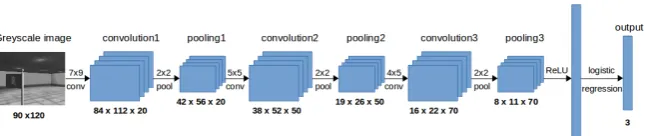
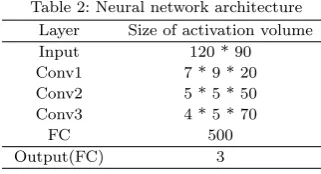
to a sequence of consecutive frames which is usually used in deep reinforcement learning. Many AI applications are formulated as a Markov Decision Process (MDP) where the current state on its own is sufficient to predict the action to perform. And while deep reinforcement learning methods [30][5] commonly represent the state by a sequence of frames, in the navigation tasks at hand the current view of the agent is enough for the optimal policy to make a de-cision. Next the captured dataset D is used to train the policy π such that u=π(x, α). Wherexis a 120×90 image anduis the action predicted by policy πfor inputxandαis the set of policy parameters that are changed through learning. The policy is learned using a deep convolutional neural network. The network used has 3 convolution layers with rectifier unit activation functions. Each layer automatically extracts higher level features from its input. The in-put to the first convolution layer is a luminance map of the captured 120x90 image. This transformation allows us to use one channel for greyscale instead of three channels for the RGB colors. Each convolutional layer is followed by a pooling layer to further reduce the dimensionality. Following is a fully con-nected layer with a rectifier unit activation function and finally an output layer which directly represents the action available to the agent. Figure 1 and Table 2 show the architecture of the network
Fig. 1: Architecture of the neural network used to train the agent
Table 2: Neural network architecture Layer Size of activation volume
Input 120 * 90
Conv1 7 * 9 * 20 Conv2 5 * 5 * 50 Conv3 4 * 5 * 70
FC 500
Output(FC) 3
current state. The opposite is the case if one action is far more probable than the rest. The confidence of the agent is estimated as the entropy of the action probabilities.
H(X) =−X
i
P(xi) log2P(xi) (1)
WhereX is a vector representing the output of the final layer in the net-work,P(xi) is the probability of taking actioni. The agent queries the optimal
policy if its confidence is lower than a certain threshold. The action returned by the optimal policy and the current frame are recorded in a dataset of ac-tive samples. The acac-tive samples represent situations that were unseen in the initial training data but are likely to appear when executing the current pol-icy. Thus active learning helps the agent generalize to relevant scenarios. The training dataset is augmented with the active dataset and used to update the agent’s policy. The policy is updated by keeping the network weights learned during supervised learning when training the network using the augmented dataset. Initializing the weights in this way results in faster and easier con-vergence as retraining the network from scratch with the augmented dataset can be time consuming [42]. The training set used in this step includes both the active samples and the samples originally collected from demonstrations. If the network is only updated with the active samples, the initial policy is forgotten and replaced by one solely learned from the active samples, which is not sufficient [43]. This is known as the catastrophic forgetting phenomena [44] and can have severe effects on the agent’s performance if the network was trained online using the acquired active samples.
Algorithm 1 shows the proposed method.
4.2 Combining Deep Learning from Demonstrations and Experience
Algorithm 1Active Deep Imitation Learning Algorithm
1: Given:A policyπtrained on a Data setD= (xi, yi)
Confidence thresholdβ
2: whileActive Learningdo
3: x= current frame 4: u=π(x, α) 5: H(X) =−P
i
P(ui) log2P(ui)
6: ifH(X)< βthen
7: y=Query(x)
8: perform actiony
9: add (x, y) toD
10: else
11: performmax(u) 12: UpdateπusingD
demonstrations. a is the action taken by the agent and belongs to the same set of possible actions as y. r is a reward provided by the environment for performing actionain statesands0is the resulting new state. Reinforcement learning assumes the task takes place in an environment . An experience is represented as a tuple (s, a, r, s0) where s is the state, a is the action taken at state s,r is the reward received for performing actionaands0 is the new state resulting from that action. To combine learning from demonstrations and experience, the agent is trained using deep reinforcement learning while demonstrations are used to facilitate the training process. The reinforcement learning algorithm follows [5] and uses a convolutional neural network to learn discounted rewards for performed actions. The network optimizes a Q function Q(s, a) that predicts an estimated reward for the input state-action pair. The Q function is learned recursively using the Bellman equation.
Q(s, a) =Es0 [r+γmaxa0Q(s0, a0)|s, a] (2)
Whereγ is a discount parameter and maxa0Q(s0, a0) is the largest estimated
reward available to the agent at the next state s0. In the case where s is a terminal state which ends the task, Q(s, a) = r as there is no future state. This ends the recursive learning ofQ.
contin-uous rewards for each available action. The agent uses random actions and its current policy to explore the environment, so initializing the network helps the agent explore behaviors similar to the teacher’s. The second approach is to use demonstrations from the optimal policy π∗ to guide the agent’s exploration. The performance policy alternates between at=π∗(st) and random actions,
to encourage exploration beyond the teacher’s demonstrations. Note that the choice between using demonstrations and random actions is performed once before each episode not before each action. It is easier in most applications for the teacher to provide demonstrations by performing the whole trajec-tory. This way the teacher is not required to produce an optimal action in the middle of the trajectory (such as in active learning techniques).The per-formance policy gradually shifts towards using the learned policy π where at=maxaQ(st, a;π) i.e. choose the action with the greatest predicted reward
according to the trained neural network. In this approach the information from demonstrations is independent of the agent’s learning process, while in the first approach the initialized policy changes with training.
Algorithm 2Learning from demonstration and experience
1: Given:Teacher policyπ∗
Exploration factorα
Performance policy ˆπalternates betweenπ∗and random choice according toα
NetworkQ(s, a) with random weights 2: forepisodesdo
3: fortimestept= 1 :T do
4: a∗t = ˆπ(st)
5: With probability,at=a∗t
6: Otherwiseat=maxaQ(st, a;π)
7: Performat and getrt,st+1
8: Given the tuple (st, at, rt, s0) trainQ(s, a):
9: ifsi+1is terminal:
10: yi=ri
11: else
12: yi=ri+γmaxa0Q0(st+1, a0;θ) +F(si, ai, st+1)
13: Optimizeπusing gradient descent forloss=yt−Q(st, at;π)
5 Experiments
This section describes the experiments conducted to evaluate the methods detailed in section 3. We present, discuss and analyze results comparing direct imitation learning, active learning and reinforcement learning methods. The experiments are conducted in the framework of mash-simulator [2] as well as a 2D Grid navigation task.
5.1 Grid Navigation Task
This task is a simplified representation of navigation tasks which facilitates testing and analysis of learning algorithms in controlled manner. The environ-ment is constructed of a grid where each cell is a state in the MDP and the agent is allowed to move between cells using 4 actions (Go Left, Go Right, Go forward, Go Back). Each state is represented by an 84×84 image of the number which reflect the number of this cell in the grid. These states are auto-matically generated given the dimension of the grid in terms of cells. The goal of the agent is to reach a target cell on the grid. Grids of dimensions 5×5, 15×15 and 30×30 are used in this paper. This task is simple in that the environment is static i.e. performing the same trajectory results in the same outcome. Therefore, the task doesn’t pose the challenges of generalization. An-other simplified aspect is having finite well defined states. However, the task presents other features which are relevant to real navigation tasks. Namely that it requires learning from raw visual data and requires long trajectories of dependent actions to achieve the target. The environment offers no intermedi-ate positive feedback while the agent is performing the task and only supplies a positive terminal reward when the target is reached. This is challenging as in a 30×30 grid, the shortest path to reach a reward consists of 57 steps. To give perspective, in a photo-realistic 3D environment which is used to train deep reinforcement learning agents [28], the shortest path to reach the reward is typically less than 20 actions. Figure 2 illustrates this task on a grid of size 5×5. The agent’s starting position is shown by the blue marker while the target state is highlighted in green.
Fig. 2: Illustration of the Grid Navigation Task
5.2 Mash Simulator
Mash simulator [2] is a framework for evaluation of vision based learning meth-ods. It contains a number of tasks and environments designed for navigation. For each task, success and failure criteria as set, as well as a reward function and a teaching policy which considers 3D information from the simulator. The experiments in this paper are evaluated on 4 tasks.
5.2.1 Reach the flag
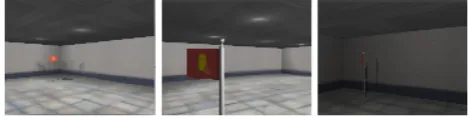
The goal of this task is to reach a flag which is placed randomly in a room. The task is considered successful if the agent reaches the flag within an allocated time limit.
Fig. 3: sample images from “Reach the flag”
5.2.2 Follow the line
Fig. 4: sample images from “Follow the line”
5.2.3 Reach the correct object
The goal of this task is to reach an object while avoiding another similar looking object. The task fails if the wrong object is reached or if a time limit is exceeded before finding the correct object.
Fig. 5: sample images from “Reach the correct object”
5.2.4 Eat all disks
The objective of this task is to collect as many disks as possible within a time limit. Several black disks are laid out in a large room and new disks appear once one is collected by the agent. Unlike other tasks, there is no failure criteria but only a score at the end of the given time.
Fig. 6: sample images from “Eat all disks”
Figures 3 - 6 show sample images of the 4 tasks. The images are shown in the same quality and size (120×90) size produced by the simulator and used by the agent in the experiments.
250000 steps each. A3C utilizes 8 parallel processes. And frame skipping of 5. Frame skipping can greatly help reinforcement learning by shortening the trajectory and enhancing exploration through taking bigger steps. However, delicate navigation can limit the number of frames to skip. For instance, in the ”Follow the line” task, navigating the narrow corners of the patterned corridor fails when using high frame skipping values even while following the optimal policy.
5.3 Inter-process Communication
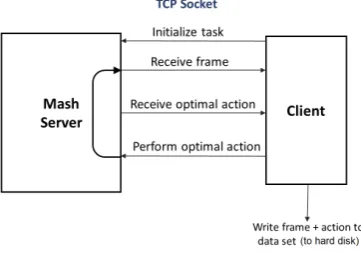
For both Simulators, the agent is decoupled from the simulator and the learn-ing algorithm. This allows for generic independent modules and facilitates interchanging tasks and learning algorithms. A TCP connection is used to communicate between the different components.
Fig. 7: Dataset Collection Flowchart
Fig. 8: Imitation Agent Playing Flowchart
Fig. 9: Reinforcement learning Flowchart
5.4 Results
Firstly, the results for experiments on the Grid task are presented. Since this task presents no states that are unseen in the demonstrations, for all grid sizes, the supervised policy was able to consistently solve the problem using only 5 demonstrations. Figure 10 shows results comparing DQN and A3C on the three grid sizes. Since success in this task is binary, the score counts how many epochs up to the current epoch have resulted in successful test sessions. This evaluation method produces a graph that shows the improvement and stability of the learned policy over training epochs.
The results on the Grid tasks show that considering static tasks, learning from demonstrations can be successful with far viewer training instances than learning from experience. Moreover, learning from experience becomes expo-nentially more difficult as the size of the grid increases. This is evident in the failure of A3C to learn on the 30×30 grid. This failure stems from the delayed rewards which makes obtaining feedback less frequent. The agent learns from the more readily available negative rewards to avoid the edges of the grid but is not able to reach the target.
a) 5 X 5 b) 15 X 15 c) 30 X 30
0 250 500 750 1000 0 250 500 750 1000 0 250 500 750 1000 0
250 500 750 1000
Epochs
Score
Method DQN
A3C
Fig. 10: DQN and A3C results on the Grid Navigation Task
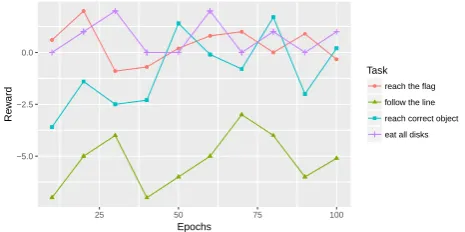
rounds. For the first 3 tasks a success rate is calculated as the percentage of rounds in which the agent successfully completed the task out of 1000 rounds. For the fourth task “Eat all disks”, the evaluation measure used is the number of disks eaten in 1000 rounds. The results for deep reinforcement learning methods are reported after 100 epochs of training. For the imitation network, the classification error on an unseen test set is also reported. The test set consists of 20000 samples collected from the teacher’s demonstrations.
the success rate is 0%. The test errors for all 3 tasks are relatively low and don’t reflect the failure rates. This shows that small prediction errors can lead the agent to face situations that are not represented in the demonstrations and therefore propagate erroneous behavior. Since the agent in “Reach the flag” was able to correct its behavior following wrong prediction, we evaluate the effect of the time limit on the agent’s success. Figure 11 shows the success rate against different time limits represented as percentages of the original time limit. The graph shows that the success rate improves with longer time limits, which shows that continuing to follow the learned policy can result in success even after sub-optimal behavior.
Table 3: Direct Imitation results
Task reach the flag reach object follow the line Direct imitation 96.20 % 53.10% 40.70%
DQN 6.40 % 6.00% 0.00%
A3C 7.60 % 8.9% 0.00%
error 2.48% 4.06% 0.86%
Fig. 11: Results for “reach the flag” task with increasing time limits
Table 4 shows results for ”Eat all disks”. The table compares the scores achieved by direct imitation, DQN, A3C and the optimal policy. The results show that direct imitation achieves 97.9% of the score achieved by the opti-mal policy while again learning from experience failed to produce an effective policy.
Table 4: “Eat all disks” results
Task Direct Imitation Optimal policy DQN A3C
score 1051 1073 51 45
error 1.70% - -
-−15 −10 −5 0
25 50 75 100
Epochs
Re
w
ard
Task
reach the flag
follow the line
reach correct object
eat all disks
Fig. 12: Results for DQN on Navigation tasks in MASH simulator
−5.0 −2.5 0.0
25 50 75 100
Epochs
Re
w
ard
Task
reach the flag
follow the line
reach correct object
eat all disks
Fig. 13: Results for A3C on Navigation tasks in MASH simulator
Direct Imitation Active 5% Active 10%
Success Rate Test Accuracy
0
25
50
75
100
Fig. 14: Results for active learning on “Follow the Line” task
Next we evaluate combining learning from demonstrations and experience. The two methods proposed in section 3.2 to help DQN using demonstrations are compared to traditional DQN on the “Reach the flag” task. ’Initialized DQN’ initializes the policy network of DQN with the parameters learned from supervised learning while ’DQN demonstrations’ refers to using demonstra-tions from the optimal policy to perform off-policy rollouts. Figure 15 shows the average rewards every 10 epochs for 100 epoch. The graph shows that utilizing demonstrations using the two proposed methods did not enhance the performance of DQN. The initial policy learned from demonstrations is quickly overwritten and thus provides no benefit to the learning policy or the rollout policy. This happens as there are no constraints to preserve the initial policy once DQN training starts. Guiding the agent by utilizing demonstrations in exploration also did not show any improvement. By looking at the probability distribution of the output layer of the network, we attribute this failure to the fact that the cost function used in DQN training doesn’t consider output nodes other than the performed action. Therefore, when applying a rollout policy of optimal actions, the probabilities of non-used actions change arbi-trarily. A cost function that includes all actions could be considered, but since DQN uses a periodically updated target network, the learned parameters for the performed actions will be overwritten with every update.
reinforce-−10.0 −7.5 −5.0 −2.5 0.0
25 50 75 100
Epochs
Re
w
ard
Method
DQN
Initialized DQN
DQN demonstrations
Fig. 15: Results for combining learning from demonstrations and experience on “Reach the flag”
ment learning methods show that learning from demonstrations can learn the same task with substantially fewer training instances. Results of deep rein-forcement learning methods showed that learning becomes more difficult with longer trajectories and that they failed to learn the 4 tasks on mash simulator.
6 Conclusion and future directions
In this paper, we propose a framework for learning autonomous policies for navigation tasks from demonstrations. A generic learning process is employed to learn from raw visual data without integrating any knowledge of the task. This method is compared to two state of the art deep reinforcement learning methods. Active learning is employed to help the agent generalize to unseen situations. Methods for combining learning from demonstrations and experi-ence are also investigated to improve the generalization ability of the agent while taking advantage of provided demonstrations. The experiments are con-ducted on a testbed that facilitates reproduction, comparison and extension of this work. The results show that CNNs can learn meaningful features from raw images of 3D environments and learn a policy from demonstrations. They also show that active learning can significantly improve a learned policy with a limited number of samples. Moreover, it is shown that learning from demon-strations can be successful with significantly fewer instances than learning from experience and outperforms deep reinforcement learning methods on the 4 3D navigation tasks used. The comparison between learning from demonstrations and experience highlights the limitations of both techniques. Direct imitation can generalize poorly if no appropriate active samples are available. While learning by trial and error from scratch can be ineffective in tasks with long trajectories and sparse rewards.
learn-ing with different expert policies. Although initial results were not successful, integrating learning with experience and demonstrations can help with gen-eralization without requiring teacher involvement. In the next step we aim to investigate using guiding demonstrations with reinforcement learning methods that use different cost functions and do not require target networks. Further-more adapting the online learning methods in [45] can speed up retraining while overcoming the catastrophic forgetting phenomenon. This can also po-tentially allow one network to learn multiple tasks.
7 Conflict of Interest
The authors declare that they have no conflict of interest.
References
1. Hussein A, Gaber MM, Elyan E (2016) Deep active learning for au-tonomous navigation. In: International Conference on Engineering Ap-plications of Neural Networks, Springer, pp 3–17
2. Mash-Simulator (2014) Mash-simulator. https://github.com/idiap/mash-simulator
3. Ciresan D, Meier U, Schmidhuber J (2012) Multi-column deep neural net-works for image classification. In: Computer Vision and Pattern Recogni-tion (CVPR), 2012 IEEE Conference on, IEEE, pp 3642–3649
4. Krizhevsky A, Sutskever I, Hinton GE (2012) Imagenet classification with deep convolutional neural networks. In: Advances in neural information processing systems, pp 1097–1105
5. Mnih V, Kavukcuoglu K, Silver D, Rusu AA, Veness J, Bellemare MG, Graves A, Riedmiller M, Fidjeland AK, Ostrovski G, et al (2015) Human-level control through deep reinforcement learning. Nature 518(7540):529– 533
6. Silver D, Huang A, Maddison CJ, Guez A, Sifre L, van den Driessche G, Schrittwieser J, Antonoglou I, Panneershelvam V, Lanctot M, et al (2016) Mastering the game of go with deep neural networks and tree search. Nature 529(7587):484–489
7. Levine S, Finn C, Darrell T, Abbeel P (2015) End-to-end training of deep visuomotor policies. arXiv preprint arXiv:150400702
8. Guo X, Singh S, Lee H, Lewis RL, Wang X (2014) Deep learning for real-time atari game play using offline monte-carlo tree search planning. In: Advances in Neural Information Processing Systems, pp 3338–3346 9. Lillicrap TP, Hunt JJ, Pritzel A, Heess N, Erez T, Tassa Y, Silver D,
Wierstra D (2015) Continuous control with deep reinforcement learning. arXiv preprint arXiv:150902971
11. Abbeel P, Ng AY (2004) Apprenticeship learning via inverse reinforcement learning. In: Proceedings of the twenty-first international conference on Machine learning, ACM, p 1
12. Hussein A, Gaber MM, Elyan E, Jayne C (2017) Imitation learning: A survey of learning methods. ACM Computing Surveys (CSUR) 50(2):21 13. Togelius J, De Nardi R, Lucas SM (2007) Towards automatic
person-alised content creation for racing games. In: Computational Intelligence and Games, 2007. CIG 2007. IEEE Symposium on, IEEE, pp 252–259 14. Sammut C, Hurst S, Kedzier D, Michie D, et al (1992) Learning to fly. In:
Proceedings of the ninth international workshop on Machine learning, pp 385–393
15. Abbeel P, Coates A, Quigley M, Ng AY (2007) An application of reforcement learning to aerobatic helicopter flight. Advances in neural in-formation processing systems 19:1
16. Ng AY, Coates A, Diel M, Ganapathi V, Schulte J, Tse B, Berger E, Liang E (2006) Autonomous inverted helicopter flight via reinforcement learning. In: Experimental Robotics IX, Springer, pp 363–372
17. Silver D, Bagnell J, Stentz A (2008) High performance outdoor naviga-tion from overhead data using imitanaviga-tion learning. Robotics: Science and Systems IV, Zurich, Switzerland
18. Ratliff N, Bradley D, Bagnell JA, Chestnutt J (2007) Boosting structured prediction for imitation learning. Robotics Institute p 54
19. Chernova S, Veloso M (2007) Confidence-based policy learning from demonstration using gaussian mixture models. In: Proceedings of the 6th international joint conference on Autonomous agents and multiagent sys-tems, ACM, p 233
20. Ollis M, Huang WH, Happold M (2007) A bayesian approach to imitation learning for robot navigation. In: Intelligent Robots and Systems, 2007. IROS 2007. IEEE/RSJ International Conference on, IEEE, pp 709–714 21. Chernova S, Veloso M (2007) Confidence-based policy learning from
demonstration using gaussian mixture models. In: Proceedings of the 6th international joint conference on Autonomous agents and multiagent sys-tems, ACM, p 233
22. Saunders J, Nehaniv CL, Dautenhahn K (2006) Teaching robots by mould-ing behavior and scaffoldmould-ing the environment. In: Proceedmould-ings of the 1st ACM SIGCHI/SIGART conference on Human-robot interaction, ACM, pp 118–125
23. Ross S, Melik-Barkhudarov N, Shankar KS, Wendel A, Dey D, Bagnell JA, Hebert M (2013) Learning monocular reactive uav control in cluttered natural environments. In: Robotics and Automation (ICRA), 2013 IEEE International Conference on, IEEE, pp 1765–1772
25. Dixon KR, Khosla PK (2004) Learning by observation with mobile robots: A computational approach. In: Robotics and Automation, 2004. Proceed-ings. ICRA’04. 2004 IEEE International Conference on, IEEE, vol 1, pp 102–107
26. Ross S, Bagnell D (2010) Efficient reductions for imitation learning. In: International Conference on Artificial Intelligence and Statistics, pp 661– 668
27. Munoz J, Gutierrez G, Sanchis A (2009) Controller for torcs created by imitation. In: Computational Intelligence and Games, 2009. CIG 2009. IEEE Symposium on, IEEE, pp 271–278
28. Zhu Y, Mottaghi R, Kolve E, Lim JJ, Gupta A, Fei-Fei L, Farhadi A (2016) Target-driven visual navigation in indoor scenes using deep reinforcement learning. arXiv preprint arXiv:160905143
29. Mnih V, Badia AP, Mirza M, Graves A, Lillicrap TP, Harley T, Silver D, Kavukcuoglu K (2016) Asynchronous methods for deep reinforcement learning. In: International Conference on Machine Learning
30. Mnih V, Kavukcuoglu K, Silver D, Graves A, Antonoglou I, Wierstra D, Riedmiller M (2013) Playing atari with deep reinforcement learning. arXiv preprint arXiv:13125602
31. Schliebs S, Fiasch´e M, Kasabov N (2012) Constructing robust liquid state machines to process highly variable data streams. Artificial Neural Net-works and Machine Learning–ICANN 2012 pp 604–611
32. Schliebs S, Kasabov N (2013) Evolving spiking neural networka survey. Evolving Systems 4(2):87–98
33. Gandhi D, Pinto L, Gupta A (2017) Learning to fly by crashing. arXiv preprint arXiv:170405588
34. Ranjan K, Christensen A, Ramos B (2016) Recurrent deep q-learning for pac-man
35. Wulfmeier M, Ondruska P, Posner I (2015) Maximum entropy deep inverse reinforcement learning. arXiv preprint arXiv:150704888
36. Clark C, Storkey A (2015) Training deep convolutional neural networks to play go. In: Proceedings of the 32nd International Conference on Machine Learning (ICML-15), pp 1766–1774
37. Levine S, Koltun V (2013) Guided policy search. In: Proceedings of The 30th International Conference on Machine Learning, pp 1–9
38. Hester T, Vecerik M, Pietquin O, Lanctot M, Schaul T, Piot B, Sendonaris A, Dulac-Arnold G, Osband I, Agapiou J, et al (2017) Learning from demonstrations for real world reinforcement learning. arXiv preprint arXiv:170403732
39. Calinon S, Billard AG (2007) What is the teachers role in robot pro-gramming by demonstration?: Toward benchmarks for improved learning. Interaction Studies 8(3):441–464
40. Judah K, Fern A, Dietterich TG (2012) Active imitation learning via re-duction to iid active learning. arXiv preprint arXiv:12104876
Automation Magazine, IEEE 19(4):24–35
42. Fiasch´e M, Verma A, Cuzzola M, Morabito FC, Irrera G (2011) Incremental–adaptive–knowledge based–learning for informative rules ex-traction in classification analysis of agvhd. In: Engineering Applications of Neural Networks, Springer, pp 361–371
43. Kasabov N (2007) Evolving connectionist systems: the knowledge engi-neering approach. Springer Science & Business Media
44. Robins A (1995) Catastrophic forgetting, rehearsal and pseudorehearsal. Connection Science 7(2):123–146