Leading Sheep 2008-2011
WP 261
Final Report.
by
A Hamilton, G Roberts, N Sallur and P McAllister
Department of Employment, Economic Development and Innovation.
Table of Contents
Page
1. Introduction from Project Advisory Panel Chair 3
2. Executive summary 4
3. Project background 5
4. Aims and methods 6
5. Measuring success 9
6. Achievements 11
7. Recommendations 21
8. Bibliography 24
Appendix 1. Outcomes of Leading Sheep 2 25
Appendix 2. List of Leading Sheep 2 activities 29
Appendix 3. Project Advisory Panel 31
1. Introduction from Project Advisory Panel Chair
This report outlines the achievements of Leading Sheep over the last three years. Leading Sheep is a project that aims to increase the profitability and viability of wool producers in Queensland, through innovative approaches to extension and technology adoption. Leading Sheep is a partnership between the Department of Employment, Economic Development & Innovation (DEEDI), Australian Wool Innovation (AWI), and AgForce and is supported by the majority of wool producers in Queensland.
Phase one of Leading Sheep saw a focus on increasing the adoption of new technologies within the wool industry. While continuing to recognize the importance of industry uptake of technology, the second phase of Leading Sheep has focused on extension and providing producers with the skills to use new technologies.
A personal highlight for me has been the confidence that Leading Sheep has been able to rekindle in producers. This confidence has allowed producers to continue in an industry that has now become very profitable and viable.
Leading Sheep has continued to focus on delivering information at a regional level to ensure information is relevant to producers. Regional committees and coordinators have played a vital role in ensuring information is relevant to their areas. I would like to acknowledge the hard work of these committees and coordinators.
Wool producers have a constant need to incorporate new technologies and practices into their businesses. Leading Sheep has played a key role in providing producers with learning
opportunities.
After six years, Leading Sheep has continued to position itself as the hub for the dissemination of information among Queensland wool producers. Leading Sheep has provided producers with a set of tools which allows them to take advantage of the improved profitability within the industry. This has been very important for the next generation of Queensland wool producers.
I have enjoyed my time as Chair of the project advisory panel and have appreciated the
enthusiasm with which agency staff and wool producers have supported the project. I hope that the next phase of Leading Sheep will continue to build on these achievements.
Jack Banks
2. Executive Summary
The second phase of Leading Sheep (2008-2011) aimed to increase the profitability and viability of Queensland wool producers through innovative approaches to extension and technology adoption. It is a partnership between the Department of Employment, Economic Development & Innovation (DEEDI, formerly DPI&F), Australian Wool Innovation (AWI), and AgForce. Leading Sheep supported a regionally specific program model based on four areas of Queensland: South-East (Traprock), Southern Inland (Box/Sandalwood), South-West (Mulga) and, North/Central-West (Mitchell Grass). Each of these regions had a dedicated coordinator, DEEDI extension officer and a regional committee to identify and prioritise issues and then plan, conduct and evaluate events based on these issues.
The immediate and long term evaluation shows that Leading Sheep has exceeded the targets on the four objectives
• A total of 84 activities across the four objectives with a total of 1954attendees • Almost 83% of attendees gained new skills or knowledge from these activities and
69% reported an intention to change their management practices
• Follow up indicated that 42% of attendees had changed practices on their property as a result of attending Leading Sheep activities.
The practice change survey, compared responses from a random sample of sheep producers during 2006, 2007 and 2011 in the areas of predation, reproduction, parasites, wool clip value, sheep sales value and natural resource management. This survey found that producer involvement with Leading Sheep has strongly increased between 2006 and 2011, especially in the areas of predators (up 22%) and parasites (up 20%). Overall, Queensland producers indicated an increase in the project’s influence on their current and future actions from 2006. Eight producer case studies gave further detailed support to these findings and in particular, that Leading Sheep was an important and reliable source of information.
The majority of Queensland sheep producers (88%) intend to stay in the industry, while 10% intend to leave. Queensland sheep producers appear to be quite confident in the future of the wool and sheep meat industries rating confidence at 7.5 and 7.9, respectively, out of 10.
A range of individuals involved with the project from the Project Advisory Panel, managers and on-ground staff were interviewed to see what was working and what needed to improve. Overall, the project partnership worked well, as did the delivery through a regional structure. Areas to work on were the need to improve webinars, communication within the project and smarter use of database information.
The following recommendations are highlighted as a result of Leading Sheep 2:
3. Project Background
Leading Sheep was the product of a series of producer consultative forums that occurred during 2003/2004 at the request of Australian Wool Innovation. Leading Sheep sought to provide a framework to deliver an education and adoption program to Queensland wool
producers. Leading Sheep supported a regionally specific program model based on four areas of Queensland: South-East (Traprock), Southern Inland (Box/Sandalwood), South-West (Mulga) and, North/Central-West (Mitchell Grass).
A critical component of Leading Sheep was the establishment of an effective partnership between AWI, AgForce and DEEDI and the producer committees – a partnership that had not been seen before in the Queensland wool industry. Active participation by producers in the development and operation of Leading Sheep enabled a focused approach that addressed the important constraints on the industry.
During the three years of funding Leading Sheep 1 delivered a total of 75 activities to 1291 attendees, covering primarily the areas of predators, reproduction, wool marketing, parasite control and resource management. Of these activities almost two thirds were face to face while the rest were either tele-workshops or used e-technology (eg webinars or eBooks).
The final evaluation showed that the overwhelming majority of participants found the activities useful and as a result they gained new knowledge and skills and plan on using this in their business. In the longer term more than half reported some form of practice change as a result of attending these activities.
Delivering information and technology has been greatly enhanced through the engagement of producers by using webinars and tele-workshops. The use of communication technology has allowed Leading Sheep to revolutionise the way it was communicated across the state which saved time and money for participants. Bringing experts to the remote areas of Queensland was as easy for industry participants as turning on their computer. This was seen by Leading Sheep as the way for doing its business in the future and Leading Sheep can claim credit for being a leader in the agricultural field.
Leading Sheep also developed an extensive network and database of sheep producers and this has provided a quick and easy method of communication and information dissemination. In addition, a major and ongoing publicity campaign led to Leading Sheep being readily recognised by producers and becoming a clear point of contact.
The success of the first phase of Leading Sheep encouraged the partners to continue with the project. The new phase of Leading Sheep (Leading Sheep 2) continued with the same
operating model but placed more emphasis on:
maintaining the partnership between AWI, AgForce, DEEDI and producers;
establishing partnerships with other projects such as Making More from Sheep;
continued development of the Leading Sheep website and database;
continued marketing of the Leading Sheep brand;
further quantifying practice change against current outcomes; and
embracing innovative approaches identified by industry to maximise the likelihood of change such as:
o electronic delivery by webinar technology;
o engaging youth in the industry;
o understanding key profit drivers; and
4. Aims and methods
4.1 Aims
Leading Sheep 2 aimed to achieve the following by the end of 2010. This end date was later extended to July 2011, as requested by AWI.
1. To have an extra 10% (80) of Queensland sheep producers implementing recognised environmental management systems in response to emerging international requirements. These will include:
• Integrated Parasite Management
• Mulesing alternatives
2. To enhance sheep and property management practices by having a total of 120 sheep producers in four regions undertaking one of the following:
• seasonal forecasting tools
• automatic handling and drafting
• electronic sharing of information and data
• breeding, selectionand production management
• sustainable resource use
3. To have 25% (200) of Queensland sheep producers improve the profitability and sustainability of their enterprise by:
• responding to key profit drivers
• managing pasture availability
• feeding for production
• confinement feeding
4. To reduce losses due to predation by providing support for participation in nil-tenure (no boundaries) integrated pest management control plans across regions for 25% (200) of sheep producers. These will include:
• wild dogs
• pigs
• foxes
The four outcomes describing how these aims were to be achieved, under the headings
4. A project management and stakeholder project advisory panel to provide strategic assessment and direction.
For project delivery, Queensland remained divided into four regions (South-East, Southern Inland, South-West, and North/Central West) and each region continued to operate a
committee. Woolgrowers and service providers on each committee had the services of a part-time coordinator1 with a DEEDI/DPI&F extension officer attached part-time to each of the four regions. Each regional committee met face to face at least once each 12 month period while holding a number (3-4) of supportive teleconferences. All regional coordinators and extension officers, as a group, along with the project manager also participated in monthly web-meetings to discuss and review activities that had been conducted and determine plans for the future.
The producer driven committees working with their regional networks identified the technology that is most relevant to their area. Co-ordinators and extension officers then organised activities delivered via the most appropriate delivery method. Co-operation between regions often
allowed a series of activities to be delivered on the same topic including sharing presenters.
Managing activities across the region relied heavily on Leading Sheep 2 having an efficient and updated producer database and processes in place to make the contents available to AWI. Emphasis was placed on ensuring the current database was continuously scrutinised for errors and omissions in order to provide the extension staff with the most efficient means of
communication with their regional producer networks. A communication partnership was established that enhanced Leading Sheep 2’s ability to assess, document and train clients in the ability to use modern communication technology for the transfer, not just of information, but also of information technologies. Maintenance of a complete and accurate database was important to communication, and its innovative online storage enabled easy, secure access and updating by a range of authorised users.
Communication was integral to achieving project outcomes. A professional media consultant was engaged to manage the major publicity campaign, using regional media outlets across the four regions. Information was broadcast so that producers knew of new technologies and those appropriate to emerging conditions, and also knew of activities available to them to build their skill and confidence in their application. The goal was also to achieve significant public
exposure and recognition of the importance of the industry to the State’s regional economy and build State and National recognition of the already established Leading Sheep brand.
The collection of reliable data to inform AWI, AgForce, the PAP and DEEDI in their design of Leading Sheep 3 was achieved through a comprehensive survey of producers from all four regions.
4.3 Innovation
Leading Sheep focused on six innovative approaches to increase the potential impact of the project:
1. E-savvy producers: Building producers’ interest and skills in using online tools to overcome some of the distance barriers of living in outback Queensland. By providing flexible delivery options, including e-technologies such as tele- and online- meetings, workshops, seminars, document sharing, websites, shared database, etc, producers would have greater and more affordable access to latest information and technologies relevant to the sheep industry. This approach was delivered alongside traditional
1
A coordinator is a private consultant, with local knowledge, who works with the committee and the extension officer to determine priorities, organise and evaluate activities for delivering the project goals in their region, in the context of local producers’ needs. Coordinators also facilitate the regional
delivery mechanisms with the flexibility to adjust the mix according to each group’s need.
2. Engaging youth, to secure the future of the industry: Partnering with educational institutions to raise the profile of the sheep industry with tertiary students from various disciplines and raise awareness of career opportunities
3. Efficiencies through synergy with other initiatives: Integrating the two projects, Leading Sheep and Making More from Sheep (MMfS), enabled the first to be enhanced with the well-developed content and tools from MMfS, and enhancing MMfS by delivering it through the well-developed networks and tools of Leading Sheep.
4. Collaboration with the Sheep CRC and other industry providers: With a particular focus on climate forecasting, automatic stock handling, genetics to improve management practices, breech strike management and lice.
5. Developing a strong foundation: Building producers’ skills in stress management, business management, negotiation and leadership to grow the resilience and capacity of the industry generally: The Queensland Government’s Building Rural Leadership course was adapted to suit the needs of sheep industry participants and was delivered in three centres, with courses being open to all regions.
5. Measuring success
5.1 Overview
Monitoring and evaluation for Leading Sheep 2 was based on the information and resources developed in Leading Sheep 1. It evaluated the performance against the project’s aims and objectives. The overarching Leading Sheep evaluation methodology was to:
• Develop a Leading Sheep 2 log frame based on project objectives linked to the elements of Bennett’s hierarchy
• Redesign evaluation tools that match Bennett’s Hierarchy elements and incorporate knowledge gained in LS 1.
• Design each activity and its expected long and short term effects using the evaluation tools
• Evaluate the immediate effects of the activity – target 100% of attendees – using a custom web-based evaluation format or a hardcopy evaluation format depending on the situation
• Regional committees to use immediate effects data to inform their future action
• Evaluate the longer term effects – target minimum 10% of original attendees with direct follow-up
• Regional committees use longer term effects data as it becomes available to inform their future action
• Report evaluation data to advisory panel and partners.
The role of the evaluator in this methodology was to support Leading Sheep staff to evaluate their work towards project objectives. This was pursued at two levels, first as practical support and second in promoting a culture of evaluation in staff and wool producers.
5.2 Evaluation methodology
Evaluation in Leading Sheep 2 at the methodology level was designed to build a platform for future long term practice change. The first step in the methodology was to determine the
content for the design tool. This will come through an action research approach to evaluation of content and process.
At the individual activity scale, evaluation design tools provide the means to direct attention to achieving project objectives and monitoring progress towards outcomes. Evaluation tools used in Leading Sheep 2 evaluation were:
1. Activities Evaluation Checklist for regional coordinating committees
2. Leading Sheep 2 Activity Design Recording Sheet – for evaluation
3. Leading Sheep 2 Assessment Recording Sheet – for evaluation
4. Leading Sheep 2 Activity Generic Short Term Evaluation Sheet
5. Leading Sheep 2 Activity Generic Long Term Evaluation Sheet
These items were used by regional coordinators to link Leading Sheep 2 objectives with activities in regions. They did so by placing Leading Sheep 2 objectives in the processes of activity design, in the conduct of activities and in evaluation of the activities. As well, the checklist encouraged the committees to at least refer to previous activities.
The tools include attention to immediate and long term effects. The structure of the tools
changed through feedback from project staff. For example, a generic framework was developed for eliciting participant self-assessment of their change in knowledge, attitude, skills and
Data to measure achievement of project objectives comes from short and long term evaluation of activities and is reported in Section 6.
5.3 Industry impact assessment
Using a Delphi survey technique, the evaluation co-coordinator electronically convened a group of specialists from across Australia with expertise in evaluation with a view to designing the best possible evaluation methodology for the project. Individuals worked anonymously to say how they would do impact evaluation. These experts each know what the others suggest and are asked to take that into account when responding to the survey questions.
The technique to emerge from the combination of the literature review and the Delphi survey material is that impacts in the economic, environmental and social arenas will be more evident if they are designed into each activity as it is prepared and presented.
5.4 Review of Leading Sheep 2 evaluation
In 2009 a desktop review of the systems of Leading Sheep 2 evaluation was conducted by an external consultant Jeff Coutts of Coutts J&R. This was in response to the wish by both project staff and AWI to ensure the evaluation was on track and capturing all relevant information. As a result of this review a number of additional evaluation assessment items were chosen to add breadth and depth in data collected. Additions include case studies with sheep producers, informed person interviews with stakeholders not directly involved in the project and structured debriefs with project staff.
5.5 Review of Leading Sheep structure
During the Mid Term Review in October 2009 AWI proposed that the structure of Leading Sheep should be reviewed, including both positives and negatives of the structure. The purpose of the review was to assess the structure and identify how it could be more efficient and cost effective in the future. The review was conducted with regional coordinators, regional committees, DEEDI extension officers, project manager and PAP members.
5.6 Industry benchmark surveying
Benchmark surveying has been run in 2006, 2007 and 2011. Each randomly sought industry data across LS 2 regions to systematically assess producer perceptions and practice changes in relation to the objectives of Leading Sheep 1 and 2. Comparisons between the three data sets are included in the final report.
5.7 Future direction
6. Achievements
6.1 Evaluation
Leading Sheep 2 has delivered 87 events over three years to 2071 sheep and wool producers.
The Leading Sheep database records that 801 different people have attended at least one event. The event and number of attendances relationships are shown in Table 6.1. This data shows that 73% of the participants only attended one activity. However not all attendees or attendances have been recorded in the database which points to the need to revise quality protocols.
Table 6.1 Event/attendances relationship
Activities attended Number of participants
1 582
2 121
3 43
4 17
5 or more 38
Queensland sheep producers are confident of the future for wool and sheep meat. The majority, 87.5%, intend to continue in the sheep industry for the next three years. Only 10% report not intending to stay. They appear to be quite confident in the future of the wool industry with a State average rating of 7.5/10. For their confidence in the future of the sheep meat industry they report an average rating of 7.9/10.
While direct attribution is not possible, survey data suggests Leading Sheep’s work in the industry has contributed to the confidence of producers by providing a reliable and important source of information for practice change to the industry. This is supported in the following evaluation data.
6.1.1 Progress towards project objectives
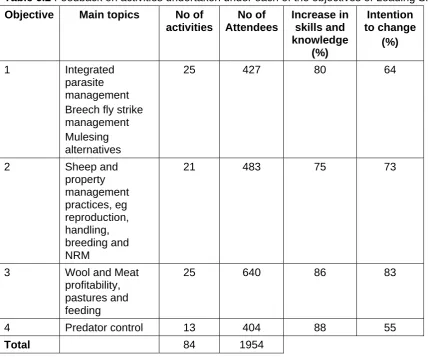
Measured industry responses to Leading Sheep 2 work on each project objective show staff have achieved all practice change targets. Table 6.2 shows the feedback obtained on activities including the change in new knowledge and skills and the intention to change for each
Table 6.2 Feedback on activities undertaken under each of the objectives of Leading Sheep
Objective Main topics No of activities
No of Attendees
Increase in skills and knowledge
(%)
Intention to change
(%)
1 Integrated parasite
management Breech fly strike management Mulesing alternatives
25 427 80 64
2 Sheep and
property management practices, eg reproduction, handling, breeding and NRM
21 483 75 73
3 Wool and Meat
profitability, pastures and feeding
25 640 86 83
4 Predator control 13 404 88 55
Total 84 1954
The long-term survey of 10% of those attending activities found 27-51% had made changes as a result. The industry practice change survey results show significantly higher numbers making changes which they attribute to involvement with Leading Sheep. That the independent survey figures for change exceed those of Leading Sheep’s own long term data suggests the projects’ process of long term data collection needs attention. Both sets of data are included and where necessary we have deferred to the practice change survey data because of its evidence of independence and rigour of the implementation.
Table 6.3 shows the target and the evaluation data that demonstrates that achievement exceeds the project target. This suggests Leading Sheep’s recognition and influence has increased.
Table 6.3 Project targets and achievement levels
Objective Main topics Made
practice changes (from long term evaluation data) (%) Attendees making changes following attendance at LS activities (from industry practice change survey) Targets No. of producers making changes in objectives Achievement of target
1 Integrated parasite
management Breech fly strike management Mulesing alternatives
47 (200) 372 240 Yes
2 Sheep and
property management practices, eg reproduction, handling, breeding and NRM
27 (130) 280 120 Yes
3 Wool and Meat
profitability, pastures and feeding
Not available
310 200 Yes
4 Predator control 51 (206) 410 200 Yes
6.1.2 Summary of Industry Practice Change surveys 2006, 2007 and 2011
That Leading Sheep’s influence has increased is supported by the practice change surveys conducted with Queensland sheep producers in 2006, 2007 (the last year of Leading Sheep 1) and 2011 (at the end of Leading Sheep 2). The surveys were conducted by telephone with 93 producers in 2006, 73 in 2007 and 80 in 2011. As the questions and topic areas were
formulated in Leading Sheep 1, the contents do no line up exactly with the objectives of Leading Sheep 2.
a) Problem size
b) Tried anything new or different to improve the problem
There has been a strong upward trend on the percentage of Queensland producers undertaking actions to do something new or different in the areas of predation (up 33%), parasites (up 29%), and wool clip value (up 19%). (Fig 6.1)
Fig 6.1 Tried anything new or different
Tried anything new or different to improve problem?
28 39 32 23 52 47 29 36 25 33 37 53 61 41 61 42 34 39 0 10 20 30 40 50 60 70
Predation Reproduction Parasites wool clip value Sheep sales value Natural resource management P er c en tag e o f re sp o n ses " yes " 2006 2007 2011
c) Attendance at Leading Sheep activities and their influence
Producer involvement with Leading Sheep has strongly increased between 2006 and 2011 in the areas of predators (up 22%) and parasites (up 20%). (Fig 6.2)
Fig 6.2 Involvement with Leading Sheep
Attended Leading Sheep activity?
37 41 29 35 45 19 49 45 41 42 29 24 59 41 49 29 25 22 0 10 20 30 40 50 60 70
Overall, Queensland producers involved in Leading Sheep indicated an increase of the
project’s influence on their current and future actions (predators up 40%, reproduction up 27%, parasites up 43%, wool clip value up 34%). See Fig 6.3.
Fig 6.3 Influence of Leading Sheep
Has Leading Sheep activity influenced current or future actions?
47
58
52
48
69
44 49
69
58
53
71 73
87 85
95
82
65
59
0 20 40 60 80 100
Predation Reproduction Parasites w ool clip value Sheep sales value
Natural resource management
Pe
rc
e
n
ta
g
e
2006 2007 2011
6.1.3 Case Studies of the changes made by clients
Case studies in this report are specific examples of the effect of the program. For Leading Sheep that means sheep producers who’ve attended one or more Leading Sheep events and changed practices.
In eight case studies 14 practice changes are reported in Managing for Improved Reproduction, Increased Weaner Survival and Parasite Control. These show that most are being innovative in and are initiating change in more than one management area.
a) Costs and returns of change
Table 6.4 Case Study cost/benefit data from producer budgets and records
*Case study producer
LS objective Change made Costs Production benefit $ benefits Central West 1 3. Value adding production
Drenching of all sheep for worms Vaccination to prevent pulpy kidney 60c/hd (excl labour) (5,300 sheep run) Increased weaner survival
2009 losses 15% 2010 losses 2%
$10,000 [based on non recurrence of losses incurred in 2009]
South East 1 2. Enhanced management practices
Increase ewe flock from 300 to 1000 over next 12 months
Budget: 700 ewes $91000
5 rams $3000
Annual cost of supplement $11000
Total $105000
Income – sales of surplus sheep or store prime lambs.
Budget: Extra wool - $30,000 Prime lambs560 @ $ 90 (28-30 kg stores) $50,000
(Note: producer is currently
understocked)
South West 1 1. Meeting customer needs (mulesing alternatives) Stopped mulesing having trialled pain relief for 1 year and now
purchases local rams adapted to the conditions
Nil − Increased
growth and survival of unmulesed lambs − More competition for wool from unmulesed sheep
Saving of the $2/lamb mulesing cost
South West 2 2 Enhanced management practices (breeding, selection and production)
Grade all ewes and use eID technology to record, grade and twin status for future selection $4/head to establish Annual cost $2/hd
− Removal of
non-productive ewes
− Expected lift of 1.5kg dressed weight
− Able to utilise country better without running more
b) Reliability and Importance of Leading Sheep information
Case study clients rated Leading Sheep as a reliable (100% of respondents) and an important source of management information (75% of respondents). (Tables 6.5 and 6.6)
Table 6.5 Reliability rating for Leading Sheep information for sheep management
Info not reliable 1
2 3
Not always reliable 4
5 6
Info very reliable 7
√√√√√ √√√
Table 6.6 Importance of Leading Sheep to you as a source of information for sheep management
Not important 1
2 3
About 50/50 4
5 6
Very important 7
√ √ √√√√√ √
Specific comment was made of Leading Sheep initiatives providing value for the wool grower dollars invested and providing information that is always up to date, specific and relevant. This is borne out also in activity and long term evaluation data.
6.1.4 Webinar delivery
Queensland sheep producers support webinar delivery with case study producers rating it positively because of cost and time efficiencies. Fifty percent of respondents rated webinars as ok and the other half rated them higher. They do however; qualify their responses in ways that signify that effectiveness varies for webinars in their current format. For example:
− ‘a bit dry – lack of discussion’ and ‘good for delivering information – not so good for interaction’
They also report access difficulties as making webinars more difficult for some. However, the limitations referred to have not seen any large decrease in the total numbers attending although they are off their peak of 2009. Table 6.7 shows attendance data for LS webinars.
Table 6.7 Attendance at webinars during Leading Sheep 1 and Leading Sheep 2
Project Year No. webinars delivered
Total no. participants
Average no. participants
LS 1 2007 only 11 181 17
2008 5 129 26
2009 14 472 34
2010 14 367 26
LS 2
Jan-Apr 2011 only 4 88 22
Continuing producer difficulties experienced in using the technology appears the major limit to gaining attendance at webinars. Other factors affecting attendance may be the relevance and timing of the topic together with the skill of the presenter and facilitator.
In achievement debriefs Regional Coordinators and LS Extension Officers recognise the difficulties and suggest ways to improve webinar delivery (Table 6.8).
Table 6.8 Suggested improvements for webinar delivery
− Their potential is yet to be developed - I don’t think they have been anywhere near as successful as they could be
− Need an educational program about (webinars) and development of their use
− Develop skills to, ‘deliver webinars in better or new ways to deliver appropriate messages’
The future for webinars in meeting the distance challenges of Queensland’s industry and supporting the achievements of Leading Sheep 3 will require action to:
− Generate positive experiences with technology for producers, and
− Increase delivery skill, knowledge and practice for facilitators and presenters.
Other webinar events
Three other webinar events were run to support the Leading Sheep network in Leading Sheep 2. Following two flooding events webinars were held to provide flood support information to the network. Both events drew an audience of about 50 people. A third event, the Leading Sheep dialogue was held to connect the Minister for Agriculture, Food and Regional Communities, Hon. Tim Mulherin MP, with members of the Leading Sheep network. This event had 17 attendees.
6.1.5 Informed person interview data
Informed Persons, for the purposes of the Leading Sheep evaluation, are those with a stake in the outcomes; however they do not contribute at the operational level. Informed Persons represent DEEDI, AWI, AgForce and the consultant to the project.
All interviewees report a positive impression of the project and that they believe Leading Sheep 2 is meeting its objectives reasonably well. Particular positive reference was made to
innovativeness in delivery methods and ways of engaging with extensive livestock industry. In relation to achieving objectives they suggest there is more to be done with getting youth involved and to ensure actions match the promise of recognition.
Other qualifying comments include ‘(Leading Sheep 2) didn’t build on success of Leading Sheep 1’ and that it ‘needs pushing to improve engagement, content & professional delivery’ because at times it, ‘struggles for direction’. The primary difficulty identified by interviewees was the breakdown of continuity of personnel which produced staffing, project leadership and management issues.
Interviewees believe the partnership across DEEDI, AWI and AgForce worked well and the project was valuable.
6.1.6 Structured Debriefs
A “structured debrief” is a systematic way to capture the observations and experiences of people working in the project.
a) With Regional Coordinators
Regional Coordinators agree the LS brand is well recognised in the regions. They acknowledge the value of Regional Co-ordination Committees and the partnership between DEEDI, AWI and AgForce as strengths of the project and important in achieving project outcomes.
Regional Coordinators are concerned about:
b) With Extension Officers
Six Extension Officers responded in the debrief. All identified the importance of the Regional Coordinating Committees and the impact they have on outcomes. They also recognise the value of the network and its role in the success of the project.
Extension officer concerns include:
o Funding inadequate for activities
o A lack of training or instruction on how to conduct webinars
Among the suggestions for a stronger project, Extension Officers suggest:
− Better use and maintenance of the network and data base
− More and better use of technology (including webinars)
− More appropriate planning, timing of initiatives and evaluation and reporting and linking activity to project goals and objectives
− An increase in communication between the Project Advisory Panel and the regions
− Introduction of new research and measurement of adoption, and
− Better leadership of and support and training for extension officers.
c) Project Managers
Two DEEDI staff filled the position of Project Manager in Leading Sheep 2. They report that Leading Sheep is a recognised brand that has stood the test of time by using a structure that includes the industry.
They report that at a state and industry level Leading Sheep had the first real impact on dog control with their educational approach to it. As well they recognise the role Leading Sheep played in establishing Queensland Government support for wild dog control coordination.
A strength referred to is Leading Sheep’s recognition as a network and the network it has with AWI projects in other states.
They suggest the Project Advisory Panel has lessened its connection with the people in the regions however it has determined strategic direction. A suggested future model is to have the Project Advisory Panel made up of one Regional Coordinating Committee member from each region which is then headed by an independent chair.
They recognise the innovative use of webinars to overcome distance difficulties in producer access to information. They suggest Leading Sheep 3 needs to manage for staff succession and remain innovative to stay relevant.
6.1.7 Industry impact assessment
Evaluation experts were engaged in a Delphi survey to develop ideas for impact assessment. A summary of the steps the skilled professionals consistently gave as important in the process of social, environmental and economic impact evaluation for an industry are shown below.
1. Clarify (with partners) the purpose and agreed outcomes for the project for social, environmental and economic situations
2. Prepare the logframe to incorporate social, environmental and economic outcomes 3. Develop with core stakeholders an understanding of what is to be evaluated (and what
is not), as well as why and how. For each activity design it to move the project towards the agreed social, environmental and economic impact
4. Decide on data collection methods matched to the data and sources
6.1.8 Review of Leading Sheep structure
A review of Leading Sheep structure was conducted with regional coordinators, regional coordinating committees, DEEDI extension officers, project manager and the Project Advisory Panel.
The review shows that due to Queensland’s size, the structure of the four regions has worked well and allowed for each region to have area-specific workshops. The majority of people interviewed for this review indicated that they would like to see the continuation of the current structure – with the regional coordinators.
However, the main recommendation from this review is that regions be changed from four to three, by combining the Southern Inland and South East regions and leaving North/Central West and South West as they are. This suggested change would reinvest the $45,000 of salary for the coordinator, over the life of the project, into operating for on-ground activities.
Also, to ensure everyone is aware of what is going on, from the Project Advisory Panel down to the committees and back up again, more work needs to be done on communication.
6.2 Future direction
An electronic survey to determine the priority issues facing Queensland sheep producers received 86 responses. Regional committee members and coordinators also consulted one-on-one with fellow producers. With the committee and survey responses combined it is estimated the results of this survey represent the views of 25% of Queensland sheep producers.
The key topic areas (in order of priority) producers require assistance with or information about are:
1. Feral animals
2. Use of day-to-day technology including E-technology eg webinars, mobile phones, computers, GPS, property mapping systems
3. Marketing and selling options for sheep 4. Nutrition to improve fertility
5. Animal welfare – working dogs and guardian animals 6. Marketing and selling options for wool
7. Maximising returns and minimising costs
Producers’ first preference for receiving training was via face to face delivery (71%) and only 30% rating webinars as number one. While for receiving information producers prefer it via email or an emailed newsletter, with 53% and 55% respectively rating this as the number one information delivery method.
6.3 Communication and promotion
7. Recommendations
1. Partnerships are essential to success
Strong linkages between Leading Sheep and AWI, MLA (Making More from Sheep), Sheep CRC, AgForce, DEEDI (including Biosecurity), DERM, and private consultants have been critical to this project’s success. These partnerships should continue to be developed and strengthened to achieve even better results, more efficient use of resources and the elimination of duplication. This includes more efficient promotion of messages and activities of, not only Leading Sheep, but also the initiatives of the partners, while demonstrating broad support for the Leading Sheep project. A particular partnership initiative will be to collaborate on the QDOG project, as wild dogs are a significant obstacle to growth of the Queensland sheep industry.
2. Increase the use of e-technology by Queensland sheep and wool producers.
Leading Sheep has pioneered the use of webinars in delivering information to producers. The success of this venture needs to be built on and there are a number of ways to achieve this including:
Getting producers to use additional on-line tools such as blogs and wikis and particularly targeting the young producers for this
Training for presenters and facilitators so they are better able to use these e-tools to achieve more learning, interaction by the group and hopefully practice change
Focusing webinars on topics that are of most interest to producers at the current time
If the webinars are well designed to promote interaction and discussion and focus on timely and relevant topics this should also increase attendance at webinars which has reduced over the last phase of Leading Sheep 2. However according to the survey by Stirton (2010) producers’ first preference to receive training was via a face to face delivery method and this needs to be considered when planning the activity along with other constraints such as financial, time and other resources.
There is high staff turnover. There has been a reduction from 36 person years of webinar experience to only five years. As new staff come on board, attention will need to be paid to training in order to maintain quality and the user experience.
3. Producer determined key areas to focus on
Data obtained from an electronic survey of sheep producers in Queensland has been the basis of determining priorities for Leading Sheep 3. The main areas to focus on will be predators, nutrition, health, business, wool and meat marketing and selling. We will use current survey data from AWI and MLA to deliver responsive services that target topical issues as they emerge. Constant contact with regional committees will provide feedback to adapt services to meet real and current needs of producers.
4. Focus on a suite of relevant activities, rather than just one-off events
Over the life of the project Leading Sheep 2 has delivered 87 events. However this has to be tempered by the fact that almost 75% of producers have only attended one Leading Sheep event. If the events are focussed on relevant and timely topics, promoted successfully with engaging speakers it is assumed that producers would attend more than one event.
data shows that Leading Sheep is seen as a reliable and important source of management information.
5. Improving evaluation
Through both Leading Sheep 1 and 2, evaluation has been a priority and a lot of work has been done to plan, capture and report this data. However, at times there has been a tendency to over-evaluate and not just collect the most important information as evidenced by the comments from both regional coordinators and extension officers in their debriefs.
Evaluation has also been made more complex by a number of projects and organisations contributing to the one event eg Leading Sheep and Making More from Sheep both funding and supporting the one workshop. The difficulty is that each project has its own set of requirements for evaluation which have to be combined together in the one format, so there is only one evaluation for the participant to complete. This adds to the number of questions and the complexity of the evaluation for the participant.
The most valuable future use of resources for Leading Sheep may be to reduce event evaluation to:
usefulness of event
scale of commitment
what can be done to make the work of Leading Sheep of more assistance to you in making management decisions to change practices
what can we learn for our future delivery
This would enable resources to be devoted to long term evaluation for implemented practice change and measurement of the impact on the industry as a whole.
By changing evaluation procedures to collect essential data only, Leading Sheep 3 can be better able to demonstrate its achievements without alienating its clientele. However, the issue of multiple funders (with differing evaluation requirements) for the one event still needs to be addressed.
6. Maintain a high emphasis on communication and promotion
Communication and maintenance of networks will continue to be a high priority. External communication with industry will improve the quality of design of workshop and webinar programs. Internal communication within the project team will ensure alignment, focusing on priorities and group learning for continuous improvement. High quality, frequent, effective communication to producers and partners will ensure messages are heard in a way which attracts participants to Leading Sheep activities and encourages their commitment to apply new knowledge.
with Leading Sheep. All communications need to be approved by the Project Manager in order to maintain quality and relevance. To maintain up-to-date information and the completeness and accuracy of the database it is necessary to give one person overall responsibility, including regular quality control at monthly staff meetings.
The role of Leading Sheep in the QDOG initiative will be as a conduit of information between producers, QDOG and Biosecurity Queensland, so that the producers drive initiatives. Leading Sheep will continue to utilise the website manager for promoting the coordination of predator control through the improved efficiency of the database and website.
A project is planned to develop a suite of tools to enable more efficient and effective evaluation, that is, data collection, analysis, reporting and storage. The database will also be used to store key documents for easy access and retrieval.
8. Maintain the focus on innovation.
8. Bibliography
Collie, G (2008) Leading Sheep Communication Plan, prepared July 2008
Collie, G (2011) List of Media Releases 2008-2010, spreadsheet prepared April 2011
Collie, G (2011) Communication report against objectives, prepared April 2011
Coutts, J&R (2009) Review of the Leading Sheep Evaluation Process, September 2009
Coutts, J&R (2011) 2011 Survey Summary Report: Leading Sheep Management Practice Change Survey, April 2011
Coutts, J&R (2011) 2006, 2007 & 2011 Survey Comparison Report: Leading Sheep Management Practice Change Survey, May 2011
Hewitt, A (2010) Review of the Leading Sheep Structure, June 2010
Knights, G (2007) Leading Sheep Project Funding Rebid 2008-2010, prepared October 2007
Knights, G (2008) Leading Sheep 2 Operational Plan 2008, prepared July 2008
Roberts, G (2008) Leading Sheep Evaluation Plan, prepared July 2008
Roberts, G (2011) Leading Sheep 2 Evaluation Report, prepared May 2011
Appendix 1. Outcomes of Leading Sheep 2
The four outcomes below were derived from consultation with industry representatives from across Queensland. All interested parties participated in a state wide workshop held in Charleville in March 2007 where regional groups were given the opportunity to be part of the overall direction of Leading Sheep 2. Following the workshop, further regional consultation fine tuned the direction industry wanted to take and these outcomes were considered critical in delivering increased profitability.
Outcome One
Meeting customer needs
Target Achievement Criteria
Groups Sheep producers and industry service providers. Attendees from both groups at LS 2 activities. Outputs Activities (workshops, seminars, field days,
tele-workshops, webinars, publications) promoting EMS pathways. (Including IPM)
Deliver one activity per region per year on EMS pathways and IPM principles which address issues of chemical residues.
Immediate Outcome After each activity, have 20% of attendees inquiring about how to establish integrated parasite management programs for their wool enterprise.
A proportion (50%) of wool growers in Queensland aware of emerging international requirements.
Regional record on the database of the numbers inquiring after each activity.
Intermediate Outcome 10% of attendees have implemented an integrated pest management plan each year.
Evidence of producers with IPM plans in place.
Final Outcome Meeting customer needs according to international requirements.
Outcome Two
Enhanced management practices
Target Achievement Criteria
Groups Sheep producers and industry service providers. Attendees from both groups at LS activities. Outputs Activities (workshops, seminars, field days,
tele-workshops, webinars, publications) promoting;
• seasonal forecasting tools
• automatic handling and drafting
• electronic sharing of information and data
• breeding, selection and production management
• sustainable resource use.
One activity per region per year depending on the demand addressing needs of advanced property management practices.
Immediate Outcome After each activity, 20% of attendees inquire about the technology presented. A proportion (50%) of sheep producers in Queensland are aware of technical advances and new technology.
Regional record on the database of enquiries after each activity.
Intermediate Outcome 10% of attendees have implemented practices for enhanced property management practices.
Evidence of infrastructure or plans that have been put in place.
Final Outcome Adopted enhanced property management practices. Producers using;
• electronic tags to identify individual sheep.
• automatic handling and drafting systems into their management.
• tools for seasonal forecasting and decision making.
Outcome Three
Value adding production
Target Achievement Criteria
Groups Sheep producers and industry service providers. Attendees from both groups at LS 2 activities. Outputs Activities (workshops, seminars, field days,
tele-workshops, webinars, publications) providing technical information on;
• key profit drivers
• managing pasture availability
• supplementary feeding for production
• confinement feeding.
One activity per region per year, depending on the demand addressing local needs on management practices.
Immediate Outcome 20% of attendees after each activity inquire about management practices that will lead to an increase in the value of their wool and/or meat.
A proportion (50%) of sheep producers in Queensland aware of the practices required to increase the value of their wool and/or meat.
Regional record on the database of enquiries after each activity.
Record of activities to create awareness of the management practices.
Intermediate Outcome 10% of attendees implement practices that will lead to the increase in value of their wool and/or meat.
Evidence of practices or plans that have been implemented from sources such as the Making More From Sheep (MMFS) program.
Final Outcome Adding value to their wool and/or meat production. Producers managing through attention to;
• the key profit drivers
• the pasture and its availability.
• the feeding for production.
Outcome Four
Management of predators
Target Achievement Criteria
Groups Sheep producers and industry service providers. Attendees from both groups at LS 2 activities. Outputs Activities (workshops, seminars, field days,
tele-workshops, webinars, publications) providing technical information on control plans for;
• wild dogs
• feral pigs
• foxes.
One activity per region per year depending on the demand addressing local needs on predator control programs.
Immediate Outcome 20% of attendees after each activity inquire about practices and participation for the control of predators. A proportion (50%) of sheep producers in Queensland aware of the practices required to achieve total management of predators.
Regional record on the database of numbers enquiring after each activity.
Record of activities to create awareness of the management practices.
Intermediate Outcome 10% of attendees implement practices that will lead to the integrated control of targeted predators.
Integration across all regions of control practices that will minimise the effects of predation on sheep by wild dogs, feral pigs and foxes.
Final Outcome Improved total management of predators in each region.
Appendix 2. List of Leading Sheep 2 activities
Name of activity Location Date Numbers
attended
Best practice baiting techniques
Webinar 15 April 2011 23
Fire: Master or Servant? Your call!
Webinar 25 March 2011 31
Marketing opportunities for Qld lamb
Webinar 15 March 2011 14
Flood support Webinar 4 March 2011 20
Bred Well, Fed Well Goondiwindi 9 December 2010 80
Skintraction Webinar 2 December 2010 10
Worm burdens in the pastoral zone
Webinar 18 November 2010 11
Pittsworth Abattoir Webinar 28 October 2010 14
Zolvix Webinar 7 October 2010 15
Predator control Thargomindah 4 October 2010 17
Pimelea Webinar 24 September 2010 24
Wean more lambs Longreach 15 September 2010 36
Buying sheep from southern states
Webinar 5 August 2010 12
Blowfly management and pasture ID
Quilpie 30 June 2010 16
Sheepmeat MSA Webinar 24 June 2010 16
Sheep reproduction and MSA for sheep meat
Winton 27 May 2010 15
Sheep reproduction and MSA for sheep meat
Quilpie 24 May 2010 13
Wool classers code of practice Webinar 23 April 2010 4 Sheep Lice – getting it right Webinar 29 March 2010 9 Sheep Lice – getting it right Muttaburra 18 March 2010 16 Sheep Lice – getting it right Blackall 17 March 2010 12 Flood information and grants Webinar 4 March 2010 78
Predator control Nindigully 26 February 2010 32
Predator control Bollon 25 February 2010 10
Improving your flock genetics Longreach 25 February 2010 31
Electric fencing Webinar 25 February 2010 55
Managing worms Webinar 18 February 2010 40
Sheep lice – getting it right Inglewood 10 February 2010 14 Sheep lice – getting it right Dirranbandi 9 February 2010 11
Managing flystrike risk Webinar 4 February 2010 70
Ley pastures and sheep Webinar 28 January 2010 9
Supplementary feeding Longreach 11 December 2009 59
LiceBoss Webinar 9 December 2009 14
LiceBoss Webinar 8 December 2009 18
Wild dog trapping Tambo 4 December 2009 29
Wild dog control – making it happen
Webinar 3 December 2009 59
LiceSense Webinar 2 December 2009 11
LiceSense Webinar 1 December 2009 20
Gain from genetics - ASBVs Webinar 1 December 2009 19
Cost of production – follow up Goondiwindi 6 November 2009 7 Cost of production – follow up Cunnamulla 4 November 2009 7 Cost of production – follow up Longreach 2 November 2009 9
Wild dog trapping Blackall 12 October 2009 15
Cost of production Goondiwindi 25 September 2009 8
Cost of production Cunnamulla 23 September 6
Cost of production Longreach 21 September 2009 11
Breech strike management Talwood 30 July 2009 11
Breech strike management Bollon 29 July 2009 22
Market focused wool and meat (global economics)
Webinar 24 July 2009 24
Breech strike management Wyandra 24 July 2009 14
Breech strike management Quilpie 23 July 2009 16
Breech strike management Longreach 16 July 2009 17
Breech strike management Blackall 15 July 2009 22
Leading Sheep dialogue forum Webinar 30 June 2009 19 Farm Safe regional tour Cunnamulla,
Thargomindah & Quilpie
30 June, 1 & 2 July 2009
37
Sheep reproduction and genetics
Longreach 28 May 2009 27
Sheep reproduction and genetics
Blackall 27 May 2009 20
Market outlook for wool Webinar 7 May 2009 138
Flock reproduction and managing scanned ewes
Cunnamulla 29 April 2009 22
Flock reproduction and managing scanned ewes
Dirranbandi 28 April 2009 12
Flock reproduction and managing scanned ewes
Goondiwindi 27 April 2009 27
Predator control Morven 23 April 2009 18
Predator control Quilpie 22 April 2009 25
Farm Safe Morven 2 April 2009 7
Carbon neutral wool Webinar 24 March 2009 44
Climate risk Webinar 16 March 2009 90
Plan for Success Cunnamulla 18 February 2009 33
Mulesing accreditation Bollon 31 October 2008 10
Mulesing accreditation Quilpie 29 October 2008 7
Predator control Hughenden, Isisford & Blackall
24 September 2008 135
Mulesing accreditation Thargomindah 22 September 2008 11
Gain from genetics St George 18 September 2008 17
Gain from genetics Cunnamulla 9 July 2008 16
Feedlot calculator Webinar 1 July 2008 16
Carbon neutral wool Webinar 5 June 2008 23
Wild dog management Webinar 8 May 2008 41
Upright shearing platform Webinar 17 April 2008 12
Carbon trading Charleville 17 April 2008 13
Carbon Trading Goondiwindi 15 April 2008 22
Carbon trading Webinar 10 April 2008 20
Dung beetles and pasture Webinar 3 April 2008 13
Worms and management Webinar 13 March 2008 4
Total number of events 87 Total number of participants
Appendix 3. Project Advisory Panel
Name Address Phone Email Representation
Jack Banks
“Springleigh” Blackall Q 4472
07 4657 5958 0429 723 998
[email protected] Chair, AgForce &
Woolgrower
Vacant AgForce
Peter Campbell
“Wyambeh” Roma Q 4455
07 4626 5454 0427 195 388
[email protected] Woolgrower
Jenny Keogh
“Amaroo” Blackall Q 4472
07 4657 5983 0427 575 987
[email protected] Woolgrower
Peter Hanrahan
P.O. Box 278 Clunes Vic 3370
03 5345 3046 0427 453 406
Peter Johnston
DEEDI GPO Box 46 Brisbane Q 4001
07 3255 4326 0401 711 465
Appendix 4. Regional Coordinating Committees
South East Southern Inland South West North & Central West Noel & Marg O’Dempsey
MS 638B “Linallie” Texas. Q. 4385 Phone: 07 4653 1441 Fax: 07 4653 0245
Fiona Borello, ‘Homeboin” Bollon. Q. 4488 Phone: 07 4625 7318 Fax: 07 4625 7398 Mob: 0416 041 221
Kylie & Brian Rutledge “Moble”
Quilpie. Q
Phone: 07 4656 4731 Fax: 07 4656 4998
Virginia Wacker “Alice Downs” Blackall. Q. 4472 Phone: 07 4657 4132 Mob: 0427 280 312
Mark & Vicki Murphy “Karbullah”
Goondiwindi. Q. 4390 Phone: 07 4676 1729 Fax: 07 4676 1739 Mob: 0427 761 739
Don & Belinda Perkins “Nelyambo”
Dirranbandi. Q. 4486 Phone: 07 4625 8686 Fax: 07 4625 8429 Mob: 0407 599 091
Sue Stirton “Armoobilla” Cheepie. Q. 4475 Phone: 07 4656 4777
Wendy Sheenan “Trinidad” Quilpie. Q.
Phone: 07 4656 3031
Ken Eley
195 Hoadleys Road The Gums Q 4406 Phone: 07 4665 9135 Fax: 07 4665 9135
Lloyd Harth “Teddington” Surat. Q. 4414 Phone: 07 4626 5410 Fax: 07 4626 5140
Kathy & Andrew Schmidt “Wallen”
Cunnamulla. Q. 4490 Phone: 07 4655 4873
Ninian Stewart-Moore, “Dunluce”
Hughenden. Q. 4821 Phone: 07 4741 1516
Scott Thrift Elders
Cunningham Hwy. Warwick. Q. 4730. Phone: 07 4661 2733
James & Kerry Hetherington “Nindi-Thana”
Dirranbandi. Q. 4486 Phone: 07 4625 8255 Fax: 07 4625 8357
Will & Narda Roberts “Victoria Downs” Morven. Q. 4468 Phone: 07 4654 8118 Fax: 07 4654 8127
David Fysh “Acacia Downs” Longreach. Q. 4730. Phone: 07 4658 5616 Mob: 0427 585 666
Neil Cameron Kurrajong MS 73 Millmerran QLD 4357 Ph. 07 4668 0248
Duncan & Gerry Banks “Dunwold”
Dirranbandi. Q. 4486 Phone: 07 4625 8245 Fax: 07 4625 8118
Brigette Hughes Autumnvale Station Thargomindah Qld 4492 Phone: 07 4655 3137
Buckles Peacey “Laidlaw”
Longreach. Qld. 4730. Phone: 4658 5341
Joe Abbott
“Bluegrass” M/S 694, Tara. Q. 4421
Phone: 07 4669 2221 Fax: 07 4669 2227
Andrew & Lauren Winks “Yendon”
Bollon. Q. 4488 Phone: 07 4625 6090
Peter Miller “Glencoe” Cunnamulla
Phone: 07 4655 4010
Ben Chandler “Gregory Park“ Barcaldine Phone: 46511 760
Bruce McLeish “Warahgai” Karara. Q. 4352. Ph: 07 4667 4114 Fax: 07 4667 4122 Mob: 0428 877 986
David & Genevieve Counsell “Dunblane” PO Box 270 Barcaldine. Q. 4725 Phone: 4651 2498 Fax: 4651 2489 Mob: 0427 073 606