Article
Influence of External Magnetic Field on the
Microwave Absorption Properties of Carbonyl Iron
and Polychloroprene Composites Film
Haiyan Wang and Xueai Li *
College of Environment and Chemical Engineering, Yanshan University, Qinhuangdao 066004, China; [email protected]
* Correspondence: [email protected]; Tel.: +86-335-806-1569
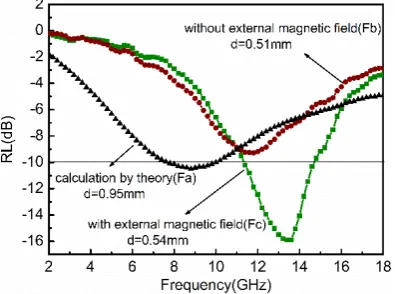
Abstract: The carbonyl iron particles were dispersed in a polychloroprene rubber (CR) matrix under an external magnetic field for practical application as microwave absorption composites film. The film prepared under external magnetic field with a thickness of only 0.54 mm showed least reflection loss of -15.98 dB and the reflection loss value less than -10.0 dB over the frequency range of 11.4~14.8 GHz. In comparison with the microwave absorption properties of calculation by transmission line theory based on the tested relative complex permittivity and permeability and film prepared by general route without external magnetic field, the film made with external magnetic field exhibited more excellent microwave absorption properties, strongly depending on the increment of anisotropy and rearrangement of magnetic particles. The results indicated the composite film made under external magnetic field have excellent microwave absorption properties, which suggest that the composites thin film could be used as a thinner and lighter microwave absorber.
Keywords: carbonyl iron; composites film; external magnetic field; microwave absorption properties
1. Introduction
Due to application saturation in the sub-gigahertz range, microwaves in gigahertz range are being utilized in local area network and wireless communication, etc. Moreover, with the development of electronics equipment and the miniaturization trend of circuitry, electromagnetic interference (EMI) becomes a serious problem in gigahertz range [1~3]. Microwave absorbing materials with excellent performance are effective means to prevent EMI problems and protection from overexposed electromagnetic wave energy as well as modern stealth technology.
For practical application as electromagnetic wave absorbers, it is expected to possess the features of small thickness, wide-band, strong absorption, and lightweight [4~5]. Most researches focus on the synthesis of microwave absorbing particles and study the electromagnetic properties by the theory
complex permittivity and permeability are needed, for the good impedance matching and attenuation of the composite film depend on the value of relative complex permittivity and permeability at a given frequency and thickness [15]. CIP is a kind of traditional ferromagnetic absorbing materials with proper value of relative complex permittivity and permeability [16,17]. Traditionally, the investigation of electromagnetic wave absorbing properties of microwave absorbers made from particles dispersed in polymer matrix focused on the achievement of strong absorption with a thickness of more than1mm [12-14, 18, 19]. However, it is better for practical application as microwave absorbers with thinner film thickness. To our best knowledge, there has no report on the influence of external magnetic field on the microwave absorbing properties during preparation process of magnetic particles and polymer composites film with the film thickness less than 1mm. In this study, we prepared thin and flexible films of carbonyl iron particles (CIP) and polychloroprene composites (CIP/CR) with thickness of 0.54mm under external magnetic field supplied by coils, and study the effect of the anisotropy and the particles dispersion uniformity in the matrix on the microwave absorbing properties.
2. Materials and Methods
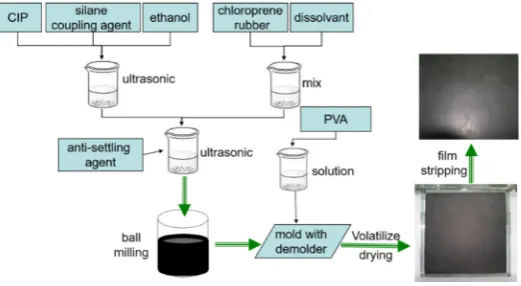
CR used as a matrix material was purchased from Tianjin Xili chemical plant (Tianjin, China) and the CIP as the main carrier of microwave absorbents were obtained from Beijing Institute of Aeronautical Materials. First, the CIP and ant-settling agent were dispersed in methylbenzene by sonication and mechanical stir, and then the CR was added, the composites was still sonication and mechanical stir for another 30min. The mass ratio of CIP treated by ant-settling agent to CR is 30:70. After ball milled 2h to obtain uniform sol-like solution, the composites were rapidly poured into a glass square box with stripping agent with a size of 180×180×20 mm3, and dried under the ambient
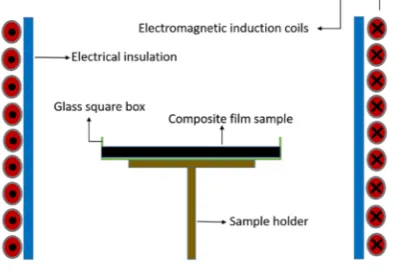
atmosphere. The preparation process of composites film was shown in Figure 1. The film made by the same process was also dried under ambient atmosphere with external magnetic field which supplied by electromagnetic induction coils and schematic representation of the magnetic direction perpendicular to the film was showed in Figure 2. The films made without and with magnetic field were defined as Fb and Fc, respectively.
Figure 1. The preparation process of composites film
The morphology of the CIP was observed by scanning electron microscopy (SEM, S-4700). The thermogravimetric analysis (TG) of and differential scanning calorimetric (DSC) were carried out on a ZRY-2P from room temperature to 800 °C at a heating rate of 5 °C/min under atmosphere. The static magnetic properties of CIP and the magnetic anisotropy of the composites films were tested using a vibrating sample magnetometer (VSM, Lakeshore 7407) at room temperature. The film sample was cut square with size less than 7×7 mm2. The electromagnetic properties (relative complex permittivity
measured by HP8757E Scalar Network Analyzer with a synthesized sweep oscillator source HPWLEET 83751B. In the measurement, the tested films with a size of 180×180 mm2 were pasted on
the metal plate.
Figure 2.Schematic diagram of the composite film dried apparatus with a static magnetic field produced by electromagnetic induction coils.
3. Results and discussion
SEM images indicated that the geometrical structure of the CIP were ball-like onion with the diameter of 1~4 µm [Figure 3(a)]. Figure 3(b) and (c) were typical SEM images of the CIP/CR composites taken from fracture surface of films of Fb and Fc, respectively. Figure s1 indicates the photographs of the film Fb and Fc.
Figure 3. SEM images of (a) pure carbonyl iron particles (b) and (c) fracture surface of CI/CR composites film
prepared by without and with external magnetic field (d) schematic diagram of CI particles dispersed in CR
matrix.
It is observed that CIP relatively good dispersion in CR and distributed randomly (schematic diagram as Figure 3d). No shape change of the particles is observed in the CIP dispersed in the polychloroprene rubber film after the pre-process ball milling. Among the particles there is certain distance, which is filled up with CR. The dispersion state of the CI particles in CR matrix wasn’t changed with external magnetic field.
800oC under atmosphere is Fe2O3. The mass loss ratio of the composite film can described as
following:
1.43
%
m
mx
100%
loss
m
−
=
×
(1) Where m is the total weight of the composite film, x is the mass ratio of iron in the composite film. According to the weight loss of ~45%, the mass ratio of iron in the composites film is 38.5%, which is a little higher than that of design for the loss of the solvent in the rubber.
Figure 4. The curves of TG-DTA for composite film
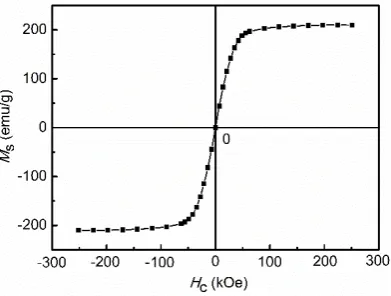
The magnetic hysteresis of CIP is showed in Figure 5, from which we can find out that the saturation magnetization (Ms), remanent magnetization (Mr), and coercivity (Hc) are 210.24 emu/g, 0.59344 emu/g, 7.3424 Oe, respectively. It indicates that the CIP used as fillers are ferromagnetic material.
Figure 5. The VSM of carbonyl iron particles at room temperature
In the present study, we focused on the influence of external magnetic field on the microwave absorption properties of the CIP and CR composites film during its preparation process. The magnetic hysteresis of composite films prepared without and with external magnetic field were shown in Figure s2 and Figure s3, respectively. The direction of x and y was indexed in Figure s1. The results indicated that the different direction magnetic hysteresis of composite films prepared without external magnetic field are coincidence. However, there are difference of the different direction magnetic hysteresis of composite films prepared with external magnetic field. In a bulk sample, the domain of ferromagnetic materials orient randomly with respect to one another. When imposed external magnetic field, the magnetic domain will line up with each other. So, the orientation of the ferromagnetic CIP was adjusted, the magnetic anisotropy of the composites film was enhanced by external magnetic field.
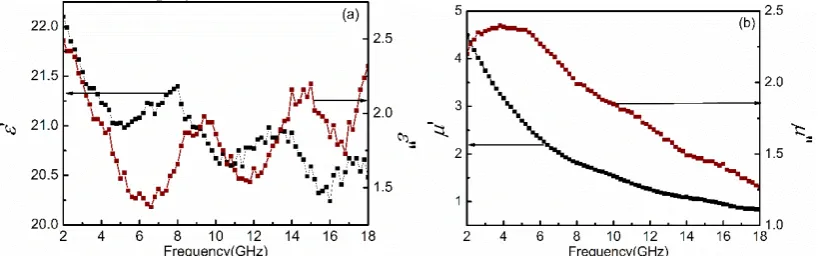
(ε″) of relative complex permittivity of CIP distribute the range of 22.09 to 20.22 and 1.37 to 2.49, respectively, over frequency range of 2.0-18.0 GHz. There are two small peaks of the real part ε′ at 9.2GHz and 14.8GHz. The ε″ of the indicated two peaks at 9.4 GHz and frequency range of 14.0-15.0 GHz, respectively. The lower ε″ values of CIP at 2.0~18.0 GHz indicates a lower electric resistivity than that of other electrical loss microwave absorption materials, which is good for impedance matching. According to the free electron theory [15],
0
" 1 (2π
f
)
ε
≈
ε ρ
(2)Where f is the frequency, ρ is the resistivity, and ε0 is the dielectric constant of vacuum. So the
lower of ε″ means the higher ρ. The dielectric loss of CIP are mainly caused by eddy current effect and space charge polarization. The eddy current effect can be weakened by ferromagnetic particles dispersed in insulation polymer matrix.
Figure 6. The relative complex permittivity and permeability of carbonyl iron-paraffin wax composites vs frequency.
It reveals that the real part of relative complex permeability (µ′) indicates an abrupt decrease from 4.49 to 0.84 over the range of 2.0~18.0 GHz for the domain-wall motion and relaxation as the frequency increases. Meanwhile the imaginary part of relative complex permeability (µ″) increases slightly from 2.2 to 2.4 over frequency range of 2~4GHz and then decreases over higher frequency because of the domain-wall resonance and relaxation. It is worth noting that the maximum value of the µ″ appears at 4.0 GHz, which reveals that the natural resonance frequency of the CIP is 4.0 GHz, and it can realize excellent microwave absorption performance in this frequency range with matching thickness.
Figure 7 presents the reflection loss of the CIP-CR composites films with 38.5 mass % CIP made with, without external magnetic field, and the calculation of the 85mass% CIP and paraffin composites, which were defined as Fb, Fc, and Fa, respectively. The calculation reflection loss (RL) curve is obtained from the relative complex permittivity and permeability, by means of transmission line theory indicated as following equations:
1 2 1 2
in 0
(
) tanh[ (2
π
)( ) ]
Z
=
Z
μ ε
j
fd c
με
(3)in 0 in 0
RL(dB) 20log (
=
Z
−
Z
) (
Z
+
Z
)
(4)Where f is the frequency, c is the velocity of light, d is the thickness, Z0 is the impedance of the
free space, and Zin is the input impedance. For film of Fa, the minimum RL is −10.5 dB at 8.8 GHz and
However, Fc shows better microwave absorption properties compared with Fb with minimum RL at higher frequency. The following reasons are related to the enhanced absorption properties of film made with external magnetic field. It is believed that the easy magnetizing axis of ferromagnetic CIP orientate with direction of external magnetic field, which enhances the magnetic anisotropy of the composites film, showed in Figure s3. According to the natural resonance equation [15]
2
π
f
r=
γ
H
a(5) where γ =2.8 GHz/kOe is the gyromagnetic ratio and Ha is the magnetocrystalline anisotropy, the natural frequency (fr) increases to higher frequency with increasing of magnetic anisotropy (Ha) ,
which accordance with the experimental results of Fc with thicker depth and same fraction mass showing higher minimum RL frequency compared with Fb. Hence more energy may be dissipated due to the improved magnetic anisotropy. Excellent absorption properties were therefore achieved compared with Fb may attribute to the increment anisotropy and the rearrangement of the magnetic domain by introducing external magnetic field during the film made process.
Figure 7. The reflection loss of calculation and films preparation with and without external magnetic field.
4. Conclusions
In conclusion, CIP dispersed in CR with external magnetic field process shows more excellent microwave absorption properties with minimum RL of -15.98 dB and the bandwidth of RL value less than -10 dB is 3.4GHz, RL value over -8.0dB can obtained in frequency range of 10.5GHz-15.5GHz with a thickness of only 0.54 mm. Compared with that of calculation by transmission line theory and film prepared without external magnetic field, film prepared under external magnetic field indicates more excellent absorption properties of attribute to the increment anisotropy and the rearrangement of the magnetic domain by introducing external magnetic field during the film made process. Our study on CIP/CR film which made under external magnetic field has demonstrated its possible applications as thinner electromagnetic wave absorbers.
Supplementary Materials: The following are available online at www.mdpi.com/link, Figure S1 The photographs of film Fb and Fc (a) front surface exposed to air of Fb; (b) reverse surface contacted glass box bottom of Fb (c) front surface exposed to air of Fc (d) reverse surface contacted glass box bottom of Fc, Figure s2 The different direction VSM of Fb at room temperature, Figure s3 The different direction VSM of Fc at room temperature.
Acknowledgments: This work is funded by Doctor Foundation of Yanshan University (B999).
Author Contributions: Haiyan Wang and Xueai Li conceived and designed the experiments; Xueai Li performed the experiments, analyzed the data, and wrote the paper. All authors have reviewed the manuscript.
References
1. Tian, C. H.; Du, Y. C.; Xu, P.; Qiang, R.; Wang, Y.; Ding, D.; Xue, J.L.; Ma, J.; Zhao, H.T.; Han, X. J.
Constructing Uniform Core−Shell PPy@PANI Composites with Tunable Shell Thickness toward
Enhancement in Microwave Absorption. ACS Appl. Mater. Interfaces, 2015, 7, 20090−20099.
http://dx.doi.org/10.1021/acsami.5b05259
2. Xia, C. L.; Zhang, S. F.; Ren, H.; Shi, Q. S.; Zhang, H. L.; Cai, L. P.; Li, J. Z. Scalable Fabrication of Natural-Fiber Reinforced Composites with Electromagnetic Interference Shielding Properties by Incorporating Powdered Activated Carbon. Mater. 2016, 9,10. doi:10.3390/ma9010010
3. Najim, M.; Modi, G.; Mishra, Y. K.; Adelung, R.; Singh, D.; Agarwala, V. Ultra-wide bandwidth with
enhanced microwave absorption of electroless Ni–P coated tetrapodshaped ZnO nano- and microstructures. Phys. Chem. Chem. Phys. 2015, 17, 22923−22933. DOI: 10.1039/c5cp03488d
4. Lv, H.L.; Ji, G.B.; Liu, W.; Zhang, H.Q.; Du, Y.W. Achieving hierarchical hollow carbon@Fe@Fe3O4
nanospheres with superior microwave absorption properties and lightweight features. J. Mater. Chem. C,
2015, 3, 10232−10241. DOI: 10.1039/c5tc02512e
5. Bhattacharya, P.; Dhibar, S.; Hatui, G.; Mandal, A.; Das, T.; Das, C. K. Graphene decorated with hexagonal shaped M-type ferrite and polyaniline wrapper: a potential candidate for electromagnetic wave absorbing and energy storage device applications. RSC Adv. 2014, 4, 17039−17053. DOI: 10.1039/c4ra00448e
6. Wu, T.; Liu, Y.; Zeng, X.; Cui, T.T.; Zhao, Y.T.; Li, Y.N.; Tong, G.X. Facile Hydrothermal Synthesis of Fe3O4/C
Core−Shell Nanorings for Efficient Low-Frequency Microwave Absorption. ACS Appl. Mater. Interfaces, 2016, 8, 7370−7380. http://dx.doi.org/10.1021/acsami.6b00264
7. Wang, Y.M.; Wang, L.D.; Wu, H.J. Enhanced Microwave Absorption Properties of α-Fe2O3-Filled Ordered
Mesoporous Carbon Nanorods. Mater. 2013, 6, 1520−1529. doi:10.3390/ma6041520
8. Hekmatara, H.; Seifi, M.; Forooraghi, K.; Mirzaee, S. Synthesis and microwave absorption characterization of SiO2 coated Fe3O4–MWCNT composites. Phys. Chem. Chem. Phys., 2014, 16, 24069−24075. DOI:
10.1039/c4cp03208j
9. Zhang, Y.B.; Wang, P.; Wang, Y.; Qiao, L.; Wang, T.; Li, F. Synthesis and excellent electromagnetic wave absorption properties of parallel aligned FeCo@C core–shell nanoflake composites. J. Mater. Chem. C, 2015,
3, 10813−10818. DOI: 10.1039/c5tc02146d
10. Qing, Y. C.; Min, D. D.; Zhou, Y.Y.; Luo, F.; Zhou, W.C. Graphene nanosheet- and flake carbonyl iron particle-filled epoxy–silicone composites as thin–thickness and wide-bandwidth microwave absorber.
Carbon 2015, 86, 98 –107. http://dx.doi.org/10.1016/j.carbon.2015.01.002
11. Kotsilkova, R.; Ivanov, E.; Bychanok, D.; Paddubskaya, A.; Demidenko,M.; Macutkevic, J.; Maksimenko, S.; Kuzhir, P. Effects of sonochemical modification of carbon nanotubes on electrical and electromagnetic
shielding properties of epoxy composites. Compos. Sci. Technol. 2015, 106, 85–92.
http://dx.doi.org/10.1016/j.compscitech.2014.11.004
12. Idris, F. M.; Hashim, M.; Abbas, Z.; Ismail, I.; Nazlan, R.; Ibrahim, I. R. Recent developments of smart electromagnetic absorbers based polymer-composites at gigahertz frequencies. J. Magn. Magn. Mater. 2016,
405, 197–208. http://dx.doi.org/10.1016/j.jmmm.2015.12.070
13. Danlée, Y.; Bailly, C.; Huynen, I. Thin and flexible multilayer polymer composite structures for effective
control of microwave electromagnetic absorption, Compos. Sci. Technol. 2014, 100, 182–188.
http://dx.doi.org/10.1016/j.compscitech.2014.06.010
14. Valentini, M.; Piana, F.; Pionteck, J.; Lamastra, F.R.; Nanni, F. Electromagnetic properties and performance of exfoliated graphite (EG) – Thermoplastic polyurethane (TPU) nanocomposites at microwaves, Compos. Sci. Technol. 2015, 114, 26–33. http://dx.doi.org/10.1016/j.compscitech.2015.03.006
15. Zhang, X. F.; Dong, X. L.; Huang, H; Liu, Y. Y.; Wang, W. N.; Zhu, X. G.; Lv, B.; Lei, J. P.; Lee, C. G. Microwave absorption properties of the carbon-coated nickel nanocapsules. Appl. Phys. Lett. 2006, 89, 053115. http://dx.doi.org/10.1063/1.2236965
16. Yu, M.; Yang, P.G.; Fu, J.; Liu, S.Z. Flower-like carbonyl iron powder modified by nanoflakes: Preparation
and microwave absorption properties, Appl. Phys. Lett. 2015, 106, 161904.
http://dx.doi.org/10.1063/1.4919064
18. Kowsari, E.; Mohammadi, M. Synthesis of reduced and functional graphene oxide with magnetic ionic liquid and its application as an electromagnetic-absorbing coating. Compos. Sci. Technol. 2016, 126, 106-114. http://dx.doi.org/10.1016/j.compscitech.2016.02.019
19. Feng, Y. B.; Qiu, T.; Shen, C. Y.; Li, X. Y. Electromagnetic and Absorption Properties of Carbonyl Iron/Rubber Radar Absorbing Materials, IEEE Trans. Magn. 2006, 42, 363-368. Digital Object Identifier 10.1109/TMAG.2005.862763
20. Yusoff, A. N.; Abdullah, M. H.; Ahmad, S. H.; Jusoh, S. F.; Mansor, A. A.; Hamid, S. A. A.; Electromagnetic
and absorption properties of some microwave absorbers, J. Appl. Phys. 2002, 92, 876.
http://dx.doi.org/10.1063/1.1489092