The Importance of Worker Reputation
Information in Microtask-Based
Crowd Work Systems
Alberto Tarable,
Member, IEEE
, Alessandro Nordio,
Member, IEEE
,
Emilio Leonardi,
Senior Member, IEEE
, and Marco Ajmone Marsan,
Fellow, IEEE
Abstract—This paper presents the first systematic investigation of the potential performance gains for crowd work systems, deriving from available information at the requester about individual worker reputation. In particular, we first formalize the optimal task
assignment problem when workers’ reputation estimates are available, as the maximization of a monotone (submodular) function subject to Matroid constraints. Then, being the optimal problem NP-hard, we propose a simple but efficient greedy heuristic task allocation algorithm. We also propose a simple “maximum a-posteriori” decision rule and a decision algorithm based on message passing. Finally, we test and compare different solutions, showing that system performance can greatly benefit from information about workers’ reputation. Our main findings are that: i) even largely inaccurate estimates of workers’ reputation can be effectively exploited in the task assignment to greatly improve system performance; ii) the performance of the maximum a-posteriori decision rule quickly degrades as worker reputation estimates become inaccurate; iii) when workers’ reputation estimates are significantly inaccurate, the best
performance can be obtained by combining our proposed task assignment algorithm with the message-passing decision algorithm.
Index Terms—Human-centered computing, human information processing, systems and information theory
Ç
1
I
NTRODUCTIONC
ROWD work is a term often adopted to identify net-worked systems that can be used for the solution of a wide range of complex problems by integrating a large number of human and/or computer efforts [1]. Alternative terms, each one carrying its own specific nuance, to identify similar types of systems are: collective intelligence, human computation, master-worker computing, volunteer comput-ing, serious games, voting problems, peer production, citi-zen science (and others). An entire host of general-purpose or specialized online platforms, such as information-sharing platforms for recommendations (e.g., Tripadvisor, Ama-zon), co-creation systems (e.g., Wikipedia, Gnu project), social-purpose communities for urban mobility (e.g., Waze), microtask-based crowd work systems, etc., can be defined under these terms.In this paper, we specialize to microtask-based crowd work systems. The key characteristic of these systems is that arequesterstructures his problem in a set oftasks, and then
assigns tasks toworkersthat provideanswers, which are then used to determine the correct tasksolutionthrough adecision
rule. A well-known example of such systems is Amazon Mechanical Turk (MTurk), which allows the employment of large numbers of low-wage workers for tasks requiring human intelligence (HIT – Human Intelligence Tasks). Examples of HIT are image classification, annotation, rating and recommendation, speech labeling, proofreading, etc. In the Amazon Mechanical Turk, the workload submitted by the requester is partitioned into several microtasks, with a simple and strictly specified structure, which are then assigned to (human) workers. Since task execution is typi-cally tedious, and the economic reward for workers is pretty small, workers are not 100 percent reliable, in the sense that they may provide incorrect answers. Hence, in most practi-cal cases, the same task is assigned in parallel (replicated) to several workers, and then a majority decision rule is applied to their answers. A natural trade-off between reliability of the decision and cost arises; indeed, by increasing the repli-cation factor of every task, we generally increase the reliabil-ity degree of the final decision about the task solution, but we necessarily incur higher costs (or, for a given fixed cost, we obtain a lower task throughput). Although the pool of workers in crowd work systems is normally large, it can be abstracted as a finite set of shared resources, so that the allo-cation of tasks to workers (or, equivalently, of workers to tasks) is of key relevance to the system performance. Some believe that microtask-based crowd work systems will pro-vide a significant new type of work organization paradigm, and will employ ever increasing [2] numbers of workers in the future, provided that the main challenges in this new type of organizations are correctly solved. In [3] the authors identify a dozen such challenges, including i) workflow A. Tarable and A. Nordio are with the CNR-IEIIT, Torino, Italy.
E-mail: {alberto.tarable, alessandro.nordio}@ieiit.cnr.it.
E. Leonardi is with the Department of Electronic and Telecommunications, Politecnico di Torino, Torino, Italy and also Research Associates with CNR-IEIIT, Torino, Italy. E-mail: [email protected].
M.A. Marsan is with the Department of Electronic and Telecommunica-tions, Politecnico di Torino, Torino, Italy and also Research Associates with CNR-IEIIT, Torino, Italy and is also a part time Research Professor at IMDEA Networks Institute in Leganes, Madrid, Spain.
E-mail: [email protected].
Manuscript received 17 Mar. 2015; revised 14 Mar. 2016; accepted 9 May 2016. Date of publication 24 May 2016; date of current version 18 Jan. 2017. Recommended for acceptance by J. L. Traff.
For information on obtaining reprints of this article, please send e-mail to: [email protected], and reference the Digital Object Identifier below.
Digital Object Identifier no. 10.1109/TPDS.2016.2572078
definition and hierarchy, ii) task assignment, iii) real-time response, iv) quality control and reputation. All these aspects can represent an interesting research subject and some of them have already stimulated a large bulk of litera-ture, as it will be detailed in the next section. However, this paper deals mainly with task assignment and with the quantitative assessment of the gain (in terms of increased decision reliability for a given cost) that a coarse knowledge of worker quality can offer. Indirectly, thus, we deal also with worker reputation, although we do not study mecha-nisms through which reputation is built upon time. Indeed, we consider a one-shot approach in which the requester has to assign a bunch of tasks to a pool of workers that are stati-cally divided intoclassesaccording to their probabilities of answering correctly. We highlight that the way this division into classes is built is out of the scope of this paper, although we will analyze the effect of errors in this classification on the decision reliability.
1.1 Previous Work
In current online platforms, task assignment is either imple-mented through a simple first-come/first-served rule, or according to more sophisticated approaches. In MTurk, the requester can specify the number of workers to be assigned to each task. MTurk also gives requesters the possibility of dismissing low-quality answers, so that each experienced worker is characterized by an approval rating. As a conse-quence, the requester is also allowed to prescribe a given qualification level for workers to be able to access her tasks. An analysis of the correlation between MTurk approval rating and worker quality is performed in [4]. In the scientific com-munity, the task assignment in crowdsourcing systems has recently been formalized [5], [6], [7], [8] as a resource alloca-tion problem, under the assumpalloca-tion that both tasks and work-ers are indistinguishable. On the worker side, this assumption is motivated by the fact that the implementation of reputation-tracing mechanisms for workers may be challeng-ing, because the workers’ pool is typically large and highly volatile. A step ahead has been recently made in [9], which proposes an adaptive online algorithm to assign an appropri-ate number of workers to every task, so as to meet a prefixed constraint on the problem solution reliability. Like in this paper, in [9] workers are partitioned in different classes, with workers within each class meeting a specified reliability index. However, unlike this paper, the allocation algorithm of [9] is adaptive, i.e., it is based on previous answers on the same set of microtasks: an assumption that, although certainly interesting, implies a time-consuming overall process of task accomplishment. The same adaptive approach is followed in [10], where a bandit-based algorithm is adopted to allocate heterogeneous tasks to workers with task-dependent skills. Given a pool ofnquestions, [11] investigates howkquestions therefrom should be assigned to a worker.
Most real-world crowdsourcing systems typically imple-ment a majority-based decision rule to obtain task solutions. In the last few years, in the scientific literature, smarter deci-sion rules have been proposed to improve the performance of crowdsourcing systems, for the case where no a-priori information about workers’ reputation is available (i.e., workers are a-priori indistinguishable) while tasks are homogeneously difficult [5], [6], [7], [8], [12], [13]. Essentially
the same decision strategy was proposed in [5], [6], and [8] for the case in which tasks require binary answers, and then recently extended in [7] and, independently, in [14], to the case in which tasks require generic multiple-choice answers. In [6], [7] it is shown that the improved decision rule can be efficiently implemented employing a message-passing tech-nique. In [12], an integrated estimation-allocation approach has been pursued with Bayesian inference and entropy reduction as utility function. Different methodologies based on the Expectation-Maximization algorithm have been pro-posed in [13], [15]. All these algorithms exploit existing redundancy and correlation in the pattern of answers returned from workers to infer an a-posteriori reliability esti-mate for every worker. The derived estiesti-mates are then used to properly weigh workers’ answers. When there is a-priori information about workers’ reliability, to the best of our knowledge, the only decision rule proposed in the literature is weighted average, like, e.g., in [10].
Worker Diary, make available to the requester periodic snap-shots of workers’ computer screens, to increase visibility on how the employed workers are behaving. The impact of the so-called attention-check questions (trick questions inserted in a task in order to test the worker’s attention) is analyzed in [4], where it is concluded that such questions are useful only for low-reliability workers and may be counter-produc-tive for high-reliability workers. Workers’ quality control can be partly automated, and made more effective by employing machine-learning techniques like reinforcement learning [35], [36]. Finally, regarding workers’ organization, [37] presents a comprehensive literature survey on human resource manage-ment in crowdsourcing systems.
1.2 Our Contribution
Task assignment and reputation are central to this paper, where we discuss optimal task assignment with approxi-mate information about the quality of answers generated by workers (with the term “worker reputation” we gener-ally mean the worker earnestness, i.e., the credibility of a worker’s answer for a given task, which we will quantify with an error probability). Our optimization aims at mini-mizing the probability of an incorrect task solution for a maximum number of tasks assigned to workers, thus pro-viding an upper bound to delay and a lower bound on throughput. A dual version of our optimization is possi-ble, by maximizing throughput (or minimizing delay) under an error probability constraint. Like in most analy-ses of crowd work systems, we assume no interdepen-dence among tasks, but the definition of workflows and hierarchies is an obvious next step. Both these issues (the dual problem and the interdependence among tasks) are left for further work.
The goal of this paper is to provide the first systematic anal-ysis of the potential benefits deriving from some form of a-priori knowledge about the reputation of workers, extending the results of our preliminary work [38]. With this goal in mind, first we define and analyze the task assignment prob-lem when workers’ reputation estimates are available. In par-ticular, we suppose that available workers are divided into classes, each of which represents a different reliability level. Under this hypothesis, we show that in some cases, the task assignment problem can be formalized as the maximization of a monotone submodular function subject to Matroid con-straints. A greedy algorithm with performance guarantees is then devised. In addition, we propose a simple “maximum a-posteriori” (MAP) decision rule, which is well known to be optimal when perfect estimates of workers’ reputation are available. Moreover, we introduce a message-passing deci-sion algorithm, which is able to encompass a-priori informa-tion about workers’ reputainforma-tion, thus improving upon the one described in [6]. Finally, our proposed approach is tested in several scenarios, and compared to previous proposals.
Our main findings are:
even largely inaccurate estimates of workers’ reputa-tion can be effectively exploited in the task assign-ment to greatly improve system performance; the performance of the maximum a-posteriori
deci-sion rule quickly degrades as worker reputation estimates become inaccurate;
when workers’ reputation estimates are significantly inaccurate, the best performance can be obtained by combining our proposed task assignment algorithm with the message-passing decision algorithm pre-sented in this paper;
there is no need for a large number of refined clas-ses, i.e., a coarse quantization of individual reputa-tions already achieves most of the related gain.
2
S
YSTEMA
SSUMPTIONSWe consider T binary tasks u1;u2;. . .;uT, whose outcomes can be represented by i.i.d. uniform random variables (RV’s) t1;t2;. . .;tT over f1g, i.e., Pftt¼ 1g ¼12, t¼
1;. . .; T. In order to obtain a reliable estimate of task out-comes, a requester assigns tasks to workers selected from a given population of sizeW, by querying each worker vw,
w¼1;. . .; Wa subset of tasks.
Each worker is modeled as a binary symmetric channel (BSC) [39, p. 8]. This means that workervw, if queried about task ut, provides a wrong answer with probability ptw,
ptw2 ½0;1=2, and a correct answer with probability1ptw. The error probabilities ptw are taken to be time-invariant and generally unknown to the requester.
Remark 1. In practice,ptw can be estimated by analyzing the workers’ performance during previous task assign-ments. However how to estimateptwis out of the scope of this work.
Remark 2. We assume that the task allocation process
works in one-shot. More precisely, at timetthe allocation algorithm submits all tasks to workers on the basis of the reputation they have at that time. Therefore, possible time variations of the workers’ reputation do not affect task allocation. Also, tasks are assumed to be evaluated by workers in a short amount of time. Therefore workers’ error probabilities, ptw, are not expected to significantly vary during the process. An analysis of the system perfor-mance in the presence of time variations of workers’ repu-tations would require models and algorithms for building reputation on the basis of previously assigned tasks. How-ever, our scope is not to investigate how these reputations can be built, rather to assess how reputation can be exploited by task allocation and decision algorithms.
By making these assumptions, we avoid modeling the workers’ behaviour as driven by latent motivations, as in, e.g., [31]. In particular, we do not deal with malicious work-ers (for which ptw¼1). As a matter of fact, a worker that always outputs the wrong answer provides as much infor-mation to the aware requester as a worker that answers cor-rectly all the times. We also assume that ptw depends on both the worker and the task, a fact that reflects the realistic consideration that tasks may have different levels of diffi-culty, that workers may have different levels of accuracy, and may be more skilled in some tasks than in others [33].
Similarly to [9], we assume in this paper that, thanks to a-priori information, the requester can group workers into
classes, each one composed of workers with similar accuracy
previous task assignments: this is the case of the approval rating in MTurk, for example. More precisely, we suppose that each worker belongs to one ofKclasses,C1;C2;. . .;CK, and that each class is characterized, for each task, by a different representative error probability, known to the requester. Letptkbe the representative error probability for class Ck and task ut,k¼1;. . .; K,t¼1;. . .; T. In practice, classes may derive from a quantization of estimated indi-vidual error probabilities. The reason of dealing with clas-ses, instead of individuals, stems from the fact that ptw is estimated heuristically and thus it is affected by inaccuracy. Because of that, sacrificing precision should not entail a major performance loss, while it simplifies the task alloca-tion phase. This intuialloca-tion will be confirmed in Secalloca-tion 6.
Most times, in the following, we will deal with a case whereptkis theaverageerror probability of workers belong-ing to classk. This allows to abstract from the practical way in which classes are built. In particular our class characteri-zation encompasses two extreme scenarios:
full knowledge about the reliability of workers, i.e., each worker belonging to classCkhas error probabil-ity for taskutdeterministically equal toptk, and
a hammer-spammer (HS) model [5], in which per-fectly reliable and completely unreliable users coex-ists within the same class. A fraction2ptkof workers in class Ck, when queried about task ut, has error probability equal to 12 (the spammers), while the remaining workers have error probability equal to zero (the hammers). Note that this is an artificial sce-nario, where the variance within a single class is pushed to the limit, thus allowing to test the robust-ness of our task assignment algorithm to a very unfa-vorable class composition.
Suppose that classCkcontains a total ofWkworkers, with
W ¼PKk¼1Wk. The first duty the requester has to carry out is the assignment of tasks to workers. We impose the follow-ing two constraints on possible assignments:
a given task ut can be assigned at most once to a given workervw, and
no more thanrwtasks can be assigned to workervw. Notice that the second constraint arises from practical considerations on the amount of load a single worker can tolerate. We also suppose that each single assignment of a task to a worker has a cost, which is independent of the worker’s class. In practical microtask-based crowdsourcing systems, such cost represents the low wages per task the requester pays the worker, in order to obtain answers to his queries.1In this work, we assume the same cost for all work-ers, although it may appear more natural to differentiate wages among different classes, so as to incentivize workers to properly behave [27], [28]. Our choice, however, is mainly driven by the following two considerations: i) while it would be natural to differentiate wages according to the individual reputation of workers, when the latter information is suffi-ciently accurate, it is much more questionable to differentiate them according to only a collective reputation index, such as
ptk, especially when workers with significantly different rep-utation coexist within the same class; ii) since in this paper our main goal is to analyze the impact on system perfor-mance of a-priori available information about the reputation of workers, we need to compare the performance of such sys-tems against those of syssys-tems where the requester is completely unaware of workers’ reputation, under the same cost model. Finally, we wish to remark that both our problem formulation and proposed algorithms naturally extend to the case in which costs are class-dependent.
Let anallocationbe a set2of assignments of tasks to work-ers. More formally, we can represents a generic allocation with a set G of pairs ðt; wÞ with t2 f1;. . .; Tg and w2 f1;. . .; Wg, where every elementðt; wÞ 2 Gcorresponds to an individual task-worker assignment. LetObe the com-plete allocation set, comprising every possible individual task-worker assignment (in other words Ois the set com-posed of all the possible TW pairs ðt; wÞ). Of course, by construction, for any possible allocation G, we have that G O. Hence, the set of all possible allocations corresponds to the power set ofO, denoted as2O.
The setG can also be seen as the edge set of a bipartite graph where the two node subsets represent tasks and workers, and there is an edge connecting task node tand worker nodewif and only ifðt; wÞ 2 G. It will be sometimes useful in the following to identify the allocation with the biadjacency matrix of such graph. Such binary matrix of size TW will be denotedGðGÞ ¼ fgtwg, gtw2 f0;1g and referred to as theallocation matrix.
In this work, we suppose that the allocation is non-adap-tive, in the sense that all assignments are made before any decision is attempted. With this hypothesis, the requester must decide the allocation only on the basis of the a-priori knowledge on worker classes. Because of this one-shot assumption, both individual and class error probabilities are considered to be constant over time, as well as constant is the mapping between workers and classes. Adaptive allo-cation strategies can be devised as well, in which, after a partial allocation, a decision stage is performed, and gives, as a subproduct, refined a-posteriori information both on tasks and on workers’ accuracy. This information can then be used to optimize further assignments. However, in [6] it was shown that non-adaptive allocations are order optimal in a single-class scenario.
When all the workers’ answers are collected, the requester starts deciding, using the received information. LetAðGÞ ¼ fatwgbe aTW random matrix containing the workers’ answers and having the same sparsity pattern as
GðGÞ. Precisely,atwis nonzero if and only ifgtwis nonzero, in which case atw¼tt with probability 1ptw and
atw¼ tt with probability ptw. For every instance of the matrixAðGÞthe output of the decision phase is an estimate vector^ttðGÞ ¼ ½^t1;t^2;. . .;^tTfor task values. In the following, for notation simplicity we will drop the dependence of the matricesGand Aand of the estimates^tton the allocation setG, except when needed for clarity of presentation.
1.We suppose that is the requester has no possibility of refusing the payment for an executed task, whether successful or not.
As a final justification of the model described in this sec-tion, we describe here a modus operandi for a microtask-based crowdsourcing system like MTurk, that would be well modeled by our assumptions. Suppose the platform first calls for a prequalification with respect to a given set of tasks. After the due number of workers have applied, this first phase is closed, and the crowd of potential workers is formed. In the second phase, such crowd is partitioned into classes according to reputation, and actual task assignment to (a subset of) applicants takes place. Finally, answers are collected and decisions are taken.
3
P
ROBLEMF
ORMULATIONIn this section, we formulate the problem of the optimal allocation of tasks to workers, with different possible per-formance objectives. We formalize such problem under the assumption that each worker in class Ck has error probability for task ut deterministically equal to ptk. By sorting the columns (workers) of the allocation matrix G, we can partition it as
G¼½G1;G2;. . .;GK; (1)
whereGkis a binary matrix of sizeTWkrepresenting the allocation of tasks to class-kworkers.
We definedtkas the weight (number of ones) in thetth row of matrix Gk, which represents the number of times taskt is assigned to class-kworkers. Such weights can be grouped into theTKmatrix of integersDðGÞ ¼ fdtkg.
Remark 3:If the individual error probability of the workers within one class is not known to the scheduler, it becomes irrelevant which worker in a given class is assigned the task. What only matters is actually how many workers of each class is assigned each task. Under this condition
1) any performance parameter to be optimized can be expressed as a function of the weight matrixD; 2) any two allocation sets G1 and G2 such that
DðG1Þ ¼DðG2Þshow the same performance; 3) by optimizing the weight matrix DðGÞ we also
optimize the set of allocationsG.
3.1 Optimal Allocation
We formulate the problem of optimal allocation of tasks to workers as a combinatorial optimization problem for a max-imum overall cost. LetFðGÞbe a given performance param-eter to be maximized. We fix the maximum number of assignments (i.e., the maximum number of ones in matrix
G) to a valueC, and we seek the best allocationGas Gopt¼ arg max
G FðGÞ
s.t. 0 dtk Wk; t¼1;. . .; T; k¼1;2;. . .; K;
XT
t¼1
dtk
X
WðkÞ
w¼Wðk1Þþ1
rw; k¼1;. . .; K;
XT
t¼1
XK
k¼1
dtk C;
(2)
wheredtkare the (integer) elements ofDðGÞ,WðkÞ¼
Pk i¼1Wi andWð0Þ¼0. The second constraint in (2) expresses the fact thatdtkis the number of ones in thetth row ofGk, the third
constraint derives from the maximum number of tasks a given worker can be assigned, and the last constraint fixes the maximum overall cost.
Note that it could also be possible to define a dual opti-mization problem, in which the optiopti-mization aims at the minimum cost, subject to a maximum admissible error probability; this alternative problem is left for future work.
We now denote byFthe family of all feasible allocations (i.e., the collection of all the allocations respecting the con-straints on the total cost and the worker loads). Observe that by constructionF 2O is composed of all the alloca-tionsGsatisfying: i)jGj C, and ii)jLðw;GÞj rw8w, where
Lðw;GÞ represents the set of individual assignments in G associated tow.
Proposition 3.1.The familyF forms a Matroid [40]. Further-more,Fsatisfies the following property. LetB F be the fam-ily of maximal sets inF, thenq¼maxminG2BjGj
G2BjGj¼1.
The proof is reported in the Supplemental material, which can be found on the Computer Society Digital Library at http://doi.ieeecomputersociety.org/10.1109/ TPDS.2016.2572078.
3.1.1 Computational Complexity
The complexity of the above optimal allocation problem heavily depends on the structure of the objective function
FðGÞ(which when specifying the dependence on the alloca-tion setGcan be rewritten asFðGÞ). As a general property, observe that necessarilyFðGÞis monotonic, in the sense that
FðG1Þ FðG2Þ whenever G1G2. However, in general, we cannot assume thatFðGÞ satisfies any other specific prop-erty (some possible definitions forFðGÞare given next). For a general monotonic objective function, the optimal alloca-tion of tasks to workers can be shown to be NP-hard, since it includes as a special case the problem of the maximization of a monotonic submodular function, subject to a uniform Matroid constraint (see [40]).3WhenFðGÞ is submodular, the optimal allocation problem falls in the class of prob-lems related to the maximization of a monotonic submod-ular function subject to Matroid constraints. For such problems, it has been proved that a greedy algorithm yields a 1/(1+q)-approximation [40] (whereqis defined as in Proposition 3.1). In the next sections, we consider dif-ferent choices for the performance parameterFðGÞ.
3.2 Average Task Error Probability
A possible objective of the optimization, which is most closely related to typical performance measures in practical crowd work systems, is the average task error probability, which (except for the minus sign, which is due to the fact that we need to minimize, rather than maximize, error prob-ability) is defined as:
F1ðGÞ ¼ 1
T XT
t¼1
Pe;t; (3)
3.A set functionf: 2O!Rþis said to be submodular if:8A;B 22O we havefðA [ BÞ þfðA \ BÞ fðAÞ þfðBÞ. The problem of the maxi-mization of a monotonic submodular function subject to a uniform Mat-roid constraint corresponds to: {maxjAj KfðAÞforK < jOjwithfðÞ
where
Pe;t¼Pf^tt6¼ttg ¼Pf^tt6¼1jtt¼1g; (4) is the error probability on task t and where the second equality in (4) follows from the fact that tasks are uniformly distributed in f1g. Note that the probabilities Pe;t,
t¼1;. . .; Tdepend on the allocation setGthrough the vector of task estimates^tt. Of course,Pe;tcan be exactly computed only when the true workers’ error probabilities ptw are available; furthermore it heavily depends on the adopted decoding scheme. As a consequence, in general,Pe;tcan only be approximately estimated by the requester by confusing the actual worker error probabilityptw(which is unknown) with the corresponding average class error probability
ptk. Assuming a maximum-a-posteriori (MAP) decoding scheme, namely,^ttðaaÞ ¼arg maxtt21Pfttjat¼aag, whereat
is thetth row ofAandaais its observed value, we have Pe;t¼
X
a
a:Pftt¼1jat¼aag<1=2
Pfat¼aajtt¼1g: (5)
It is easy to verify that the exact computation of this average task error probability estimate requires a number of opera-tions growing exponentially with the number of classesK. Thus, when the number of classesKis large, the evaluation of (5) can become critical.
To overcome this problem, we can compare the perfor-mance of different allocations on the basis of a simple pessimistic estimate of the error probability, obtained by applying the Chernoff bound to the random variable that is driving the maximum-a-posteriori (MAP) decoding (details on a MAP decoding scheme are provided in the next sec-tion). We have:
Pe;t Pbe;t¼exp
P
kdtkð12ptkÞztk
P
kðdtkztkÞ2
! ;
whereztk¼logð 1ptk
ptk Þ. Thus, the performance metric
associ-ated with an allocation becomes F2ðGÞ ¼ T1PTt¼1Pbe;t. The computation of F2ðGÞ requires a number of operations that scales linearly with the productT K. However, in practical cases, we expect the number of classes to be sufficiently small (order of few units), so that the evaluation of (5) is not an issue.
3.3 Overall Mutual Information
An alternative information-theoretic choice for FðGÞ is the mutual information between the vector of RVs associated with taskstt¼ ðt1;t2;. . .;tTÞand the answer matrixAðGÞ, i.e.,
F3ðGÞ ¼IðA;ttÞ ¼X
T
t¼1
Iðat;ttÞ: (6)
It is well known that a tight relation exists between the mutual information and the achievable error probability, so that a maximization of the former corresponds to a minimi-zation of the latter. We remark, however, that, contrary to error probability, mutual information is independent from the adopted decoding scheme, because it refers to an opti-mal decoding scheme. This property makes the adoption of mutual information as the objective function for the task
assignment quite attractive, since it permits to abstract from the decoding scheme. The second equality in (6) comes from the fact that tasks are independent and workers are modeled as BSCs with known error probabilities, so that answers to a given task do not provide any information about other tasks. By definition
Iðat;ttÞ ¼HðatÞ HðatjttÞ ¼HðttÞ HðttjatÞ; (7) where HðaÞ denotes the entropy of the RV a, given by4 HðaÞ ¼ Ea½logPðaÞand for any two random variablesa; b,
HðajbÞ is the conditional entropy defined as HðajbÞ ¼ EbEajb½logPðajbÞ. In what follows, we assume perfect knowledge of worker reliabilities, i.e., we assume that each class-kworker has error probability with respect to task tt exactly equal to ptk, remarking that in the more general case, the quantities we obtain by substituting ptw with the corresponding class average ptk, can be regarded as com-putable approximations for the true uncomcom-putable mutual information.
Since we have modeled all workers as BSCs, each single answer is independent of everything else given the task value, so that
HðatjttÞ ¼
X
atw6¼0
HðatwjttÞ ¼
XK
k¼1
dtkHbðptkÞ: (8)
whereHbðpÞ ¼ plogp ð1pÞlogð1pÞ. For the second equality in (7), HðttÞ ¼1 because tt is a uniform binary RV, and
HðttjatÞ ¼
X
a a
Pfat¼aagHðttjat¼aaÞ
¼X
a a
Pfat¼aagHbðPftt¼1jat¼aagÞ; (9)
whereaaruns over all possible values ofat.
By symmetry, for everyaasuch thatPftt¼1jat¼aag < 12, there is aa0 such that Pfat¼aa0g ¼Pfat¼aag and Pftt¼1j
at¼aa0g ¼1Pftt¼1jat¼aag. As a consequence, we can write
HðttjatÞ ¼2
X
aa:Pftt¼1jat¼aag<12
Pfat¼aagHbðPftt¼1jat¼aagÞ
¼ X
a
a:Pftt¼1jat¼aag<12
Pfat¼aajtt¼1g þPfat¼aajtt¼1g
ð Þ
HbðPftt¼1jat¼aagÞ:
(10)
Notice the relationship of the above expression with (5). If in (10) we substitute HbðPftt¼1jat¼aagÞ with Pftt¼1j
at¼aag, thanks to Bayes’ rule, we obtain (5).
An explicit computation of IðA;ttÞ can be found in the Supplemental material, available online. Like for the task error probability, the number of elementary operations required to computeIðA;ttÞ grows exponentially with the number of classesK.
An important property that mutual information satisfies is submodularity. This property provides some guarantees
about the performance of the greedy allocation algorithm described in Section 4.1.
Proposition 3.2 (Submodularity of the mutual informa-tion).LetGbe a generic allocation for taskuand letaðGÞbe a random vector of answers for tasku. Then, the mutual informa-tionIðaðGÞ;tÞis a submodular function.
Proof. The proof is given in the Supplemental material,
available online. tu
3.4 Max-Min Performance Parameters
The previous optimization objectives represent a sensible choice whenever the target is to optimize the average task performance. However, in a number of cases it can be more appropriate to optimize the worst performance among all tasks, thus adopting a max-min optimization approach. Along the same lines used in the definition of the previous optimization objectives, we can obtain three other possible choices of performance parameters to be used in the optimi-zation problem defined in (2), namely, the maximum task error probability, F4ðGÞ ¼ maxt¼1;...;TPe;t the Chernoff bound on the maximum task error probability, F5ðGÞ ¼
maxt¼1;...;TPbe;t and the minimum mutual information,
F6ðGÞ ¼mint¼1;2;...;TIðat;ttÞ.
4
A
LLOCATIONS
TRATEGIESAs we observed in Section 3, the optimization problem stated in (2) is NP-hard, but the submodularity of the mutual information objective function over a Matroid, cou-pled with a greedy algorithm yields a 1/2-approxima-tion [40] (see Proposi1/2-approxima-tion 3.1). We thus define in this sec1/2-approxima-tion a greedy task assignment algorithm, to be coupled with the MAP decision rule which is discussed in the next section.
4.1 Greedy Task Assignment
The task assignment we propose to approximate the opti-mal performance is a simple greedy algorithm that starts from an empty assignment (Gð0Þ¼ ;), and at every iteration iadds to Gði1Þ the individual assignmentðt; wÞðiÞ, so as to maximize the objective function. In other words;
ðt; wÞðiÞ¼ arg max ðt;wÞ2OnGði1Þ
ðGði1Þ[fðt;wÞgÞ2F
FðGði1Þ[ fðt; wÞgÞ:
The algorithm stops when no assignment can be further added toGwithout violating some constraint.
To execute this greedy algorithm, at stepi, for every taskt, we need to i) find, if any, the best performing worker to which tasktcan be assigned without violating constraints, and mark the assignmentðt; wÞas a candidate assignment; ii) evaluate for every candidate assignment the performance indexFðGði1Þ[ ðt; wÞÞ 8t; iii) choose among all the candidate assignments the one that greedily optimizes performance.
Observe that, as a result, the computational complexity of our algorithm isOðT2WZÞwhereZrepresents the num-ber of operations needed to evaluateFðGÞ.
Note that in light of both Propositions 3.1 and 3.2, the above greedy task assignment algorithm provides a
1=2-approximation when the objective functionF3ðGÞ (i.e.,
mutual information) is chosen. Furthermore, we wish to mention that a better ð11=eÞ-approximation can be obtained by cascading the above greedy algorithm with the special local search optimization algorithm proposed in [40]; unfortunately, the corresponding cost in terms of computational complexity is rather severe, because the number of operations requested to run the local search pro-cedure isOððTe WÞ8ZÞ.5
4.2 Uniform Allocation
Here we briefly recall that [5], [6] proposed a simple task allocation strategy (under the assumption that workers are indistinguishable) according to which a random regular bipartite graph is established between tasks and selected workers. Every selected worker is assigned the same maxi-mal number of tasks, i.e.,rw¼r,8w, except for rounding effects induced by the constraint on the maximum total number of possible assignmentsC.
5
D
ECISIONA
LGORITHMS 5.1 Majority VotingMajority voting is the simplest possible task-decision rule and is currently implemented in all real-world crowd work systems. For every taskut, it simply consists in counting the
fþ1gand thef1ginatand then taking^ttðatÞin accordance to the answer majority. More formally:
^
ttðatÞ ¼sgn
X
w
atw
!
: (11)
Note that whenPwatw¼0,^ttðatÞ is randomly chosen in
f1;þ1g.
5.2 MAP Decision for Known Workers’ Reputation For the case where each class-kworker has error probability with respect to task tt deterministically equal to ptk, the optimal MAP decision rule can be derived analytically. Indeed, given an observed value ofat, the posterior log-like-lihood ratio (LLR) for taskttis
LLRtðatÞ ¼log
Pftt¼1jatg Pftt¼ 1jatg
¼ X
w:atw6¼0
log Pfatwjtt¼1g Pfatwjtt¼ 1g
;
(12)
where the second equality comes from Bayes’ rule and the fact that tasks are uniformly distributed over 1, and the third equality comes from modeling workers as BSCs. Let mtk be the number of “1” answers to taskt from class-k workers. Then
LLRtðatÞ ¼
XK
k¼1
dtk2mtk
ð Þlog1ptk
ptk
: (13)
The MAP decision rule outputs the task solution estimate
^
tt¼1ifLLRt > 0and^tt¼ 1ifLLRt < 0, that is,
^
ttðatÞ ¼sgn LLRð tðatÞÞ: (14)
5.The functionfðnÞisOðgðnÞÞe iffðnÞ ¼OðgðnÞlogbnÞfor any
Observe that the computation of (13) has a complexity growing only linearly with K, and that, according to (14), each task solution is estimated separately. Note also that, whenever worker reputation is not known a-priori, the above decision rule is no more optimal, since it neglects the information that answers to other tasks can provide about worker reputation.
5.3 Oracle-Aided MAP Decision
The oracle-aided MAP decision rule is a non-implementable decision strategy which has direct access to the error proba-bilitiesptwof every individual worker for every task.
According to the oracle-aided MAP decision rule, first we compute for every taskut:
OLLRtðatÞ ¼
X
w
atwlog
1ptw
ptw
: (15)
Then, the oracle-aided MAP decision rule outputs the task solution estimate ^tt¼1 if OLLRt > 0 and ^tt¼ 1 if
OLLRt < 0, that is,
^
ttðatÞ ¼sgn OLLRð tðatÞÞ: (16)
Observe that the oracle-aided MAP decision rule pro-vides an upper bound to the performance of every imple-mentable decision rule (i.e., it gives a lower bound on the error probability).
5.4 Low-Rank Approximation (LRA)
For the sake of comparison, we briefly recall here the Low-Rank Approximation decision rule proposed in [5], [6], [8] for the case when: i) no a-priori information about the reputation of workers is available, ii) the error probability of every individual workerwis the same for every task, i.e., ptw¼pw 8t. The LRA decision rule was shown to provide asymptotically optimal performance under assumptions i) and ii) [6].
Denote withvthe leading right singular vector ofA, the LRA decision is taken according to:
^
ttðatÞ ¼sgn LRAð ðatÞÞ; where
LRAðatÞ ¼
X
w
atwvw:
The idea underlying the LRA decision rule is that each component of the leading singular vector ofA, measuring the degree of coherence among the answers provided by the corresponding worker, represents a good estimate of the worker’s reputation.
5.5 Message Passing
Another possible suboptimal decision algorithm is based on message passing (MP). The fundamental idea behind MP is that, if the allocation matrixGis sparse, the MAP algorithm can be well approximated by exchanging locally computed messages, between the nodes of the bipartite graph whose biadjacency matrix isG, for a certain number of iterations. The algorithm is based on the hypothesis that a given
worker behaves in the same way for all tasks, i.e.,ptw¼pw for alltandw, so thatptk¼pkfor alltandk.
Our MP algorithm is an extension of the one described in [6], where we take into account the a-priori information about worker classes. In [6] it is shown that a particular MP algo-rithm can be seen as an efficient implementation of the LRA decision rule. In such MP algorithm, workers are seen as a sta-tistical mixture of a hammer (pw¼0) and a malicious worker (pw¼1). Initially, the statistical mixture assigns the same weight to both hypotheses, while at each iteration the weights are corrected, strengthening or weakening the hammer hypothesis for each worker according to whether she has answered correctly most tasks or not. Our implementation, instead, assumes a different statistical mixture for each class, and a more complex weight update rule, which is essentially locally optimal. The details of our implementation follow.
In the considered bipartite graph, nodes are either task nodes or worker nodes. An edge connects task node t to worker node w if and only if gtw¼1. Messages are exchanged along the edges. Let kðwÞ be the class which workerwbelongs to andfkð0ðwÞÞðpÞ be the a-priori pdf of the
error probability for classkðwÞ. Letmðt!lÞw andmðwlÞ!tbe the messages sent from task node t to worker node w (resp. from worker node w to task node t) in the l-th iteration, l¼1;2;. . .Given the answer matrixA¼ fatwg, the MP algo-rithm reads as follows.
Initial condition:
pðtw0Þ¼pkðwÞ; (17) Forl¼1;2;. . .
Output LLR:
LLRðlÞ
t ¼
X
w
atwlog
1pðtwl1Þ
pðtwl1Þ ; ( 18)
Task-to-worker message:
mðtl!Þw¼ X
w06¼w
atw0log
1pðtwl01Þ
pðtwl01Þ
; (19)
Worker-to-task message:
mðwlÞ!t¼pðtwlÞ¼ Z 1
0 pf
ðlÞ
twðpÞdp; (20)
being
ftwðlÞðpÞ/f
ð0Þ
kðwÞðpÞ
Y
t06¼t
1þð12pÞat0wtanh
mðtl0Þ!w
2 !
" #
: (21)
It can be seen from (18) that, at each iteration, task nodes perform the LLR computation as in the MAP decision rule for known workers’ reputation, similarly to (13), with the current estimates of workers’ error probabilities. Because of the initialization in (17), the LLR outputs at the first iteration are equal to (13).
The task-to-worker message in (19) is theextrinsicLLR, i.e., the one that does not consider the incoming message on the same edge. The worker-to-task message in (20) is the updated estimatepðtwlÞ of the error probabilitypw of worker
derivation of (21) are given in the Supplemental material, available online.
Regarding the a-priori pdf, several choices are possible. In our implementation, we have considered as a-priori pdf fkð0ÞðpÞthe max-entropy distribution [39, Ch. 12] over½0;1=2 with a mean equal topk, namely
fkð0ÞðpÞ /ekp; (22)
where k is a parameter that depends on the mean pk. If Haldane priors are assumed for all workers, i.e.,
fkð0ÞðpÞ ¼1 2dðpÞ þ
1
2dðp1Þ; (23)
where dðÞ denotes Dirac delta function, then we obtain the simplified MP algorithm whose description can be found in [6]. Simulation results will show in many cases the advantage of using (22) instead of (23), whose perfor-mance is essentially the same as the LRA decision rule of Section 5.4.
6
R
ESULTSIn this section, except stated otherwise, we evaluate the performance of a system where T ¼100 tasks are assigned to a set of workers, which are organized in K¼3 classes. Each worker can handle up to 20 tasks, i.e., rw¼20, w¼1;. . .; W. We compare the performance of the allocation algorithms and decision rules described in Sections 4 and 5, in terms of achieved average error probability,Pe¼T1
P
tPe;t. We study the performance of:
the “Majority voting” decision rule applied to the “Uniform allocation” strategy, hereinafter referred to as “Majority uniform”;
the “Majority voting” decision rule applied to the “Greedy allocation” strategy, hereinafter referred to as “Majority greedy”;
the “Low rank approximation” decision rule applied to the “Uniform allocation” strategy, in the figures referred to as “LRA uniform”;
the “Low rank approximation” decision rule applied to the “Greedy allocation” strategy, in the figures referred to as “LRA greedy”;
the “MAP” decision rule applied to the “Greedy allocation” strategy, in the following referred to as “MAP greedy”.
the “Message Passing” decision algorithm applied to the “Greedy allocation” strategy, in the following referred to as “MP greedy”.
the “Oracle-aided MAP” decision rule applied to the “Greedy allocation” strategy, in the following referred to as “OMAP greedy”.
Specifically, for the greedy allocation algorithm, described in Section 4.1, we employed the overall mutual information F3ðGÞ as objective function. We consider 4 scenarios characterized by different number of workers, number of classes, and workers’ error probabilities. The main system parameters for all scenarios are summa-rized in Table 1.
6.1 Scenario 1
The first set of results is reported in Figs. 1a, 1b, 1c, and 2. For starters, results in these figures refer to the most classical sce-nario, where all tasks are identical. For what concerns work-ers, we define three classes, and the number of available workers per class is set to W1¼30; W2¼120; W3¼150. Since each worker can handle up to 20 tasks (rw¼20), the maximum number of assignments that can be handled by the three classes are 600, 2,400, and 3,000, respectively.
We setpt1¼0:1;pt2¼0:2;pt3¼0:5for allt. This means that workers in class 1 are the most reliable, while workers in class 3 are spammers. This situation is summarized in Table 1 as Scenario 1.
The results depicted in Fig. 1a assume that all workers belonging to the same class have the same error probability i.e.,ptw¼pt;kðwÞ,kðwÞbeing the class worker wbelongs to.
TABLE 1
Main Parameters for the Three Considered Scenarios
T pt1 pt2 pt3 W1 W2 W3
Scenario 1 100 0.1 0.2 0.5 30 120 150 Scenario 2 50 0.05 0.1 0.5
30 120 150 50 0.1 0.2 0.5
Scenario 3 50 0.1 0.2 0.5
40 120 40 50 0.5 0.2 0.1
Scenario 4 100 ptk¼2k4K1,1 k K
P
kWk¼90
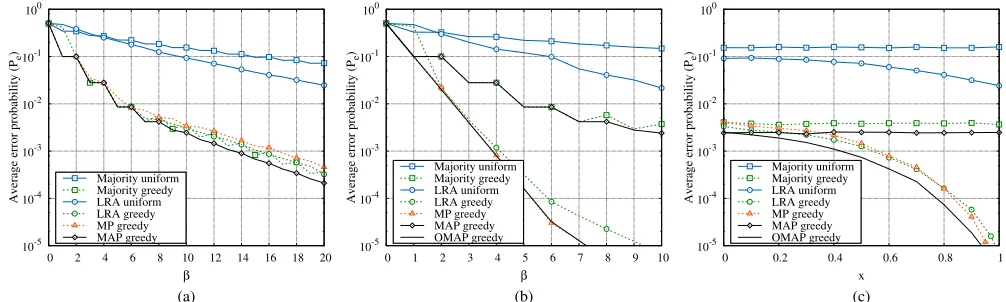
In particular, the figure shows the average task error proba-bility, plotted versus the average number of workers per task,b¼C=T. As expected, greedy allocation strategies per-form much better due to the fact that they exploit the knowl-edge about the workers’ reliability (ptw), and thus they assign tasks to the best possible performing workers. These strategies provide quite a significant reduction of the error probability, for a given number of workers per task, or a reduction in the number of assignments required to achieve a fixed target error probability. For example,Pe¼102can be achieved by greedy algorithms by assigning only 6 work-ers per task (on average), while algorithms unaware of workers reliability require significantly more than 20 work-ers per task (on average).
Since class 1 can handle up to 600 assignments, for the greedy allocation algorithm, and forb > 6the requester has to allocate tasks to workers of class 2 as well. Since workers of class 2 are less reliable than workers of class 1 the slopes of the curves decrease. This behavior is not shown by algo-rithms employing uniform allocation since they choose workers irrespectively of the class they belong to.
We also observe that: i) in this scenario the simple MAP decision rule is optimal (it perfectly coincides with the OMAP) ii) every decision rule (even the simple majority rule) when applied in conjunction with a greedy scheduler provides comparable performance with respect to the opti-mal MAP algorithm (within a factor 2), iii) the performance of the MP greedy algorithm is slightly worse than LRA greedy in this scenario; iv) some of the algorithms such as the “Majority greedy” exhibit a non monotonic behavior with respect to b; this is a consequence of the fact that in order to provide best performance, these schemes require the number of workers assigned to tasks to be odd.
As final remark, we would like to observe that we have also implemented the MP algorithm proposed in [6], obtain-ing in all cases results that are practically indistobtain-inguishable from LRA.
Next, we take into account the case where in each class workers do not behave exactly the same. As already observed, this may reflect both possible inaccuracies/errors in the reconstruction of user profiles, and the fact that the behavior of workers is not fully predictable, since it may vary over time. Specifically, we assume that, in each class, two types of workers coexist, each characterized by a differ-ent error probabilityptw. More precisely, workers of type 1 have error probability ptw¼ ð1xÞptk, while workers of type 2 have error probability probability ptw¼ ð1xÞ
ptkþx=2, where0 x 1is a parameter. Moreover, work-ers are of type 1 and type 2 with probability 12ptk and
2ptk, respectively, so that the average error probability over the workers in class k is ptk. This bimodal worker model, even if it may appear somehow artificial, is attractive for the following two reasons: i) it is simple (it depends on a single scalar parameter x), and ii) it encompasses as particular cases the two extreme cases of full knowledge and hammer-spammer. We would like to remark that the allocation algo-rithm is unaware of this bimodal behavior of the workers. Indeed, it assumes that all workers within classkhave the same error probability,ptk.
For x¼0 all workers in each class behave exactly the same (they all have error probabilityptw¼ptkðwÞ); this is the
case depicted in Fig. 1a. Forx¼1we recover the hammer-spammer scenario; this case is represented in Fig. 1b, where workers are spammers with probability2ptk and hammers with probability 12ptk. Here, strategies employing the greedy allocation still greatly outperform schemes employ-ing uniform allocations. However, differently from the pre-vious case, the performance of the MAP decision rule is significantly sub-optimal in this scenario, when compared to “LRA greedy”, and “MP greedy”. This is due to the follow-ing two facts: i) MAP adopts a mismatched value of the error probability of individual workers, whenx6¼0, ii) MAP does not exploit the extra information on individual worker reli-ability that is possible to gather by jointly decoding different tasks. Observe that the performance of “LRA greedy” and “MP greedy’ is not significantly different from OMAP. In particular the scheme “MP greedy” provides performance practically indistinguishable from OMAP in this scenario.
In Fig. 1c, forb¼10, we show the error probability plot-ted versus the parameter x. We observe that the perfor-mance of the “MAP greedy” strategy is independent on the parameterx while the performance of “LRA greedy” and “MP greedy” improves as x increases. This effect can be explained by observing that the ability of distinguishing good performing workers from bad performing workers within the same class increases asxincreases. Observe also that the error probability achieved by “LRA greedy” and “MP greedy” is within a factor 2 from OMAP for everyx. In particular, observe that for small values of x the simple MAP decision rule represents a low-cost good performing decision strategy, but, asxincreases (i.e., the degree of het-erogeneity increases within each class), more sophisticated decision rules which jointly decode large groups of tasks are needed to achieve good performance. It is worth observ-ing that the performance of the “MP greedy” algorithm becomes very close to OMAP for large values ofx.
In light of the previous observations, we can conclude that the a-priori information about worker reliability can be effectively exploited to improve the overall performance of the system both at the scheduler level (e.g., greedy versus uniform schemes) and at the decision rule level (e.g., “MAP” versus “Majority greedy” for small x and “MP greedy” versus “LRA greedy” for largex).
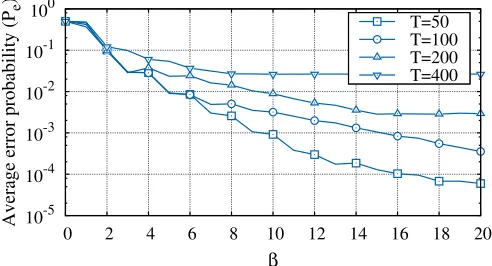
In Fig. 2 we show the performance of the “LRA greedy” algorithm as the number of tasks varies while the pool of workers is the same as in the previous figures. Clearly, as the number of tasks increases the error probability increases since a larger amount of work is conferred to workers of
classes 2 and 3. By looking at the curve for T ¼200 we observe that (i) for 0 b 3 only workers of class 1 are used; (ii) for 3 < b 15 the slope of the curve decreases since workers of both classes 1 and 2 are used; (iii) for
b > 15the requester allocates tasks also to workers of class 3 which are spammers. Therefore forb > 15the error prob-ability does not further decrease.
6.2 Scenario 2
Next, we assume that the T¼100 tasks are divided into 2 groups of 50 each. Workers processing tasks of group 1 and 2 are characterized by average error probabilities
pt1¼0:05;pt2¼0:1;pt3¼0:5 and pt1¼0:1;pt2¼0:2;
pt3¼0:5, respectively. This scenario reflects the case where tasks of group 2 are more difficult to solve than tasks of group 1 (error probabilities are higher). Workers of classC3 are spammers for both kinds of tasks. This situation is sum-marized in Table 1 as Scenario 2. Two different approaches are possible while applying LRA to scenario 2: i) we can independently apply LRA to blocks of indistinguishable tasks (we denote this strategy with “LRA greedy blocks”) placing ourselves on the safer side. ii) we can embrace a more risky approach by applying directly LRA to the whole set of tasks (we denote this strategy with “LRA greedy”). Regarding the MP decision algorithm, we have applied two independent instances of the algorithm to the two groups of tasks. The error probabilities provided by the considered
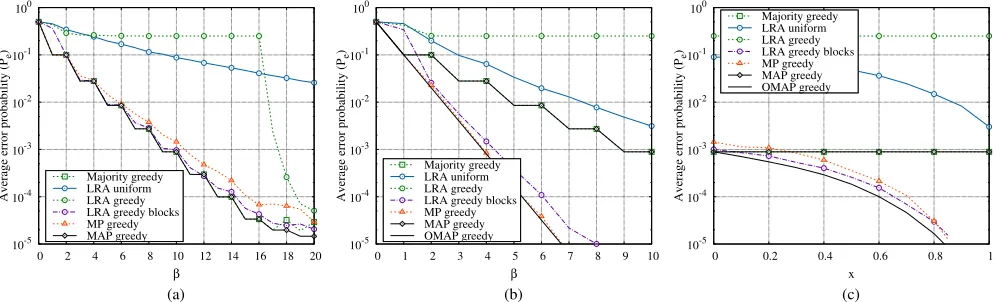
algorithms are plotted in Figs. 3a, 3b, and 3c. For the sake of figure readability results of the basic “Majority uniform” strategy are not reported. First, observe that the relative ranking of all strategies is essentially not varied with respect to Scenario 1. In particular, we wish to highlight the signifi-cant performance gain exhibited by strategies employing the greedy allocation strategy over those employing a uniform allocation, such as “LRA uniform”. Second, observe that at first glance unexpectedly the “LRA greedy” slightly outper-forms “LRA greedy blocks” for smallx. This should not be too surprising, in light of the fact that: i) even if the error probability of each user depends on the specific task, the rela-tive ranking among workers remains the same for all tasks, ii) “LRA greedy” gets advantage from the fact that all tasks are jointly decoded (i.e., SVD decomposition is applied to a larger matrixAbetter filtering out noise).
6.3 Scenario 3
Finally, in Figs. 4a, 4b, and 4c we consider a third scenario in which again tasks are partitioned into two groups of 50 each. Here, however, the number of available workers per class is set toW1¼40; W2¼120; W3¼40, and the workers error probabilities for the tasks in group 1 and 2 are given by pt1¼0:1;pt2¼0:25;pt3¼0:5, and pt1¼0:5;pt2¼0:25;
pt3¼0:1, respectively. This situation reflects the case where workers are more specialized or interested in solving some kinds of tasks. More specifically, here workers of class 1
Fig. 3. Scenario 2. Figures (a) and (b) report the average error probability versus the average number of workers per task,b, forx¼0andx¼1, respectively. Figure (c) shows the average error probability versusxand forb¼10. The parameters of Scenario 2 are reported in Table 1.
(class 3) are reliable when processing tasks of group 1 (group 2), and behave as spammers when processing tasks of group 2 (group 1). Workers of class 2 behave the same for all tasks. This situation is summarized in Table 1 as Scenario 3. We remark that, as in Scenario 2, we have applied two independent instances of the MP decision algorithm to the two groups of tasks. In terms of performance, first observe that, also for this scenario, even a fairly imprecise character-ization of the worker behavior can be effectively exploited by the requester to significantly improve system perfor-mance. Second observe that the “LRA greedy” algorithm shows severely degraded error probabilities for b 16, while the “LRA greedy blocks” (which we recall applies LRA independently to the two blocks of indistinguishable tasks) behaves properly. The behavior of “LRA greedy” should not surprise the reader, since our third scenario may be considered as possibly adversarial for the LRA scheme (when applied carelessly), in light of the fact that the rela-tive ranking among workers heavily depends on the specific task. Nevertheless, it may still appear amazing that “LRA greedy” behaves even worse than the “LRA uniform” scheme in several cases. The technical reason for this behav-ior is related to the fact that, in our example, for b 16, tasks of group 1 (group 2) are allocated to workers of class 1 (class 3) only, whilst workers of class 2 are not assigned any task. Instead, for 16 < b 20tasks of both types are also allocated to workers of class 2. This situation is summarized in Table 2 wheredðtkiÞrepresents the number of times a task of type iis assigned to workers of class k. For this reason, whenb 16the matrixAturns out to have a block diagonal structure, which conflicts with the basic assumption made by LRA that matrix E½A can be well approximated by a rank-1 matrix.
It follows that the rank-1 approximations are extremely inaccurate when applied to the whole matrix A and thus provide high error probabilities. In such situations, by applying the LRA algorithm separately on each block of tasks (under the assumption that we have enough a-priori information to partitioning tasks into groups), we achieve huge performance gains.
Finally, we want to remark that we have tested several versions of greedy algorithms under different objective functions, such asF1ðGÞ,F2ðGÞ, andF3ðGÞ, finding that they provide, in general, comparable performance. The version employing mutual information was often providing slightly better results, especially in the case of LRA greedy and MP greedy. This can be attributed to the following two facts: i) the mutual information was proved to be submodular; ii) being mutual information independent from the adopted decoding scheme, it provides a more reliable metric for comparing the performance of different task allocations under the LRA decoding scheme with respect to the error probabilityF1ðGÞ(which, we recall, is computed under the
assumption that the decoding scheme is MAP). Unfortu-nately, due to the lack of space, we cannot include these results in the paper.
6.4 Scenario 4
Now, we move to a different scenario in which T ¼100 identical tasks are assigned to a population of 90 workers, each one characterized by an individual reliability index pt;w. pt;w are uniformly and interdependently extracted in the rangeð0;1=2. Parameters pt;w are assumed, in general, to be unknown to the system, which possesses just noisy estimatesp^t;wof them. Such estimates are typically inferred from the analysis of past behavior of each worker, as better explained in the following. On the basis ofp^t;w, workers are grouped intoKclasses. Specifically, classes are obtained by uniformly partitioning the interval½0;1=2inKsubintervals and assigning to classk2 f1;2; Kgall the workers whose estimated reliability index (error probability)p^t;wfalls in the range ðk1
2K;2Kk. Then, the nominal error probability ptk assigned to classk, is set equal to the median point of he considered interval, i.e.,ptk¼2k4K1.
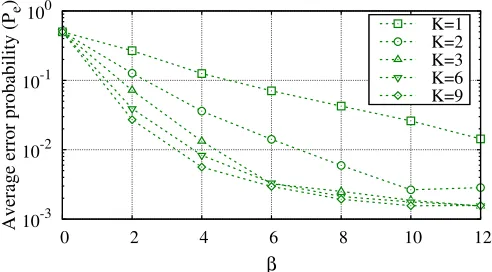
Fig. 5 reports the error probability achieved by the LRA-greedy algorithm versus b for different values of K in a optimistic scenario, in which perfect estimates of reliability indices are known to the system, i.e.,^pt;w¼pt;w.
As expected, by increasing K, a reduction of the error probability is observed. However note that performance improvements are significant only for relatively small val-ues of K andb. The marginal performance gain observed by increasingK from 6 to 9, is rather limited for all values of b. Even in this ideal case in which full information on workers’ characteristics is available to the systems, schedul-ing tasks just on the basis of a rough classification of the workers into few classes is not particularly penalizing! These results, therefore, provide an empirical justification of our approach of partitioning users into few classes.
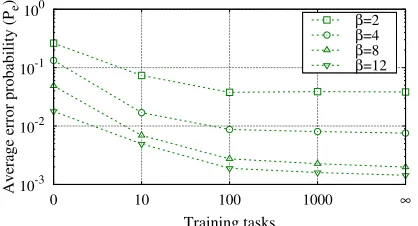
To complement previous results, Fig. 6 reports the error probability for specific values ofbandK¼6when the reli-ability estimate p^t;w is noisy. To keep things simple, we assume that all workers are tested on an initial number of tasks (called training tasks) and^pt;wis derived accordingly, as the empirical estimate ofpt;won the training tasks. How-ever, we wish to remark that p^t;w can be, in principle, obtained by analyzing answer of workers on previously assigned tasks without the necessity of subjecting workers
TABLE 2
Assignments Per Task for Scenario 3 as a Function ofb
dðt11Þ dðt12Þ dðt21Þ dðt22Þ dðt31Þ dðt32Þ
b 16 b 0 0 0 0 b
16<b 20 b 0 b16 b16 0 b
to an initial training phase. Once again, we would like to highlight that a detailed investigation of how ^pt;w can be obtained goes beyond the scope of this paper.
Observe that when the number of training task is 0, no information about p^t;w is available and, therefore, workers are assigned to classes at random. Instead, when the num-ber of training tasks becomes arbitrarily large, the system can count on exact estimates of the workers reliability indi-ces. i.e.,p^t;w¼pt;w.
Fig. 6 shows that even rather imprecise estimates ofp^t;w (i.e., obtained through the analysis of relatively short sequences of training tasks) can be effectively exploited to significantly improve the performance of the system. Fur-thermore, observe that marginal gains significantly reduces as the length of training set increases. In particular, for mod-erate values of b, performance obtained when the training set size is set to 100 is hardly distinguishable from that observed when arbitrarily long training sets are employed. This provides further support to the viability of our approach, which appears rather robust to possibly impre-cise estimates of workers’ reliability indices.
7
C
ONCLUDINGR
EMARKSIn this paper we have presented the first systematic investi-gation of the impact of information about workers’ reputa-tion in the assignment of tasks to workers in crowd work systems, quantifying the potential performance gains in sev-eral cases. We have formalized the optimal task assignment problem when workers’ reputation estimates are available, as the maximization of a monotone (submodular) function subject to Matroid constraints. Then, being the optimal problem NP-hard, we have proposed a simple but efficient greedy heuristic task allocation algorithm. We have also described a simple “maximum a-posteriori” decision rule and a well-performing message-passing decision algorithm. We have tested our proposed algorithms, and compared them to different solutions, which can be obtained by extrapolating the proposals for the cases when reputation information is not available, showing that the crowd work system performance can greatly benefit from even largely inaccurate estimates of workers’ reputation. Our numerical results have shown that:
even a significantly imperfect characterization of the workers’ reputation can be extremely useful to improve the system performance;
the application of advanced joint task decoding schemes such as message passing can further
improve the overall system performance, especially in the realistic case in which the a-priori information about worker reputation is largely affected by errors; the performance of advanced joint tasks decoding schemes such as LRA applied naively may become extremely poor in adversarial scenarios.
the results show that “LRA greedy” and “MP greedy” algorithms perform well in most of the cases; their difference in terms of performance is rather limited, therefore they can both be used equiv-alently in a real-world scenario.
Future work directions include the extension to time-varying workers’ behavior, non-binary tasks, and the desing of effective algorithms for estimating workers’ error probability.
R
EFERENCES[1] M.-C. Yuen, I. King, and K.-S. Leung, “A survey of crowdsourcing systems,” Proc. IEEE 3rd Int. Conf. Privacy, Security, Risk Trust IEEE 3rd Int. Conf. Social Comput., 2011, pp. 766–773.
[2] D. E. Difallah, M. Catasta, G. Demartini, P. G. Ipeirotis, and P. Cudr-Mauroux, “The dynamics of micro-task crowdsourcing: The case of Amazon mturk,” in Proc. 24th Int. Conf. World Wide Web, 2015, pp. 238–247.
[3] A. Kittur, et al., “The future of crowd work,”Proc. Conf. Comput. Supported Cooperative Work, 2013, pp. 1301–1318.
[4] E. Peer, J. Vosgerau, and A. Acquisti, “Reputation as a sufficient condition for data quality on Amazon Mechanical Turk,”Behavior Res. Methods, vol. 46, pp. 1023–1031, 2014.
[5] D. R. Karger, S. Oh and D. Shah, “Budget- optimal Crowdsourcing Using Low-rank Matrix Approximations,” in Proc. 49th Allerton Conf. Commun., Control, Comput., 2011 pp., 284–291.
[6] D. R. Karger, S. Oh, and D. Shah, “Budget-optimal task allocation for reliable crowdsourcing systems,”Operations Res., vol. 62, no. 1, pp. 1–24, 2014.
[7] D. R. Karger, S. Oh, and D. Shah, “Efficient crowdsourcing for multi-class labeling,” SIGMETRICS Perform. Eval. Rev., vol. 41, no. 1, pp. 81–92, Jun. 2013.
[8] A. Ghosh, S. Kale, and P. McAfee, “Who moderates the modera-tors?: Crowdsourcing abuse detection in user-generated content,” inProc. 12th ACM Conf. Electron. Commerce, 2011, pp. 167–176. [9] I. Abraham, O. Alonso, V. Kandylas, and A. Slivkins, “Adaptive
crowdsourcing algorithms for the bandit survey problem,” 2013 [Online]. Available: http://arxiv.org/abs/1302.3268 [10] H. Zhang, Y. Ma, and M. Sugiyama, “Bandit-based task
assign-ment for heterogeneous crowdsourcing,”Neural Comput., vol. 274, pp. 2447–2475, 2015.
[11] Y. Zheng, J. Wang, G. Li, R. Cheng, and J. Feng, “QASCA: A quality-aware task assignment system for crowdsourcing applications,” in Proc. ACM SIGMOD Int. Conf. Manage. Data, 2015 pp. 1031–1046.
[12] Y. Bachrach, T. Graepel, T. Minka, and J. Guiver, “How to grade a test without knowing the answers–A Bayesian graphical model for adaptive crowdsourcing and aptitude testing,” inProc. 29th Int. Conf. Machine Learn., arXiv:1206.6386, 2012, pp. 1183–1190. [13] V. C. Raykar, et al., “Learning from crowds,”J. Mach. Learn. Res.,
vol. 11, pp. 1297–1322, 2010.
[14] D. Lee, J. Kim, H. Lee, and K. Jung, “Reliable Multiple-choice Iter-ative Algorithm for CS Systems,” inProc. ACM SIGMETRICS Int. Conf. Meas. Model. Comput. Syst., 2015, pp. 205–216.
[15] J. Whitehill, T.-f. Wu, J. Bergsma, J. R. Movellan, and P. L. Ruvolo, “Whose vote should count more: Optimal integration of labels from labelers of unknown expertise,” inProc. Adv. Neural Inform. Process. Syst., 2009, pp. 2035–2043.
[16] S. Kerr, “On the folly of rewarding A, while hoping for B,” Acad-emy Manage. J., vol. 18, pp. 769–783, 1975.
[17] D. Chandler, and A. Kapelner, “Breaking monotony with mean-ing: Motivation in crowdsourcing markets,”J. Econ. Behavior Org., vol. 90, pp. 123–133, 2013.
[18] A. Kittur, E.H. Chi, and B. Suh, “Crowdsourcing user studies with mechanical turk,” inProc. 26th Ann. SIGCHI Conf. Human Factors Comput. Syst., 2008, pp. 453–456.