Article
Mining Productive-associated Periodic-frequent
Patterns in Body Sensor Data for Smart Home Care
Walaa Ismail and Mohammad Mehedi Hassan
Information Systems Department, College of Computer and Information Sciences King Saud University, Riyadh 11543, Saudi Arabia
E-mail: [email protected], [email protected] * Correspondence: [email protected];
Abstract: The understanding of various health-oriented vital sign data generated from body sensor networks (BSNs) and discovery of the associations between the generated parameters is an important
task that may assist and promote important decision making in healthcare. For example, in a smart
home scenario where occupants’ health status is continuously monitored remotely, it is essential to
provide the required assistance when an unusual or critical situation is detected in their vital sign
data. In this paper, we present an efficient approach to mine the periodic patterns obtained from BSN
data. In addition, we employ a correlation test on the generated patterns and introduce
productive-associated periodic-frequent patterns as the set of correlated periodic-frequent items. The
combination of these measures has the advantage of empowering healthcare providers and patients
to raise the quality of diagnosis as well as improve treatment and smart care, especially for elderly
people in a smart home. We develop an efficient algorithm named PPFP-growth (Productive
Periodic-Frequent Pattern-growth) to discover all productive-associated periodic frequent patterns
using these measures. PPFP-growth is efficient and the productiveness measure removes
uncorrelated periodic items. An experimental evaluation on synthetic and real datasets shows the
efficiency of the proposed PPFP-growth algorithm, which can filter a huge number of periodic
patterns to reveal only the correlated ones.
Keywords: Body sensor network; Smart home, knowledge discovery in BSN data; frequent patterns; periodic patterns and productive pattern.
1. Introduction
In recent years, the use of body sensor networks (BSNs) to remotely monitor and collect the vital sign data of patients to extract knowledge on their health condition has become an effective solution in a smart home environment to enable the growing number of elderly as well as physically impaired people to stay alone in their homes with full care and support [1, 2, 3, 4]. With several ambient sensors, wearable sensors, and biomedical devices implemented throughout the home as well as wearable health trackers, the resident’s health conditions are continuously monitored and any urgent assistance is triggered when an abnormal situation is detected. Depending on the situation, healthcare caregivers can receive warnings or help alerts from healthcare service providers. A smart
home goal is to help the elderly and people with disabilities feel comfortable and practice their daily activities on their own, while monitoring their safety and well-being. This improves the elderly’s feeling and reduces the costs imposed on society and the healthcare system.
With the improvement in health consciousness and advances in BSNs that are used to collect the vital signs of a patient in their smart home environment, there is a need for new approaches and systems to address healthcare monitoring and decision making [5, 6, 7, 8, 9, 10]. BSNs can be used to extract knowledge about the health condition of the patient and these have enabled the development of many real-time activity recognition approaches [11, 12, 13, 14]. Recently, most research has focused on human activity recognition through wearable devices and BSN-generated data to monitor and follow up patient health. The analysis of BSN-generated data can enable the early detection of unusual activities or abnormal health conditions by monitoring the daily living activities of users (e.g., elderly, cognitively impaired people, patients). Moreover, the behavior profile parameters sensed by the body sensors provide knowledge for doctors to treat a particular patient. For example, identifying periodic changes in the body temperature or heart rate of a patient can be useful information. Thus, the discovery of the shape of a pattern's occurrences (i.e., periodic or partial periodic) and the relationship between the physiological information obtained from the BSN can help predict or provide care to the user.
However, using pattern matching [15, 16] or human daily activity recognition [11-14] algorithms to find such important and interesting knowledge from BSN readings may be unsuitable because of the high data rate and variety of data streams obtained from BSNs. Recently, data mining techniques that aim to discover new knowledge from the obtained data have also been utilized to analyze knowledge from the BSN data [17, 18, 19, 20]. A software architecture has been developed by [19] to monitor routine behavior based on a patient’s daily activity. This obtains frequent patterns in order to identify the structure of a human’s daily activity using a frequent pattern mining [21] technique. An automatic data mining method using physical activity measurements has been proposed by Candás et al. [22] to detect abnormal human behavior. Machado et al. [23] designed a human activity recognition framework using on-body accelerometer sensors. Nevertheless, all these pattern mining approaches are limited in terms of detecting periodic changes in human behavior or identifying a subject’s activity.
algorithms because the approaches in [24-26] try to discover those patterns that are frequent and have complete cyclic repetitions in the entire database. Most of these algorithms use a maximum periodicity threshold to discover periodic patterns, which measures pattern periodicity based on the largest amount of time difference or number of timeslots between two occurrences of a pattern. Typically, a pattern with single periodicity greater than the user-defined maximum periodicitythreshold will be discarded and it will be considered as non-periodic. This approach is not flexible, as some interested patterns can be discarded based on only one of its periods. In this paper, we propose a solution to this problem by discovering periodic patterns using three measures: the interested-recurrence period, minimal-itemset occurrence, and average interested-period.
In addition, data analysis in the case of BSN is no easy task. Consider, for example, the case of caregivers or doctors being interested in identifying the set of vital health parameters with similar occurrence periods that occur nearly in the same time periods. On the other hand, some of a patient’s periodic (regular) frequent patterns are periodic due to random sensor readings without inherent association. Using such periodic-frequent patterns without analyzing item associations could be detrimental for caregivers in decision making about a patient’s health. To overcome this challenge, we employ a productivity test to identify the set of productive-associated periodic-frequent patterns.
Example 1: During human profile analysis, the caregiver observed from the set of readings that the patient’s heart rate and blood pressure status were very high and less frequently occurred compared with the high readings of blood pressure and body temperature. Furthermore, the duration between two consecutive high readings can be generally longer than the two consecutive high readings of blood pressure and body temperature. Identifying the above types of inherent regularities in a patient’s health-related readings can be significantly helpful for caregivers in following up a patient’s health condition and enabling real-time health-related data analysis.
In [28], the authors introduced a new class of patterns known as chronic-frequent patterns by investigating the partial periodic behavior of frequent patterns in a transactional database. A pattern is said to be chronic frequent if it has a sufficient number of cyclic repetitions in the entire database. The method uses a pattern-growth mining approach with two database scans, which cannot be applied in the case of BSN-generated data because of the high rate of data that need to be read once. In addition, the number of generated patterns is huge, partially because of random occurrences without item relationships. The work of [29] introduced a new type of periodic pattern named productive patterns, which have the ability to find full period patterns (i.e., patterns that occur at regular intervals), and conducted a productivity test to ensure the association between the generated patterns. Nevertheless, the approach uses a generate-and-test method based on the a priori algorithm, which results in huge search space and thus cannot be applied in the case of stream data [21]. In our current work, we employ the productivity test using an efficient fp-growth-inspired approach to mine the set of productive patterns.
randomly generated patterns,the overall system helps reduce false alarms in monitoring stations. In this paper, we introduce a new tree structure, called the Productive Periodic-Frequent Pattern Tree (PPFP-tree), to capture both the frequency and the periodic behavior of the patterns. A pattern-growth algorithm, called Productive Periodic-Frequent Pattern-pattern-growth (PPFP-pattern-growth), is then proposed to discover the patterns from the PPFP-tree. Our contributions are as follows:
1. We focus on mining the different parameter readings obtained from body sensors that occur either fully or partially in the smart home in order to follow up a patient’s health conditions using a novel tree-based data structure, called the PPFP-tree, with a single database scan. 2. We further employ two pruning techniques. The first technique is based on the concepts of
partial periodic patterns and is used to discover periodic-frequent patterns containing either cyclic or acyclic pattern repetition. The second one is a productiveness measure used to ensure that periodic-frequent patterns without item associations or more generally obtained due to random occurrences are eliminated.
3. Once the PPFP-tree is constructed, we use an efficient pattern-growth-based mining technique to mine the patient readings (PPFP-growth) algorithm using our pruning techniques.
4. A performance study is conducted to compare the performance of PPFP-growth with existing periodic mining algorithms, and we show that PPFP-growth is more runtime efficient than existing algorithms.
The rest of the paper is organized as follows. Section 2 presents an example scenario for applying the proposed approach in BSNs. Section 3 presents related work. Section 4 introduces our model of mining productive-associated patterns. Section 5 describes the working of the PPFP-growth algorithm. The experimental evaluation of PPFP-growth and some recent related work is presented in Section 6. Finally, Section 7 concludes the paper and provides directions for future work.
2. Productive-associated Periodic Pattern Mining in Healthcare
Consider an assisted living system where a patient lives alone and let a set of body sensors be attached
to a patient’s body to obtain health-related data continuously (i.e., each minute). Each sensor will
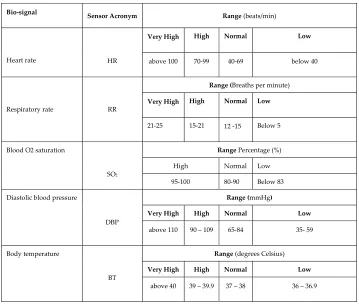
Table 1. The five vital signs and their sensor acronyms used in this example.
Bio-signal
Sensor Acronym Range (beats/min)
Heart rate HR
Very High High Normal Low
above 100 70-99 40-69 below 40
Respiratory rate RR
Range (Breaths per minute)
Very High High Normal Low
21-25 15-21 12 -15 Below 5 Blood O2 saturation
SO2
Range Percentage (%) High Normal Low 95-100 80-90 Below 83 Diastolic blood pressure
DBP
Range (mmHg)
Very High High Normal Low
above 110 90 – 109 65-84 35- 59 Body temperature
BT
Range (degrees Celsius)
Very High High Normal Low
above 40 39 – 39.9 37 – 38 36 – 36.9
Thus, the sensor readings obtained by all sensors (e.g., HR, RR, So2, DBP, and BT) can be shown as a combination of the different vital signs from all sensors (e.g., a vital sign reading list). Depending on the ranges and/or types of vital parameters, the values sensed by each sensor can be subdivided into several categories based on a predefined range, as shown in Table 1. For example, if the readings from HR and BT are HR-High and BT-High at time Tn, respectively, the vital sign reading list for Tn would be as follows: Tn: (HR-High, BT-High). Thus, the five readings continuously generated by the sensors for the patients can be represented as:
T1: SO2 -Low, RR-Low.
T2: DBP-Normal, HR- High, BT-Very High. T3: HR-High, BT-High.
T4: SO2 -Low, RR-Low. T5: DBP- Very High, HR- Low. T6: HR-High, BT-Low.
T7: DBP-low, HR-Very High, BT-Low. T8: HR-High, BT-High.
T9: SO2 -Low, RR-Low.
reading vital sign at (T1, T4, T9), which may indicate that the blood oxygen saturation and respiratory rate decreases at least once during the daytime. Once we find this pattern, we apply our productivity test to see to what extent SO2 and RR have a productive association. Once we discover such knowledge, the caregiver will easily detect that the patient will experience hypoventilation [30] at any time. Moreover, the monitoring caregiver can identify additional patterns of abnormalities by monitoring the productive-associated periodic vitals. For example, a serious emergency known as sepsis can occur when the patient has low blood pressure, a very high heart rate, and a decrease in body temperature. Therefore, caregivers need to be aware of these abnormalities to avoid any potentially emergent situation associated with periodic changes in multiple vital signs.
3. Related Work
The flexibility and widespread use of wearable sensors have promoted the process of modeling
human behavior from sensor-generated data for the purpose of following human health and
detecting any unusual or emergent behavior through human recognition systems that can monitor
occupants’ behavior in smart environments. The research community has presented several
frameworks for prototyping general smart environments or particular smart homes. As an example,
[31] proposed the Syndesi framework. Syndesi creates a personalized smart environment to realize human actions based on human behavior profiles. The framework provides the necessary services to
home occupants to quickly control and react easily with their environment (e.g., electrical devices
based on human preferences and needs). [32] Proposed Gaia, a distributed middleware supporting ubiquitous computing environments. Gaia allows developers to monitor a combination of individual services as a whole by introducing programmable active spaces. In the context of the CASAS project,
[33, 34] presented automatic daily life activity pattern discovery and monitoring for assisted living.
This overcomes the limitation of supervised activity-recognizing approaches by discovering human
activity from collected sensor data. Additionally, the system can detect variations in human
monitoring services and is also able to handle real-time multi-sensor data efficiently. Recently, many
cloud-assisted frameworks for the development of smart homes have been proposed by the research
community [35, 36, 37, 38]. The work in [39] shows CASE, a framework that recognizes human activities by discovering the frequent episodes from occupant-related data based on the a priori
algorithm [40]. The work in [41] shows a probabilistic-based approach to forecast smart home
occupants’ behavior and wellness by monitoring the daily usage of home appliances. For example,
elderly people’s behavior follows some regularity in their activity execution such as eating at 7 a.m.
and sleeping at 9 p.m. When daily activities are performed regularly, it means that the smart home
inhabitant is in a state of wellness. In this work, ambient-assisted predictive techniques are used for
the extraction of patterns related to sensor activation time. Recently, many works in the areas of
human behavior analysis [14, 15, 17] and human activity recognition have been conducted; however
unfortunately, most of those methods require supervised techniques for handling and labeling
sensor-generated data. Additionally, real-time human activity recognition using data mining
[22] proposed an unsupervised data mining method to detect unusual (abnormal) human behavior
using physical activity. This detects anomalies in behavior automatically by assessing the physical
activity level of human and compares it with existing historical data.
Despite the accuracy of the proposed approaches in activity recognition, a significant
proportion of smart home services provided by a smart home comprises monitoring residents’
activities to find only frequent patterns in their activities of daily living for health purposes. Hence,
a significant amount of research is still required to develop algorithms that can help with an accurate
diagnosis. Moreover, frequent patterns are huge in space if we try to find them in BSN-generated
data and are limited in terms of detecting changes in human behavior that occur regularly or periodic
in everyday life.
Nevertheless, mining periodic-frequent patterns is no easy task as it is faced with several
challenges. For instance, the periodicity measure in [27], which is susceptible to noise in the database,
might often report the noised maximal period of a pattern as its regular period. Additionally, as we
mentioned earlier, the methods in [25] and [26] often generate regular (periodic) frequent patterns
that occur in the whole database with totally distinct periods.
Recently, Tanbeer et al. [26] developed a regular pattern tree to exactly mine regular patterns
from transactional databases. This approach requires two database scans and uses the maximum
occurrence interval of a pattern in a database to measure a pattern’s periodicity. Thus, many
researchers are extending Tanbeer’s work to mine top−k [42, 43, 44] periodic patterns, but their
approaches remain limited to k items. The work presented in [24, 25] proposed an efficient and
scalable regular mining algorithm with one database scan. The algorithm can be conducted in either
single or multiple distributed BSN data for the purpose of following up the health conditions of users.
A major drawback of those approaches is using a maximum periodicity threshold as a measure for
finding periodic patterns, which results in discarding the itemset automatically if it has a single
period of length value greater than the MaxPr threshold. Thus, this measure is too strict and could lead to losing a very important pattern that appears irregularly or partially.
In [45], the authors introduced a periodic-ratio measure to report the partial periodic pattern that
occurs frequently in a transaction-like database. Unfortunately, the periodic-ratio measure does not
satisfy the downward closure property, and as a result the approach is computationally extensive. In
[28], the authors reported a kind of periodic pattern called a chronic-frequent pattern, namely
frequent patterns that have either complete cyclic repetition in the database or partial cyclic
repetition. The model builds a chronic-frequent tree with two database scans. In [29], a productive
periodic pattern is generated; productive patterns are exhibited frequently, and this regularity is not
due to the random occurrences of uncorrelated items. Further, the framework in [29] limits the
pattern’s periodicity to a given threshold and within the same range of a period’s values given by the
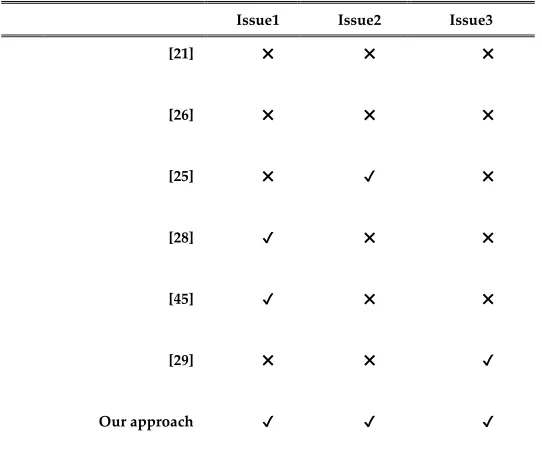
Table 2: Comparison of the issues addressed by our approach against current related work. ‘issues1 ‘discover
full or partial pattern,’ issues2 ‘one database scan,’ and issues3 ‘the ability to generate correlated
periodic-frequent patterns.’ The symbol ‘✔’ represents the issue addressed and ‘✖’ represents the
issue not addressed by the corresponding work.
Issue1 Issue2 Issue3
[21] ✖ ✖ ✖
[26] ✖ ✖ ✖
[25] ✖ ✔ ✖
[28] ✔ ✖ ✖
[45] ✔ ✖ ✖
[29] ✖ ✖ ✔
Our approach ✔ ✔ ✔
Again, some of the mentioned work considers both partial and full cyclic pattern mining with
two database scans. However, none of the above algorithms can be applicable to efficiently mining
the big data coming from BSN data, which are close to transactional databases, to detect the periodic
patterns that occur in partial or full cyclic databases. Such correlated patterns could help detect some
new knowledge, especially for human care or disease detection. Therefore, there is a need to develop
an efficient mining technique to address the problem of productive pattern mining from body sensor
data. Table 2 compares our approach and related approaches with respect to three issues: i) the ability
to discover full or partial patterns, ii) the ability to discover patterns using one database scan, and iii)
the discovery of correlated periodic-frequent patterns. It can be observed that our approach tries to
address all of the issues, while related work addresses only some of them.
4. Proposed Model
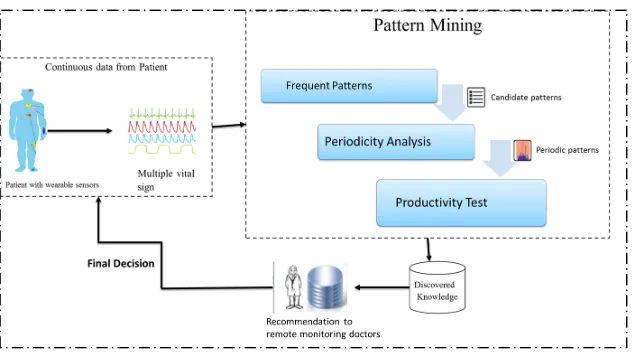
Figure 1. The workflow of productive-associated periodic-frequent pattern mining.
The basic notations and definitions of productive-associated periodic pattern mining in a body sensor
database are as follows:
Let a set of body sensors represented as T= { , , …, } be in a particular BSN at smart
home SM. The pattern of a sensor’s X = { ,… …, } ⊆T, where j ≤ k, is of length-k, satisfying some
conditions of measures such as frequency; for instance, X = { , , } is a length-3 pattern.
A body sensor database, BSD, over T is defined to be a nonempty set of an epoch’s BSD = { , …..,
}, where each epoch in the BSD is identified by m (called TID), where TID represents the occurrence
of the timeslot-id of the sensor. The cover of pattern X in SDB, ( ), is the set of epochs’ TIDs
that contain X. That is,
( ) = { ∶ ∈ ∧ ⊆ } (1)
The support of a pattern X in ( ), is defined as
( ) = | | ( )|| (2)
where | ( )| is called the support count of X in SDB and | | represents the size of SDB in
the total number of epochs. Pattern X in SDB is said to be frequent if ( ) is larger than or
equal to ( ), a user-specified minimum support threshold value.
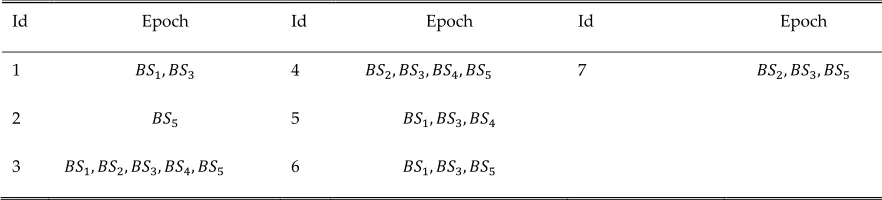
Example 2. Consider the sensor database shown in Table 3. It contains seven epochs. The set of items, I = { , , , , }, and the set of body sensor readings ′ ′ ′ i.e., ‘{ , }’ is known as an itemset (or a pattern). This pattern contains two items. Therefore, it is a length-2 pattern. The pattern ‘{ , }’ appears in the epochs having ids 3, 4, and 7. Therefore, ( , )= {3, 4, 7}. Hence,
( , )= |{3,4,7}| = 3. If the user-defined ( )= 3, then ‘‘{ , } is a frequent pattern
Table 3. A SENSOR DATABASE (SDB)
Definition 1 (a period of X). Let and ; j ∈ [1, (m -1)] be two consecutive timeslot-ids of pattern X in BSD. Then, = − (i.e., the number of timeslots) is defined as the j-th
period of X in BSD. As mentioned in [25], a ‘null’ epoch with no sensor data is considered in the
period computation at the beginning of BSD, i.e., = null, where is the first epoch in the pattern
occurrence list. Similarly, , is the n-th epoch in BSD, i.e., the last epoch to be considered.
Example 3. Continuing with Example 2, the pattern ‘ , ’ has appeared in the TID of 3, 4, and 7. Therefore, a period for ‘ , ,’ is 3(= 3 - ), 1(=4 -3), 3(=7-4), 0(= − 7) where =0, = 7.
Definition 2. (The interested-recurrence period of pattern X.)
Let ( ) = { , , … … . , }, where r is the total number of periods of X in BSD, be the
complete set of all the periodic occurrences of X in TDB. A ∈ ( ) is said to be the
periodic-Recurrence iff ℎ , where maxPer (ɛ) is the largest occurrence
interval defined by use.
Example 4. From Example 3, the complete set of periods for the pattern ‘ , ’ is ( , ) =
{ 3, 1, 3, 0} if the user-defined ( )= 2; then, , and , are the periodic-recurrence of the patterns but , and , are not periodic-recurrence as their value ≰ ( ).
In order to solve the problem of finding periodic patterns that may have acyclic repetition in the
BSN database, we add a measure to check the number of interested periods in an itemset, which is:
Definition 3. (The minimal-itemset occurrence) Let ⊆ ( ) be the set of interested
periods such that ∀ ∈ , ≤ ( ). The minimal-itemset occurrence, say MPR(x), is
the size of , that is, MPR(x) = | |.
Tanbeer [28] and all the extension work considered the periodicity of the pattern to be the
maximum period in ( ), that is, periodicity (X) = ( |∀ ∈ ( )). A drawback of
maximum periodicity is that this measure may be too strict as the periodic pattern is discarded
automatically if one of its periods is of a length greater than the maximum periodicity threshold
defined by the user. To provide more flexibility in evaluating pattern periodicity and overcome this
Id Epoch Id Epoch Id Epoch
1 , 4 , , , 7 , ,
2 5 , ,
limitation of traditional PFP mining algorithms, the concept of the average interested-period is
proposed, which is defined as follows.
Definition 4. (Average interested-period of an itemset X.) Let ⊆ ( ) be the set of
interested periods such that ∀ ∈ , ≤ ( ). The periodicity of X is defined as ( ) = ∑ ∈ /| |.
For example, let the interested period of itemset ′ , be , = {1, 0} and its average
periodicity is ( , ) = 0.5.
Although the usefulness of considering average periodicity as a measure of the period length of
an itemset ensures that we consider any partial or full periodic pattern without any restriction, we
cannot directly evaluate the periodicity of a pattern with similar periods or even use the average as a
sole measure because Definition 2 does not consider whether an itemset has an occurrence’s periods that are similar or vary widely. For instance, consider an itemset with the given = {1, 3, 5, 7}
and = {10, 10, 10, 10, 10, 10, 10, 10}. Although itemsets BSx and BSy have totally distinct periods,
(x) = ( ) = 8. Hence, using only the average as a sole periodicity measure is
misleading and will not solve the problem of reporting patterns with similar periods. The work in
[29] solved this issue by combining the average periodicity measure with the standard deviation
measures(s). Here, we use the same solution, but we restrict our periodicity only to the interested
periods that match the user’s request.
Definition 5. (Problem Definition) We have a BSN database BSD, user-defined minimum
support threshold ε, maximum period maxPrd, minimal-itemset occurrence threshold MPR, periodicity measure per difference factor p1, pattern X, and interested period . X is a periodic-frequent pattern if (X) ≥ε, | | ≥ MPR, (per − p1) ≤ ( ) − std( ) and
( ) + std( ) ≤ (per + p1).
With Definition5, we report every periodic pattern that has either cyclic or acyclic occurrences with similar regular periods in the BSN database. Many diseases may have some set of values that
occurs at the same time and later disappears and then reappears, for example. Suppose disease X
results in increases in body temperature and in heart rate beats three times within one month; then,
the patient may face another disease symptom. Moreover, how we can detect the relationships
between different BSN reading parameters and ensure that the generated patterns are not due to
random occurrences is a major issue in analyzing the vital signs obtained from BSNs. To enable
reporting only the periodic-frequent physiological parameters that are vital for decision making, we
test the positive correlations among them using the productive-associated test as proposed in [29] as
follows.
| | − ( ) ( ). | |
> | | −( 1). | ( 1)|
× | | −( 2). | ( 2)| (3)
Our productive pattern test in definition 6 is the same as the productivity test proposed in [29, 46] as
follow: For any periodic itemset , | | ( ).|( |) can be re-written as | | ( () ) ×| |
where | | ( () )= | (| )= ( ). Hence our productive-association test can be
expressed as utilized in [46] as:
| | − ( ) ( ). | | >
| | − ( 1) ( 1). | | ×
| | − ( 2)
( 2). | | = ( ) > ( )× ( )
Through Definition 6, a periodic-frequent pattern, X in BSD is productive iff every subset itemset formed with an inherent item association in BSD ensures that all reported patterns are
correlated and not due to random occurrences. The productive-associated test satisfies the downward
closure property that every superset of a productive itemset will always contain a productive itemset,
and hence we use it as one of our pruning strategies to eliminate non-productive itemsets from the
reported periodic-frequent patterns.
5. Mining Productive-Associative Periodic-Frequent Patterns
Here, we propose an efficient PPFP-tree data structure with one database scan over the BSN database
to mine the complete set of periodic patterns that has productive association.
5.1. PPFP-tree Structure
The PPFP-tree has a root node referred to as the ‘null’ and a set of prefix trees. It also has a header
table called the body sensor data table (BSD-table). The BSD-table consists of five fields (i, f, rc, Lt, p):
(i) body sensor name (BSi), (ii) frequency count of BSi, (iii) periodicity of BSi, (iv) last occurrence tid of BSi, and (v) a pointer to the first node in the PPFP-tree for each sensor value. After building the PPFP-tree and traversing it once, we calculate the periodicity (rc) and Lt for each sensor. The prefix
tree structure is similar to Han’s [21] prefix tree used to mine the Frequent Pattern-tree (FP-tree).
However, the nodes in the PPFP-tree do not maintain the support count. Instead, they maintain the
occurrence information of each sensor in the BSN database by keeping each sensor timeslot only at
the last node of every epoch. The prefix tree has two types of nodes: ordinary nodes and tail nodes.
The former is similar to the FP-tree ordinary node, whereas the latter is the node that represents the
last item of any sorted epoch. The structure of the tail node is of the form Nj[t1,t2,...,tn], where Nj ∈ X
To ensure a high degree of compactness in the PPFP-tree, items are arranged in support-descending
order. Both nodes maintain parent, children, and node traversal pointers to fasten the tree traversing
process for sensor BSi.
5.2. PPFP-tree Construction
The construction of a PPFP-treeis similar to the frequent pattern tree and Regular Pattern tree [21,
26]. However, we use a single database scan over the sensor data, and captures the complete sensor
database information in a compact manner.
The PPFP-tree construction process initialized with a root node “null”. Using the BSD-list, we
perform a single scan on the database to discover single items and their support inside the sensor
database. Afterward, the BSD-table is created. The BSD-table is in descending order to ensure tree
compactness. Moreover, only the items that satisfy the minimum user support threshold will take
part in the construction of the PPFP-tree. Let tcur represent the sensor timeslot of the current epoch. A
temporary array lt explicitly records the last occurring epochs of all patterns in the BSD-list. Let us visit a construction example for the database given in Table 3 by following algorithm 1 given in Fig. 2.
Algorithm1: PPFP-Tree construction
Input: The sensor database BSD;
Output: An PPFP-tree;
1: Begin
2: Create the root R of an PPFP-tree, Tree, and label it “null”.
3: for each epoch ti ∈ BSD do
4: if ti ≠ NULL then
5: for each item tcur ∈ ti do
6: if tcur.f == 0 then /* it’s first occurrence */
7: Set tcur.f=1 and lt=tcur
8: else
9: if tcur- lt <= maxPrd then
10: add tcur- lt to tcur.pr
11: endif
12: Set ++f and lt=tcur.
13: Endif
14: Add candidate items of ti to BSD-list.
15: endif
16: end for
17: Select and sort the candidate items in BSD-list in support descending order.
18: Call Insert_PPFP_tree(BSD-list, Tree).
19: end for
20: Update BSD- table.
21: Call PPFP-growth (PPFP-Tree, null);
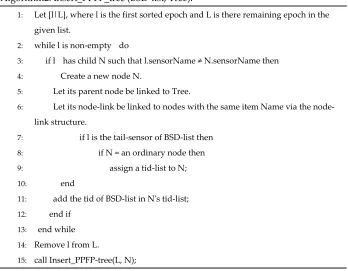
Figure 2. PPFP-Tree construction algorithm.
A root node with ‘null’ (line: 2) is the first step in the tree building process. Next, we scan the
database once and get the support of each single item (lines: 3–14); then, we sort the items listed in
support-descending order. The construction of the tree starts with a call to the procedure on line 19
by executing the Insert_PPFP_tree procedure given in Fig. 3.
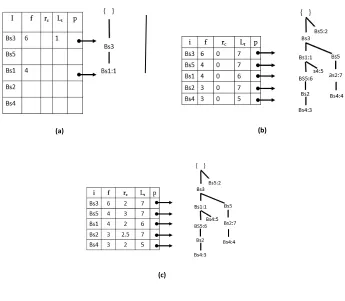
The tree construction starts by adding the first epoch {1: Bs3, Bs1}, according to the BSD-list order, as shown in Fig. 4(a). The tid occurrence value of the epoch is saved in the tail node “Bs1:1” (line 11). The process is repeated recursively for the other epochs in the database. Fig. 4(b) shows the PPFP-tree constructed after scanning the second epoch, third epoch, and entire database. For the
simplification of the figures, the node traversal pointers are not shown.
Algorithm2: Insert_PPFP_tree (BSD-list, Tree).
1: Let [l|L], where l is the first sorted epoch and L is there remaining epoch in the
given list.
2: while l is non-empty do
3: if l has child N such that l.sensorName ≠ N.sensorName then
4: Create a new node N.
5: Let its parent node be linked to Tree.
6: Let its link be linked to nodes with the same item Name via the
node-link structure.
7: if l is the tail-sensor of BSD-list then
8: if N = an ordinary node then
9: assign a tid-list to N;
10: end
11: add the tid of BSD-list in N's tid-list;
12: end if
13: end while
14: Remove l from L.
15: call Insert_PPFP-tree(L, N);
Figure 3. Insert_PPFP_tree Procedure.
Once the PPFP-tree is constructed, we use the pointers of each sensor from the BSD-table in order
temporary array for each sensor in the BSD-table by traversing the whole tree once. During the tid accumulation process, we begin in BSD-table in reverse order, i.e., we start from the last sensor of the
BSD-table.
Continuing with our running example, Fig. 4(c) shows the final PPFP-tree status and the BSD-table with the periodicity (rc) and last tid (Lt) of each sensor. Therefore, with a single BSDscan, the
PPFP-tree maintains all BSDinformation in a compact manner. Once the PPFP-tree is constructed, an
efficient FP-growth-inspired pattern mining technique is employed to find the complete set of
productive-associated periodic-frequent patterns from the current database (line: 21). In the next
subsection, we discuss the productive-associated periodic-frequent pattern mining process from the
PPFP-tree.
(a) (b)
(c)
Figure 4. PPFP-tree construction with MinSup=3, Maxper=3, MPRD=2. (a) PPFP-tree after inserting TID=1, (b) PPFP-tree after
inserting all BSD epochs, (c) Final PPFP-tree.
5.3 Mining the PPFP-tree
We mine the PPFP-tree recursively in decreasing size using a pattern-growth approach by creating
conditional pattern-bases and corresponding conditional trees without constructing any additional
Algorithm 4 shows the construction of the prefix-tree in PPFP-growth. After we construct the tree and all of its nodes, we have to execute the call to Algorithm 4. Then, we choose the last
sensor ‘Bsi’ from the BS-table (line 1). After that, weconstruct its prefix-tree (line 2).
Algorithm3: CalculateInterestedPeriodicity ( : an array of timeslot-ids containing S)
1: Begin
2: Set IP= −1 minpr=0 and IPcur = 0 . /* subtract 0 from the first value ( 0 − 0 ).*/
3: if IPcur > maxPer then
4: add IPcur to IP. /* list of interested period*/
5: end if
6: for i = 1; i < . − 1;++i do
7: Calculate IPcur = + 1 − .
8: if IPcur > maxPer then
9: add IPcur to IP.
10: end if
11: end for
12: Calculate IPcur = |SDB| − [ . ], and repeat the steps numbered from 8 to 10.
13: If . ≥ then
14: Calculate average and Standard Deviation of IP.
15: end
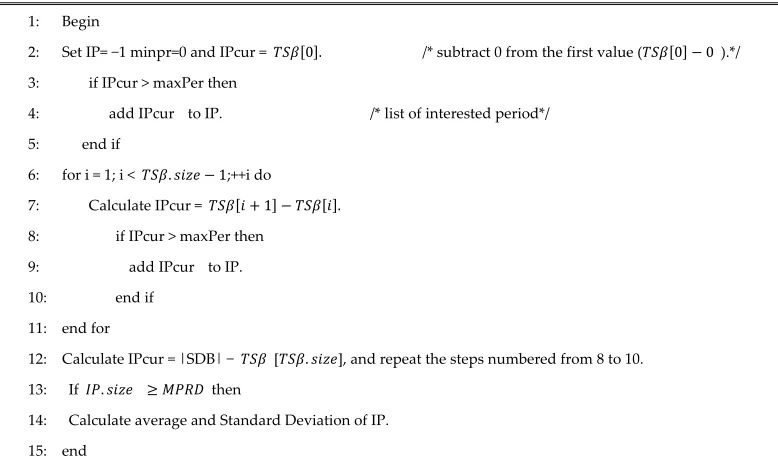
Figure 5. Algorithm 3
Then, we check the productivity of the new itemset and check its support value (line 3). If
the pattern is productive with Definition6, we then call Algorithm 3 (shown in Fig. 5) to check the pattern periodicity.
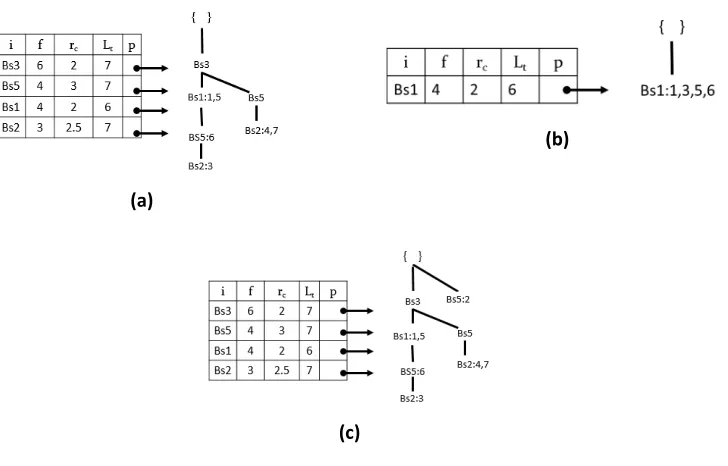
Fig. 6(a) shows the prefix-tree of ‘Bs4’. Fig. 6(b) shows the conditional tree of ‘Bs4,’ the status of the PPFP-tree after removing the last item ‘Bs4’ from the BSD-table shown in Fig. 6(c), assuming that the user defines maxper = 3 avg=1.4 diff=0.8.
(a)
(b)
(c)
Figure 6. Prefix-tree and conditional tree construction with the PPFP-tree. (a) Prefix-tree for ‘Bs4’ (b) Conditional tree for
‘Bs4’ and (c) PPFP-tree after removing item ‘Bs4’.
In Algorithm 3, the tid list of the construct node is used to calculate the set of an interested pattern period. The period is considered if its values are no greater than the user-given minimum periodicity
threshold (line 3). The pattern’s average periodicity and standard deviation are calculated.
Continuing with the ‘Bs4’ pattern, we find that the pattern ‘Bs4, Bs1’ is productive. A recursive
process of creating the prefix-tree and its conditional tree is repeated for further extensions of ‘ij’ until
BS-table = ∅.
Algorithm4: PPFP-growth (tree , α)
1: for each sensor Sα in the header of Tree in reverse-order do
2: Generate pattern Sβ = Xi∪ Sα. map all Xi’s tid-list to temporary arrays (TSβ) for all sensors in Sα.
3: if β. ≥ ( ) and Sβ Productive according to Definition 6 then
4: Call CalculateInterestedPeriodicity (TSβ).
5: if Sβ is periodic according Definition 5 then
6: Construct first Sβ conditional pattern base then Sβ_Tree conditional PPFP-tree.
7: if Tree Sβ_Tree = ∅ then
8: Call PPFP-growth(Sβ_Tree, Sβ);
9: end if
10: end if
11: Delete the node Xifrom the Tree and push the Xi’s tid-list to its parent nodes.
6. Experimental Study
The experiment was carried out on a 64-bit Core i5 processor running Windows 10, and with 12 GB
of free RAM. We selected three benchmark datasets that are both synthetic and real-world databases.
The datasets were chosen because they represent the main characteristics of the vital parameters and
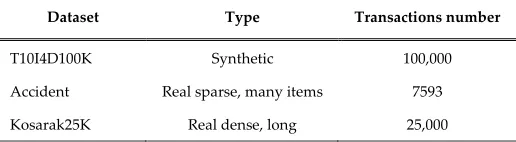
sensors’ data (dense, sparse, and long transactions), as shown in Table 4. In our experimental analysis, we implement the following algorithms:
- PPFP-growth is our implementation of the mining algorithm based on Definitions 5 and 6.
PPFP reports the productive-associated full/partial periodic-frequent pattern using a
pattern-growth mining approach with one database scan, and we use the productive measure to
report only the periodic-frequent patterns with pattern associations. At the same time, this
accelerates the process of mining.
- CPFP is our implementation of the work presented in [28]. CPFP finds the periodic-frequent
pattern that occurs in acyclic or cyclic database repetition without the productive measure
and within two database scans.
- PPFP is our implementation of the work in [29] that reports productive periodic-frequent
patterns using an a priori-like approach [40].
-Table 4. Dataset characteristics
Dataset Type Transactions number
T10I4D100K Synthetic 100,000
Accident Real sparse, many items 7593
Kosarak25K Real dense, long 25,000
Synthetic databases are used frequently to evaluate frequent-pattern mining algorithms. Those
datasets generated by using the IBM data generator [40] and the real dataset are used from SPMF [47,
48, 49]. All mentioned algorithms are implemented in Java. The experiments consisted of two parts.
First, we compare the PPFP-growth algorithm with the CPFP algorithm. Second, we compare the
PPFP-growth algorithm with PPFP.
6.1. Comparing the execution time of the PPFP-growth algorithm and CPFP algorithm
In the first part of the experiments, the PPFP-growth algorithm and CPFP algorithm were run on each
dataset with fixed MPR, periodicity, and range values, while varying the minSup and maxPer parameters. To be able to compare PPFP-growth with CPFP, CPFP was run with the value calculated
For each dataset, the values for MPR, periodicity, and range are dataset-specific (i.e., they were found empirically for each dataset) and are chosen to show the trade-off between the execution time
of each algorithm. Additionally, the notation PPFP-growth X-W-Y represents the PPFP-growth
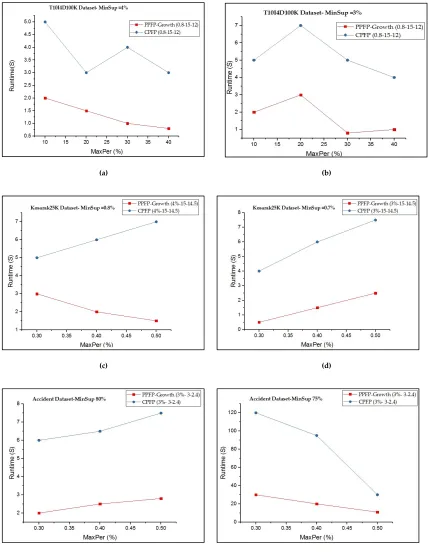
algorithm with MPR = X, periodicity = W, and range = Y. Fig. 7(a–f) compares the execution time of our proposed algorithm with that of the CPFP for mining all periodic-frequent patterns that occur in
all or part of the database with respect to the user-given X-W-Y values. It can be observed that mining
PPFP-growth is generally much faster than mining periodic items using the CPFP algorithm.
Considering all the datasets, PPFP-growth is up to four times faster than CPFP depending on the
parameters. The reason is that the search space is huge when we try to find all periodic patterns
without using the productivity test. Moreover, CPFP uses two database scans. Additionally, the
PPFP-growth algorithm only searches for productive-associated periodic patterns and thus prunes a
large part of the search space containing non-productive periodic patterns. For the accident dataset, PPFP-growth can be up to four times faster than CPFP depending on the parameters. However, it
begins to be the same runtime in some cases. The reason is that the dataset is sparse and the cost of
(a) (b)
(c) (d)
(e) (f)
6.2. Comparing the execution time of the PPFP-growth algorithm and PPFP algorithm
In the second part of the experiments, to compare the execution time of the PPFP-growth algorithm
and the PPFP algorithm, we fixed the minSup,maxPer, and MPR parameters for the ‘T10I4D100K’ and ‘accident’ datasets, while varying the periodicity(per) and range (diff) values. However, for the ‘Kosarak25K’ dataset, we changed the minSup values and fixed the maxPer, MPR,per, and diff values. Further, the parameter values are dataset-specific. Additionally, the notation PPFP-growth X-W-Y
for the Kosarak25K dataset represents the PPFP-growth algorithm with MPR = X, periodicity = W, and range = Y. We also used the calculated value (periodicity, diff) of PPFP-growth to show the execution time of the PPFP algorithm.
(a) (b)
(c)
Figure 8. Execution time of PPFP-growth and PPFP.
algorithm outperforms the Apriori-based PPFP execution time depending on the parameter values.
For the Kosarak25K dataset, no results are shown for PPFP because it cannot terminate within 1,000 seconds,while PPFP-growth terminates in less than seconds. The reason is that when decreasing
minSup in these datasets, the search space increases, which increases the delay for discovering the patterns depending on the generate-and-test PPFP algorithm. On the other hand, PPFP-growth still
terminates on these datasets because the PPFP-tree avoids the combinatorial explosion problem of candidate generation as in a priori-like algorithms [40].
7. Conclusions and Future Work
Demand for new technologies to promote and assist significant decision making in a smart health system has been greatly boosted in the past few years. Here, we provide a new pattern mining algorithm to mine the productive-associated PFPs from health-related information collected from smart homes to promote important decision making in healthcare. We present the interested pattern measures to identify the interested PFP set of periods and a measure to identify the set of productive-associated PFPs. We also develop PPFP-growth, an efficient algorithm for mining the set of productive-associated PFPs. In the future, we plan to develop a context-aware abnormal human behavior algorithm in which the patient’s vital signs are analyzed with respect to other human activity data such as sitting, sleeping, or exercising. Context-aware multiple stream data from different home sensors could reveal more accurate patterns regarding human health, as vital signs are sometimes affected by human activity. The heart rate could increase when exercising if we have not considered this context situation, meaning a false alarm could be generated. In addition, we would like to investigate alternative techniques to further reduce the computational cost of mining productive patterns.
References
1. Liu, L., Stroulia, E., Nikolaidis, I., Miguel-Cruz, A., & Rincon, A. R. Smart homes and home health
monitoring technologies for older adults: A systematic review. International journal of medical informatics,
2016, vol. 91, pp. 44-59.
2. Memon, M., Wagner, S. R., Pedersen, C. F., Beevi, F. H. A., & Hansen, F. O. Ambient Assisted Living
Healthcare Frameworks, Platforms, Standards, and Quality Attributes. Sensors, 2014, vol. 3, no. 14, pp.
4312-4341.
3. Chen, H., Smart health and wellbeing (Trends & Controversies). IEEE Intelligent Systems, 2011, vol. 5,
no. 26, pp. 78–90.
4. Hassan, M.M., Lin, K., Yue, X. and Wan, J., A multimedia healthcare data sharing approach through
cloud-based body area network. Future Generation Computer Systems. 2016, vol. 66, pp. 48–58
5. Hu, L., Zhang, Y., Feng, D., Hassan, M. M., Alelaiwi, A., & Alamri, A., Design of QoS-aware multi-level
6. Suryadevara, N. K., Subhas C. M., Smart Home Related Research. Smart Homes. Springer International
Publishing, 2015. pp. 11-51.
7. Raffaele G., Parastoo A., Hassan G., Giancarlo F., Multi-sensor fusion in body sensor networks:
State-of-the-art and research challenges. Information Fusion, 2017, vol. 35, pp. 68-80.
8. Stefano G., Roberta G., Antonio L., Giancarlo F., A Task-Oriented Framework for Networked Wearable
Computing. IEEE Trans. Automation Science and Engineering, 2016, vol. 13, no. 2, pp. 621-638.
9. Fortino, G., Giannantonio, R., Gravina, R., Kuryloski, P., & Jafari, R. , Enabling Effective Programming
and Flexible Management of Efficient Body Sensor Network Applications, IEEE T. Human-Machine
Systems, 2013, vol. 43, no. 1, pp. 115-133.
10. Raveendranathan, N., Galzarano, S., Loseu, V., Gravina, R., Giannantonio, R., Sgroi, M., Fortino, G.,
From modeling to implementation of virtual sensors in body sensor networks, IEEE Sensors Journal,
2012, vol. 12, no. 3, pp. 583-593.
11. Bulling, A., Blanke, U., & Schiele, B., A tutorial on human activity recognition using body-worn inertial
sensors, ACM Computing Surveys (CSUR), 2014, vol. 3, no. 46, pp. 33.
12. Gravina, R. and Fortino, G.. Automatic methods for the detection of accelerative cardiac defense
response. IEEE Transactions on Affective Computing, 2016, vol. 7, no. 3, pp.286-298.
13. Gaber, M. M., Gama, J., Krishnaswamy, S., Gomes, J. B., & Stahl, F., Data stream mining in ubiquitous
environments state-of-the-art and current directions, Wiley Interdisciplinary Reviews: Data Mining and
Knowledge Discovery, 2014, vol. 4, no. 2, pp. 116-138.
14. Minnen, D., Starner, T., Essa, I., & Isbell, C., Discovering Characteristic Actions from On-Body Sensor
Data, Proc. 10th IEEE International Symposium on Wearable Computers, 2006, pp. 11-18.
15. Gu, T., Wang, L., Wu, Z., Tao, X., & Lu, J., A Pattern Mining Approach to Sensor-Based Human Activity
Recognition, IEEE Transactions on Knowledge and Data Engineering, 2011, vol. 23, no. 9, pp. 1359-1372.
16. Hemalatha, C. S., , Vaidehi, V., Frequent bit pattern mining over tri-axial accelerometer data streams
for recognizing humanactivities and detecting fall, Procedia Computer Science, 2013, vol. 19, pp. 65-63.
17. Rashidi, P., Cook, D. J., Mining Sensor Streams for Discovering Human Activity Patterns over Time, in
International Conference on Data Mining, 2010.
18. Lombriser, C., Bharatula N.B., R. D., On-Body Activity Recognition in a Dynamic Sensor Network, in
Proc. International Conference on Body Area Networks (BodyNets), 2007.
19. Ali, R., ElHelw, M., Atallah, L., Lo, B., & Yang, G.-Z., Pattern mining for routine behaviour discovery
in pervasive healthcare environments, in Information Technology and Applications in Biomedicine, 2008.
20. Suman, M. C., & Prathyusha, K., A body sensor network data repository with a different mining
technique, Int. J. Eng. Sci. Adv. Technol, 2012, vol. 2, no. 1, pp. 105-109.
21. Han, J., Pei, J., & Yin, Y., "Mining frequent patterns without candidate generation," in ACM Sigmod
Record, 2000.
22. Candás, J. L., Peláez, V., López, G., Fernández, M. Á., Álvarez, E., & Díaz, G., An automatic data mining
method to detect abnormal human behaviour using physical activity measurements, Pervasive and
Mobile Computing, 2014, vol. 15, pp. 228-241.
23. Machado, I. P., Gomes, A. L., Gamboa, H., Paixão, V., & Costa, R. M., Human activity data discovery
from triaxial accelerometer sensor: Non-supervised learning sensitivity to feature extraction
parametrization, Information Processing & Management, 2015, vol. 51, no. 2, pp. 204-214.
24. Tanbeer, S. K., Hassan, M. M., Alrubaian, M., & Jeong, B.-S., Mining regularities in body sensor network
data, in International Conference on Internet and Distributed Computing Systems, 88-99, 2015.
25. Tanbeer, S. K., Hassan, M. M., Almogren, A., Zuair, M., & Jeong, B.-S., Scalable regular pattern mining
in evolving body sensor data, Future Generation Computer Systems, 2016.
26. Tanbeer, S. K., Ahmed, C. F., Jeong, B.-S., & Lee, Y.-K., Mining regular patterns in transactional
databases, IEICE TRANSACTIONS on Information and Systems, 2008, vol. 91, no. 11, pp. 2568-2577.
27. Rashid, M. M., Karim, M. R., Jeong, B.-S., & Choi, H.-J., Efficient mining regularly frequent patterns in
transactional databases,in International Conference on Database Systems for Advanced Applications, 2012.
28. Kiran, R. U., & Kitsuregawa, M., Discovering chronic-frequent patterns in transactional databases, in
International Workshop on Databases in Networked Information Systems, 2015.
29. Nofong, V. M., Discovering Productive Periodic Frequent Patterns in Transactional Databases, Annals
of Data Science, 2016, vol. 3, no. 3, pp. 235-249.
30. Wilkins L.W., ECG Interpretation Made Incredibly Easy,fifthed., LippincottWilliams &Wilkins, 2011.
31. Evangelatos, O., Samarasinghe, K., and Rolim, J., Syndesi: A Framework for Creating Personalized
Smart Environments Using Wireless Sensor Networks. In: Proceedings of the 2013 IEEE international
conference on distributed computing in sensor systems. DCOSS ’13, washington, DC, USA, pp. 325–330,
2013.
32. Rom´an, M., Hess, C., Cerqueira, R., Ranganathan, A., Campbell, R.H., and Nahrstedt, K., A 642
Middleware Infrastructure for Active Spaces. IEEE Pervasive Comput. 2002, vol. 4, pp.74–83.
33. Rashidi, P., and Cook, D.J., Com: A method for mining and monitoring human activity patterns in
home-based health monitoring systems. ACM Trans. Intell. Syst. Technol. 2013, vol. 4, no. 4, pp.1–20.
34. Cook, D. J., Krishnan, N. C., and Rashidi, P., Activity Discovery and Activity Recognition: A New
35. Abawajy, J. H. and Hassan M. M. Federated Internet of Things and Cloud Computing Pervasive Patient
Health Monitoring System. IEEE Communication Magazine, 55(1), pp.48-53, 2017
36. Zhang, Y., Qiu, M., Tsai, C.W., Hassan, M.M. and Alamri, A.Health-CPS: Healthcare Cyber-Physical
System Assisted by Cloud and Big Data. IEEE Systems Journal, Vol. PP (99), pp. 1-8, Online First,
August 24, 2015
37. Hassan MM. Cost-effective resource provisioning for multimedia cloud-based e-health systems.
Springer Multimedia Tools and Applications, July 2015, vol. 74, no. 14, pp 5225-5241.
38. Cloud-based Activity-aaService cyber–physical framework for human activity monitoring in mobility
R Gravina, C Ma, P Pace, G Aloi, W Russo, W Li… - Future Generation Computer Systems, 2016
39. Cicirelli, F., Fortino, G., Giordano, A., Guerrieri, A., Spezzano, G. and Vinci, A. On the design of smart
homes: A framework for activity recognition in home environment. Journal of medical systems, 2016, vol.
40. No. 9, pp.200.
40. Agrawal R., T. Imieliński and A. Swami, Mining association rules between sets of items in large
databases, in Acm sigmod record, 1993.
41. Suryadevara, N., Mukhopadhyay, S., Wang, R., and Rayudu, R., Forecasting the behavior of an elderly
using wireless sensors data in a smart home. Eng. Appl. Artif. Intell., 2013, vol. 26, no. 10, pp.2641–2652.
42. Amphawan, K., Lenca, P., & Surarerks, A., Mining top-k regular-frequent itemsets using database
partitioning and support estimation, Expert Systems with Applications, 2012, vol. 39, no. 2, pp. 1924-1936.
43. Amphawan, K., Lenca, P., & Surarerks, A., Mining top-k periodic-frequent pattern from transactional
databases without support threshold, in International Conference on Advances in Information Technology,
2009.
44. Amphawan, K., & Lenca, P., Mining top-k frequent-regular closed patterns, Expert Systems with
Applications, 2015, vol. 42, no. 21, pp. 7882-7894.
45. Kiran, R. U., Venkatesh, J., Toyoda, M., Kitsuregawa, M., & Reddy, P. K., Discovering partial
periodic-frequent patterns in a transactional database, Journal of Systems and Software, 2017, vol. 125, pp. 170-182.
46. Webb, G. I., Self-sufficient itemsets: An approach to screening potentially interesting associations
between items, ACM Transactions on Knowledge Discovery from Data (TKDD), 2010, vol. 4, no. 1, p. 3.
47. "SPMF," [Online]. Available: http://www.philippe-fournier-viger.com/spmf/. [Accessed 14 Feb 2017].
48. Monowar, M.M., Hassan, M.M., Bajaber, F., Al-Hussein, M. and Alamri, A. McMAC: towards a MAC
protocol with multi-constrained QoS provisioning for diverse traffic in wireless body area networks.
49. Iyengar, S., Bonda, F.T., Gravina, R., Guerrieri, A., Fortino, G. and Sangiovanni-Vincentelli, A. A
framework for creating healthcare monitoring applications using wireless body sensor networks. In