PERCEPTIONS OF DIVINITY
THE CHANGING CHARACTERS OF ROMAN VENUS
Frances Brealey
29001509
2014
A thesis submitted to the
University of Wales Trinity Saint David
in partial fulfilment of the requirements for
Master’s Degrees by Examination and Dissertation Declaration Form.
1. This work has not previously been accepted in substance for any degree and is not being concurrently submitted in candidature for any degree.
Name: Frances Elizabeth Brealey
Date: 20th March 2014
2. This dissertation is being submitted in partial fulfilment of the requirements for the degree of Master of Arts
Name: Frances Elizabeth Brealey
Date: 20th March 2014
3. This dissertation is the result of my own independent work/investigation, except where otherwise stated.
Other sources are acknowledged by footnotes giving explicit references. A bibliography is appended.
Name: Frances Elizabeth Brealey
Date: 20th March 2014
4. I hereby give consent for my dissertation, if accepted, to be available for photocopying, inter- library loan, and for deposit in the University’s digital repository
Name: Frances Elizabeth Brealey
Date: 20th March 2014
Supervisor’s Declaration.
I am satisfied that this work is the result of the student’s own efforts.
Signed: ………...
i Contents
Abstract iii
Acknowledgements iv
List of Figures v
Introduction 1
Chapter 1 The Gods of the Romans: The Changing Paradigm 5
1.1 The Old Paradigm: Primitivism and Foreign Influence 5
1.2 The Old Paradigm: Formalism and Decline 10
1.3 Challenging the Old Paradigm: The Re-evaluation of Roman Religion 12
1.4 The Significance of Gender 19
Chapter 2 Four 'foreign goddesses': Influential Characters? 23
2.1 Introduction 23
2.2 The Influence of Aphrodite 24
2.3 The Influence of Etruscan Turan 32
2.4 The Influence of Isis 38
2.5 The Influence of the Anatolian Mother, Cybele 42
2.6 Aeneas, Son of Venus 46
2.7 Summary 49
Chapter 3 Characters of the Goddess: Venus at Rome 52
3.1 Introduction 52
3.2 The Character of the Earliest Roman Venus 54
3.3 Obsequens and Verticordia, a Women's Goddess? 57
ii
3.5 Venus Erycina, a Foreign Goddess? 66
3.6 Summary 69
Chapter 4 Mother and Protector of Rome: The Politicising of Venus 71
4.1 Introduction 71
4.2 Venus as Protector 72
4.3 Augustan Venus, the Mother of the Empire 79
4.4 Venus in the Augustan Poets 87
4.5 Venus, Goddess of War? 90
4.6 Summary 92
Conclusions: Recognising Venus 95
iii Abstract
This dissertation examines how at Rome the characters of the goddess Venus changed from the fourth century BC to the first century AD. It is argued that the different ways in which she was perceived, and the associations, powers and responsibilities she was assigned, were significant for the Romans’ engagement with the goddess during the Republic and early Empire.
A discussion of some theories of Roman religion since the nineteenth century shows how these views and their subsequent re-evaluation have influenced understandings of Venus. The belief that the Romans of this period took little interest in the characters of their gods is challenged, though it is suggested that traces of this remain as negative preconceptions in some modern approaches.
Earlier theories of Roman religion saw the identities of the gods as late Greek imports. Four foreign goddesses known at Rome during the Republic (Aphrodite, Turan, Isis and Cybele) are examined to discover how their characters were represented and in what ways these might have influenced the character of Venus at Rome. The extent to which they were ‘mother’ or ‘women’s’ goddesses, and whether they and Venus had similar connections with fertility and childbirth are discussed.
iv Acknowledgements
Dr David Noy gave advice at the outset of this project, and Dr Ralph Haeussler kindly agreed to take on the supervision of the dissertation even before he had arrived in Lampeter.
My employers, Bristol Baptist College, generously awarded me study leave, and colleagues, friends and family have provided much encouragement during the writing of this dissertation.
Libraries in Bristol, Lampeter and Oxford have all furnished useful resources.
Dr Richard de Puma graciously gave permission for the use of his drawing of an Etruscan mirror.
v List of Figures
1. Vessel depicting the meeting of Helen and Paris © Trustees of the British
Museum.
2. Detail of krater depicting Aphrodite, Helen and Menelaus, Louvre, Paris.
3. Roman copy of the Aphrodite of Knidos. Digital image courtesy of the John Paul Getty Museum’s Open Content Programme
4. Roman statuette of Crouching Venus © Trustees of the British Museum.
5. Relief from Ludovisi Throne depicting flute player. Museo Nazionale
Romano Palazzo Altemps, Rome. © Marie-Lan Nguyen
6. Relief from Ludovisi Throne of woman making an offering. Museo Nazionale
Romano di Palazzo Altemps, Rome. © Marie-Lan Nguyen
7. Etruscan mirror depicting the Judgement of Paris. © Trustees of the British
Museum.
8. Etruscan mirror depicting the Judgement of Paris. Indiana University Art
Museum, Bloomington. Drawing by R. De Puma.
9. Egyptian statuette of Isis suckling Horus © Metropolitan Museum of Art, New
York. www.metmuseum.org
10. Roman statuette of Isis/Tyche © Metropolitan Museum of Art, New York.
www.metmuseum.org
11. Roman statue of Cybele. Ny Carlsberg Glypotek, Copenhagen.
Photographer: Ole Haupt.
12. Roman coin depicting Cybele. RRC 385.4.10 © Trustees of the British
Museum.
13. Attic vessel depicting Aeneas and Anchises. Louvre, Paris. Photograph in
the public domain.
14. Coin depicting Venus and Cupid.RRC 313.1.50. © Trustees of the British
Museum.
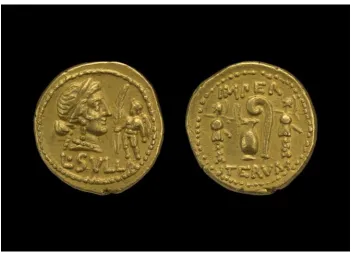
15. Gold coin of Sulla depicting Venus and Cupid. RRC 359.1.1 © Trustees of
the British Museum.
16. Coin of Julius Caesar depicting Venus and Aeneas.RRC 458.1.8. ©
vi
17. Coin of Julius Caesar depicting Venus. RRC 480.17.4 © Trustees of the
British Museum.
18. Coin of Octavian depicting Venus. Image AN00632966 © Trustees of the
British Museum.
19. Coin of Octavian depicting Venus. BMC Augustus 609 © Trustees of the
British Museum.
20. Coin of Cleopatra depicting her as Venus. CM BMC Cleopatra VII 2
© Trustees of the British Museum.
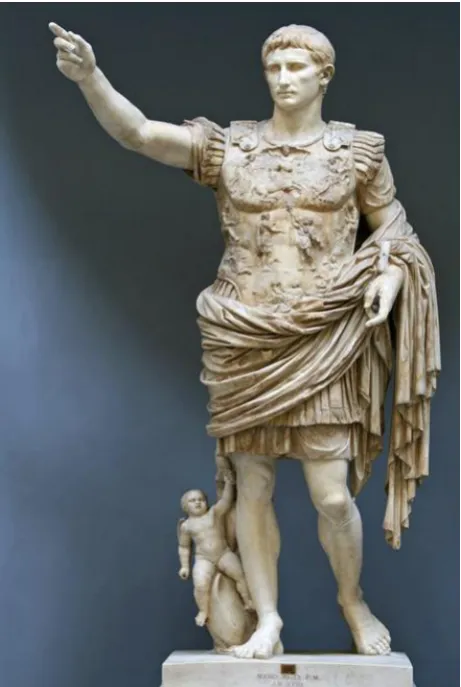
21. Statue of Augustus with Cupid. Vatican Museums.
22. Cameo of Livia as Venus. Digital image courtesy of the John Paul Getty Museum’s Open Content Programme
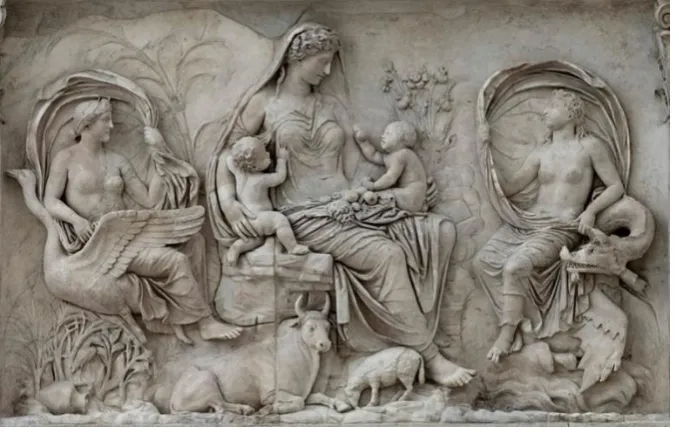
23. A relief on the Ara Pacis. Museo dell’Ara Pacis, Rome. Photograph in the
public domain.
24. Statue of Maria Furnilla as Venus. Ny Carlsberg Glypotek, Copenhagen.
Photographer: Ole Haupt.
25. Relief depicting Venus Genetrix and Mars Ultor. Algiers Archeological
1 Introduction
Venus is popularly identified as the goddess of love and most frequently
appears today as a symbol of sexual attraction.1 Representing feminine
seductiveness, she remains a favourite subject for artists.2 But was the same simple equation ‘Venus = love’ all that the Romans knew? What were the
different guises in which they recognized her? This dissertation examines the
changing characters of the goddess at Rome, from the fourth century BC to the
first century AD. Here by character is meant how she was perceived, and the
way her powers and spheres of responsibility were represented.
A study of the character of one of the gods in this period of Roman history
needs to begin with a consideration of past and present approaches to religion
at Rome. This is because, as Feeney points out, ‘according to the
long-dominant models of Roman religion, the problems of the gods as entities, and of
how to represent or engage with them, did not seem very pressing [to the
Romans]’.3
The first chapter therefore examines theories of primitivism and
conservatism, formalism and decline, and understandings of divine gender. All
of these earlier models down-played the significance of individual gods in
Roman religion, and denied the importance of their characters. The rejection of
these theories and the re-evaluation which has taken place in recent decades
1 The term gods will be used generically, and interchangeably with deities, and does not necessarily indicate male gender. When deities of one gender only are intended this will be made clear.
2 Grigson, 1978: 228 provides a range of examples. Though his book is subtitled, The birth,
triumph, death and return of Aphrodite, he acknowledges ‘that her pretty Greek name never
triumphed in the western world’. References to works of ancient writers mentioned or quoted are given within the text. All other references are in the footnotes.
2
will be discussed, but it will be suggested that, despite these developments,
traces of the attitudes embodied in the old approaches still endure.
A number of key questions arise from the discussion in chapter one. These
include the importance to the Romans of the diverse character(s) of Venus, the
significance of foreign and other influences in forming those characters, and the
connection between character in general and gender in particular and the way
the Romans engaged with the goddess. The second chapter discusses foreign
influence on the character of Venus by considering four ‘foreign goddesses’ that
particularly shaped Roman perceptions: Aphrodite, Turan, Isis and Cybele. The
time period chosen for this study is one in which the importance of the goddess
grew, but at the same time her character changed. Chapters three and four
look in detail at the changing characters of Venus as they were experienced by
the Romans in the middle years of the Republic, and the instrumentalisation of
the goddess during the Late Republic and Principate. By examining what
shaped the different ways in which the goddess was viewed by the Romans,
this dissertation seeks a reappraisal of the relationship between character
(including gender) and personal engagement, and of the importance of both.
How the Romans engaged with Venus and the way this was affected by
changes in her character is examined.
Rüpke suggests that the gods may be understood by looking at the ‘signs’
which represent them, their images and the associated rituals.4 However this
3
study will look more widely, not only examining the evidence of public and
private cult, but also references to Venus (and the goddesses who influenced
her) in literature and inscriptions, together with images on monuments, coins
and other artefacts, in order to gain the widest view of perceptions at Rome.
These sources for our knowledge of the religious life of the Republic and early
Empire, even when taken together can only furnish a fragmentary picture, and
much is unknowable. Information comes from a wide range of literature, though
its value for providing reliable evidence is sometimes disputed.5 Most concerns
public religion and the activities of the elite. Even then we know very little about
what actually happened in the ceremonies and the temples of Venus in Rome.
Some prose writers rarely discuss individual gods, preferring to speak of the
gods collectively.6 Livy and Plutarch do provide information about Venus, but
even they only give passing or conflicting reports, especially when describing
events that occurred long in the past.7 The difficulty of interpreting ritual needs to be borne in mind and the perspective of male writers when writing about its
significance will be particularly relevant when some of the practices relating to
Venus are considered.8 Jenkyns suggests that poetry cannot supply reliable
information about religion, yet it will be included here because of its value in
giving different perceptions of the goddess, which may represent those widely
5 The scholarship is vast in this area. On Livy contrasting views are expressed in Orlin 2010: 8 ff. and Davies, 2004; Fantham, 1995 reviews different evaluations of Ovid.
6 For example Cic, Att. 16.6, 77.1; Tac. Ann. 4.1.2. For the defence of using poetry to understand perceptions of the gods, see Feeney, 1998: 97-114. For an opposing view see Jenkyns, 2013: 211-17. Abbreviations of ancient authors and their works follow the style of the Oxford Classical Dictionary.
7 Feeney, 1998: 123-133 assumes that all the different explanations reflect actual understandings. Jenkyns is more sceptical, 2013: 211.
4
held, or present innovative viewpoints.9 Jenkyns claims that ‘the Roman poets and their readers knew that the myths about the gods were all fiction’, but it is
the different characters of Venus expressed by the poets as they retold or
reinterpreted the myths that are important for this study.10 The contribution of literature can be supplemented and sometimes questioned by inscriptions and
votive offerings which help to show what personal engagement Romans had
with Venus. Offerings in particular may provide some indication of how the
non-elite perceived and related to the gods, and it will be important to discover
whether there is evidence of these in the case of Venus.11 The images on coins and monuments give a different perspective from that of cult, and it must be
assumed that they would have been easily recognisable.12 Stewart has shown that the Romans did not necessarily make a clear distinction between cult
statues and other representations, and these too are likely to have influenced
their understandings of the gods.13 All these different sources will be used to explore the perceptions of Venus that existed at Rome in the time period in
question.
9 Jenkyns, 2013: 211; for an opposite view see Feeney, 1998: 137. 10 Jenkyns, 2013: 210. Though few Romans actually read the poets.
11 It may not only have been the non-elite who made votive offerings, see Glinister, 2006: 28-9. 12 Certain images may have been as unclear to the Romans as they are to modern
scholarship.
5 Chapter 1
The Gods of the Romans: The Changing Paradigm1
1.1 The Old Paradigm: Primitivism and Foreign Influence
This chapter will examine changing views of religion at Rome, showing how
they affected understandings of the gods and the Romans’ engagement with
them. From the eighteenth century the observations of explorers returning to
Europe from their travels had contained reports of apparent parallels to
descriptions of the religious activities found in classical texts.2 However it was European expansion in India in the nineteenth century which gave an impetus
to what would become known as comparative studies, providing large amounts
of evidence, first from Sanskrit writings and, as the number of foreign territories
increased, giving access to religious material from a wide range of other
contexts.3 As evolutionary concepts were extended by anthropologists from biology to society during this period, the idea that all societies had developed in
the same way, from primitive to sophisticated beliefs, seemed convincing to
many.4 In comparing those at the same stage of development, Edward Tylor,
the first Reader, and later professor of Anthropology at Oxford, explained that
‘little respect need be had in such comparisons for date in history or for place on
the map; the ancient Swiss lake-dweller may be set aside the mediaeval Aztec,
1 This description is used by Feeney, 1998:2-6.
2 There are a number of examples throughout Flaherty, 1992.
3 The study of myth was closely linked to the study of religion and also much affected by comparative studies. For understandings of myth from the Enlightenment, and especially connections with ideas of nationhood, see Lincoln, 1999, especially section II.
4 Phillips, 2007: 21. Burrow, 1996: 136 argues that the development of evolutionary
anthropology owes as much to the ‘impasse reached by mid-nineteenth century positivism’ as to the work of Darwin. It was chiefly British scholars who applied evolutionary theories to Roman religion. For a discussion of philosophical and other reasons for German
6
and the Ojibwa of North America beside the Zulu of South Africa’.5
Tylor's focus
was on psychological explanations of religion rather than on the different social
structures of these varied peoples.6 All religions, he argued, had developed from an animistic stage, a belief in ‘Spiritual Beings’ who lived in all of nature,
and this remained evident amongst more developed societies through what
Tylor termed ‘survivals’.7
These last he defined as:
processes, customs, opinions and so forth, which have been carried on by force of habit into a new state of society different from that in which they had their original home, and they thus remain as proofs and examples of an older condition of culture out of which a newer has evolved.8
Jevons acknowledged his indebtedness to Tylor, as well as to Robertson Smith,
who had applied Tylor's views to Ancient Near Eastern religion, and to James
Frazer, who had collected his observations of ‘superstitious and religious
observances of primitive nations in all parts of the globe’.9
Jevons described his
Introduction to the History of Religion as an attempt ‘to summarise the results of
recent anthropology, to estimate their bearing on religious problems, and to
weave the whole into a connected history of early religion’.10
He traced a
process from animism (defined as pre-religion) to totemism (tribal or clan gods),
which led both to polytheism and to monotheism.11
5 Tylor, 1903: vol. 1, 6. His first contribution to the subject was published in 1871. 6 Burrow, 1966: 238-9.
7 Tylor, 1903: vol. 1.424 ff. Scholars differed in the exact terminology they used and the stages of progression they described.
8 1903: 16.
9 His book was first published in 1896: v; Robertson Smith’s lectureson The Religion of the
Semites in 1894 and Frazer’s The Golden Bough (dedicated to Robertson Smith) in 1890;
Johnstone 1995: section D traces relationships and influences between Robertson Smith, Frazer and Jevons in the 1870s.
7
These ideas had a significant influence on the understanding of Roman religion
throughout the first half of the twentieth century. Warde Fowler wrote in 1911:
If we wish to try and get to the original significance of [Roman] acts and thoughts, it is absolutely impossible in these days to dispense with the works of a long series of anthropologists, many of them fortunately British, who have gradually been collecting and classifying the material which in the long run will fructify in definite results.12
Commenting on Codrington's book The Melanesians, in which he had described
those people's belief in a supernatural power called mana, Rose noted that ‘a
great deal of what the good bishop says of his Melanesian parishioners could
be taken over with little change when we speak of the earliest Roman ideas’.13
In his view religion in archaic Rome was similar to that of the contemporary
‘primitive’ peoples studied by the anthropologists, consisting of the worship of
the power located in the natural world, and the attempts to protect themselves
from the harm which this power could bring about.14 What the Melanesians called mana, the Romans knew as numen.15 Warde Fowler described early Roman religion as the ‘well-regulated practical life of the early agricultural
settlers, with its careful attention to the claims of its divine protectors’.16
Where
‘primitive’ concepts, such as magic and taboo, could be found in Roman religion
they were declared to be vestiges of this earliest period.17
The primitivists traced the stages of the development of the gods at Rome: the
earliest deities, the indigitamenta, had particular spheres of responsibility in
12 1911: 19. 13 1948: 13.
14 Rose, 1948: 12 distinguishes ‘dynamism’ from animism; Warde Fowler, 1911: 85. 15 Rose, 1948: 13.
16 1911: 92.
8
agricultural life; according to Rose these were ‘not so much gods as particular
manifestations of mana’.18 The relevance of these ideas for this study can be seen in Schilling’s theory that in the presumed primitive stage of Roman religion
Venus had been an indistinct and impersonal deity who represented ‘cette force
mystérieuse que l’homme s’est plu à utiliser dans ses incantations’.19
He linked
her name with the verb venerari which he thought was originally related to
magic: ‘ce verbe remonte à la phase primitive de la religion’.20
Impersonal spirits
like this became personalised when they were given a cult and a priest in a
particular locality, and in this way Venus was the personification of divine
grace.21 These ideas will be considered further in chapter three.22
Theories about the evolution of religion often described a gradual progression
towards the truth (usually Christianity), from animism to monotheism. However,
the development of personalized gods with their individual characters was seen
as a hiatus in this onward march. The idea of the ‘Noble Savage’ had been
discarded by most scholars by the mid-nineteenth century, but it enjoyed a
revival amongst those writing about Roman religion.23 Warde Fowler disparaged the lectisternium:
The old Roman invisible numen working with force in a particular department of human life and its environment, was a far nobler mental conception, and far more likely to grow into a power for good, than the miserable images of Graeco-Roman full-blown gods and goddesses reclining on their couches.24
18 Rose, 1948: 44-5. 19 1954: 60.
20 1954: 47.
21 Warde Fowler, 1911: 123-4; Schilling, 1954: 59ff.
22 Schilling's monograph remains the most recent detailed treatment of the goddess. His theory is cited by Beard, 1998: 62 (though without clear agreement).
9
According to Rose, ‘Left to itself, the old religion of Rome might in time have
risen into something lofty and pure, (…) but what good qualities it might have
developed were (...) buried under foreign accretions’. 25
The effect of
judgements of this kind was to downplay the importance of the characters of the
Roman gods, which were not thought to be found in the most ancient form of
religion.26
Coupled with theories of primitivism, the old paradigm suggested that Roman
religion was unusually conservative and had remained in its primitive stage far
longer than in the neighbouring regions.27 Although most direct information
about religion at Rome dated from the writings of Romans no earlier than the
third century BC, it now seemed possible to reach back to the beliefs and
actions of their ancestors as early as the eighth century, and thus to gain a
deeper understanding of the religion which was described in such literature.
This perceived conservatism suggested that it was only under the much later
influence of the Etruscans that the Romans anthropomorphised some of their
personified spirits, later identifying them with the Greek gods, and adopting their
rites, mythology and characters. So, for example, Rose describes Venus's
association with the Vinalia, and the custom of prostitutes sacrificing to her ‘as
an example of undesirable foreign elements making their way into sober and
decent Roman ritual’. 28
This statement epitomises the kind of value judgements
25 1948: 88.
26 As some ancient writers themselves thought, for example Varro, quoted in August. De Civ. D. 5.31, an idea apparently supported by nineteenth-century theories of myth which argued that the Romans had no mythology of their own, Phillips 2007: 19.
10
which were once made about the quality of so-called primitive Roman religion
and the ‘contamination’ which caused its change.
1.2 The Old Paradigm: Formalism and Decline
A further feature of the old paradigm was the view that whatever the vitality of a
presumed primitive religion, by the first century BC it had been replaced by a
widespread scepticism. Warde Fowler concluded that by this date the gods
were ‘quite dead’; once Rome was no longer an agricultural community they
had lost their significance for its people. His description of deities surviving
‘only as the obscure objects of some still obscurer form of cult, or (...) absorbed
by Greek anthropomorphic gods, as the host will often be absorbed by the
parasite, though retaining for the most part its outward appearance’, exemplifies
the negative attitude that held sway.29 The view that the gods were not important was combined with the suggestion that the rituals of their cults had
little meaning for the average Roman. All that mattered was their accurate
performance by the priests.30 Warde Fowler argued that a grain of the primitive religious instinct remained in the private household religion, but was
extinguished in the increasing formalism of the public cult under the control of
the priests, ‘until it became a mere skeleton in dry bones, without life and
power’. 31
In such a system, the gods could hold little attraction. The
interpretation of comparative material varied. Mommsen considered that Roman
religion was founded on enjoyment and not fear of nature, as the primitivists
29 1911: 29.
11
had suggested.32 However he too thought that the religion of the Republic became formal and lifeless, it ‘sank into an incredible insipidity and dulness (…)
shrivelled into an anxious and dreary round of ceremonies’. 33
The popularity of
the oriental religions was a sign of this loss of appeal ‘as well as the increased
craving of the multitude after stronger stimulants’. 34
Franz Cumont also accepted the idea that the religion of Rome was reduced to
a meaningless series of rituals, musing that ‘perhaps there never was a religion
so cold and prosaic as the Roman’.35
He set out to explain the impact of
‘oriental religions’ on Rome, attempting to demonstrate how the arrival of cults
from Asia Minor, Syria, Persia and Egypt in the first and second centuries AD
prepared the way for the Romans' conversion to Christianity.36 He based his
understanding of these religions on Frazer's concept of the myth of the dying
and rising god, a myth which the latter thought originated in the rites used by
primitive societies to attempt to control the forces of nature.37 Whereas in the
west, Cumont argued, by the time of the Empire there was no trace of these
primitive nature religions, in the east they remained powerful, offering
worshippers greater intellectual, sensual, emotional and moral satisfaction.38 These cults would transform the religion of Rome, offering any adherent an
assurance of present and eternal well-being.39 For Cumont the triumph of
32 1854: I.12.221. 33 1854: I. XII. 222. 34 1854: IV.XII. 209. 35 Cumont, 1911: 28.
36 Showerman in his preface to the English translation of Cumont, 1911: v. 37 1911: part 3.
38 1911: 28.
12
Christianity seemed the ‘culmination of a long evolution of beliefs’.40
This debate
emphasised the supposed unsatisfying nature of the Romans' own cults and
gods. Their characters and rituals were thought to be of little interest because
they no longer met the religious needs of an urbanized people. This then was
the dominant paradigm of Roman religion until well into the twentieth century: a
primitive piety based on the life of an agricultural community and its worship of
aniconic numina; its subsequent overwhelming and corruption by foreign ideas;
a decline into meaningless formalism. 41
1.3 Challenging the Old Paradigm: The Re-evaluation of Roman Religion
In the last fifty years this view of Roman religion has been challenged on many
fronts. Evans-Pritchard dismissed the work of Jevons as ‘a collection of absurd
reconstructions, unsupportable hypotheses and conjectures, wild speculations,
suppositions and assumptions, inappropriate analogies, misunderstandings and
misinterpretations, and (...) just plain nonsense’ 42
The concept of survivals
failed to recognise that different understandings could be held simultaneously
by the same people, and that actions or concepts labelled as primitive could not
be automatically assigned to an early date.43 The primitivists' dismissal of the importance and antiquity of the gods was challenged on the basis of its false
presuppositions: that the early lack of visual portrayal of deities was equivalent
to a denial of personality; that numen was equivalent to Codrington's mana; and
that the indigitamenta were either the object of cults or the source of more
40 1911: xxiv.
41 Beard, 1998: 10-11 summarises the elements of the old paradigm; also Feeney, 1998: 3. 42 1965: 5.
13
developed deities. 44 Furthermore, Burrow highlighted the fundamental weakness at the heart of the primitivists’ enterprise; ‘contemporary social
anthropologists do not regard it as their task to collect information about
primitive peoples with a view to reconstructing the prehistory of civilisation’.45
In
fact this had largely been the case since the end of the nineteenth century, but
was only belatedly acknowledged by those who studied Roman religion.46
One result of the rejection of the theory of primitivism was to re-emphasise the
importance of individual gods, arguing that they had been part of Roman
religion from the earliest times. Dumézil's understanding of the origins of Roman
religion was based on the theory that Indo-European societies shared not only
the same parent language but also an identical threefold social structure or
idéologie of ruler, warrior, and farmer.47 Dumézil described his methodology as a genetic comparativism. Using the term ‘ensembles’, he stressed the
importance of relating details to the whole and not studying them in isolation. 48
The different components of religion, such as mythology and the gods, were not
to be fragmented into isolated themes but seen as an entity and understood in
relation to each other.49 Dumézil argued that fundamental to the mythology and religion of all Indo-European societies was a structured arrangement of the
gods which reflected the triadic idéologie. At Rome this explained the
44 Dumézil, 1966: 26-7, 29-30, 35-7. 45 1966: xi.
46 Burrow, 1966: 262-3.
47 First noted by Wissowa, 1902: 23. See also Renfrew, 1987: 9-11; 48 1966: 22.
14
importance of the gods Jupiter, Mars and Quirinus. 50 Criticisms of Dumézil's work and of Indo-European theories in general included the over-rigidity of the
model, its incompatibility with the social structure existing at Rome, the lack of a
goddess in his triad, his inconsistency and methodology and the misuse of such
theories by those who wished to defend racialist ideologies.51 Dumézil's
defenders argued that many of these arose from misunderstandings of his
arguments, and there was flexibility in his theory, yet it did not receive
widespread support in relation to Roman religion.52 Dumézil did re-focus
attention on the gods, in contrast to the primitivists, but his structure relied on
deities having more clearly-defined functions than was the case at Rome, where
the gods in general, and certainly Venus, seem to have operated more widely
and more interchangeably. 53
The idea that non-Roman influences were a relatively late phenomenon was
also abandoned. Beard, North and Price have described Rome as ‘an amalgam
of different traditions from as far back as we can go’.54
Archaeological evidence
has demonstrated that Rome was receptive to Greek and Etruscan influences
as early as the sixth century and the names of deities and indeed the word deus
itself, suggest they shared Indo-European origins even earlier.55 Near-eastern influence was also felt much earlier than Cumont allowed.56 Contact with Rome’s neighbours through military conquest and commercial activity meant
50 1966: 25.
51 Renfrew, 1987: 250ff; Derks, 1998: 78; Beard, 1998: 15. 52 For example Eliade in the preface to Dumézil, 1966: xi-xii. 53 Beard, 1998: 16.
54 1998: 12.
55 Beard, 1998: 12; North, 2000: 15; Rüpke, 2013: 339.
15
that religion continued to evolve.57 In these ways the character of Venus was shaped and re-shaped by a variety of cultural influences.
The earlier view of Roman religion as a static and conservative institution has
been revised. Though there is indeed evidence of the endurance of some
religious practices over the centuries, the emphasis of modern scholarship is on
change rather than continuity; change caused both by internal and external
influences at Rome.58 There is now a more nuanced understanding of how ideas were shared between cultures. Whereas ‘foreign influence’ was seen
under the old paradigm as a contaminating and detrimental affect on the
primitivism of the past, it is now more likely to be interpreted as a positive
characteristic, a sign of a dynamic religious system.59 The next chapter
considers external influence of goddesses from other cultures, and explores
how their characters shaped perceptions of Venus, mindful of Scheid's
comment that ‘cultural borrowing … always transforms whatever is taken from
another culture’.60
Influence is no longer seen merely as external to Rome.
Changes are equally likely to have been caused by locally-occurring
developments in cultures as to have resulted from the influence of their
neighbours.61 Recent accounts of Roman religion have located the prime cause
57 Rüpke, 2013: 358.
58 For example North, 2000: 17.
59 Gruen, 1992: 103; Orlin, 2010: 32 contrasting the Romans with the Babylonians, suggests that this was perhaps not typical of other ancient cultures, and was comparable to the Romans' ‘willingness to extend citizenship to others’.
60 2003: 14; Alvar, 2008: 421 argues against a ‘simple transactional model of borrowings, which assumes a dominant culture as donor, and a junior one in no position to do more than passively receive’.
16
of much change in events endogenous to Rome.62 In the case of Venus, developments in the way she was represented can be linked to social changes
and views of women, as well as to political events. The adoption of the Aeneas
legend in particular was significant for the goddess's growth in prominence.
These and other internal influences on Venus will be discussed in chapters
three and four.
Theories of widespread scepticism among the Romans by the time of the Late
Republic have also been disputed. Whereas in the past the literature of the elite
was interpreted as evidence either of disinterest or hostility, Beard, for example,
has argued more positively that Cicero's De Divinatione indicates not only
‘intense interest in religion’ but also the growing phenomenon of the
development of individual religious viewpoints. 63 References by Late Republican writers to that period as religiously negligent ought to be read as
expressing their belief in the extremely close relationship between the security
of the city and its dealings with the gods.64 The success of ‘oriental’ religions as evidence for decline and lack of engagement by the end of the Republic has
also been questioned. MacMullen has emphasised the continuing strength of
the public religion of Rome, arguing that the evidence for its decline was patchy
and unreliable.65 Archaeology has increasingly provided evidence of individual
62 For example North, 2000: 17.
63 1986: 46. See also Feeney, 1998: 19 on Caesar, and Davies, 2004: 138-42 on Livy. This is not to deny the existence of scepticism. Liebeschuetz, 1995: 315 suggests that it was nothing new but was always one strand of Roman thought.
17
involvement in religion through the discovery of votive deposits and traces of
private domestic religion.66
Recent scholarship has largely abandoned the endeavour to find the origins of
Roman religion, recognising it to be fruitless.67 For example Scheid judges that ‘the ability to reconstruct “pure” Roman religion is a modern myth’.68
A number
of recent approaches to Roman religion, however, whilst avoiding many of the
worst aspects of the old paradigm, still do not give the characters of the gods
and the Romans’ interest in them sufficient attention. The focus on the
importance of the civic cults at Rome, which has rightly stressed the
interpenetration of religion into the whole of political and public life, has also
made personal engagement with individual gods appear a secondary matter.
Scheid maintains that ‘tout ce qui concerne la religiosité intime de l'individu (…)
n'est pas religieux au sens romain, mais superstitieux’.69
The wise avoidance of attempts to understand Roman religion in terms of the
credal nature or experiential language of Christianity can contribute to a
suggestion that the Romans did not engage individually with the gods. Turcan,
for example, states that ‘religion was not a matter of personal devotion’.70
Scullard suggests that ‘what was done was more important [than belief] but only
66 Schultz, 2006a: chapters 3 and 4. 67 Scheid, 2003: 9.
68 2003: 8.
69 Scheid, 2001: 155. Scheid’s approach is critiqued by Ando, 2009.
18
in a ritualistic sense’.71
Here a false dichotomy is set up between ritual and
devotion. Though involvement probably varied and was doubtless more intense
when the life of the state or the individual seemed to be at risk, the assumption
that (especially) public religion was meaningless to many Romans rests on the
dubious supposition that organised ritual is of its nature less meaningful than
spontaneous acts of worship, that it is impossible for individuals to feel engaged
in ceremonies which others perform on their behalf, and that an urban
population is less likely to engage with ritual than those from the country.72 In
fact the evidence shows that city-dwellers continued to celebrate festivals (such
as the Vinalia) connected to rural life and its issues. 73
Gods are a valid area of enquiry in Roman religion, since as Rüpke puts it, ‘the
entire apparatus of religion depends on them’.74
However Rüpke also suggests
that ‘the Romans were not excessively eager to contact’ them.75
Shelton
considers that many Romans ‘felt no personal interest in the minor deities of the
state religion’.76
Scullard describes Roman cults and festivals, not as an
opportunity to engage with particular deities, but merely as ‘interesting
spectacles and reminders of the past’.77
Often the inference continues to be
drawn that Romans found not only the rites but also the characters of new
71 1981:31.
72 Shelton, 1988: 380, 382, note 145 even suggests that silence during religious ceremonies is evidence of non-engagement. For the idea that the privileging of earlier rustic religion by ancient writers is part of a general nostalgia for rural life, see Feeney, 1998: 133-6. 73 See chapter 3 below.
74 2007: 65. 75 2006: 225.
76 Shelton, 1988: 370. In fact she retains much of the old paradigm, see chapter 15 throughout.
19
foreign deities more attractive than their own gods.78 Turcan suggests it was their omnipotence which made them preferable to the Roman gods who were
‘often limited in scope and in function’.79
These attitudes continue to downplay
the importance of the characters of the Romans’ gods and engagement with
them. Despite knowledge of, for example, modern Hinduism, it may be that
scholars from a monotheistic tradition have had difficulty relating to the different
characters and functions of the gods found in polytheism.80 Jenkyns observes that ‘there is a firm feeling that we should take Roman religion seriously, and
maybe this has carried with it an unconscious impulse to play down those
aspects of it which we find ourselves unable to take seriously’.81
It will be
argued in subsequent chapters that the changing and varied characters of
Venus were key to the goddess’s importance for the Romans. The evidence to
be examined in chapters three and four suggests that, contrary to the views of
Scullard and others mentioned above, it was thought important to engage with
Venus.
1.4 The Significance of Gender
The relation between character, engagement and gender forms part of this
enquiry. Rüpke argues that ‘differentiation by gender (was) crucial to the
establishment of (a god’s) identity’. 82
Earlier understandings of religion
provided a number of explanations for the existence of male and female deities,
78 Scullard, 1981: 22. 79 Turcan, 1996: 25.
80 A brief internet search will bring up examples of preferences for the characters of individual gods within the Hindu pantheon.
81 Jenkyns, 2013: 194, speaking in particular about ‘small functional gods’, but the point can be applied more widely.
20
relating variously to nature, society and psychology. Tylor's evolutionary
theories had suggested that the assigning of gender to a god was linked to the
characteristics of that particular deity.83 In other words the perceived character
of the god preceded gender. However he also connected the widespread
existence of myths of a heavenly father and earth mother with the prevalence of
patriarchy in ancient society.84 Influenced by Tylor, Jane Harrison came to the view that goddesses reflected the existence of primitive matrilineal societies.85 She saw, for example, the myth of the Judgement of Paris as a patriarchal
retelling of a story which originally depicted three ‘givers of blessing’, but which
had recast Aphrodite and the other two goddesses as contestants in a beauty
contest.86
The archaeologist Marija Gimbutas followed Dumézil's view of mythology as
reflecting the structure of societies, but criticised the way he dealt with
goddesses.87 She argued that goddess symbolism reflected societies ‘in which
women as heads of clans or queen-priestesses played a central part’.88 In Campbell’s view however such cults may actually have existed in inverse
proportion to the position of women.89 In ancient polytheism power was not necessarily related to gender. Male and female deities shared power and were
often worshipped by people of both genders, the actions of the gods being
83 1903: 302. 84 1903: 328.
85 1903: 261; in 1861 Bachofen had already claimed to have discovered survivals at Rome of matrilineal inheritance law.
21
shared by both genders and their character traits not being defined by their
gender.90
James maintained that the development of agriculture led to the ‘growing
consciousness of the duality of male and female in the generative process’.91
The worship of the earth mother gradually gave way to the prominence of the
cosmic figure of the sky-father. Nevertheless goddess worship continued
because it met particular human needs.92 Discussions of feminist theory, and
religious history from the perspective of women as well as much popular writing
about female engagement with the divine still pay attention to goddess worship,
sometimes suggesting that goddesses express ‘a feminine aspect of divinity’.93 ‘Mother goddesses’ can be treated as if they were ‘functionally equivalent’.94
However Preston argues that these goddesses were ‘polymorphous’ and could
be perceived in a number of ways, for example as idealized extensions of
motherhood or models to be imitated by women.95 Another developing area of
research in recent decades has been the involvement of women in antiquity in
religious activity.96 These wider debates are outside the scope of this study, but,
since the female gender of Venus may reasonably be described as an aspect of
her personality its importance, especially for her female worshippers, will be
discussed. In what sense was Venus a goddess for women, and what character
90 1981: 29. 91 1959: 257. 92 1959: 259-260
93 Armstrong, 1986: 72, quoted in Benko, 2004: 16, note 38.
94 Benko, 2004: 16, note 38, ‘The “eternal feminine”, the female face of God, was the object of those various approaches which we know as a bewildering multiplicity of cults. In this sense we should be able to talk about “the goddess”’.
95 1982: 337.
22
traits (such as connections with fertility and childbirth) did she share with other
‘mother goddesses’? The aim is to discover how far she was a goddess whose
attributes or cult were related to gender and whether she was particularly
attractive to females, or provided a model for them.
Earlier ideas about Roman religion did and still do affect the importance given to
the characters of individual deities. The ‘foreign contamination’, of Roman
religion was a central motif of some earlier theories. Though such negative
attitudes no longer hold sway, in order to understand the changing relationship
between the characters of Venus and her significance to the Romans the
impact of neighbouring cultures on the goddess must be considered. Chapter
two will examine a group of foreign goddesses known at Rome during the
Republic, to discover how their characters were represented, the way
individuals (especially women) engaged with them, and how they influenced
23 Chapter 2
Four ‘foreign goddesses’: Influential Characters?
2.1 Introduction
The first chapter considered how changing views of religion at Rome affected
understandings of the goddess Venus and recognised that foreign influence,
once only perceived as negative, is now more thoroughly appreciated. This
chapter examines how perceptions of Venus were affected by the characters of
some other goddesses. Venus was equated with Greek Aphrodite, and by the
Etruscans with Turan. The Greeks also saw Isis as the equivalent of Aphrodite,
but these three goddesses were different in a number of ways from each other,
and Aphrodite herself had various Greek forms. It is important therefore to
distinguish which characters of these goddesses the Romans knew. A fourth
goddess, Cybele, also has links with Venus as great Mother, protector of Rome
and ancestor of the Romans.
A network of themes connect all the goddesses; beauty, sexuality, reproduction,
fertility, motherhood and protection. This chapter attempts to untangle them, by
exploring both how they were expressed in myth, cult, and image, and how they
influenced the character of Venus.1 Though she was equated with other ‘foreign’ goddesses, and shared with them some attributes, she differed in
significant ways from each of them. Each goddess will be considered in turn
with a summary discussing their influence on Venus. The Trojan legend is also
24
introduced here, before discussion in later chapters of its importance in relation
to Venus.
2.2 The Influence of Aphrodite
By 400 BC Greek culture had already been influencing Rome (at first via
Etruria) for several centuries.2 Rome's contact with Greek literature and religion had increased over this period, both directly with Greece herself, and with the
Greek cities of Campania which had come under Roman rule.3 During the third
and second centuries Romans became familiar with works of Greek art, the
prize of conquests in the East, and Greek artists were also moving to work in
Rome.4 In the same period Roman writers began to re-tell Greek myths, and Latin versions of Greek plays were performed in the city.5 Playwrights like
Plautus and Terence referred to the gods and goddesses as they
freely-adapted Greek stories for their Roman audiences. Representations of Aphrodite
thus reached the Romans through visual images, the retelling of myths about
her, and travellers' experience of her cult.
Burkert’s view that the four categories necessary for the understanding of a
deity are ‘a complex [which] is easily dissolved’ is important in considering the
influence of Aphrodite.6 Though in Greek myth each god normally had their
2 Crawford, 1986: 402; Rüpke, 2013: 340. 3 Beard, 1998: 75.
4 Rawson, 1986: 433-34. Pollitt, 1978: 155-74 discusses changing attitudes of the Romans to Greek art. Bergmann 1995: 90 highlights Rome’s re-use of Greek art as a sign of her own power.
25
own sphere, cultic expression could be much more fluid.7 Greek gods were worshipped in local representations and with a variety of epithets, appearing
differently in different sanctuaries, offering varied benefits and eliciting a range
of human responses.8 Kearns points out that in the representations of all the gods, in myth, art and in the cult, locally or more widely, with which the Greeks
were familiar, ‘no way at looking at (…) a god, was the only approach that an
individual knew, however logically incompatible the different possibilities might
be’.9
The diversity described by Kearns would have been a feature of the way
Romans experienced Aphrodite, giving them varying ideas of the goddess's
character and powers, in turn affecting the way they saw Venus with whom she
was equated.10 By the fourth century the goddess’s character had already bifurcated: Aphrodite Ourania representing higher spiritual love, and Aphrodite
Pandemos, sometimes linked with sexual life and prostitution, but also
representing the power of the goddess to unite all people.11
In Greek myth Aphrodite was associated with love and erotic desire, both
because she experienced these emotions herself, and because she aroused
them in others.12 In the Homeric Hymn to Aphrodite the ‘laughter-loving
goddess’ is:
7 Heinrichs, 2010: 36.
8 Kearns, 2013: 283; Graf 2010: 67. Rutherford 2010: 46-7, suggests that the emergence in the sixth century of a dodecathon may have been an attempt to standardize some of this diversity. Aphrodite was sometimes a member of this group, but not consistently so. 9 2013: 284.
10 Pausanias in his Guide to Ancient Greece alone mentions twenty-seven epithets for the goddess. Some of these represented locations of her cult, but others referred to aspects of her character and functions.
11 Kearns, 2013: 283. Plato Symp. 180 gave one responsibility for homosexual love, and one for the love of women.
26
the golden one, the Cyprian,
she who awakens sweet longing in the gods and subdues the race of human beings and the birds that fly through the air
all the wild beasts and the many creatures that the dry land feeds, that the sea nourishes.
(Hymn. Hom. Ven. 5. 2-5, trans. Cashford)
She aroused longing in both humans and animals, ‘so that they all went in twos
into the shade of the valleys and made love with each other’ (Hymn. Hom. Ven.
5. 74-76). Homer describes her power: ‘Sexual Pleasure and Desire and
Intimacies and Sweet Persuasion that turn even wise men into fools’ (Il. 14.216,
trans. Jones). Aphrodite was responsible for ‘blinding’ Helen and causing her
infatuation with Paris (Od. 4.260). Moreover she was not immune from the ‘terrible passion’ herself when she loved Anchises (Hymn. Hom. Ven, 5l.58).13
Homer tells of her adultery with Ares and their entrapment by Hephaistos in the
marital bed, but even then she remains so enticing that Hermes says, ‘Though
the chains that kept me prisoner were three times as many, though all you gods
and all the goddesses were looking on, yet would I gladly sleep by Aphrodite’s
side’ (Od. 8. 340 trans. Rieu).14 Aphrodite was associated with beauty through
her winning of the competition in the judgement of Paris, yet the tale also turns
on her ability to inflame the Trojan's lust by offering him the beautiful Helen.15 Hesiod has the goddess give Pandora ‘charm upon her head and painful strong
desire’ (Hes. Op. 67-8 trans. Wender).
13 Aphrodite’s relationship with Adonis is absent from Greek epic. First mentioned in Sappho, he probably entered her cult through her identification with Astarte, see Boedeker, 1974: 66. For other connections between the Greek and Semitic goddesses, including the sea and gardens, see Burkert, 1985: 152-3.
27
The goddess’s appearance to Anchises is described in the Homeric Hymns,
‘unearthly beauty shone from her cheeks, such as belongs to the Cytherean in
her lovely crown’ (Hymn. Hom. Ven. 5.174). Hesiod describes one version of
the goddess's birth, from the foam containing the seed of the castrated
Ouranos:
The goddess came forth, lovely, much revered, (…) From the beginning, both among gods and men She had this honour and received this power: Fond murmuring of girls, and smiles, and tricks, And sweet delight, and friendliness and charm.
(Theog.197, 203-206 trans. Wender)
Aphrodite’s beauty and erotic powers were frequently illustrated by Greek
artists.16 Her birth was a popular subject; she was shown either emerging as an adult female from the waves or from a shell.17 The goddess was often shown
inciting Helen's flight and adultery, and protecting her from Menelaus, or
accompanied by the three Graces (figs. 1 and 2 below).18
16 Bron, 1996: 297 discusses the different ways Greek vase painters presented the story. 17 The two locations of the goddess’s birth in myth were marked by shrines there. Her
connection with the sea gave her a special concern for sea-farers, a role which was adopted by both Venus and Isis.
18 A scene also visible on the Parthenon. Other examples can be seen in Bron, 1996: 303, figs. 3-5.
Fig.1. The meeting of Helen and Paris, watched over byAphrodite. c.350 BC. This vase is from Campania, an area influenced by Etruscan culture, where the
28
In the mid-fourth century BC the famous statue of the goddess was carved by
Praxiteles for her shrine at Knidos.19 Probably painted in bright colours, the statue depicted the naked goddess standing, her weight unevenly distributed
and leaning on her right leg, and her head turned to the left. Her right hand
covered her pubic region, and her left held some drapery. Visitors to the shrine
would have seen the goddess as ‘a heavenly apparition of the goddess of love’
unrelated to any particular myth.20 The statue was much imitated at Rome and throughout the Mediterranean world from the second century BC, often in the
form of small statuettes for personal use, until its destruction in 476 AD (fig. 3
below).
19 Havelock 2007: 9-19 describes in detail the statue’s likely appearance.
20 Havelock, 2007: 37. She suggests the statue was initially intended to be viewed from a distance but by Late Republican times was moved to a position where it could be seen much closer and in the round. She also dismisses earlier interpretations of the
representation as related to the bath of Aphrodite.
Fig.2. Aphrodite (left) protects Helen from Menelaus, while Eros flies
29
Havelock argues that these, as well as other innovative types of Aphrodite such
as Aphrodite Anadyomene, the Sandal-Binder and the crouching Aphrodite
(fig.4) represented a surge of interest in the naked female body in the form of
the goddess during the Late Republic. In cities like Delos, on important trade
routes, travellers to and from Rome could see these statues and figurines in
shrines to the goddess as well as in private homes.21 Such sculptures became popular in the houses and gardens of wealthy Romans where they emphasised
Venus' connection with the erotic sphere.22 Even in Augustan times when, as will become clear, the goddess's character was in some ways ‘re-formed’, she
was never to lose her association with love, sex and the attraction of the female
form.
21 Havelock, 2007: 107, though seeing the Hellenistic period as ‘one of skepticism’ argues that such objects combined decorative and religious function.
22 Pollitt, 1978: 160-62, traces the development in Roman attitudes to Greek art. Bergmann, 1995:79-120 suggests that Roman artists sought to bring their own ideas and interpretations rather than making slavish imitations of Greek originals.
Fig.3. Roman copy of the Aphrodite of Knidos c.
175 AD
30
Aphrodite was served by both male priests and female priestesses, and though
women were forbidden from some shrines, there were also ceremonies
restricted to women.23 At Athens, young girls took part in rituals on the eve of
their marriage.24 Cults in a number of Greek cities were connected with prostitution, both that of ordinary working girls and sacred prostitutes. This was
especially the case in Greek Corinth whose protector goddess was Aphrodite,
and where the worship of prostitutes was seen to be essential to the safety of
the city.25 Dillon suggests that the so-called Ludovisi throne depicts a respectable female citizen and a prostitute, indicating the goddess’s dual role as
‘goddess of sexuality worshipped by the prostitute, and the deity who brings
love to the marriage bed’ (figs.5 and 6).26
This idea of the inclusion of two kinds
of women may have influenced Ovid’s description of the festival of Verticordia at
Rome.
23 A ceremony for women is described by Pausanias, 2.10.4. For the exclusion of women see Dillon, 2002: 79, 134-5.
24 Calame, 2010: 246-7, describes rituals carried out at Athens by young girls on the eve of their marriage.
25 Dillon, 2002: 207-8.
26 Dillon, 2002: 202-3, though the identity of the central figure as Aphrodite is uncertain. Figs. 5 and 6. Left and right hand reliefs of the Ludovisi Throne
31
Votive offerings provide evidence that individuals wished to achieve a
relationship with Aphrodite. Gifts were given in gratitude to the goddess for
answered prayer and hope of help in the future.27 At the shrine of Aphrodite
Psithuros at Delphi, worshippers were invited to whisper secret prayers into the
ear of the cult statue.28 Some individuals associated themselves closely with
Aphrodite, and by designating her with a personal epithet, claimed her special
protection.29 Worshippers sought the goddess particularly in connection with sexual matters. A fourth century votive relief from the goddess's sanctuary
between Athens and Eleusis depicts female genitalia and invites those passing
by to praise the goddess.30 Reliefs of this kind may represent answered prayer
for healing of gynaecological disease, or success in pregnancy, or possibly
success in attracting a sexual partner. Worshippers of Aphrodite were not only
women, but women appear to have made more offerings in relation to disease,
whilst men made them in relation to their priestly service. 31 Male anatomical offerings to Aphrodite have also been found, and worshippers made dedications
on behalf of others as well as themselves.32
Votive reliefs dedicated to Aphrodite by family groups are less common but this
may merely indicate that the practice of seeking healing was normally an
individual one.33 Groups did associate themselves with Aphrodite as their
27 Van Straten, 1981: 72. 28 Versnel, 1981: 27.
29 Wallensten 2008: 82, provides evidence of a 2nd century BC inscription of this kind on Delos relating to Isis/Aphrodite.
30 Illustrated in Van Straten, 1981: fig. 63. 31 Cole, 2004: 172.
32 Cole, 2004: 172-3 suggests that women offered more models of body parts and jewellery, whilst men other more valuable items.
32
protector in a more general sense.34 Aphrodite then was not a goddess merely for women, though her connection with sex may have encouraged women to
seek her help with gender-specific problems.35 She appears to have been one
of a number of Greek healing deities, such as Artemis, Zeus and Asklepios,
who attracted similar offerings and requests.36 At Rome however, Venus does
not seem to have had this role.
2.3 The Influence of Etruscan Turan
Etruscan influence was being felt at Rome and throughout Latium from the sixth
century BC.37 Even when Etruria’s political domination declined, cultural and
religious influence continued as its cities were conquered by Rome during the
fourth and third centuries. The gods of the Greek myths were gradually
identified with Etruscan deities, though these correspondences were not exact
equivalents.38 The Etruscans equated Turan with Aphrodite (and also with Venus). Like the Greek goddess Turan was associated with love and beauty,
and she adopted many of Aphrodite’s attributes but it is her non-Greek aspects
or emphases which are of particular interest here. Since no Etruscan literature
survives much of the evidence concerning Turan comes from her iconography,
often on mirrors dating from the fourth century, from Etruscan cities subdued by
the Romans (fig. 7 below).
34 Wallensten, 2008:92; Roller 2013: 303. Ascough, 2012: 19, 22 has a number of examples of groups or associations dedicated to the goddess.
35 Hdt 1.105.4 describes an occasion when Aphrodite’s temple at Ascalon was robbed and the goddess punished the culprits by inflicting them with ‘the female disease’, though he himself denies the illness had any divine origin, see Lloyd, 2003: 117.
36 Cole, 2004: 172-3, suggests that models of breasts and vulvae are more often found in shrines to Aphrodite.
33
Greek ceramics painted with mythical scenes had been imported into Etruria
since the eighth century, their designs imitated by both local and immigrant
Greek artists.39 It is not certain whether the Etruscans received Greek myths
purely through such images or if they had any knowledge of the texts of the Iliad
and Odyssey.40 Lowenstam argues for a milieu in which different versions of
the myths (oral, visual and written) circulated and interacted upon each other. 41 The Etruscans only depicted a selection of the available Greek myths and
39 Lowenstam, 2008: 124.
40 Lowenstam 2008: 2-3 discusses the various possibilities. 41 2008:124-8.
Fig.7. A mirror depicting the Judgement of
Elscntre/Paris. A popular Etruscan image
34
presented them rather differently from the Greeks, perhaps to draw attention to
particular characters or elements in the stories.42 These items depict images which are recognisable from Greek myth as well as others from unknown,
presumably Etruscan, myths concerning native deities. Different gods often
appeared in similar compositions.43 Bonfante finds four typical features in
Etruscan representations of myth: the prevalence of couples; the importance of
mothers; the depiction of birth; and the appearance of ghosts.44 Caution needs to be exercised in suggesting that all these aspects were especially important to
the Etruscans, since many of the surviving representations are on mirrors, and
these subjects may have been thought particularly suitable for items used
predominantly by women.45
Turan's responsibility for arousing the love of Helen and Paris interested the
Etruscan illustrators, as it had the Greeks, but Etruscan versions often show
Aeneas taking a role in the story.46 The goddess's involvement in one of her
own love affairs, with Atunis/Adonis, was also frequently depicted.47 The Judgement of Elcentre/Paris was another very popular topic illustrating Turan's
seductive charm, which enabled her to win the competition. Schilling suggests
that it was this Etruscan emphasis which led to the association of Venus with
42 Bonfante, 2006b: 9. Torelli, 2000: 283 suggests particular Greek myths were chosen by the ruling Etruscans to convey a political message.
43 See the examples in Simon, 2006: 50-51 44 2006a: 19-20.
45 De Grummond, 2006: 11. Engraved gems worn by men, for example, show more male gods and heroes alongside females.
46 See examples in Lowenstam, 2008: figs. 75-77; Galinsky, 1969: 129. Aeneas’ importance to the Etruscans as well as the Romans is discussed further in section 2.6.