53
Reflecting User-Created Persona in
Indigenous Namibia – what NOT to do
when working in foreign land
Daniel G. Cabrero
1, 2, Gereon Koch Kapuire
2, Heike
Winschiers-Theophilus
2, Colin Stanley
2, Kasper Rodil
3, José Abdelnour-Nocera
11 University of West London, School of Computing and Technology, London, UK, 2Polytechnic of Namibia, School of Computing and Informatics, Windhoek, 3Aalborg University, Department of Architecture, Design and Media Technology,
Aalborg, Denmark
[email protected], [email protected],
[email protected], [email protected], [email protected], [email protected]
Abstract. This paper presents the initial experiences and reflective accounts on the arrival of a European research colleague who recently joined our team of researchers working with Indigenous communities in Namibia. He aims to explore how communities across Namibia take on, understand and create persona artefacts of their own, and whether this may simulate or differ from persona as depicted in literature. We report on the first set of interventions in three pastoral locales where persona creation by Namibian Ovaherero was first attempted. We narrate this as a synchronous dialogue that recounts the blunders, protocol-breakings, misunderstandings, and also some breakthroughs obtained thus-far. Ultimately, we reflect on the importance of the preliminary preparation of the researcher and on the usefulness that local experienced researchers’ guidance provides. We conclude drawing on a series of thoughts on how the overall experience has resulted thus-far.
Daniel G. Cabrero, Gereon Koch Kapuire, Heike Winschiers-Theophilus, Colin Stanley, Kasper Rodil, José Abdelnour-Nocera (2015): Reflecting User-Created Persona in Indigenous Namibia what NOT to do when working in foreign land.
54
1
Introduction
As modern technology advancements usually come from Westerly-biased settings, many researchers and practitioners equally tour the world deploying methods originated in such milieus. This is in sharp contrast with accounts where Occidental approaches have proven unsuited in locales such as rural Kenya (Walker et al., 2008) or pastoral Namibia (Winschiers-Theophilus, 2009). To palliate this phenomenon, researchers and practitioners may well strive to conceive and explore methods, tools and techniques that facilitate understanding and an effective communication of people’s needs, requirements and aspirations regarding acceptable uses of technologies as experienced in diverse ethnic locales.
Here we describe and reflect on the initial experiences of a European researcher who has recently joined our research team working with Indigenous Namibian communities. His research proposal originates from the lack of empirical persona research in general (Nielsen and Hansen, 2014) and the greater paucity of persona in non-western settings in particular (Nielsen, 2012). He attempts to find out how communities in pastoral Namibia take on, understand and create persona artefacts of their own. This he positions as User-Created Personas (UCP) that ultimately aim to explore what goals of User Experience (UX) such persona creations may provide, and whether these may simulate or differ from personas a la Western (G. Cabrero, 2014).
In spite of the continuous guidance and support offered by local and other researchers, our colleague initially arrived to these sceneries with a strong wiring and an embedded sagacity based on his Western upbringing an experiences.
“Despite the synergies created and the results obtained so far (G. Cabrero, 2015), my initial arrival to foreign land resulted in one of the most guttering and stressful experiences I have ever gone through.”
We hence collectively reflect upon the blunders, protocol-breakings, misunderstandings, and the breakthroughs obtained thus-far. We ultimately attempt to offer an honest account on where to enter and not, and how to proceed without harming or interrupting, but constructing and progressing on the research.
2
Indigenous Namibia
55
may help to communicate needs, requirements and aspirations relevant to users and design professions alike. Ultimately, we aim to deploy the potential personas towards the development, design and deployment of an Indigenous Knowledge crowdsourcing system (Stanley et al., 2013), and also to compare whether they may simulate of differ from current persona depictions in literature.
It must be noted that at this stage in the research process we aim for exploration, alternatives and ideas on methods to deploy to engage communities in UCP, rather than to obtain complete upfront artefacts in one single attempt.
In October and November 2014 three studies, hence, were initially carried out in Okomakuara, Otjinene and Erindiroukambe - three Otjiherero speaking villages where Ovahereros are settled. These studies and the findings below highlight the importance of adopting a cultural openness, an understanding of the communities to work with, and a commitment to existing agendas from local research projects.
3
Face-loss in Okomakuara
This day-workshop was an event part of the PDC held in Windhoek in October 2014 where the aim was to co-design personas with locals in two complementary sessions: one on important things from past, present and future, and a second one where participants would design personas based on the above findings.
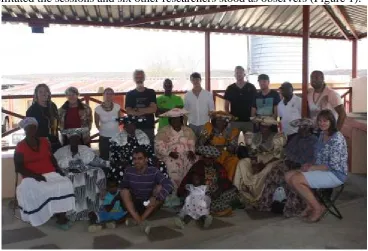
Eight local females in Okomakuara worked with two facilitators: Professor Brereton from QTU and our European colleague G. Cabrero. Sessions were filmed and audio recorded for further analysis, while five local researchers facilitated the sessions and six other researchers stood as observers (Figure 1).
56
The first method was based upon things of matter to Professor Brereton in the form of family portraits introduced from a digital tablet, and accompanied by an oral explanation on who those photographed were, and why their importance to Brereton. Participants readily took on the discussion. Yet, introducing nice family depictions led to a pre-defined route whereby they equally stated nice things on their families, and no other issues of further relevance.
The session evolved into finding on other pleasant things in participants’ lives. When asked about flowers, a participant conveyed these as providing her of pleasure in looking after, and contemplating them. Her daughter, also a participant, stated flowers as likable too. The rest of participants then followed this route in stating flowers as pleasant. Yet when further enquired, aside from mother and daughter, no one cultivated flowers. The session, hence, got entangled into common agreements and nice, not relevant things of matter.
Cabrero deployed a complementary method inspired on Fantasy Personas and their use of props to fantasize technological tools (Light et al., 2009). However, no props had been previously gathered, and this got repurposed as an oral recount of needs and aspirations participants envisage as things of matter.
“It was at this point one of the ladies referred to me asking if I knew who they were. Inside me, an initial sense of panicking unleashed as I started thinking I may have offended the participants in questioning them about things they would like to see changing in their lives at present.
So I then I responded assertively they were Hereros and waited, anxiously!”
The cultural reassurance led the mother above to rapidly state that since widowhood, it is now her brother who looks after her cattle as this is the traditional way. She nonetheless expressed a desire to get her cattle back, as she argued feeling hopeless in decision-making, and that she aspires to grow her cattle in numbers so she can make better business than at present. Her daughter, furthermore, stated a desire to own a computer to help managing the cattle.
Cattle are basic and traditional means of survival and trade for Ovaherero, as well as a means for the male to find recreation in its contemplation. However, in a changing society where values and logics evolve and the technological gap between elder and youth widens, the mother conveyed a desire towards a positive change in attitudes regarding male-female traditional roles in decision-making, while the daughter additionally hinted technology as apt for such change to occur.
Unfortunately, the above did not evolve into further detail as that day, and as life goes, there were two weddings in Okomakuara, and participants needed dressing accordingly for the occasion.
57
and implicit outcomes that inspires for future interventions including nice things for a start, but also to kindly search for further implicit cues.
4
Rapid-Ethnography in Otjinene
This weekend-long intervention sparked from an ongoing project funded by the Wikipedia Foundation. Three Wikipedians from Namibia, South Africa and Botswana aimed to go in the wild and collect first, to then appeal towards the value, thus the inclusion of IK oral tradition in Wikipedia (Gallert, 2014).
On the other hand, and inspired by Bødker et al. (2012) facilitation of users’ testimonials and imagery through persona artefacts, the new researcher aimed to apply a rapid-ethnography (Millen, 2000) to collect data on things of matter at the Wikipedians’ session, to then translate these into relevant statements and imagery, and ultimately propose participants to create personas based on such findings.
We run two sessions outside an elder couple’s Homestead with a local researcher facilitating (Figure 2). These were documented for further analysis.
On the first day, Wikipedians run a three-hour focus-group. Questions revealed data on distribution and arrangement of the household, and that this belongs to the wife’s realm, whereas external labour belongs to the male chores. Objects symbolizing the male elder’s status also emerged in the way of (1)the chair he sits-on, (2)the hat he wears, and (3)the knife and (4)stick he carries with him at all times (Figure 3). The significance of the tree outside the Homestead also came from the discussion, due to the protection it provides; its provision of constant shade, and its importance in being a placing for important family gatherings.
Fig. 2: Wikipedia researchers and elders; Fig. 3: Persona-like elder portrait.
Besides they argued books as important and an unreliability of technologies for education, as these, they argued, can be modified unlike the printed book. They expressed a further concern on youth frequent encounters with alcoholic drinks.
Knife Hat
Chair
58
The session finished and as planned, the European researcher went on collecting tangible objects either mentioned or implied in the above session: (1)tree branches to represent a tree; (2)an empty bottle of beer to portray alcohol issues, and (3)a used airtime voucher to depict technological needs.
On the second day foreign and local researcher revisited the elders for an hour-long UCP session where participants got first asked on the importance of the tree
“Being used to making abstractions in my daily life, I expected elders would agree and even repurpose the meaning of the branches as a depiction of the tree.”
The elders reaffirmed the relevance of the tree while they were handed the branches and asked whether they would serve to depict the tree. They negated this appraisal arguing the tree as safeguarding and a vital part of their lives, whereas branches portray fire, thus also danger. When enquired on youth alcohol encounters, they were alos presented with the empty bottle of beer. They claimed an empty bottle not being suitable to portray alcohol issues, and concluded empty bottles as dangerous for they can cut and also cause fire. The telephone voucher got an similar result and the local facilitator decided to kindly end the session.
No personas emerged and the rapid-ethnography sank against cultural misunderstandings in abstractions of objects presented like branches for trees and emptied bottles standing for booze. Thus, relationships object-meaning, signifier-signified, did not serve the researcher’s aims towards persona creation.
“Rather, this experience dissipated my aims in becoming a cultural broker due to lack of contextual knowledge and differences in understanding abstractions.”
It can be concluded that motivated choices about what to study, who to observe, what activities to record, and how to analyze and integrate the data into valuable insights (ibid, p.280) are not enough in these locale, as they can readily lead to mistaken outcomes (Brereton et al., 2014) or participant disengagement.
Despite all, the female participant invited us to return to Otjinene once she had finished a dress she was sewing with her Singer machine (Figure 4).
59
5
Rule-breaking in Erindiroukambe
This was a three-day trip where three sessions occurred in Erindiroukambe with 5 locals with experience designing with local designers; local designers themselves; a skilled designer familiar with the community, and the new European researcher.
Scaffolding from both, the lessons previously learnt and a plan previously drawn together with local researchers, UCP was the main aim of this session so as to then run a further scenario-based session where participants were intended to run the personas created towards the co-design of an Indigenous Knowledge crowdsourcing tool being developed by one of the local researchers [Colin’s].
The UCP session lasted 3 hours and despite the initial plan, the novel researcher broke away from the established and begun an interview-like session aimed as an icebreaker where designing personas turned into findings on who the participants were and how they would depict themselves. As a result, participants ended-up stereotyping one another: first as Ovaherero, then as the funny, the naughty, the elder, the doctor1 and the youngster respectively.
Stereotypes are shared across cultures as simplified, clichéd ideas functioning as social representations to categorized people who are alike (Nielsen, 2013). Note it is in applying nothing but realistic stereotyping or a simplified outline of the user (Katre, 2007) many hold prejudices on the value of persona (Williams and Brereton, 2014). It is then paramount to avoid stereotypes of flat characters with an only trait neither creating engagement nor identification (Nielsen, 2013).
Three hours over-talking eventually worn out participants (Figure 5), while no much relevant persona data emerged (Figure 6).
Fig. 5 & 6: Tired participants & ‘Persona-Homestead’: the holy-fire & a poo.
“When the session finished I learnt from my colleagues that the person self-described as “the naughty” was in fact “the doctor” due to his wisdom; whereas the one self-depicted as “the doctor” was, in actuality, “the goody” himself.”
1In this context a doctor is a person who acts as a savoir in the community. This person knows about cattle, car-fixing and other
60
In the very early hours of the last day participants came back to the Homestead while all researchers except the new one were still in bed.
“I greeted participants while my colleagues still slept, and then proposed them to continue the persona co-creation where we left it on the previous day.”
Participants agreed on this proposal and rearranged the materials in the sand. “On questioning them about desires they may had on things of relevance, they pinpointed and drew elements in the sand with a stick such as a water-tap that portrayed the relevance of water towards subsistence. Since participants seemed engaged in the process, I then enquired on possible technological needs and they added solar panels to my request claiming with those they could watch TV and listening to music as well” (Figure 7).
At this point a local researcher emerged, learnt what was happening, and stated the session should stop as this type of exercise could be misunderstood as a promise in providing solar panels, something utterly wrong when this is not to be realized. The workshop hence came to an end with no personas elicited.
Fig 7: Personas in the sand: the augmented outcome from an illicit session.
6
Conclusions and further work
This paper reflects on a first set of interventions in different Namibian pastoral locales whereby UCP has been attempted. Blunders, misunderstandings, protocol-breakings, and breakthroughs thus-far let us draw the next set of conclusions:
“From this initial experience I learnt that in deploying foreign methods in localised cultures, one must first get well-acquainted with existing literature both, on the methods to deploy and in the locations to do so. As such, I have now found out that other researchers have already tested and re-designed artefacts such as persona for other settings (Chavan and Prabhu, 2011; Katre, 2007), and that research colleagues underwent similar past experiences (Rodil et al., 2012).”
By applying a stronger literature review, our new team member has found out, for instance, that persona research is currently, and uncontestably, being deployed following western procedures, and that this is, however, in sharp opposition to the
Family members Solar panel
Homestead
Cooking-fire Holy-fire
Water tap
61
claim made by Chavan and Prabhu (2011) in that methods are subjective to the culture they originate in, and as such the data collected will get tainted if deploying the method in further locales with dissimilar values and understandings.
“Moreover, and provided there are local researchers at hand, it is of outmost importance to get on with them first, and then follow their guidance throughout.”
The former occurs at present and the European researcher now knows and supports structures in place for his own, the team and the communities’ benefit.
“Besides I’ve also learnt that if sensing you scratch the surface, and yet do not obtain fecund results, either end the session amicably before it is too late, or try and gently discover through suitable and localised means and solutions.”
In Otjinene the Rapid-Ethnography ended before too late, and we then obtained better results in a subsequent session (G. Cabrero, 2015). In Okomakuara, however, by softly persisting relevant things of matter emerge in the one session.
“Based on the above learnings and experiences, I am happy to state I currently work in total communion with my local research team, while I try to keep my aims and those of the communities healthily, mutually and productively engaging.”
7
Acknowledgments
The new team member wishes to thank his research colleagues and celebrates his current acceptance by the Ovaherero communities of pastoral Namibia by the name of Pamue -together.
8
References
Brereton, M., Roe, P., Schroeter, R., Lee Hong, A. Beyond Ethnography: Engagement and Reciprocity as Foundations for Design Research Out Here, in Proc. of CHI '14, ACM, Toronto, 2014, pp. 1183-1186.
Bødker, S., Christiansen, E., Nyvang, T., Zander, P.-O. Personas, people and participation: challenges from the trenches of local government, in Proc. of the 12th PDC, ACM Press, Roskilde, Denmark, 2012, pp. 91–100.
Chavan, A.L., Prabhu, G.V. (eds.) (2011) . Innovative Solutions: What Designers Need to Know for Today’s Emerging Markets. CRC Press, Boca Raton, London.
Gallert, P. Workshop: indigenous knowledge for Wikipedia, in Proc. of the 13th PDC. ACM Press, Windhoek, Namibia, 2014, pp. 199–200.
G. Cabrero., Participatory design of persona artefacts for user eXperience in non-WEIRD cultures, in Proc. of the PDC’14. ACM Press, Windhoek, Namibia, 2014, pp. 247–250.
G. Cabrero., User-Created Persona: Namibian rural Otjiherero speakers, in Proc. of the SIGDOC’15. ACM Press, Limerick, Ireland, 2015 – UPCOMING.
62
Kapuire, G.K., Winschiers-Theophilus, H., Stanley, C., Chivuno-Kuria, S., Rodil, K., Katjivirue, M., Tjitendero, E. Community-based co-design in Okomakuara a contribution to “design in the wild”, in: Proc. of the 13th PDC, ACM Press, Windhoek, Namibia, 2014, pp. 207–208. Katre, D.S.. ‘User Persona: Its Application and The Art of Stereotyping’. J. HCI 2, 2007.
Light, A., Simpson, G., Weaver, L., Healey, P.G. Geezers, turbines, fantasy personas: making the everyday into the future, in: Proc. of the C&C’09, ACM Press, 2009, pp. 39–48.
Millen, D.R. Rapid ethnography: time deepening strategies for HCI field research, in: Proc. of the DIS ’00, ACM Press, Brooklyn, New York, 2000, pp. 280–286.
Nielsen, L. Personas in Cross-Cultural Projects, in: Proc. HWID09. Pune, India, 2009, pp. 76–82. Nielsen, L. Acting as Someone Like Me: personas in participatory innovation, in Proc. of the
PIN-C’12, ACM Press, Melbourne, Australia, 2012, pp. 1-7. Nielsen, L. (2013): Personas, Springer, Amsterdam, London etc.
Nielsen, L. and Hansen, K.S. Persona is Applicable: A Study on the Use of Personas in Denmark, in Proc. of the CHI '14. ACM Press, Toronto, Canada, 2014, pp. 1665-1674.
Rodil, K., Winschiers-Theophilus, H., Jensen, K. Enhancing cross-cultural participation through creative visual exploration, in Proc. of the PDC'12. ACM, Roskilde, Denmark, 2012,pp. 81–90 Stanley, C., Winschiers-Theophilus, H., Onwordi, M., Kapuire, G.K. Rural communities
crowdsource technology development: A Namibian Expedition, in Proc. of the ICTD'13, ACM Press, Cape Town, South Africa, 2013, pp. 155-158.
Walker, K., Underwood, J., Waema, T., Dunckley, L., Abdelnour-Nocera, J., Luckin, R., Oyugi, C., Camara, S. A resource kit for participatory socio-technical design in rural Kenya, in: Proc. of the CHI’08. ACM Press, Florence, Italy, 2008, pp. 2709–2714.
Williams, I., Brereton, M., 2014. ‘A Collaborative Rapid Persona-Building Workshop: Creating Design Personas with Health Researchers’. Int. J. Sociotech Knowl. Dev, vol. 6, pp. 17–35. Winschiers-Theophilus, H. (2009): ‘The Art of Cross-Cultural Design for Usability’. Universal