Article
Identification of Drought-Responsive microRNAs
from Roots and Leaves of Alfalfa by
High-Throughput Sequencing
Yue Li †, Liqiang Wan †, Shuyi Bi, Xiufu Wan, Zhenyi Li, Jing Cao, Zongyong Tong, Hongyu Xu, Feng He and Xianglin Li *
Institute of animal sciences, Chinese academy of agricultural sciences, Beijing 100193, China;
[email protected] (Y.L.); [email protected] (L.W.); [email protected] (S.B.); [email protected] (X.W.); [email protected] (Z.L.); [email protected] (J.C.); [email protected] (Z.T.);
[email protected] (H.X.); [email protected] (F.H.) * Correspondence: [email protected]
† These authors equally contributed to this work.
Abstract: Alfalfa, an important legume forage, is an ideal crop for sustainable agriculture and a potential bioenergy plant. Drought, one of the most common environmental stresses, substantially affects plants’ growth, development and productivity. MicroRNAs (miRNAs) are newly discovered gene expression regulators that have been linked to several plant stress responses. To elucidate the role of miRNAs in drought stress regulation of alfalfa, a high-throughput sequencing approach was used to analyze 12 small RNA libraries comprising of 4 samples, each with 3 biological replicates. We identified 348 known miRNAs, belonging to 80 miRNA families, from the 12 libraries and 281 novel miRNAs using Mireap software. 18 known miRNAs in roots and 12 known miRNAs in leaves were screened out as drought-responsive miRNAs. Except for miR319d and miR157a which were upregulated under drought stress, the expression pattern of drought-responsive miRNAs were different between roots and leaves in alfalfa. This is the first study discovering miR157a, miR1507, miR3512, miR3630, miR5213, miR5294, miR5368 and miR6173 are drought-responsive miRNAs. Target transcripts of drought-responsive miRNAs were computationally predicted. All 447 target genes for the known miRNAs were predicted using an online tool. This study provides a significant insight on understanding drought-responsive mechanisms of alfalfa.
Keywords: alfalfa; drought; microRNA; small RNA; differential expression
1. Introduction
Alfalfa (Medicago sativa L.) is an important forage species, with high nutritional quality and high yield [1]. As a legume plant, alfalfa is capable of fixing nitrogen into nitrate in nodules by establishing symbiotic relationship with Rhizobium in the root system, making it an ideal crop for sustainable agriculture. Thus planting alfalfa can also improve the condition of the soil and reduce the usage of fertilizer. Alfalfa also has the potential to become a bioenergy plant, with many attributes including high biomass yield potential [2, 3]. However, the yield of alfalfa is often constrained by diverse abiotic stresses including drought. Drought is a common environmental stresses, affecting plants’ productivity [4, 5]. Thus understanding the molecular mechanism of alfalfa responding to drought stress becomes a necessary step in improving the drought tolerance of alfalfa.
level. At the transcriptional level, massive genes and transcriptional factors, related to drought stress responses, have been identified, including those involved with abscisic acid (ABA). Through the action of a number of known transcription factors, ABA-dependent and independent pathways can be induced by drought [7], which finally activate the synthesis of LEA proteins, active oxygen scavenging enzymes and osmolytes [8, 9].
Recently, the discovery of miRNAs sheds light on the post-transcriptional gene regulation. MicroRNAs are 21 to 24 nt in length, endogenously expressed, and noncoding small RNAs that negatively regulate the gene expression [5, 10, 11]. MiRNAs are derived from untranslated DNAs and miRNA sequences are usually conserved in related organisms. Unlike miRNAs, small interfering RNAs are double-stranded RNA, and processed from double-stranded precursors [12, 13]. MiRNAs as well as siRNAs can be incorporated into silencing Argonaute proteins complexes, thus repressing mRNA expression [14].
Now it has been accepted that miRNAs play vital roles on multiple crucial biological and metabolic processes in plants. For example, the leaf morphology was severely affected by miR319 overexpression in the jaw-D mutant [15]. Changing the expression level of miR172 can affect the flower morphology [16]. A group of miRNAs also play pivotal regulatory roles in plant response to various stresses such as hypoxia [17], salinity [18], cold [19], UV-B radiation [20], nutrient deficiency [21], heavy metal [22], and drought [4].
Studies from sequencing, microarray, qRT-PCR and northern blot have demonstrated that the expression level of miRNAs was altered by drought in lots of plant species, including Medicago truncatula [23], Vigna unguiculata [24], Manihot esculenta [25], Solanum tuberosum [26], Gossypium [27], Nicotiana tabacum [28], populous [29], Oryza sativa [6], Saccharum officinarum [30], Panicum virgatum [31], Hordeum vulgare [32], and foxtail millet [33]. Importantly, genes associated with miRNA pathway, such as DCL1 and AGO genes, were up-regulated under drought stress, implying the involvement of miRNA in plant adaptation to drought [34]. Conversely, changing the expression level of miRNAs can affect plants’ response to drought stress [35]. All these studies suggest that miRNAs can potentially be a very powerful tool for modifying drought resistance in alfalfa and other legumes.
2. Materials and methods
2.1. Plant materials and experiment design
Medicago sativa L. cv Aohan was used in this study, this cultivar was kindly kindly provided by Dr. Liqiang Wan (Institute of animal sciences, Chinese academy of agricultural sciences, Beijing, China). Alfalfa plants were grown in pots with a diameter of 3 inches containing a mixture of sand: vermiculite (1:1, v/v) in a growth chamber at 25-28oC under a 16hr light/8hr dark photoperiod. Plants were supplied daily with MS nutrient solution. Alfalfa plants at the age of eight weeks were then randomly separated into two groups, namely drought treatment and control groups. Drought stress treatment was imposed by withholding water supply for 10 days. The control plants received normal watering throughout the experiment.
2.2. Total RNA isolation
Roots and leaves samples from both drought and control plants were collected at the fifth and tenth day during the stress treatment, respectively. For each sample of leaf or root, 3 biological replicates were prepared, with each biological replicate collected from 10 plants. Samples were fast frozen in liquid nitrogen, stored at -80°C.
Total RNA samples were extracted and then were prepared for sequencing, reverse transcription PCR and qRT-PCR. Equal quantities of RNA isolated from leaves and/or roots at each stress stage were pooled, using HiPure Plant RNA Mini Kit (Magen, China) according to the manufacturer's instructions.
2.3. Small RNA library construction and high-throughput sequencing
A total of 4 groups of RNA samples (WL: leaves with watering, WR: roots with watering, DL: leaves with drought stress, and DR: roots with drought stress), each with three biological replicates, were prepared. For each group, RNA at both 5d and 10d were equally pooled to make one sample. Thus a total of 12 samples were used to construct small RNA libraries. Since we pool samples at different stress treatment time points (5d and 10d), only robust and consistent responses could be detected.
Total RNA was isolated by 15% polyacrylamide gelelectrophoresis, and RNA molecules that are less than 50 nt in length were enriched and ligated with proprietary adapters. The RNA samples ligated with adapters were reverse-transcribed and amplified by PCR to produce sequencing libraries. And then the 12 sRNA libraries from alfalfa leaves and roots were sequenced on an Illumina Hiseq 2500 platform at the Guangzhou RiboBio Company, China. The raw data has been deposited in the Sequence Read Archive of NCBI, the Study accession number of the SRA data is SRP094823.
2.4. Identification of known and novel miRNAs
Novel miRNAs were predicted by using Mireap [39]. Novel miRNA candidates were identified according to the criteria reported by [40]. The normalization of reads count and calculation of log Fold change were processed as [18] described.
2.5. MiRNAs validation by qRT-PCR
The same RNA samples used for Illumina sequencing were employed into qRT-PCR analysis. First, all the miRNAs in a sample were reversely transcribed into cDNAs by using the miRcute miRNA First-Strand cDNA Synthesis Kits (Tiangen, China). According to the instruction, the miRNAs were polyadenylated and reversely transcribed in one step using miRNA RT Enzyme Mix (E.coli Poly(A) Polymerase, RTase and RNasin). The Universal RT Primer was provided in the kit. Then the first-strand cDNA was prepared for qRT-PCR analysis.
The qRT-PCR was performed on an Applied Biosystems 7300 Real-Time PCR System (Applied Biosystems, American). The reaction system was constructed according to the instruction of the miRcute miRNA qRT-PCR Kits (Tiangen, China) containing SYBR® Green detection reagents. The cycling parameters were set according to the instruction. Briefly, an initial polymerase activation step for 15 minutes at 95°C, 40 cycles for 20 seconds at 94°C for denaturation, 34 seconds at 60°C for annealing and elongation followed by a disassociation stage. The forward primer were designed according to the miRNA sequences of interest and synthesized by Invitrogen, and the Universal qPCR Primer was provided in the kit. The transcript abundance of each miRNA was normalized to U6 snRNA, and the 2-ΔΔCt method was used to calculate relative expression of miRNAs [41]. In order to compare pair-wise differences in expression, Student’s t-test was performed by using SAS program.
2.6. miRNAs target prediction and function analysis
Target genes of drought-responsive miRNAs in alfalfa were predicted by using an online tool of psRNATarget (http://plantgrn.noble.org/psRNATarget/). Meanwhile gene annotation can also be accomplished by using this online tool. psRNATarget is a modified version of miRU. The M. truncatula spliced transcript sequences 4.0V1 was selected as the transcript library for target search. Mature miRNA sequences responsive to drought, identified in alfalfa roots and leaves, were used as custom miRNA sequences. The parameters for targets prediction were set by default.
3. Results
3.1. Overview of small RNAs from alfalfa via high-throughput sequencing
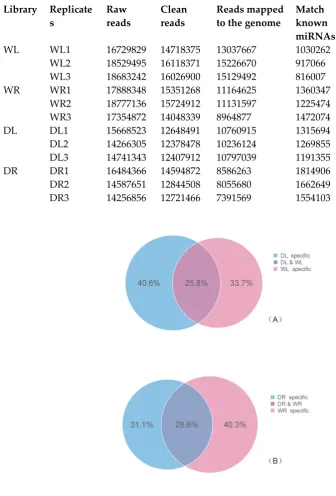
Table 1. The alfalfa sRNA sequencing datasets/Statistics of small RNA sequences for water and drought stress libraries from Medicago sativa leaf and root
Library Replicate s
Raw reads
Clean reads
Reads mapped to the genome
Match known miRNAs
WL WL1 16729829 14718375 13037667 1030262
WL2 18529495 16118371 15226670 917066
WL3 18683242 16026900 15129492 816007
WR WR1 17888348 15351268 11164625 1360347
WR2 18777136 15724912 11131597 1225474
WR3 17354872 14048339 8964877 1472074
DL DL1 15668523 12648491 10760915 1315694
DL2 14266305 12378478 10236124 1269855
DL3 14741343 12407912 10797039 1191355
DR DR1 16484366 14594872 8586263 1814906
DR2 14587651 12844508 8055680 1662649
DR3 14256856 12721466 7391569 1554103
Figure 1. The venn diagram illustrating common and specific sRNA sequences induced by drought stress. (A) Common and specific sRNA sequences in leaves; (B) Common and specific sRNA sequences in roots.
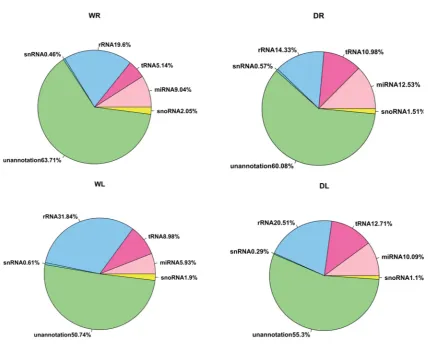
samples (leaves 8.98%; roots 5.14%). For rRNA, the opposite is true. Both drought and control samples had large number of unannotated reads (WR 63.71%, WL 50.74%, DR 60.08%, DL 55.3%) (Fig. 2). The number of total sequences that matched M. truncatula genome was given in Table 1. The sequences failing to map to the genome ranged from 5.5 to 17.3 % with exception of the WR (30.9%) and DR (40.1 %). These unmapped reads may be due to unavailable genome or sequencing errors.
Figure 2. An overview of the frequency of different small RNA species present in the different groups. 3.2. Identification of known miRNAs
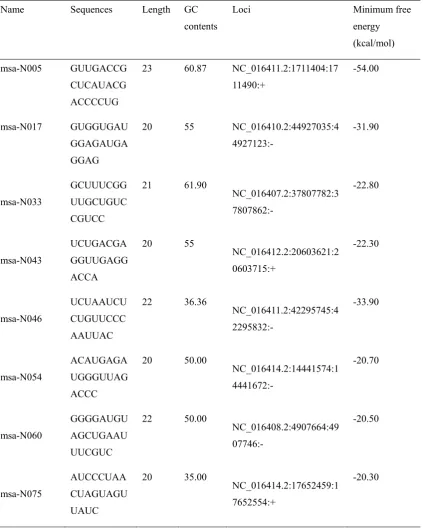
Table 2. Eight novel miRNAs identified from M. truncatula genome databases
Name Sequences Length GC
contents
Loci Minimum free
energy (kcal/mol)
msa-N005 GUUGACCG CUCAUACG ACCCCUG
23 60.87 NC_016411.2:1711404:17 11490:+
-54.00
msa-N017 GUGGUGAU GGAGAUGA GGAG
20 55 NC_016410.2:44927035:4 4927123:- -31.90 msa-N033 GCUUUCGG UUGCUGUC CGUCC 21 61.90 NC_016407.2:37807782:3 7807862:- -22.80 msa-N043 UCUGACGA GGUUGAGG ACCA 20 55 NC_016412.2:20603621:2 0603715:+ -22.30 msa-N046 UCUAAUCU CUGUUCCC AAUUAC 22 36.36 NC_016411.2:42295745:4 2295832:- -33.90 msa-N054 ACAUGAGA UGGGUUAG ACCC 20 50.00 NC_016414.2:14441574:1 4441672:- -20.70 msa-N060 GGGGAUGU AGCUGAAU UUCGUC 22 50.00 NC_016408.2:4907664:49 07746:- -20.50 msa-N075 AUCCCUAA CUAGUAGU UAUC 20 35.00 NC_016414.2:17652459:1 7652554:+ -20.30
3.3. Identification of novel miRNAs
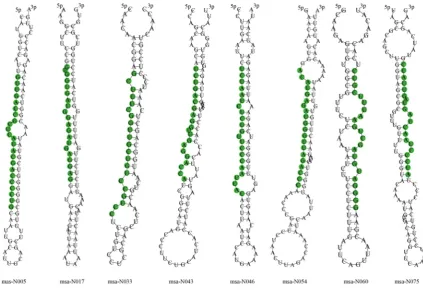
miRNA candidates with higher confidence. Their precursor sequences as well as the stem-loop hairpin secondary structure were shown in Fig. 3.
Figure 3. Representatives of precursors’ hairpin structures for predicted miRNAs from the M.truncatula genome databse. Mature miRNA sequences are shown in green.
3.4. Drought-responsive miRNAs identified in alfalfa
To identify drought-responsive miRNAs, miRNAs which absent from two of three biological replicates were filtered out, then the normalized expression profiles of the known miRNAs of drought-treated samples were compared to the control samples using generalized linear model analysis with edgeR package [42]. A log Fold Change (logFC) change cut-off of 1 and a p-value ≤ 0.05 were used to obtain the differentially expressed miRNAs [43]. These differentially expressed miRNAs between the control and drought treatment group were called as “Drought-responsive miRNAs”.
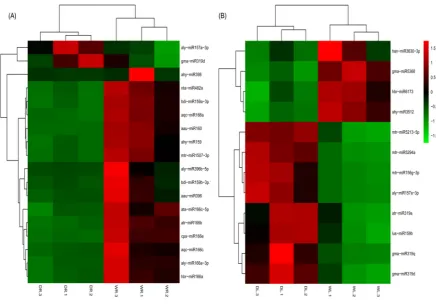
Figure 4. Heatmap representing the expression profile of the drought-responsive miRNAs. Differential expression of drought-responsive miRNAs in leaves (A) and roots (B). The upregulated miRNAs are showed in red colour whereas the downregulated miRNAs are showed in green colour.
Our results also revealed that miR396, miR159, miR160, miR482, and miR1507 were down-regulated in alfalfa roots; miR3512, miR5368, miR3630 and miR6173 were down-down-regulated in leaves, whereas miR156, miR157, miR159/319, miR5213 and miR5294 were up-regulated in alfalfa leaves. It is worthy to note that the expression of the homologues miRNAs belonging to the same miRNA family is consistent in similar trend. For instance, in alfalfa roots, aqc-miR166a, hbr-miR166a and aly-miR166a-3p were all down-regulated.
We also detected other drought related miRNAs, but the expression level of these miRNAs did not change significantly in this experiment, such as miR168, miR393, miR408 and miR2118.
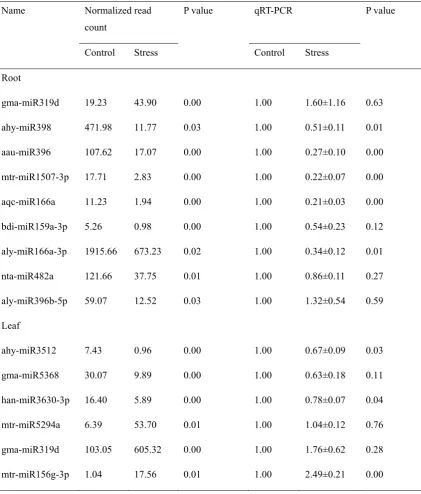
3.5. Validation of drought-responsive miRNAs by qRT-PCR
Table 3. The expression levels detected by high-throughput sequencing and qRT-PCR of some drought-responsive miRNAs.
Name Normalized read
count
P value qRT-PCR P value
Control Stress Control Stress
Root
gma-miR319d 19.23 43.90 0.00 1.00 1.60±1.16 0.63
ahy-miR398 471.98 11.77 0.03 1.00 0.51±0.11 0.01
aau-miR396 107.62 17.07 0.00 1.00 0.27±0.10 0.00
mtr-miR1507-3p 17.71 2.83 0.00 1.00 0.22±0.07 0.00
aqc-miR166a 11.23 1.94 0.00 1.00 0.21±0.03 0.00
bdi-miR159a-3p 5.26 0.98 0.00 1.00 0.54±0.23 0.12
aly-miR166a-3p 1915.66 673.23 0.02 1.00 0.34±0.12 0.01
nta-miR482a 121.66 37.75 0.01 1.00 0.86±0.11 0.27
aly-miR396b-5p 59.07 12.52 0.03 1.00 1.32±0.54 0.59
Leaf
ahy-miR3512 7.43 0.96 0.00 1.00 0.67±0.09 0.03
gma-miR5368 30.07 9.89 0.00 1.00 0.63±0.18 0.11
han-miR3630-3p 16.40 5.89 0.00 1.00 0.78±0.07 0.04
mtr-miR5294a 6.39 53.70 0.01 1.00 1.04±0.12 0.76
gma-miR319d 103.05 605.32 0.00 1.00 1.76±0.62 0.28
mtr-miR156g-3p 1.04 17.56 0.01 1.00 2.49±0.21 0.00
3.6. Targets of drought-responsive miRNAs and their function analysis
Table 4. Predicted targets for drought-responsive miRNAs identified from M. truncatula genome databases
miRNA name Target accession Expectation UPE Target start Target end Inhibition Target description
han-miR3630-3p Medtr0168s0060.1 2.5 18.13 35 56 Translation zein-binding protein
han-miR3630-3p Medtr0021s0360.1 3 16.35 3893 3913 Cleavage phospholipid-transporting ATPase-like protein
han-miR3630-3p Medtr1g015620.1 3 17.66 1832 1852 Cleavage myosin heavy chain
han-miR3630-3p Medtr2g039770.1 3 17.55 1184 1203 Cleavage disease resistance protein (TIR-NBS-LRR class)
hbr-miR6173 Medtr8g009970.1 3 15.51 593 612 Cleavage splicing factor 3A subunit 2
ahy-miR3512 Medtr8g063940.1 2 21.78 980 999 Cleavage spermidine synthase
ahy-miR3512 Medtr3g058220.1 2.5 15.17 1732 1751 Cleavage cytochrome P450 family 71 protein
ahy-miR3512 Medtr7g028160.1 3 13.87 1624 1643 Cleavage TCP family transcription factor
aly-miR157a-3p Medtr8g101880.1 3 15.82 23 42 Cleavage ATP synthase G subunit family protein
mtr-miR5213-5p Medtr3g025460.1 0 14.58 73 94 Cleavage neutral/alkaline invertase
mtr-miR5213-5p Medtr4g014580.1 1.5 13.06 121 142 Cleavage TIR-NBS-LRR class disease resistance protein
mtr-miR1507-3p Medtr7g091550.1 2 20.51 883 904 Cleavage NBS-LRR disease resistance protein
mtr-miR1507-3p Medtr7g078630.1 2 22.30 655 676 Cleavage cysteine proteinase superfamily protein
mtr-miR1507-3p Medtr5g015600.1 3 15.75 1400 1419 Cleavage condensin-2 complex subunit G2, putative
nta-miR482a Medtr6g463480.1 1 17.17 329 350 Cleavage kinesin KIF2A-like protein
nta-miR482a Medtr6g477950.1 1 13.93 39 60 Cleavage B3 DNA-binding domain protein
nta-miR482a Medtr7g088640.1 2 17.84 550 569 Cleavage NBS-LRR type disease resistance protein
nta-miR482a Medtr7g026400.1 3 14.25 1263 1283 Cleavage response regulator receiver domain protein
nta-miR482a Medtr5g099160.1 3 14.68 67 86 Cleavage cation/calcium exchanger, putative
doi:10.20944/preprints201702.0085.v1
Peer-reviewed version available at
Genes
2017
,
8
, , 119;
In this study, we constructed 12 libraries from different tissues of alfalfa treated with drought stress and well watering (control). All these libraries were sequenced on an Illumina Hiseq 2500 platform. An elaborate sRNA deep sequencing from leaves and roots of alfalfa and comprehensive and systematic analysis are involved. We firstly identified drought-responsive miRNAs and their targets, and secondly focused on discovering novel miRNAs.
In general, RNAseq tag density of 2–5 M reads is sufficient for miRNA expression profiling and discovery applications [43]. In the current study, about 14 - 18 M reads for each library were generated by high-throughput sequencing. Furthermore, we sequenced three biological replicates for WL, DL, WR and DR. So our sRNA sequencing data are deep enough not only for profiling of the miRNAs expression, but also for the discovery of novel miRNAs lowly expressed.
Around 82 – 94 % of the reads sequenced in alfalfa leaves mapped to the M. truncatula genome, indicating that most of the miRNAs of M. truncatula and M. sativa are identical in leaves. However, only 58 – 73% of the reads sequenced in alfalfa roots matched to the M. truncatula. This similar results can be found in several previous studies, such as the studies on peach [44]and even on M. truncatula [22]. The known miRNAs comprised a range of the mapped reads (5.1–12.9 %), with DL and DR having the higher amount (10.1–12.5 %) while WL and WR have the lower amount (5.9–9.0 %). This indicates that the drought treatment activated some miRNA related pathway. The unannotated sequences ranged from 50.7– 63.7 %, which strongly implies the existence of huge amounts of undiscovered sRNAs in alfalfa.
In silico analysis, we identified 348 known miRNAs from the 12 libraries. The expression of miR166, miR159, miR482 and miR2118 families were abundant. Meanwhile miR166a-3p and miR5213-5p are the most abundant miRNAs. These highly expressed miRNAs may play important regulatory roles in gene expression. For example, miR166 involves in plant organism morphgenesis, such as shoot apical meristem and floral development [45].
Discovering novel miRNAs is one of the advantages of next generation sequencing compared to other technologies such as microarray. In this study, 281 new miRNA candidates were predicted by computational method. However, only a few miRNAs were commonly expressed in roots and/or leaves. Most of the novel miRNAs were uniquely expressed in each library, thus we cannot profile the differential expression of the novel miRNAs among libraries. For profiling the expression of the novel miRNAs, an enhanced sequencing depth might need to be performed. Moreover, the expression level of the predicted miRNA candidates is relatively lower than conserved miRNAs, and this result is agreed with the former reports [22, 44, 46, 47]. One possible explanation for this result is that the conserved miRNAs regulate the target genes which might be involved in lots of important metabolic processes in viridiplantae, meanwhile the expression of nonconserved miRNAs might be environmentally inducible or tissue specific, thus the expression level of conserved miRNAs may be higher than non-conserved miRNAs [46, 47].
Besides identifying known and novel miRNAs, the high-throughput sequencing technology also provides an alternative way to evaluate expression of miRNA genes. To obtain drought-responsive miRNAs, the mature miRNA expression profile of drought treated leaves and roots was compared with the control group to obtain the miRNAs significantly modulated by drought. Finally, 18 known miRNAs in roots and 12 known miRNAs in leaves were screened out as drought-responsive miRNAs.
results. Similarly, Long et al. [18] previously reported that miRNAs in M. truncatula and M. sativa presented the opposite expression pattern under salt stress. The difference of expression pattern between M. truncatula and M. sativa may be caused by the different resistance to stresses.
MiR159/319 was also down-regulated in alfalfa root. MYB family and TCP family are targets families of this miRNA, and both of them were identified by 5’ RACE. Under drought condition, most of MYB transcription factors are involved in ABA signaling pathway. Previous studies in Arabidopsis spp. indicated that some MYBs including MYB2 are positive regulators of ABA signaling [53, 54]. With decreasing expression of miR159 positively regulating ABA signaling pathway, the down-stream of ABA signaling pathway was stimulated including root development. Similarly, miR160, whose target is ABA response factor (ARF), also has positive regulatory roles in drought stress responses.
Known targets of miR398 are involved in respiration and oxidative stress [55]. We found that drought stress down-regulated miR398 in alfalfa roots, in accordance with the results in maize [56] and M. truncatula [23]. However, Kantar et al. [50] got the opposite results in M. truncatula. The differences in the expression of miR398 showed here may be caused by differences in species, duration of drought stress and the metabolic states of the individual plants in different studies [5].
MiR396, miR482 and miR1507 were down-regulated under drought stress. However, currently their identified roles only include development or disease resistance; therefore, it can be predicted that they may have additional targets that are yet to be identified.
Two of these drought-responsive miRNAs (gam-miR319d and aly-miR157a-3p) were up-regulated in alfalfa roots. In order to conserve water and protect the cell, miRNAs are expected to be up-regulated during drought stress, so that those processes involved in normal growth and metabolism can be shut down. However, we failed to get valuable information about stress resistance from their target gene annotation. Interestingly, as a member of miR159 family, gam-miR319d was expected to be down-regulated by drought to positively regulate ABA signaling pathway, but it did not show down-regulation in our study. However, the target gene of gam-miR319d, is NB-ARC domain protein, which is a disease resistance protein, instead of MYB transcription factor, predicted using the online program psRNATarget. There are two possible reasons to explain this result: (1) gam-miR319d may have other unknown targets that play negative roles in drought adaption in alfalfa; (2) gam-miR319d plays no role in drought adaption, but can be stimulated by drought through an unknown mechanism. With the function of gam-miR319d still being unclear, further studies will be needed to explore the roles of gam-miR319d in drought stress.
In alfalfa leaves, most of the drought-responsive miRNAs were involved in development, substance synthesis and transportation. MiR3512, miR5368, miR3630-3p and miR6137, whose targets remain unknown, were down-regulated in this experiment. Target genes of miR3512, miR3630-3p and miR6137 were obtained using the online program psRNATarget. These targets include zein-binding protein, polyol/monosaccharide transporter, spermidine synthase, cytochrome P450 family 71 protein and TCP family transcription factor.
meanwhile some candidates of drought responsive miRNAs have been screened out, thus this attempt paves the path for better understanding the drought-responsive mechanisms of alfalfa. In addition, the 300 novel miRNAs also provide great resources for future research to understand the post-transcriptional regulation in alfalfa. Future studies should focus on the verification of novel miRNAs and predicted targets by experimental approaches, and also the effects of drought-responsive miRNAs on drought tolerance need to be illuminated. For all we know, our study is the first systematic and comprehensive identification of drought-responsive miRNAs in an alfalfa species. This study is valuable for improving drought tolerance and systems to mitigating crop losses under drought stress.
Supplementary Materials: The following are available online at www.mdpi.com/link,Table S1. Members and expression abundance of known miRNAs from leaves of alfalfa treated with drought and irrigation. Table S2. Members and expression abundance of known miRNAs from roots of alfalfa treated with drought and irrigation. Table S3. Mature and precursor sequences of predicted miRNAs and the other information including reads length, reads number, GC contents and minimum free energy. Table S4. Members and expression abundance of drought-responsive miRNAs from roots of alfalfa treated with drought and irrigation. Table S5. Members and expression abundance of drought-responsive miRNAs from leaves of alfalfa treated with drought and irrigation. Table S6. Targets of drought-responsive miRNAs from leaves of alfalfa. Table S7. Targets of drought-responsive miRNAs from roots of alfalfa.
Acknowledgments: This work was supported by the National Natural Science Foundation of China (No. 31372370) and the China Forage and Grass Research System (CARS-35-12). And we thank Lihong Miao and Qixin Zhang for preparing the alfalfa plants used in the experiments.
Author Contributions: YL, LW and XL conceived and designed research. YL, SB and XW conducted experiments. YL, ZL, JC, HX, FH and ZT analyzed data. YL and LW wrote the manuscript. All authors read and approved the manuscript.
Conflicts of Interest: The authors have declared no conflict of interest. References
1. Fan, W.; Zhang, S.; Du, H.; Sun, X.; Shi, Y.; Wang, C. Genome-wide identification of different dormant Medicago sativa L. microRNAs in response to fall dormancy. PLoS ONE 2014, 9(12), e114612.
2. Aung, B.; Gruber, M.Y.; Amyot, L.; Omari, K.; Bertrand, A.; Hannoufa, A. MicroRNA156 as a promising tool for alfalfa improvement. Plant Biotechnology Journal 2015, 13, 779-790.
3. Samac, D.A.; Bucciarelli, B.; Miller, S.S.; Yang, S.S.; O’Rourke, J.A.; Shin, S.; Vance, C.P. Transgene silencing of sucrose synthase in alfalfa (Medicago sativa L.) stem vascular tissue suggests a role for invertase in cell wall cellulose synthesis. BMC Plant Biology 2015, 15, 283.
4. Akdogan, G.; Tufekci, E. D.; Uranbey, S.; Unver, T. miRNA-based drought regulation in wheat. Functional & Integrative Genomics 2016, 16(3), 221-233.
5. Ding, Y.; Tao, Y.; Zhu, C. Emerging roles of microRNAs in the mediation of drought stress response in plants. Journal of Experimental Botany 2013, 64(11), 3077-3086.
6. Cheah, B.H.;Nadarajah, K.; Divate, M.D.;Wickneswari, R. Identification of four functionally important microRNA families with contrasting differential expression profiles between drought-tolerant and susceptible rice leaf at vegetative stage. BMC Genomics 2015, 16, 692.
7. Shinozaki, K.; Yamaguchi-Shinozaki, K. Gene networks involved in drought stress response and tolerance. Journal of Experimental Botany 2007, 58(2), 221-227.
8. Ramanjulu, S.; Bartels, D. Drought-and desiccation-induced modulation of gene expression in plants. Plant; cell & environment 2002, 25, 141-151.
9. Battaglia, M.; Olvera-Carrillo, Y.; Garciarrubio, A.; Campos, F.; Covarrubias, A.A. The enigmatic LEA proteins and other hydrophilins. Plant Physiology 2008, 148, 6-24.
10. Khraiwesh, B.; Zhu, J.K.; Zhu, J. Role of miRNAs and siRNAs in biotic and abiotic stress responses of plants. Biochimica et Biophysica Acta 2012, 1819(2), 137-148.
Reviews Genetics 2007, 8, 884-896.
13. Mallory, A.C.; Bouché, N. MicroRNA-directed regulation: to cleave or not to cleave. Trends in Plant Science 2008, 13(7), 359-367.
14. Förstemann, K; Horwich, M. D.; Wee, L. M.; Tomari, Y.; Zamore, P. D. Drosophila microRNAs are sorted into functionally distinct Argonaute protein complexes after their production by Dicer-1. Cell 2007, 130(2), 287- 297.
15. Palatnik, J.F.; Allen, E.;Wu, X.; Schommer, C.; Schwab, R.; Carrington, J.C.; Weigel, D. Control of leaf morphogenesis by microRNAs. Nature 2003, 425, 257–63.
16. Chen X. A microRNA as a translational repressor of APETALA2 in Arabidopsis flower development. Science 2004, 303, 2022–25.
17. Moldovan, D.; Spriggs, A.; Yang, J.; Pogson, B.J.; Dennis, E.S.; Wilson, I.W. Hypoxia-responsive microRNAs and trans-acting small interfering RNAs in Arabidopsis. Journal of Experimental Botany 2010, 61(1), 165-177.
18. Long, R.C.; Li, M.N.; Kang, J.M.; Zhang, T.J.; Sun, Y.; Yang, Q.C. Small RNA deep sequencing identifies novel and salt-stress-regulated microRNAs from roots of Medicago sativa and Medicago truncatula. Physiologia Plantarum 2015, 154, 13-27.
19. Ci, D.; Song, Y. P.; Tian, M.; Zhang, D. Q. Methylation of miRNA genes in the response to temperature stress in Populus simonii. Frontiers in Plant Science 2015, 6, 921. DOI: 10.3389/fpls.2015.00921.
20. Zhou, X.; Wang, G.; Zhang, W. UV-B responsive microRNA genes in Arabidopsis thaliana. Molecular Systems Biology 2007, 3, 103.
21. Paul, S.; Datta, S. K.; Datta, K. miRNA regulation of nutrient homeostasis in plants. Frontiers in Plant Science 2015, 6, 232. DOI: 10.3389/fpls.2015.00232.
22. Zhou, Z.S.; Zeng, H.Q.; Liu, Z.P.; Yang, Z.M. Genome-wide identification of Medicago truncatula microRNAs and their targets reveals their differential regulation by heavy metal. Plant, Cell and Evironment 2012, 35, 86-99.
23. Wang, T.Z.; Chen, L.; Zhao, M.G.; Tian, Q.Y.; Zhang, W.H. Identification of drought-responsive microRNAs and their targets in Medicago truncatula by genome-wide high-throughput sequencing and degradome analysis. BMC Genomics 2011, 12, 367.
24. Shui, X.R.; Chen, Z.W.; Li, J. X. MicroRNA prediction and its function in regulating drought-related genes in cowpea. Plant Science 2013, 210, 25-35.
25. Ballen-Taborda, C.; Plata, G.; Ayling, S.; Rodriguez-Zapata, F.; Becerra, L.A.; Duitama, J.; Tohme, J. Identification of cassava MicroRNAs under abiotic stress. International Journal of Genomics 2013, 2013, 857986.
26. Zhang, N.; Yang, J.; Wang, Z.; Wen, Y.; Wang, J.; He, W.; Liu, B.; Si, H.; Wang, D. Identification of novel and conserved microRNAs related to drought stress in potato by deep sequencing. PLoS ONE 2014, 9, e95489.
27. Wang, M.; Wang, Q.; Zhang, B. Response of miRNAs and their targets to salt and drought stresses in cotton (Gossypium hirsutum L.). Gene 2013, 30, 26–32.
28. Yin, F.; Gao, J.; Liu, M.; Qin, C.; Zhang, W.; Yang, A.; Xia, M.; Zhang, Z.; Shen, Y.; Lin, H.; Luo, C.; Pan, G. Genome-wide analysis of Water-stress-responsive microRNA expression profile in tobacco roots. Functional & Integrative Genomics 2014, 14, 319-332.
29. Shuai, P.; Liang, D.; Zhang, Z.; Yin, W.; Xia, X. Identification of drought-responsive and novel Populus trichocarpa microRNAs by high-throughput sequencing and their targets using degradome analysis. BMC Genomics 2013, 14, 233.
30. Ferreira, T.H.; Gentile, A.; Vilela, R.D.; Costa, G.G.; Dias, L.I.; Endres, L.; Menossi, M. MicroRNAs associated with drought response in the bioenergy crop sugarcane (Saccharum spp.). PLoS ONE 2012, 7, e46703.
sequencing to identify miRNAs and their targets in response to drought in foxtail millet. BMC Genetics 2016, 17, 57.
34. Capitão, C.; Paiva, J.A.P.; Santos, D.M.; Fevereiro, P. In Medicago truncatula, water deficit modulates the transcript accumulation of components of small RNA pathways. BMC Plant Biology 2011, 11, 79.
35. Li, W.X.; Oono, Y.; Zhu, J.; He, X.J.; Wu, J.M.; Iida, K.; Lu, X.Y.; Cui, X.; Jin, H.; Zhu, J.K. The Arabidopsis NFYA5 transcription factor is regulated transcriptionally and posttranscriptionally to promote drought resistance. Plant Cell 2008, 20, 2238–2251.
36. Burge, S.W.; Daub, J.; Eberhardt, R.; Tate, J.; Barquist, L.; Nawrocki, E.P.; Eddy, S.R.; Gardner, P.P.; Bateman, A. Rfam 11.0: 10 years of RNA families. Nucleic Acids Research 2013, 41, D226-232.
37. Kozomara, A.; Griffiths-Jones, S. miRBase: annotating high confidence microRNAs using deep sequencing data. Nucleic Acids Research 2014, 42 (D1), D68-D73.
38. Li, H.; Durbin, R. Fast and accurate short read alignment with Burrows–Wheeler transform Bioinformatics 2009, 25(14), 1754-1760.
39. Li, Y.; Zhang, Z.; Liu, F.; Vongsangnak, W.; Jing, Q.; Shen, B. Performance comparison and evaluation of software tools for microRNA deep-sequencing data analysis. Nucleic Acids Research 2012, 40(10), 4298-4305.
40. Chen, L.; Wang, T.; Zhao, M.; Tian, Q.; Zhang, W. Identification of aluminum-responsive microRNAs in Medicago truncatula by genome-wide high-throughput sequencing. Planta 2012, 235, 375-386.
41. Livak, K.J.; Schmittgen, T.D. Analysis of relative gene expression data using real time quantitative PCR and the 2-∆∆CT method. Methods 2001, 25(4), 402-408.
42. Robinson, M.D.; McCarthy, D.J.; Smyth, G.K. edgeR: a Bioconductor package for differential expression analysis of digital gene expression data. Bioinformatics 2010, 26(1), 139-140.
43. Vaz, C.; Wee, C. W.; Lee, G. P. S.; Ingham, P. W.; Tanavde, V.; Mathavan, S. Deep sequencing of small RNA facilitates tissue and sex associated microRNA discovery in zebrafish. BMC Genomics 2015, 16, 950. 44. Eldem, V.; Akcay, U.C.; Ozhuner, E.; Bakir, Y.; Uranbey, S.; Unver, T. Genome-wide identification of
miRNAs responsive to drought in peach (Prunus persica) by high-throughput deep sequencing. PLoS ONE 2012, 7, e50298.
45. Jung, J. H.; Park, C. M. MIR166/165 genes exhibit dynamic expression patterns in regulating shoot apical meristem and floral development in Arabidopsis. Planta 2007, 225(6), 1327-1338.
46. Rajagopalan, R.; Vaucheret, H.; Trejo, J.; Bartel, D.P. A diverse and evolutionarily fluid set of microRNAs in Arabidopsis thaliana. Genes & Development 2006, 20, 3407–3425.
47. Fahlgren, N.; Howell, M.D.; Kasschau, K.D.; Chapman, E.J.; Sullivan, C.M.; Cumbie, J.S.; Givan, S.A.; Law, T.F.; Grant, S.R.; Dangl, J.L.; Carrington, J.C. High throughput sequencing of Arabidopsis microRNAs: evidence for frequent birth and death of MIRNA genes. PLoS ONE 2007, 2, e219.
48. Juarez, M.T.; Kui, J.S.; Thomas, J.; Heller, B.A.; Timmermans, M.C. microRNA-mediated repression of rolled leaf1 specifies maize leaf polarity. Nature 2004, 428, 84-88.
49. Boualem, A.; Laporte, P.; Jovanovic, M.; Laffont, C.; Plet, J.; Combier, J.P.; Niebel, A.; Crespi, M.; Frugier, F. MicroRNA166 controls root and nodule development in Medicago truncatula.The Plant Journal 2008, 54, 876-887.
50. Kantar, M.; Lucas, S.; Budak, H. MiRNA expression patterns of Triticum dicoccoides in response to shock drought stress. Planta 2011, 233, 471–484.
51. Kantar, M.; Unver, T.; Budak, H. Regulation of barley miRNAs upon dehydration stress correlated with target gene expression. Functional & Integrative Genomics 2010, 10, 493-507.
52. Trindade, I.; Capitao, C.; Dalmay, T.; Fevereiro, M.P. and Santos, D.M. miR398 and miR408 are up-regulated in response to water deficit in Medicago truncatula. Planta 2010, 231, 705–716.
53. Abe, H.; Yamaguchi-Shinozaki, K.; Urao, T.; lwasaki, T.; Hosokawa, D.; Shinozaki K. Role of Arabidopsis MYC and MYB homologs in drought and abscisic acid-regulated gene expression. The Plant Cell 1997, 9, 1859-1868.
in Arabidopsis is mediated by downregulation of miR398 and important for oxidative stress tolerance. Plant Cell 2006, 18, 2051–2065.
56. Wei, L.; Zhang, D.; Xiang, F.; Zhang, Z. Differentially expressed miRNAs potentially involved in the regulation of defense mechanism to drought stress in maize seedlings. International Journal of Plant Science 2009, 170, 979–989.
57. Allen, R.S.; Li, J.Y.; Alonso-Peral, M.M.; White, R.G.; Gubler, F.; Millar, A.A. MicroR159 regulation of most conserved targets in Arabidopsis has negligible phenotypic effects. Silence 2010, 1, 18.
58. Reyes, J.; Chua, N. ABA induction of mir159 controls transcript levels of two Myb factors during Arabidopsis seed germination. The Plant Journal 2007, 49, 592–606.