Visualization of Thomas-Wigner Rotations
Georg Beyerle ID
GFZ German Research Centre for Geosciences, Potsdam, Germany; [email protected]
Abstract: It is well known that a sequence of two non-collinear Lorentz boosts (pure Lorentz
1
transformations) does not correspond to a Lorentz boost, but involves a spatial rotation, the Wigner
2
or Thomas-Wigner rotation. We visualize the interrelation between this rotation and the relativity of
3
distant simultaneity by moving a Born-rigid object on a closed trajectory in several steps of uniform
4
proper acceleration. Born-rigidity implies that the stern of the boosted object accelerates faster than
5
its bow. It is shown that at least five boost steps are required to return the object’s center to its starting
6
position, if in each step the center is assumed to accelerate uniformly and for the same proper time
7
duration. With these assumptions, the Thomas-Wigner rotation angle depends on a single parameter
8
only. Furthermore, it is illustrated that accelerated motion implies the formation of an event horizon.
9
The event horizons associated with the five boosts constitute a natural boundary to the rotated
10
Born-rigid object and ensure its finite size.
11
Keywords:special relativity; Thomas-Wigner rotation; visualization
12
1. Introduction 13
In 1926 the British physicist L. H. Thomas (1903–1992) resolved a discrepancy between observed
14
line splittings of atomic spectra in an external magnetic field (Zeeman effect) and theoretical calculations
15
at that time [see e.g. 41]. Thomas’ analysis [39,40] explains the observed deviations in terms of
16
a special relativistic [9] effect. He recognized that a sequence of two non-collinear pure Lorentz
17
transformations (boosts) cannot be expressed as one single boost. Rather, two non-collinear boosts
18
correspond to a pure Lorentz transformation combined with a spatial rotation. This spatial rotation
19
is known as Wigner rotation or Thomas-Wigner rotation, the corresponding rotation angle is the
20
Thomas-Wigner angle [see e.g.2,4,5,14,15,17,18,24,27,28,30,32,34,36,42–44, and references therein].
21
The prevalent approach to discuss Thomas-Wigner rotations employs passive Lorentz
22
transformations. An objectGis simultaneously observed fromNinertial reference frames, denoted by
23
[1],[2], . . . ,[N]. Frame[i]is related to the next frame[i+1]by a pure Lorentz transformation, where
24
1≤i≤N−1. Now, for given non-collinear boosts from frame[1]to frame[2]and then from[2]to[3],
25
there exists a unique third boost from[3]to[4], such thatGis at rest with respect to both, frame[1]and
26
frame[4]. It turns out, however, that the combined transformation[1]→[2]→[3]→[4], is not the
27
identity transformation, but involves a spatial rotation.
28
In the present paper, following Jonsson [22], an alternative route to visualize Thomas-Wigner
29
rotations using active or “physical” boosts is attempted.Gis accelerated starting from zero velocity in
30
frame[1], which is denoted by “laboratory frame” in the following. During its journeyGperforms
31
several acceleration and/or deceleration manoeuvres and finally returns to its starting position. The
32
visual impression ofGmoving through the series of acceleration phases and finally coming to rest in a
33
rotated orientation (see fig.5below) hopefully outweigh the mathematical technicalities of the present
34
approach.
35
The paper is sectioned as follows. First, the general approach is described and basic assumptions
36
are introduced. The second section recalls uniform accelerations of Born-rigid objects. Sequences of
37
uniform, non-collinear accelerations for a given vertex point within a planar grid of vertices and the
38
trajectories of its neighbouring vertices are addressed in the following section. The last two sections
39
present the visualization results and discuss their implications. AppendixAexamines the required
40
number of boost steps, details of the computer algebraic calculations performed in this study are given
41
in appendixB.
42
For simplicity length units of light-seconds, abbreviated “ls” (roughly 300,000 km) are used with
43
the speed of light taken to be unity.
44
2. Method 45
We consider the trajectory of a square-shaped gridGconsisting ofMvertices.Gis assumed to be
46
Born-rigid, i.e. the distance between any two grid points, as observed in the momentarily comoving
47
inertial frame (MCIF) [see e.g.25, chapter 7], remains constant [3]. The grid’s central pointR, which
48
serves as the reference point, is uniformly accelerated for a given proper time period∆τR. To obtain 49
a closed trajectory several of these sections with constant proper acceleration, but different boost
50
directions are joined together.
51
InR’s MCIF the directions and magnitudes of the vertices’ proper accelerations~αi(i=1, . . . ,M) 52
change discontinuously at the switchover from one boost section to the next. In the MCIF the vectors~αi 53
change simultaneously; in other frames, such as the laboratory frame, the change is asynchronous and
54
G, despite its Born-rigidity, appears distorted and twisted (see fig.5below). On the other hand,G’s
55
Born-rigidity implies that it is sufficient to calculateR’s trajectory, the motion of the reference pointR 56
uniquely determines the trajectories of the remainingM−1 vertices [20,29]. We note that the spacetime
57
separations between individual switchover events, linking boost stepskandk+1, are spacelike. I.e.
58
these switchover events are causally disconnected and each vertex has to be “programmed” in advance
59
to perform the required acceleration changes [26].
60
In the following,αRand∆τRdenote the magnitude of the proper acceleration ofG’s reference 61
pointRand the boost duration in terms ofR’s proper time, respectively. To simplify the calculations
62
we impose the following four conditions on allNboosts.
63
1. The gridGis Born-rigid.
64
2. At the beginning and after completion of theNth boostGis at rest in frame[1]andRreturns to
65
its starting position.
66
3. R’s proper accelerationαRand the boost’s proper duration∆τRare the same in allNsections. 67
4. All boost directions and therefore all trajectories lie within thexy-plane.
68
Let the unit vector ˆe1denote the direction of the first boost in frame[1]. This first boost lasts for a
69
proper time∆τR, as measured byR’s clock, whenRattains the final speedvR ≡ βwith respect to 70
frame[1]. Frame[2]is then defined asR’s MCIF at this instant of time. The corresponding Lorentz
71
matrix transforming a four-vector from frame[2]to frame[1]is
72
Λ(γ, ˆe1)≡
γ, γ βeˆT1 γ βeˆ1, 13×3+ (γ−1)eˆ1·eˆT1
. (1)
Here,13×3is the 3×3 unit matrix, the superscriptTdenotes transposition, the Lorentz factor is
73
γ≡ p 1
1−β2
(2)
and, in turn,β=pγ2−1/γ. Similarly, frame[3]isR’s MCIF at the end of the second boost, etc. In 74
general, the Lorentz transformation from frame[i]to frame[i+1]is given by eqn. (1), with ˆe1replaced
75
by ˆei, the direction of theith boost in frame[i]. 76
Assumption {3} implies that the angles between consecutive boosts (“boost angles”)
77
ζi,i+1 ≡ arccos
ˆ
eTi ·eˆi+1
are the only unknowns, since proper accelerationαRand boost duration∆τRare given parameters. In 78
the following the “half-angle” parametrization
79
T≡tan
ζ 2
(4)
is used; it allows us to write expressions involving
80
sin(ζ) = 2T
1+T2 (5)
cos(ζ) = 1−T 2
1+T2 . as polynomials inT.
81
We will find that, first, no solutions exist if the number of boostsNis four or less (see appendixA),
82
second, forN=5 the solution is unique and, third, the boost anglesζ(γ)depend solely on the selected
83
value ofγ=1/p1−β2. ChangingαRand/or∆τRonly affects the spatial and temporal scale ofR’s 84
trajectory (see below).
85
The derivation ofζi,i+1(γ)is simplified by noting that the constraints {2}, {3} and {4} imply time
86
reversal invariance. I.e.R’s trajectory from destination to start, followed backward in time, is a valid
87
solution as well and thereforeζi,i+1=ζN−i,N−i+1fori=1, . . . ,N−1. Thus, forN=5 the number of
88
unknowns reduces from four to two, withζ1,2=ζ4,5andζ2,3=ζ3,4. 89
3. Uniform acceleration of a Born-rigid object 90
In the laboratory frame we consider the uniform acceleration of the reference pointR, initially
91
at rest, and assume that the acceleration phase lasts for the proper time period∆τR. During∆τRthe 92
reference point moves from location~rR(0)to location
93
~rR(∆τR) = ~rR(0) + 1 αR
(cosh(αR∆τR)−1)eBˆ (6)
with unit vector ˆeB denoting the boost direction [see e.g.19,21,27,33,36,37]. The coordinate time
94
duration∆tRcorresponding to the proper time duration∆τRis 95
∆tR =
1 αR
sinh(αR∆τR) (7)
andRattains the final speed
96
vR=tanh(αR∆τR) =β . (8)
LetGbe an arbitrary vertex point ofGat location~rG(0)and
97
b≡(~rG(0)−~rR(0))·eBˆ (9)
the projection of the distance vector fromRtoGonto the boost direction ˆeB. The verticesGandRstart
98
to accelerate simultaneously sinceGis Born-rigid (assumption {1}) and analogous to eqns. (6), (7) and
99
(8) we obtain forG’s trajectory
100
~rG(∆τG) = ~rG(0) +
1 αG
(cosh(αG∆τG)−1) +b
ˆ
eB (10)
∆tG = 1
αG sinh
(αG∆τG)
At the end of the first boost phase all grid points move at the same speed with respect to the laboratory
101
frame; however, in the laboratory frame the boost phase does not end simultaneously for all vertices.
102
Simultaneity is only observed inR’s MCIF. WithvG=vRand eqn. (10) it follows
103
αG∆τG = αR∆τR . (11)
G’s Born-rigidity implies that the spatial distance betweenGandRat the end of the boost phase inR’s
104
MCIF is the same as their distance at the beginning of the boost phase. A brief calculation leads to
105
− 1 αG
(γ−1) +bγ+ 1 αR
(γ−1) =b (12)
which simplifies to
106
αG = 1
1+bαR
αR (13)
and with eqn. (11)
107
∆τG = (1+bαR)∆τR (14)
provided γ 6= 1. Eqn. (13) expresses the well-known fact that the proper accelerations aboard a 108
Born-rigid grid may differ from one vertex to the next. More specifically, at a location trailing the
109
reference pointRthe acceleration exceedsαR, vertex points leadingRaccelerate less thanαR. (In 110
relativistic space travel the passengers in the bow of the spaceship suffer lower acceleration forces than
111
those seated in the stern. This amenity of a more comfortable acceleration, however, is counterbalanced
112
by faster ageing of the space travellers (eqn. (14)). These considerations, of course, assume Born-rigidly
113
constructed space vehicles.)
114
The position-dependent acceleration is well-known from the Dewan-Beran-Bell spaceship paradox
115
[7,8] and [1, chapter 9]. Two spaceships, connected by a Born-rigid wire, accelerate along the direction
116
separating the two. According to eqn. (13) the trailing ship has to accelerate faster than the leading
117
one. Conversely, if both accelerated at the same rate in the laboratory frame, Born-rigidity could
118
not be maintained and the wire connecting the two ships would eventually break. This well-known,
119
but admittedly counterintuitive fact is not a paradox in the true sense of the word and discussed
120
extensively in the literature [see e.g.11–13,16,31,38].
121
Eqns. (13) and (14) also imply, thatαG →∞and∆τG →0, as the distance between a (trailing) 122
vertexGand the reference pointRapproaches the critical value
123
b∗≡ −1/αR . (15)
Clearly, a Born-rigid object cannot extend beyond this boundary, which is referred to as “event horizon”
124
in the following. Section6.2will discuss its consequences.
125
Finally, we note that eqn. (14) implies that a set of initially synchronized clocks mounted on
126
a Born-rigid grid will in general fall out of synchronization once the grid is accelerated [37]. Thus,
127
the switchover events, which occur simultaneous inR’s MCIF, are not simultaneous with respect to
128
the time displayed by the vertex clocks. As already mentioned, the acceleration changes have to be
129
“programmed” into each vertex in advance, since the switchover events are causally not connected and
130
lie outside of each others’ lightcones [10].
131
4. Sequence of five uniform accelerations 132
The previous section discussedR’s trajectory during the first acceleration phase (eqn. (10)). Now
133
we connect several of these segments to form a closed trajectory forR. Let A[k]denoteR’s start event
134
as observed in frame[k]and B[k], C[k], etc. correspondingly denote the “switchover” events between 1st
and 2stboost, 2ndand 3rdboost, etc., respectively. In the following, bracketed superscripts indicate the
136
reference frame. Frame[1], i.e.k=1, is the laboratory frame, frame[2]is obtained from frame[1]by
137
the Lorentz transformationΛ(γ,−eˆ1)(eqn. (1)). Generally, frame[k+1]is calculated from frame[k]
138
using the transformation matrixΛ(γ,−ekˆ ).
139
It can be shown (see appendix A) that at least five boosts are needed to satisfy the four
140
assumptions {1}–{4} listed in section2. As illustrated in fig.3for a sequence ofN = 5 boosts the
141
reference point starts to accelerate at event A and returns at event F via events B, C, D and E. The
142
corresponding four-positionPand four-velocityVare
143
P[F1] = PA[1]+S[A1]→B (16)
+Λ(γ,−eˆ1)·S[B2→] C
+Λ(γ,−eˆ1)· Λ(γ,−eˆ2)·S[C3→] D
+Λ(γ,−eˆ1)· Λ(γ,−eˆ2)· Λ(γ,−eˆ3)· S[D4]→E
+Λ(γ,−eˆ1)· Λ(γ,−eˆ2)· Λ(γ,−eˆ3)· Λ(γ,−eˆ4)· S[E5→] F and
144
V[F1] = Λ(γ,−eˆ1)· Λ(γ,−eˆ2)· Λ(γ,−eˆ3) (17) ·Λ(γ,−eˆ4)· Λ(γ,−eˆ5)· V[F6] ,
respectively. Here, the four-vector
145
S[A1]→B ≡ 1 αR
sinh(αR∆τR) (cosh(αR∆τR)−1)eˆ1
!
(18)
= 1
αR
γ β (γ−1)eˆ1
!
describes R’s worldline from A to B (eqn. (10)); S[B2→] C, SC[3→] D, S[D4→] E and S[E5→] F are defined
146
correspondingly. Assumption {2} implies that
147
~
PA[1]=~PF[1]=~PA[6]=~PF[6] =~0 (19) and
148
VA[1]=V[F1] =VA[6]=V[F6]= ~1 0
!
. (20)
To simplify the expressions in eqns. (16) and (17) time reversal symmetry is invoked. It implies that
149
the set of boost vectors−eˆ5,−eˆ4, . . . ,−eˆ1constitutes a valid solution, provided ˆe1, ˆe2, . . . , ˆe5is one and
150
satisfies assumptions {1}–{4}. Thereby the number of unknowns is reduced from four to two, the angle
151
between the boost vectors ˆe1and ˆe2, and the angle between ˆe2and ˆe3
152
ζ1,2 ≡ arccos
ˆ
eT1 ·eˆ2
=arccoseˆ4T·eˆ5
(21)
ζ2,3 ≡ arccos
ˆ
eT2 ·eˆ3
=arccoseˆ3T·eˆ4
.
Fig.3illustrates the sequence of the five boosts in the laboratory frame[1]. Since the start and final
153
velocities are zero, R’s motion between A and B and, likewise, between E and F is rectilinear. In
154
contrast, the trajectory connecting B and E (via C and D) appears curved in frame[1]; as discussed
and illustrated below, the curved paths are in fact straight lines in the corresponding boost frame (see
156
fig.4).
157
From eqns. (17) and (20) follows
(T12)2−2γ−1
(T23)2−4(1+γ)T12T23+ (T12)2+4γ2+2γ−1=0 (22) with the two unknownsT12≡tan(ζ1,2/2)andT23≡tan(ζ2,3/2)(for details see appendixB). Eqn. (22)
158
has two solutions,
159
T23(±) = 1
−(T12)2+2γ+1 (23)
×
−2T12 (γ+1)
±q−(T12)4+8(T12)2γ+6(T12)2+8γ3+8γ2−1
provided
160
(T12)2−2γ−16=0 . (24)
Assumption {2} implies that the spatial component of the eventP[F1]vanishes, i.e.
161
~
PF[1]=0 . (25)
Since all motions are restricted to thexy-plane, it suffices to consider thex- andy-components of
162
eqn. (25). They-component leads to a product of the following two expressions
163
(T12)8 (26)
+(T12)64 (γ+2) +(T12)4(−2) (2γ+1)
2γ2+8γ+9
+(T12)2(−4)
8γ4+28γ3+26γ2+5γ−2
−(2γ+1)3
4γ2+2γ−1
or
164
(T12)8 (γ+3)2 (27)
+(T12)6(−4)
6γ3−15γ2−12γ+5
+(T12)4(−2)
24γ4−44γ3−55γ2+26γ+1
+(T12)2(−4)
8γ5−16γ4−14γ3+5γ2+1
+4γ2+γ−1
2
(see appendixB). The solutions of equating expression (27) to zero are disregarded since forγ=1 it 165
yields
166
(T12)8+4(T12)6+6(T12)4+4(T12)2+1=0 (28) which has no real-valued solution forT12.
It turns out (see appendixB) that thex-component of eqn. (25) results in an expression containing
168
two factors as well, one of which is identical to the expression (26). Thus, the roots of the polynomial (26)
169
solve eqn. (25).
170
The degree of the polynomial (26) in terms of(T12)2is four; its roots are classified according
171
to the value of the discriminant∆ (see e.g. en.wikipedia.org/wiki/Quartic_function), which for
172
expression (26) evaluates to
173
∆ = −524288γ(γ−1)3(γ+1)7(4γ4+28γ3+193γ2+234γ+81) . (29)
For non-trivial boostγ>1, the discriminant is negative and the roots of the quartic polynomial consist 174
of two pairs of real and complex conjugate numbers (seeen.wikipedia.org/wiki/Quartic_function).
175
The real-valued solutions are
176
(T12)2 = −(γ+2) +S+ 1 2
r
−4S2−2p− q
S (30)
and
177
T12(b)2 = −(γ+2) +S −1 2
r
−4S2−2p− q
S (31)
with
178
p ≡ −2(γ+1) 4γ2+17γ+21
(32)
q ≡ −16(γ+1)γ2−2γ−9
S ≡ 1
2√3
r
−2p+Q+∆0 Q
∆0 ≡ 16(γ+1)2 4γ4+28γ3+157γ2+126γ+9
Q ≡ 4 3
q
Q0+12 √
6pQ0
Q0 ≡ γ(γ−1)3(γ+1)7(4γ4+28γ3+193γ2+234γ+81) .
The solution from eqn. (31) turns out to be negative and thus does not produce a real-valued solution
179
forT12. The remaining two roots of the polynomial (26)
180
T12(c)2 = −(γ+2)− S+1 2
r
−4S2−2p+ q
S (33)
T12(d)2 = −(γ+2)− S −1 2
r
−4S2−2p+ q S
correspond to replacingS by−S in eqns. (30) and (31); they are complex-valued and therefore
181
disregarded as well. The second unknown,T23, follows from eqn. (23) by choosing the positive square
182
root+p(T12)2and using
183
T23 ≡ T23(+) (34)
(see eqn. (22)). For a given Lorentz factorγthe angles between the boost directions ˆeiand ˆei+1are
184
ζ1,2(γ) = arccos
ˆ
eT1 ·eˆ2
=2 arctan
+
q
(T12(γ))2
(35)
ζ2,3(γ) = arccos
ˆ
eT2 ·eˆ3
=2 arctan
+
q
(T23(γ))2
10
010
110
210
310
410
5γ
50
75
100
125
150
175
200
ζ
1,2,
ζ
2,3[deg]
Figure 1. The angle between the boost direction vectors ˆe1and ˆe2in frame[1](blue line), and the angle
between ˆe2and ˆe3in frame[2](red) as a function ofγ. The dotted line marks+180◦, the limit ofζ1,2
andζ2,3forγ→∞.
and, withζ4,5=ζ1,2andζ3,4 =ζ2,3, the orientation of the five boost directions ˆeifori=1, . . . , 5 within 185
thexy-plane are obtained.
186
Fig.1shows numerical values of the boost anglesζ1,2(γ)andζ2,3(γ)as a function ofγ. The angles increase from
ζ1,2(γ=1) =2 arctan
q
−5+4√10
≈140.2◦
and
ζ2,3(γ=1) =2 arctan
p
−5+4√10−√3p−5+2√10 −2+√10
!
≈67.2◦
atγ=1 toζ1,2(γ→∞) = +180◦=ζ2,3(γ→∞)asγ→∞. 187
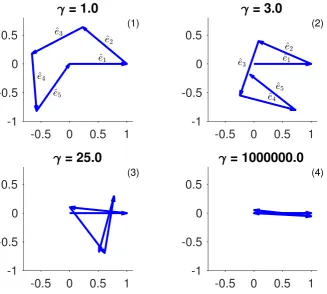
Fig.2depicts the orientation of the five boost directions for several values ofγ. Here the first boost 188
vector ˆe1is taken to point along thex-axis. We note that the panels in fig.2do not represent a specific
189
reference frame; rather, each vector ˆekis plotted with respect to frame[k](k = 1, . . . , 5). The four 190
panels show the changes in boost directions for increasing values ofγ. Interestingly, the asymptotic 191
limitsζ1,2(γ→∞) = +180◦andζ2,3(γ→∞) = +180◦imply that in the relativistic limitγ→∞the 192
trajectory ofRessentially reduces to one-dimensional motions along thex-axis. At the same time the
193
Thomas-Wigner rotation angle increases to+360◦asγ→∞(see the discussion in section6below). 194
Since the accelerated object is Born-rigid, the trajectories of all grid verticesG are uniquely
195
determined once the trajectory of the reference pointRis known [10,20,29]. Following the discussion in
196
section3the position and coordinate time of an arbitrary vertexG, in the frame comoving withRat the
-0.5
0
0.5
1
-1
-0.5
0
0.5
= 1.0
(1)
-0.5
0
0.5
1
-1
-0.5
0
0.5
= 3.0
(2)
-0.5
0
0.5
1
-1
-0.5
0
0.5
= 25.0
(3)
-0.5
0
0.5
1
-1
-0.5
0
0.5
= 1000000.0
(4)Figure 2. Boost directions for four different values ofγ=1/p1−β2. The boost direction in frame[1],
ˆ
e1is assumed to point along thex-axis. In the relativistic limitγ→∞(panel (4)) the angles between
ˆ
ek and ˆek+1 approach+180◦ and the motion of the reference pointRtends to be more and more
0
0.1
0.2
0.3
0.4
x [ls]
-0.05
0
0.05
0.1
0.15
0.2
0.25
0.3
y [ls]
B[1]
C[1] D[1]
E[1]
B[6]
C[6]
D[6]
E[6]
A[1]=F[1], A[6]=F[6]
[1] [6]
Figure 3. Trajectories of reference pointRforγ=2/ √
3≈1.15 as seen from (laboratory) frame[1]and frame[6]. The two frames are stationary with respect to each other, but rotated by a Thomas-Wigner angle ofθTW=14.4◦.
beginning of the corresponding acceleration phase, follows from eqn. (10). The resulting trajectories
198
are discussed in the next section.
199
5. Visualization 200
The trajectory of the reference point R in the laboratory frame for a boost speed β = 1/2, 201
corresponding toγ=2/ √
3≈1.15, is displayed in fig.3(black solid line). The same trajectory as it
202
appears to an observer in frame[6]is marked in grey. The two frames are stationary with respect to
203
other, but rotated by a Thomas-Wigner angle of about 14.4◦. In addition, dots mark the locations of the
204
four switchover events B, C, D and E in the two frames. As required by assumption {2} the starting
205
and final positions, corresponding to the events A and F, coincide.
206
Fig.4shows the same trajectory as fig.3. In addition,R’s trajectories as recorded by observers
207
in the frames[2], . . . ,[5]are plotted as well (solid coloured lines). Corresponding switchover events
208
are connected by dashed lines. At B[2], C[3], D[4] and E[5] (and of course at the start event A[1,6]
209
and destination event F[1,6]) the reference pointRslows down and/or accelerates from zero velocity
210
producing a kink in the trajectory. In all other cases the tangent vectors of the trajectories, i.e. the
211
velocities are continuous at the switchover points.
212
With eqns. (30) and (34) all necessary ingredients to visualize the relativistic motion of a Born-rigid
213
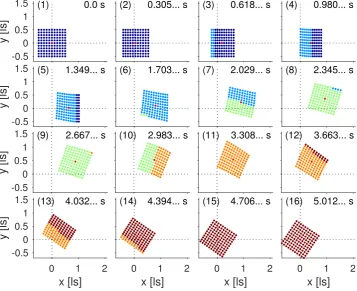
object are available. In fig.5the object is modelled as a square-shaped grid of 11×11 points, arranged
214
around the reference pointR. The object uniformly accelerates in thexy-plane changing the boost
215
direction four times by the anglesζ1,2 (as measured in frame [2]),ζ2,3 (frame[3]),ζ2,3 (frame[4])
216
and finallyζ1,2(frame[5]). The vertices’ colour code indicates the corresponding boost section. The
-2
-1.5
-1
-0.5
0
0.5
1
1.5
x [ls]
-1
-0.5
0
0.5
1
1.5
y [ls]
B[2] C[2] D[2]
E[2] F[2]
B[3] C[3] D[3]
E[3]
F[3]
B[4] C [4] D
[4]
E[4] F[4] B[5]
C[5] D[5] E[5]
F[5]
frame [1]
frame [2]
frame [3]
frame [4]
frame [5]
frame [6]
Figure 4. Trajectories of the reference pointRas seen from the six reference frames[1],[2], . . . ,[6]. The switchover points are marked byX[ik]withX=A, . . . , F. Corresponding switchover points are connected by dashed lines. The Lorentz factor isγ=2/
√
-0.5 0 0.5 1 1.5
y [ls]
0.0 s (1)
-0.5 0 0.5 1 1.5
y [ls]
1.349... s (5)
-0.5 0 0.5 1 1.5
y [ls]
2.667... s (9)
0 1 2
x [ls]
-0.50 0.5 1 1.5
y [ls]
4.032... s (13)
0.305... s (2)
1.703... s (6)
2.983... s (10)
0 1 2
x [ls]
4.394... s (14)0.618... s (3)
2.029... s (7)
3.308... s (11)
0 1 2
x [ls]
4.706... s (15)0.980... s (4)
2.345... s (8)
3.663... s (12)
0 1 2
x [ls]
5.012... s (16)Figure 5. A series of grid positions as seen in the laboratory frame. The boost speed is taken to be
β =0.7, resulting in a Thomas-Wigner rotation angle of about 33.7◦. Coordinate time is displayed
16 panels depict the grid positions in the laboratory frame[1]for specific values of coordinate time
218
displayed in the top right.
219
To improve the visual impression the magnitude of the Thomas-Wigner rotation in fig.5is
220
enlarged by increasing the boost speed fromβ=0.5, used in figs.3and4, toβ=0.7 corresponding 221
toγ≈1.4. Despite appearance the gridG is Born-rigid, inR’s MCIF the grid maintains its original 222
square shape. In the laboratory frame, however,Gappears compressed, when it starts to accelerate
223
or decelerate and sheared, when one part ofG has not yet finished boostk, but the remaining part
224
ofG already has transitioned to the next boost sectionk+1. This feature is clearly evident from
225
panels (4), (7), (10) or (13) in fig.5with the occurrence of two colours indicating two boost sections
226
taking effect at the same epoch of coordinate laboratory time. We note, however, that the switchover
227
events occur simultaneously for all grid points inR’s MCIF. The non-uniform colouring illustrate the
228
non-simultaneity of the switchovers in the laboratory frame and thereby the relationship between
229
Thomas-Wigner rotations and the non-existence of absolute simultaneity.
230
6. Discussion 231
In this final section the Thomas-Wigner rotation angle is calculated from the known boost
232
angles ζ1,2(γ) and ζ2,3(γ) (eqn. (35)). In addition, the maximum diameter of Born-rigid objects,
233
Thomas-Wigner-rotated by a series of boosts, is discussed.
234
6.1. Derivation of Thomas-Wigner angle 235
From the preceding sections follows a straightforward calculation of the Thomas-Wigner angle
236
as a function of Lorentz factor γ. Assumption {2} implies that the sequence of the five Lorentz 237
transformations[6]→[5]→. . .→[1]is constructed such that frame[6]is stationary with respect to
238
frame[1]and their spatial origins coincide. I.e. the combined transformation reduces to an exclusively
239
spatial rotation and the corresponding Lorentz matrix can be written as
240
Λ(γ,−eˆ1)· Λ(γ,−eˆ2)· Λ(γ,−eˆ3)· Λ(γ,−eˆ4)· Λ(γ,−eˆ5) =
1 0 0 0
0 R1,1 R1,2 R1,3 0 R2,1 R2,2 R2,3 0 R3,1 R3,2 R3,3
. (36)
Since the rotation is confined to thexy-plane, the matrix elementsR3,i =0=Ri,3withi=1, 2, 3 vanish.
241
The remaining elements
242
R1,1(γ) = R2,2(γ)≡cos(θTW(γ)) (37)
R1,2(γ) = −R2,1(γ)≡sin(θTW(γ))
yield the Thomas-Wigner rotation angleθTW 243
˜
θTW(γ) ≡ atan2(R2,1(γ),R1,1(γ)) (38)
θTW(γ) ≡
(
˜
θTW(γ) : θ˜TW(γ)≥0
˜
θTW(γ) +2π : θ˜TW(γ)<0
with atan2(·,·)denoting the four-quadrant inverse tangent. Eqn. (38) ensures that angles exceeding
244
+180◦are unwrapped and mapped into the interval[0◦,+360◦](see fig.6).
With eqn. (36) the rotation matrix elementsR1,1andR2,1are found to be (see appendixB)
246
R1,1(γ) = −1+
(γ+1)
((T12)2+1)4((T23)2+1)4
(39)
×
(T12)4(T23)4+2(T12)4(T23)2+ (T12)4
−4(T12)3(T23)3γ+4(T12)3(T23)3−4(T12)3T23γ +4(T12)3T23−2(T12)2(T23)4γ+4(T12)2(T23)4 +4(T12)2(T23)2γ2+8(T12)2(T23)2γ−8(T12)2(T23)2 −4(T12)2γ2+10(T12)2γ−4(T12)2
+12T12(T23)3γ−12T12(T23)3−16T12T23γ2 +12T12T23γ+4T12T23+2(T23)4γ
−(T23)4−4(T23)2γ2+6(T23)2+4γ2−2γ−1
2
and
247
R2,1(γ) = 4
(γ−1) (γ+1)
((T12)2+1)4((T23)2+1)4
(40)
×
(T12)3(T23)2+ (T12)3+3(T12)2(T23)3 −2(T12)2T23γ+ (T12)2T23+T12(T23)4 −2T12(T23)2γ−3T12(T23)2+2T12γ −(T23)3+2T23γ+T23
×
(T12)4(T23)4+2(T12)4(T23)2+ (T12)4
−4(T12)3(T23)3γ+4(T12)3(T23)3−4(T12)3T23γ +4(T12)3T23−2(T12)2(T23)4γ+4(T12)2(T23)4 +4(T12)2(T23)2γ2+8(T12)2(T23)2γ−8(T12)2(T23)2 −4(T12)2γ2+10(T12)2γ−4(T12)2
+12T12(T23)3γ−12T12(T23)3−16T12T23γ2 +12T12T23γ+4T12T23+2(T23)4γ
−(T23)4−4(T23)2γ2+6(T23)2+4γ2−2γ−1
withT12=T12(γ)andT23 =T23(γ)given by eqns. (30) and (34), respectively.
248
The resulting angleθTW(γ)as a function ofγis plotted in fig.6. The plot suggests thatθTW → 249
+360◦asγ → ∞. As already mentioned in subsection4(see fig.2) the boost anglesζ1,2 →+180◦
250
andζ2,3 → +180◦in the relativistic limitγ → ∞. Notwithstanding thatR’s trajectory reduces to 251
an one-dimensional motion asγ →∞, the grid’s Thomas-Wigner rotation angle approaches a full 252
revolution of+360◦in the laboratory frame.
253
6.2. Event horizons 254
As illustrated by fig.5the Born-rigid objectGrotates in thexy-plane. Clearly, in order to preclude
255
paradoxical faster-than-light translations of sufficiently distant vertices,G’s spatial extent in thex- and
256
y-directions has to be bounded by a maximum distance from the reference pointRon the order of
10
010
110
210
310
410
5γ
0
60
120
180
240
300
360
θ
TW[deg]
Figure 6. Thomas-Wigner rotation angle as a function ofγ. For clarity the angle is unwrapped and
-1.5
-1
-0.5
0
0.5
1
x [ls]
0
0.5
1
1.5
t [s]
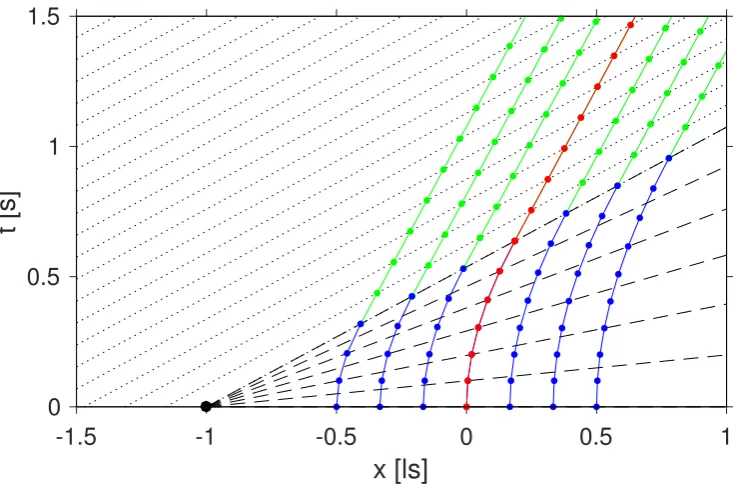
Figure 7. Spacetime diagram of a one-dimensional grid consisting of seven points. The grid accelerates towards the positivex-direction. The trajectories are marked in blue/green, the mid point is taken as the referenceRand its worldline is colored in red. Dots indicate the lapse of 0.1 s in proper time. After 0.6 s have passed onR’s clock, the acceleration stops and the points move with constant speed (green lines). Dashed and dotted lines connect simultaneous spacetime events inR’s comoving frame.
∆t/θTW[3]. As discussed in the following, this boundary is put into effect by event horizons associated 258
withG’s acceleration in each of the five boosts.
259
Fig. 7exemplifies the formation of an event horizon for an accelerated object in 1+1 (one
260
time and one space) dimensions [see e.g. 6,10,19,35]. Here, the Born-rigid object is assumed to
261
be one-dimensional and to consist of seven equidistant grid points. Each point accelerates for a
262
finite time period towards the positivex-direction (blue worldlines); the reference pointR, marked
263
in red, accelerates withαR ≡ 1 ls/s2. Contrary to the simulations discussed in fig.5above, for 264
illustrative purposes the acceleration phase is not followed immediately by another boost. Rather,
265
the object continues to move with constant speed after the accelerating force has been switched off
266
(green worldlines in fig.7). The completion of the acceleration phase is synchronous inR’s MCIF
267
(dashed-dotted line) and asynchronous in the laboratory frame. Fig. 7also illustrates that for an
268
uniform acceleration the event horizon (black dot) is stationary with respect to the laboratory frame.
269
In this simulation each vertex is assumed to be equipped with an ideal clock ticking at a proper
270
frequency of 10 Hz, the corresponding ticks are marked by dots; the boost phase lasts for 0.6 s onR’s
271
clock. The clocks of the left-most (trailing) and right-most (leading) vertex measure (proper time) boost
272
durations of 0.3 s and 0.9 s, respectively. Thus, with respect to the MCIFs (dashed lines) the vertex
273
clocks run at different rates (see eqn. (14)). The trailing clocks tick slower, the leading clocks faster
274
than the reference clock atR. From eqns. (13) and (14) it follows that the proper time variations are
275
compensated by corresponding changes in proper acceleration experienced by the seven vertices. For
the numerical values used in fig.7the accelerations of the trailing and leading vertex are 2αRand 277
2αR/3, respectively. 278
The spatial components of the inertial reference frames, comoving withR, are plotted in fig.7as
279
well. During the acceleration-free period following the boost phase the grid moves with constant speed
280
and the equal-time slices of the corresponding comoving frames (dotted lines) are oriented parallel to
281
other. During the boost phase, however, the lines intersect and eqn. (10) entails that the equal-time
282
slices of the comoving frames all meet in one spacetime point, the event horizonxH≡ −1 ls (black dot
283
atx=−1 ls andt=0 s in fig.7).
284
If the accelerating grid extended toxH, the corresponding vertex would experience infinite proper
285
acceleration (eqns. (13) and (14)) and its clock would not tick. Clearly, a physical object accelerating
286
towards positivex(fig.7) cannot extend beyond this boundary atxH. If the grid in fig.7is regarded
287
as realization of an accelerating coordinate system, this frame is bounded in the spatial dimension
288
and ends at the coordinate valuexH. However, as soon as the grid’s acceleration stops, the event
289
horizon disappears and coordinatesx<xHare permissible. We note, that the event horizon in fig.7 290
is a zero-dimensional object, a point in 1+1-dimensional spacetime considered here. The horizon is
291
frozen in time and exists only for the instantt=0.
292
Generalizing this result we find that the five boosts described in subsection4and depicted in
293
fig.3induce five event horizons in various orientations. It turns out that the accelerated objectGis
294
bounded by these horizons in all directions within thexy-plane. They limitG’s maximum size [3] and
295
thereby assure that all of its vertices obey the special relativistic speed limit [9].
296
7. Conclusions 297
It is well known that pure Lorentz transformations do not form a group in the mathematical sense,
298
since the composition of two transformations in general is not a pure Lorentz transformation again,
299
but involves the Thomas-Wigner spatial rotation. The rotation is visualized by uniformly accelerating
300
a Born-rigid object, consisting of a finite number of vertices, such that the object’s reference point
301
returns to its starting location. It turns out that at least five boosts are necessary, provided, first, the
302
(proper time) duration and the magnitude of the proper acceleration is the same within each boost
303
and, second, the object’s motion is restricted to thexy-plane. Analytic expressions are derived for the
304
angles between adjacent boost directions.
305
The visualization illustrates the relationship between Thomas-Wigner rotations and the relativity
306
of simultaneity. The transition from one boost section to the next occurs synchronously in the MCIF
307
of the object’s reference point. In the laboratory frame, however, the trailing vertices perform the
308
transition to the next boost phase, which in general involves a direction change, earlier than the
309
leading vertices. Thus, in this frame the accelerated object not only contracts and expands along
310
its direction of propagation, but also exhibits a shearing motion during the switchover phases. The
311
simulations illustrate clearly that the aggregation of these shearing contributions finally adds up to the
312
Thomas-Wigner rotation.
313
Accelerated motions induce event horizons, which no part of a physical, Born-rigid object may
314
overstep. Thus, the object’s size is limited to a finite volume or area (if its motion is restricted to two
315
spatial dimension) and Thomas-Wigner rotations by construction observe the special relativistic speed
316
limit.
317
Acknowledgments: Several calculations of this study were performed with the computer algebra system “SymPy”
318
[23], available at the URLwww.sympy.org. “SymPy” is licensed under the General Public License; for more
319
information seewww.gnu.org/licenses/gpl.html. All trademarks are the property of their respective owners.
320
Supplementary Materials: An MPEG-4 video animation of the Thomas-Wigner rotation, the MATLABsource
321
code used to create fig.5and the “SymPy” script file discussed in appendixBare available at the URLwww. 322
gbeyerle.de/twr.
323
Conflicts of Interest:The author declares no conflict of interest.
324
MCIF momentarily comoving inertial frame
326
Appendix A Number of boosts 327
We determine the smallest number of boosts that satisfies the four assumptions listed in section2.
328
Denoting the number of boosts byN, it is self-evident thatN≥3, since forN=1 the requirement of
329
vanishing final velocity cannot be met ifvR6=0. And forN=2 the requirement of vanishing final
330
velocity implies collinear boost directions. With two collinear boosts, however, the reference pointR 331
does not move along a closed trajectory. In addition, we note, that collinear boosts imply vanishing
332
Thomas-Wigner rotation [see e.g.36].
333
Appendix A.1 Three boosts 334
Consider three boosts of the reference pointRstarting from location A and returning to location D
335
via locations B and C. In the laboratory frame (frame[1]) the four-position at the destination D is given
336
by
337
P[D1] = PA[1]+SA[1→] B (A1)
+Λ(γ,−eˆ1)· S[B2→] C
+Λ(γ,−eˆ1)· Λ(γ,−eˆ2)· S[C3→] D and
338
VD[1] = Λ(γ,−eˆ1)· Λ(γ,−eˆ2)· Λ(γ,−eˆ3)· V[D4] (A2) is the corresponding four-velocity. For the definition of the four-vector S[A1]→B see eqn. (18).
339
Assumption {2} implies that
340
~
PA[1]=~PD[1]=~PA[4]=~PD[4] =~0 (A3) and
341
VA[1]=V[D1] =VA[4]=V[D4]= ~1 0
!
. (A4)
Inserting eqn. (1) into eqn. (A2) yields
342
T12 = T23 =±
p
2γ+1 (A5)
(see appendixB) and, in turn, using eqn. (A3) we obtain
343
~
PD[1]= 1 (γ+1)2
−(γ−1)2(2γ+1)2 −(γ−1) (2γ+1)
3
2 (3γ+1)
0
!
=~0 . (A6)
Its only solution for real-valuedβis the trivial solutionγ=1, i.e.β=0. Thus, there are no non-trivial 344
solutions forN=3 boosts, which are consistent with the assumptions {1}-{4}.
345
Appendix A.2 Four boosts 346
For a sequence of four boosts time reversal symmetry implies thatR’s velocity in the laboratory
347
frame vanishes at event C after the second boost, i.e.~VC[1]=~0. However, stationarity in the laboratory
frame can only be achieved if the first two boosts A→B and B→C are collinear. In order to fulfil
349
assumption {2} the third and fourth boosts have to be collinear with the first (and second) boost
350
as well. As already noted, a sequence of collinear boosts, however, does not produce a non-zero
351
Thomas-Wigner rotation.
352
Appendix B Computer algebra calculations 353
Some equations in this paper were derived using the computer algebra system “SymPy” [23].
354
The corresponding “SymPy” source code filesvtwr3bst.py(three boost case, see sectionA.1) and
355
vtwr5bst.py(five boost case, see section4) are available for download atwww.gbeyerle.de/twr. These
356
scripts process eqns. (A1), (A2), (16) and (17) and derive the results given in eqns. (A5), (A6), (23), (26),
357
(27), (39) and (40). The following paragraphs provide a few explanatory comments.
358
First, we address the case of three boosts (superscript(3B)) and the derivation of eqn. (A5). The
359
corresponding boost vectors in thexy-plane ˆe(i3B)withi=1, 2, 3 are taken to be
360
ˆ
e(13B)≡ Ca Sa
!
= 1
1+ (T12)2
1−(T12)2 2T12
!
(A7)
ˆ
e(23B)≡ 1 0
!
ˆ
e(33B)≡ Ca −Sa
!
= 1
1+ (T12)2
1−(T12)2 −2T12
!
with
361
Sa≡sin(ζ1,2) Ca≡cos(ζ1,2) (A8)
in terms of the direction angleζ1,2and the half-angle approximation (eqn. (5)). Here, thez-coordinate
362
is omitted since the trajectory is restricted to thexy-plane andζ2,3=ζ1,2from time reversal symmetry
363
is being used. Inserting the corresponding Lorentz transformation matrices (eqn. (1)) into eqn. (A2)
364
and selecting the time component yields
365
(γ−1)((T12) 2−2
γ−1)2 ((T12)2+1)2
=0 (A9)
which reduces to eqn. (A5) if the trivial solutionγ=1 is ignored. 366
For five boosts (superscript(5B)) and the derivation of the expression (26) we define in analogy
367
to eqn. (A7)
368
ˆ
e(15B) ≡ Cx Sx
!
= C12C23−S12S23 −S12C23−C12S23
!
(A10)
ˆ
e(25B) ≡ Cy Sy
!
= C23 −S23
!
= 1
1+ (T23)2
1−(T23)2 −2T23
!
ˆ
e(35B) ≡ 1 0
!
ˆ
e(45B) ≡ Cy −Sy
!
= C23 S23
!
= 1
1+ (T23)2
1−(T23)2 2T23
!
ˆ
e(55B) ≡ Cx −Sx
!
= C12C23−S12S23 S12C23+C12S23
with
369
S12 ≡sin(ζ1,2) C12 ≡cos(ζ1,2) (A11)
S23 ≡sin(ζ2,3) C23 ≡cos(ζ2,3) .
The corresponding Lorentz transformation matrices are too unwieldy to reproduce them here. “SymPy”
370
scriptvtwr5bst.pycalculates these matrices and their products in terms ofT12andT23and inserts the
371
result into eqn. (17). The time component of eqn. (17) yields the equation
372
γ−1
((T12)2+1)2((T23)2+1)2 (A12) ×(T12)2(T23)2+ (T12)2−4T12T23γ
−4T12T23−2(T23)2γ−(T23)2+4γ2+2γ−1
2
=0 .
We exclude the trivial solutionγ=1 and restrict ourselves to real values ofT12andT23; eqn. (A12)
373
then leads to eqn. (22), a second order polynomial with respect toT23. The two solutions are given in
374
eqn. (23).
375
Next insertT23 =T23(T12,γ)in eqn. (16). Since its time component involves the travel time ofR
376
along its closed trajectory as an additional unknown and thez-coordinate vanishes by construction,
377
we focus on thex- andy-components of eqn. (16). The scriptvtwr5bst.pyshows that the result for the
378
y-component of the four-vector equation~PF[6]=0 can be expressed as
379
−8((T12)2+1) (γ+1)2
X1(T12,γ) +X2(T12,γ)
p
X3(T12,γ)
((T12)2−2γ−1)6 =0 . (A13)
Here,X1(T12,γ),X2(T12,γ)andX3(T12,γ)are polynomials inT12.
380
For realT12andγ≥1 the numerator has to equate to zero. Moving the term involving the square 381
root to the right hand side and squaring both sides yields
382
(X1(T12,γ))2−(X2(T12,γ))2 X3(T12,γ) =0 . (A14) Its evaluation (see scriptvtwr5bst.py) leads to the product of two polynomials (expressions (26) and
383
(27)), each of which is of fourth order with respect to(T12)2.
384
Repeating the corresponding calculation for thex-component of the equation~PF[6] = 0 leads
385
to the product of two polynomials, one of which is identical to expression (26). Thus, the roots of
386
polynomial (26) constitute a solution of eqn. (19). The Thomas-Wigner angleθTW (eqn. (38)) follows 387
from the Lorentz matrix relating frame[1]to frame[6](eqn. (36)). Scriptvtwr5bst.pyevaluates the
388
matrix elementsR1,1andR2,1in terms ofT12andT23. Again, the resulting expressions are too unwieldy
389
to reproduce them here.
390
References 391
1. J. S. Bell. Speakable and Unspeakable in Quantum Mechanics. Cambridge University Press, Cambridge, second
392
edition, 2004. ISBN 978-0-521-52338-7.
393
2. A. Ben-Menahem. Wigners rotation revisited. Am. J. Phys., 53(1):62–66, 1985. doi:10.1119/1.13953.
394
3. M. Born. Die Theorie des starren Elektrons in der Kinematik des Relativitätsprinzips. Annalen der Physik, 335
395
(11):1–56, 1909. doi:10.1002/andp.19093351102.
396
4. J. P. Costella, B. H. J. McKellar, A. A. Rawlinson, and G. J. Stephenson Jr. The Thomas rotation. Am. J. Phys.,
397
69(8):837–847, 2001. doi:10.1119/1.1371010.
398
5. J. T. Cushing. Vector Lorentz transformations. Am. J. Phys., 35(9):858–862, 1967. doi:10.1119/1.1974267.
6. E. A. Desloge and R. J. Philpott. Uniformly accelerated reference frames in special relativity. Am. J. Phys., 55
400
(3):252–261, 1987. doi:10.1119/1.15197.
401
7. E. Dewan and M. Beran. Note on stress effects due to relativistic contraction. Am. J. Phys., 27(7):517–518,
402
1959. doi:10.1119/1.1996214.
403
8. E. M. Dewan. Stress effects due to Lorentz contraction. Am. J. Phys., 31(5):383–386, 1963.
404
doi:10.1119/1.1969514.
405
9. A. Einstein. Zur Elektrodynamik bewegter Körper. Annalen der Physik, 322(10):891–921, 1905.
406
doi:10.1002/andp.19053221004.
407
10. E. Eriksen, M. Mehlen, and J. M. Leinaas. Relativistic rigid motion in one dimension. Phys. Scr., 25(6B):
408
905–910, 1982. doi:10.1088/0031-8949/25/6B/001.
409
11. A. A. Evett. A relativistic rocket discussion problem. Am. J. Phys., 40(8):1170–1171, 1972.
410
doi:10.1119/1.1986781.
411
12. A. A. Evett and R. K. Wangsness. Note on the separation of relativistically moving rockets. Am. J. Phys., 28(6):
412
566–566, 1960. doi:10.1119/1.1935893.
413
13. F. Fernflores. Bell’s spaceships problem and the foundations of special relativity.Int. Stud. Philos. Sci., 25(4):
414
351–370, 2011. doi:10.1080/02698595.2011.623364.
415
14. R. Ferraro and M. Thibeault. Generic composition of boosts: an elementary derivation of the Wigner rotation.
416
Eur. J. Phys., 20(3):143–151, 1999. doi:10.1088/0143-0807/20/3/003.
417
15. G. P. Fisher. The Thomas precession.Am. J. Phys., 40(12):1772–1781, 1972. doi:10.1119/1.1987061.
418
16. J. Franklin. Lorentz contraction, Bell’s spaceships and rigid body motion in special relativity. Eur. J. Phys., 31
419
(2):291–298, 2010. doi:10.1088/0143-0807/31/2/006.
420
17. H. Gelman. Sequences of co-moving Lorentz frames. J. Math. Anal. Appl., 145(2):524–538, 1990.
421
doi:10.1016/0022-247X(90)90418-F.
422
18. E. Gourgoulhon. Special Relativity in General Frames. Springer, Berlin, Heidelberg, 2013.
423
19. J. D. Hamilton. The uniformly accelerated reference frame. Am. J. Phys., 46(1):83–89, 1978.
424
doi:10.1119/1.11169.
425
20. G. Herglotz. Über den vom Standpunkt des Relativitätsprinzips aus als “starr” zu bezeichnenden Körper.
426
Annalen der Physik, 336(2):393–415, 1909. doi:10.1002/andp.19103360208.
427
21. M. P. Hobson, G. P. Efstathiou, and A. N. Lasenby. General relativity: An introduction for physicists. Cambridge
428
University Press, Cambridge, 2006. ISBN 0-521-82951-8.
429
22. R. M. Jonsson. Gyroscope precession in special and general relativity from basic principles. Am. J. Phys., 75
430
(5):463–471, 2007. doi:10.1119/1.2719202.
431
23. D. Joyner, O. ˇCertík, A. Meurer, and B. E. Granger. Open source computer algebra systems: SymPy.ACM
432
Communications in Computer Algebra, 45(3/4):225–234, 2012. doi:10.1145/2110170.2110185.
433
24. W. L. Kennedy. Thomas rotation: A Lorentz matrix approach. Eur. J. Phys., 23(3):235–247, 2002.
434
doi:10.1088/0143-0807/23/3/301.
435
25. D. Koks.Explorations in Mathematical Physics: The Concepts Behind an Elegant Language. Springer–Verlag, New
436
York, 2006. ISBN 978-0-387-30943-9.
437
26. D. Koks. Simultaneity on the rotating disk.Found. Phys., 47(4):505–531, 2017. doi:10.1007/s10701-017-0075-6.
438
27. C. W. Misner, K. S. Thorne, and J. A. Wheeler.Gravitation. Palgrave Macmillan, 1973. ISBN 978-0716703440.
439
28. C. I. Mocanu. On the relativistic velocity composition paradox and the Thomas rotation.Found. Phys. Lett., 5
440
(5):443–456, 1992. doi:10.1007/BF00690425.
441
29. F. Noether. Zur Kinematik des starren Körpers in der Relativtheorie. Annalen der Physik, 336(5):919–944, 1910.
442
doi:10.1002/andp.19103360504.
443
30. K. Re¸bilas. Thomas precession and torque. Am. J. Phys., 83(3):199–204, 2015. doi:10.1119/1.4900950.
444
31. D. V. Red˘zi´c. Note on Dewan–Beran–Bell’s spaceship problem. Eur. J. Phys., 29(3):N11–N19, 2008.
445
doi:10.1088/0143-0807/29/3/N02.
446
32. J. A. Rhodes and M. D. Semon. Relativistic velocity space, Wigner rotation, and Thomas precession.Am. J.
447
Phys., 72(7):943–960, 2004. doi:10.1119/1.1652040.
448
33. W. Rindler. Relativity: Special, General, and Cosmological. Oxford University Press, USA, 2006.
449
34. E. G. P. Rowe. The Thomas precession. Eur. J. Phys., 5(1):40–45, 1984. doi:10.1088/0143-0807/5/1/009.
450
35. C. Semay. Observer with a constant proper acceleration. Eur. J. Phys., 27(5):1157–1167, 2006.
451
doi:10.1088/0143-0807/27/5/015.
36. A. M. Steane. Relativity Made Relatively Easy. Oxford University Press, 2012. ISBN 019966286X.
453
37. D. F. Styer. How do two moving clocks fall out of sync? A tale of trucks, threads, and twins.Am. J. Phys., 75
454
(9):805–814, 2007. doi:10.1119/1.2733691.
455
38. A. Tartaglia and M. L. Ruggiero. Lorentz contraction and accelerated systems.Eur. J. Phys., 24(2):215–220,
456
2003. doi:10.1088/0143-0807/24/2/361.
457
39. L. H. Thomas. The motion of the spinning electron.Nature, 117(2945):514–514, 1926. doi:10.1038/117514a0.
458
40. L. H. Thomas. The kinematics of an electron with an axis. Philos. Mag., 3(13):1–22, 1927.
459
doi:10.1080/14786440108564170.
460
41. S.-I. Tomonaga. The story of spin. The University of Chicago Press, Chicago, 1997. ISBN 0-226-80794-0.
461
42. A. A. Ungar. The relativistic velocity composition paradox and the Thomas rotation.Found. Phys., 19(11):
462
1385–1396, 1989. doi:10.1007/BF00732759.
463
43. A. A. Ungar. Thomas precession: Its underlying gyrogroup axioms and their use in hyperbolic geometry and
464
relativistic physics. Found. Phys., 27(6):881–951, 1997. doi:10.1007/BF02550347.
465
44. E. P. Wigner. On unitary representations of the inhomogeneous Lorentz group.Ann. Math., 40(1):149–204,
466
1939. doi:10.2307/1968551.
![Figure 1. The angle between the boost direction vectors ˆe1 and ˆe2 in frame [1] (blue line), and the anglebetween ˆe2 and ˆe3 in frame [2] (red) as a function of γ](https://thumb-us.123doks.com/thumbv2/123dok_us/1076982.1608405/8.595.83.463.98.398/figure-boost-direction-vectors-frame-anglebetween-frame-function.webp)
![Figure 3.6 θ]TW = 14.4◦/frame. The two frames are stationary with respect to each other, but rotated by a Thomas-Wignerangle of [ 2√ Trajectories of reference point R for γ =3 ≈ 1.15 as seen from (laboratory) frame [1] and.](https://thumb-us.123doks.com/thumbv2/123dok_us/1076982.1608405/10.595.82.465.107.401/figure-stationary-rotated-thomas-wignerangle-trajectories-reference-laboratory.webp)
![Figure 4. Trajectories of the reference pointThe switchover points are marked by R as seen from the six reference frames [1], [2],](https://thumb-us.123doks.com/thumbv2/123dok_us/1076982.1608405/11.595.104.453.264.563/figure-trajectories-reference-pointthe-switchover-points-marked-reference.webp)
![Figure 6. Thomas-Wigner rotation angle as a function of γ. For clarity the angle is unwrapped andmapped to the range [0◦, +360◦].](https://thumb-us.123doks.com/thumbv2/123dok_us/1076982.1608405/15.595.89.466.268.567/figure-thomas-wigner-rotation-function-clarity-unwrapped-andmapped.webp)