-India" J. Pia"t PlJy$lol., Vol.
,
...
r
I
XXIX No.1 pp. 1:13 (Marcb 1986)
PRE-HARVEST PARAQUAT SPRAY fOR GRAIN DRYING IN RICH
B. VENKATESWARLU', S. PADMAJA RA02, V.T. GAlBHIYE', AND N. AGNIHOTRI·
Directorate of Rice Research. Hyderabad
SUMMARY
Grain moisture content was reduced to 17 percent by 4 and 6 days
after spraying paraquat (0.1%) in dry and wet seasons respectively. Spraying 25 days after flowering (DAF) was found to be more effective.
Varieties Jaya and Prakasb sbowed slow reduction in moisture while Rasi
and Mabsuri were fast. The moisture content of grain stored in gunny bags immediately after spraying also reduced tbe moisture content considerably by tbe 4th and 6tb day. The residue content of grain was witbin tolerance limits. The germinabUity, filled grain proportion. kemel colour, flavour and grain yield were not affected.
INTRODUCfION
Rice being a major monsoon crop faces unpredictable.cyclones or typhoons at harvest and the weather is wet due to mist and high relative humidity during the ripening period. This situation exposes the grain to the problems of non uniform drying and intermittent wetting leading to untimely harvest due to lot of green material. Further. due to lack of drying facilities like drying floors and dryers in the third world countries, farmers are compelled to dry in the field itself: Consequently -the losses are huge particularly in milling as the paddy sheaves are amenable to rain, dew, and unpredictable cyclonic weather in all the coastal areas of Asia and Africa. Even in advanced countries, occurrence of similar conditions were posing problems to harvesting and threshing equipment like combines, harvesters and threshers.
Therefore. different types of desiccants were tested (Hinkle. 1952 and
1953; Smith et al., 1959; Williams, 1952; Ramanujam et al., 1979; Bastin. 1978,
1980) as preharvest methods of drying paddy crop to facilitate mainly timely harvest, and secondly to make the harvesting equipment more efficient. In the
I and I Senior and Junior Physiologists, respectively. at the Directorate
or
Rice Research.Hyderabad.
J .and. Junior and Senior €hemists. respectively, at the Indian Agricultural Researcb Institute,
·
.
2 B. VENKATESWARLU BT AL.
present studies efforts are made to assess the influence of desiccants (I) on the nature of grain moisture reductions in situ; (2) on the moisture content of grain in stored conditions; (3) on discoloration, off-flavour. germinability and grain yields; and (4) on the residues in grain and straw.
MATERIALS AND MEmODS
The Mahsuri variety was grown in Kharif (wet) season (1980) adopting the standard cultural praCtices. The crop was managed to 60 kg N, 30 kg P20S and 30 kg K20/ha in all the experiments. At 25 days after flowering (DAF), the
crop Was sprayed with diquat (6, 7-dihydrol-dipyrida (I, 2-a: 2', l'c)
pyrazinadium ion (Reglone) at 0.05 and 0.1 %. Paraquat (I-1'-dimethyl-4-4' bipyridinium ion (dichloride salt-gramoxone) at 0.5 and 0.1%, and common salt at 5 a.nd 10.0% concentrations.
The study was repeated in rabi (dry) season (1981) with Rasi (early) and Prakash (medium duration) varieties. Only paraquat was sprayed at 0.05,0.1, 0.2 and 0.4% concentrations both at 20 and 25 DAF. The study was further repeated with Jaya and Mahsuri varieties in Kharif 1981 and Kharif 1982, and with Rasi and Prakash in rabi, 1982. Paraquat was sprayed at 0.1 % concentra tion at 20 and 25 DAF. Observations were recorded on grain moisture content at 2-day intervals till 8 days after spraying (DAS) and on germination percent, cbanges in colour of spikelets, moisture content of grain stored in gunny bags, test weight of grains and grain yield.
Multi-site study
The study was also organised at Calcutta, Cuttack, Karjat, Maruteru,
Patna and Titabar, besides at Hyderabad, mainly restricting to paraquat at 0.1 %
concentration but using the same varieties in both Kharif and raro seasons. Observations on grain moisture content both in situ and gunny bag stored condi tions. germinability and grain yield were recorded.
The residue content of paraquat in straw and grain was determined at the Indian Agricultural Research Institute, New Delhi, from samples collected at all the centres by adopting the coloro-metric procedure of Calderbank and Yuen (965).
RESULTS AND DISCUSSIONS
i
PARAQUAT IN ~ICB GRAIN DRYING 3
culady in cereals like rice which results in breakage of kernels, deterioration in keeping quality, mould development and fetch lower price if not dried adequatly.
Earlier studies (Hinkle, 1952, Williams, 1952; Smith et aI.. 1959; Eastin, 1978.
~. 1980; Ramanujam et aI., 1979) examined desiccation of straw and grain and were
mainly oriented to assess the amount of time taken for drying rather, than on the
nature of drying and the amount of moisture eliminated from the grain. In the
current studies it was found that grain moisture content reduced gradually to
around 22 to 16% by 6th DAS. In kharif 1980 experiment (Fig.
0,
paraquatFig." Infiuence of desiccants 00 grain moisture content of Mahsuri when sprayed at
25 DAF (Kharif 1980).
and diquat were more effective than the common salt which showed 20-22% moisture at 6 and 8 DAS also. Common salt has certain limitations like its deposits on grain create problems in the roUers during milling and would effect germination of the succeeding pulse crops besides being an inefficient drying
agent. Paraquat reduced moisture from 33% to 18 and 16% in 6 days which is
40
35
30
25
20
15
10
5
• -Control
o -
Commori salt - 5%.& - Common salt - 10%
V - Diquat - 0.05%
X - Diquat - 0.10%
0 - Paraquat
• - Paraquat
- 0.05%
-
0.'
%o
2 4 6 8B. VENKATESWARLU ET AL.
acceptable even for immediate marketability, while it decreased to around 13 to
14% by 8th DAS wluch is preferred for storage purposes. Diquat was only next to paraquat.
Groin moisture (Ok)
30
20
10
30
20
10
Sprayed 20 OAF
Control
0.1 }
0.2 Paraquat
0.3 0.4
o
2 4 6 8Days after spraying
Sprayed 25 OAF
Control
0.1 }
0,2 Paraquat
0,3
0.4
o
2 4 6 8Fig. 2. Influence or paraquat at different concentrations (%) on grain moisture content of Rasi, rabi 1981,
PARAQUAT IN R,ICB GR.A1N DRYING
s
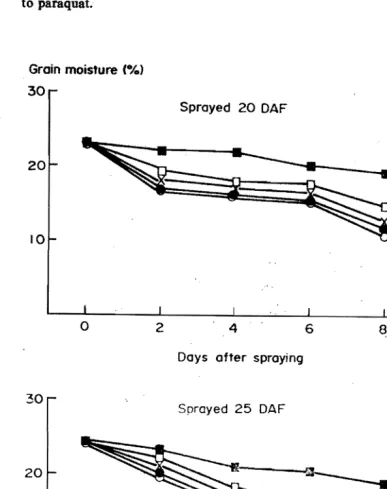
In rabi (dry season) 1981, paraquate sprayed at 25 OAF was more
effective as the moisture content reached around 12% by 6th OAS. Apparently
dry weather conditions (high temperatures 33-37°C) might have further catalysed the dehydration process. Even 0.1 % concentration was equally effective as the
difference was negligible considering the moisture levels required for
marketability and storage.
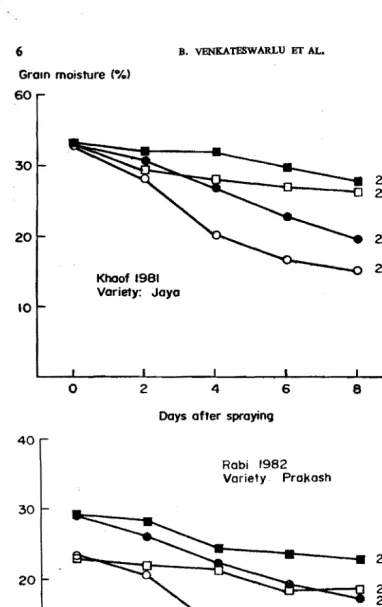
In kharif 1981 and rabi 1982, where paraquat was used at 0.1% but sprayed at 20 and 25 OAF (Fig. 2), the reduction in moisture content was drastic when sprayed at 25 OAF in both 1aya and Prakash varieties. In 1aya at 4th OAS,
the moisture percent was around 26% in the treatment at 20 OAF while it ~as
at 20% in 25 DAF treatment. The desired effect is reached by 6th day when
sprayed in kharif. The advantage of spraying at 25 OAF was clear which wa~
more drastic in rabi than in kharif(Mahsuri variety).
The reduction in moisture content during kharif 1980 was from 3 to 10%, while in rabi 1981 from 5 to 7% in Rasi, and 8 to 13% in Prakash when sprayed at 20 OAF. The reduction was 5 to 7 and 7 to 11% in Rasi and Prakash respectively when sprayed at25 OAF. In kharif 1981 and 1982, the reduction in moisture content ranged from 5 to 8 and 2 to 11 % when sprayed a't 20 and 25 OAF respectively. Although the degree of reduction was less when sprayed at 25 OAF. it reached the desired level 2 days earlier and to even to very lower
levels. Further, 1aya and Prakash showed high grain moisture levels
intrinsically while Rasi and Mahsuri lower levels.
The earlier studies (Eastin, 1978, 1980) showed a maximum reduction of 4.4 to 7.0% which was determined only at the end of harvest. Therefore,
in thos~ studies the nature of moisture loss, the effect of the season, the basic
varietal differences in retaining more moisture and the magnitude of the water loss were not examined.
The study was also organised at 7 important locations in India which showed (Table 1) that the grain moisture content attained marketable levels at 4 and 5 centres by 4th day when sprayed at 20 and 25 OAF respectively. However, the moisture content reduced fast when sprayed at 25 OAF and at 2 locations it touched the desired level even on 2nd day. These observations strengthen the point that 4 to 6 days time is adequate enough for manifesting the desired effect on the grain moisture content.
6 B. VBNKATflSWARLU ET AL.
Gram moisture (%)
(i . .
60
30
20
10
40
30
20
·10
20
OAF}
ContrOl25
OAF
20
OAF}
Paraquat 25 OAF
Khaof 1981 Variety: Jaya
o
2 4 6 8Days offer sprayino
Rabi 1982
Variety Prakash
20
OAF}
Control25
OAF
20
OAF}
. Paraquat
25 OAF
o
Days after sprayrng
1
,
'., ! \.
"'.,.' ... "fable I : Influence of paraquat (0.1 'Yo) on moisture content of grain ('Yo) sprayed at 20 and 25 DAF (Mahsuri) at different locations in India. Kharif. 1982 Time of spraying DASHyderabad S
C Calcutta Cuttack
---_._
S C S C Karjat---
S CMaruteru S
C Patna Titabar
---
S C S C Mean--
S C~ ~ >
20
DAF
0 2 4 6
31.0 26.6 24.4 17.2
31.0 27.2 26.1 22.2
30.0 25.2 16.7 15.1
30.3 28.0 26.0 24.6
22.5 19.1 IS.0 14.6 22.5 21.7 20.7 17.7
24.S 22.1 17.4 16.7
26.0 22.6 21.3 20.9
22.3 21.1 17.7 14.S
22.4 21.7 19.0 IS.4
32.5 2S.3 25.8 25.1
32.3 30.0 28.2 26.4
27.2 23.7 20.0 17.3
27.4 25.2 23.6 21.7
~
.-j .... Z~
8 13:0 20.1 21.2 16.3 20.7 14.2 17.5 24.1 25.0 16.9 17.4
~
'Ii 2S DAF0 2 4
24.6 19.6 17.4
24.6 21.1 20.5
26.S 20.3 17.S
26.4 23.8 22.0
19.3 15.6 14.3
19.0 17.3 1S.7
24.2 20.S 14.8
28.4 23.4 20.2
20.5 19.3 17.4
21.1 20.1 19.6
22.1 19.4 IS.7
22.2 20.4 19.1
26.3 24.3 21.6
32.5 31.5 26.8
23.4 19.9 17.4
24.9 22.5 20.6
8 B. VENKAT,ESWARLU ET AL.
Drying in stored conditions
The wet and the threatening weather of the monsoon season could be
overcome relatively if the grain could dry in gunny bags wh~n stored after
immediate threshing. Interestingly such an. effort emerged successful and effective as could be seen in the current studies (Table II). The paraquat was sprayed at two concentrations (0.1 and 0.2%) in rabi 1982, and at 20 and 25 OAF in kharif 1982, and the grain immediately threshed and stored in gunny bags. The reducation in moisture content was apparent in the grain stored in gunny bags on the lines of in situ drying and sometimes even better than in situ drying. The fall was rapid in dry season as by 4th OAS it touched 12.4 and 8.4% in in situ and stored conditions respectively. Again it reduced to the desired levels when sprayed 25 OAF by 4th day while up to 6th day when sprayed at 20 OAF. Jaya showed slow reduction stretching up to 6 to 8th day
which appears to be due to its inherent high moisture retention capacity. Similar
study conducted at 3 more locations viz Calcutta, Maruteru and Patna, besides Hyderabad have conclusively shown that there is dependable reduction in moisture content of grain in gunny bag stored conditions (Table In). These findings have greater practical implications and particularly paraquat must be acting even in deionized conditions persistently.
Grain yield
Paraquat spraying did not affect grain yield in all the experiments except
in kharif 1982, where control had given relatively hi~er yields (Table IV). Even
tn the multi loCation trials conducted at 7 locations, !the yields were not effected except at Maruteru. The germinability although initially effected but improved gradually restoring to normalcy. The filled grain proportion, test weight of grains, grain or kernel colour and the flavour of grains were not affected nor off flavour felt; These findings are in conformity with the observations of the
. carlier workers (Eastin, 1978, 1980; Ramanujam et ali, 1979).
I
However. as paraquat is known for its poisonous nature, its higher residues are harmful. The current studies indicated that paraquat residue content showed
lower levels in grain samples sprayed at 20 and 25.Di\F.
It
touched a maximum,,-~~
.---,..
...
.---....-...-..,t'-.
Ta\>le
II:
Influence
of
paraquat
on
moisture
content
of
grain
(%)
in
situ
and
stored
in
sunny
bags
during
rabi
and
kharif,
1982.
at
Hyderabad
Days
arter
storage
o
days
---
2
days
4
days
6
days
8
days
---
Particulars
Concentra tlon
(%)
Grain in
situ
Grain in
situ
Stored
in
gunny bags
Grain in situ
Stored
in
gunny bagl
Grain in
situ
Stored
in
gunny bags
Grain in
situ
Stored in
gunny bags
~
~
I I. I
Rabi
1982
Prakash
Kharif
1982
20
DA.F Mahsuri laya
0.10 0.20
Control
0.10
Control 0.10 Control
23.0 23.S 23.3 31.0 31.0 30.5 30.0
20.7 16.6 22.6 27.2 29.6 28.4 29.2
20.6 16.5 22.S 26.6 29.0 26.3 28.8
12.4 11.5 22.1 24.4 28.S 26.0 28.4
8.4 8.8 19.4
20.7 26.4 23.2 27.7
10.5 8.0 18.6 20.3 26.2 24.4 26.0
8.3 7.2 16.8 16.0
24.0 22.0 26.4
8.5 8.3 14.9 19.9 23.0 22.8
25.2
6.7 6.4 14.1 15.0 19.8 19.0
23.4
~
2
'e! Q ~2
~ 10(~
""
25
DA.F Mabsuri laya
0.10
Control 0.10 Control
24.6· 25.0 27.2 27.0
21.1 24.0 27.1 27.0
19.6 23.4 26.6 26.2
21.0 22.8 26.1 26.5
17.4 22.0 21.5 24.0
19.3 22.2 23.8 25.8
l!I.2 21.2 19.1 23.6
16.4 20.1 20.4 24.6
13.3 19.6 17.0 21.8
~
0
Table III: Inftuence of paraquat (0.1 %) on moisture content (%) of grain stored in gunny bags at different locations, Kharif 1982 Hyderabad Calcutta Maruteru Patna Moan Particulars DAS---
S C S C S C S C S C 20 DAP Jaya 0 310 31.0 20.0 21.4 20.0 21.4 18.8 19.1 22.0 23.2 2 26.3 21.4 16.5 19.3 18.4 21.3 IS.S 18.4 19.6 21.8I
!:II 4 23.2 26.0 14.0 18.1 17.7 19.9 14.7 18.0 18.7 20.4 6 22.0 24.4 14.0 17.2 17.6 19.1 13.9 16.7 17.4 20.0 Mahsuri 0 31.0 31.0 20.3 21.2 21.0 22.1 19.0 19.3 19.3 21.8 2 26.6 27.2 16.3 19.6 16.7 20.6 15.0 17.0 18.0 20.9 4 20.7 24.,4 13.7 17.6 16.9 19.6 14.8 16.2 16.2 19.4 6 16.0 20.3 13.015.'
16.3 18.8 14.2 1S.6 14.7 17.4'~ CI
12 B. VENKATESWARLU ET.~L.
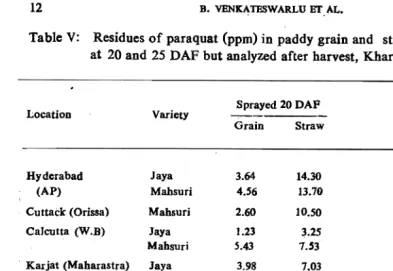
Table V: Residues of paraquat (ppm) in paddy grain and straw when sprayed at 20 and 25 DAF but analyzed after harvest, Kharif 1982
Sprayed 20 DAF Sprayed 25 DAP
Location Variety
Grain Straw Grain Straw
Hyderabad Jaya 3.64 14.30 2.98 8'36
(AP) Mahsuri 4.56 13.70 5.25 9.33
CuttaCk (Orissa) Mahsuri 2.60 10.50 2.27 9.73
Calcutta (W.B) Jaya 1.23 3.25 0.55
Mahsuri 5.43 7.S3 3.87 6.73
. Karjat (Maharastra) Jaya 3.98 7.03 2.98 4.80
Mahsuri 2.20 1.76 2.15 083
Maruteru (A.P.) Jaya 1.90 13.66 2.33 11.50
Mahsuri· 2.57 ]0.60 2.63 12.86·
Titabar (Assam) Jaya 1.33 1.38 1.22 Q.96
Mansuri 1.25 1.90 1.15 1.10
while samples from Cuttack just touched 10.5 ppm and the rest of the centres showed lower levels. Singh and Agnihotri (1981) reported that the residues are below the tolerance limit in different fractions of paddy as the contents varied from 1.6 to 7.6 ppm. They stated that par boiHng had further reduced the residues. Again, Funderburk, Negi and Lawrence (1966) also stated that there was considerable photochemical decomposition of diquat and paraquat. These findings indicate that residues are not likely to pose serious problems. Further. as rough rice (paddy) is milled and washed before raw cooking, this process itself reduces the content.
Therefore, paraquat emerges as a potential chemical for monitoring grain· moisture content in rice and holds greater promise for rescuing from enersy crisis faced due to the use of dryers.
ACKNOWLEDGEMENTS