Exploring .NET Core with Microservices,
ASP.NET Core, and Entity Framework Core
Selected by Dustin Metzgar
Manning Author Picks
Copyright 2017 Manning Publications
www.manning.com. The publisher offers discounts on these books when ordered in quantity.
For more information, please contact
Special Sales Department Manning Publications Co. 20 Baldwin Road
PO Box 761
Shelter Island, NY 11964 Email: [email protected]
©2017 by Manning Publications Co. All rights reserved.
No part of this publication may be reproduced, stored in a retrieval system, or transmitted, in any form or by means electronic, mechanical, photocopying, or otherwise, without prior written permission of the publisher.
Many of the designations used by manufacturers and sellers to distinguish their products are claimed as trademarks. Where those designations appear in the book, and Manning
Publications was aware of a trademark claim, the designations have been printed in initial caps or all caps.
Recognizing the importance of preserving what has been written, it is Manning’s policy to have the books we publish printed on acid-free paper, and we exert our best efforts to that end. Recognizing also our responsibility to conserve the resources of our planet, Manning books are printed on paper that is at least 15 percent recycled and processed without the use of elemental chlorine.
Manning Publications Co. 20 Baldwin Road Technical PO Box 761
Shelter Island, NY 11964
Cover designer: Leslie Haimes
ISBN: 9781617295089
iii
contents
Introduction iv
R
EFACTORING
1
Refactoring
Chapter 4
from Re-Engineering Legacy Software by Chris Birchall. 2
I
DENTIFYING
AND
S
COPING
M
ICROSERVICES
39
Identifying and scoping microservices
Chapter 3
from Microservices in .NET Core by Christian Horsdal
Gammelgaard. 40
C
REATING
AND
C
OMMUNICATING
WITH
W
EB
S
ERVICES
63
Creating a Microservice
Chapter 7
from .NET Core in Action by Dustin Metzgar. 64
C
REATING
W
EB
P
AGES
WITH
MVC C
ONTROLLERS
85
Creating web pages with MVC Controllers
Chapter 4
from ASP.NET Core in Action by Andrew Lock. 86
Q
UERYING
THE
D
ATABASE
111
Querying the database
Chapter 2
from Entity Framework Core in Action by Jon Smith. 112
introduction
Developers love to write code. We follow the latest trends, learn new techniques, and try to implement what we learn in our daily work. Most developers, however, are not writing projects in completely green fields. Most often we write software to maintain, augment, replace, or interact with older applications. .NET Core integrates modern development practices into your daily work with legacy applications, and may be just the option you’ve been looking for.If you’re not developing with the .NET Framework, you’ve likely heard of .NET before and decided not to use it for various reasons. If you are one of the many users who are not using .NET because it is only available on Windows, doesn’t have a strong open source community, and isn’t keeping up with high performance web frame-works, you should take another look at .NET Core. .NET Core is now available in Linux with open-source source code. You’ll also find that current .NET Core frame-works are lightweight, modular, and focused on delivering high-performance results. Perhaps you are already a .NET Framework developer. If so, you may want to take advantage of the latest advances like containers, ASP.NET Core, or Entity Framework Core. Either way, there has never been a better time to use .NET.
This collection of chapters from several Manning books offers guidance on refac-toring legacy code, carving monolithic n-tier architectures into microservices, and using ASP.NET Core and Entity Framework Core to build microservices and web applications. Learn how to apply modern development practices to your daily work and feel confident that the code you’re writing is making your applications better.
We hope you’ll enjoy this selection and the code you’ll write because of it.
Dustin Metzgar
L
egacy code is code that you have no confidence in your ability to change. Chris Birchall’s book, Re-Engineering Legacy Software, gives you the tools and tech-niques to tackle legacy projects with confidence. What better opportunity is there to tackle those projects than to move to .NET Core? In this chapter, you’ll learn how to understand, test, and refactor legacy code, which will make moving to a modern development framework much easier.Legacy Software
by Chris Birchall.
Refactoring
In this chapter we’ll look at your most important weapon in the fight against legacy, namely refactoring. I’ll introduce some general tips for effective refactoring, as well as a few specific refactorings that I often use in real-world code. We’ll also look at techniques for writing tests for legacy code, which is vital if you want assurance that your refactoring work hasn’t broken anything.
4.1
Disciplined refactoring
Before we start looking at specific refactoring techniques, I want to talk about the importance of discipline when refactoring code. When performed correctly, refac-toring should be perfectly safe. You can refactor all day long without fear of intro-ducing any bugs. But if you’re not careful, what started out as a simple refactoring can rapidly spiral out of control, and before you know it you’ve edited half the files
This chapter covers
Methods for maintaining discipline when refactoring
Common smells found in legacy code, and refactoring techniques for removing them
3 Disciplined refactoring
in the project, and you’re staring at an IDE full of red crosses. At this point you have to make a heart-wrenching decision: should you give up and revert half a day’s work, or keep going and try to get the project back into a compiling state? Even if you can reach the other side, you have no guarantee that the software still works as it’s sup-posed to.
The life of a software developer is stressful enough without having to make deci-sions like that, so let’s look at some ways to avoid getting into that situation.
4.1.1 Avoiding the Macbeth Syndrome
I am in blood
Stepped in so far that, should I wade no more, Returning were as tedious as go o’er.
—Macbeth, act 3, scene 4
When Macbeth uttered these words, he’d already done away with his beloved King Duncan, two innocent guards, and his best friend Banquo, and he was debating with himself whether to stop the carnage or to carry on slaughtering people until he had no enemies left. (In the end he chooses the latter path, and, suffice it to say, it doesn’t work out.)
Now, if I’m interpreting the text correctly, and this may come as quite a shock to the Shakespeare scholars among you, the Scottish play was actually intended to be an allegory about undisciplined refactoring. Macbeth, spurred on by a feature request from his wife and Project Manager, Lady Macbeth, starts out with the simple aim of removing a piece of global mutable state called King Duncan. He succeeds in this, but it turns out that there were some implicit dependencies that also needed to be refac-tored. Macbeth tries to tackle all of these at once, leading to excessive amounts of change, and the refactoring rapidly becomes unsustainable. In the end, our hero is attacked by trees and decapitated, which is pretty much the worst result I can imagine for a failed refactoring.
So what can we do to avoid ending up like poor Macbeth? Let’s look at a few sim-ple techniques.
4.1.2 Separate refactoring from other work
Often you realize that a piece of code is ripe for refactoring when you’re actually try-ing to do somethtry-ing else. You may have opened the file in your editor in order to fix a bug or add a new feature, but then decide that you may as well refactor the code at the same time.
For example, imagine you’ve been asked to make a change to the following Java class.
/**
* Note: This class should NOT be extended -- Dave, 4/5/2009 */
public class Widget extends Entity { int id;
public String getWidgetId() { return "Widget_" + id; }
@Override
public String getEntityId() { return "Widget_" + id; }
@Override
public String getCacheKey() { return "Widget_" + id; }
@Override
public int getCacheExpirySeconds() { return 60; // cache for one minute }
@Override
public boolean equals(Object obj) { ...
}
}
The specification for widgets has changed so that the cache expiry of a widget should depend on the value of its isStable flag. You’ve been asked to update the logic in the #getCacheExpirySeconds() method accordingly. But as soon as you glance at the code, you notice a number of things you’d like to refactor.
There’s a comment from some guy called Dave saying the class shouldn’t be extended, so why not mark it as final?
The fields are mutable and they have package-private visibility. This is a danger-ous combination, as it means other objects might change their values. Maybe they should be private and/or final?
There is redundancy among the various ID/key-generating methods. The ID generation logic could be factored out into one place.
The class overrides #equals(Object) but not #hashCode(). This is bad form and can lead to some nasty bugs.
There’s no comment explaining the meaning of the isStable flag. It might be nice to add one.
The actual change to the cache expiry logic is quite simple, so it’s tempting to com-bine it with a spot of refactoring. But be careful! Some of the refactorings in the pre-ceding list are more complex than they first appear.
5 Disciplined refactoring
extend Widget after all? Or should those subclasses be fixed to remove the inheritance?
What about those mutable fields? Is anybody actually mutating them? If so, should they be? If you want to make them immutable, you’ll have to change any code that is currently relying on their mutability.
Although the lack of a #hashCode() method is generally a Bad Thing in Java code, there might be some code somewhere that actually relies on this behav-ior. (I’ve seen code like this in the wild.) You’ll have to check all code that deals with Widgets. Also, if the person who wrote Widget (Dave?) also wrote any other entity classes, the chances are that they’re all missing this method. If you decide to fix all of them, it might become a much larger job.
If you try to take on all this refactoring at the same time as the change you were origi-nally planning, that’s a lot of stuff to fit in your head. Maybe you’re a refactoring wiz-ard, in which case go for it, but I wouldn’t trust myself to handle that kind of cognitive load without making any mistakes.
It’s much safer to split the work into stages: either make the change, then refactor, or vice versa. Don’t try to do both at the same time. Splitting refactoring work and other changes into separate commits in your version control system also makes it eas-ier for you and other developers both to review the changes and to make sense of what you were doing when you revisit the code later.
4.1.3 Lean on the IDE
Modern IDEs provide good support for the most popular refactoring patterns. They can perform refactorings automatically, which obviously has a number of benefits over performing them by hand.
Faster —The IDE can update hundreds of classes in milliseconds. Doing this by hand would take a prohibitively long time.
Safer —They’re not infallible, but IDEs make far fewer mistakes than humans when updating code.
More thorough —The IDE often takes care of things that I hadn’t even thought of, such as updating references inside code comments and renaming test classes to match the corresponding production classes.
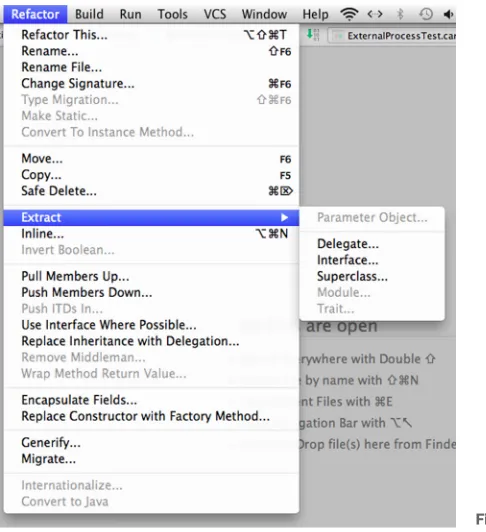
To give you a taste of what the IDE is capable of, figure 4.1 shows a screenshot of IntelliJ IDEA’s Refactor menu for a Java project. (Your menu might look slightly differ-ent, depending on what IDE you use and what plugins you have installed.) It’s defi-nitely worth the time to go through each of your IDE’s refactoring options, try them out on some real code, and see what they do.
Figure 4.1 IntelliJ’s Refactor menu
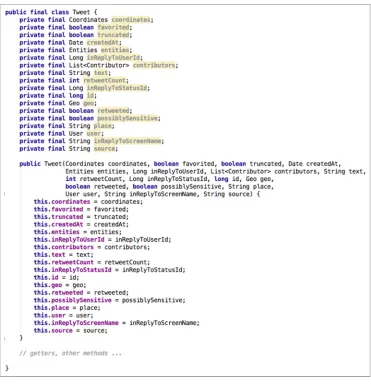
As an example of what your IDE can do for you, let’s use IntelliJ IDEA to help us replace a large and unwieldy constructor using the Builder pattern. Figure 4.2 shows a Java class that represents a tweet. As you can see, the large number of fields results in a constructor that’s frankly ridiculous.
Figure 4.2 A Java class representing a tweet
7 Disciplined refactoring
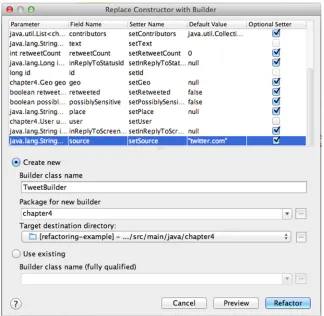
Let’s ask IntelliJ to create a Builder to fix this mess. Figure 4.4 shows the Replace Con-structor with Builder wizard, where I can set default values for optional fields.
Figure 4.4 The Replace Constructor with Builder wizard
When I click the Refactor button, the IDE generates a new class called Tweet-Builder. It also automatically rewrites any code that’s calling the Tweet constructor, updating it to use TweetBuilder instead. After a little manual reformatting, the code to create a new Tweet now looks like figure 4.5. Much better!
9 Disciplined refactoring
IDEs make mistakes too
Occasionally the IDE can get it wrong. Sometimes it’s overzealous, trying to update files that are completely unrelated to the change you want to make. If you rename a method called execute(), the IDE might try to update an unrelated code comment such as “I will execute anybody who touches this code.” Sometimes it doesn’t update a file that it should. For example the IDE’s dependency analysis is often foiled by the use of Java reflection.
With this in mind, it’s best not to trust the IDE unconditionally: If the IDE offers a preview of a refactoring, inspect it carefully.
Check that the project still compiles afterward, and run automated tests if you have them.
Use tools like grep to get a second opinion.
4.1.4 Lean on the VCS
I assume that you’re using a version control system (VCS) such as Git, Mercurial, or SVN to manage your source code. (If not, put this book down and go and fix that situ-ation right now!) This can be really useful when refactoring. If you get into the habit of committing regularly, you can treat the VCS as a giant Undo button. Any time you feel like your refactoring is getting out of control, you have the freedom to back out by hitting the Undo button (reverting to the previous commit).
Refactoring is often an exploratory experience in which you don’t know whether a particular solution will work out until you try it. The safety net of the VCS gives you the freedom to experiment with a number of solutions, safe in the knowledge that you can back out whenever you want. In fact, effective use of branches means that you can have a few different solutions
on the go at the same time, while you explore the pros and cons of each approach.
Figure 4.6 shows an exam-ple of the Git commits and branches that might be left after a session of experimental refactoring. The newest com-mits are at the top. You can see that there were a couple of experimental branches that didn’t end up getting merged
4.1.5 The Mikado Method
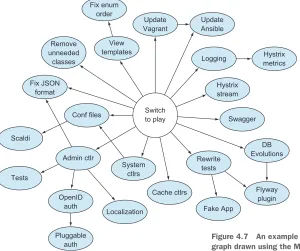
One method that I have recently been using with great success to implement large changes, including refactoring, is called the Mikado Method. It’s very simple but effective. Basically it involves building up a dependency graph of all the tasks you need to perform, so that you can then execute those tasks more safely and in an optimal order. The dependency graph is constructed in an exploratory manner, with plenty of backtracking and leaning on the VCS.
For more details on the method itself and the motivations behind it, I highly rec-ommend Ola Ellnestam and Daniel Brolund’s book The Mikado Method (Manning, 2014).
Figure 4.7 shows an actual Mikado graph that I drew recently when I was porting the UI layer of a large application from one web framework to another.
Switch
to play Swagger
Conf files
Scaldi
Admin ctlr
Tests
Logging
Fix JSON format
Hystrix metrics
Hystrix stream Update Ansible Update
Vagrant
View templates Fix enum
order
Remove unneeded
classes
DB Evolutions System
ctlrs
Cache ctlrs
Localization Fake App
Rewrite tests
Flyway plugin OpenID
auth
Pluggable auth
Figure 4.7 An example of a dependency graph drawn using the Mikado Method
4.2
Common legacy code traits and refactorings
11 Common legacy code traits and refactorings
Imagine that you maintain World of RuneQuest, an online fantasy RPG. You’re planning to start development on a new version of the game, but recently you’ve noticed that the code has become bloated and disorganized, and development veloc-ity has dropped as a result. You want to give the codebase a thorough spring clean before you start developing the new version. Let’s look at some areas you could tackle.
4.2.1 Stale code
Stale code is any code that remains in the codebase even though it’s no longer needed. Deleting this unneeded code is one of the easiest, safest, and most satisfying refactoring tasks you can hope for. Because it’s so easy, it’s often a good way to warm up before embarking on more serious refactoring.
Removal of stale code has a number of benefits:
It makes the code easier to understand, because there’s now less code to read. It reduces the chance of somebody wasting time on fixing or refactoring code
that isn’t even used.
As a satisfying bonus, every time you delete some code, the project’s test cover-age increases.
Stale code can be divided into a few categories.
COMMENTED-OUTCODE
This is the lowest of all low-hanging fruit. If you see a block of code that has been com-mented out, don’t think twice, just delete it! There’s absolutely no reason to leave commented-out code lying around. It’s often left deliberately as a record of how the code was changed, but that’s exactly what the version control system is for. It’s point-less noise, making the surrounding code more difficult to read.
DEADCODE
Dead code is any code in your software that will definitely never be executed. It might be a variable that’s never used, a branch of an if statement that’s never taken, or even a whole package of code that’s never referenced.
In the following simple example of dead code, the armorStrength variable can never have a value greater than 7, so it’s always less than 10 and the else block will never run. It’s dead code and thus can and should be removed.
int armorStrength = 5;
if (player.hasArmorBoost()) { armorStrength += 2; }
...
if (armorStrength < 10) {
Armor strength is always 7 or less, so this branch will always run.
defenceRatio += 0.1; } else {
defenceRatio += 0.2;
This branch is dead code.
There are many tools that can help you find and remove dead code from your code-base. Most IDEs will point out fields, methods, and classes that aren’t referenced, and tools such as FindBugs (discussed in chapter 2) also include relevant rules.
ZOMBIECODE
Some code that’s actually dead may look very much alive. I call this zombie code. Its liveliness (or lack of) is impossible to discover just from reading the surrounding source. Examples include
Code that branches based on data received from an external source such as a database, in which some of the branches are never triggered
Pages of a website or screens of a desktop application that are no longer linked from anywhere
As an example of the first point, let’s alter the previous code sample so that the value of armorStrength is read from a DB. Just by reading the code, you have no idea what value armorStrength might have, so the code looks alive and reasonable.
int armorStrength = DB.getArmorStrength(play.getId()); ...
if (armorStrength < 10) { defenceRatio += 0.1; } else {
defenceRatio += 0.2;
Is this branch dead or alive?
}
But when you look at the actual data in the DB, you might find that all 5 million play-ers have an armor strength of less than 10, so in fact the else will never run.
In this case, you should check all the places that are setting this value in the DB (to make sure that a strength of 10 or more is impossible), and then add a DB constraint to act as documentation for your understanding of the model, before finally deleting the unneeded else block.
In the case of pages or screens that aren’t linked from anywhere, it’s often difficult and time-consuming to confirm that a given page of a web application is dead. Even if there are no links to it, users might still be accessing it directly, perhaps via browser bookmarks, so you may have to trawl through web server access logs to check that the page is safe to delete.
13 Common legacy code traits and refactorings
A/B TESTING A/B testing is a commonly used process to investigate the effect that a change to a website will have on users’ behavior. The basic idea is to introduce the change to only a limited segment of the site’s users at first. Users are separated into two buckets, A and B, and one group is served the normal site, while the other is served a version of the site that includes the change. You then measure key metrics (page views, attention time, scroll depth, and so on) for each user segment and compare the results.
EXPIREDCODE
It’s common for business logic to apply only within a certain timespan, especially in web applications. For example, you might run a particular ad campaign or A/B test for a few weeks. In World of RuneQuest, perhaps you run half-price sales on in-game purchases occasionally. This often requires corresponding date-specific logic in the code, so it’s common to see code that looks like this:
if (new DateTime("2014-10-01").isBeforeNow() && new DateTime("2014-11-01").isAfterNow()) { // do stuff ...
}
While there’s nothing wrong with temporary code like this, developers often forget to go back and delete it after it has served its purpose, leading to a codebase littered with expired code.
There are a couple of ways of avoiding this problem. One is to file a ticket in your issue tracker to remind yourself to delete the code. In this case, make sure that the ticket has a deadline and is assigned to a specific person; otherwise it’s easily ignored.
A smarter solution is to automate the check for expired code.
1 When writing code that has a limited lifespan, add a code comment in a specific format to mark it as expiring code.
2 Write a script that can search through the codebase, parse these comments, and flag any expired ones.
3 Set up your CI server to run this script regularly and fail the build if it finds any expired code. This should be much harder to ignore than a ticket in the issue tracker.
The following code shows an example of one of these comments.
// EXPIRES: 2014-11-01
if (new DateTime("2014-10-01").isBeforeNow() && new DateTime("2014-11-01").isAfterNow()) { // do stuff ...
}
4.2.2 Toxic tests
When you’re handed a legacy project to maintain, you might count yourself lucky if it includes some automated tests. They can often act as a good substitute for documen-tation, and the presence of tests gives a hint that the code quality might be reasonable. But be careful: there are some kinds of tests that are worse than no tests at all. I call these toxic tests. Let’s have a look at some of them.
TESTSTHATDON’TTESTANYTHING
The basic template for a good software test, no matter whether it’s manual or auto-mated, unit, functional, system, or whatever, can be summed up in just three words: given-when-then.
Given some preliminary conditions and assumptions, when I do this
then this should be the result.
Surprisingly often I encounter tests in legacy projects that don’t fit this simple pattern. I see a lot of tests that are missing the “then” part, meaning that they don’t include any assertions to check the result of the test against what was expected.
Imagine that World of RuneQuest uses an event bus to manage in-game events and their corresponding notifications. For example, when a player proposes a treaty with another player, an event is posted to the event bus. A listener might pick up this event and send a notification mail to the player in question. The event bus is implemented using a bounded queue data structure that automatically discards the oldest element when it becomes full, in order to bound the amount of memory used. Here’s the JUnit 3 test that the original developer wrote to check that the bounded queue worked as expected.
public void testWorksAsItShould() { int queueSize = 5;
BoundedQueue<Integer> queue =
new BoundedQueue<Integer>(queueSize); for (int i = 1; i <= 20; i++) {
queue.enqueue(i); }
while (!queue.isEmpty()) {
System.out.println(queue.dequeue()); }
}
Most likely the test was written before the days of CI, so the author never expected it to be run more than once. They ran the test, manually verified that the numbers printed to the screen matched what they expected, and then forgot about it.
15 Common legacy code traits and refactorings
Tests like this one are particularly toxic because they look and feel like a test, even though they aren’t testing anything at all. They falsely inflate the project’s test count and test coverage, giving developers a false sense of security. The solution is simple: either fix the test by adding proper assertions, or delete it. (In this particular case, an even better solution would be to delete both the test and the BoundedQueue class itself, replacing it with a trustworthy third-party implementation such as Guava’s Evicting-Queue.)
BRITTLETESTS
Good unit tests can prove valuable when refactoring, by providing assurances that the behavior of given parts of the codebase is preserved. But if you find that tests often break when you refactor, it may be a sign that the tests are too brittle. In this case, the tests become a hindrance, as you end up spending more time fixing them than refac-toring.
A common cause of fragility is unit testing at too fine-grained a level. Continuing our BoundedQueue example, imagine you wrote a test for it like the following (this time using JUnit 4 syntax).
@Test
public void wibbleFlagIsSet() throws Exception { int queueSize = 5;
BoundedQueue<Integer> queue =
new BoundedQueue<Integer>(queueSize);
Field wibble =
Expose the private field “wibble”
BoundedQueue.class.getDeclaredField("wibble"); wibble.setAccessible(true);
assertThat(wibble.getBoolean(queue), is(false));
Flag should start off false
for (int i = 1; i <= queueSize; i++) { Fill the queue queue.push(i);
}
assertThat(wibble.getBoolean(queue), is(true));
Flag should now be true
}
This test uses Java reflection hackery to expose a private field and check its value. So if you ever remove or rename this field in the course of a refactoring, the test will break.
In general there’s no need to write tests like this. We should be testing the behav-ior that components expose to each other, not any internal state they might be hold-ing. If you ever find a test that’s accessing private members of a class, or you find yourself wanting to write one, it might be a hint that the class contains too much state or is doing too much. You should consider splitting it into smaller classes that are eas-ier to test.
RANDOMLYFAILINGTESTS
and will fail occasionally. Examples include concurrency tests that depend on process-ing completprocess-ing within a certain timeout, and integration tests that depend on the con-tents of an external database or filesystem.
These tests are dangerous, as they lead developers to start treating a test suite with a few failing tests as normal. Your test suite should be as simple as possible to under-stand: zero failing tests = GOOD, anything else = THE SKY IS FALLING! It’s difficult to maintain this sense of urgency if two or three tests in your suite fail occasionally. Con-sequently, any randomly failing tests should be
Fixed —If it is easy to do so
Disabled —If they can be fixed but you don’t have time to do so right now Deleted or rewritten —If they look very difficult to fix
4.2.3 A glut of nulls
Tony Hoare, the inventor of the null reference, calls the following his “billion-dollar mistake.”
if (x == 0) {
return null; NOOOOOOO!!!
}
Null references are the bane of the programmer’s existence, and my heart sinks every time I see a NullPointerException (or .NET’s equivalent NullReferenceException).
The use of null makes it more difficult to read and write code because nullability is not made explicit, at least in languages like Java. When reading a block of code, it’s not obvious that a given variable might be null, so the reader must remember to keep the implicit nullability of references in mind at all times.
Modern languages strive to make developers’ lives easier concerning null. Kotlin, for example, builds the concept of nullability into its type system, so that String and String? are separate types (non-nullable and nullable strings, respectively). The
com-piler is also smart enough to know whether you’ve performed a null check on a nullable reference, so that this will fail to compile:
print(player.getCharacterId())
In contrast, the next example will compile just fine:
if (player != null) {
print(player.getCharacterId()) }
Scala provides an Option type in its standard library to reduce the need for null. A value with Option type can be either a Some(thing) or a None, where None assumes the role for which null is used in other languages. You might wonder if there’s actually any benefit to replacing a null with a None, but the point is that the Option type
17 Common legacy code traits and refactorings
makes the “there was no result” case more explicit and forces the developer to deal with it, whereas a null result can be easily overlooked.
Compare the following Java and Scala code for retrieving a Player from a data-base. First the Java:
Player player = playerDao.findById(123);
Returns null if player with ID 123 does not exist System.out.println("Player name: " + player.getName());
In the Java case, the developer has forgotten to include a null check, so if player 123 isn’t found in the database, this code will throw a NullPointerException.
Now let’s look at the same code written in Scala.
val maybePlayer = playerDao.findById(123)
Returns an Option[Player] // Do a pattern-match on the result
maybePlayer match {
case Some(player) => println("Player name: " + player.getName()) case None => println("No player with ID 123")
}
In this case, because the DAO gives us an Option, both the “player exists” and “player does not exist” cases are obvious, and we’re forced to handle both cases appropriately.
In Java it’s possible to emulate the approaches used in languages such as Scala. If you’re using Java 8 (which is unlikely, if you’re working with legacy code), you can use the java.util.Optional class. Otherwise, Google’s Guava library contains, among a host of other useful utilities, a class called com.google.common.base.Optional. The following code shows one way you could rewrite the previous code using Java 8’s Optional.
Optional<Player> maybePlayer = playerDao.findById(123); if (maybePlayer.isPresent()) {
System.out.println("Player name: " + maybePlayer.get().getName()); } else {
System.out.println("No player with ID 123"); }
If you have a lot of legacy Java code that uses null extensively and you don’t want to rewrite it all to use Optional, there’s a simple way to keep track of null-ness and thus make your code more readable. JSR 305 standardized a set of Java annotations that you can use to document the nullability (or otherwise) of various parts of your code. This can be useful purely as documentation, to make the code more readable, but the annotations are also recognized by tools such as FindBugs and IntelliJ IDEA, which will use them to aid static analysis and thus find potential bugs.
To use these annotations, first add them to your project’s dependencies:
<dependency>
<groupId>com.google.code.findbugs</groupId> <artifactId>jsr305</artifactId>
Once you’ve done that, you can add annotations such as @Nonnull, @Nullable, and @CheckForNull to your code. It’s good to get into the habit of adding these
annota-tions whenever you read through legacy code, both to aid your own understanding and to make life easier for the next reader. The following sample shows a method with JSR 305 annotations added.
@CheckForNull
public List<Player> findPlayersByName(@Nonnull String lastName, @Nullable String firstName) { ...
}
Here the @CheckForNull annotation means that the method might return null (per-haps if there are no matches or if an error occurred), the @Nonnull annotation means that the first parameter must not be null, and the @Nullable annotation means that it’s OK to pass null as the second parameter.
Null in other languages
Languages other than Java treat null in different ways. Ruby, for example, has the nil object, which acts in a “falsey” way, so you often don’t need to check whether a variable is nil before referencing it.
Regardless of the language, you can generally use the Null Object pattern, whereby you define your own object to represent the absence of a value, instead of relying on the language’s built-in null. Wikipedia has some simple examples of the Null Object pattern in various languages here: https://en.wikipedia.org/wiki/Null_Object _pattern.
4.2.4 Needlessly mutable state
Unnecessary use of mutability ranks alongside overuse of null in terms of making code difficult to read and debug. In general, making objects immutable makes it eas-ier for a developer to keep track of the state of a program. This is especially true in multithreaded programming—there’s no need to worry about what happens when two threads try to alter the same object at the same time, because the object is immu-table and can’t be altered in the first place.
Mutable state is common in legacy Java code for a couple of reasons:
Historical —Back in the day when Java Beans were cool, it was standard practice to make all model classes mutable, with getters and setters.
19 Common legacy code traits and refactorings
Mutability certainly has its place (for example, modeling a system as a finite state machine is a useful technique that entails mutability), but I usually design code to be immutable by default, only introducing mutability if it makes the code easier to reason about or if profiling has shown the immutable code to be a performance bottleneck.
Taking an existing mutable class and making it immutable usually goes something like this.
1 Mark all fields as final.
2 Add constructor arguments to initialize all fields. You may also want to intro-duce a builder, as shown earlier in the chapter.
3 Update all setters to create a new version of the object and return it. You might want to rename the methods to reflect this change in behavior.
4 Update all client code to make it use instances of the class in an immutable fashion.
Imagine that players of World of RuneQuest can acquire and use magic spells. There are only a few different spells, and they’re large, heavyweight objects, so for memory efficiency it would be nice if you could have only one singleton object in memory for each spell, and share them among many different players. However, the spells are cur-rently implemented in a mutable fashion, whereby the Spell object keeps track of how many times its owner has used it, so you can’t share a given spell object between multi-ple users. The following sammulti-ple shows the current, mutable immulti-plementation of Spell.
class Spell {
private final String name;
private final int strengthAgainstOgres; private final int wizardry;
private final int magicalness; Lots more fields
private int timesUsed = 0; Only this field is mutable
Constructor, other methods ... public void useOnce() {
this.timesUsed += 1; }
}
If, however, we move the timesUsed field out of Spell, the class will become com-pletely immutable, and thus safe to share among all users. We could create a new class SpellWithUsageCount that holds the Spell instance and the usage count, as shown in the following sample. Note that the new SpellWithUsageCount class is also immutable.
class SpellWithUsageCount {
public final Spell spell; Spell#timesUsed
field has been removed public final int timesUsed;
public SpellWithUsageCount(Spell spell, int timesUsed) { this.spell = spell;
}
/**
* Increment the usage count.
* @return a copy of this object, with the usage count incremented by one */
public SpellWithUsageCount useOnce() {
return new SpellWithUsageCount(spell, timesUsed + 1); }
}
This is an improvement over the original code for a couple of reasons. First, we can now share the heavyweight Spell objects between all players in the system, with no danger of one player’s actions accidentally affecting another player’s state, so we can save a lot of memory. We’re also safe from any potential concurrency bugs whereby two threads try to update the same Spell at the same time, resulting in corrupted state. Immutable objects are safe to share both between multiple objects and between threads.
Immutability in other languages
Mainstream languages other than Java provide differing degrees of support for immu-tability.
C# has good support for immutability. It has the readonly keyword to mark a specific field as write-once (meaning it’s immutable once it has been initial-ized), and anonymous types are an easy way to create immutable objects. The standard library also contains some immutable collections.
Dynamic languages such as Python, Ruby, and PHP don’t provide much support for immutability, and idiomatic code written in those languages tends to be writ-ten in a mutable style. Python at least provides the ability to “freeze” instances of some built-in types, such as set. For Ruby, Hamster (https://github.com /hamstergem/hamster) is a nice library of immutable collections.
4.2.5 Byzantine business logic
The business logic in legacy applications can often seem very complicated and diffi-cult to follow. This is usually for a couple of reasons.
The business rules really are complicated. Or rather, they started off simple and gradually became more complicated over time. Over the years that the system has been in production, more and more special cases and exemptions have been added.
21 Common legacy code traits and refactorings
Let’s look at an example. Imagine that World of RuneQuest generates some of its rev-enue from banner ads, and the following class is responsible for choosing a banner ad to display to a given player on a given page.
public class BannerAdChooser {
private final BannerDao bannerDao = new BannerDao(); private final BannerCache cache = new BannerCache();
public Banner getAd(Player player, Page page) { Banner banner;
boolean showBanner = true;
// First try the cache
banner = cache.get(player, page);
if (player.getId() == 23759) {
// This player demands not to be shown any ads. // See support ticket #4839
showBanner = false; }
if (page.getId().equals("profile")) { // Don't show ads on player profile page showBanner = false;
}
if (page.getId().equals("top") &&
Calendar.getInstance().get(DAY_OF_WEEK) == WEDNESDAY) { // No ads on top page on Wednesdays
showBanner = false; }
if (player.getId() % 5 == 0) {
// A/B test - show banner 123 to these players banner = bannerDao.findById(123);
}
if (showBanner && banner == null) {
banner = bannerDao.chooseRandomBanner(); }
if (banner.getClientId() == 393) { if (player.getId() == 36645) {
// Bad blood between this client and this player! // Don't show the ad.
showBanner = false; }
}
Dozens more checks and conditions ... // cache our choice for 30 minutes
cache.put(player, page, banner, 30 * 60);
if (showBanner) {
// make a record of what banner we chose logImpression(player, page, banner); }
return banner; }
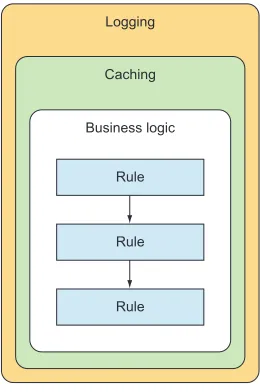
All of these special cases that have accumulated over the years have made the method very long and unwieldy. They’re all necessary, as far as we know, so we can’t just delete them, but we can refactor the code to make it easier to read, test, and maintain. Let’s combine a couple of standard design patterns, Decorator and Chain of Responsibility, to refactor the BannerAdChooser. The plan is as follows.
1 Use the Chain of Responsibility pattern to sepa-rate business rules into their own testable unit.
2 Use the Decorator pattern to separate the implementation details (caching and logging) from the business logic.
Once we’re finished, a conceptual view of our code should look something like figure 4.8.
First, we’ll create an abstract Rule class that each of our business rules will extend. Each concrete sub-class will have to implement two methods: one to decide whether the rule applies to a given player and page, and another to actually apply the rule.
abstract class Rule {
private final Rule nextRule;
protected Rule(Rule nextRule) { this.nextRule = nextRule; }
/**
* Does this rule apply to the given player and page? */
abstract protected boolean canApply(Player player, Page page);
/**
* Apply the rule to choose a banner to show. * @return a banner, which may be null
*/
abstract protected Banner apply(Player player, Page page);
Banner chooseBanner(Player player, Page page) { if (canApply(player, page)) {
// apply this rule
return apply(player, page); } else if (nextRule != null) { // try the next rule
return nextRule.chooseBanner(player, page); } else {
// ran out of rules to try! return null;
}
Logging
Caching
Business logic
Rule
Rule
Rule
23 Common legacy code traits and refactorings
Next, we’ll write a concrete subclass of Rule for each of our business rules. I’ll show a couple of examples.
final class ExcludeCertainPages extends Rule {
// Pages on which banners should not be shown private static final Set<String> pageIds = new HashSet<>(Arrays.asList("profile"));
public ExcludeCertainPages(Rule nextRule) { super(nextRule);
}
protected boolean canApply(Player player, Page page) { return pageIds.contains(page.getId());
}
protected Banner apply(Player player, Page page) { return null;
} }
final class ABTest extends Rule { private final BannerDao dao;
public ABTest(BannerDao dao, Rule nextRule) { super(nextRule);
this.dao = dao; }
protected boolean canApply(Player player, Page page) { // check if player is in A/B test segment
return player.getId() % 5 == 0; }
protected Banner apply(Player player, Page page) { // show banner 123 to players in A/B test segment return dao.findById(123);
} }
Once we have our Rule implementations, we can chain them together into a Chain of Responsibility.
Rule buildChain(BannerDao dao) { return new ABTest(dao,
Only showing a few links of the chain, for brevity new ExcludeCertainPages(
new ChooseRandomBanner(dao))); }
Whenever we want to choose a banner to show, each rule will be tried in turn until a matching one is found.
We’ll use the name BannerAdChooser for the interface and rename the concrete class to BannerAdChooserImpl. (This is a horrible name, but we’re about to replace this class anyway.)
interface BannerAdChooser {
public Banner getAd(Player player, Page page);
}
final class BannerAdChooserImpl implements BannerAdChooser {
public Banner getAd(Player player, Page page) { ...
}
}
Next we’ll split the method into a base case and a couple of decorators. The base case will be the main Chain of Responsibility-based implementation.
final class BaseBannerAdChooser implements BannerAdChooser { private final BannerDao dao = new BannerDao();
private final Rule chain = createChain(dao);
public Banner getAd(Player player, Page page) { return chain.chooseBanner(player, page); }
}
We’ll also have decorators that transparently take care of caching and logging respectively.
The following code shows a decorator for wrapping the existing banner ad logic with caching. When asked for an ad, it first checks if it already has an appropriate ad in its cache. If so, it returns it. Otherwise, it delegates the choice of ad to the underly-ing BannerAdChooser, and then caches the result.
final class CachingBannerAdChooser implements BannerAdChooser { private final BannerCache cache = new BannerCache(); private final BannerAdChooser base;
public CachingBannerAdChooser(BannerAdChooser base) { this.base = base;
}
public Banner getAd(Player player, Page page) { Banner cachedBanner = cache.get(player, page); if (cachedBanner != null) {
return cachedBanner; } else {
// Delegate to next layer
Banner banner = base.getAd(player, page); // Store the result in the cache for 30 minutes cache.put(player, page, banner, 30 * 60); return banner;
25 Common legacy code traits and refactorings
The next code segment shows another decorator, this time for adding logging. The choice of ad is delegated to the underlying BannerAdChooser, and then the result is logged before being returned to the caller.
final class LoggingBannerAdChooser implements BannerAdChooser { private final BannerAdChooser base;
public LoggingBannerAdChooser(BannerAdChooser base) { this.base = base;
}
public Banner getAd(Player player, Page page) { // Delegate to next layer
Banner banner = base.getAd(player, page); if (banner != null) {
// Make a record of what banner we chose logImpression(player, page, banner); }
return banner; }
private void logImpression(...) { ...
} }
Finally, we need a factory to take care of wiring up all our decorators in the correct order.
final class BannerAdChooserFactory {
public static final BannerAdChooser create() { return new LoggingBannerAdChooser(
new CachingBannerAdChooser( new BaseBannerAdChooser())); }
}
Now that we’ve separated each business rule into a separate class and separated the implementation concerns of caching and logging from the business logic, the code should be easier to read, maintain, and extend. Both the Chain of Responsibility and Decorator patterns make it very easy to add, remove, or reorder layers as needed. Also, each business rule and implementation concern can now be tested in isolation, which was not possible before.
4.2.6 Complexity in the view layer
In practice, however, it’s easy for logic to infect the view layer. This is often a conse-quence of trying to reuse the same model for multiple purposes. For example, a model that’s designed for easy serialization to a relational database will directly reflect the DB schema, but this model is probably not suitable for being passed as-is to the view layer. If you try to do so, you’ll end up having to put a lot of logic into the view layer to transform the model into a form suitable for showing to the user.
This accumulation of logic in the view layer is a problem for a few reasons:
The technologies used in the view layer (such as JSP in a Java web application) are usually not amenable to automated testing, so the logic contained within them can’t be tested.
Depending on the technology used, the files in the view layer might not be compiled, so errors can’t be caught at compile time.
You might want people such as visual designers or front-end engineers to work on the view layer, but this is difficult if the markup is interspersed with snippets of source code.
We can alleviate these problems by introducing a transformation layer between the model and the view. This layer, as shown in figure 4.9, is sometimes called a presentation model or a ViewModel, but I tend to call it a view adapter. By moving the logic out of the view and into the view adapter, we can simplify the view templates, making them more readable and easier to maintain. This also makes the transformation logic easier to test, because the view adapters are plain old objects, with no dependencies on the view technology, and can thus be tested just like any other source code.
Model DB
Before
View
Logic
Model
View DB
After
View adapter
Logic
27 Common legacy code traits and refactorings
This model is passed to a JSP in order to render the character profile page. The Char-acterProfile is shown here.
class CharacterProfile { String name;
Species species; DateTime createdAt; ...
}
The following code is a snippet of the JSP.
<table> <tr>
<td>Name</td>
<td>${profile.name}</td> </tr>
<c:choose>
<c:when test="${species.name == 'orc'>
<c:set var="speciesTextColor" value="brown" /> </c:when>
<c:when test="${species.name == 'elf'>
<c:set var="speciesTextColor" value="green" /> </c:when>
<c:otherwise>
<c:set var="speciesTextColor" value="black" /> </c:otherwise>
</c:choose> <tr>
<td>Species</td>
<td style="color: $speciesTextColor">${profile.species.name}</td> </tr>
<%
CharacterProfile profile = (CharacterProfile)(request.getAttribute("profi le"));
DateTime today = new DateTime();
Days days = Days.daysBetween(profile.createdAt, today); request.setAttribute("ageInDays", days.getDays()); %>
<tr>
<td>Age</td>
<td>${ageInDays} days</td> </tr>
</table>
This JSP is horrible! It has logic jumbled together with presentation, making it very hard to read. Let’s introduce a view adapter and pass that to the JSP, instead of passing the CharacterProfile model directly.
class CharacterProfileView {
private final CharacterProfile profile:
public CharacterProfileView(CharacterProfile profile) { this.profile = profile;
}
public String getName() {
// return the underlying model's property as is return profile.getName();
}
public String getSpeciesName() {
return profile.getSpecies().getName(); }
public String getSpeciesTextColor() {
if (profile.getSpecies().getName().equals("orc")) { return "brown";
} else if (profile.getSpecies().getName().equals("elf")) { return "green";
} else {
return "black"; }
}
public int getAgeInDays() {
DateTime today = new DateTime();
Days days = Days.daysBetween(profile.createdAt, today); return days.getDays();
}
...
}
The next code snippet shows how the JSP looks when we make use of the view adapter.
<table> <tr>
<td>Name</td>
<td>${profile.name}</td> </tr>
<tr>
<td>Species</td>
<td style="color: ${profile.speciesTextColor}">${profile.speciesName}</td >
</tr> <tr>
<td>Age</td>
<td>${profile.ageInDays} days</td> </tr>
</table>
There, that’s better! The logic is now contained in a testable Java class, and the tem-plate is much more readable than before.
29 Testing legacy code
views. I’ve had success with logic-less template languages such as Mustache for build-ing simple, readable views for web applications. The templates can be written and maintained by web designers, allowing the developers to focus on the business logic.
APPLICABILITY TO OTHER LANGUAGES The View Adapter pattern is not specific to Java and JSP templates. It’s useful no matter whether you’re using Ruby and ERB, ASP.NET, or any other technology. Whenever you have an application with a UI of some kind, you can and should keep complex logic out of the view layer.
4.3
Testing legacy code
When refactoring legacy code, automated tests can provide valuable assurances that the refactoring has not inadvertently affected the behavior of the software. In this sec-tion I’ll talk about how to write these automated tests, and what to do when you’re faced with untestable code.
4.3.1 Testing untestable code
Before you start refactoring, you want to have unit tests in place. But before you can write unit tests, you need to refactor the code to make it testable. But before you start refactoring, you want to have unit tests in place ...
Further reading
I’ve just scratched the surface in this brief foray into refactoring. If you’d like to learn more about refactoring, there are plenty of excellent books dedicated to the subject. Here are three recommendations.
Refactoring: Improving the Design of Existing Code by Martin Fowler et al. (Addison-Wesley Professional, 1999). Although it’s getting a little dated (it was written when Java was at version 1.2), it’s a classic and still a great refer-ence. It takes a pattern-based approach, describing in what situation you might want to use a particular refactoring.
Refactoring to Patterns by Joshua Kerievsky (Addison-Wesley Professional, 2004). This book cleverly shows how you can take legacy code that lacks a clear structure, and migrate it toward well-known design patterns using the refactorings described in Martin Fowler’s book. If you want to brush up on design patterns before reading this book, read Design Patterns: Elements of Reusable Object-Oriented Software by Erich Gamma, Richard Helm, Ralph Johnson, and John Vlissides (Addison-Wesley Professional, 1994), also known as the Gang of Four book.
This chicken-and-egg situation is something we often face when trying to retroac-tively add tests to legacy code. If we insist on having unit tests in place before refactor-ing, then it seems like an unbreakable paradox. But it’s worth remembering that if we can manage to get a few tests in place, we can start refactoring, making the software more testable, allowing us to write more tests, in turn allowing more refactoring, and so on.
Think of it like peeling an orange. At first it seems perfectly round and impenetra-ble, but once you apply a little force to break the skin, the thing practically peels itself. So we need to lower our standards temporarily in order to break the skin and get our first few tests in place. When we do this, we can use code review to make up for the lack of tests.
Our first priority when trying to make code testable is to isolate it from its depen-dencies. We want to replace all of the objects that the code interacts with, with objects that we control. That way we can feed it whatever inputs we like and measure its response, whether it consists of returning a value or calling methods on other objects.
Let’s look at an example of how we can refactor a piece of legacy code in order to get it into a test harness. Imagine we want to write tests for the Battle class, which is used when two players fight each other in World of RuneQuest. Unfortunately, Battle is riddled with dependencies on a so-called “God class,” a 3,000-line monster of a class called Util. This class is filled with static methods that do all kinds of useful things, and it’s referenced from all over the place.
BEWARE THE UTIL Whenever you see a class with Util in the name, alarm bells should start ringing in your head. It may well be a good candidate for refactoring, if only to rename it to something more meaningful.
Here’s how the code looks before we start.
public class Battle {
private BattleState = new BattleState(); private Player player1, player2;
public Battle(Player player1, Player player2) { this.player1 = player1;
this.player2 = player2; }
...
public void registerHit(Player attacker, Weapon weapon) { Player opponent = getOpponentOf(attacker);
int damageCaused = calculateDamage(opponent, weapon); opponent.setHealth(opponent.getHealth() - damageCaused);
Util.updatePlayer(opponent);
31 Testing legacy code
public BattleState getBattleState() { return battleState;
}
...
}
The class has a nice, simple constructor, so we can easily construct an instance in order to test it. It also has a public method exposing its internal state, which should be useful for our tests. We have no idea what that suspicious call to Util.updatePlayer (opponent) is doing, but let’s ignore it for now and try writing a test.
public class BattleTest {
@Test
public void battleEndsIfOnePlayerAchievesThreeHits() { Player player1 = ...;
Player player2 = ...; Weapon axe = new Axe();
Battle battle = new Battle(player1, player2);
battle.registerHit(player1, axe); battle.registerHit(player1, axe); battle.registerHit(player1, axe);
BattleState state = battle.getBattleState(); assertThat(state.isFinished(), is(true)); }
}
OK, let’s run the test, and ... whoops! It turns out that the Util.updatePlayer (player) method not only writes the Player object to a database, it may also send an
email to the user to inform them that their character is unhealthy/lonely/running out of gold. These are side effects that we definitely want to avoid in our tests. Let’s see how we can fix this.
Because the Battle class’s dependency is on a static method, we can’t use any tricks such as subclassing Util and overriding the method. Instead, we’ll have to cre-ate a new class with a method that wraps the static method call, and then have Battle call the method on the new class. In other words, we’ll introduce a layer of indirection between Battle and Util. In tests, we’ll be able to substitute our own implementation of this buffer class, thus avoiding any unwanted side effects.
First, let’s create an interface.
interface PlayerUpdater {
public void updatePlayer(Player player);
}
public class UtilPlayerUpdater implements PlayerUpdater {
@Override
public void updatePlayer(Player player) { Util.updatePlayer(player);
}
}
We now need a way to pass the PlayerUpdater to Battle, so let’s add a constructor parameter. Notice how we create a protected constructor for use in tests, and we avoid changing the signature of the existing public constructor.
public class Battle {
private BattleState = new BattleState(); private Player player1, player2;
private final PlayerUpdater playerUpdater;
public Battle(Player player1, Player player2) { this(player1, player2, new UtilPlayerUpdater()); }
protected Battle(Player player1, Player player2, PlayerUpdater playerUpdater) { this.player1 = player1;
this.player2 = player2;
this.playerUpdater = playerUpdater; }
...
public void registerHit(Player attacker, Weapon weapon) { Player opponent = getOpponentOf(attacker);
int damageCaused = calculateDamage(opponent, weapon); opponent.setHealth(opponent.getHealth() - damageCaused);
playerUpdater.updatePlayer(opponent);
updateBattleState(); }
...
}
PROTECTED METHODS IN JAVA Because we added the new constructor with protected visibility, it will only be visible to subclasses of Battle or classes in the same package. We should put our test class in the same package as Battle so that it can call the constructor we added.
So far we’ve made changes to the Battle class, but we think we’ve maintained the existing behavior. Now is the time to pause, commit what we have so far, and ask a col-league for a code review, just to check that we haven’t done anything silly. Once that’s complete, we can move on to fixing our test.
33 Testing legacy code
a mock implementation, we can also check that Battle calls our updatePlayer() method as we expected. Let’s use the Mockito library (http://mockito.github.io/) to create our mock implementation.
import static org.mockito.Mockito.*;
public class BattleTest {
@Test
public void battleEndsIfOnePlayerAchievesThreeHits() { Player player1 = ...;
Player player2 = ...; Weapon axe = new Axe();
PlayerUpdater updater = mock(PlayerUpdater.class);
Creates a mock implementation of PlayerUpdater interface
Passes the
mock to the Battle
instance Battle battle = new Battle(player1, player2, updater);
battle.registerHit(player1, axe); battle.registerHit(player1, axe); battle.registerHit(player1, axe);
BattleState state = battle.getBattleState(); assertThat(state.isFinished(), is(true));
verify(updater, times(3)).updatePlayer(player2);
Checks that the updatePlayer() method was called 3 times }
}
Yay, we’ve broken the skin and our first working test is in place. Not only did we break the dependency on the Util class, we also managed to verify the test subject’s interac-tions with other classes.
Further reading
For a whole book dedicated to examples like this one, as well as detailed explana-tions of the reasoning behind the approach taken in each case, I highly recommend
Working Effectively with Legacy Code by Michael Feathers (Prentice Hall, 2004).
4.3.2 Regression testing without unit tests
Here’s a deliberately inflammatory statement for you:
Writing unit tests before refactoring is sometimes impossible and often pointless.
Of course I’m exaggerating, but I wanted to get two points across here:
Writing tests is “often pointless” because refactoring isn’t always restricted to an individual unit (a single class, in object-oriented languages). If your refactoring affects multiple units, then the very refactoring that you’re about to perform can wipe out the value of the unit tests you’re writing.
For example, if you’re about to perform a refactoring that combines existing classes A and B into a new class C, then there’s little point in writing tests for A and B beforehand. As part of the refactoring, A and B will be deleted, so their tests will no longer compile, and you’ll have to write tests for the newly created class C anyway.
UNITTESTSARENOTASILVERBULLET
If your refactoring is going to break unit tests, you need to have a backup—functional tests for the module that contains those units. Likewise, if you’re planning a larger-scale refactoring of a whole module, then you need to be prepared for your refactor-ing to break all of that module’s tests. You’ll need to have tests in place at a higher level, that can survive the refactoring. As a general rule, you should make sure that you have tests at a level of modularity one level higher than the code that will be affected by your refactoring.
For this reason, it’s important to build up a suite of tests at multiple levels of mod-ularity (see figure 4.10). When working with legacy code that wasn’t designed for test-ability, it’s often easiest to start at the outside, writing system tests, and then working your way in as far as you can.
System
Component
Levels of modularity
Module
Unit
System tests
Integration tests
Levels of testing
Functional tests
Unit tests
Figure 4.10 Levels of modularity and their corresponding tests
DON’TGETHUNGUPONCOVERAGE
35 Testing legacy code
weeks trying to increase the coverage, and then give up at around 20% with no notice-able improvement in quality or maintainability. (I also saw a team inherit a large C# codebase with no tests, and 18 months later they had achieved their goal of 80% cov-erage, so there are exceptions to every rule!)
The problem with setting an arbitrary goal of improved test coverage is that you’ll start by writing the easiest tests first. In other words, you’ll write dozens of tests for
Code that happens to be easily testable, neglecting more important but less test-able parts of the codebase
Code that is well written and easy to reason about, even though a code review might be enough to verify that this code works as expected
AUTOMATEALLYOURTESTS
Most developers would agree that unit tests should be fully automated, but the level of automation for other kinds of tests (such as integration tests) is often much lower. Although we want to run these tests as often as possible when refactoring, in order to spot regressions quickly, we can’t do so if they rely on manual labor. Even if we had an army of willing testers to rerun the whole integration test suite every time we made a commit, it’s possible that they would forget to run a test, or misinterpret the results. Plus it would slow down the development cycle. Ideally we want all of our regression tests, not just the unit tests, to be 100% automated.
One area that cries out for automation is UI testing. Whether you’re testing a desk-top application, a website, or a smartphone app, there’s a huge selection of tools avail-able to help you automate your tests. For example, tools such as Selenium and Capybara make it easy to write automated web UI tests. The following code sample shows a Capybara script that you could use to test World of RuneQuest’s player profile page, which you saw earlier in the chapter. This simple Ruby script opens a web browser, logs in to World of RuneQuest, opens the My Profile page, and checks that it contains the correct content, all within a matter of seconds.
require "rspec" require "capybara" require "capybara/dsl" require "capybara/rspec"
Capybara.default_driver = :selenium
Capybara.app_host = "http://localhost:8080"
describe "My Profile page", :type => :feature do
it "contains character's name and species" do visit "/"
Login as a known test user
fill_in "Username", :with => "test123" fill_in "Password", :with => "password123" click_button 'Login'
visit "/profile"
Opens the 'My Profile' page and checks its content
expect(find("#playername")).to have_content "Test User 123" expect(find("#speciesname")).to have_content "orc"
end