https://doi.org/10.5194/amt-11-3373-2018 © Author(s) 2018. This work is distributed under the Creative Commons Attribution 4.0 License.
The Community Cloud retrieval for CLimate (CC4CL) – Part 1:
A framework applied to multiple satellite imaging sensors
Oliver Sus1, Martin Stengel1, Stefan Stapelberg1, Gregory McGarragh2, Caroline Poulsen3, Adam C. Povey4, Cornelia Schlundt1, Gareth Thomas3, Matthew Christensen2,3, Simon Proud2, Matthias Jerg1, Roy Grainger4, and Rainer Hollmann1
1DWD – Deutscher Wetterdienst, Frankfurter Straße 135, 63067 Offenbach, Germany
2Department of Physics, University of Oxford, Clarendon Laboratory, Parks Road, Oxford OX1 3PU, UK 3RAL Space – Rutherford Appleton Laboratory, Chilton, Didcot OX11 0QX, UK
4National Centre for Earth Observation, Atmospheric, Oceanic and Planetary Physics, University of Oxford, Parks Road, Oxford OX1 3PU, UK
Correspondence:Martin Stengel ([email protected])
Received: 13 September 2017 – Discussion started: 17 October 2017 Revised: 30 May 2018 – Accepted: 5 June 2018 – Published: 13 June 2018
Abstract. We present here the key features of the Commu-nity Cloud retrieval for CLimate (CC4CL) processing algo-rithm. We focus on the novel features of the framework: the optimal estimation approach in general, explicit uncertainty quantification through rigorous propagation of all known er-ror sources into the final product, and the consistency of our long-term, multi-platform time series provided at various res-olutions, from 0.5 to 0.02◦.
By describing all key input data and processing steps, we aim to inform the user about important features of this new retrieval framework and its potential applicability to climate studies. We provide an overview of the retrieved and de-rived output variables. These are analysed for four, partly very challenging, scenes collocated with CALIOP (Cloud-Aerosol lidar with Orthogonal Polarization) observations in the high latitudes and over the Gulf of Guinea–West Africa.
The results show that CC4CL provides very realistic esti-mates of cloud top height and cover for optically thick clouds but, where optically thin clouds overlap, returns a height be-tween the two layers. CC4CL is a unique, coherent, multi-instrument cloud property retrieval framework applicable to passive sensor data of several EO missions. Through its flex-ibility, CC4CL offers the opportunity for combining a variety of historic and current EO missions into one dataset, which, compared to single sensor retrievals, is improved in terms of accuracy and temporal sampling.
1 Introduction
Satellite data are an essential source of information for understanding and predicting climate change. They provide global long-term observations from which geophysical pa-rameters can be derived. These are used for time series anal-ysis of climate variables as well as for the assimilation into or validation of climate models (Comiso and Hall, 2014; Yang et al., 2013). A paramount goal of these efforts is the com-prehensive characterization of the global energy and water budgets (Stephens et al., 2012).
Clouds considerably influence the global energy budget through direct forcing effects (Kiehl and Trenberth, 1997). However, clouds are difficult to quantify, having highly vari-able composition and spatiotemporal distributions, and pro-duce the largest uncertainty in our understanding of climate change (Norris et al., 2016; IPCC, 2013). Observations from passive imagers do not sufficiently resolve several important cloud properties, such as vertical structure, sub-pixel hetero-geneity, the cloud boundary, and the column-integrated ice or liquid water path. Several secondary variables (cloud forward model assumptions, state of surface and atmosphere, viewing geometry, sensor calibration, and spectral response uncer-tainties) further complicate cloud retrievals, and insufficient quantification of their state propagates uncertainties into the derived cloud properties (Hamann et al., 2014). Nonetheless, passive satellite imagers are the most widely used instru-ments for cloud retrievals as they provide long-term, global coverage at acceptable cost for the user.
There are several satellite-based retrieval frameworks. One of the earliest is the International Satellite Cloud Clima-tology Project (ISCCP) (Rossow and Schiffer, 1999). IS-CCP provides data on cloud products for 1983–2009 and introduced a cloud type classification based on cloud opti-cal thickness and cloud top pressure (COT–CTP) joint his-tograms that is still popular even today. Continuously repro-cessed retrieval systems include Pathfinder Atmosphere Ex-tended (PATMOS-x) (Heidinger and Pavolonis, 2009; Hei-dinger et al., 2012), EUMETSAT Satellite Application Fa-cility on Climate Monitoring (CM SAF) cLoud, Albedo and RAdiation (CLARA-A1) (Karlsson et al., 2013), and Mod-erate Resolution Imaging Spectroradiometer (MODIS) Col-lection 6 (MODIS C6) (Platnick et al., 2017) as well as the CERES–MODIS products (Minnis et al., 2011). These retrievals vary in their ancillary data sources, approaches, and complexity but generally use radiative transfer models and/or derived look-up tables (LUT) to provide a clear-sky reference and for simulating atmospheric and cloud contri-butions to top-of-atmosphere (TOA) radiances. Cloud prop-erties are derived using decision trees and thresholding (PPS in CLARA-A1), LUT-based inversions (MODIS C6), or op-timal estimation theory (PATMOS-x). COT and CER (cloud effective radius) are usually calculated following Nakajima and King (1990). However, the derived microphysical vari-ables are not guaranteed to be radiatively consistent with independently derived cloud parameters, as most of the re-trieval methods are separated into solar and thermal
Satellite observations of clouds are available for the last 40 years. However, data need to be carefully processed and analysed in order to derive a consistent long-term data record from several intercalibrated satellite platforms. There is a trade-off between using the information from a single sor optimally and using the information from different sen-sors consistently. The former may provide the most scientif-ically accurate data but often results in sharp discontinuities as instruments are introduced. Towards the aim of produc-ing a stable, self-consistent climate record, this paper focuses on evaluating data from a range of sources through a uni-fied methodology. Modern sensors provide improved spec-tral coverage and spatial resolutions and, thus, potentially better cloud retrievals. However, their data records are too short to produce climatologies of at least 30 years, and dis-continuities are built into time series when higher-resolution satellite data are input to the processing. Major complica-tions of cloud retrievals include optically transparent clouds, multilayer or overlapping clouds, and effective CTH deter-mination. The degree to which these complications can be addressed depends on the nature of the retrieval and the type of input satellite data used. MODIS provides a much larger spectral sampling than the six AVHRR heritage channels. MODIS and atmospheric sounders are clearly superior when detecting cloud height through the application of the “CO2 -slicing” technique. However, when consistent climatologies are to be built, time series length and spatiotemporal resolu-tion limit the choice in retrieval type and input satellite data. In order to produce the cloud CDR presented here, we used satellite data from MODIS Aqua and Terra (2000–2014) (King et al., 1992), AVHRR on NOAA-7 to NOAA-19 and METOPA (1978–2014) (Jacobowitz et al., 2003), second-generation Along Track Scanning Radiometer (ATSR-2) on ERS-2 (1995–2003), and Advanced Along Track Scanning Radiometer (AATSR) on ENVISAT (2002–2012). Only the AVHRR-equivalent channels from MODIS and AATSR are used. Hence, the resulting retrieval data are hereafter referred to as the “AVHRR heritage dataset”. Moreover, the resulting time series were carefully validated against well-established climatologies (ISCCP, PATMOS-x, CM SAF, and MODIS C6), reanalysis and model data (ERA-Interim and EC-Earth), ground-truth synoptic observations, and CALIOP lidar data (Stengel et al., 2017, 2018).
The CC4CL core algorithm was developed in a modu-lar fashion and provides open-source access to support dis-tribution and development within the scientific community. Particular attention was paid to allow processing of multi-ple instruments within a single framework, thus maximiz-ing the consistency of cloud products independent of the sensor source. The framework accounts for physical consis-tency amongst all output variables and radiative consisconsis-tency amongst all input satellite radiances. This is an improvement over other established retrieval frameworks. These com-monly derive COT and CER by adopting the Nakajima and King (1990) approach, but macrophysical products are
es-timated independently and are thus radiatively inconsistent with the former variables. Here, parameters are retrieved si-multaneously, providing a retrieval that is radiatively con-sistent over the wavelengths of the observations, given that the instrument’s noise characteristics are well known. An-other key feature of CC4CL is the production of uncertainty estimates of retrieval parameters (see also Platnick et al., 2017) through explicit error propagation from input to out-put data. With these criteria in mind, the Optimal Retrieval of Aerosol and Cloud (ORAC) (Thomas et al., 2009a; Poulsen et al., 2012) was chosen from three competing algorithms in a “round robin” (i.e. each algorithm is tested against all other algorithms) analysis. All algorithms have proven their maturity for deriving the considered cloud parameters (cloud cover, liquid and ice water path, CTH) from AVHRR and MODIS data (Stengel et al., 2015).
In this study, we present the key features of the CC4CL processing algorithm. We particularly focus on discussing the key features of the framework: the optimal estimation approach in general, the explicit uncertainty quantification through rigorous propagation of all known error sources to the final product, and the consistency of our long-term, multi-platform time series provided at various resolutions, from 0.5 to 0.02◦. By describing all key input data and processing steps, we inform the future user about important features of this new processing framework and its potential applicability in climate studies. We provide an overview of the retrieved and derived output variables. These are initially examined in a detailed analysis of retrieval results that we collocated with CALIOP observations for three scenes in the Arctic and one scene in the Gulf of Guinea–West Africa. The results show that CC4CL produces mixed-layer estimates for cases where optically thin clouds overlap, but provides realistic estimates of cloud top height and cover for optically thick clouds.
2 Data and methods
2.1 Level-1 (L1) satellite data 2.1.1 AVHRR
after-Table 1.The CC4CL AVHRR heritage dataset channel characteris-tics for AVHRR, AATSR, and MODIS. Instrument noise as applied within CC4CL is in reflectance for CC4CL channels 1–3 and in brightness temperature (K) for channels 4–6.
CC4CL Sensor ID Channel width Noise
ID (µm)
AVHRR 1 1 0.58–0.68 0.005 2 2 0.725–1.10 0.005 3 3a 1.58–1.64 0.005 4 3b 3.55–3.93 0.25 5 4 10.50–11.50 0.2 6 5 11.5–12.5 0.2
MODIS 1 1 0.62–0.67 0.01 2 2 0.841–0.876 0.01 3 6 1.628–1.652 0.01 4 20 3.66–3.84 0.2 5 31 10.78–11.28 0.2 6 32 11.77–12.27 0.2
AATSR 1 1 0.545–0.565 0.005 2 2 0.649–0.669 0.005 3 4 1.58–1.64 0.005 4 5 3.51–3.89 0.25 5 6 10.4–11.3 0.1 6 7 11.5–12.5 0.1
noon (ECT>12:00 LST) satellites. To reduce drift-induced changes in retrieved cloud properties, any AVHRR is re-placed with its corresponding successor once available (the AVHRR prime record). Typically, one morning and one af-ternoon NOAA satellite are in orbit at any time.
For CC4CL, we use Global Area Coverage (GAC) L1c data on a reduced spatial resolution of 1.1 km×4 km at nadir (Devasthale et al., 2018). The AVHRR GAC L1c data record, including advanced intercalibration efforts, was pro-duced for ESA Cloud_cci and CMSAF (Schulz et al., 2009; Karlsson et al., 2013). CC4CL processed AVHRR data from August 1981 (NOAA-7) to December 2014 (Metop-A + NOAA-19). We applied a filtering technique to channel 3b data and a database algorithm for splitting midnight orbits and blacklisting.
2.1.2 MODIS
MODIS is carried by NASA’s Terra and Aqua satellite plat-forms in a near sun-synchronous polar orbit at 705 km al-titude. Due to orbit control, ECT is a constant 10:30 LST for Terra and 13:30 LST for Aqua. The Aqua satellite is a member of the A-Train constellation, which also includes the CALIPSO and CloudSat satellites. MODIS is a cross-track scanner with a 2330 km swath width, producing a complete near-global coverage in less than 2 days (Xiong et al., 2009). CC4CL is applied to C6 MOD021km (Terra) and MYD021km (Aqua) L1b input data (NASA LP DAAC,
2015). For the AVHRR heritage dataset produced here, the NASA Goddard Space Flight Center performed a spectral subsetting of the 36 MODIS channels available (see Table 1 for the channels extracted), and data were directly shipped to ECMWF (European Centre for Medium-Range Weather Forecasts) for archiving. The files are stored in HDF-EOS format at 1 km spatial resolution, with the 250 and 500 m channels having been aggregated to 1 km resolution. MODIS L1b data are organized in granules, each of which contains ∼5 min of MODIS data or∼203 scan lines. Geolocation in-formation is provided in separate files for Terra (MOD03) and Aqua (MYD03), containing geodetic latitude and longi-tude and solar–satellite zenith and azimuth angles. L1b data are corrected for all known instrumental effects through on-board calibrator data and are organized into a viewing swath matching the geolocation file structure (MODIS Character-ization Support Team, 2009). With CC4CL, we processed data from February 2000 (Terra) or August 2002 (Aqua) to December 2014.
2.1.3 ATSR-2 and AATSR
The second-generation ATSR-2 and third-generation AATSR (Merchant et al., 2012) were launched on ESA’s polar-orbiting satellites ERS-2 and ENVISAT in April 1995 and March 2002, respectively. Both platforms were put into a sun-synchronous orbit at ∼780 km altitude, with ECT of 10:30 LST for ERS-2 and ECT of 10:00 for ENVISAT. Both ATSRs are identical in their overall configuration except for data transfer bandwidth (Table 1). ATSR is equipped with on-board calibration capabilities, such as two blackbody targets for the thermal channels and a sun-illuminated opal target for the visible–near-infrared channels. ATSR uses a dual-view system: a nadir view and a forward view that scans the sur-face at an angle of 55◦. The continuous scanning pattern pro-duces a nadir resolution of approximately 1 km×1 km with a swath width of 512 pixels or∼500 km, providing global coverage every 6 days.
We used no forward view data for cloud retrievals, as the three-dimensional cloud structure produces parallax ef-fects which are not accounted for within the current forward model. With CC4CL, we processed ATSR data from launch date until May 2003 (ERS-2) and April 2012 (ENVISAT).
2.2 Ancillary data 2.2.1 ERA-Interim
spherical-harmonic representation for the basic dynamical fields and through a reduced Gaussian grid with ∼79 km spacing for surface fields. We downloaded ERA-Interim data from the ECMWF’s MARS archive at a spatial resolution of 0.72◦(the default preprocessing grid resolution) and at a higher resolu-tion of 0.1◦for the neural network cloud mask input variables (Table A1). We acquired analysis (i.e. not forecast) data at 6-hourly timesteps. After download, all files were remapped to the CC4CL preprocessor grid through Climate Data Opera-tors (CDO, 2015). This was necessary, as ERA-Interim co-ordinates are defined at the cell boundaries, whereas they are defined at the cell centres within CC4CL. The reanalysis data are temporally interpolated onto the satellite image’s centre time by linearly weighting the files before and after.
ERA-Interim’s land surface model still needs to be im-proved in terms of its simulation of soil hydrology and snow cover. This affects the utilization of satellite data over land surfaces within ERA-Interim, which has negative effects on the representation of clouds and precipitation (Berris-ford et al., 2011). The confidence in temperature trend es-timates, however, has improved considerably so that ERA-Interim data have been used as an alternative to observational datasets to monitor climate change (Willett et al., 2010).
2.2.2 Land use
We downloaded United States Geological Service (USGS) Land Use/Land Cover raster data from the global land cover characteristics database (US Geological Survey, 2016). This was necessary, as early AVHRR data are distributed without masking information. The USGS data are used as a land– sea mask within the optimal estimation retrieval (Sect. 3.3.3) as well as a land cover classification within the cloud mask and the Pavolonis cloud typing scheme (Sect. 3.3.2). The dataset is defined on a regular latitude–longitude grid with 0.05◦resolution. The USGS land cover classification was pri-marily derived from 1 km AVHRR Normalized Difference Vegetation Index (NDVI) 10-day composites for April 1992 through March 1993 (US Geological Survey, 2016).
2.2.3 Land surface BRDF
MODIS C6 bidirectional reflectance distribution function (BRDF) data (MCD43C1; Schaaf and Wang, 2015), pro-viding kernel weights for the Ross thick–Li sparse recipro-cal BRDF model, are used within the retrieval scheme to set surface albedo and bidirectional reflectance distribution conditions. These data are available every 8 days derived from cloud-cleared 16-day Terra and Aqua measurements, and provided in HDF-EOS format at 0.05◦ spatial resolu-tion. MCD43C1 data are classified as high-quality given suf-ficient observations, and otherwise a low-quality estimate is produced based on climatology anisotropy models. Vali-dation against albedo measurements made at Baseline Sur-face Radiation Network (BSRN) sites show that the
black-sky and white-black-sky albedo computed from the single sensor MCD43A1 high-quality product are well within 5 % of the measured albedo, while the low-quality product is within 10 % (Lucht, 1998).
We regridded MCD43C1 data to instrument resolution through bilinear interpolation, and filled missing pixels within the time series with pixel values of the temporally closest 8-day composite file providing valid data. For the pre-MODIS era, we produced a BRDF climatology by averaging all data available for a particular 8-day time slot. MCD43C1 kernel weights are applied to all CC4CL sensors, neglecting differences in spectral response functions. This might result in retrieval biases, particularly in spectral regions that are sensitive to rapidly changing environmental processes such as vegetation growth (near-infrared). Note that the use of a climatology would add a discontinuity in the surface time se-ries if there were trends in the surface BRDF and emissivity time series during the MODIS era.
2.2.4 Land surface emissivity
For land surface emissivity, we used the Cooperative In-stitute for Meteorological Satellite Studies (CIMSS) global land surface infrared emissivity database created by the base-line fit method (Seemann et al., 2008). These data are derived from the MODIS operational land surface emissivity product (MOD11), to which the fit method is applied for filling spec-tral gaps between channels. CIMSS emissivity data are avail-able on a monthly basis at 10 wavelengths with 0.05◦spatial resolution.
As for BRDF, we produced a land surface emissivity cli-matology for the pre-MODIS era by averaging all data avail-able for a particular month.
2.3 Collocating CC4CL Level-2 (L2) data and CALIOP
Figure 1.Schematic of the CC4CL preprocessor.
3 The CC4CL retrieval system 3.1 Heritage
In the early stages of the Cloud_cci project, a “round robin exercise” evaluated three different algorithms regarding their applicability for retrieving cloud parameters from satellite data (Stengel et al., 2015), which were (1) the operational processing system of the CM SAF (2015), (2) the Clouds from AVHRR Extended (CLAVR-x) algorithm used to gen-erate the PATMOS-x climatology (Heidinger et al., 2013), and (3) the ORAC retrieval which was previously used to produce the Global Cloud and Aerosol Dataset Produced by the Global Retrieval of ATSR Cloud Parameters and Evalu-ation (GRAPE) dataset (Thomas et al., 2009b; Natural En-vironment Research Council et al., 2015). All three algo-rithms were driven with identical MODIS and AVHRR in-put data and ERA-Interim meteorological background infor-mation for 5 days in 2008. The results where analysed with respect to CloudSat, CALIOP, and AMSR-E reference data.
Based on the outcomes of that study (Stengel et al., 2015), ORAC was selected to be the cloud retrieval scheme within CC4CL. Moreover, code modifications were identified and characterized to render ORAC fit for the purpose of ECV production.
3.2 Preprocessing
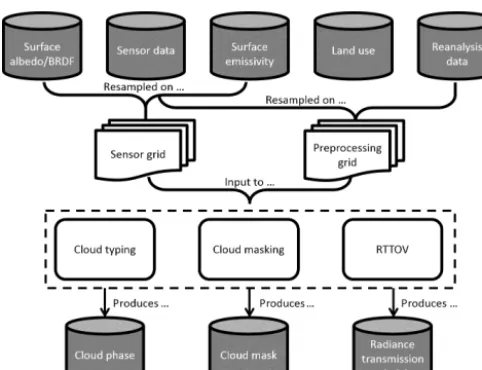
The CC4CL preprocessor initially defines the dimensions and content of the sensor and preprocessing grids (Fig. 1).
The sensor grid has the same extent and resolution as the input orbit or granule. The sensor grid is filled with sensor radiances and angles, time, and geolocation data (Sect. 2.1), whereas surface BRDF (Sect. 2.2.3), snow or ice cover-age (from ERA-Interim, Sect. 2.2.1), and surface emissiv-ity (Sect. 2.2.4) are bilinearly interpolated onto that grid. We
Table 2.Threshold values applied to ANNCOD data for cloud mask classification.
Day Night Twilight Land Sea Snow/ice Threshold
x x 0.2
x x x 0.35
x x 0.1
x x x 0.4
x x 0.3
x x x 0.35
x x 0.2
x x x 0.4
x x 0.3
x x x 0.4
x x 0.35
x x x 0.4
use BRDF data over land only. For sea pixels, the Cox and Munk ocean surface reflectance model calculates BRDF co-efficients as a function of ERA-Interim wind speed. These coefficients also contain foam and underlight components (Sayer et al., 2010). The albedo of snow- or ice-covered pix-els is set to globally constant values of 0.958 (Ch1, CC4CL ID as in Table 1), 0.868 (Ch2), 0.0364 (Ch3), and 0.0 (Ch4) and is area-weighted in the event of fractional sea or ice cover.
The preprocessing grid is a regular latitude–longitude grid that covers the extent of the sensor grid, but at a coarser res-olution of 0.72◦×0.72◦. It is used to store the average of all sensor angle and surface emissivity values falling within a grid box and spatially interpolated (nearest neighbour) land-use data (Sect. 2.2.2). ERA-Interim variables were trans-formed before input to the preprocessing grid as described in Sect. 2.2.1. For profile variables, vertical geopotential co-ordinates are calculated from pressure coco-ordinates.
The preprocessor then calls the cloud mask (Sect. 3.3.1) and cloud typing (Sect. 3.3.2) algorithms. Finally, the Ra-diative Transfer for TOVS (RTTOV) model is executed on the preprocessing grid data as defined by ERA-Interim sur-face and profile variables. RTTOV outputs profiles of cloud transmittance both above and below cloud for the shortwave channels and emissivity for the longwave channels. For de-tails on RTTOV and the forward model, see Part 2 of this paper (McGarragh et al., 2018c).
3.3 CC4CL cloud retrieval 3.3.1 Cloud detection
The CC4CL cloud mask is produced by (1) estimating pseudo-CALIOP cloud optical depth (ANNCOD) from L1 measurements with an artificial neural network (ANN), (2) correcting ANNCOD for viewing-angle dependencies, and (3) classifying ANNCOD into binary cloud mask infor-mation by thresholding.
CC4CL applies a set of ANNs for cloud masking, one for each of the illumination conditions day (solar zenith an-gleθ0<80◦), night (θ0≥90◦), and twilight (80≤θ0<90◦). The ANNs are multilayer perceptrons with one input layer, one hidden layer with 50 neurons, and one output layer, which produces ANNCOD ranging from 0 to 1. Through in-cremental testing, we found that 50 neurons was the value for which the trade-off between output quality and comput-ing speed was optimal. For the input layer, input variables are surface temperature, snow or ice cover, and the land–sea mask for all three cloud masks. Regarding sensor data, input channels are Ch1, Ch2, Ch5, Ch6, and Ch5-Ch6 for the day ANN, Ch4, Ch5, Ch6, Ch5-Ch4, and Ch5-Ch6 for the night ANN, and Ch5, Ch6, and Ch5-Ch6 for the twilight ANN.
The various ANNs were trained with NOAA-18 AVHRR L1c data, ancillary information (ECMWF land–sea mask, snow–ice mask, and surface temperature), and cloud optical depth (COD) “truth” data obtained from CALIOP’S 532 nm lidar product (CAL_LID_L2_05kmCLay-Prov-V3-01). AVHRR Ch3a data were generally excluded. We trained the day ANN with all remaining AVHRR channels, but also excluded Ch3b to be consistent with those NOAA platforms that switch between Ch3b transmission at night and Ch3a during the day (NOAA-16, NOAA-17, Metop-A). For night and twilight conditions, we produced ANNs both with and without Ch3b data input. This was necessary to avoid misclassification of very cold clouds and/or land surfaces due to Ch3b’s very low signal-to-noise ratio. In addition to the days evaluated in the “round robin” comparison, we selected 12 further training days in 2008 that contain collocations between NOAA-18 and CALIOP, represent COD seasonality, and provide global coverage. Prior to training, all CALIOP COD values>1 were set to unity. Ancillary data input are the ERA-Interim skin temperature, a snow or ice mask derived from ERA-Interim snow depth and sea-ice concentration, and the USGS land–sea mask. Finally, we applied a simple correction algorithm to remove a cosine viewing-angle dependency of retrieved ANNCOD. This was necessary, as the maximum viewing angle in the AVHRR training dataset was just 35◦. The binary cloud mask is estimated by classification of ANNCOD data into clear and cloudy through a set of threshold values. The thresholds themselves vary depending on illumination and surface conditions, namely land, sea, and snow or ice cover (Table 2), and were quantified through iterative
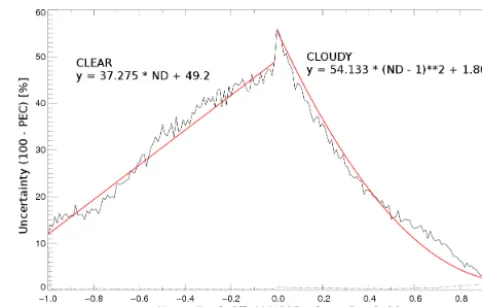
Figure 2.Neural network cloud mask uncertainty as derived from observations.
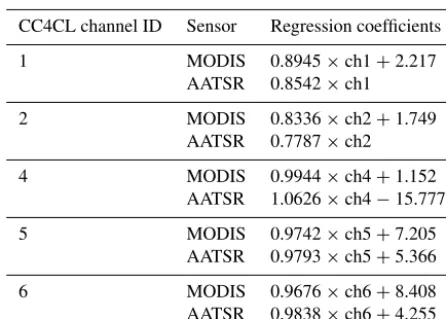
optimization. They are fixed for all sensors and orbits. As the ANN was trained with AVHRR data only, differences in spectral response functions need to be considered before the ANN can be applied to MODIS and AATSR. We derived appropriate coefficients through linear regression analysis between collocated satellite observations for each input channel pair (Table 3), applying a filter on differences in satellite zenith angle (>0.5◦), sun zenith angle (>1◦), and observation time (>30 min). The resulting coefficients were applied to MODIS and AATSR satellite data before ANN input.
We estimate cloud mask uncertainty based on the assump-tion that this uncertainty is inversely proporassump-tional to the dif-ference between retrieved ANNCOD and the threshold ap-plied. As a first step, we generated a CALIOP cloud mask by application of a clear–cloudy threshold value of 0.05. The CALIOP cloud mask is then compared with the collo-cated ANN mask by quantification of a percent correct (PEC) score. PEC estimates the ratio between all correctly classi-fied pixels and the number of all pixels analysed. Finally, the “truth” uncertainty is defined as 100−PEC %. We then es-tablished the statistical relationship between this uncertainty and the ANNCOD difference to its threshold. Before appli-cation of the approach, we normalized differences (ND) to 1. We found a linear correlation between uncertainty and ND for clear cases given by
y =37.275×ND+49.2, (1) and a second-order polynomial correlation for cloudy cases (Fig. 2)
Table 3.Linear regression coefficients between collocated AVHRR and MODIS/AATSR channels.
CC4CL channel ID Sensor Regression coefficients
1 MODIS 0.8945×ch1+2.217 AATSR 0.8542×ch1
2 MODIS 0.8336×ch2+1.749 AATSR 0.7787×ch2
4 MODIS 0.9944×ch4+1.152 AATSR 1.0626×ch4−15.777
5 MODIS 0.9742×ch5+7.205 AATSR 0.9793×ch5+5.366
6 MODIS 0.9676×ch6+8.408 AATSR 0.9838×ch6+4.255
3.3.2 Cloud typing
Cloud phase is determined by application of the Pavolonis cloud typing algorithm (Pavolonis et al., 2005). The Pavolo-nis algorithm outputs six cloud types (Table 4), which we then reclassified into water or ice clouds: liquid is fog/warm liquid/supercooled and ice is opaque ice/cirrus/overlap. For CC4CL, the fog type test was deactivated. The algorithm always uses the 0.65, 11, and 12 µm channel data. It reads 3.75 µm data whenever available and 1.65 µm otherwise. These two different approaches produce nearly identical re-sults, except for certain thin clouds and cloud edges (Pavolo-nis et al., 2005). In addition, we introduced two new cloud types within CC4CL. In response to validation studies, we decided to change the phase of ice clouds whose retrieved CTT is >273.16 K, the freezing point of water (new cloud type being SWITCHED_TO_ WATER), and of water clouds whose CTT<233.16 K, the lower limit of supercooled water (SWITCHED_TO_ICE).
The Pavolonis algorithm has weaknesses in detecting cir-rus clouds at high latitudes, which are often misclassified as opaque ice clouds. Performance is considerably better when the VIIRS algorithm is used, which provides additional chan-nels and threshold tests. However, these cannot be applied to our AVHRR heritage dataset (Pavolonis et al., 2005).
3.3.3 Optimal estimation retrieval of COT, CER, and CTP
The optimal estimation retrieval ORAC is a non-linear sta-tistical inversion method based on Bayes’ theorem (Rodgers, 2009). A state vector containing all variables to be retrieved is optimized to obtain the best fit between observed TOA ra-diances and rara-diances simulated by a forward model. The re-trieval problem is that of finding the minimum value of a cost function. This function is based on aχ2distribution, which is a combination of the squared deviations between the
mea-Table 4.Cloud type classification for CC4CL and CALIOP. n/a – not applicable.
ID CC4CL ID CALIOP
0 clear 0 low transparent 1 switched to water 1 low opaque 2 fog 2 stratocumulus 3 water 3 low broken cumulus 4 supercooled 4 altocumulus 5 switched to ice 5 altostratus 6 opaque ice 6 cirrus
7 cirrus 7 deep convective 8 overlap 8 n/a
surements and the forward model and the retrieved state vec-tor and the a priori state vecvec-tor, each weighted by their associ-ated uncertainties. The important benefits of ORAC, relative to more traditional retrieval methods, are that cloud param-eters are retrieved using information in all satellite channels simultaneously, so that the retrieved parameters provide a ro-bust representation of the shortwave and longwave radiance effects of the observed cloud. The algorithm estimates the re-trieval uncertainty, which quantifies the range of values that are feasible considering the uncertainty in the satellite mea-surements, ancillary data, and ORAC forward model. For a more detailed description of the ORAC algorithm see Part 2 of this publication (McGarragh et al., 2018c).
3.4 Post-processing
For each input pixel, the main processor evaluates these in-puts twice, assuming different cloud phases (e.g. ice and liquid). In theory, ORAC could use the preprocessed cloud mask and phase to select an appropriate method to re-duce processing time. The post-processor will then select the appropriate output variables according to the Pavolonis cloud phase. As described in Sect. 3.3.2, the post-processor changes cloud phase in case retrieved CTT does not match the Pavolonis phase. Finally, output variables are written to primary and secondary NetCDF files (Table 5).
4 L2 data – initial analysis
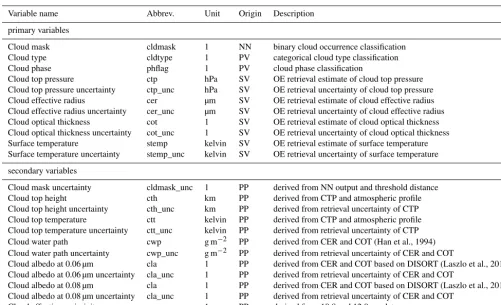
Table 5.CC4CL primary and secondary output. NN is neural network, SV is state vector, PP is post-processed, PV is Pavolonis et al. (2005) algorithm, and OE is optimal estimation.
Variable name Abbrev. Unit Origin Description
primary variables
Cloud mask cldmask 1 NN binary cloud occurrence classification
Cloud type cldtype 1 PV categorical cloud type classification
Cloud phase phflag 1 PV cloud phase classification
Cloud top pressure ctp hPa SV OE retrieval estimate of cloud top pressure Cloud top pressure uncertainty ctp_unc hPa SV OE retrieval uncertainty of cloud top pressure Cloud effective radius cer µm SV OE retrieval estimate of cloud effective radius Cloud effective radius uncertainty cer_unc µm SV OE retrieval uncertainty of cloud effective radius Cloud optical thickness cot 1 SV OE retrieval estimate of cloud optical thickness Cloud optical thickness uncertainty cot_unc 1 SV OE retrieval uncertainty of cloud optical thickness Surface temperature stemp kelvin SV OE retrieval estimate of surface temperature Surface temperature uncertainty stemp_unc kelvin SV OE retrieval uncertainty of surface temperature
secondary variables
Cloud mask uncertainty cldmask_unc 1 PP derived from NN output and threshold distance
Cloud top height cth km PP derived from CTP and atmospheric profile
Cloud top height uncertainty cth_unc km PP derived from retrieval uncertainty of CTP Cloud top temperature ctt kelvin PP derived from CTP and atmospheric profile Cloud top temperature uncertainty ctt_unc kelvin PP derived from retrieval uncertainty of CTP Cloud water path cwp g m−2 PP derived from CER and COT (Han et al., 1994) Cloud water path uncertainty cwp_unc g m−2 PP derived from retrieval uncertainty of CER and COT
Cloud albedo at 0.06 µm cla 1 PP derived from CER and COT based on DISORT (Laszlo et al., 2016) Cloud albedo at 0.06 µm uncertainty cla_unc 1 PP derived from retrieval uncertainty of CER and COT
Cloud albedo at 0.08 µm cla 1 PP derived from CER and COT based on DISORT (Laszlo et al., 2016) Cloud albedo at 0.08 µm uncertainty cla_unc 1 PP derived from retrieval uncertainty of CER and COT
Cloud effective emissivity cee 1 PP derived from 10.8 and 12.0 µm data
4.1 CC4CL cloud properties
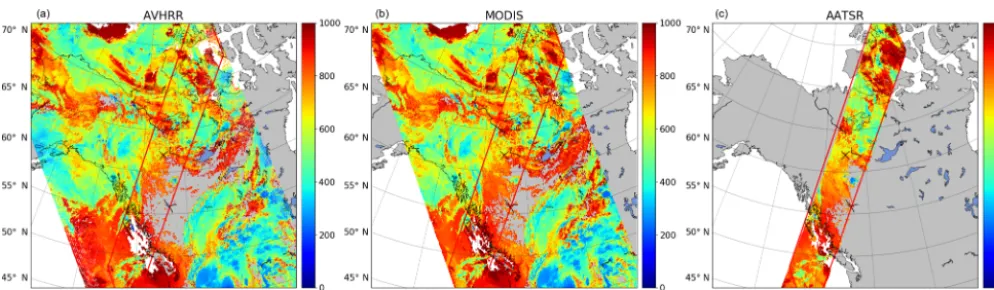
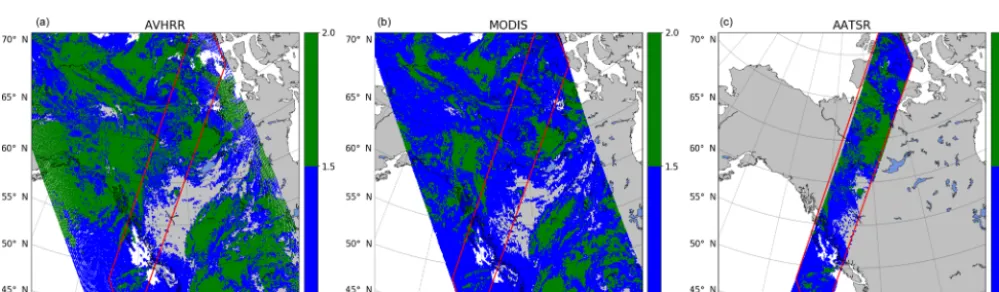
The sample scene (22 July 2008 20:58 LST) is character-ized by various cloud types, and the CC4CL cloud mask defines a relatively small fraction as cloud-free (Figs. 3, 4, 5, 6). Visually, similar spatial patterns are observed in the three products. The data show that there are more cloud-free AVHRR pixels, which is related to the coarser spatial resolu-tion compared to MODIS and AATSR. The LST difference is≤5 min, so there is little cloud displacement between ob-servations.
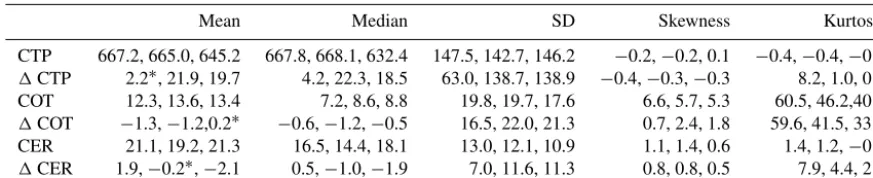
CTP data are approximately normally distributed for all three sensors. Both COT and CER show positive kurtosis and skewness, as values close to 0 are common. CER data are somewhat bimodal, having a primary peak at ∼12 µm and a secondary peak at ∼35 µm (Fig. 8, Table 6). These peaks probably correspond to liquid and ice phase clouds, respectively. Mean value differences are not significant be-tween AVHRR and MODIS for CTP, MODIS and AATSR for COT, and AVHRR and AATSR for CER. The standard deviation of differences between two sensors is always low-est for AVHRR minus MODIS (Table 6). Significance tlow-ests of mean differences and standard deviations of residuals be-tween sensor retrievals are sensitive to outliers. Although cloud displacement due to observation time differences is
probably small, we cannot discard its influence on such out-liers. Even though we found no significant relationship be-tween sensor retrieval residuals and observation time differ-ence (not shown), residuals are likely to be smaller and thus possibly insignificant if sensor observation times were iden-tical. Moreover, even modest relative radiometric calibration differences between sensors of a couple percent could cause large retrieval differences, particularly for COT.
4.2 Uncertainties
Figure 3.CTP retrieval values for study area NA2 with data from AVHRR(a), MODIS(b), and AATSR(c).
Figure 4.COT retrieval values for study area NA2 with data from AVHRR(a), MODIS(b), and AATSR(c).
relative retrieval uncertainties (100×uncertainty/retrieved value) are shown for CTP, COT, and CER.
4.3 Comparison with CALIOP
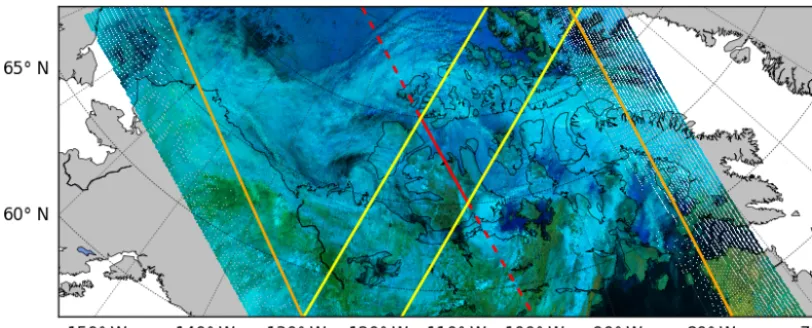
We found collocations between CALIOP, AVHRR, MODIS, and AATSR for three study areas in the Arctic at 22 July 2008 19:15 LST (study area North America 1= NA1, n=120, Fig. 9; RGB channels: red is ,Ch4 solar component, green is Ch2, blue is Ch1), 22 July 2008 20:58 LST (NA2,n=163, Fig. 11), and 27 July 2008 08:10 LST (Siberia=SIB,
n=116, Fig. 13). These are located within 60 to 75◦N lat-itude and contain vegetated land, snow-covered land, open ocean, and sea-ice surfaces. For NA1 and SIB, all CALIOP pixels were classified as cloud-covered, while for NA2 about half of the pixels are cloud-free.
When including AATSR, collocations are restricted to high-latitude areas and by the narrow swath of AATSR. We thus decided to include another scene without AATSR data in the Gulf of Guinea–West Africa between 7◦S and 12◦N at 24 October 2009 13:45 LST (Africa=AFR, n=1181, Fig. 15). There, about 10 times more pixels are available than in the other scenes and cloud systems not contained in
the Arctic data are observed, such as low-level stratocumulus and deep convection.
Figure 5.CER retrieval values for study area NA2 with data from AVHRR(a), MODIS(b), and AATSR(c).
Figure 6.Cloud phase retrieval values for study area NA2 with data from AVHRR(a), MODIS(b), and AATSR(c).
which adjusts the retrieved CTH to where the physical cloud top would be expected, assuming an adiabatic profile.
4.3.1 Case studies Case study NA1
Study area NA1 is a completely cloud-covered scene over northern Canada containing clear and ice-covered land and open ocean surfaces (Figs. 9, 10). There are a variety of single and multilayered clouds. CC4CL correctly classifies all pixels as cloud-covered, with a few exceptions in sec-tors 3 and 4 (Figs. 9, 10). CTH retrievals are consistent between the three sensors, only differing in sector 2. CTH is generally lower than CALIOP’s top-layer height, unless the latter is optically thick as in sector 4. In the case of a (semi-)transparent cloud top layer, multiple surfaces (several cloud layers, Earth surface) contribute to the observed satel-lite data. CC4CL CTH is then located closer to, at, or even below the underlying cloud layer (sectors 1, 3, and 2, respec-tively). For a single-layer cloud with COT>1, CC4CL and CALIOP CTH agree very well (sector 4). Under such condi-tions, the retrieval is very accurate. Cloud phase agreement between CC4CL and CALIOP is very variable. It is best for
optically thick high ice cloud coverage (sector 1) and worst for low water clouds (sector 4).
Case study NA2
Study area NA2 is located entirely over snow- or ice-free land in western Canada. CALIOP cloud coverage is 4.5 %, spatially broken, and variable in height and phase. Clear-sky pixels are mostly identified by CC4CL (69.3 % rect), and cloudy pixels are occasionally missed (78.7 % cor-rect). CC4CL retrievals of thin high clouds and false positive cloudy pixels have low CTH values (sector 1). Small-scale horizontal variability in CALIOP cloud phase is reflected by CC4CL data, which overestimate the fraction of liquid wa-ter clouds in sector 2. CC4CL reproduces CALIOP’s spatial variability in CTH, which it slightly underestimates by 0.5– 1 km in sector 2. In sector 3 CC4CL considerably underesti-mates CTH by up to 7 km. Most of these clouds are optically and geometrically thin.
Case study SIB
par-Figure 7.Absolute uncertainties of MODIS AQUA retrieval data for study area NA2 and CTP [hPa], COT, CER [µm], and Cloud mask [%].
Figure 8.Density histograms of NOAA18 (N18), MODIS AQUA (MYD), and AATSR (ENV) retrieval data for study area NA2 and(a)CTP,
(b)COT, and(c)CER.
tially snow- or ice-covered land surfaces. According to both CALIOP and CC4CL, it is completely cloud-covered.
In the event of single-layer cloudiness, CC4CL CTH agrees very well with CALIOP (sector 1 and, in particular, sector 3). The CTH difference between CC4CL retrievals increases in the presence of overlapping clouds (sector 2).
op-Table 6.Statistics of CTP, COT, and CER retrieval values for study area NA2 and AVHRR (first value in each cell), MODIS (second value), and AATSR (third value).1values are given for AVHRR minus MODIS (first value in each cell), AVHRR minus AATSR (second value), and MODIS minus AATSR (third value).
Mean Median SD Skewness Kurtosis
CTP 667.2, 665.0, 645.2 667.8, 668.1, 632.4 147.5, 142.7, 146.2 −0.2,−0.2, 0.1 −0.4,−0.4,−0.8
1CTP 2.2∗, 21.9, 19.7 4.2, 22.3, 18.5 63.0, 138.7, 138.9 −0.4,−0.3,−0.3 8.2, 1.0, 0.7 COT 12.3, 13.6, 13.4 7.2, 8.6, 8.8 19.8, 19.7, 17.6 6.6, 5.7, 5.3 60.5, 46.2,40.8
1COT −1.3,−1.2,0.2∗ −0.6,−1.2,−0.5 16.5, 22.0, 21.3 0.7, 2.4, 1.8 59.6, 41.5, 33.1 CER 21.1, 19.2, 21.3 16.5, 14.4, 18.1 13.0, 12.1, 10.9 1.1, 1.4, 0.6 1.4, 1.2,−0.8
1CER 1.9,−0.2∗,−2.1 0.5,−1.0,−1.9 7.0, 11.6, 11.3 0.8, 0.8, 0.5 7.9, 4.4, 2.3
∗ttestpvalue>0.1, indicating that differences in mean values are not significant.
tically thin clouds (sector 2) and, less frequently, stratiform cloudiness (sector 3).
4.3.2 Case study AFR
Study area AFR is located over the Gulf of Guinea and Western Africa, containing open ocean and snow- and ice-free land surfaces. As we excluded AATSR data, about 10 times more pixel collocations with CALIOP are available (n=1181) than for previous cases. Additionally, measure-ments contain tropical and coastal cloud systems such as ex-tensive low-level stratiform cloudiness and continental deep convection (Fig. 15).
In general, the quantitative and qualitative agreement be-tween CC4CL and CALIOP CTH is impressive. CC4CL data track the spatial pattern of continental CTH very well (sec-tor 3), which increases northwards and shows some small-scale variability beyond 8◦N. However, CC4CL underesti-mates CTH of vertically thick clouds and instead places the cloud top at a layer’s vertical centre. The height of the strati-form cloud field is almost identical for CC4CL and CALIOP, although CTH of near-surface stratiform clouds is overesti-mated below thin high cirrus (sector 1). For the small layer located at 4 km height at ∼6.7◦S and the thin high cirrus layer around 2◦S, MODIS retrieval values differ somewhat from CC4CL AVHRR and CALIOP. Again, the phase of op-tically thick clouds is retrieved very well, but this is not the case for the thin ice cirrus clouds. Generally, CC4CL using the AVHRR heritage channel dataset is almost entirely in-sensitive to the very high, thin cloud layer in sector 1 (cov-ering stratiform clouds) and 2 (cov(cov-ering the sea surface). Here, CC4CL is rather driven by contributions from very low clouds or the sea surface.
4.3.3 Summary of case studies
The four study areas clearly show that CC4CL retrievals of CTH are very close to CALIOP values for single-layer, op-tically thick clouds. For significant extents of the regions presented, the CTH is accurate to within 240 m. For mul-tilayer clouds, CC4CL estimates are almost exclusively
lo-cated in between CALIOP’s top and bottom layer estimates. For these cases, the optimal estimation algorithm processes satellite signals that are likely to contain radiance contribu-tions from multiple cloud layers. The OE then optimizes the fit between modelled and observed radiances by placing the cloud lower in the atmospheric profile, and so the mixed na-ture of the satellite data leads to an underestimation of CTH. The results shown here are a representative sample from an extensive validation performed within the Cloud_cci project (Stengel et al., 2017).
There is no clear influence of the underlying land type or topography on retrieval values or the cloud mask. However, the limited sample size does not allow for generalizations. For site NA2, CALIOP identified cloud-free pixels, 69.3 % of which were also detected as cloud-free by CC4CL’s neu-ral network cloud mask, and with few exceptions as low-level water clouds otherwise. In relatively few cases, CC4CL fails to detect clouds seen by CALIOP (% of missed clouds is 9.0 (NA1), 21.3 (NA2), 0.6 (SIB), 3.1 (AFR)). We did not ac-count for fractional cloud coverage, as we set a grid box as cloud-covered when any corresponding CC4CL pixel con-tains cloud information. As a consequence, there are slightly more cloud-covered pixels for the spatially higher resolved MODIS and AATSR data than for AVHRR.
Figure 9.Study area NA1 (North America 1). Red (Ch1), green (Ch2), and blue (Ch4–Ch5) image derived from NOAA18 data resampled to 0.01◦×0.01◦resolution. Date of observation is 22 July 2008, 19:15 LST. Orange lines: extent of the collocated MODIS granule; yellow lines: extent of the collocated AATSR orbit; red line: CALIOP track outside (dashed) and within (solid) study area.
Figure 10.Vertical cross section of study area NA1 (North America 1) along the CALIOP track at 5 km horizontal resolution. Top: CTH for CC4CL retrievals (coloured points) and CALIOP measurements (vertical bars), and surface elevation and surface type (blue is open water, green is land, grey is snow/ice). The CALIOP data are shown for those pressure layers where the cumulative top-to-bottom COD exceeds a threshold value of 0 (top layer), 0.15 (mid-layer), and 1 (bottom layer). Bottom: cloud mask/phase (ice to water is red to blue, cloud-free is white, not determined is grey) and type (see Table 4 for key–value pairs) for all three CALIOP layers and CC4CL retrievals. For CC4CL, cloud phase was averaged when resampling, and cloud type was assigned to the most frequent class per grid box. Sectors of characteristic cloud fields are separated by black vertical lines. Number of pixelsn=120.
For ice clouds, the most frequently occurring cloud types are cirrus (ID=6) for CALIOP and overlap (ID=8) or cir-rus (ID=7) for CC4CL. Water cloud types are more het-erogeneous and for CALIOP predominantly low transparent (ID=0), but altostratus (ID=5) and altocumulus (ID=4) are also frequent. CC4CL water clouds are approximately equally distributed amongst water (ID=3) and supercooled (ID=4) cloud types.
Figure 11.Study area NA2 (North America 2). As Fig. 9, but on 22 July 2008, at 20:58 LST.
Figure 12.Study area NA2 (North America 2). As Fig. 10, but on 2 July 2008, 20:58 LST (n=163).
5 Discussion
5.1 The flexibility of the optimal estimation approach In general, the retrieved values are insensitive to the spe-cific instrument evaluated. Absolute mean differences are ≤21.9 hPa for CTP, ≤1.3 for COT, and ≤2.1 for CER. These are mostly smaller than the mean retrieval uncertain-ties themselves. Moreover, the RGB images show that all ma-jor patterns of cloud coverage and structure are resolved by all three sensors. However, AATSR data show larger devia-tions than the other sensors (Fig. 8). It is unlikely that differ-ences in spectral response functions are the reason. MODIS and AATSR heritage channels are relatively close in their spectral response but their retrieval values do differ consid-erably. Also, even though spectral response differences are largest between MODIS and AVHRR (which results in a
re-flectance difference of up to 30–40 % (Trishchenko et al., 2002), their retrieval values are much more similar. The dif-ference between AATSR and both AVHRR and MODIS is largest for CER, so microphysical variables, which are de-rived from reflectance data only, appear to be most affected.
non-Figure 13.Study area SIB (Siberia). As Fig. 9, but on 27 July 2008, 08:10 LST.
Figure 14.Study area SIB (Siberia). As Fig. 10, but on 27 July 2008, 08:10 LST (n=116).
significantt test result is possibly too strict a metric for es-timating the consistency of retrieval results. There is a range of confounding processes that affect each individual retrieval estimate, such as observation times, spectral responses, cal-ibration deficiencies, and a varying number of cloudy pixels to be compared. We did not quantify the contribution of each of these processes to overall retrieval differences when us-ing different sensor data. Although we expect that spectral response differences are probably negligible, we still find it worth quantifying their impact, which was outside the scope of this paper and the ESA Cloud_cci project. The case stud-ies clearly show that, under optimal conditions for single-layer cloud retrievals, CC4CL products are consistent with CALIOP and practically insensitive to sensor characteristics. We suggest that AVHRR and MODIS data can be used interchangeably, depending on the user’s application, such
Figure 15.Study area AFR (Africa). As Fig. 9, but on 24 October 2009, 13:45 LST.
Figure 16.Study area AFR (Africa). As Fig. 10, but on 24 October 2009, 13:45 LST. Due to space restrictions, no cloud type values are shown in table.n=1181.
5.2 The value of uncertainty quantification
The retrieval uncertainties prove to be a valuable source of information. On the one hand, they are useful for several user applications, such as model validation, data assimilation applications, or climate studies in general (Liu et al., 2017; Yang et al., 2016). On the other hand, they allow for diag-nosis of potential retrieval shortcomings. For example, we see that COT uncertainty scales with COT itself and is thus heteroscedastic (see also Poulsen et al., 2012). CC4CL COT values are at times unnaturally large, and the associated un-certainty reflects that. Also, it highlights under which condi-tions the optimal estimator converges to a solution with a rel-atively large divergence from the measurements, which here are associated with optically thick clouds or underlying snow or ice cover (see also Kahn et al., 2015; Wang et al., 2011).
COT and CER uncertainties are clearly largest and reflect the limited information available with which to retrieve these values. For further possible explanations due to assumptions and limitations within the methodology applied, please see Part 2.
area NA2 (Fig. 7) show uncertainties of 40–50 %. This indi-cates that the NN is sensitive to bright ground cover, which may be confused with clouds. We suggest that users of ESA Cloud_cci data should routinely consult cloud mask uncer-tainties. If a more conservative cloud mask is required, it can be easily built by setting a maximum value for an acceptable uncertainty level.
5.3 Strengths and weaknesses
The results clearly show that CC4CL retrieves CTH of single-layer, optically thick clouds with high accuracy and precision. When compared to CALIOP, the mean deviation for these cases is as low as 10–240 m CTH. This is a promis-ing result and shows that the optimal estimation framework is robust and appropriate for retrieving cloud properties from AVHRR heritage channels.
In the case of multilayer clouds, CC4CL is not able to re-trieve CTH of the top layer when it is optically thin. The estimate is somewhere between the two cloud pressure val-ues. This is an expected limitation of our framework, and also of other retrieval algorithms using passive sensor data (Holz et al., 2008; Karlsson and Dybbroe, 2010). Poulsen et al. (2012) found that ORAC CTP and CER estimates are robust when the top ice cloud layer is>5 optical depths, and otherwise they are the weighted average of several cloud lay-ers. The AVHRR heritage channels do not provide sufficient information on retrieving cloud vertical structure. In the case of semi-transparent top-layer clouds, the upwelling signal, whether it stems from a cloud or the Earth’s surface, con-tributes to the total TOA reflectance or brightness tempera-ture. This mixed satellite measurement is input to CC4CL, which retrieves cloud parameters assuming a single cloud layer. As brightness temperatures and reflectances of, for ex-ample, a cold, semi-transparent, bright top-layer cirrus cloud overlapping a warmer, opaque, and darker low-level water cloud, are a mix of several contributing surfaces, so will be the final retrieval value. Any CTH retrieved from AVHRR (heritage) data is the radiatively effective rather than physical cloud top (Karlsson et al., 2013). For CC4CL, we often see that the final CTH estimate is placed between top and lower levels and is thus an underestimate, which is a common prob-lem amongst retrieval algorithms using passive sensor data (Watts et al., 2011; Holz et al., 2008; Karlsson et al., 2013).
Multilayer cloud property retrievals have been developed (Watts et al., 2011), and we also implemented and tested such an approach within CC4CL (McGarragh et al., 2018b). However, this method requires MODIS channels beyond the AVHRR heritage set and thus will not be applicable to a full AVHRR reprocessing. For ESA Cloud_cci, a conscious de-cision was made to trade spectral information for time se-ries continuity. Thus, discontinuities due to changing spec-tral coverage within the entire dataset are avoided (Stengel et al., 2017). In addition, we introduced corrected estimates of CTP and the derived CTT and CTH to get closer to the
physical or geometrical cloud top. The correction is based on a vertical displacement of CTP along the atmospheric profile based on optical thickness and the cloud’s extinction coeffi-cient, which is a function of CER (McGarragh et al., 2018a). The correction is only made for ice phase clouds.
At first glance, estimates of cloud phase appear reason-able when compared to CALIOP. However, we find the best overall agreement of∼65 % for the lower layers (cumulative COD>0.15 or>1). This is just slightly better than a ran-dom guess of cloud phase. Cloud phase is generally difficult to quantify, and estimates of various satellite-derived prod-ucts disagree considerably for that variable (Stengel et al., 2015). An evaluation of MODIS C6 cloud phase yielded a total cloud phase agreement of over 90 % with CALIOP. However, as the study is exclusively based on single-phase cloudy pixels, the performance of MODIS C6 as applied to multi-phase pixels is still unknown (Marchant et al., 2016). We also find very high scores for cloud phase determination when restricting the analysis to optically thick, spatially ex-tensive cloud fields such as in study site AFR. There, cloud phase agrees with lower layer CALIOP estimates by as much as 95 %.
The key problems for phase determination are vertical stratification and the lack of direct in situ measurements of cloud phase. CALIOP observations, as well as DARDAR (radar–lidar; Ceccaldi et al., 2013), are currently considered to be the most advanced estimates of cloud phase, relying on active measurement principles with depolarization and to-tal attenuated backscatter at multiple wavelengths for addi-tional constraints (Winker et al., 2009; Karlsson and Dyb-broe, 2010). However, this assumption is primarily based on the physical theory underlying their retrievals rather than on a comprehensive validation with independent observations of cloud phase.
Within CC4CL, we apply the Pavolonis algorithm for phase detection (Pavolonis et al., 2005). It was designed us-ing simulated radiance data for varyus-ing phase and further ad-justed after analysis with real satellite data. The algorithm itself is a decision tree that contains a set of fixed thresh-old values for input reflectances and brightness temperatures, and it was tuned to AVHRR. Even though we expect differ-ences in phase determination between AVHRR vs. MODIS and AATSR due to varying spectral response functions, these were not large for the three study sites. Pavolonis et al. (2005) state that their product could not be validated due to the lack of direct observations, but rather underwent a consistency check with ground-based, independent estimates.
optically thick clouds, CC4CL can be compared with any layer exceeding a cumulative optical thickness of 0 or 1. If such a cloud layer was covered by optically and geometri-cally thin cirrus clouds, the satellite data are still dominated by lower cloud level reflectance and, in particular, emittance. Consequently, Pavolonis cloud phase is not a top-layer esti-mate in such cases. For study area AFR, we also found sit-uations where the NN cloud mask, which was trained with CALIOP data, correctly identifies thin high cirrus as cloud over ocean but the cloud type algorithm failed to identify its ice phase. One potential improvement would be to use the NN to provide an estimate of cloud phase. Initial tests indi-cated that this approach would indeed improve the (global) agreement with CALIOP, which is to be expected, as the NN is trained with CALIOP data. However, no estimate of cloud type would be provided. It would also be worth investigat-ing the relationship between the quality of retrieved variables (CTH, COT, CER, cloud phase) and cloud mask uncertainty. CALIOP data are considered to be the current benchmark of cloud detection, vertical structure, and phase (Winker et al., 2009; Karlsson and Johansson, 2013; Holz et al., 2008) and are – except for the cloud mask – a source of validation with absolute independence from CC4CL. The main limi-tation of CALIOP though is its narrow view, so that global coverage is very limited. Also, the instrument is only able to probe the full geometrical depth of clouds whose total op-tical thickness is not larger than about 3–5 (Karlsson and Johansson, 2013). We found no clear relationship between CC4CL CTP uncertainty and the difference between CC4CL CTP and CALIOP CTP (data not shown). This suggests that the AVHRR heritage channels provide independent informa-tion on cloud vertical structure that is not clearly related to CALIOP’s CTP estimates. Retrieval uncertainty is estimated using only well-understood error sources (e.g. measurement and forward model error), neglecting errors due to model as-sumptions (e.g. the complex, real vertical structure). Such er-rors can be approximated through validation activities and are not currently believed to be significant in most circum-stances.
6 Conclusions
We have shown that CC4CL is a robust and flexible frame-work for producing cloud products from passive satellite sensor data. Differences between retrieved values for collo-cated satellite data are smaller than estimated uncertainties for AVHRR, MODIS, and AATSR. ESA Cloud_cci data pro-vide climatologies (AVHRR) as well as highly resolved snap-shots for selected regions (e.g. Europe, MODIS). The com-plete sensor set of CC4CL data forms a unique, coherent, long-term, multi-instrument cloud property product that ex-ploits synergistic capabilities of several EO missions. Com-pared to single sensor retrievals, CC4CL data are improved in terms of accuracy and spatiotemporal sampling.
CC4CL explicitly estimates retrieval uncertainties accord-ing to the principles of error propagation through optimal es-timation theory. These uncertainties are a valuable source for model validation, data assimilation, climate studies, or re-trieval diagnosis. Cloud mask uncertainty is a novel feature that enables the user to assess product quality and to create individualized cloud masks.
We find that CC4CL is limited by weaknesses that are common to passive sensor cloud product retrievals. In gen-eral, an initial comparison against CALIOP data shows that the CTH of optically thin clouds is underestimated. In the case of multilayer clouds, the retrieved CTH is a mixture of all radiatively contributing cloud layers. The AVHRR her-itage channels do not provide sufficient physical informa-tion that would allow for detailed retrievals of cloud vertical structure. Moreover, the forward cloud model is structurally incomplete, as it assumes a single-plane cloud layer. A multi-layer cloud property retrieval has been added to CC4CL, but is only applicable to MODIS data.
To account for CTH underestimation, we implemented a correction for CTH that assumes that passive sensor data see beyond the top into the clouds up to a penetration depth of ∼1 optical depth. Corrected cloud top values are stored as separate variables within CC4CL output files.
Similarly, we find that the cloud phase estimate is only accurate for optimal retrieval conditions (optically thick top clouds). In a subsequent reprocessing of the AVHRR data record, we replaced the Pavolonis et al. (2005) algorithm with a neural network cloud phase estimation with better per-formance scores.
Under optimal conditions for single-layer cloud retrievals, CC4CL products show little sensitivity to sensor character-istics. Single-layer, optically thick cloud retrievals are very accurate when compared against CALIOP (bias<240 m), which emphasizes the maturity and robustness of CC4CL. We thus recommend ESA Cloud_cci data to be used for mul-tiannual studies of cloud parameters and more detailed as-sessments of regional patterns and diurnal variability.
Data availability. Please refer to Stengel et al. (2017) for DOIs of
Appendix A
Table A1.ERA-Interim variables used within CC4CL. Variables marked with * are available at 0.1◦spatial resolution; all others default to 0.72◦.
Variable name Abbrev. ID Unit
Profile variables
Geopotential Z 129 m2s−2
Temperature T 130 K
Specific humidity Q 133 kg kg−1 Log. surface pressure LNSP 152 Pa Ozone mass mixing ratio O3 203 kg kg−1
Surface and single level variables
Sea-ice cover* CI 31 (0–1)
Snow albedo ASN 32 (0–1)
Sea surface temperature SSTK 34 K Total column water vapour TCWV 137 kg m−2
Snow depth* SD 141 m of water equivalent 10 mUwind component U10M 165 m s−1
10 mUwind component V10M 166 m s−1
2 m temperature T2M 167 K
Land–sea mask LSM 172 (0,1)
Skin temperature* SKT 235 K
Table A2.CC4CL L2 primary output variables. NN is neural network.
Variable name Abbrev. Unit
Latitude lat degree
Longitude long degree
Solar zenith solzen degree
Satellite zenith satzen degree Relative azimuth relaz degree
Cloud top pressure ctp hPa
Cloud top height cth kilometre
Cloud top temperature ctt kelvin Cloud liquid water path cwp g m−2 Cloud effective radius cer µm Cloud optical thickness cot 1 NN cloud optical thickness cccot 1
Cloud albedo cla 1
Cloud effective emissivity cee 1
Cloud fraction cc_total 1
NN cloud mask cldmask (0,1)
Cloud phase flag phflag 1
Table A3.CC4CL L2 secondary output variables. NN is neural network.
Variable name Abbrev. Unit
Competing interests. The authors declare that they have no conflict of interest.
Acknowledgements. NASA kindly provided MODIS Collection
6 radiance data. ECMWF kindly provided support and assistance with their computing facilities for development and processing. This work was supported by the European Space Agency through the Cloud_cci project (contract no. 4000109870/13/I-NB).
Edited by: Brian Kahn
Reviewed by: three anonymous referees
References
Baum, B. A., Menzel, W. P., Frey, R. A., Tobin, D. C., Holz, R. E., Ackerman, S. A., Heidinger, A. K., and Yang, P.: MODIS Cloud-Top Property Refinements for Collection 6, J. Appl. Me-teorol. Clim., 51, 1145–1163, https://doi.org/10.1175/JAMC-D-11-0203.1, 2012.
Berrisford, P., Dee, D., Poli, P., Brugge, R., Fielding, K., Fuentes, M., Kållberg, P., Kobayashi, S., Uppala, S., and Simmons, A.: The ERA-Interim archive Version 2.0, Shinfield Park, Reading, 2011.
CDO: Climate Data Operators, available at: http://www.mpimet. mpg.de/cdo, last access: 1 July 2015.
Ceccaldi, M., Delanoë, J., Hogan, R. J., Pounder, N. L., Protat, A., and Pelon, J.: From CloudSat-CALIPSO to EarthCare: Evolu-tion of the DARDAR cloud classificaEvolu-tion and its comparison to airborne radar-lidar observations, J. Geophys. Res.-Atmos., 118, 7962–7981, https://doi.org/10.1002/jgrd.50579, 2013.
Christensen, M. W., Stephens, G. L., and Lebsock, M. D.: Exposing biases in retrieved low cloud properties from CloudSat: A guide for evaluating observations and cli-mate data, J. Geophys. Res.-Atmos., 118, 12120–12131, https://doi.org/10.1002/2013JD020224, 2013.
CM SAF: The Satellite Application Facility on Climate Monitoring, available at: http://www.cmsaf.eu, last access: 13 October 2015. Comiso, J. C. and Hall, D. K.: Climate trends in the Arctic as observed from space, Wires Clim. Change, 5, 389–409, https://doi.org/10.1002/wcc.277, 2014.
Dee, D. P., Uppala, S. M., Simmons, A. J., Berrisford, P., Poli, P., Kobayashi, S., Andrae, U., Balmaseda, M. A., Balsamo, G., Bauer, P., Bechtold, P., Beljaars, A. C. M., van de Berg, L., Bid-lot, J., Bormann, N., Delsol, C., Dragani, R., Fuentes, M., Geer, A. J., Haimberger, L., Healy, S. B., Hersbach, H., Hólm, E. V., Isaksen, L., Kållberg, P., Köhler, M., Matricardi, M., McNally, A. P., Monge-Sanz, B. M., Morcrette, J.-J., Park, B.-K., Peubey, C., de Rosnay, P., Tavolato, C., Thépaut, J.-N., and Vitart, F.: The ERA-Interim reanalysis: configuration and performance of the data assimilation system, Q. J. Roy. Meteor. Soc., 137, 553–597, https://doi.org/10.1002/qj.828, 2011.
Devasthale, A., Raspaud, M., and Schlundt, C.: PyGAC: an open-source, community-driven Python interface to preprocess more than 30-year AVHRR Global Area Coverage (GAC) data, in preparation, 2018.
ESA CCI: The ESA Climate Change Initiative, available at: http: //cci.esa.int/, last access: 13 October 2015.
Hamann, U., Walther, A., Baum, B., Bennartz, R., Bugliaro, L., Derrien, M., Francis, P. N., Heidinger, A., Joro, S., Kniffka, A., Le Gléau, H., Lockhoff, M., Lutz, H.-J., Meirink, J. F., Minnis, P., Palikonda, R., Roebeling, R., Thoss, A., Platnick, S., Watts, P., and Wind, G.: Remote sensing of cloud top pressure/height from SEVIRI: analysis of ten current retrieval algorithms, At-mos. Meas. Tech., 7, 2839–2867, https://doi.org/10.5194/amt-7-2839-2014, 2014.
Han, Q., Rossow, W. B., and Lacis, A. A.: Near-Global Survey of Effective Droplet Radii in Liquid Water Clouds Using IS-CCP Data, J. Climate, 7, 465–497, https://doi.org/10.1175/1520-0442(1994)007<0465:NGSOED>2.0.CO;2, 1994.
Heidinger, A. K. and Pavolonis, M. J.: Gazing at Cir-rus Clouds for 25 Years through a Split Window. Part I: Methodology, J. Appl. Meteorol. Clim., 48, 1100, https://doi.org/10.1175/2008JAMC1882.1, 2009.
Heidinger, A. K., Evan, A. T., Foster, M. J., and Walther, A.: A Naive Bayesian Cloud-Detection Scheme Derived from CALIPSO and Applied within PATMOS-x, J. Appl. Meteo-rol. Clim., 51, 1129–1144, https://doi.org/10.1175/JAMC-D-11-02.1, 2012.
Heidinger, A. K., Foster, M. J., Walther, A., and Zhao, X.: The Pathfinder Atmospheres–Extended AVHRR Cli-mate Dataset, B. Am. Meteorol. Soc., 95, 909–922, https://doi.org/10.1175/BAMS-D-12-00246.1, 2013.
Hollmann, R., Merchant, C. J., Saunders, R., Downy, C., Buchwitz, M., Cazenave, A., Chuvieco, E., Defourny, P., de Leeuw, G., Forsberg, R., Holzer-Popp, T., Paul, F., Sandven, S., Sathyen-dranath, S., van Roozendael, M., and Wagner, W.: The ESA Climate Change Initiative: Satellite Data Records for Essen-tial Climate Variables, B. Am. Meteorol. Soc., 94, 1541–1552, https://doi.org/10.1175/BAMS-D-11-00254.1, 2013.
Holz, R. E., Ackerman, S. A., Nagle, F. W., Frey, R., Dutcher, S., Kuehn, R. E., Vaughan, M. A., and Baum, B.: Global Moder-ate Resolution Imaging Spectroradiometer (MODIS) cloud de-tection and height evaluation using CALIOP, J. Geophys. Res.-Atmos., 113, D00A19, https://doi.org/10.1029/2008JD009837, 2008.
IPCC: Summary for Policymakers, book section SPM, Cambridge University Press, Cambridge, United Kingdom and New York, NY, USA, 1–30, https://doi.org/10.1017/CBO9781107415324.004, 2013. Jacobowitz, H., Stowe, L. L., Ohring, G., Heidinger, A., Knapp,
K., and Nalli, N. R.: The Advanced Very High Resolution Ra-diometer Pathfinder Atmosphere (PATMOS) Climate Dataset: A Resource for Climate Research, B. Am. Meteorol. Soc., 84, 785– 793, https://doi.org/10.1175/BAMS-84-6-785, 2003.
Kahn, B. H., Schreier, M. M., Yue, Q., Fetzer, E. J., Irion, F. W., Platnick, S., Wang, C., Nasiri, S. L., and L’Ecuyer, T. S.: Pixel-scale assessment and uncertainty analysis of AIRS and MODIS ice cloud optical thickness and effec-tive radius, J. Geophys. Res.-Atmos., 120, 11669–11689, https://doi.org/10.1002/2015JD023950, 2015.
Karlsson, K.-G. and Johansson, E.: On the optimal method for evaluating cloud products from passive satellite imagery us-ing CALIPSO-CALIOP data: example investigatus-ing the CM SAF CLARA-A1 dataset, Atmos. Meas. Tech., 6, 1271–1286, https://doi.org/10.5194/amt-6-1271-2013, 2013.
Karlsson, K.-G., Riihelä, A., Müller, R., Meirink, J. F., Sedlar, J., Stengel, M., Lockhoff, M., Trentmann, J., Kaspar, F., Holl-mann, R., and Wolters, E.: CLARA-A1: a cloud, albedo, and radiation dataset from 28 yr of global AVHRR data, Atmos. Chem. Phys., 13, 5351–5367, https://doi.org/10.5194/acp-13-5351-2013, 2013.
Karlsson, K.-G., Sedlar, J., Devasthale, A., Stengel, M., Hanschmann, T., Meirink, J. F., Benas, N., and van Zadelhoff, G.-J.: Validation Report – CM SAF Cloud, Albedo, Radiation data record, AVHRR-based, Edition 2 (CLARA-A2) – Cloud Products, Tech. Rep. 2.3, EUMET-SAT Satellite Application Facility on Climate Monitoring, https://doi.org/10.5676/EUM_SAF_CM/CLARA_AVHRR/V002, 2016.
Kiehl, J. and Trenberth, K. E.: Earth’s annual global mean energy budget, B. Am. Meteorol. Soc., 78, 197–208, 1997.
King, M., Kaufman, Y., Menzel, W., and Tanre, D.: Remote sensing of cloud, aerosol, and water vapor properties from the moder-ate resolution imaging spectrometer (MODIS), IEEE T. Geosci. Remote, 30, 2–27, https://doi.org/10.1109/36.124212, 1992. Laszlo, I., Stamnes, K., Wiscombe, W. J., and Tsay, S.-C.: The
Discrete Ordinate Algorithm, DISORT for Radiative Trans-fer, Springer Berlin Heidelberg, Berlin, Heidelberg, 3–65, https://doi.org/10.1007/978-3-662-49538-4_1, 2016.
Liu, C., Allan, R. P., Mayer, M., Hyder, P., Loeb, N. G., Roberts, C. D., Valdivieso, M., Edwards, J. M., and Vidale, P.: Evaluation of satellite and reanalysis-based global net surface energy flux and uncertainty estimates, J. Geophys. Res.-Atmos., 122, 6250– 6272, https://doi.org/10.1002/2017JD026616, 2017.
Lucht, W.: Expected retrieval accuracies of bidirectional re-flectance and albedo from EOS-MODIS and MISR angu-lar sampling, J. Geophys. Res.-Atmos., 103, 8763–8778, https://doi.org/10.1029/98JD00089, 1998.
Marchant, B., Platnick, S., Meyer, K., Arnold, G. T., and Riedi, J.: MODIS Collection 6 shortwave-derived cloud phase classifica-tion algorithm and comparisons with CALIOP, Atmos. Meas. Tech., 9, 1587–1599, https://doi.org/10.5194/amt-9-1587-2016, 2016.
McGarragh, G., Poulsen, C., Christensen, M., Sus, O., Povey, A., Proud, S., and Grainger, R.: On the retrieval of cloud top pressure of semi-transparent clouds: Methods and radiative consistency, J. Atmos. Sci., in preparation, 2018a.
McGarragh, G., Poulsen, C., Siddans, R., Povey, A., Proud, S., Thomas, G., and Grainger, R.: Optimal Retrieval of Aerosol and Cloud (ORAC): the multilayer cloud retrieval, Atmos. Meas. Tech. Discuss., in preparation, 2018b.
McGarragh, G. R., Poulsen, C. A., Thomas, G. E., Povey, A. C., Sus, O., Stapelberg, S., Schlundt, C., Proud, S., Christensen, M. W., Stengel, M., Hollmann, R., and Grainger, R. G.: The Com-munity Cloud retrieval for CLimate (CC4CL) – Part 2: The op-timal estimation approach, Atmos. Meas. Tech., 11, 3397–3431, https://doi.org/10.5194/amt-11-3397-2018, 2018c.
Menzel, W. P., Frey, R. A., and Baum, B. A.: Cloud top proper-ties and cloud phase algorithm theoretical basis document,
ver-sion 11, available at: https://modis-images.gsfc.nasa.gov/_docs/ MOD06-ATBD_2015_05_01.pdf (last access: 11 June 2018), 2015.
Merchant, C. J., Embury, O., Rayner, N. A., Berry, D. I., Cor-lett, G. K., Lean, K., Veal, K. L., Kent, E. C., Llewellyn-Jones, D. T., Remedios, J. J., and Saunders, R.: A 20 year independent record of sea surface temperature for climate from Along-Track Scanning Radiometers, J. Geophys. Res.-Oceans, 117, c12013, https://doi.org/10.1029/2012JC008400, 2012.
Minnis, P., Sun-Mack, S., Young, D. F., Heck, P. W., Garber, D. P., Chen, Y., Spangenberg, D. A., Arduini, R. F., Trepte, Q. Z., Smith, W. L., Ayers, J. K., Gibson, S. C., Miller, W. F., Hong, G., Chakrapani, V., Takano, Y., Liou, K. N., Xie, Y., and Yang, P.: CERES Edition-2 Cloud Property Re-trievals Using TRMM VIRS and Terra and Aqua MODIS Data – Part I: Algorithms, IEEE T. Geosci. Remote, 49, 4374–4400, https://doi.org/10.1109/TGRS.2011.2144601, 2011.
MODIS Characterization Support Team: MODIS Level 1B Product User’s Guide, NASA Goddard Space Flight Center, 2009. Nakajima, T. and King, M. D.: Determination of the
Opti-cal Thickness and Effective Particle Radius of Clouds from Reflected Solar Radiation Measurements. Part I: Theory, J. Atmos. Sci., 47, 1878–1893, https://doi.org/10.1175/1520-0469(1990)047<1878:DOTOTA>2.0.CO;2, 1990.
NASA LP DAAC: MOD02 Level-1B Calibrated Geoloca-tion Data Set. Version 6. NASA EOSDIS Land Pro-cesses DAAC, USGS Earth Resources Observation and Science (EROS) Center, Sioux Falls, South Dakota, https://doi.org/10.5067/MODIS/MOD021KM.006, 2015. Natural Environment Research Council, NERC CWVC GRAPE
campaign participants, and Grainger, D.: Global Cloud and Aerosol Dataset Produced by the Global Retrieval of ATSR Cloud Parameters and Evaluation (GRAPE) Project as part of the Clouds, Water Vapour and Climate (CWVC) Programme. NCAS British Atmospheric Data Centre, available at: http://catalogue. ceda.ac.uk/uuid/cf7ae349d16c067cd00d3d2d910bee89, last ac-cess: 13 October 2015.
Norris, J. R., Allen, R. J., Evan, A. T., Zelinka, M. D., O’Dell, C. W., and Klein, S. A.: Evidence for climate change in the satellite cloud record, Nature, 536, 72–75, https://doi.org/10.1038/nature18273, 2016.
Pavolonis, M. J., Heidinger, A. K., and Uttal, T.: Daytime Global Cloud Typing from AVHRR and VIIRS: Algorithm Description, Validation, and Comparisons, J. Appl. Meteorol., 44, 804–826, 2005.
Platnick, S.: Vertical photon transport in cloud remote sens-ing problems, J. Geophys. Res.-Atmos., 105, 22919–22935, https://doi.org/10.1029/2000JD900333, 2000.
Platnick, S., Meyer, K. G., King, M. D., Wind, G., Amarasinghe, N., Marchant, B., Arnold, G. T., Zhang, Z., Hubanks, P. A., Holz, R. E., Yang, P., Ridgway, W. L., and Riedi, J.: The MODIS Cloud Optical and Microphysical Products: Collection 6 Updates and Examples From Terra and Aqua, IEEE T. Geosci. Remote, 55, 502–525, https://doi.org/10.1109/TGRS.2016.2610522, 2017. Poulsen, C. A., Siddans, R., Thomas, G. E., Sayer, A. M., Grainger,

![Figure 7. Absolute uncertainties of MODIS AQUA retrieval data for study area NA2 and CTP [hPa], COT, CER [µm], and Cloud mask [%].](https://thumb-us.123doks.com/thumbv2/123dok_us/22606.1502248/12.612.49.548.453.588/figure-absolute-uncertainties-modis-aqua-retrieval-study-cloud.webp)