University of New Hampshire
University of New Hampshire Scholars' Repository
NH Water Resources Research Center Scholarship NH Water Resources Research Center
6-1-2017
Determining the Effectiveness of the Clean Air Act
and Amendments for the Recovery of Surface
Waters in the Northeastern U.S.
William H. McDowell
University of New Hampshire, [email protected]
Sarah J. Nelson University of Maine
Steve Kahl
University of New Hampshire
J. Saros
University of Maine
Follow this and additional works at:https://scholars.unh.edu/nh_wrrc_scholarship
This Report is brought to you for free and open access by the NH Water Resources Research Center at University of New Hampshire Scholars' Repository. It has been accepted for inclusion in NH Water Resources Research Center Scholarship by an authorized administrator of University of New Hampshire Scholars' Repository. For more information, please [email protected].
Recommended Citation
McDowell, William H.; Nelson, Sarah J.; Kahl, Steve; and Saros, J., "Determining the Effectiveness of the Clean Air Act and
Amendments for the Recovery of Surface Waters in the Northeastern U.S." (2017).NH Water Resources Research Center Scholarship. 4.
Determining the Effectiveness of the Clean Air Act and Amendments for the Recovery of Surface Waters in the Northeaste
Determining the Effectiveness of the Clean Air Act and
Amendments for the Recovery of Surface Waters in the
Northeastern U.S.
Basic Information
Title: Determining the Effectiveness of the Clean Air Act and Amendments for the Recovery of Surface Waters in the Northeastern U.S.
Project Number: 2014NH192S
USGS Grant
Number: G14AP00132
Sponsoring Agency: EPA
Start Date: 7/26/2014
End Date: 8/31/2017
Funding Source: 104S
Congressional District:
Research Category: Not Applicable
Focus Categories: None, None, None
Descriptors: None
Principal Investigators:
Publications
1. Brown, R., J. Saros S. Nelson. 2016. Using paleolimnological evidence to assess the consequences of increased dissolved organic carbon in recent decades in lakes of the Northeastern US. J Paleolimnol, in review.
2. Boeff, K.A., K.E. Strock, J.E. Saros. 2016. Evaluating planktonic diatom response to climate change across three lakes with differing morphometry. J Paleolimnol. DOI 10.1007/s10933-016-9889-z. 3. Strock, K.E., Saros, J.E., Nelson, S.J., S.D. Birkel, J.S. Kahl, W.H. McDowell. 2016. Extreme
weather years drive episodic changes in lake chemistry: implications for recovery from sulfate deposition and long-term trends in dissolved organic carbon. Biogeochemistry, 127(2-3), 353-365. 4. Brown, R., J. Saros S. Nelson. 2016. Using paleolimnological evidence to assess the consequences of
increased dissolved organic carbon in recent decades in lakes of the Northeastern US. J Paleolimnol, in review.
Determining the Effectiveness of the Clean Air Act and Amendments for the Recovery of Surface Waters in the Northeaste
6. Strock, K.E., Saros, J.E., Nelson, S.J., S.D. Birkel, J.S. Kahl, W.H. McDowell. 2016. Extreme weather years drive episodic changes in lake chemistry: implications for recovery from sulfate deposition and long-term trends in dissolved organic carbon. Biogeochemistry, 127(2-3), 353-365. 7. Soranno, P.A., and 79 others, including S.J. Nelson, W.H. McDowell, 2017. LAGOS-NE: A
multi-scaled geospatial and temporal database of lake ecological context and water quality for thousands of U.S. lakes. Submitted, GigaScience (GIGA-D-17-00112).
8. Gavin, A.L., S.J. Nelson, A.J. Klemmer, I.J. Fernandez, K.E. Strock, W.H. McDowell, 2017. Climate linkages to increases of dissolved organic carbon in acid-sensitive high elevation lakes. Submitted, Water Resources Research (2017WR020963).
9. Brown, R.E., S.J. Nelson, J.E. Saros, 2016. Paleolimnological evidence of the consequences of recent increased dissolved organic carbon (DOC) in lakes of the northeastern USA. Journal of
Paleolimnology, 57(1), 19-35.
10.Hunt , C. W., Snyder, L., Salisbury, J.E., Vandemark, D., McDowell, W.H. 2017. SIPCO2: A simple, inexpensive surface water pCO2 sensor. Limnology and Oceanography Methods. doi:
10.1002/lom3.10157.
11.Boeff, K.A., K.E. Strock, J.E. Saros. 2016. Evaluating planktonic diatom response to climate change across three lakes with differing morphometry. J Paleolimnol. 56(1), 33-47.
Annual Report to
USGS WRD WRRI, Reston, VA US EPA, CAMD, Washington DC and
US EPA, ORD, Corvallis OR
May, 2017
Determining the effectiveness of the Clean Air Act and Amendments on the
recovery of surface waters in the northeastern US
IAG 06HQGR0143
Principal Investigators: William H. McDowell1, Sarah J. Nelson2, J. Steve Kahl1, J. Saros2
1Univ. of New Hampshire, 2Univ. of Maine
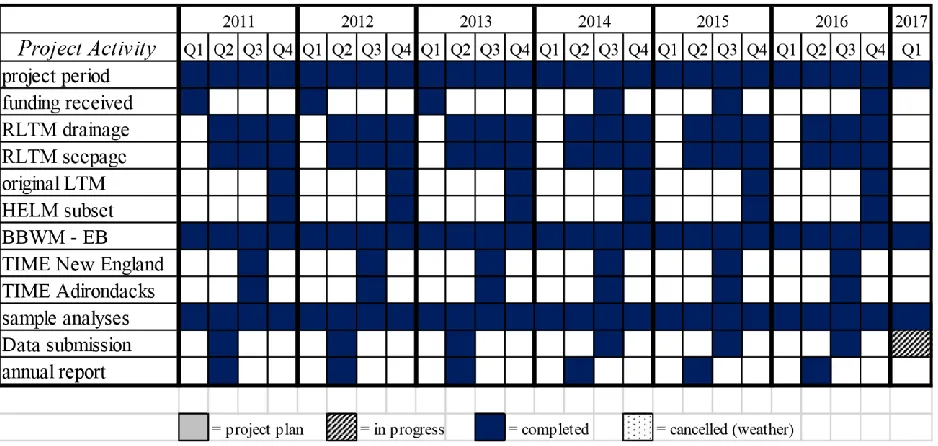
Overview of activities during 2016-2017. A schematic summary of progress on the project plan is provided below (Table 1) and discussed on the following pages. We have concluded the final year of five for the most current project agreement, which supports the continuing needs of EPA to assess the effectiveness of the Clean Air Act Amendments of 1990 (CAAA). Field work and data assessment continue on schedule. Project coordination as well as most analytical chemistry, and some field sampling are conducted by the University of New Hampshire. Additional field sampling, data quality assurance, and data reporting are conducted by the University of Maine. This year the project is partially funding a Postdoctoral Researcher who is evaluating biotic and abiotic changes in the LTM and TIME lakes. One graduate student at the University of Maine was partly funded through this project. Publications by three graduate students who were
supported last year by this funding or leveraged research were completed. One publication by the current graduate student is in review. One research faculty at the University of Maine was partly supported during this project year to coordinate sampling, develop R code for data QA and analysis, and begin to transition data management to a new secure server. Additionally, this project continues to fund a portion of the base program of stream chemistry monitoring at Bear Brook Watershed in Maine (BBWM), for the reference watershed, East Bear. BBWM has just completed a three-year NSF DEB grant that is evaluating nitrogen dynamics in both watersheds using 15N tracer studies, and has transitioned to a NSF RAPID grant that funds observation of ‘recovery’ from acidification. The base funding through this IAG project created continuity that was key in securing the NSF award.
Table 1. 2011-2016 Project plan progress to date.
Project background
Objectives. This research is part of EPA CAMD programs that are verifying the effectiveness of emission controls at reducing acidification of surface waters. Our approach is to collect longterm high-quality data that characterize the trends and patterns of response in low ionic-strength
surface waters. We have specifically targeted waters that have been classified as being sensitive to acidic deposition and will represent lakes across the Northeast in varying landscape settings. The goals and methods are hierarchical, ranging from intensive site-specific investigations to regional assessment of sites that have been chosen to provide a statistically rigorous sample of regional surface waters. The objectives are to:
1) document the changes and patterns in aquatic chemistry for defined sub-populations and sites that are known to be susceptible to acidification or recovery;
2) evaluate the extent to which changes in surface waters, if any, can be linked to changes in deposition that are driven by regulatory actions;
3) characterize the effectiveness of the CAAA in meeting goals of reducing acidification of surface waters and improving biologically-relevant chemistry in the northeastern US;
4) provide information for assessment of the need for future reductions in atmospheric deposition based on the long-term trajectories of the systems under study; and
3
Approach. The schedule of tasks ranges from weekly to annual, continuing data records that now range from 23 to 34 years. We evaluate chemistry on a weekly basis year-round at the small watershed-scale at BBWM, quarterly in LTM, and annually during the historical index period for the TIME and HELM lakes. These project components provide a statistical framework for inferring regional patterns in chemistry using TIME and LTM (and ELS-II under separate funding). The
long-term records of LTM, HELM and BBWM provide information on seasonal and annual variability, and thus provide a seasonal context for the annual surveys.
Expected Results. This information is needed for EPA to meet its Congressional mandate to assess the effectiveness of the CAAA. The combination of site-specific data within the regional context provides a rigorous assessment of the effects of declining pollutant emissions on SO4
concentrations, base cation depletion, and changes in N-saturation or DOC contributions to acidbase status. The results are also central to assessing whether additional emission reductions may be needed to produce recovery.
Project Status: Water Chemistry
Field sampling. All project field objectives in 2016 were accomplished as planned. A summary of the annual field schedule for this project is provided below (Table 2). HELM sampling was
previously accomplished through helicopter access, but in 2016 a limited set of HELM sites were sampled during day hikes.
Table 2. Annual project field schedule for lake sampling
Times
Project sub-project n Sampled Field work May June July Aug. Sept. Oct.
RLTM-Maine
seepage 3 3 UMaine X X X
drainage 10 3 UMaine/UNH X X X
LTM lakes 3 1 UMaine X
TIME
New England 31 1 UNH X X X
Adirondacks 43 1 ALSC X X X
HELM 8 1 UMaine X
Analytical. Analyses are complete for all samples collected through 2016. All laboratory
Service Region 1 laboratory in Durham, NH. All analyses for TIME, RLTM, and HELM continue to be conducted by, or under the supervision of, Jody Potter as has been the case since 2012.
Samples from East Bear Brook at BBWM, which are collected on a regular basis year-round,
continue to be analyzed at the University of Maine Sawyer Water Research Lab. The LTM color and closed cell pH samples were also analyzed there.
Data reporting. All data collected through 2015 have been delivered to EPA. The next delivery of data to EPA is expected by August 31 2017, after evaluation of inter-laboratory comparisons and regular QA analyses by UNH and UMaine.
Presentation of findings. Several publications and presentations continue to result from this project and are listed at the end of this report. Recent leveraged funding supported portions of two M.S. theses and a Ph.D. dissertation at UMaine under the supervision of co-PI Saros; results of those projects are now published (Strock et al. 2014, 2016; Boeff et al. 2016; Brown et al. 2016).
New developments: During the past five years we were able to make routine two new sets of analyses to continue to extract new and innovative information from these study sites. A subset of lakes were analyzed for DOC quality using SUVA and fluorescence (EEMS) analysis, as well as concentrations of the dissolved greenhouse gases (CH4, CO2, and N2O) in surface waters. Moving
forward, these data will provide valuable insight into changes in organic sources to acidbase status as well as the influence of precipitation event variability on long-term changes in surface water chemistry.
Publications using related project information (recent publications in bold):
Soranno, P.A., and 79 others, including S.J. Nelson, W.H. McDowell, 2017. LAGOS-NE: A multi-scaled geospatial and temporal database of lake ecological context and water quality for thousands of U.S. lakes. Submitted, GigaScience (GIGA-D-17-00112).
Gavin, A.L., S.J. Nelson, A.J. Klemmer, I.J. Fernandez, K.E. Strock, W.H. McDowell, 2017. Climate linkages to increases of dissolved organic carbon in acid-sensitive high elevation lakes. Submitted, Water Resources Research (2017WR020963).
Brown, R.E., S.J. Nelson, J.E. Saros, 2016. Paleolimnological evidence of the consequences of recent increased dissolved organic carbon (DOC) in lakes of the northeastern USA. Journal of Paleolimnology, 57(1), 19-35.
Hunt , C. W., Snyder, L., Salisbury, J.E., Vandemark, D., McDowell, W.H. 2017. SIPCO2: A simple, inexpensive surface water pCO2 sensor. Limnology and Oceanography Methods. doi: 10.1002/lom3.10157.
Boeff, K.A., K.E. Strock, J.E. Saros. 2016. Evaluating planktonic diatom response to climate change across three lakes with differing morphometry. J Paleolimnol. 56(1), 3347.
5
recovery from sulfate deposition and long-term trends in dissolved organic carbon.
Biogeochemistry, 127(2-3), 353-365.
Strock, K., S. Nelson, J. Kahl, J. Saros, W. McDowell, 2014. Decadal trends reveal recent acceleration in the rate of recovery from acidification in the northeastern US. Environ. Sci. Technol. 48(9):4681-4689.
Sanclements, M., G. Oelsner, D. McKnight, S.J. Nelson, J. Stoddard, 2012. New insights into the source of decadal increases of dissolved organic matter (DOM) in acid-sensitive lakes of the northeastern U.S. Environmental Science and Technology 46(6): 3212–3219; DOI:
10.1007/s11356-009-0176-7.
Nelson, S.J., P. Vaux, M.J. James-Pirri, and G. Giese. 2012. Natural resource condition assessment: Cape Cod National Seashore, Massachusetts. Natural Resource Report NPS/NER/NRR— 2012/605. National Park Service, Fort Collins, Colorado.
James-Pirri, M. J., S. J. Nelson, and P. D. Vaux. June 2011. Natural Resource Condition Assessment for Saugus Iron Works National Historic Site. Natural Resource Report NPS/NER/NRR— 2011/457. National Park Service. Fort Collins, Colorado.
Kerr, J.G., M.C. Eimers, I.F. Creed, M.B. Adams, F. Beall, D. Burns, J.L. Campbell, S.F.
Christopher, T.A. Clair, F. Courchesne, L. Duchesne, I. Fernandez, D. Houle, D.S. Jeffries, G.E. Likens, M.J. Mitchell, J. Shanley, H. Yao, 2011, The effects of seasonal drying on sulphate dynamics in streams across southeastern Canada and the northeastern USA, Biogeochemistry DOI 10.1007/s10533-011-9664-1.
Navrátil, T., S.A. Norton, I.J. Fernandez, S.J. Nelson, 2010. Twenty-year inter-annual trends and seasonal variations in precipitation and stream water chemistry at the Bear Brook Watershed in Maine, USA. Environ. Monit. Assess. 171:3-21.
Norton, S.; Fernandez, I.; Kahl, J.; Rustad, L.; Navratil, Tomas; Almquist, H., 2010. The
evolution of the science of Bear Brook Watershed in Maine, USA. Environmental Monitoring and Assessment, 171(1-4): 3-21.
Vaux, P.D., S.J. Nelson, N. Rajakaruna, G. Mittelhauser, K. Bell, B. Kopp, J. Peckenham, G. Longsworth, 2008. Assessment of natural resource conditions in and adjacent to Acadia National Park, Maine. Natural Resource Report NPS/NRPC/WRD/NRR—2008/069. National Park Service, Fort Collins, Colorado.
Baumann, A.J. and J.S. Kahl, 2007. Chemical trends in Maine High Elevation Lakes. LakeLine 27:30-34.
Hunt, K., J.S. Kahl, J. Rubin, and D. Mageean, 2007. Assessing the science-based needs of stakeholders; a case study on acid rain research and policy. Journal of Contemporary Water Research and Education, 136: 68-79.
Rosfjord, C., K. Webster, J.S. Kahl, S.A. Norton, I. Fernandez, and A. Herlihy, 2007.
Anthropogenically-driven changes in chloride complicate interpretation of base cation trends in lakes recovering from acidic deposition. Environ Sci Technol, 41:7688 -7693.
Campbell, J, J. Hornbeck, M. Mitchell, M. Adams, M. Castro, C. Driscoll, J.S. Kahl, and others, 2004. Input-output budgets for inorganic nitrogen for 24 watersheds in the northeastern United States. Water Air Soil Pollution, 151:373-396.
Lawler, J., J. Rubin, B.J. Cosby, I. Fernandez, J.S. Kahl, S. Norton, 2005. Predicting recovery from acidic deposition: Applying a modified TAF (Tracking Analysis Framework) Model to Maine High Elevation Lakes, Water Air Soil Pollution. 164:383-389.
Dupont, J., T. Clair, C. Gagnon, D. Jeffries, J.S. Kahl, S. Nelson, and J Peckenham, 2005. Estimation of critical loads of acidity in the northeastern US and eastern Canada. Environ. Monit. Assess. 109:275-291.
Kahl, J.S., J. Stoddard, R. Haeuber, S. Paulsen, R. Birnbaum, F. Deviney, D. DeWalle, C. Driscoll, A. Herlihy, J. Kellogg, P. Murdoch, K. Roy, W. Sharpe, S. Urquhart, R. Webb, and K.
Webster, 2004. Response of surface water chemistry to changes in acidic deposition: implications for future amendments to Clean Air Act. Environmental Science and Technology, Feature Article 38:484A-490A.
Norton, S., I. Fernandez, J.S. Kahl, and R. Reinhardt, 2004. Acidification trends and the evolution of neutralization mechanisms through time at the Bear Brook Watershed, Maine, USA. Water, Air, Soil, Pollution Focus 4:289-310.
Dissertations/theses:
Strock, K.E. 2013. Deciphering Climate-Mediated Changes in Boreal Lake Ecosystems. Ph.D. Dissertation, University of Maine, Orono, Maine.
Boeff, K. 2014. Evaluating the effect of a changing climate on thermocline depth in Maine’s Great Ponds. Master’s thesis, University of Maine, Orono, Maine.
Brown, R. 2014. Assessing the ecological effects of increased dissolved organic carbon in Maine lakes over recent decades. Master’s thesis, University of Maine, Orono, Maine.
Presentations using related project information (recent presentations in bold):
Nelson, S.J., W. H. McDowell, J. Saros, 2017. Northern New England Update. LTM Cooperators Meeting, May 16–17, 2017.
Saros, J.E., W. Gawley, S.J. Nelson, A. Klemmer, 2017. Monitoring Dissolved Organic Carbon (DOC) and Water Clarity in Maine’s Lakes. First Annual Lake Monitoring Summit, Feb. 15, 2017. Augusta, ME.
Nelson, S.J., C.Y. Chen, D.P. Krabbenhoft, J.S. Kahl, 2016. Beyond “hotspots” – dragonfly bio-sentinels describe vulnerability (or not) of northeastern lakes and their foodwebs to mercury accumulation. American Society for Limnology and Oceanography, June 6, 2016, Santa Fe, NM.
Nelson, S.J., C.Y. Chen, D.P. Krabbenhoft, J.S. Kahl. 2016. Beyond “Hotspots”: Dragonfly BioSentinels Describe Vulnerability (or not) of Northeastern Lakes and Their
7
of Environmental Biologists (NEAEB), March 23-25, 2016, Rockport, ME.
W.H. McDowell, S.J. Nelson, J.D. Potter, 2015. DOC concentrations of New England (USA) lakes: is there a response to changing atmospheric deposition? Acid Rain 2015, Rochester, NY, Oct. 19–23, 2015.
Roy, K., H. Pembrook, S. Nelson, A. Riscassi, M. McHale, E. Boyer, G. Lampman, C. Funk, 2015. Long Term Monitoring of Acidification in Sensitive Areas of the Northern and Eastern United States: A New Generation of Research. Poster Presentation. Acid Rain 2015,
Rochester, NY, Oct. 19–23, 2015.
McDowell, W.H. 2015. EPA TIME/LTM New England 2015. EPA Clean Air Act Cooperators meeting, Montpelier, VT. May 26 2015.
McDowell, W.G., K. Webster, S.J. Nelson, W.H. McDowell, J. Haney. Regulation and results: biotic and abiotic changes to northeastern lakes following tightening of air emission rules. Society for Freshwater Science, Milwaukee, WI, May 17- 21, 2015.
Appling, A.P., W.H. McDowell, J.D. Potter, S.J. Nelson, J.S. Kahl, 2014. From the frying pan into the fire? Lake greenhouse gas responses to acid rain recovery. Joint Aquatic Sciences Meeting. Portland, OR, May 18 – 23, 2014.
Brown, R.E., Saros, J.E. & S.J. Nelson. 2014. Algal community response to increases in dissolved organic carbon over recent decades. Poster presentation. Association for the Sciences of Limnology & Oceanography, Portland, OR, May, 2014.
Boeff, K. & J.E. Saros. 2014. Evaluating the effect of a changing climate on thermocline depth in Maine’s Great Ponds. Poster presentation. Association for the Sciences of Limnology & Oceanography, Portland, OR, May, 2014.
Brown, R.E., Saros, J.E. & S.J. Nelson. 2014. Algal community response to increases in dissolved organic carbon over recent decades. Poster presentation. Maine Water Conference, Augusta, ME, March, 2014.
Strock, K.E., Saros, J.E., Nelson, S.J. & S. Birkel. 2014. Interactive effects of extreme weather and reduced sulfate deposition: accelerated recovery from acidification and increased
brownification in lakes of the Northeast U.S. Association for the Sciences of Limnology & Oceanography, Portland, OR, May, 2014.
Boeff, K. & J.E. Saros. Evaluating the effect of changing wind strength on thermocline depth in Maine’s Great Ponds. 22nd Annual Harold W. Borns Jr. Symposium, Orono, ME, USA, April, 2014.
Brown, R.E., Saros, J.E. & S.J. Nelson. 2014. Algal community response to increases in dissolved organic carbon over recent decades. 22nd Annual Harold W. Borns Jr. Symposium, Orono, ME, USA, April, 2014.
S.J. Nelson, 2013. School of Forest Resources Faculty Blitz. Sept. 13, 2013.
Brown, R.E., Saros, J.E. & S.J. Nelson. 2013. Algal community response to increases in dissolved organic carbon: Implications for drinking water utilities. Poster presentation. North American Diatom Symposium, Bar Harbor, ME, August, 2013.
Nelson, S.J., C. Chen, D.P. Krabbenhoft, J.S. Kahl, B. Zoellick, 2013. Validating landscape models for mercury in northeastern US lakes using dragonfly larvae as mercury bio-sentinels. Accepted for poster presentation at the ICMGP - International Conference on Mercury as a Global
Pollutant, July 28- Aug. 3, 2013, Edinburgh, Scotland.
Boeff, K., J. Saros. 2013. Evaluating the Effect of Changing Wind Strength on Thermocline Depth in Maine’s Great Ponds. 21st Annual Harold W. Borns Jr. Symposium, Orono, ME, USA, April, 2013.
Brown, R.E., J.E. Saros, S.J. Nelson. Algal community response to increases in dissolved organic carbon in Maine lakes: implications for drinking water utilities. 21st Annual Harold W. Borns Jr. Symposium, Orono, ME, USA, April, 2013.
Strock, K.E., J.E. Saros, S. Birkel, S.J. Nelson, 2013. Exploring the effects of extreme hydrologic events in the northeastern U.S.: Implications for brownification and episodic acidification in Maine Lakes. 21st Annual Harold W. Borns Jr. Symposium, Orono, ME, USA, April, 2013.
Nelson, S.J., C. Chen, D.P. Krabbenhoft, J.S. Kahl, 2013. Dragonfly larvae as mercury biosentinels: a statistical survey of northeast lakes reveals landscape-driven patterns in water and biota
mercury concentrations. NERC (Northeastern Ecosystems Research Cooperative) meeting, March 19 – 20, 2013, Saratoga Springs, NY.
Strock, K.E.D., J.E. Saros, S.J. Nelson. 2013. The effects of extreme climate events on lakewater chemistry: Implications for “brownification” in Maine lakes. Maine Water Conference. Augusta, Maine, March 19, 2013.
Strock, K.E.D., J.E. Saros, S.J. Nelson, S.D. Birkel. 2013. The effects of extreme climate events on lakewater chemistry: implications for dissolved organic carbon trends in the northeast U.S. American Society of Limnology and Oceanography Meeting. New Orleans, Louisiana,
February 17-22, 2013.
Sanclements, M., G. Oelsner, D. McKnight, I.J. Fernandez, S.J. Nelson, M.B. Adams, M. Mineau, K. Simon, 2012. The effects of acidification and recovery on DOM quality and source in temperate forested watersheds. BIOGEOMON 2012, July 15-20, 2012, Northport, ME.
Strock, K.E., J.E. Saros, S.J. Nelson, 2012. Analyzing Legacy Data in a Climate Context to
Decipher Modern Changes in Lakewater Chemistry. Poster presentation. BIOGEOMON 2012, July 15-20, 2012, Northport, ME.
Fernandez, I.J., Norton, S.A., Nelson, S.J., Salvino, C., 2012. Evidence of Transient Alteration of N Dynamics From an Ice Storm at the Bear Brook Watershed in Maine, USA. Poster presentation. BIOGEOMON 2012, July 15-20, 2012, Northport, ME.
Saros, J.E., K.E.D. Strock, S. Birkel & S.J. Nelson. 2012. Deciphering the effects of extreme
9
Nelson, S.J., J.S. Kahl, A.J. Baumann, K.B. Johnson, 2012. “Rugged shores and clear waters”: Interpreting biogeochemical response to environmental stressors using the lakes and ponds of Maine’s Baxter State Park. Maine Water Conference, Augusta, ME, March 14, 2012.
Strock, K.E., J.E. Saros, S. Nelson. Why climate matters in recovery from acidification in northeastern US surface waters. Maine Water Conference, Augusta, ME, March 14, 2012.
Baumann, A.J., J.S. Kahl, T.R. Boucher, S.J. Nelson, and K.J. McGuire, 2012. “Changes in surface water chemistry in Maine high elevation lakes in response to the 1990 Clean Air Act Amendments. Maine Water Conference, Augusta, ME, March 14, 2012.
Mineau, M. M., K. S. Simon, D. T. Ely; R. L. Rancatti, I. J. Fernandez, S. A. Norton, and H. M. Valett. 2011. Effects of chronic nitrogen enrichment and acidification on coupled nitrogen and phosphorus cycling in streams: Insights from multiple spiraling techniques. Annual meeting, North American Benthological Society, Providence, RI.
Nelson, S.J., P. Vaux, M.J. James-Pirri. Data-driven assessments of National Park resources. (Invited). Acadian Internship in Regional Conservation and Stewardship, July 15, 2011.
Schneider, S.B., I.J. Fernandez, S.A. Norton, K.S. Simon. 2011. Soil base cation response to two decades of change at the Bear Brook Watershed in Maine. Gordon Conference on Catchment Science: Interactions of Hydrology, Biology and Chemistry. Bates College, Lewiston, Maine. July 10-15.
Nelson, S.J., C. Chen, H. Roebuck, B. Zoellick. Sensible sentinels: Preliminary mercury data for dragonfly nymphs (Odonata: anisoptera) across northern New England corroborate expected spatial pattern. The 10th International Conference on Mercury as a Global Pollutant (ICMGP), Halifax, NS, July 24-29, 2011; and presented at the Acadia Science Symposium, October 26, 2011.
Baumann, A.J., and J.S. Kahl, 2009. Assessing the effectiveness of federal acid rain policy using remote and high elevation lakes in northern New England. North American Lake Management Society International Symposium, Hartford, CT, October 29, 2009.
Kahl, J.S., 2009. Changes in base cations related to long-term changes in Cl distribution in northeastern lakes. Gordon Research Conference, Forested Catchments, July 12-17, 2009, Proctor Academy, NH.
Kahl, J.S., 2008 (invited). Twenty year changes in spatial patterns of Cl distribution in the northeastern US. NH Water Conference, April, 2008.
Kahl, J.S., 2007 (invited). Using societal-based incentives to address new threats to New
England Lakes. Day-long short course in New England Lake Science Academy, Camp Kieve, Maine. July, 2007.
Kahl, S., K. Webster, D. Sassan, C. Rosfjord, S. Nelson, M. Greenawalt-Yelle, 2007. Increasing Cl in northeastern surface waters: an indicator of increasing development pressure. Maine Water Conference, Augusta, ME, March 21, 2007.
Kahl, J.S., et al., 2006 (invited). The design of a national mercury monitoring network: Learning from the EPA acid rain experience. The Eighth International Mercury Conference, Madison WI, August 8, 2006.
Kahl, J.S. et al., 2006. Obfuscation of trends in base cations by regional salt contamination. Hubbard Brook Committee of Scientists annual meeting, July 12, 2006.
Kahl, J.S., 2006 (invited). 'Natural and human-derived sources of acidity in Maine Atlantic Salmon Rivers'. Atlantic Salmon Commission workshop on acidity, Bangor ME. April 10, 2006.
Kahl, J.S., 2005 (invited). The intersection of environmental science and environmental policy. NH Charitable Foundation Lakes Region annual meeting, Meredith, NH, September, 2005.
Kahl, J.S., 2005 (invited). Tracking response and recovery in surface waters in the northeastern US. Annual meeting of the Ecological Society of America, Montreal, August, 2005.
Kahl, J.S., and Catherine Rosfjord, 2005 (invited). Acid rain and the Clean Air Act in the northeastern US. Annual meeting of the NH-ME Androscoggin River Watershed Council, Bethel, June, 2005
Kahl, J.S., 2005 (invited). Developing a lake research agenda for NH. NSF workshop on lake research infrastructure in the northeast, Colby Sawyer College, April 2005.
Kahl, J.S., S. Nelson, and A. Grygo, 2004. Surface water chemistry data for the northeastern US for interpreting climate and acid rain trends. Northeast Ecosystems Research Consortium meeting, Durham, NH, October, 2004.
Kahl, J.S., K. Webster, M. Diehl, and C. Rosfjord, 2004. Successes of the Clean Air Act Amendments of 1990. Maine Water Conference invited plenary talk, Augusta, ME, 2004.
Kahl, J.S. and K. Johnson, 2004. Acid-Base Chemistry and Historical Trends in Downeast Salmon Rivers. Maine Water Conference, Augusta ME, April 2004.
Kahl, J.S., 2004 (invited). The Clean Air Act Amendments of 1990; testing a program designed to evaluate environmental policy. Lecture, Colby College. April, 2004
S.J. Nelson, J.S. Kahl, N.C. Kamman, D.P. Krabbenhoft, W.H. Halteman, 2009. (Poster) Predicting mercury concentrations in northeast lakes using hydrogeomorphic features, landscape setting and chemical co-variates. Gordon Research Conference, Forested Catchments, July 12-17, 2009, Proctor Academy, NH.
Nelson, S.J., I. Fernandez, S. Norton, B. Wiersma, L. Rustad, J.S. Kahl, 2008. The Bear Brook Watershed in Maine: Long-term research supporting climate change inquiry. Hydroclimatic effects on ecosystem response: participant workshop, Syracuse, NY, September 19, 2008. Nelson, S.J., N. Kamman, D. Krabbenhoft, J.S. Kahl, K. Webster, 2008. Evaluating spatial patterns in mercury and methyl mercury in northeastern lakes: Landscape setting, chemical climate, and human influences. Northeastern Ecosystem Research Cooperative Conference, Durham, NH, November 12-13, 2008.
11
Bear Brook publications and presentations that include “base program” data (East Bear Brook stream chemistry partly funded through this grant; recent publications and presentations in bold):
Crossman, J., M.C. Eimers, N.J. Casson, D.A. Burns, J.L. Campbell, G.E. Likens, M.J. Mitchell, S.J. Nelson, J.B. Shanley, S.A. Watmough, K.L. Webster, 2016. Regional meteorological drivers and long term trends of winter-spring nitrate dynamics across watersheds in north-eastern North America. Biogeochemistry, 130(3), 247-265.
Fatemi, F. R., Fernandez, I. J., Simon, K. S., & Dail, D. B. (2016). Nitrogen and phosphorus regulation of soil enzyme activities in acid forest soils. Soil Biology and Biochemistry, 98, 171-179.
Phelan, J., Belyazid, S., Jones, P., Cajka, J., Buckley, J., & Clark, C. (2016). Assessing the Effects of Climate Change and Air Pollution on Soil Properties and Plant Diversity in Sugar Maple–Beech–Yellow Birch Hardwood Forests in the Northeastern United States: Model Simulations from 1900 to 2100. Water, Air, & Soil Pollution, 227(3), 1-30.
Lawrence, G. B., Hazlett, P. W., Fernandez, I. J., Ouimet, R., Bailey, S. W., Shortle, W. C., ... & Antidormi, M. R. (2015). Declining Acidic Deposition Begins Reversal of Forest-Soil
Acidification in the Northeastern US and Eastern Canada. Environmental science & technology, 49(22), 13103-13111.
Eimers, C., J. Crossman, N. Casson, D. Burns, J. Campbell, G. Likens, M. Mitchell, S. Nelson, J. Shanley, S. Watmough, K. Webster, 2015. Nitrogen dynamics in the dormant season: an inter-watershed comparison. Poster presentation. Acid Rain 2015, Rochester, NY, Oct. 19– 23, 2015.
Mineau M. M., F. R. Fatemi, I. J. Fernandez and K. S. Simon. 2014. Microbial enzyme activity at the watershed scale: Response to chronic nitrogen deposition and acute phosphorous
enrichment. Biogeochemistry 117:131-142.
Mineau, Madeleine M., Chad M. Grigsby, Damon T. Ely, Ivan J. Fernandez, Stephen A. Norton, Tsutomu Ohno, H. Maurice Valett, and Kevin S. Simon. 2013. Chronic catchment nitrogen enrichment and stoichiometric constraints on the bioavailability of dissolved organic matter from leaf leachate. Freshwater Biology 58:248-260.
Gruselle, Marie-Cecile, Cayce Salvino, Ivan J. Fernandez, Kevin Simon and Corianne Tartariw. 2013. Does Chronic N Fertilization Increase P Limitation in Northeastern U.S. Forest Soils? (Paper 383-4). Presented at the ASA-CSSA-SSSA International Meetings. Tampa, Florida. November 3-6. ASA, CSSA, SSSA, Madison, WI.
Fatemi, Farrah, Michael D. SanClements, and Ivan J. Fernandez. 2013. Microbial Carbon Cycling Along a Drainage Sequence in a New England Forested Watershed. (Paper 252-2).
Presented at the ASA-CSSA-SSSA International Meetings. Tampa, Florida. November 3-6. ASA, CSSA, SSSA, Madison, WI.
Minneapolis, Minnesota 8/4-8/9.
SanClements, Michael, Ivan Fernandez, Mary Beth Adams, and Jenny Erwin. 2013. Linking Stream DOM Quality and Source to Watershed Acidification and Recovery in Temperate Forests of the Northeastern United States. 12th North American Forest Soils Conference, Whitefish, Montana. p. 112.
Gruselle, Marie-Cecile, Ivan Fernandez, and Corianne Tatariw. 2013. Manganese Dynamics in the Third Decade of Forest Ecosystem Experimental Acidification and Nitrogen Enrichment. 12th North American Forest Soils Conference, Whitefish, Montana. p. 35
MacRae, J.D., C. Tatariw, D. Rothenheber, S. Nelson, I.J. Fernandez. The effects of nitrogen enrichment on forest soil microbial communities and their activities, 2013 AEESP 50th Anniversary Conference, July 14-16, Golden, CO.
Boca, Antra, Mercedes Roman Dobarco, Helga Van Miegroet, Marie-Cecile Gruselle, Beate Michalzik, and Ivan Fernandez. 2013. Linking Overstory, Soil and Climate Characteristics to Explain C Storage in Forest Soils. 12th North American Forest Soils Conference, Whitefish, Montana. p. 29.
Gruselle, M.-C., Fernandez, I., Simon, K., Norton S., 2013. The effects of long-term ecosystem N enrichment on 15N dynamics at the Bear Brook Watershed in Maine. NERC 2013
Conference, Saratoga Springs, NY.
Minocha, Rakesh, Swathi A. Turlapati, Stephanie Long, Mohammad M. Bataineh, Aaron Weiskittel, Ivan Fernandez, and Lindsey Rustad. 2013. Chronic N and S additions impact foliar physiology of forest trees at the Bear Brook Watershed in Maine, USA. Hubbard Brook Experimental Forest Annual Meeting, Thornton, NH.
Ohno, Tsutomu, Ivan J. Fernandez, Rachel L. Sleighter, and Patrick G. Hatcher. Influence of depth on soil organic matter characteristics: An ultrahigh resolution mass spectrometry study. Advanced Analytical Characterization of Natural Organic Matter, Goldscmidt 2013, Florence, Italy, August 25-30, 2013.
Fernandez, Ivan J. and Sarah J. Nelson. 2013. Bear Brook, Backpack Sprayers, and What’s More Fun Than Gym Class? Invited seminar at the School of Forest Resources noon-time seminar series. University of Maine, Orono, Maine.
Mayewski, Paul, Ivan J. Fernandez, Stephen A. Norton and Sean Birkel. 2013. Presentation on Climate Change and Maine to the Allagash Wilderness Waterway Advisory Council. March 22. Augusta, Maine.
Fatemi, Farrah R., Ivan J. Fernandez, Stephen A. Norton and Lindsey E. Rustad. 2013. Soil solution response to two decades of experimental acidification at the Bear Brook Watershed in Maine. Water Air Soil Pollution. 223:6171–6186.
13
Fernandez, Ivan J., Stephen A. Norton, and Tiffany Wilson (eds.). 2012. BIOGEOMON 2012, The 7th International Symposium on Ecosystem Behavior. Northport, Maine. ISBN 978-087723-108-0. 261 pp. Fernandez, Ivan J., Madeleine M. Mineau, Kevin S. Simon, and Stephen A. Norton. 2012. The influence of decadal-scale N enrichment on N dynamics and 15N discrimination in a New England Forested Watershed. (Paper 302-2). Presented at the ASA-CSSA-SSSA International Meetings. Cincinnati, Ohio. October 22-25. ASA, CSSA, SSSA, Madison, WI.
Mineau, M.M., K.S. Simon, I.J. Fernandez, S.A. Norton, and H.M. Valett. The effect of chronic watershed nitrogen deposition and acidification on the interaction among phosphorus, carbon, and nitrogen uptake in streams. BIOGEOMON 2012, The 7th International Symposium on Ecosystem Behavior. Northport, Maine. ISBN 978-0-87723-108-0. p. 167.
Norton, S.A., I.J. Fernandez, T. Navratil, K.S. Simon, and S. Jain. 2012. The Bear Brook Watershed in Maine (BBWM) at 25: manipulation, monitoring, mechanisms, and modeling. BIOGEOMON 2012, The 7th International Symposium on Ecosystem Behavior. Northport, Maine. ISBN 978-0-87723-108-0. p. 177.