Effect of Multi-axis Whole Body Vibration
Exposures and Subject Postures on Typing
Performance
M.K. Bhiwapurkar V.H. Saran S.P. Harsha
Mechanical and Industrial Engineering Department, Indian Institute of Technology, Roorkee, India,
Abstract
The whole body vibration are known to affect the passenger’s activities such as reading, writing and typing, while traveling by train. An experimental study was therefore performed to investigate the extent of interference in typing task under multi axial random vibration in two seated postures (laptop on lap and on table). The study involved 30 male subjects, were excited with vibrations in three translational axes simultaneously in 1–20 Hz at magnitudes of 0.4, 0.8 and 1.2 m/s2. The subjects are required to type the given paragraph in 2 minutes of duration on laptop under vibration stimuli. The typing performance was evaluated by three measures; typing speed, typing error and subjective evaluation of typing difficulty. The result revealed that the typing difficulty increased with vibration stimuli and was affected more on table. The typing speed and typing error was found to adversely affect in vibration environment as against static condition.
Keywords: whole body vibration; typing performance; multi axis vibration.
1. Introduction
Studies of the vibration effects on activities have often focused on military personnel, with investigations of its effects on the vision or manual control of pilots and tank crew. There has been relatively less attention has been given to the tasks performed by the general public as vehicle passengers. Exceptions are studies of the effects of vibration on drinking [1, 2], effects of vibration on writing [2, 3] and effects on reading [4, 5]. There are a number of studies [4, 6] on the effects of horizontal (x, y) vibrations, but none of these studies have been performed in trains or uses the similar vibration conditions as of in the trains.
In a recent field study done on various Indian railway passenger trains [7] which include both questionnaire survey and vibration measurements has shown that the maximum difficulty was found in writing activity (72%), than in working with laptop (58%) and comparatively less with reading activity (56%). Most of the laptop users prefer to work with laptops on their laps instead of the table. The reasons could be attributed to the inappropriate height and size of the table and as a means to attenuate the vibration. The study reported that the vibration levels measured from floor of passenger compartment found to be in the range of 0.2 – 0.67 m/s2 rms in longitudinal (X-axis) direction; 0.23 – 0.83 m/s2 rms in lateral (Y-axis) direction and 0.38 – 1.2 m/s2 rms in vertical (Z-axis) direction. Comparing quantitatively vibration with X-axis, the vibration level was found to be about 30% higher in the Y- axis and approximately 80% higher in Z-axis. Therefore, these vibration magnitudes have been chosen for the study.
There are numerous studies of typing using computer but are performed in static (no vibration) conditions [8, 9]. Recently, Mandy and Griffin [10] performed an experimental study to understand the effects of vibration magnitude, vibration frequency and vibration direction on typing performance. The task required subjects to enter a letter on the keyboard and subject estimate of typing difficulty. It was reported that lateral vibration, especially in the range 1.6 to 6.3 Hz, created the greatest difficulty in typing, vertical vibration caused least difficulty. The study also reveals that there were no statistically significant effects of vibration on typing speed or typing accuracy.
vice versa, and both speed and accuracy may depend on effort and motivation. It is desirable that speed, accuracy, and effort are controlled or monitored when determining typing performance.
Earlier experimental studies were determined the effect of mono axes vibrations on various sedentary activities, but none of the studies are available in multi-axis vibration. For which no previous reference is available to the best knowledge of the authors especially for typing activity. The objective of the study is to investigate the extent of interference perceived in typing task by seated subjects in two postures under low frequency, multi axial Gaussian random vibration environment. Typing performance was measured in terms of typing speed (number of character entered per minutes), typing error (number of errors in 2 minute duration of typing task) and subjective evaluation of typing difficulty.
2. Material and Methods 2.1 Subjects
A total of 30 healthy male subjects with age in years (22.91 ± 4.58), weight in kg (68.91 ± 12.04) and height in cms (173.87 ± 5.86), the students of the Institute, participated in the experiments. All the subjects had normal eyesight (normal visual acuity 6/6 vision). They were either graduate/post graduate students or research scholars and their mean net English typing speed was 104 characters per minutes. The reported daily computer use was 5-6 hours, while mouse and keyboard use time were 2-3 and 2-3 hours, respectively. Ethical approval was obtained from IIT Roorkee Human Ethical Committee.
2.2 Subject posture
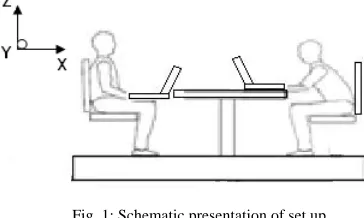
In the laboratory study, two main subject postures were investigated as shown in Fig. 1. In the first posture the seated person leans against the back of the seat, with the Laptop computer held on his lap. In the second posture the seated person leans forward with the Laptop computer placed on the table.
2.3 Vibration environment and stimuli
The study was conducted on the vibration simulator, developed as a mockup of railway vehicle, in Vehicle Dynamics Laboratory of IIT Roorkee, India. It consists of a platform on which a table and two rigid chairs have been securely fixed, Fig. 1. The backrest of the chair was rigid, flat, and vertical. The seat, the backrest, and the table are not in resonance condition within the frequency range studied (up to 20 Hz) in any of the three axes. Three Electro-Dynamic Vibration shakers are used to provide vibration stimuli simultaneously to the platform in three axes; longitudinal (X-axis), lateral (Y-axis) and vertical (Z-axis). The onboard vibrations of the platform were measured on line for continuous monitoring of the vibration signal by using a tri-axial accelerometer (KISTLER 8393B10), the signal transmitted to the Labview Signal Express software via a data acquisition card (NI 6218). The simulator provides a controlled train atmosphere with a working illumination well above 250 lux using both direct and indirect light sources for constant and well-distributed illumination at all seats and tables. The test subjects were seated on the chairs rigidly mounted on the platform of vibration simulator such that these are excited with the same frequency as the platform, up to 20 Hz. This range is considered critical, since it coincides with the most vulnerable range for writing activity and perhaps for typing activity as well.
Fig. 1: Schematic presentation of set up
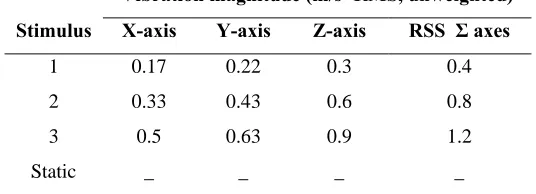
Therefore, in multi axis, three mono axes are excited simultaneously with above relation, which resulted in RSS magnitudes of 0.4, 0.8 and 1.2 m/s2, Table 1. The RSS is the vibration total value which is obtained from the square root of the sum of the squares of the measured RMS values in the X-, Y-, and Z- directions [13]. To cover all the travel condition, vibration levels of 0.4, 0.8 and 1.2 m/s2 were considered in the laboratory study.
Table 1. Vibration levels in three axes acting simultaneously
Vibration magnitude (m/s2 RMS, unweighted)
Stimulus X-axis Y-axis Z-axis RSS Σ axes
1 0.17 0.22 0.3 0.4
2 0.33 0.43 0.6 0.8
3 0.5 0.63 0.9 1.2
Static _ _ _ _
RMS = root mean square; RSS = root sum of squares. 2.4 Typing task and test procedure
The typing task was performed in a laboratory using laptop computer similar to those found in office work. The laptop computer (Lenovo R61) of size (13.2 × 9.3 × 1.37) in inches had a standard 89 letter-key with a 14.1-inch XGA TFT display screen and weighing about 2.35 kg. The heights of the home row on the keyboard and the top of the monitor were 76 and 102 cm above the floor, respectively.
The test subjects were instructed to occupy themselves with the prescribed task during vibration exposure. When the vibration faded out, the subjects were given an intermediate pause to rate their perceived difficulty of typing. This procedure was repeated for all the vibration stimuli, with all the ratings made according to Borg’s CR-10 scale. A Borg CR10 category-ratio scale [14], shown in Fig. 2, was used to provide direct estimation of the perceived intensity of vibration. The Borg CR10 scale has been found to be reliable in quantifying the human perception of whole body vibration for both physical and
mental tasks.
Fig. 2: Borg CR10 category-ratio scale
The subjects sat on rigid chair without armrests. The test was conducted simultaneously on two subjects at a time. Each subject was exposed to an overall 6 conditions, from a combination of three levels of vibration magnitudes and two levels of subject’s posture. A static condition with no vibrations was also used. The conditions were presented in randomly to minimize order effects.
2.2 Data analysis
A Wilcoxon matched-pairs signed ranks test was carried out on all the data to determine whether vibration magnitude and subject’s posture had a significant effect on typing performance and typing difficulty. The two-tailed test was used and statistical significance was accepted at 5 % level (p < 0.05). The statistical package for social sciences (SPSS Inc., Chicago, USA, version 16) was used for statistical analysis.
3. Results
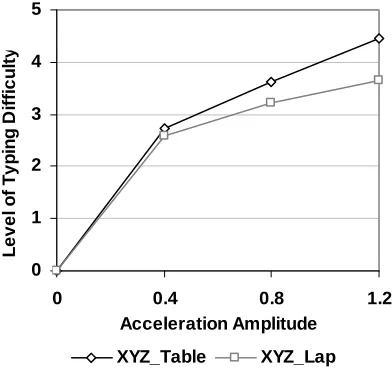
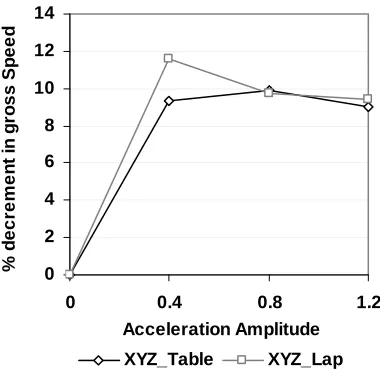
The mean values of level of typing difficulty (Fig. 4), percentage decrement in gross speed (Fig. 5) and percentage increase in typing error (Fig. 6) for typing task are plotted as a function of vibration magnitude for two seated postures.
0 1 2 3 4 5
0 0.4 0.8 1.2
Acceleration Amplitude
Le
v
e
l of
Ty
p
in
g D
if
fic
ul
ty
XYZ_Table XYZ_Lap
0 2 4 6 8 10 12 14
0 0.4 0.8 1.2
Acceleration Amplitude
% d
e
cr
em
en
t
in
g
ro
s
s S
p
e
ed
XYZ_Table XYZ_Lap
Fig. 5: Influence of vibration magnitudes on Gross speed for typing
0 1 2 3 4 5
0 0.4 0.8 1.2
Acceleration Amplitude
% i
n
cr
ea
se
i
n
T
yp
in
g
E
rr
o
r
XYZ_Table XYZ_Lap
Fig. 6: Influence of vibration magnitudes on typing error
3.1 Subjective evaluation of typing difficulty
From Fig. 4, it was observed that the mean typing difficulty rated by subjects, progressively increased with increase in vibration magnitude for both the seated postures (p<0.05). It was also found that the typing with laptop on table was found more difficult than typing with laptop on lap posture. Statistically, the effect of subject posture on typing difficulty was found insignificant (p>0.05) for lowest vibration magnitude (0.4 m/s2) and found significant (p<0.05) for higher vibration magnitudes (i.e. at 0.8 and 1.2 m/s2).
The mean values were taken for the percentage decrement in gross speed and percentage increase in typing error in vibration condition with respect to control condition and has been represented as mean percentage decrement for gross speed and mean percentage increase in typing error.
For multi axis vibration, the mean percentage decrement in gross speed while typing the text paragraph (for both postures) does not have any significant effect (p>0.05) for vibration magnitudes between 0.4 m/s2 and 1.2 m/s2 (Fig. 5), however a reduction in gross speed was seen at all vibration magnitudes when compared to static condition (p<0.05). Similar trend was observed for variation in typing error with the vibration magnitude (Fig. 6). For both postures, the effect of vibration magnitudes between 0.4 m/s2 and 1.2 m/s2 on mean percentage increase in typing error was not found significant (p>0.05), but mean percentage increase in typing error was found higher at all vibration magnitude when compared to static condition (p<0.05). It was also observed that the subjects postures was remained unaffected by multi axis vibration exposure for both gross speed and typing error (p>0.05).
4. Discussions
In this study, the changes in vibration magnitude and subjects postures had no statistically significant effect on typing speed and typing error, but both typing speed and typing error was affected in vibration conditions as compared to static conditions (p<0.05).
However, the subjective evaluation of typing difficulty was depending on vibration stimuli and extent to which typing difficulty was affected increased with increasing vibration magnitude (Fig. 4). Previous studies [2, 4, 15] have indicated that low levels of vibration in mono axes may not adversely affect task performance. However, the results from the present study (Fig. 5) indicate that diminution in typing performance was found between the control condition and the lowest vibration condition (0.4 m/s2). This could suggest that typing tasks are more sensitive to multi axis vibration than mono axes.
Subjective evaluation (Fig. 4) showed a progressive increase in typing difficulty with an increase in vibration magnitude, which matches with the results of Mansfield and Maeda [16], where subjective ratings of intensity increased with vibration magnitude for both single axis and dual axis vibration conditions. Humans generally have the ability to compensate for adverse conditions and maintain a certain level of performance; however, this usually results in an increased workload [17]. The results show that although the subjective evaluation indicated an increase in typing difficulty with vibration magnitude, the typing performance remained unaffected (Fig. 5 and 6). This could suggest that the adaptation capabilities of the participants to cope with the adverse conditions (increased vibration magnitudes) may have contributed to the unchanged typing performance.
The experiment was conducted with the subjects resting their wrist on the laptop computer while the hands remained unsupported, and the computer placed on rigid table or lap, which is a common practice in typing task. Therefore, it could be possible for subjects to adapt themselves to the vibration magnitudes and control the relative movement of their fingers on the keyboard that would otherwise be disturbed by the vibration.
For lap posture, the subjects were in contact with a flat rigid backrest that partially controlled the movement of the upper-body. For the posture with laptop placed on table, the typing performance is greatly affected; this could be attributed to less restraint to the upper-body. It could also have arisen from individual or combined influence of unsupported upper-body movement resulting in more mechanical disruption of finger movement and more vision interference.
5. Conclusions
The objective of the experiment is to investigate the extent of interference perceived in typing task by seated subjects in two postures under multi axial random vibration environment. The results concluded that:
Typing speed and typing error has been affected in vibration condition as compared to static condition. The changes in vibration magnitude chosen for study and subjects postures had no statistically significant
The subjective evaluation of typing difficulty is dependent on vibration stimuli and the extent to which typing difficulty is affected increased with increasing vibration magnitude
The subjects reported most difficulty while typing with table than with lap.
Acknowledgement
The financial assistance received from Department of Science & Technology, New Delhi (India) for the research work is duly acknowledged.
References
[1] E.M. Whitham and M.J. Griffin, Interference with drinking due to whole-body vibration. Proceedings of the United Kingdom Informal
Group on Human Response to Vibration Meeting held at the National Institute of Agricultural Engineering, Silsoe, Bedfordshire, 1978.
[2] C. Corbridge and M.J. Griffin, Effects of Vertical Vibration on Passenger Activities - Writing and Drinking, Ergonomics, 34:1313-1332,
1991.
[3] J. Westberg, Interference of lateral vibration on train passenger activities: an experiment on human ability to perform reading, writing and
drinking, Master thesis, Royal Institute of Technology, KTH, Stockholm, Sweden, 2000.
[4] M.J. Griffin and R.A. Hayward, Effects of horizontal whole-body vibration on reading, Applied Ergonomics, 25 (3), 165-169, 1994.
[5] J. Sundström and S. Khan, Influence of stationary lateral vibrations on train passengers’ ability to read and write, Applied Ergonomics, 39,
710-718, 2008.
[6] C. Corbridge and M.J. Griffin, Vibration and comfort: vertical and lateral motion in the range 0.5–5.0 Hz, Ergonomics, 29 (2), 249–272,
1986.
[7] M.K. Bhiwapurkar, P. P. Singh, J. Yadav, V.H. Saran and S.P. Harsha, Influence of vibration on passenger comfort– A survey on Indian
train. Presented at International Conference on Advances in Industrial Engineering Applications, Anna University, Chennai, India, 2010.
[8] N. G. Swanson, T. L. Galinsky, L. L. Cole, C. S. Pan and S. L. Sauter, The impact of keyboard design on comfort and productivity in a
text-entry task, Applied Ergonomics, 28:9-16, 1997.
[9] Huey-Wen Liang a, Yaw-Huei Hwang a, Fu-Han Chang, Effects of input methods on inter-key press intervals during continuous typing,
Ergonomics, 52(9), 1153–1161, 2009.
[10] Mandy Lo and M.J. Griffin, Effect of fore-and-aft, lateral, and vertical whole-body vibration on typing, ISVR Technical Report No. 327,
University of Southampton, 2009.
[11] E.I.S. Matias, MacKenzie and W. Buxton, One-handed touch typing on a QWERTY keyboard, Human-Computer Interaction, 11:1-27,
1996.
[12] A. Sears, and Y. Zha, Data entry for mobile devices using soft keyboards: Understanding the effects of keyboard size and user tasks,
International Journal of Human-Computer Interaction, 16:163-184, 2003.
[13] N.J. Mansfield, Human response to vibration, CRC press, London, 2005.
[14] G. Borg, Borg's Perceived Exertion and Pain Scales, Human Kinetics, 1998.
[15] N.J. Mansfield, Y. Arora, and A. Rimell, Computer use on moving trains: which pointing device? In: P. Bust, ed. Contemporary
ergonomics, Taylor & Francis, London, 2007, pp. 255–260.
[16] N.J. Mansfield and S. Maeda, Comparison of subjective ratings of whole-body vibration for single and multi-axis vibration, Proc. of 40th
United Kingdom conference on human response to vibration, England, 2005.