ON HIGH TEMPERATURE
MATERIALS : MODELING PHASE
STABILITY DIAGRAM FOR HOT
HORROSION OF AISI 310S ALLOY BY
TURBO C++ PROGRAMMING
A. KANNI RAJ
School of Basic Sciences, Vel Tech Rangarajan Dr.Sagunthala R&D Institute of Science & Technology 400feet Outer Ring Road, Avadi, Chennai 600062, Tamil Nadi, India
[email protected] https://www.veltech.edu.in
Abstract : AISI 310S stainless steel is used in high temperature components up to 1050ºC. It is excellent heat resistant alloy used in oxidizing and hot gaseous and molten salt corrosion environment. An attempt is made in calculating PSD from ΔG values using Turbo C++ Programming. It is fast in doing PSD construction. It is simplified due to three reasons: Tedious calculations of partial pressures can be avoided, Variations in diagram with activity, in case of multi-component alloys can be determined easily, and Variations in diagram with temperature can be determined.
Keywords: Phase Stability Diagram, Hot Corrosion, AISI 310S, Turbo C++.
1. Introduction
Oxidation and hot corrosion affects material chemistry and component integrity. Materials that are capable of withstanding high temperature aggressive environments are not found in abundance. Research and modeling are progressing at a rapid pace in these directions. Current work analyses oxidation and hot corrosion behavior of AISI 310S stainless steel taken from Salem stainless steel plant (Steel Authority of India Limited, Ministry of Steel, Government of India). AISI 310S stainless steel is austenitic and superalloy, and so is very good for temperatures ranging from -273°C to 1050°C [Kanniraj (2011); Kanniraj (2013); Sequueira (2018)].
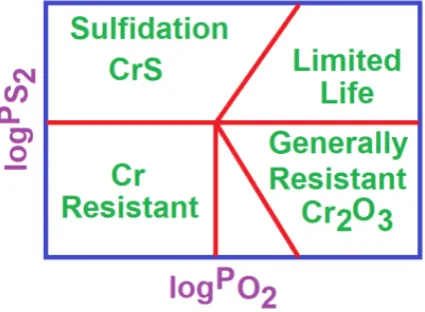
Hot corrosion involves breakdown of protective chromia oxide layer by reaction with fused salt or corrosive gaseous environments. Phase stability diagram (predominance area diagrams or kellog diagrams) are drawn with log(oxygen partial pressure) on x-axis versus log(sulphur pressures /sulphur dioxide /sulphur trioxide) on y-axis. Regions of stability of various oxides or sulphides are demarcated by horizontal, vertical or oblique lines that represent equilibria between parent and product phases. If a particular coordinate defined by partial pressure of sulphur or oxygen is known, then the region in which it lies will indicate the phase that will be present under such conditions as that are consequent on pressures being of magnitude as specified. Diagram can also be used in prediction of phases in roasting operations where the atmospheres consist of oxygen and sulphur. This will help in a converse manner in that pressures of gases required to form of a particular oxidation product can be predicted [Kanniraj (2011); Kanniraj (2013); Sequueira (2018); Hernandez et al (2013); Gleeson (2004)].
Selection of alloy for industrial service at high temperatures is based on either iron, nickel or cobalt. In iron base systems, both high temperature strength and oxidation capability are increased with increase in Cr content. Low alloy ferritic steels are limited to temperatures below about 650°C. This temperature limit can be raised to 750°C by using higher Cr contents but the service temperature of ferritic steels cannot be pushed much higher. Austenitic stainless steels show appreciable increase in operating temperature AISI 316 with 18% Cr (<900°C) or AISI 310 with 25%Cr (<1050°C). AISI 301S superalloy stainless steel possesses remarkable strength properties with the strength remaining almost constant over a temperature range as wide as -273 to 1000°C (Table 1). Type 310S alloy is useful where intermittent heating and cooling are encountered, because it forms a more adherent scale. Type 310 is used for parts such as superheated tubes, firebox sheets, furnace linings, boilers, baffles, thermocouple wells, aircraft cabin heaters and jet engine burner liners [Gleeson (2004), Safarzadeh (2018); Liu et al (2019); Majumdar et al (2001)].
Table 1. Chemical composition of AISI 310S stainless steel
C Mn P S Si Cr Ni Fe
2. Analytical Methods
Reaction free energy is driving force for reaction of a metal with a gas (see Table 2). In most cases, the activities of solids (metal and oxides) are invariant, that is, their activities=1 for pure solids, and for the reliability high temperatures and moderate pressures encountered in oxidation reactions,
2 o
a
can be approximated by itspressure. At equilibrium ΔG=0,
2
0
tan
ln
product2
ln
o reac ta
y
G
RT
RT
P
a
whereP
o2 is the partialpressure of oxygen.
Table 2. Reaction energetics : Reaction types and Gibbs free energy
S.No. Reaction Free Energy Description
1 Reactants→Products ΔG =ΔH-TΔS ΔH - enthalpy, T - temperature, ΔS
- entropy, Spontaneous ΔG<0,
Equilibrium ΔG=0,
Non-spontaneous ΔG>0 (Reaction in opposite) 2 aA+bB=cC+dD 0
ln
c d C D a b A Ba a
G
G
RT
a a
A, B, C, D-Reactants/products, a, b, c, d-number of moles
3
2
2
x yy
xM
O
M O
2
0
2
ln
M Ox yy x M O
a
G
G
RT
a a
M - reacting metal, MxOy - metal oxide, x - moles of oxygen, y - moles of oxygen, A=1 for pure solids,
2 o
a
=2 o
P
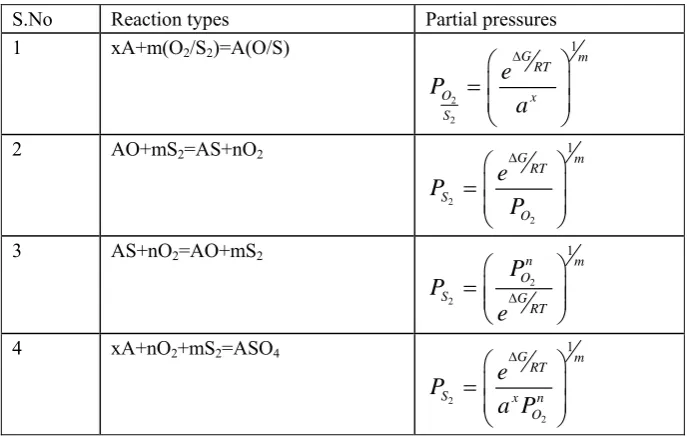
for gasesThough high temperature corrosion is a highly complex phenomenon in real component life, oxidation and sulphidation are the two principal modes of degradation. Both oxidation and sulphidation have been extensively studied on a number of metals and alloys. Reactions under high temperature corrosion can be classified into 4 types, and equilibrium relating the partial pressures with the ΔG values can be presented suitably as per II law. In Table 3, AO, AS, and ASO4 are the oxides, sulphides and sulphate reaction products respectively. ‘x’ is the
stoichiometric coefficient of the pure metal.
Table 3. Bioxidant systems: Reaction Types and Partial Pressures
S.No Reaction types Partial pressures
1 xA+m(O2/S2)=A(O/S)
2 2 1 G m RT O x S
e
P
a
2 AO+mS2=AS+nO2
2 2 1 G m RT S O
e
P
P
3 AS+nO2=AO+mS2
2 2 1 n m O S G RT
P
P
e
4 xA+nO2+mS2=ASO4
2
2
1
G m RT S x n O
e
P
a P
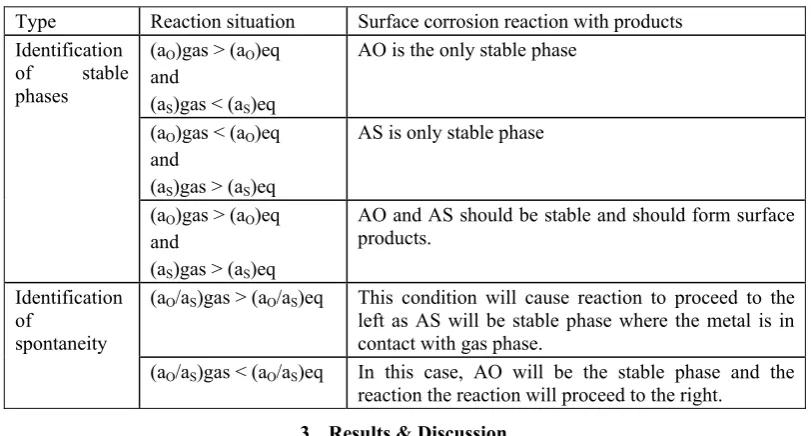
Table 4. Equilibrium situations and Surface corrosion reaction with products
Type Reaction situation Surface corrosion reaction with products Identification
of stable phases
(aO)gas > (aO)eq
and
(aS)gas < (aS)eq
AO is the only stable phase
(aO)gas < (aO)eq
and
(aS)gas > (aS)eq
AS is only stable phase
(aO)gas > (aO)eq
and
(aS)gas > (aS)eq
AO and AS should be stable and should form surface products.
Identification of
spontaneity
(aO/aS)gas > (aO/aS)eq This condition will cause reaction to proceed to the
left as AS will be stable phase where the metal is in contact with gas phase.
(aO/aS)gas < (aO/aS)eq In this case, AO will be the stable phase and the
reaction the reaction will proceed to the right.
3. Results & Discussion
From above thermodynamical analysis of oxidation and hot corrosion analytical model, reactions of hot gases with AISI 310S alloy that are considered for inclusion in analysis are listed in Table 5. Activities of pure metals in are taken as 0.55, 0.25 and 0.20 for Fe, Cr and Ni respectively. Table 3 lists properties that are used in evaluating stability plot.
Table 5. Oxidation and sulphidation reactions of AISI 310S superalloy stainless steel
Iron Chromium Nickel
Fe+ S2→Fe S2
FeO+
1
2
S2→FeS+1
2
O2Fe3O4+
3
2
S2→3FeS+2 O2Fe2O3+S2→2FeS+
3
2
O2FeS2+2O2→FeSO4+
1
2
S2Fe+
1
2
S2+2O2→FeSO4Fe2O3+S2+
5
2
S2→2FeSO42FeSO4+
1
2
S2+2O2→Fe2(SO4)3FeS+
1
2
S2+6O2→ Fe2(SO4)3FeO+
1
2
S2+3
2
O2→ FeSO4Fe2O3+
3
2
S2+9
2
O2→Fe2(SO4)32Cr+
3
2
O2→ Cr2O3Cr2S3+6O2→ Cr2(SO4)3
Cr+
1
2
S2→ CrS7Cr+4S2→ Cr7S8
5Cr+3S2→ Cr5S6
3Cr+2S2→ Cr3S4
2Cr+
3
2
S2→ Cr2S3Cr2O3+S2→2CrS+
3
2
O27
2
Cr2O3+4S2→ Cr7S8+21
4
O25
2
Cr2O3+3S2→ Cr5S6+15
4
O23
2
Cr2O3+2S2→ Cr3S4+9
4
O22Cr+
3
2
S2+6O2→ Cr2(SO4)3Cr2O3+
3
2
S2+9
2
O2→ Cr2(SO4)3Ni+
1
2
O2→NiONiS+2O2→ NiSO4
Ni+
1
2
S2→NiSNi +S2→ NiS2
3Ni +S2→ Ni 3S2
NiS+
1
2
S2→NiS2NiO+
1
2
S2→ NiS+1
2
O2NiO+S2→NiS2+
1
2
O23NiO+S2→ Ni 3S2+
3
2
O2NiO+
1
2
S2+3
2
O2→NiSO4
Ni+
1
2
S2+2O2→ NiSO4Table 6. Data used for constructing phase stability diagram of AISI 310S stainless steel sheet
property Fe Cr Ni
FeO FeS Cr2O3 CrS Cr2S3 NiO NiS
Number Reaction of Type1 1 1 1 1 1 1 1
Number Reaction of Type2 1 1 1 1 1 1 1
Coefficient of pure metal 1 1 2 1 2 1 1
Coefficient of gas 0.5 0.5 1.5 0.5 1.5 0.5 0.5
Reaction Free Energy (kCal/mol)
-50.8 -25.6 -222 -33.6 -47.0 -59.7 -20.6
Temperature (K) 1073 1073 1073 1073 1073 1073 1073
Activity of the metal 0.55 0.55 0.25 0.25 0.25 0.20 0.20
Oxygen pressure range 10-20
-1010 10
-20
-1010 10
-20-1010 10-20
-1010 10
-20
-1010 10
-20
-1010 10
-20
-1010
Type 1 (coefficient-metal) M + (coefficient-gas) O2 → (coefficient) MO
Type 2 (coefficient) MO + (coefficient-gas) S2 → (coefficient) MS + (coefficient-gas) O2
Fig.1 Phase stability diagram of AISI 310S stainless steel at 850°C
Fig.2 Effect of oxidation on reducing protective nature of chromia scale
4. Conclusion
References
[1] Kanniraj, A.(2011). Creep : Basic Theory and Dissertation. Lambert Academic Publishing, Saarbrucken, Germany
[2] Kanniraj, A.(2013). On High-Temperature Materials: A Case on Creep and Oxidation of a Fully Austenitic Heat-Resistant Superalloy Stainless Steel Sheet. Hindawi : Journal of Materials, 2013, pp1-6, Paper ID: 124649
[3] Sequeira, C.A.C.(2018). High Temperature Corrosion: Fundamentals and Engineering. John Wiley & Sons, New Jersey, USA [4] Hernandez, J.J.R.; Calderon, J.P.; Bravo, V.M.S.; Gonzalez, C.D.A.; Rodriquez, J.G.G.; and Gomez, L.M.(2013). Phase Stability
Diagrams for High Temperature Corrosion Processes. Hindawi: Mathematical Problems in Engineering, 2013, pp.1-7, Paper ID : 54061
[5] Gleeson, B.M.(2004). Alloy degradation under oxidizing-sulfidizing conditions at elevated temperatures. Materials Research, 7, pp.61-69
[6] Safarzadeh, M.S.; and Howard, S.M.(2018). Revisiting the Kellogg diagrams: roaster diagrams and their usefulness in pyrometallurgy. Journal of Mineral Processing and Extractive Metallurgy Review, 39, pp.191-197.
[7] Liu, J.; Guan, P.W.; Marker, C.N.; Smith, N.D.; Orabona, N.; Shang, S.L.; Kim, H.; and Liu, Z.K.(2019). Thermodynamic properties and phase stability of the Ba-Bi system: A combined computational and experimental study. Journal of Alloys and Compounds, 771, pp. 281-289.