University of New Hampshire
University of New Hampshire Scholars' Repository
Applied Engineering and Sciences Scholarship Applied Engineering and Sciences
6-1-2015
Evaluation of a computing and engineering
outreach program for girls in grades 8–10
Mihaela C. Sabin
University of New Hampshire, Manchester, [email protected]
Paul Snow Mary Laturnau The Way, Inc.
Follow this and additional works at:https://scholars.unh.edu/unhmcis_facpub
This Article is brought to you for free and open access by the Applied Engineering and Sciences at University of New Hampshire Scholars' Repository. It has been accepted for inclusion in Applied Engineering and Sciences Scholarship by an authorized administrator of University of New Hampshire Scholars' Repository. For more information, please [email protected].
Recommended Citation
EVALUATION OF A COMPUTING AND ENGINEERING OUTREACH PROGRAM FOR GIRLS IN GRADES 8-10
Mihaela Sabin
University of New Hampshire
88 Commercial Street, Manchester, NH 03101 603 641 4144
Paul Snow
Independent consultant
P.O. Box 6134, Concord, NH 03303-6134 603 753-1011
Mary Laturnau
Project Lead The Way, Inc.
3939 Priority Way South Drive, Suite 400, Indianapolis, IN 46240
603 479 1664
ABSTRACT
An outreach program of workshops and guided group activities for New Hampshire’s eighth, ninth and tenth grade girls was offered to stimulate the girls' interest in computing and engineering coursework and careers. Attitude changes before and after participation were measured using a survey instrument adapted from one developed by the Georgia Tech’s Institute for Computing and Education. Eight attitudinal themes were surveyed. With suitable adjustments for simultaneous testing of multiple hypotheses, statistically significant changes with moderate effect sizes were detected for three of the themes: enjoyment of technology-related activities, motivation to succeed in technical problem solving, and intention to persist in computing and engineering courses and careers.
INTRODUCTION
Diversity benefits the society and economy. It expands the qualified employee pool, improves the bottom line, enhances innovation, and promotes equality. The fast-growing Computing and Engineering (C&E) sectors have highly paid jobs, but relatively few C&E graduates. Women’s participation in C&E occupations is remarkably low, 25% of the mathematical/computer scientists and 12% of the engineers were women in 2011. Women’s share of C&E bachelor’s degrees is also low, only 18% in 2010. Further, there is a worrisome trend of women leaving C&E jobs despite good job security and salaries [1, 2].
and developed a full-day program, Girls Technology Day (GTD), designed to engage grade 8-10 girls in workshops with opportunities to learn about C&E academic and career pathways.
The first GTD was offered in Spring 2013 on the campus of NHTI, Concord’s Community College. 147 girls and 27 teachers and counselors participated and shared their positive experience. That August, the GTD expanded into a larger annual event with a wider variety of workshops. This paper reports evaluation findings on the 2014 offering of the program.
PROGRAM DESCRIPTION Objectives
The goal of the GTD program is to increase interest and engagement of 8th, 9th, and 10th grade girls in computing and engineering majors and careers. To achieve this goal, the GTD 2014 program’s objectives were to:
1. Organize a full-day event of C&E workshops during spring break on the NHTI Concord’s Community College campus.
2. Recruit 250 girls in grades 8-10 from 15 Career and Technical Education centers and their feeder middle schools.
3. Engage the girls in meaningful activities that feature C&E practices and showcase academic and career opportunities in C&E.
4. Assess changes in girls’ attitudes towards C&E as a result of their participation in the program to evaluate and improve program’s activities.
Implementation
The GTD management team of six educators and industry and business leaders in 2013 expanded for GTD 2014 program’s planning and organizing committee to 25 members, drawn from NH community colleges, University of New Hampshire, Career Development Bureau of the NH DOE, US Navy, and four local tech and business firms. The management team and other members met monthly and were responsible for developing workshop curricula and activities; raising funds from corporate donors; creating informational and recruiting materials, and defining evaluation protocols, instruments, and a data analysis plan. Recruitment of students started in January, reaching out to 15 Career and Technical Education (CTE) centers and two feeder middle schools, all within a two-hour bus ride of the event site, about an 85-mile radius.
The program’s curriculum and workshop activities sought to dispel beliefs that computing and engineering are “boring, difficult, antisocial or do not have much impact on solving the world’s problems”[5]. Guided by the design principles of the computing summer camps run by Georgia Tech’s Institute for Computing and Education (ICE) [6], GTD workshops were designed to demonstrate the creative, collaborative, and stimulating nature of C&E and to allow the girls to interact with each other, faculty, and C&E and business professionals.
Student choices among the workshops and program structure are summarized in Figure 1. All workshops featured project-based teamwork to stimulate interactions and communication among participants and workshop facilitators. A college and industry fair was held during the two lunch periods (from 11:00 - 12:20) to give students and teachers the opportunity to learn more about C&E academic programs and careers in NH.
Workshop Student Participation (attendees % of total participants) Program Structure
# Workshops 13
# Schools 17
# Students 203
# Students/
session 10-25
Sessions
attended by
each school
2-5
Total number
of sessions
attended
54
Figure 1. Student participation in the GTD workshops and overall program structure.
Participants
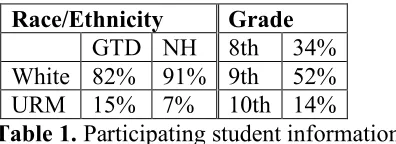
203 girls from 17 schools attended GTD 2014. Most were White (85%). The rest (15%) Underrepresented minority (URM) students in STEM (Black, Hispanic, and of two or more races), which is more than twice the proportion of these groups in NH (6.6 percent) [11]. Most students were 9th graders (52 percent). Table 1 summarizes participants’ backgrounds.
Race/Ethnicity Grade
GTD NH 8th 34%
White 82% 91% 9th 52%
URM 15% 7% 10th 14%
Table 1. Participating student information
Evaluation Plan
To evaluate the program, student surveys were administered before and after the event within a week time interval. Participating teachers who registered their school’s student groups assisted with having students take the surveys. The purpose of the evaluation was to determine the effectiveness of the program in producing positive changes in girls’ attitudes toward computing, engineering, and technology. Students responded to 16 statements on a five-point scale (1 = strong disagreement, .., 5 = strong agreement).
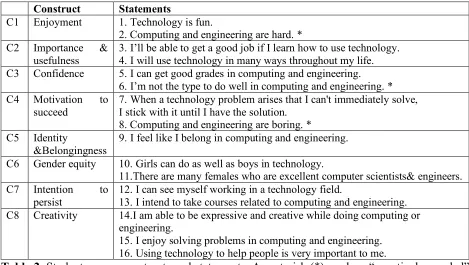
The survey is an adaptation of the ICE survey [6] to reflect the C&E disciplinary content and technology-related activities of the GTD program (see Table 2). Georgia Tech’s ICE surveys are available at http://home.cc.gatech.edu/ice-gt/310. The following changes were made
, 0Workshops, 0 3D Modeling, 47%
to the ICE survey:
1. The use of word computing or computer science was extended to encompass both
computing and engineering. (Statements 5, 6, 8, 9, 12, 13, 14, 15).
2. One instance of the work programming was replaced with computing and engineering
(Statement 2).
3. The reference to computer scientists was changed to include engineers (Statement 11). 4. Instances of the words computer(s) and computing in the context of “use/using,” “do” and
“field” became technology (Statements 1, 3, 4, 10, 12, 16).
As noted in [6], the constructs in Table 2 have been psychometrically validated [7] and identified by literature in computing and engineering [8, 9] as critical to increasing the number of women and racially underrepresented students who persist in computing and engineering fields.
Construct Statements
C1 Enjoyment 1. Technology is fun.
2. Computing and engineering are hard. *
C2 Importance &
usefulness
3. I’ll be able to get a good job if I learn how to use technology. 4. I will use technology in many ways throughout my life.
C3 Confidence 5. I can get good grades in computing and engineering.
6. I’m not the type to do well in computing and engineering. *
C4 Motivation to
succeed
7. When a technology problem arises that I can't immediately solve, I stick with it until I have the solution.
8. Computing and engineering are boring. * C5 Identity
&Belongingness
9. I feel like I belong in computing and engineering.
C6 Gender equity 10. Girls can do as well as boys in technology.
11.There are many females who are excellent computer scientists& engineers.
C7 Intention to
persist
12. I can see myself working in a technology field.
13. I intend to take courses related to computing and engineering.
C8 Creativity 14.I am able to be expressive and creative while doing computing or
engineering.
15. I enjoy solving problems in computing and engineering. 16. Using technology to help people is very important to me.
Table 2. Student survey constructs and statements. An asterisk (*) marks a “negatively worded” statement that was recoded for analysis.
EVALUATION AND RESULTS Data Analysis
In addition to identifying and demographic information, each survey presented 16 statements about attitudes towards computing, engineering, and technology-related activities, coursework, and careers shown in Table 2 above. Three of the statements were worded “negatively,” so that agreement would mean an attitude that would preferably be turned toward disagreement. For analysis, the responses to those three statements were recoded by subtracting the respondent’s answer from six, so that “higher values are better” throughout the data set, with a shared 1-to-5 scale for each statement.
The recoded responses to the 16 statements were grouped according to the eight constructs. The score for each construct was the average (recoded) response among the statements in its group. If a student did not respond to a statement in the construct group on either survey, then no construct score was calculated for that student. That is, both pre- and post- survey values for that student and that construct were coded as “missing.”
Major Findings
Three constructs showed statistically significant changes (each item’s p < .00625), using a standard two-tailed t-test for matched-pair data (Table 3). The significance threshold of .00625 for each item results in a family wise significance level of .05 over the eight tests, according to the widely used Dunn-Bonferroni correction for testing several hypotheses at once [11]. All changes were in the desired direction.
Construct N Average
score before before
Average score after
after
p-value Effect size (d-value)
C1 Enjoyment 47 3.64 3.91 0.0014 0.49
C2 Importance and usefulness 45 4.29 4.53 0.036 -
C3 Confidence 44 4.01 4.08 0.452 -
C4 Motivation to succeed 46 4.00 4.21 0.0053 0.39
C5 Belonging 47 3.53 3.68 0.109 -
C6 Gender equity 47 4.60 4.81 0.091 -
C7 Intention to persist 45 3.69 3.99 0.0058 0.37
C8 Creativity 47 3.95 4.06 0.149 -
Table 3.Evaluation results.
Effect sizes were assessed by Cohen’s “d” statistic [12], with root mean square pooling of standard deviations. For all three of the significantly changed constructs, effect sizes were in the small-to-medium range (conventionally regarded as d-values between about 0.2 and about 0.5).
CONCLUSION
STEM outreach programs for pre-college girls could impact their choices for disciplines and careers in fields that suffer from women underrepresentation. The GTD program is a statewide annual event for girls in grades 8-10, who participate in a variety of highly interactive and stimulating C&E activities.
The GTD program was designed with two guiding principles in mind:
• Involve educators from 2-year and 4-year colleges and professionals from local businesses with high STEM employment needs to share how C&E connects with the world of work and discoveries.
In the GTD program, statistically significant gains in girls’ attitudes towards computing and engineering were found in the areas of enjoyment, intention to persist, and motivation to succeed, with the largest impact on enjoyment. These results suggest that workshop curriculum and activities can be further improved to increase girls’ confidence, sense of belonging, and self-efficacy in doing C&E. A positive outcome of the program is continued support from the NHDOE and participating colleges to double the size of the program. To increase participation from more than 400 girls, workshops will be offered on two community college campuses in Nashua and Manchester in 2015.
ACKNOWLEDGMENTS
This material is based upon work supported by a NH EPSCoR grant. Special thanks go to the NH CTE centers’ educators who participated in the GTD program and the many volunteers who shared their professional experiences with the girls.
REFERENCES
[1] National Science Foundation, National Center for Science and Engineering Statistics: Women, Minorities, and Persons with Disabilities in Science and Engineering, 2013, http://www.nsf.gov/statistics/wmpd/2013/.
[2] Center for Talent Innovation, Athena 2.0 Factor: Accelerating Female Talent in Science, Engineering & Technology, 2014.
[3] Labov, J., Evolving Relationships Between Two- and Four Year Colleges and Universities in STEM Education, New Hampshire STEM Conference, Manchester, NH, November 27, 2012. [4] New Hampshire Career Pathways, Bureau of Career Development, NH Department of Education. 2015, http://www.education.nh.gov/career/career/career_pathways.htm.
[5] WGBH Educational Foundation and the Association for Computing Machinery, New Image for Computing Report, 2009, http://www.acm.org/press-room/membership/NIC.pdf.
[6] Engelman, S., McKlin, T., Ericson, B, & Guzdial, M., Georgia Computes! Roll-Up Analysis: Student Summer Camps, 2012.
[7] Fennema, E., and Sherman, J.A., Fennema-Sherman Mathematics Attitudes Scales: Instruments designed to measure attitudes toward the learning of mathematics by females and males. Journal for Research in Mathematics Education, 7(6), 324-326, 1976.
[8] Williams, L., Wiebe, E., Yang, K, Ferzli, M., and Miller, C. In support of paired programming in the introductory computer science courses, Computer Science Education, 12, 197-212, 2002.
[9] Cech, E., Rubineau, B., Slibey, S., and Seron, C. Professional role confidence and gendered persistence in engineering, American Sociological Review, 76, 641-665, 2012.
[10] U.S. Census Bureau: New Hampshire State & County Quick Facts, 2014, ttp://quickfacts.census.gov/qfd/states/33000.html.
[11] Dunn, O. J. Multiple comparisons among means, Journal of the American Statistical Association, 56(293), 52–64, 1961.