Honors Theses and Capstones Student Scholarship
Spring 2018
Sex Differences in Internalizing and Externalizing
Behaviors in Children with Autism Spectrum
Disorder
Caroline C. Cherry
University of New Hampshire, Durham, [email protected]
Follow this and additional works at:https://scholars.unh.edu/honors Part of theSpeech Pathology and Audiology Commons
This Senior Honors Thesis is brought to you for free and open access by the Student Scholarship at University of New Hampshire Scholars' Repository. It has been accepted for inclusion in Honors Theses and Capstones by an authorized administrator of University of New Hampshire Scholars' Repository. For more information, please [email protected].
Recommended Citation
Cherry, Caroline C., "Sex Differences in Internalizing and Externalizing Behaviors in Children with Autism Spectrum Disorder" (2018).Honors Theses and Capstones. 397.
Sex Differences in Internalizing and Externalizing Behaviors
in Children with Autism Spectrum Disorder
Caroline Cherry
Abstract
This study used a retrospective practice-based research method to compare levels of internalizing
and externalizing behaviors of a clinically-ascertained sample of young children with autism
spectrum disorder (ASD; n=90). As measured by the Child Behavior Checklist (CBCL),
internalizing and externalizing behaviors were compared to normative behavior, and between
boys and girls with ASD. Findings suggest that in a clinical sample, children with ASD are more
likely than typically developing children to have internalizing and/or externalizing problems. No
significant sex differences were found for Internalizing Problems, Externalizing Problems, or
Total Problems scores on either the parent or teacher versions of the CBCL. These findings may
help clinicians better understand how children with ASD are affected by co-morbid psychiatric
Autism spectrum disorder (ASD) is characterized by deficits in social communication
and interaction, as well as repetitive behaviors and restricted interests. Many children with ASD
present with co-morbid psychiatric disorders as well. For example, internalizing behaviors, such
as depression and anxiety, and externalizing behaviors, such as attention and behavioral
problems, present more frequently in children with ASD than in typically developing children
(Hull, Mandy, & Petrides, 2016). Previous research has found evidence that girls with ASD
experience more internalizing problems than boys, while externalizing problems occur with
similar frequency across the sexes (Vaillancourt et al., 2017). Further, studies have reported a
relationship between higher levels of emotional and behavioral problems and an increased
probability of an ASD diagnosis in girls, but not boys (Duvekot et al., 2017), as well as earlier
and more frequent diagnoses for males (1 in 42) than females (1 in 189) in the United States
(Reinhardt, Wetherby, Schatschneider, & Lord, 2015). Thus, research has begun to ask whether
males and females with ASD present with different co-morbid symptoms, such as internalizing
and externalizing behaviors, which importantly might affect age and frequency of diagnosis,
among other factors. Understanding sex differences in the internalizing and externalizing
behaviors of children with ASD may also permit refinement of diagnostic criteria to reflect how
such differences influence the manifestation of ASD symptoms. The aim of this study is to
examine rates of these behaviors relative to normative expectations as well as sex differences in
these behaviors, using a retrospective, practice-based research method.
Internalizing and Externalizing Behaviors in ASD
According to Leyfer et al. (2006 as cited by Vaillancourt et al., 2017), about 72% of
children with ASD have at least one other psychiatric disorder, frequently internalizing
behavioral deficits (Hull et al., 2016). Prior longitudinal studies indicate that internalizing and
externalizing problems occur in children with ASD starting at a young age, often last throughout
life, and regularly co-occur with each other (Eisenberg et al., 2009 as cited by Vaillancourt et al.,
2017). Vaillancourt et al. (2017) investigated the trajectory of internalizing and externalizing
problems in preschool children with ASD, over four assessments that spanned about 3 years.
Results indicated that 76.8% of the sample showed a low/declining trajectory for internalizing
problems, and 23.2% had a high/stable trajectory. Thus, about 1 in 5 children in the sample had
clinically significant internalizing problems over the 3-year study. The results further showed
that 46.4% of the sample had a moderate/declining trajectory for externalizing problems; 40.1%
showed a low/declining trajectory; 13.5% showed a high/stable trajectory (Vaillancourt et al.,
2017). Vaillancourt et al. (2017) concluded that children who followed a high-risk trajectory for
externalizing problems also were more likely to follow a high-risk trajectory for internalizing
problems, with only a small minority group of boys (1% of the sample) showing declining
internalizing behaviors and high/stable externalizing problems.
However, there have been some differing results regarding internalizing and externalizing
behaviors of children with ASD. Turygin et al. (2013) found that children with ASD were not
more likely to have internalizing behaviors than children without ASD, while Hull et al. (2016)
reported higher levels of internalizing and externalizing in children with ASD than those with
typical development. These varied research findings clearly show the need for more research
regarding internalizing and externalizing behaviors, which have significant implications for
diagnosis and treatment. Specifically, if children exhibit internalizing or externalizing behaviors,
the manifestation of ASD symptoms may be affected. Symptoms may be more or less detectable
2014 as cited in Duvekot et al., 2017; Mandy et al. 2012 as cited in Duvekot et al., 2017).
Because externalizing behaviors tend to be more noticeable, it also follows that girls who exhibit
more internalizing behaviors and fewer of the more obvious externalizing behaviors may go
unnoticed and be less likely to receive a referral.
Internalizing and Externalizing Sex Differences in ASD
Many studies have found higher rates of internalizing behaviors in girls with ASD than
boys with ASD, but fairly even rates between the sexes for externalizing behaviors. Despite the
fact that Hull et al. (2016) reported no overall significant sex differences in internalizing and
externalizing in children with ASD, results indicated that sex differences in internalizing
behaviors might exist at younger ages. Specifically, females with ASD had higher rates of
depressive symptoms than males with ASD until adolescence. Further, Vaillancourt et al. (2017)
found that girls demonstrated more internalizing problems than boys, and more externalizing
problems than typically developing girls, though they found no differences in externalizing
trajectories between the sexes (Vaillancourt et al., 2017). Interestingly, Duvekot et al. (2017)
found that girls had more internalizing problems across TD and ASD samples, yet there were no
significant differences based on diagnosis, meaning sex differences in internalizing behaviors in
ASD mirrored those observed in typically developing children. This was consistent with
previous reports of sex differences in internalizing behaviors in the general population (Compas
et al., 1997 as cited by Duvekot, et al., 2017).
Understanding internalizing and externalizing sex differences in ASD could have
profound consequences for diagnosis and treatment. Specifically, internalizing and externalizing
behaviors might affect how ASD symptoms manifest, and therefore how early ASD is
be one variable contributing to the later referral and diagnosis of girls with ASD in comparison
to boys. For example, Duvekot et al. (2017) found that higher levels of emotional and behavioral
problems were related to increased probability that girls would receive an ASD diagnosis, but
did not affect diagnosis for boys. This suggests that if girls do not demonstrate such externalizing
behaviors (e.g., based on copying of others' social cues, or social "camouflage"), they may be
less likely to receive a diagnosis because their symptoms may be less obvious during an
evaluation. Supporting this idea, teachers have reported girls who received a diagnosis as having
fewer externalizing problems than boys who also received a diagnosis (Hiller et al., 2014 as cited
in Duvekot et al., 2017; Mandy et al. 2012 as cited in Duvekot et al., 2017). In such situations,
parents may need to report behaviors they have observed at home, where girls may be tired and
irritable after expending a great deal of energy masking their symptoms at school (Duvekot et al.,
2017). Furthermore, the fact that girls typically receive an ASD diagnosis later in life may
exacerbate or lead to the development of internalizing problems, because they may spend much
of their lives without necessary intervention or services, and may feel misunderstood or different
from their peers (Bargiela et al., 2016 as cited by Duvekot et al., 2017). Finally, recognizing sex
differences in internalizing and externalizing behaviors may help clinicians identify co-morbid
conditions that otherwise might go unnoticed.
To improve recognition of differences between internalizing and externalizing behavior
in children with ASD versus typically developing children, and in boys and girls with ASD,
researchers must address the following limitations: 1) a paucity of research currently addresses
these topics, and 2) prior studies with strong internal validity controls have prevented bias, but
Practice-Based Research
The present study uses practice-based research methods to address the clinically
important question of sex differences in internalizing and externalizing behaviors in ASD and
increase generalizability of findings. Epstein (2001) defines practice-based research as “the use
of research-inspired principles, designs and information gathering techniques within existing
forms of practice to answer questions that emerge from practice in ways that inform practice” (p.
17). The purpose of this research is to generalize findings specific to certain clients to a larger
clinical population, thus increasing understanding of the subject throughout the entire field
(Crooke & Olswang, 2015). Practice-based research is collaborative in nature, as clinicians and
researchers often work together to “mine” clinical data retrospectively to gain knowledge about a
cohort, which may improve future clinical decision-making and further programmatic research
(Crooke & Olswang, 2015). In the current study, clinical data provides an opportunity to
examine internalizing and externalizing differences in children with ASD versus typically
developing children, as well as sex differences in children with ASD, providing a different
perspective and supplementing the findings of controlled studies. The trends in this sample may
be generalizable to other clinically-derived samples of children with ASD and may help to bridge
the gap between research and practice.
Research Questions
This study addressed the following research questions: 1) What proportion of a
clinically-ascertained sample of young children with ASD demonstrated elevated rates of internalizing and
externalizing behaviors, as measured by the Child Behavior Checklist, compared to normative
expectations? 2) Are there significant sex differences in the internalizing and externalizing
majority of the ASD group would demonstrate elevated Internalizing Problems, Externalizing
Problems, and Total Problems composite scores, compared to normative expectations. In
addition, it was hypothesized that females in the sample would display more internalizing
behaviors, while males would display more externalizing behaviors.
Methods
Participants
The current study used existing clinical data from developmental assessments at the
Seacoast Child Development Clinic (SCDC), from 2011-2017. Data includes scores from
developmental assessments administered with 90 children ages 6 years and younger, whose
parents were concerned with their development, and whose assessment led to a diagnosis of
ASD. ASD diagnosis was confirmed based on a combination of clinical judgment and
administration of the ADOS by clinically trained professionals. The SCDC, which recently
closed, was affiliated with the University of New Hampshire (UNH). All clients signed a notice
of privacy practice that permitted the use of collected data for research purposes. The UNH
Institutional Review Board approved the use of existing, de-identified clinic data for this study.
Of the 90 children, there were 18 girls and 72 boys. Eighty percent were Caucasian; 9%
indicated non-Caucasian races; 11% did not report their race. Ethnicity was only reported for
86.6% of the sample; 3.3% were Hispanic. The mean chronological age of the sample was 41.31
Table 1
Demographic Information and CBCL Results for Males and Females
Males Females Fisher’s exact
test, p
Race, Caucasian:Other:NR 57:8:7 15:0:3 0.341
Ethnicity, Hispanic:nonHispanic:NR 1:62:9 2:13:3 0.093
Mean SD Mean SD t p
Chronological age (months) 41.34 (13.170) 41.17 (12.557)
CBCL-P n=70 n=18
Internalizing Problems 60.700 (9.708) 61.278 (10.425) .222 .825
Externalizing Problems 59.643 (12.496) 60.667 (10.825) .318 .751
Total Problems 62.171 (11.194) 62.389 (10.678) .074 .941
CBCL-T n=56 n=15
Internalizing Problems 62.643 (7.052) 66.467 (11.243) 1.628 .108
Externalizing Problems 61.482 (8.253) 65.200 (6.178) 1.624 .109
Total Problems 63.839 (7.774) 66.467 (6.610) 1.197 .236
Note: NR=not reported, CBCL-P = Child Behavior Checklist-Parent; CBCL-T = Child Behavior Checklist-Teacher.
Procedure
Existing SCDC health records were de-identified and recorded in a protected database,
using the following process to maintain clients’ privacy and the confidentiality of all
HIPAA-protected health information or identifiers. A former clinician directly involved in operations at
the SCDC (RS) and one HIPAA-trained graduate research assistant, trained in appropriate data
access, managed the data de-identification process. After conducting an initial review of all
received an ASD diagnosis. The connection between each identification number and personally
identifiable information was kept in a separate file, only accessible by former SCDC
researchers/clinicians and the approved graduate research assistant. Following assignment of an
identification number, demographic information and assessment scores (see below for specific
measures) were read to trained student research assistants, who recorded this data in a protected
database.
Measures
The Autism Diagnostic Observation Schedule (ADOS-G: Lord et al., 1999; ADOS-2:
Lord et al., 2012) is a partially structured observation of children designed to evaluate their
social communication and restricted/repetitive behaviors and interests (ASD symptomology). It
is the gold-standard assessment for diagnosing ASD. Depending on the child’s age and
expressive language ability, one of five modules is chosen. The ADOS-G generates algorithm
scores for communication, reciprocal social interaction, and stereotyped behaviors and restricted
interests; the ADOS-2 consolidates communication and social behaviors in a social affect
algorithm score. In conjunction with clinical judgment, cut-offs for these algorithm scores
confirm or rule out ASD. The ADOS has strong inter-rater reliability, validity, and diagnostic
accuracy for identifying ASD (Lord et al. 2000). ADOS algorithm scores combined with clinical
judgment served to confirm ASD diagnoses for participants in this study.
The Child Behavior Checklist (Achenbach & Rescorla, 2001) is a checklist that evaluates
internalizing and externalizing symptoms as reported by a parent/caregiver (CBCL-P)or teacher
(CBCL-T). Caregivers and teachers rate statements about various emotional or behavioral
problems from 0 (“not true”) to 3 (“very true”). The CBCL has excellent test-retest reliability
2001). The following norm-referenced composite scores served as dependent variables for this
study: Internalizing Problems, Externalizing Problems, and Total Problems.
Data analysis
To compare the ASD sample’s internalizing and externalizing behaviors to normative
behaviors, we determined the proportions of the sample that had borderline and/or clinically
significant scores for the three composite scores on the CBCL-P and CBCL-T.
To examine sex differences, multiple t-tests were conducted using sex as the independent
variable, and Internalizing Problems, Externalizing Problems, and Total Problems for both the
CBCL-P and CBCL-T as the dependent variables. Eighty-eight children in the sample had a
CBCL-P that was used in the analysis, while 71 of the children had a CBCL-T available for use.
Results
ASD sample compared to norms
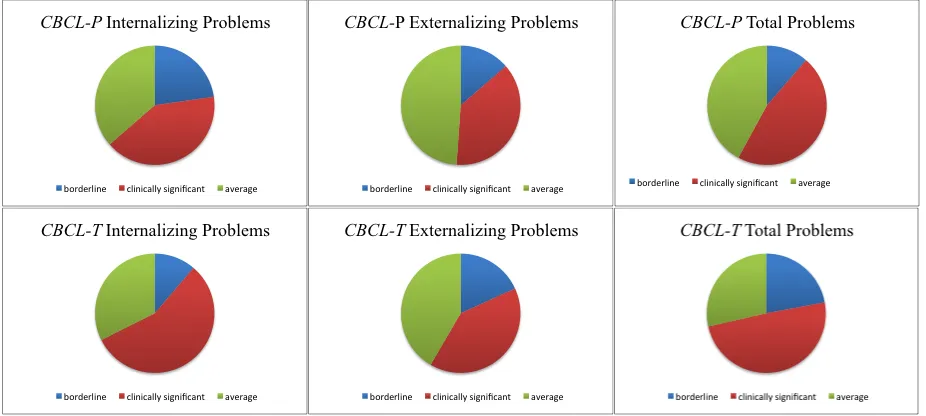
Twenty of 88 (22.727%) children with ASD had a CBCL-P Internalizing Problems score
in the borderline significant range; 36 of 88 (40.909%) were in the clinically significant range on
this score. Thus, 63% of the sample demonstrated elevated rates of internalizing problems, in
comparison to same-aged peers in the normative sample. Twelve of 88 (13.636%) children with
ASD had a CBCL-P Externalizing Problems score in the borderline significant range; 33 of 88
(37.500%) scored in the clinically significant range. This means that 51% of the sample showed
elevated rates of externalizing problems as compared with peers in the normative sample. For the
Total Problems score on the CBCL-P, 10 of 88 (11.364%) children scored in the borderline
significant range, while 41 of 88 (46.591%) children scored in the clinically significant range.
On the CBCL-T, 8 of 71 (11.268%) children with ASD scored in the borderline
significant range for Internalizing Problems; 40 of 71 (56.338%) scored in the clinically
significant range. Thus, 68% of the sample demonstrated elevated levels of internalizing
problems, compared with same-aged peers in the normative sample. For the Externalizing
Problems score, 14 of 71 (19.718%) children scored in the borderline significant range; 31 of 71
(43.662%) children scored in the clinically significant range. This means that overall, 63% of the
sample showed elevated rates of externalizing problems according to the CBCL-T. For the Total
Problems score, 17 of 71 (23.944%) children with ASD scored in the borderline significant
range; 38 of 71 (53.521%) children scored in the clinically significant range. Thus, 77% of the
sample had an elevated Total Problems score as reported on the CBCL-T. This information is
displayed in Figure 1.
Figure 1. Paneled pie charts depicting the proportion of the sample with average, borderline, and clinically significant scores on the (left to right) Internalizing, Externalizing, and Total Problems scores, as reported by parents (top) and teachers (bottom) on the Child Behavior Checklist
Sex differences in the ASD sample
As summarized in Table 1, independent-samples t-tests were conducted to determine if
there were differences in Internalizing Problems, Externalizing Problems, or Total Problems
scores between boys and girls with ASD based on parent report on the CBCL-P. No significant
differences were found for Internalizing Problems, t = .222, p = .825, Externalizing Problems, t =
.318, p = .751, or Total Problems, t = .074, p = .941.
Additional independent-samples t-tests were conducted to determine if there were
differences in Internalizing Problems, Externalizing Problems, or Total Problems scores between
these same boys and girls based on teacher report on the CBCL-T. Again, no significant
differences were found for Internalizing Problems, t = 1.628, p = .108, for Externalizing
Problems, t = 1.624, p = .109, or for Total Problems, t = 1.197, p = .236.
Discussion
This study compared the internalizing and externalizing behaviors of a clinically
ascertained sample of children with ASD to normative behavior based on the CBCL-P and
CBCL-T, and investigated differences in these behaviors between boys and girls with ASD.
According to parent report, 63% of children with ASD had elevated scores related to
Internalizing Problems; 51% had elevated externalizing scores; and 58% had elevated Total
Problems scores. Thus, parents reported a majority of the sample had elevated rates of
internalizing and/or externalizing behaviors in comparison with typical rates of these behaviors,
based on the normative sample. These findings suggest that in clinical samples, children with
ASD are more likely than typically developing children to have either internalizing or
externalizing problems, or that they may be affected to a greater extent. There were no
Problems, or Total Problems based on the scores from the CBCL-P or CBCL-T. This lack of
significance suggests that boys and girls in this sample did not differ in the extent to which they
demonstrated internalizing and externalizing problems.
Similar to our findings, prior research by Hull et al. (2016) found that children with ASD
had higher levels of internalizing and externalizing problems than typically developing children.
This contradicts the findings of Turygin et al. (2013) who found that children with ASD were not
more likely to exhibit internalizing behaviors than typically developing children. This
discrepancy in research findings indicates a need for continued study in this area. Specifically,
studies should be conducted with both an ASD group and a typically developing group to more
directly compare internalizing problems and externalizing problems scores, using either the
scores from the CBCL, or data gathered from other measures that address these behaviors.
No significant sex differences were found in internalizing or externalizing in the present
sample. This finding was consistent with Hull et al. (2016), but inconsistent with findings from
many other studies. For example, Vaillancourt et al. (2017) found that girls with ASD exhibited
higher levels of internalizing behaviors than boys with ASD, while Duvekot et al. (2017) found
that girls in general (both with ASD and typically developing) had higher levels of internalizing
problems than boys with or without an ASD diagnosis. One potential explanation for this
discrepancy could be publication bias. Studies that found differences are more likely to be
published than studies that found no significant differences, meaning that the literature is likely
to contain more studies that find differences simply due to the nature of publication. Another
possible explanation for our lack of significant differences between boys and girls might be our
methodology. Specifically, the current sample was comprised of clinical data from children who
ASD diagnosis. Thus, it is possible that our sample was composed of children with more
noticeable manifestations of ASD symptoms than an average child with ASD. It is also possible
that if girls are engaging in social camouflage early, they might not be referred, and therefore
would not be represented in clinical samples, like the one used for this study. Those who were
referred might be more likely to show traditional manifestation of ASD and co-morbid
symptoms, which would likely have a large impact on our results when examining sex
differences.
Limitations
Certain limitations existed in this study that may have impacted the results. Most notably,
our sample size was quite small, especially with respect to the number of girls, which may have
limited our power to detect differences between the sexes. Additionally, while our study’s
clinically ascertained sample made it more likely to generalize to clinical samples in the
community, it lacked the strong internal validity controls seen in traditional studies, which
prevent bias. In the present research, the strength of generalizability was felt to outweigh the
limitations related to internal validity controls; however, it should be noted that both approaches
have their merits and flaws.
Conclusion
This study showed evidence supporting the hypothesis that children with ASD are likely
to have higher rates of internalizing and externalizing problems than same-aged typically
developing peers. This is important to know because it could make clinicians more sensitive to
the possibility of children with ASD having these co-morbid psychiatric disorders, and it also
might help inform how clinicians approach intervention. In addition, no significant differences in
suggesting that boys and girls with ASD have similar levels of internalizing and externalizing
problems within a clinical sample. Overall, this study allowed us to compare internalizing and
externalizing problems in a clinically ascertained sample of children with ASD versus a
same-aged normative sample, and to compare boys versus girls with ASD, contributing to the growing
body of research in a way that is generalizable to the clinical community. These findings may
help clinicians better understand how children with ASD are affected by co-morbid psychiatric
Acknowledgements
I would first of all like to thank my main advisor on this project, Dr. Kathryn Greenslade,
without whose insight, encouragement, and hard work this would not have been possible. I could
not have asked for a better, more passionate advisor. Also to Drs. Rae Sonnenmeier and
Elizabeth Humphreys, thank you both for your significant contributions to the data collection and
the overall research process. I am so appreciative of the time you put into this project from the
beginning. To Michelle LaCroix, Jade Bowden, and Alexandra Morgan, thank you for the long
hours you spent collecting and organizing data. I am also extremely grateful to the participants
and their families for generously allowing us to use the clinical data we needed in order to
complete this study. Lastly, to my mom and dad, thank you so much for your unconditional love
References
Achenbach, T. M., & Rescorla, L. A. (2001). Manual for the ASEBA School-Age Forms &
Profiles. Burlington, VT: University of Vermont, Research Center for Children, Youth, &
Families.
Crooke, P. J., & Olswang, L. B. (2015). Practice-based research: Another pathway for closing
the research-practice gap. Journal of Speech, Language, and Hearing Research, 1-12.
doi: 10.1044/2015_JSLHR-L-15-0243.
Duvekot, J., van der Ende, J., Verhust, F. C., Slappendel, G., van Daalen, E., Maras, A., &
Greaves-Lord, K. (2017). Factors influencing the probability of a diagnosis of autism
spectrum disorder in girls versus boys. Autism: The International Journal of Research
and Practice, 21(6), 646-658.
Epstein, I. (2001). Using available clinical information in practice-based research. Social Work in
Health Care, 33, 15–32. doi:10.1300/ J010v33n03_03
Hull, L., Mandy, W., & Petrides, K. V. (2016). Behavioural and cognitive sex/gender differences
in autism spectrum condition and typically developing males and females. Autism, 21(6),
706-727.
Lord, C., Rutter, M., DiLavore, P. C., & Risi, S. (1999). Autism Diagnostic Observation
Schedule (ADOS). Los Angeles, CA: Western Psychological Services.
Lord, C., Rutter, M., DiLavore, P. C., Risi, S., Gotham, K., & Bishop, S. (2012). Autism
Diagnostic Observation Schedule (2nd ed.). Torrance: Western Psychological Services.
Reinhardt, V. P., Wetherby, A. M., Schatschneider, C., & Lord, C. (2015). Examination of sex
development. Journal of Autism & Developmental Disorders, 45, 697-706. doi:
10.1007/s10803-014-2223-6
Turygin, N. C., Matson, J. L., Adams, H., & Belva, B. (2013). The effect of DSM-5 criteria on
externalizing, internalizing, behavioral and adaptive symptoms in children diagnosed
with autism. Developmental Neurorehabilitation, 16(4), 277-282.
doi:10.3109/17518423.2013.769281
Vaillancourt, T., Haltigan, J. D., Smith, I., Zwaigenbaum, L., Szatmari, P., Fombonne, E., & ...
Bryson, S. (2017). Joint trajectories of internalizing and externalizing problems in
preschool children with autism spectrum disorder. Development and