Using contribution analysis to assess the
influence of farm link programs in the U.S.
Angela Hersey a * and Michelle Adams b Dalhousie University
Submitted September 5, 2016 / Revised February 20 and April 18, 2017 / Accepted April 18, 2017 / Published online July 11, 2017
Citation: Hersey, A., & Adams, M. (2017). Using contribution analysis to assess the influence of farm link programs in the U.S. Journal of Agriculture, Food Systems, and Community Development, 7(3), 83–103. http://dx.doi.org/10.5304/jafscd.2017.073.006
Copyright © 2017 by New Leaf Associates, Inc.
Abstract
This paper examines 12 U.S. farm link programs (FLPs) using a type of program evaluation called contribution analysis (CA) to determine if FLPs are effective in facilitating farmland transfers between retirement-aged farmers without family successors and new farmers beginning their career. CA guided the data collection, which included web audits, interviews, questionnaires, and scholarly and grey literature review. We developed an analytical framework in the form of a theory of change, followed by analysis of the FLPs and their contribution to farm transfers. The analysis focused on four themes that emerged from the theory of change: (1) the effectiveness of FLP
design and program activities; (2) the usefulness of FLP databases to meet the needs of farmers; (3) farmer motivation toward development or land preservation; and (4) trends and systemic
influences on farm transfers. Although some FLPs experienced relative success, the lack of
professional support systems, a heavy reliance on a self-serve Internet database, and the presence of various external conditions prevent most FLPs from facilitating substantial numbers of farm transfers. To conceptualize how FLPs may be more successful, a revised theory of change was developed, offering new perspectives on the systemic conditions in which FLPs operate.
Keywords
Contribution Analysis; Family Farm; Farm Link Programs; Farm Transfers; Retiring Farmers; Succession Planning
Introduction
In the U.S., farm link programs (FLPs) endeavor to preserve productive agricultural landby facilitating farm transfers from retiring farmers or landowners a * Corresponding author: Angela Hersey, School for Resource and
Environmental Studies, Dalhousie University; 6100 University Avenue; P.O. Box 15000; Halifax, Nova Scotia B3H 4R2 Canada; +1-902-802-0117; [email protected]
Permanent address: 1-83 Queen Street; Dartmouth, Nova Scotia B2Y 1G7 Canada.
b School for Resource and Environmental Studies, Dalhousie
to those starting a farming career (Hubbard, 2006). FLPs also look to other types of arrangements to support this transition, such as short- or long-term leases. Nonprofit organizations, universities, and outreach arms of government departments typically run FLPs, also known as ‘land link’ programs (Hubbard, 2006). Their overall intent is to keep farmland “in agricultural production while helping preserve rural communities and family farms in the face of ever-growing corporate interests” (Slack, 2013, p. 505). FLPs hope to enable farmers to retire comfortably, make affordable land accessible to beginning farmers, and limit the loss of farmland to development.
The literature describes mostly what FLPs do and how they function (Goeller, 2012; Hubbard, 2006; Slack, 2013; Strange, Thompson, Prosch, & Johnson, 2003). Ingram and Kirwan (2011), however, explore the difficulties FLPs face through the lens of the challenges and ultimate dissolution of the Fresh Start FLP in Cornwall, U.K. They suggest that it is nearly impossible for FLPs to account for, and thereby mitigate, the ‘social fac-tors’ that influence farm transfers, such as lack of trust between retiring and new farmers (Ingram & Kirwan, 2011). Their critique highlights the fact that research on the ultimate effectiveness of FLP efforts is lacking.
The intent of our research was to evaluate the capacity of FLPs to facilitate various types of farm transfers while identifying barriers and challenges that may interfere with this goal. The research was undertaken using the program evaluation frame-work contribution analysis (CA). With CA as a guide, we analyzed literature and interview data from FLP staff in order to position FLPs in the broader scheme of farm transfers in the U.S. We also analyzed the environments in which FLPs operate to identify some general program design flaws as well as the ability of the programs to facilitate farm transfers effectively.
Literature Review
Farmland occupies roughly 40 percent (914 million acres) of privately owned U.S. land (Daniels & Bowers, 1997; Nickerson, Morehart, Kuethe, Beckman, Ifft, & Williams, 2012). Total acreage, however, has decreased since the shift to industrial
agricultural production began in 1935 (U.S. Environmental Protection Agency [U.S. EPA], 2013). Large farms dominate agricultural production, and smaller family-run farms have been going out of business (Hamilton, 2005; Lyson, 2007). Each year up to 500,000 acres (202,343 hectares) of farmland is lost and developed. Between 1982 and 2010, about 24,125,400 acres (9,763,203 hectares) were lost (Farmland
Information Center, 2013). As urban areas expand, the economic value of farmland increases (Kuethe, Ifft, & Morehart, 2011). In the 2000s, farmland values increased significantly (Gloy, Boehlje, Dobbins, Hurt, & Baker, 2011; Weber & Key, 2015), influencing the ability of new farmers to afford farmland. Moreover, three-quarters of new farmers do not come from a farming family who could help them access land and capital (Ahearn & Newton, 2009; Inwood, 2013; Inwood, Clark, & Bean, 2013; Mailfert, 2007).
Urban sprawl—the expansion of urban and suburban areas onto rural land—can cause farmers to perceive development as inevitable, thus affect-ing their desire to update their agricultural model (Lindstrom & Bartling, 2003). “Farmers often feel discouraged from taking creative action to continue farming and are put in a financial situation where they need to sell quickly” (Lindstrom & Bartling, 2003, p. 2), so farmers often sell their farm for less than market value, a cycle that leaves farmers without adequate retirement income while encour-aging continued suburbanization.
Many aging farmers have no familial succes-sors (Scott, Cameron, & Benjamin, 2010). Tradi-tionally, farms are passed on to children as farmers approach retirement age, but the difficulties of farming encourage farmers’ children to pursue other careers (Ball & Wiley, 2005). The average age of farmers in the U.S. is 58, up from 55 in 2002, and the number of farmers over 75 has increased 20 percent since 2002 (U.S. Department of Agri-culture [USDA], 2007a, 2012). Without successors, farmers work well beyond traditional retirement age (Amshoff & Reed, 2005; Ball & Wiley, 2005), and without adequate succession plans, the future of their farms may be at risk.
hands (USDA, 2014). Many farmers will need to sell their farms, but to whom and for how much? Those wanting to enter farming often struggle with high start-up costs and obtaining land, despite their willingness to enter the profession (Ingram & Kirwan, 2011) and often cannot purchase land at a price that enables financial security for retiring farmers (Pitts, Fowler, Kaplan, Nussbaum, & Becker, 2009), thereby making farm transfers impracticable. When developers offer good prices for farmland, it is understandable that a farmer without a successor would sell land to finance retirement. Research that can help unpack the nuances of supporting more successful farm transfers is important to disrupt this trend.
Methods and Analytical Approach
We based the methodological framework for this research on a Program Evaluation (PE) method called contribution analysis (CA), first developed by John Mayne in 2001 (Mayne, 2012). CA
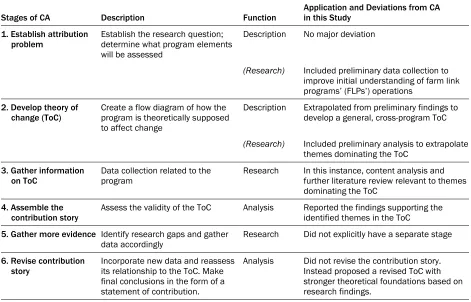
accounts for the fact that external factors may have more of an impact on a program’s observable outcome than the structured activities of the program itself (Shadish, Cook, & Leviton, 1991), and thus is based on the understanding that pro-grams do not operate in a vacuum. In using CA, we conducted an initial round of data collection fol-lowed by preliminary analysis, which provided the foundation for the development of the key tool in CA, the theory of change (ToC) (Anderson, 2005). We then created the analytical framework, collected more data, and conducted another round of anal-ysis, which informed a revised ToC. Use of the CA framework required information about the pro-gram and its outcomes, and also required incor-poration of program-specific data. Table 1 outlines the standard stages of CA and how we applied each of them in this study, including deviations from standard CA procedures that were necessary for this study.
Initial data collection consisted of Internet
Table 1. Stages of Contribution Analysis (CA) and Applications in This Study of Farm Link Programs
Stages of CA Description Function Application and Deviations from CA in this Study
1. Establish attribution
problem Establish the research question; determine what program elements will be assessed
Description No major deviation
(Research) Included preliminary data collection to improve initial understanding of farm link programs’ (FLPs’) operations
2. Develop theory of
change (ToC) Create a flow diagram of how the program is theoretically supposed to affect change
Description Extrapolated from preliminary findings to develop a general, cross-program ToC
(Research) Included preliminary analysis to extrapolate themes dominating the ToC
3. Gather information on ToC
Data collection related to the program
Research In this instance, content analysis and further literature review relevant to themes dominating the ToC
4. Assemble the
contribution story Assess the validity of the ToC Analysis Reported the findings supporting the identified themes in the ToC
5. Gather more evidence Identify research gaps and gather
data accordingly Research Did not explicitly have a separate stage
6. Revise contribution
story Incorporate new data and reassess its relationship to the ToC. Make final conclusions in the form of a statement of contribution.
Analysis Did not revise the contribution story. Instead proposed a revised ToC with stronger theoretical foundations based on research findings.
searches for U.S. farm link programs. The researchers searched Google, using the search terms ‘farm link programs,’ ‘land link programs,’ and ‘farm matching programs’ to identify as many programs as possible. We reviewed each program website for information about process, intention, operational history, success metrics, contact infor-mation, and other relevant documentation. We then entered the information into a spreadsheet and developed a questionnaire to address infor-mation gaps such as budgets, staffing levels, and any governmental relationships. The questionnaire also included open-ended questions.
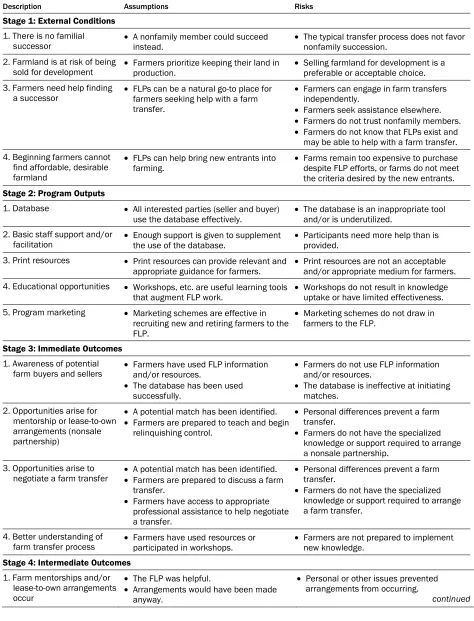
To supplement publicly available information, we emailed participation requests to staff at 19 FLPs; 12 agreed to participate. Over a three-month period we collected data. Eight participants com-pleted the questions in writing and submitted them by email; four chose a phone interview format. The researcher conducting the interview took notes throughout the phone interview and returned these to the participant for verification. We entered par-ticipant responses into tables and reviewed the data for significant trends and themes. We then con-ducted more research based on those trends and themes and used all data to produce the theory of change(ToC) (Table 2).
We developed the ToC based on what we learned about FLPs as a category during the pre-liminary data gathering and initial analysis de-scribed above. Table 2 reflects the resulting ToC for FLPs. Each section of the table represents a specific stage in an ideal FLP farm transfer process, with the progress of each stage depending on the success of the previous stage. This ToCoutlines the ideal process flow that should occur in an FLP.
Four themes emerged from the ToC: (1) the effectiveness of FLP design and program activities; (2) the usefulness of FLP databases to meet the needs of farmers; (3) farmer motivation toward development or land preservation; and (4) trends and systemic influences on farm transfers. These themes guide the second round of data collection, providing context for the findings and structure for the contribution story (CS) (Delahais &
Toulemonde, 2012; Lemire, Nielsen, & Dybdal, 2012), which is based on evidence collected about the themes emerging from the ToC. The CS can be
described as a narrative explaining why the ToC is or is not accurate, and hence why the program is effective or ineffective. The ToC is tested by exam-ining each theme in the context of how it affects FLPs and the land transfer process. The assump-tions associated with each theme (Table 2) are chal-lenged using literature and empirical data (inter-views and/or questionnaires). This approach incor-porates common practices found in other types of theory-driven evaluations, where the strength of a program is tested according to how well the com-ponents of the theory function (Mayne, 2001). Once the influence of each theme is understood, each theme can be discussed in relation to the others; how these influencing factors impact FLPs and farm transfers then can be better appreciated. At the CS development stage, program credi-bility and its contribution, if any, to observed out-comes are assessed (Mayne, 2008). The CS serves to validate, question, and explain the theory of change, and includes the primary empirical data and a review of relevant academic and grey litera-ture. Specific to this research, the creation of the CS allows flaws within FLP functioning that pre-vent (or limit) success to be identified. The final result of the CS is a Statementof Contribution (SoC) (Mayne, 2008), which, in this case, clearly states if and how FLPs are contributing to land transfers. Several recommendations emerged that may help FLPs mitigate some of their operational challenges.
Evaluating Program ‘Success’
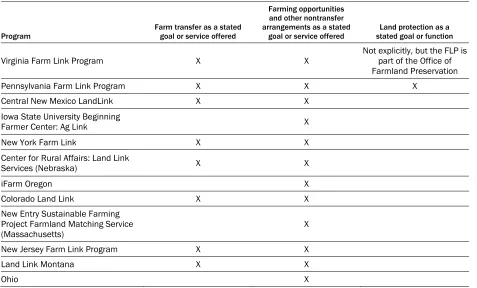
Determining what success means for FLPs war-ranted further inspection of each FLP’s stated objectives. Each FLP included in this research has stated goals, which are described in Table 3.
Results and Analysis: How FLPs Affect Farm
Transfers (the Contribution Story)
Table 2. Theory of Change for a Farm Link Program
Description Assumptions Risks
Stage 1: External Conditions
1. There is no familial
successor • A nonfamily member could succeed instead. • The typical transfer process does not favor nonfamily succession. 2. Farmland is at risk of being
sold for development • Farmers prioritize keeping their land in production. • Selling farmland for development is a preferable or acceptable choice. 3. Farmers need help finding
a successor • FLPs can be a natural go-to place for farmers seeking help with a farm transfer.
• Farmers can engage in farm transfers independently.
• Farmers seek assistance elsewhere.
• Farmers do not trust nonfamily members.
• Farmers do not know that FLPs exist and may be able to help with a farm transfer. 4. Beginning farmers cannot
find affordable, desirable farmland
• FLPs can help bring new entrants into
farming. •
Farms remain too expensive to purchase despite FLP efforts, or farms do not meet the criteria desired by the new entrants.
Stage 2: Program Outputs
1. Database • All interested parties (seller and buyer)
use the database effectively. •
The database is an inappropriate tool and/or is underutilized.
2. Basic staff support and/or
facilitation • Enough support is given to supplement the use of the database. • Participants need more help than is provided. 3. Print resources • Print resources can provide relevant and
appropriate guidance for farmers. •
Print resources are not an acceptable and/or appropriate medium for farmers. 4. Educational opportunities • Workshops, etc. are useful learning tools
that augment FLP work. •
Workshops do not result in knowledge uptake or have limited effectiveness. 5. Program marketing • Marketing schemes are effective in
recruiting new and retiring farmers to the FLP.
• Marketing schemes do not draw in farmers to the FLP.
Stage 3: Immediate Outcomes
1. Awareness of potential
farm buyers and sellers • Farmers have used FLP information and/or resources.
• The database has been used successfully.
• Farmers do not use FLP information and/or resources.
• The database is ineffective at initiating matches.
2. Opportunities arise for mentorship or lease-to-own arrangements (nonsale partnership)
• A potential match has been identified.
• Farmers are prepared to teach and begin relinquishing control.
• Personal differences prevent a farm transfer.
• Farmers do not have the specialized knowledge or support required to arrange a nonsale partnership.
3. Opportunities arise to
negotiate a farm transfer •• A potential match has been identified. Farmers are prepared to discuss a farm transfer.
• Farmers have access to appropriate professional assistance to help negotiate a transfer.
• Personal differences prevent a farm transfer.
• Farmers do not have the specialized knowledge or support required to arrange a farm transfer.
4. Better understanding of
farm transfer process • Farmers have used resources or participated in workshops. • Farmers are not prepared to implement new knowledge.
Stage 4: Intermediate Outcomes
1. Farm mentorships and/or lease-to-own arrangements occur
• The FLP was helpful.
• Arrangements would have been made anyway.
• Personal or other issues prevented arrangements from occurring.
Description Assumptions Risks
2. Farm transfers occur • The FLP was helpful.
• Farm transfers would occur anyway. •
Personal or other issues prevented transfers from occurring.
3. Retiring farmers are
financially secure • Farm transfers adequately provide farmers with enough money to fund retirement.
• Farmers are not able to sell the farm for enough money to live comfortably in retirement.
4. Agricultural production is
sustained in region • New farmers will maintain existing level of production. • New farmers engage in smaller-scale farming, possibly part-time.
Stage 5: Final Outcomes
1. Farm preservation • Farms are transferred to a new farming
generation. • Farms are sold for development or left fallow.
2. Rural employment • The farming venture is successful and able to employ staff.
• Spin-off industries maintain viability.
• Farms are too small to require extra staffing.
• Farms are unsuccessful businesses.
• Farms have difficulty finding qualified, willing laborers.
3. Farmland transferred to a
new generation • Farms are sold to people for farming purposes.
• Farmers retire financially secure.
• Farms are not transferred.
• Farms are sold to people who choose to significantly downsize farming operations.
Table 3. Stated Objectives of Farm Link Programs (FLPs) in This Study
Program Farm transfer as a stated goal or service offered
Farming opportunities and other nontransfer arrangements as a stated
goal or service offered stated goal or functionLand protection as a
Virginia Farm Link Program X X
Not explicitly, but the FLP is part of the Office of Farmland Preservation
Pennsylvania Farm Link Program X X X
Central New Mexico LandLink X X
Iowa State University Beginning
Farmer Center: Ag Link X
New York Farm Link X X
Center for Rural Affairs: Land Link
Services (Nebraska) X X
iFarm Oregon X
Colorado Land Link X X
New Entry Sustainable Farming Project Farmland Matching Service (Massachusetts)
X
New Jersey Farm Link Program X X
Land Link Montana X X
Effectiveness of FLP Design and Program Activities
Each FLP has unique characteristics, which are identified and examined to understand their impact on program outcomes. Impact is specified as the number of successful matches, transfers, and/or leases resulting from program efforts. Three FLPs stand above the rest. Since the FLP came into existence, New York Farm Link reported 75 trans-fers and 500 farmers receiving services related to long-term transfers; the Iowa Ag Link program reported 68 farm transfers; and iFarm Oregon reported 35 transfers, including long-term lease agreements. The other programs that reported a specific number of transfers reported fewer than 10, while some could not provide a specific num-ber because they did not keep such data. There were no consistent trends apparent in the data that could easily explain the differences in the number of farm transfers between programs, which indi-cates a need to further analyze and understand the programs at a more fundamental level.Notably, some FLP staff stated that programs should be evaluated on their ability to help estab-lish any type of connection with potential farmers, not just on the number of successful transfers. However, program websites still specifically iden-tify farm transfers as an important outcome (Table 3), in addition to helping establish other farming opportunities. Given that programs were created to support land transfers, in addition to these other types of connections,1 the term ‘transfer’ will here-after include sales, leases, and other forms of longer-term partnerships.
Budgets and funding. FLPs rarely operate as the sole activity or focus of an organization. When asked about the yearly budgets of FLPs, most par-ticipants could provide only an approximate dollar amount. The budgets of the surveyed FLPs range from none2 to over US$120,000 per year. Most budgets were between US$15,000 and US$50,000 (eight out of 12); much of this money went to
1 Some FLP staff included any type of connection made between farmers (e.g. long-term leases, partnerships, or land-share arrangements) within their definition of ‘transfer.’ 2 One program reported that it was operating at a loss—its organizational budget did not allocate any funds for FLP work, but the work was being done by staff anyway.
ing staff.
An important finding was that neither levels nor sources of funding corresponded with the number of transfers. For example, a program that reported a budget of US$120,000 had zero matches associated with the program, while a program reporting a high number of matches had a budget of approximately US$45,000 per year. A young program also reported a high number of matches while operating with a budget of only US$30,000. Sources of funding—mainly from the government, university funding, and private donations—did not correspond with program success. Some programs charged a user fee to new farmers, but this was not typical. Retiring farmers were not charged a fee in any of the study programs.
Staffing. Staff levels at all programs are mini-mal: three programs have only one full-time staff member, and nine have only a part-time staff mem-ber. Aiming to learn from existing FLPs to design a well-functioning FLP in Montana, Hubbard (2006) considered the day-to-day role and function of staff in FLPs: “It is no surprise that these under-staffed programs facilitate matches as efficiently as possible by publicizing the information and resources, hoping their participants will utilize them well” (p. 20). The energy needed to actively initiate matches is not always available to staff. However, even understaffed programs have been relatively successful, suggesting that success and funding are not necessarily related. This finding suggests that further investigation is needed to bet-ter understand the specific nature of program fea-tures that are most commonly linked to success.
Program focus. FLPs all operate on similar principles. Therefore, variations in the number of transfers may result from differences in the organi-zations that run FLPs, or from the influence of the other services the organization offers.3Additional services that FLPs provide can be divided into three categories. The first is farmer education and includes business planning, educating on farming
issues, and/or providing additional educational resources to farmers. The second category of ser-vices encourages social and political engagement and includes the operation of farmers markets and development of consumer information and resources, policy formation or government lobby-ing, and/or rural development work. The third category relates to land issues such as preservation, conservation, and zoning.
Of the three programs that declare the most number of matches to date, two strongly focus on farmer education. The third program has some focus on education for farmers, and some on broader social and political engagement activities. None of the three are concerned explicitly with land conservation. That these three FLPs focus on education and broader social and political activities is not necessarily the cause of their relative success; other FLPs also participate in these types of pro-gramming activities, yet do not have success rates comparable to these three. Therefore, it is difficult to attribute those successes to one replicable pro-gram characteristic.
Given the small number of farm transfers made through the 12 FLPs surveyed, even includ-ing those reportinclud-ing higher transfer rates, it appears that FLP transfers are responsible for only a minority of farm transfers or start-ups. According to the USDA, 291,329 new farms started between 2002 and 2007, making up about 13 percent of all farms in production during those years (USDA, 2007b). It is unclear whether these farms were transferred to family or nonfamily members, or were entirely new farming operations starting up on previously unfarmed land. The relatively small influence that FLPs have on the overall number of farm transfers raises the question of what wider issues may also be influencing low transfer rates among FLPs. This part of the CS suggests that present program designs may be inadequate to influence land transfers. As the CS is developed, a clear portrayal of what FLPs do with limited staff and financial resources will underpin the overall understanding of the potential impact of FLPs. The limited influence on farm transfers is clear, but is this the whole story? The following three sec-tions endeavor to uncover some specific challenges that may be linked to poor outcomes for FLPs,
what additional factors may need to be considered, and what modifications could be made to improve FLP success.
Usefulness of FLP Databases to Meet the
Needs of Farmers
Questionnaire and interview results indicate that FLPs place a heavy emphasis on database use. Participants indicated that these databases auto-mated much of the FLP matching process. The database set-up differs in each case, but many participants indicated that they allow automated emails or contact information to be sent to a farm seller or seeker under certain conditions. Some programs screen participants and facilitate initial contacts between parties. That FLP staff rely so heavily on databases to facilitate matches is, there-fore, worth examining, as their usefulness and the level of uptake on the part of users are likely significant factors in the success of FLPs.
Participants (staff who completed the inter-view or questionnaire) reported significantly more farm seekers than sellers using these databases. Several participants observed that the farm seekers drive the program, as they are the more eager of the parties. Two FLPs directly encouraged retiring farmers to be the main drivers of the process by initiating contact with potential buyers. Goeller (2012) also noted a disproportionate number of farm owners (fewer) and farm seekers (more) listed in FLP databases, although it is usually free for landowners to register, while seekers often have to pay a fee. The limited use of these programs by retiring farmers signifies a potential problem. It is possible that retiring farmers are less interested in engaging with an FLP that requires submission of an online form to begin the matching process. Therefore, it may be problematic that FLPs rely so heavily on databases to facilitate matches between farmers. These issues are discussed further below.
Whitacre, 2010), the scope and scale of Internet usage depend predominantly on things like farm size (Briggeman & Whitacre, 2010; Mishra & Park, 2005; Stenberg & Morehart, 2007), income level, education, and age (Stenberg & Morehart, 2007).
Computers are used fairly often for farm business-related tasks (Mishra & Park, 2005). In the early days of the Internet, however, the rate of its regular use for daily farm business tasks was much lower than that of other businesses of similar size (Warren, 2004). Since then, the literature suggests that activities such as sourcing information, email, online banking, and purchasing and/or selling goods are minimal and not universal among farmers (Charatsari & Lioutas, 2013; Chiu et al., 2015; Taragola & Van Lierde, 2010). This lack of use is not due to limited rural access: by 2011, about 60 percent of rural residents had access to high speed Internet, compared to 70 percent of urban residents (U.S. Department of Commerce, 2011). Although the rate of farmer Internet use is increasing (USDA, 2013), rural farmers still lag behind those in other sectors (Khanel & Mishra, 2013). Limited Internet use among farmers is not necessarily a problem, unless the Internet is used as a “default medium for knowledge transfer, com-merce, etc.” (Warren, 2004, p. 380), thus leaving some farmers at a disadvantage.
There are legitimate reasons why Internet adoption has been slower among aging farmers; FLPs need to understand these issues. “Older operators are less likely to adopt the internet” (Briggeman & Whitacre, 2010, p. 573). Studies consistently show a clear negative correlation between age and Internet use in farmer business (Howell & Habron, 2004; Stenberg & Morehart, 2007), and a 2015 study by Chiu et al. investigating where farmers got health and safety information shows the Internet to be a least trusted source of information among farmers of all ages. While farmers may have computers and Internet access, they may not use them as a business tool or a source for business-related information (Chiu et al., 2015; Stenberg & Morehart, 2007). Varble, Secchi, and Druschke (2016) suggest that those farmers who do use the Internet more extensively—such as for business communications and sourcing infor-mation—would be considered ‘innovators,’
suggesting that the use of the Internet for these purposes is not the norm for farmers. Such condi-tions provide plausible explanation for why the FLP databases are sparsely populated with farm owners.
Personal security on the Internet. Older farmers are concerned that personal information will not remain secure on the Internet (Briggeman & Whitacre, 2010; Warren, 2004), more so than other population groups (Stenberg & Morehart, 2007). FLP staff have noted this concern and emphasized the need to take extra care to protect contact information stored in FLP databases to alleviate farmers’ concerns about security. FLPs need to improve farmer confidence that their personal information is secure.
Perceived usefulness of the Internet.
Hubona and Geitz (1997) suggest that any type of technology adoption process requires the potential adopter first to perceive the technology as useful and easy to use. This positive (or negative) percep-tion determines adopter attitude toward the tech-nology, which in turn drives his or her intention to use it (or not). Research suggests that farmers often are not aware of how they can benefit from using the Internet (Taragola & Van Lierde, 2010), and their “lack of perceived need for the internet” (Briggeman & Whitacre, 2010, p. 581) will prevent its use. In addition, “farmers are more skeptical of the quality of the internet as compared with that of face-to-face information diffusion” (Charatsari & Lioutas, 2013, p. 122), and believe that the Internet is not actually a suitable replacement for traditional methods of conveying information to farmers (Ballantyne, 2009).
successful, FLPs may need to invest in more tradi-tional communication methods including, ideally, more face-to-face contact. One opportunity could be to arrange networking sessions in hub locations that involve both buyers and sellers and a form of facilitated interaction. Other industrial sectors seek-ing to development relationships between disparate actors have used this “speed-dating” approach with considerable success (Liu, Adams, Cote, Geng, & Li, 2016), thus demonstrating the potential for such events.
Farmer Motivations Concerning Development
and Land Preservation
Data analyses suggest that FLPs assume that farm-ers prefer their farmland to be kept in production and that it is only the difficulty of transferring the farm that prevents it from being used for contin-ued agricultural production. These assumptions are simplistic, as complex economic, personal, and geographic factors influence farmers’ decisions about the future use of their farmland. Farmland is a financial asset and can be a source of income during retirement; it is a potential home during retirement; it is a place filled with sentimental value for many farmers (Mishra, El-Osta, & Johnson, 2004); and in many cases, it is a legacy (Duffy, 2011). The services FLPS offer may not address the reasons a farmer might decide to sell farmland.
Financial considerations. Farmers considering selling land take into account things like their health, age, children’s interest in farming, opportunity for nonfarm occupation, and desire to relocate (White, 1998). Financial needs strongly motivate farmers’ decisions about their land; in many cases, farmer financial needs are better served by selling the land at development prices (Zollinger & Krannich, 2002) than by passing it on to subsequent generations (Pitts et al., 2009). A farmer facing unfavorable farming conditions, such as sprawl, may consider transferring to a family member who has expressed interest in taking over the family farm, but not to a nonfamily member (Zollinger & Krannich, 2002) because “farmers may feel that the child who has been planning to take over the farming operation should have the right to attempt farming operations in the current area or sell the operation for non-agricultural land
use” (Zollinger & Krannich, 2002, p. 459). If there is no family member to take over the farm, how-ever, the farmer may simply sell the land for non-agricultural uses (Zollinger & Krannich, 2002) or hold onto the land as long as possible (Duffy, 2011). For FLPs, this means that some decisions regarding farm sales have little to do with the farmer’s ability to find a buyer. These common tendencies of retiring farmers may prevent farm-land from becoming available to new farmers, thus limiting the rate of possible transfers.
If the farm owner is interested in selling to a new farmer, pricing can make selling difficult. Retiring farmers seek to profit enough to make retirement comfortable, but to keep the land undeveloped and in production, the asking price must be affordable for the new farmer (Pitts et al., 2009). Without a family successor, farmers may feel it is not worth the effort to find a successor if they believe market, community, or geographical condi-tions are poor. Alternatively, a farmer may simply not be willing to put the farm on the market for a nonfamily member to purchase (Duffy, 2011). This presents a question of convenience: when faced with various options, will a farmer opt for the simplest type of sale?
Sentimental attachment to family farmland.
be used for agriculture (Darnhofer, 2010; Higby, Ruhf, & Woloschuk, 2004). The absence of suc-cession planning will likely limit the likelihood that farmers will be able to transfer their farms, thus undermining the possibility of its continued use as farmland (Pitts et al., 2009).
Urbanization considerations. Urban and suburban encroachment results in decreased output and productivity for remaining farms and, over time, a higher amount of idle farmland (Daniels & Bowers, 1997; Thompson & Prokopy, 2009). In a phenomenon known as ‘impermanence syndrome,’ when farmers assume that their land will be devel-oped eventually, they reduce their investments in soil health and their production capacity wanes (Daniels & Bowers, 1997; Olson, 1999). Farmers adapt to urban encroachment with ‘negative adaptation’; they attempt to maintain business as usual, but eventually they close the farm business (Johnston & Bryant, 1987; Sharp & Smith, 2003). External pressures, then, further affect the circum-stances under which farmers operate and make decisions about farmland preservation or develop-ment. If an FLP works under the expectation that farmers want to keep their land in production at all costs, that FLP may be on the path to failure.
Trends and Systemic Influences on Farm Transfers
Succession process. Arranging transfers with nonfamily members is a difficult, emotionally wrought endeavor; a farmer may not be willing or able to bring an unknown person into their opera-tion as easily as they might bring in a family mem-ber.This is not to suggest that transitions with family members are simple; they too can be diffi-cult. A farmer’s attachment toward his or her farmland makes it difficult to break ties to the land upon retirement (Mishra, Johnson, & Morehart, 2003). Relinquishing control may also be financially worrisome for farmers who need to generate retirement income from farm assets (Keating & Munro, 1989). Any of these issues can hinder the transition process (O’Neill, Komar, Brumfield, & Mickel, 2010).
Much of the motivation to modify a farm business is linked to preparations undertaken to pass on the farm within a family (Inwood et al., 2013). Keating and Munro (1989) describe how
younger farmers prepare to take over a farm by engaging in activities of increasing responsibility in the following order: general farm work; livestock care; production management; marketing manage-ment; financial managemanage-ment; land holdings; and equipment holdings. Any good succession process typically begins long before a farmer sells the farm to a successor because the mere expectation of a successor (or none) can affect the succession process (Pitts et al., 2009). Farmers who intend to pass on their business are more likely to make decisions aimed for longer-term growth (Gasson et al., 1988; Stiglbauer & Weiss, 1999). Potter and Lobley (1992) describe this phenomenon as ‘the successor effect.’
Larger farms are more likely to have a family successor than smaller farms (Glauben, Tietje, & Weiss, 2002). Smaller family farms may be at a greater risk of experiencing the impermanence syndrome. Furthermore, relatively few farmers have concrete retirement plans, intending instead to use their farms for income once they retire (Duffy, 2011). This finding is congruent with other studies that indicate that as farmers become semiretired, they expect to be able to continue drawing income from the farm (Gasson, Errington, & Tranter, 1998; Keating & Munro, 1989;
Kirkpatrick, 2013). Such farmers tend to adopt static management practices or disinvest in the farm, selling off some land and assets with the intention of continuing to use the remaining land to finance their retirement (Inwood & Sharp, 2012).
Leasing as a potential farm transfer option.
Leasing can be a more affordable and gradual way for new farmers to begin their farm business or gain valuable experience (Hubbard, 2006). Also, some farmers wanting to sell land have more to sell than is typical for new farmers to purchase. Leasing may allow new farmers to take partial control of the land, which can offer alternative retirement financing options for the landowning farmer.
farmers are likely to take few big risks in their farming operations (Fukunaga & Huffman, 2009). Leasing arrangements offer no guarantee that production would continue after the death of the landowner (Slack, 2013). Furthermore, farmland available to rent may not be suitable for new farm-ers; if the land available is excess land without a house or other buildings, it is more likely that an established neighboring farmer will lease it. The more farmland that is rented in such scenarios limits the land available for young farmers to pur-chase (Ilbery, Ingram, Kirwan, Maye & Prince, 2012).
Given the limitations on the viability of leasing land on a long-term basis, FLPs should nurture farmers wanting to enter such arrangements, while being mindful that many new farmers choose to own land (Shute et al., 2011). As a short-term option, leasing may be acceptable, but as a long-term strategy, ownership may be a more successful option.
New farmers. Understanding the behavior, motivations, situations, and needs of aspiring farmers is important when trying to create a more favorable farm transfer environment. New farmers are not all young; in the U.S., their average age in 2007 was 48 (USDA, 2007b), with approximately one-third over 55 (Ahearn & Newton, 2009; Inwood et al., 2013). New farmers are unevenly distributed across the U.S.; concentrations range from 10 percent or less in a county to as much as 50 (Ahearn & Newton, 2009). New farmers tend to start out with smaller farming operations; “entry rates decline as farm size grows” (Ahearn & Newton, 2009, p. 20). The average size of new farms in 2007 was 201 acres (81 hectares), less than half the average farm size of 418 acres or 169 hectares (USDA, 2007b). New farmers may want to start with smaller farms due to the challenges of accessing financing, resources, and information (Clark, Inwood, & Sharp, 2016). Furthermore, as beginning farmers are likely to have off-farm employment (as 80% do) (Inwood et al., 2013; USDA, 2007c), there is less need to make money solely from farming, lessening the need to purchase a large land parcel. The connection between age and off-farm employment is notable: new farmers may enter farming later in life after working in
other careers and saving for a farm purchase. They may also continue working in other jobs; new farmers are often drawn to the farming lifestyle as opposed to a farming career (Ahearn & Newton, 2009). In fact, in the 2007 U.S. census, 32 percent of new farmers4 did not report any production on their land at all (Ahearn & Newton, 2009). Under-standing that new farmers are not always young, are likely to seek out smaller farms, and may choose to be employed off the farm can provide insight that may support program innovations within FLPs to alleviate the potential difficulties in transferring land caused by these realities.
Incongruent needs: retiring vs. new farm-ers. Beginning farmers have needs that are not aligned with those of established farmers. One problem is that established farmers have much more land and a larger farm business than a beginning farmer can often afford or manage (Inwood et al., 2013). New farmers face high start-up costs (Ahearn & Newton, 2009), and as land values increase, it becomes even more difficult to buy large parcels of farmland (Lobley & Baker, 2012), which may not even suit the needs of new farmers (Ahern & Newton, 2009).
Importance of social networks. Existing social networks create both opportunities and barriers. Strong social networks are important for beginning farmers, yet many—when they are from outside a given agricultural community—experi-ence social isolation in communities where they attempt to begin their farming career (Mailfert, 2007). Such networks facilitate farm acquisition, since it is more likely for farms to be exchanged between friends, family members, and neighbors (Robison, Myers, & Siles, 2002, p. 45). Further-more, farmland typically sells at a lower price when the seller knows the buyer, demonstrating that “relationships do matter in farmland exchange” (Robison et al., 2002, p. 57). New farmers who want to rent farmland may find themselves com-peting against established area farmers who want to
expand their business (Ingram & Kirwan, 2011). Accordingly, new farmers wanting to make short-term arrangements with an established farmer to gain experience may find it difficult to do so.
Study participants emphasized that they are as interested in helping farmers find opportunities as they are in facilitating farm sales. Recalling what was discussed earlier about incorrect assumptions about how farmers value their farmland, the under-standing that farmers have strong social bonds can be an advantage to FLPs. We suggest that time and
energy spent building social networks between retiring and new farmers could result in more favorable outcomes later in terms of farm transfers.
Recap of FLP Challenges
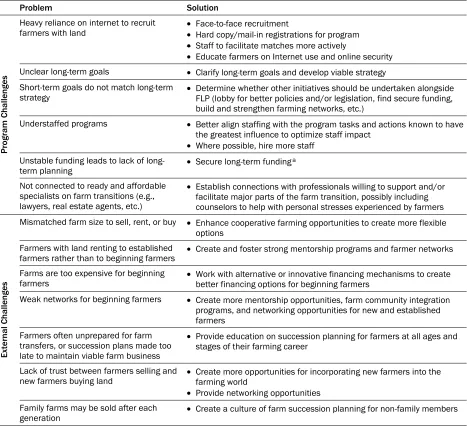
Table 4 summarizes the challenges FLPs identified during this research (Column 1), and possible solutions that we have proposed (Column 2). Acknowledging and addressing challenges, prob-lems, and common mistakes of FLPs are founda-tional in developing a more effective FLP. The
Table 4. FLPs: Existing Problems and Potential Solutions
Problem Solution
Program Challe
nges
Heavy reliance on internet to recruit
farmers with land •• Face-to-face recruitment Hard copy/mail-in registrations for program
• Staff to facilitate matches more actively
• Educate farmers on Internet use and online security
Unclear long-term goals • Clarify long-term goals and develop viable strategy
Short-term goals do not match long-term
strategy • Determine whether other initiatives should be undertaken alongside FLP (lobby for better policies and/or legislation, find secure funding, build and strengthen farming networks, etc.)
Understaffed programs • Better align staffing with the program tasks and actions known to have
the greatest influence to optimize staff impact
• Where possible, hire more staff Unstable funding leads to lack of
long-term planning • Secure long-term funding
a
Not connected to ready and affordable specialists on farm transitions (e.g., lawyers, real estate agents, etc.)
• Establish connections with professionals willing to support and/or facilitate major parts of the farm transition, possibly including counselors to help with personal stresses experienced by farmers
External Challenges
Mismatched farm size to sell, rent, or buy • Enhance cooperative farming opportunities to create more flexible options
Farmers with land renting to established
farmers rather than to beginning farmers • Create and foster strong mentorship programs and farmer networks Farms are too expensive for beginning
farmers • Work with alternative or innovative financing mechanisms to create better financing options for beginning farmers Weak networks for beginning farmers • Create more mentorship opportunities, farm community integration
programs, and networking opportunities for new and established farmers
Farmers often unprepared for farm transfers, or succession plans made too late to maintain viable farm business
• Provide education on succession planning for farmers at all ages and stages of their farming career
Lack of trust between farmers selling and
new farmers buying land • Create more opportunities for incorporating new farmers into the farming world
• Provide networking opportunities Family farms may be sold after each
generation • Create a culture of farm succession planning for non-family members
a The difficulty of this task is fully recognized, but it must be stated here because adequate funding is imperative to the long-term planning and
table has been divided into two sections: the chal-lenges specific to how the programs operate (Pro-gram Challenges), and external challenges (External Challenges) that are more systemic and institution-alized within the agriculture sector. By understand-ing the problems with current FLPs, one can inte-grate mechanisms and strategies into newly devel-oped programs to address such issues.
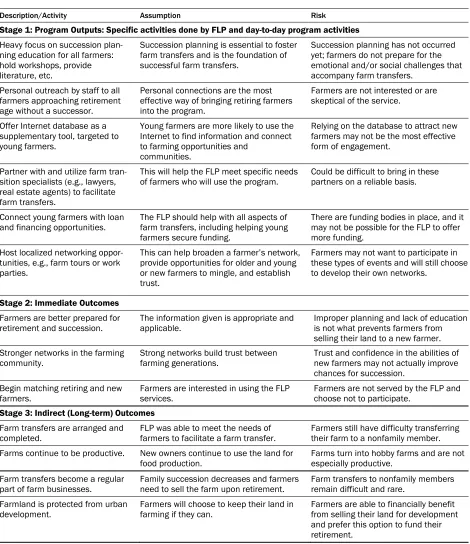
The revised ToC (Table 5) draws from the evaluation work completed here. From the devel-opment of the CS, it became clear that the original ToC is flawed; that is, program activities seem to be based on flawed assumptions. Therefore, the ToC was revised to better reflect conditions that may ensure the success of an FLP. The hope is that this new, more robust ToC can be used to create a new FLP or to update an existing FLP’s program-ming. Stage 1 of Table 5 focuses on an FLP’s day-to-day activities, the reasoning behind them, and possible risks that may prevent success. If the actions taken by the FLP as outlined in Stage 1 are successful, certain short-term outcomes would be expected. Stage 2 outlines immediate (short-term) expected outcomes. Stage 3 focuses on indirect (long-term) outcomes that may result from the program outputs (Stage 1) and the short-term outcomes (Stage 2). This revised ToC can serve as either a starting point for a new FLP or a point of evaluation for existing FLPs.
Discussion: Contribution of FLPs
Stages four through six of CA focus on building the contribution story of FLPs. The information needed to build the CS is presented in the previous sections. The final task in the CS is to make a statement of contribution (SoC), a short summary of how well the programs meet—or do not meet— intended outcomes (Mayne, 2001). In the context of this research, the following statement is offered: FLPs are well-intentioned programs aimed at addressing real concerns in the farming community, but in their current form are not able to effectively facilitate large numbers of farm transfers.
FLPs have not demonstrated their ability to successfully, reliably, and routinely facilitate farm transfers on a large scale. Although this is a reason-able metric of success, FLP staff have often been reticent to define success in this way. This would
suggest a recognition of their limited influence. While their efforts have not been entirely in vain, one must consider the steady rate of farmland loss each year, the number of farm sales that occur outside an FLP program, and the limited influence FLPs have had facilitating these transfers. It re-mains unclear if FLPs actually did facilitate success-ful matches, thereby preventing the sale of farm-land for development, or if FLPs simply capitalized on a farmer’s commitment to succession and provided an additional avenue to do so.
The crucial challenges FLPs have yet to face include reliance on the Internet for initiating farmer connections, despite evidence of its lack of effectiveness; a small staff complement, who are unable to provide legal, financial, and professional assistance required by farmers; limited resources and mechanisms for bridging the gap between new farmer financial capacity and the price of farmland; weak networks for new farmers and FLPs’ limited ability to improve them; and a mismatch in the requirements of new and retiring farmers. If they are to be relevant in the longer term, FLPs need to carefully assess each of these challenges and deter-mine their capacity to overcome them. Importantly, challenges must be addressed simultaneously—as they are essential components of a farm transfer— and work synergistically. FLPs should consider several improvements to their structure, program-ming, and skill set. While these recommendations are not necessarily a component of CA, our research has resulted in several recommendations that may help mitigate problems experiences by FLPs.
Strengthening Networks
resources that FLPs can offer.
By affiliating with other farming organizations, FLPs can gain credibility with potential land sellers. Relying on landowning farmers to register online to
list their land has not proven successful; FLPs need to find other ways to foster participation. More direct interaction may help farmers recognize the benefits and opportunities of participating in FLP
Table 5. Revised Theory of Change for a Farm Link Program (FLP)
Description/Activity Assumption Risk
Stage 1: Program Outputs: Specific activities done by FLP and day-to-day program activities
Heavy focus on succession plan-ning education for all farmers: hold workshops, provide literature, etc.
Succession planning is essential to foster farm transfers and is the foundation of successful farm transfers.
Succession planning has not occurred yet; farmers do not prepare for the emotional and/or social challenges that accompany farm transfers.
Personal outreach by staff to all farmers approaching retirement age without a successor.
Personal connections are the most effective way of bringing retiring farmers into the program.
Farmers are not interested or are skeptical of the service.
Offer Internet database as a supplementary tool, targeted to young farmers.
Young farmers are more likely to use the Internet to find information and connect to farming opportunities and
communities.
Relying on the database to attract new farmers may not be the most effective form of engagement.
Partner with and utilize farm tran-sition specialists (e.g., lawyers, real estate agents) to facilitate farm transfers.
This will help the FLP meet specific needs of farmers who will use the program.
Could be difficult to bring in these partners on a reliable basis.
Connect young farmers with loan
and financing opportunities. The FLP should help with all aspects offarm transfers, including helping young farmers secure funding.
There are funding bodies in place, and it may not be possible for the FLP to offer more funding.
Host localized networking oppor-tunities, e.g., farm tours or work parties.
This can help broaden a farmer’s network, provide opportunities for older and young or new farmers to mingle, and establish trust.
Farmers may not want to participate in these types of events and will still choose to develop their own networks.
Stage 2: Immediate Outcomes
Farmers are better prepared for
retirement and succession. The information given is appropriate and applicable. Improper planning and lack of education is not what prevents farmers from selling their land to a new farmer. Stronger networks in the farming
community.
Strong networks build trust between farming generations.
Trust and confidence in the abilities of new farmers may not actually improve chances for succession.
Begin matching retiring and new farmers.
Farmers are interested in using the FLP services.
Farmers are not served by the FLP and choose not to participate.
Stage 3: Indirect (Long-term) Outcomes
Farm transfers are arranged and
completed. FLP was able to meet the needs of farmers to facilitate a farm transfer. Farmers still have difficulty transferring their farm to a nonfamily member. Farms continue to be productive. New owners continue to use the land for
food production. Farms turn into hobby farms and are not especially productive. Farm transfers become a regular
part of farm businesses.
Family succession decreases and farmers need to sell the farm upon retirement.
Farm transfers to nonfamily members remain difficult and rare.
Farmland is protected from urban
programming and the transfer process. In addition, implementing integrated networking strategies that have been utilized in other sectors is important; farmers are a heterogeneous, disparate group, and looking to other sectors that have integrated such network development successfully could be tre-mendously helpful. Of particular interest could be industrial-sector network development strategies that seek to bring together small and medium-sized enterprises and industrial players who have poten-tial resources to exchange but no other obvious grounds for interaction.
Normalize Succession Planning
As the number of farmers seeking to retire increases and land values continue to rise, FLPs will need to strengthen their programming if they are to play a relevant role in supporting sustainable succession of farm land in the U.S. As noted, FLPs need to improve opportunities for face-to-face networking and facilitating more meaningful inter-action. This will either require more staff and fund-ing (a challenge), or more innovative approaches to facilitating interaction between land sellers and seekers. Family transfers are declining, so it is essential for FLPs and related initiatives to find ways to meaningfully connect with farmers and actively encourage them to think and plan for succession early on.
Improve Financial Support
Funding a new farming venture is onerous; FLPs can expand financial support services and secure avenues that would allow them to offer financial assistance to new farmers. Although California FarmLink did not participate in this research,5 publicly available information suggests that its program structure allows it to facilitate financial support for new farmers. It has more staff than any of the FLPs that participated in this study, and its staff becomes very involved in the transfer process. California FarmLink also can offer new farmers loans of up to US$25,000 and has connected with alternative financing sources to provide further assistance (California FarmLink, 2013). It has reportedly assisted over 3,000 farm businesses and
5 They were, however, invited to do so.
has successfully arranged 125 farm leases and related partnerships (California FarmLink, n.d.). Its hands-on, practical approach appears to demon-strate an understanding of the main challenges linked to farm transfers. Ideally, FLPs serve as a distribution broker for resources such as start-up grants or funding that supports new farmers, thus helping new farmers to find both land and funding.
Evaluation Processes
Regular and systematic evaluation of FLP activities is essential. Part of the evaluation should be to ensure that the FLP’s goals are articulated clearly and specifically. Understanding the links between initiatives and the FLP’s goals, internal capacity to deliver on initiatives, and ultimate success of the transfer program should help inform any changes or improvements the FLP may need. Those work-ing in FLPs must also recognize outside contribu-ting factors that influence farm transfers, and those factors must be accounted for in FLP program-ming as much as possible. CA could serve as a useful framework for individual, ongoing FLP evaluations.
Innovative Stakeholder Engagement
FLPs are not the only operations that face chal-lenges engaging with their stakeholder groups. During their program evaluations, it is imperative that FLPs seek out innovative mechanisms used to connect disparate groups, not only those within other farming related organizations, but also those in different sectors.
Conclusions
of FLPs within a broader context, leading to a bet-ter understanding of the contribution FLPs can make toward preserving farmland, helping farmers retire with financial security, and assisting new farmers with start-up costs and access to land. FLPs need to clearly understand and articulate their own internal goals and limitations in order to be a useful resource, and they should monitor and eval-uate their program offerings. Providing an Internet database and a website is not enough to encourage farm transfers. More work needs to focus on the actual development and strengthening of networks, particularly between other organizations supporting successful farm transfers, and between potential land sellers and seekers.
This research contributes to the body of knowledge associated with FLP effectiveness, which currently suffers from a dearth of material. In addition, we have found CA to be a useful framework for future FLP research because it requires analysis that incorporates many outside factors, from tax structures to attitudes and beliefs about farmland. Each factor is worthy of specific study in the context of farm transfers and FLPs. A fuller understanding of the changing trends in farm ownership and the opportunities and challenges presented is also an important research area.
It was beyond the scope of this research to engage directly with farmers who have used FLP services, but further research could focus on whether FLPs met their needs and expectations, and thus identify more specific criteria for success for FLPs. Additionally, it would be useful to research the experiences of farmers who have sold their farmland for development; their stories could inform ways to mitigate the loss of farmland to urban development.
Understanding the role of FLPs can be an important component in the discussion about farmland preservation and how to better support transitioning farmers. To date, FLP programs have met with limited success, but with specific changes, FLPs could play an important role in keeping farmland in production. This study has used an evaluation framework for the first time to assess FLPs’ effectiveness in facilitating farm transfers. This research has made a strong case for FLPs to include formal evaluations regularly as a means to
find practical ways to improve on program offer-ings. As external conditions change and more farmers find they have difficulty transferring their farms, FLPs will need to change and adapt as well. Knowing where change is necessary in their pro-gram operations can be found through rigorous evaluation, thus improving prospects for FLP success.
References
Ahearn, M. C., & Newton, D. J. (2009). Beginning farmers and ranchers. Economic Information Bulletin, 53. https://dx.doi.org/10.2139/ssrn.1408234
Amshoff, S., & Reed, D. (2005). Health, work, and safety of farmers ages 50 and older. Geriatric Nursing, 26(5), 304–308.
http://dx.doi.org/10.1016/j.gerinurse.2005.08.008 Anderson, A. (2005). An introduction to theory of
change. The Evaluation Exchange, 11(2). Retrieved from http://www.hfrp.org/evaluation/the- evaluation-exchange/issue-archive/evaluation-methodology/an-introduction-to-theory-of-change
Ball, A. L., & Wiley, A. (2005). The aspirations of farm parents and pre-adolescent children for generational succession of the family farm. Journal of Agricultural Education, 46(2), 36–46.
http://www.jae-online.org/index.php/back-issues/ Ballantyne, P. (2009). Accessing, sharing and
communicating agricultural information for development: Emerging trends and issues.
Information Development, 25(4), 260–271.
http://dx.doi.org/10.1177/0266666909351634 Briggeman, B. C., & Whitacre, B. E. (2010). Farming and the Internet: Reasons for non-use. Agricultural and Resource Economics Review, 39(3), 571–584.
https://dx.doi.org/10.1017/S1068280500007528
California FarmLink. (n.d.). About us. Retrieved in February 2013 from
http://www.californiafarmlink.org/about-us Charatsari, C., & Lioutas, E. D. (2013). Of mice and
men: When face-to-face agricultural information is replaced by a mouse click. Journal of Agricultural & Food Information, 14(2), 103–131.
https://dx.doi.org/10.1080/10496505.2013.774276 Chiu, S., Cheyney, M., Ramirez, M., & Gerr, F. (2015).
Clark, J. K., Inwood, S., & Sharp, J. S. (2016). Local food systems: The birth of new farmers and the demise of the family farm? In N. Reid, J. Gatrell, & P. Ross. (Eds.), Local food systems in old industrial regions: Concepts, spatial context, and local practices (pp. 131–145). Abingdon, UK & New York: Routledge. Daniels, T. L., & Bowers, D. (1997). Holding our ground:
Protecting America’s farms and farmland. Washington, DC: Island Press.
Darnhofer, I. (2010). Strategies of family farms to strengthen their resilience. Environmental Policy and Governance, 20(4), 212–222.
http://dx.doi.org/10.1002/eet.547
Delahais, T., & Toulemonde, J. (2012). Applying contribution analysis: Lessons from five years of practice. Evaluation, 18(3), 281–293.
http://dx.doi.org/10.1177/1356389012450810
Dessein, J., & Nevens, F. (2007). “I’m sad to be glad”. An analysis of farmers’ pride in Flanders. Sociologia Ruralis, 47(3), 273–292. http://dx.doi.org/ 10.1111/j.1467-9523.2007.00437.x
Duffy, M. (2011). The current situation on farmland values and ownership. Choices:The Magazine of Food, Farm, and Resource Issues, 26(2).Retrieved from
http://choicesmagazine.org/choices- magazine/theme-articles/farmland-values/the- current-situation-on-farmland-values-and-ownership#sthash.iyEhMn8k.dpuf
Farmland Information Center (2013). 2010 Natural Resources Inventory. Washington, DC: USDA Natural Resources Conservation Service & American Farmland Trust. Retrieved from
http://www.farmlandinfo.org/2010-national-resources-inventory
Fukunaga, K., & Huffman, W. E. (2009). The role of risk and transaction costs in contract design: Evidence from farmland lease contracts in U.S. agriculture. American Journal of Agricultural Economics,91(1), 237–249. https://dx.doi.org/ 10.1111/j.1467-8276.2008.01164.x
Gasson, R., & Errington, A. J. (1993). The Farm Family Business. Wallingford, UK: CAB International. Gasson, R., Errington, A., & Tranter, R. (1998). Carry on
farming: A study of how English farmers have adapted to the changing pressures on farming. London: Imperial College Press.
Gasson, R., Crow, G., Errington, A., Hutson, J., Marsden, T., & Winter, D. (1988). The farm as a
family business: A review. Journal of Agricultural Economics, 39(1), 1–41. http://dx.doi.org/ 10.1111/j.1477-9552.1988.tb00560.x Glauben, T., Tietje, H., & Weiss, C. R. (2002).
Intergenerational succession on family farms: Evidence from survey data (Working Paper No. 0202). Kiel, Germany: University of Kiel, Department of Food Economics and Consumption Studies. Retrieved from http://citeseerx.ist.psu.edu/viewdoc/down load?doi=10.1.1.577.6675&rep=rep1&type=pdf
Gloy, B., Boehlje, M., Dobbins, C., Hurt, C., & Baker, T. (2011). Are economic fundamentals driving
farmland values? Choices:The Magazine of Food, Farm, and Resource Issues, 26(2). Retrieved from
http://www.choicesmagazine.org/choices- magazine/theme-articles/farmland-values/are-economic-fundamentals-driving-farmland-values
Goeller, D. (2012). Facilitating succession and
retirement in U.S. agriculture: The case of Nebraska. In M. Lobley, J. R. Baker, & I. Whitehead (Eds.),
Keeping it in the family: International perspectives on succession and retirement on family farms (pp. 149–163).
Surrey, UK: Ashgate Publishing.
Hamilton, L. B. (2005). Agricultural land trusts: Preserving small farm heritage. Winnipeg, Manitoba: Canadian Centre for Policy Alternatives.
Higby, A., Ruhf, K., & Woloschuk, A. (2004). Holding ground: A guide to Northeast farmland tenure and stewardship.Belchertown, Massachusetts: New England Small Farm Institute.
Howell, J. L., & Habron, G. B. (2004). Agricultural landowners’ lack of preference for Internet extension. Journal of Extension, 42(6). Retrieved from
http://www.joe.org/joe/2004december/a7.php Hubbard, P. F. (2006). A land link for western Montana:
Keeping land in agriculture from one generation to the next
(Master’s thesis, University of Montana, Environmental Studies Department). Retrieved from http://scholarworks.umt.edu/etd/267/ Hubona, G. S., & Geitz, S. (1997). External variables,
beliefs, attitudes and information technology usage behavior. In R. H. Sprague (Ed.), System Sciences, 1997, Proceedings of the Thirtieth Hawaii International Conference on System Sciences, v. 3 (pp. 21–28). Los Alimotos, California: IEEE Computer Society Press.
Ilbery, B., Ingram, J., Kirwan, J., Maye, D., & Prince, N. (2012). Non-successional entry into UK farming: An examination of two government-supported schemes. In M. Lobley, J. R. Baker, & I. Whitehead (Eds.), Keeping It in the family: International perspectives on succession and retirement on family farms (pp. 111– 127). Surrey, UK: Ashgate Publishing.
Ingram, J., & Kirwan, J. (2011). Matching new entrants and retiring farmers through farm joint ventures: Insights from the Fresh Start initiative in Cornwall, UK. Land Use Policy, 28(4), 917–927. http://dx.doi. org/10.1016/j.landusepol.2011.04.001
Inwood, S. (2013). Social forces and cultural factors influencing farm transition. Choices:The Magazine of Food, Farm, and Resource Issues, 28(2), 1–5. Retrieved from http://choicesmagazine.org/choices- magazine/theme-articles/transitions-in- agriculture/social-forces-and-cultural-factors-influencing-farm-transition#sthash.
FD4Ba1hm.dpuf
Inwood, S. M., & Sharp, J. S. (2012). Farm persistence and adaptation at the rural-urban interface: Succession and farm adjustment. Journal of Rural Studies, 28(1), 107–117.
http://dx.doi.org/10.1016/j.jrurstud.2011.07.005
Inwood, S., Clark, J. K., & Bean, M. (2013). The differing values of multigeneration and first‐generation farmers: Their influence on the structure of agriculture at the rural-urban interface. Rural Sociology, 78(3), 346–370.
http://dx.doi.org/10.1111/ruso.12012
Johnston, T., & Bryant, C. (1987). Sustaining agriculture near cities. In W. Lockeretz (Ed.), Sustaining agriculture near cities (pp. 9–22). Ankeny, Iowa: Soil and Water Conservation Society.
Keating, N., & Munro, B. (1989). Transferring the family farm: Process and implications. Family Relations, 38(2), 215–218.
http://dx.doi.org/10.2307/583678 Khanal, A. R., & Mishra, A. K. (2013, February).
Assessing the impact of internet access on household incomes and financial performance of small farms. Paper presented at the annual meeting of the Southern Agricultural Economics
Association, Orlando, Florida. Retrieved from
http://ageconsearch.umn.edu/bitstream/143019/1 /SAEA_paper_Aditya_re_18Jan.pdf
Kuethe, T.H., Ifft, J., & Morehart, M. (2011). The
influence of urban areas on farmland values. Choices: The Magazine of Food, Farm, and Resource Issues, 26(2). Retrieved from http://www.choicesmagazine. org/UserFiles/file/cmsarticle_30.pdf Kirkpatrick, J. (2013). Retired farmer—An elusive
concept. Choices:The Magazine of Food, Farm, and Resource Issues, 28(2), 1–5. Retrieved from
http://www.choicesmagazine.org/UserFiles/file/c msarticle_305.pdf
Kuehne, G. (2013). My decision to sell the family farm.
Agriculture and Human Values, 30(2), 203–213.
http://dx.doi.org/10.1007/s10460-012-9393-7 Lemire, S. T., Nielsen, S. B., & Dybdal, L. (2012).
Making contribution analysis work: A practical framework for handling influencing factors and alternative explanations. Evaluation, 18(3), 294–309.
http://dx.doi.org/10.1177/1356389012450654 Lindstrom, M. J., & Bartling, H. (2003). Culture and
society: Contested visions and values. In M. J. Lindstrom & H. Bartling (Eds.), Suburban sprawl: Culture, theory, and politics (pp.1–3). Lanham, Maryland: Rowman & Littlefield.
Liu, Z., Adams, M., Cote, R., Geng, Y., & Li, Y. (2016) Comparative study on the pathways of industrial parks towards sustainable development between China and Canada. Resources,Conservation and Recycling. Advance online publication.
http://dx.doi.org/10.1016/j.resconrec.2016.06.012 Lobley, M., & Baker, J. R. (2012). Succession and
retirement in family farm businesses. In M. Lobley, J. R. Baker, & I. Whitehead (Eds.), Keeping it in the family: International perspectives on succession and retirement on family farms (pp. 1–20). Surrey, UK: Ashgate Publishing.
Lyson, T. A. (2007). Civic agriculture and the North American food system. In C. Hinrichs & T. A. Lyson (Eds.), Remaking the North American food system: Strategies for sustainability (pp. 19–32). Lincoln: University of Nebraska Press.
Mailfert, K. (2007). New farmers and networks: How beginning farmers build social connections in France. Journal of Economic and Social Geography, 98(1), 21–31.
http://dx.doi.org/10.1111/j.1467-9663.2007.00373.x