DAMAGE REDUCTION METHODS OF CENTRE PIVOT
IRRIGATION SYSTEMS IN WINDSTORMS
1
MAJEED SAFA, 2BIRENDRA KC
Department of Land Management and Systems, Lincoln University, New Zealand
Abstract- The September and October (2013) wind storms in Canterbury, New Zealand had highest worldwide reported windstorm damaged on centre pivot irrigation systems. Around 800 centre pivot has been damaged and it cost farmers millions dollars directly and indirectly. It was very difficult to find the engineering proofed recommendation for farmers to protect their irrigation systems during windstorms. The study has developed to understand farmers’ reactions, before, during and after wind storm to protect their irrigation systems. After several face to face interview and analysing 91 questionnaires, and evaluating available guidelines the best recommendations were selected to help farmers. The study shows appropriate action plan can reduce the windstorm damages significantly. The information of this study will be useful for all farmers to reduce wind storm damage on centre pivots.
Key Words- Centre Pivots, Wind Storm, Irrigation System, Anchor.
I. INTRODUCTION
The September and October (2013) wind storms in Canterbury brought several concerns to local farmers, which damaged more than 800 small and large irrigators. The wind was described as the worst in 40 years(Stewart et al., 2013). Different types of irrigators were affected differently; however, the majority(and also the more difficult to repair) were centre pivot irrigators. In some areas the wind was blowing from different directions making it difficult to prevent losses. Windstorm damage occurred particularly overnight making it difficult to tackle the situation. About 60% of damaged irrigators were repairable(BASF New Zealand, 2013). Diverse repairs were made in the short-term (up to nine weeks) to bring some irrigators into normal condition. Other irrigators with major damage required long-term repair procedures to fix the damage. (BASF New Zealand, 2013). Hence, farmers had to deal with extra costs, concerns, and extra time that was not previously planned. Many farmers belive the cost of production reduction even is more than the cost of the irrigation repair after the windstorm.
Centre-pivot irrigation is a method of crop irrigation in which a horizontal boom rotates around a centre point and crops are watered with low-pressure sprinklers or spray nozzles mounted along the boom (Mader & Kan, 2010; Omary et al., 1997). The circular area under centre-pivot irrigation is centred to the pivot when viewed from above, which is also called crop circles (Gray, 2012).The pivot irrigation system includes a central pivot and a series of mobile support towers connected to the central pivot and to one another by truss-type framework sections. The mobile support towers are supported on wheels that are driven by a motor on each tower. The water distribution conduit is supported by the framework sections and a number of sprinkler heads, spray guns, drop nozzles, or other fluid-emitting devices which are spaced along the length of the conduit. The main
purpose of the sprinkler is to deliver water with low water pressure in order to make efficient use of a limited water resource(Valmont, 2009).
The design of each centre pivot irrigator differs between manufacturing companies and with each farmer’s requirements. Most centre pivot irrigators are designed to withstand 130 km/h winds when empty of water. The overturning threshold of water loaded irrigators is considerably higher. It is argued by (Guyer & Moritz, 2002)that besides different design specifications, other factors such as the original orientation of the pivot, and whether the pivot has a braking system or not, influence the resistance to irrigator overturning, in high wind circumstances.
II. TECHNICAL FACTORS AFFECTING STABILITY OF CENTRE PIVOT IRRIGATORS
To move the system, tyres and an electric motor are installed on the towers of the centre pivot. A steel pipe runs through the towers to supply water to the sprinklers along the lateral. The distance between two consecutive towers is called a span. The pipe and the towers are typically galvanized to prevent corrosion. Equipment height depends on required crop clearance. If crop clearance is too low, it will damage crops like maize. On level ground the ground clearance varies from 2.75 to 4.5 metres for high profile machines.
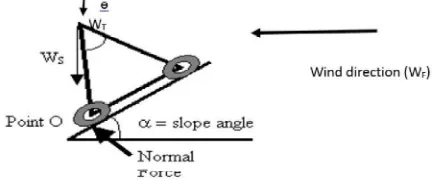
slope angle (α)(Figure 1) are other key elements which have immense impact on the stability of a centre pivot. Whether weight of the span will tip the tower at different slope angles can be determined by analysing the moment of truss weight (WT) and the moment of span weight (Ws) about O.
For example, a pivot with a 7.26 m height tower is stable until the slope angle approaches 65 degrees. A larger central angle results in more stable towers. The height of the tower also affects the stability. However, different brands have their own recommended values for stability. For example, allowable cross-sectional inclination (between the adjacent wheels) is between 10-15% and the allowable longitudinal inclination (between two towers) is 8° for a BAUER CENTERSTAR 500 (Bauer, 2005).
Figure 1. Centre pivot at an inclined surface
Span length depends on the diameter of the pipe. The bigger the diameter, the shorter the span. The pipeline and the truss rod arches should maintain the even distribution of weight between the towers to maintain stability. Truss angles and length should be uniform to ensure even loading. Truss rod heads should be tightly contacted within the socket. In addition, the spans are equipped with flexible joints at the ends, allowing the pipeline side-to-side, up and down and rotational movement with no stress on the pipeline(Phocaides, 2007).To improve the stability, depending on the model and brand, specific sections of a pivot can have different tube diameters, tube length and tube thickness.
Similarly, different models and brands can have different truss rod diameters, truss rod design, and arc shape of the trussing. To improve the strength of the truss rods, they can be made using material with high tensile strength and large safety reserves. Besides the brands and models, the truss rod design also changes with span lengths. Drive towers and wheel bases can also affect the degree of stability of a centre pivot system. A wider wheelbase gives more stability for rough ground applications, and on rolling and windy conditions (Valmont, 2006). Depending on the model and brand, specific sections can have different dimensions(Bauer, n.d.; Centre Irrigation, 2010; i-water, n.d.; Martin, n.d.; Reinke, n.d.).
Basic centre pivot irrigators are capable of watering only circular areas. They are not able to irrigate the corner areas of square fields and areas around existing structures and trees (Valley, 2014). A corner
arm has been developed to supply irrigation and chemicals onsuch odd-shaped fields efficiently and economically without setting up a new water system.In the corner arm system, a flexible joint connects the corner arm to the basic unit on the last tower(Valmont, 2009). The overhang is the overhanging partfrom the last tower to the system end(Phocaides, 2007). The overhang is mounted to irrigate an additional area without adding a new irrigator segment (Institute for Agricultural Engineering, 2003).The length of the overhang depends on span length. The longer the span length, the longer the overhang length (Bauer, 2003).
III. SURVEY
The main purpose of thesurvey was to collect Farmer’s perspectivesabout the windstorm damage from the September and October 2013 windstorms.Diversity in the farming communityis high; therefore, it was important to design and use appropriate questions relevant to the whole community. More closed-ended questions were prepared than open-ended questions, as such questions are easier and quicker to answer and analyse. Also, multiple choice questions were used to help farmers find the right answers in a short time. It was easier for farmers to choose the right answers for categorised questions.
Face to face interviews, postal surveys andusing the online survey tool Qualtricswere used to collect farmers opinions aboutwindstorm damage. In the postal survey, hard copies of the questionnaires were sent to 430farmers,out of which 62 (68%) farmers provided theirresponses. A total of 19 (21%) farmers were interviewed and 10 (11%) farmers completed the online questionnaire, making a total response of 91.
IV. RESULTS
i. Main Parts of the Irrigator Damaged
Table 1. The major damage
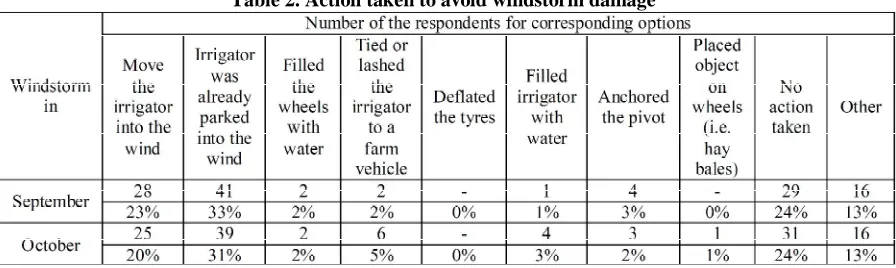
ii. What actions farmers took and what worked Farmers took different actions to avoid windstorm damage. The majority of the farmers had already
parked their irrigators in shelter or had to move their irrigators during the windstorms. In September 33%, and in October 31%, of the total respondents reported that they had already parked their irrigator behind the shelter (
Table ). Out of the total respondents 23% farmers in September and 20% in October reported that they had to move their irrigator into the shelter during the windstorm. Surprisingly 24% of the total respondents
reported that they did not take any action. This is because of various limitations as listed inError! Reference source not found..
Table 2. Action taken to avoid windstorm damage
iii. Weather Warning System
There is a very high chance of power outages before and during the windstorm. Most farmers couldn’t move their irrigators during the storm and had other things on their farms to manage aswell. Therefore,
early warnings are very critical for moving irrigators to the right positions. Both for September (84%), and October (75%), the majority of farmers reported that they received windstorm warnings around two days before the event (
Table ).
Table 3. Proportion of Farmers receiving Windstorm Warning
Based on this information it seems reasonable to disseminate weather warnings through multiple sources including radio, newspapers and the internet. During the interviews few farmers mentioned they have been warned a few times after the main windstorms and that the wind was not that strong. If farmers receive wrong warnings or warnings for the weak storms a few times, they will loss their sensitivity to the warningsystem.
V. INVESTIGATING AVAILABLE PROTECTION METHODS
To protect irrigators during windstorms, the following wind-related protection measures were
forwarded by Federated Farmers, irrigation and insurance companies, it seems some of the recommendations need more consideration. The main recommendations are discussed in this section.
and this will increase the importance of fast reactions to warnings. When irrigators point downwind the corner arms should be in line with them, which is very difficult in some paddocks. The worst angle between spans or corner arms with wind direction is 90°.
Anchor the overhang: Long and heavy overhangs are very prone to windstorm damage. Therefore, it is recommended to lightly strop the end of the overhang to a suitable anchor. This will reduce any bouncing and prevent fatigue or overstressing. However, the best place to stop the overhang should be carefully considered. If farmers can remove the whole overhang or at least the heavy parts before the windstorms, then the risk of damage will be reduced significantly. Tie (anchor) the irrigator: According to
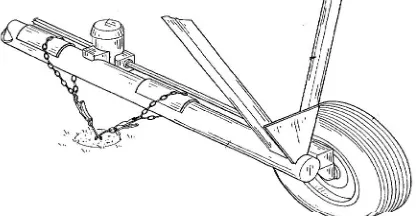
farmers’ observations, the irrigators started to bounce before falling over. It is important to note that the wind doesn’t blow hard continually. Wind gusts increase the bouncing especially when the irrigators are faced to the wind. However, finding the right place to tie the irrigators is a big challenge. Irrigators have not been designed for extra support for anchors. At the wheels – tying from the base beam to the ground is not very common in New Zealand. It would be the fastest way to tie the irrigators; however the force that the beam can support should be investigated carefully. We know the beams are not designed to support the anchors. The question is, is the beam strong enough and where is the best place to tie it down to (Figure 2).
Figure 2. The tie-down anchor to support span beams
Across the span – If only the wheels are tied down then the spans can still roll over in wind gusts. It will reduce the bouncing; however, in all current irrigators, there is no specific place to tie the high parts. The only places for tying would be truss rod brackets or main pipes, which need mechanical testing to find whether they can support the weight of the irrigators during windstorms and gust. If the wrong points are selected for attaching the strops, then they will be broken quickly. Estimating the strength of each truss rod bracket (in different models and brands) will help to estimate how many of them are needed to keep the span stable.
Filling the irrigator with water: It is recommended to fill the irrigator with water if
the cross-sectional area of the farm is perfectly horizontal. However, if the cross-sectional area of the farm is inclined, then the additional weight caused by the water can have both positive and negative effects on the irrigator’s stability. If the wind force (WF) and the resultant weight of the span (Ws) due to the irrigator being filled with water are acting in the same direction (Figure2) then filling the irrigator with water can be very risky. The additional force due to the water will contribute to overturning the irrigator at point O and the risk of overturning increases with increasing inclination. However, if the wind force (WF) and the resulting weight of the span (Ws) are acting in the opposite direction then the additional force due to the water can be supportive to increasing the irrigator’s stability. Deflating the tyres: Some farmers believe that
the centre pivots with air-filled tyres can be rolled away easily by strong wind storms. They mentioned the air-filled tyres would increase the bouncing and that deflated tyres would make it harder for the centre pivot to roll away. Therefore, deflating the tyres could be an option. However, it is important to note that we couldn’t find any technical evidence that deflating the tyres can reduce the damage. Also, during a windstorm event it might not be practicable to deflate all the tyres, which would be very time consuming and possibly dangerous.
Placing objects on the wheel and filling the tyres with water: It would be useful to move down the centre of gravity. Therefore, anything that makes the lower part of the irrigator heavier would be useful. However, placing object on the wheels and filling the wheels with water are time consuming and unfortunately do not change the centre of gravity significantly.
This study shows that most farmers do not even general information about their irrigators. For most of the farmers with irrigation damage, the lack of information and underestimating the windstorms were their most important limitations. Still 96% of the farmers with no irrigator damage did not feel any limitation. They would underestimate the wind storm and the damage on their irrigators in next storm probably would be much higher than others. Therefore, providing practical advice for farmers, especially for the farmers with no damage in the last windstorm would be necessary.
REFERENCES
[1] BASF New Zealand. (2013). Big Storm in Canterbury &
Irrigators. Retrievedfrom
http://www.agro.basf.co.nz/blog/category/13-09-20/Big-STORM-in-Canterbury-Irrigators.aspx
[2] Bauer. (2003). BAUER Centerstar.
[3] Bauer. (2005). OPERATING MANUAL for BAUER CENTERSTAR 5000.
http://www.kirkirrigation.co.nz/documents/Bauer%20Syst em%205000%20Brochure.pdf.
[5] Centre Irrigation. (2010). Division of PFT Agribusiness
Group. from
http://www.centerirrigation.com.au/index.php?pr=Kwik% 20Tow.
[6] Gray, E. (2012). NASA Goddard Space Flight Center. Retrievedfrom http://climate.nasa.gov/news/729
[7] Guyer, J. L., & Moritz, M. L. (2002). ON ISSUES OF TORNADO DAMAGE ASSESSMENT AND F-SCALE ASSIGNMENT IN AGRICULTURAL AREAS. [8] i-water. (n.d.). Intelligent Solutions for Efficient Irrigation.
from http://www.i-water.com.au/pages/products/centre-pivots.php.
[9] Institute for Agricultural Engineering. (2003). Irrigation Design Moving irrigation systems. Retrieved from http://www.agis.agric.za/agric_engineering/pdf/IrrigationD esignMovingirrigationsystems.pdf
[10] Mader, S., & Kan, H. (2010). Center pivot irrigation revolutionizes agriculture Retrievedfrom http://www.thefencepost.com/article/20100525/NEWS/10 0529954
[11] Martin, J. (n.d.). Center Pivot Analysis. from Retrieved from http://emweb.unl.edu/Mechanics-Pages/JennieMartin/Pivot%20Analysis.htm
[12] Omary, M., Camp, C., & Sadler, E. (1997). Center pivot irrigation system modification to provide variable water application depths. Applied Engineering in Agriculture, 13(2), 235-239.
[13] Phocaides, A. (2007). Handbook on pressurized irrigation techniques: Food & Agriculture Org.
[14] Reinke. (n.d.). Irrigation Products. Retrieved from http://www.reinke.com/irrigation-products/center-pivots. Retrieved
[15] Stewart, A., Mathewson, N., & Cronshaw, T. (2013). Irrigator damage to cost millions. Retrievedfrom http://www.stuff.co.nz/business/farming/9159807/Irrigator -damage-to-cost-millions
[16] Valley. (2014). Center Pivots, Precision Irrigation Choices to Fit Your Needs. Retrievedfrom
http://www.valleyirrigation.com/valley-irrigation/us/irrigation-products/center-pivots [17] Valmont. (2006). Valley Product Catalog. [18] Valmont. (2009). Valley Product Catelogue.